Wasting Resources: Examining Our MSW Selected U.S. and CharMeck Data from 1997-2009 Derrick Willard Providence Day School
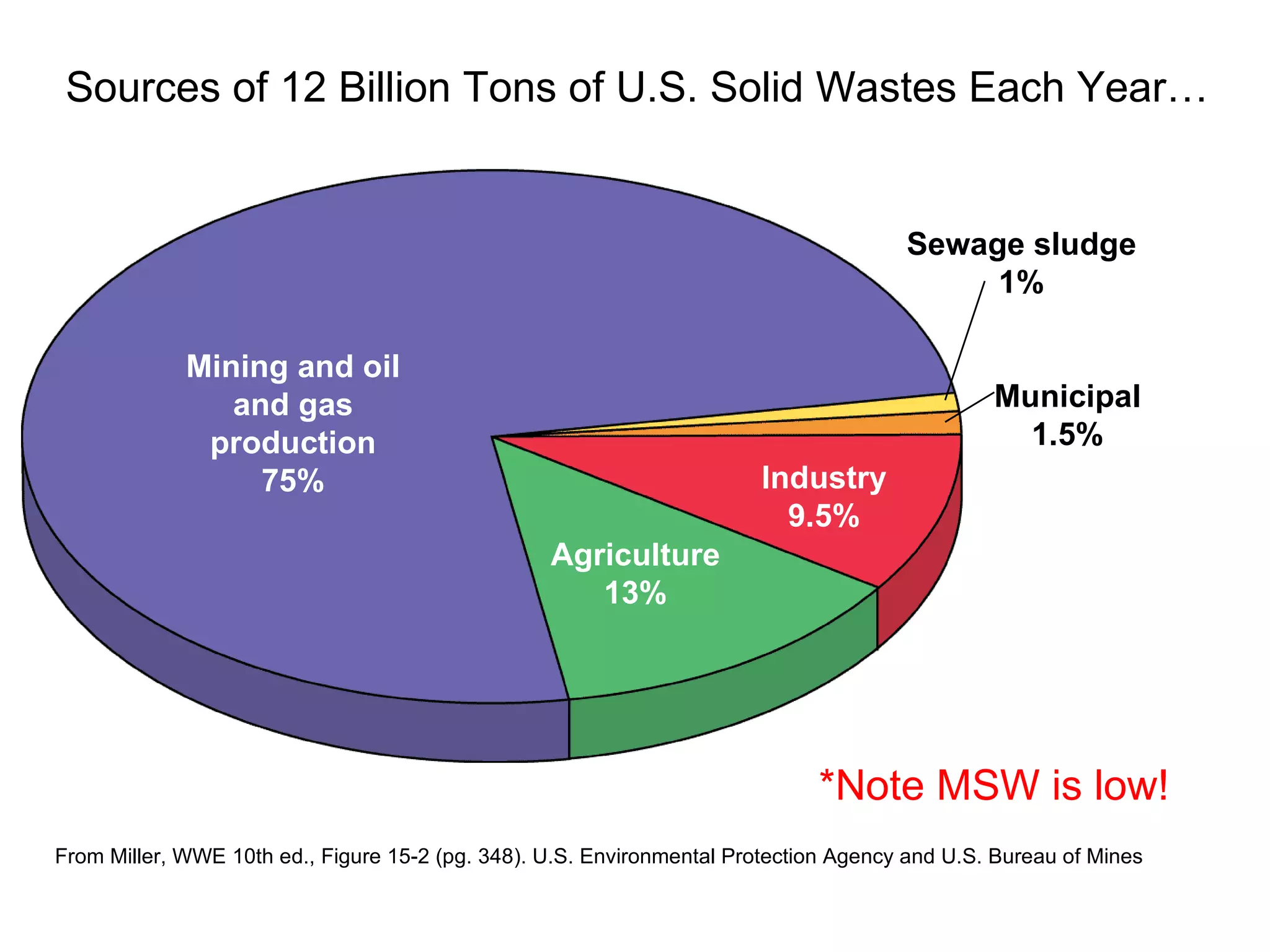
From Miller, WWE 10th ed., Figure 15-2 (pg. 348). U.S. Environmental Protection Agency and U.S. Bureau of Mines Sources of 12 Billion Tons of U.S. Solid Wastes Each Year…  *Note MSW is low! Municipal 1.5% Sewage sludge 1% Mining and oil and gas production 75% Industry 9.5% Agriculture 13%
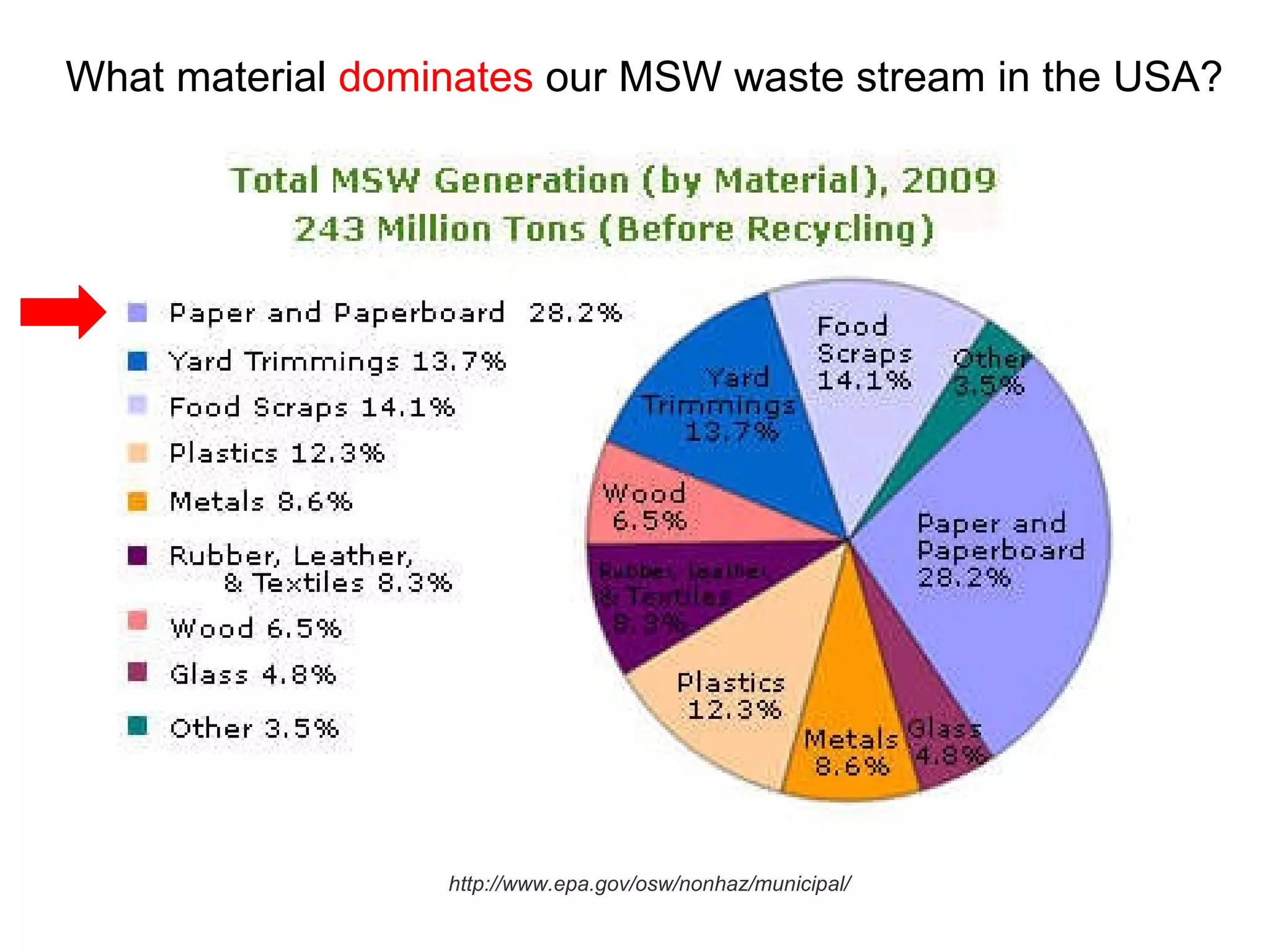
What material  dominates  our MSW waste stream in the USA? http://www.epa.gov/osw/nonhaz/municipal/
Contact the  Direct Marketing Association (DMA) .  DMA is the oldest and largest trade association for the users and suppliers in the direct, database and interactive marketing field. You can use the DMA website to request their no cost Mail Preference Service (MPS). With DMA's MPS you can remove your name from DMA member prospect lists.  Please note that signing up with MPS may prevent you from receiving mail you want, such as new catalogs, coupons, announcements about new businesses in your community, and notices of special offers.  But, this can significantly reduce your “junk mail” load (at least 75%).  If  you  want to REDUCE your  paper  MSW, here is an easy first step:   https:// www.dmachoice.org/dma/member/regist.action
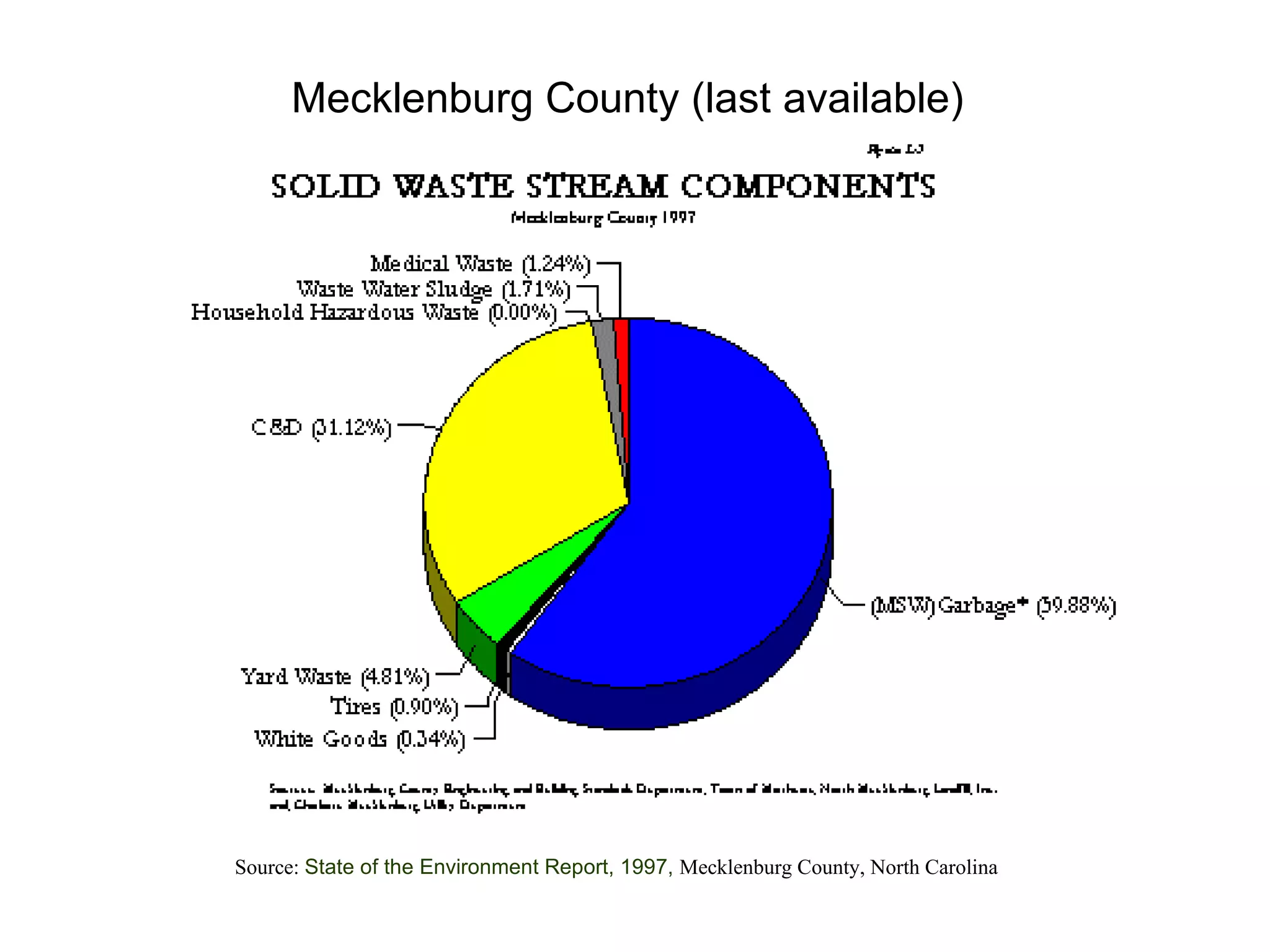
Source:  State of the Environment Report, 1997,  Mecklenburg County, North Carolina Mecklenburg County (last available)
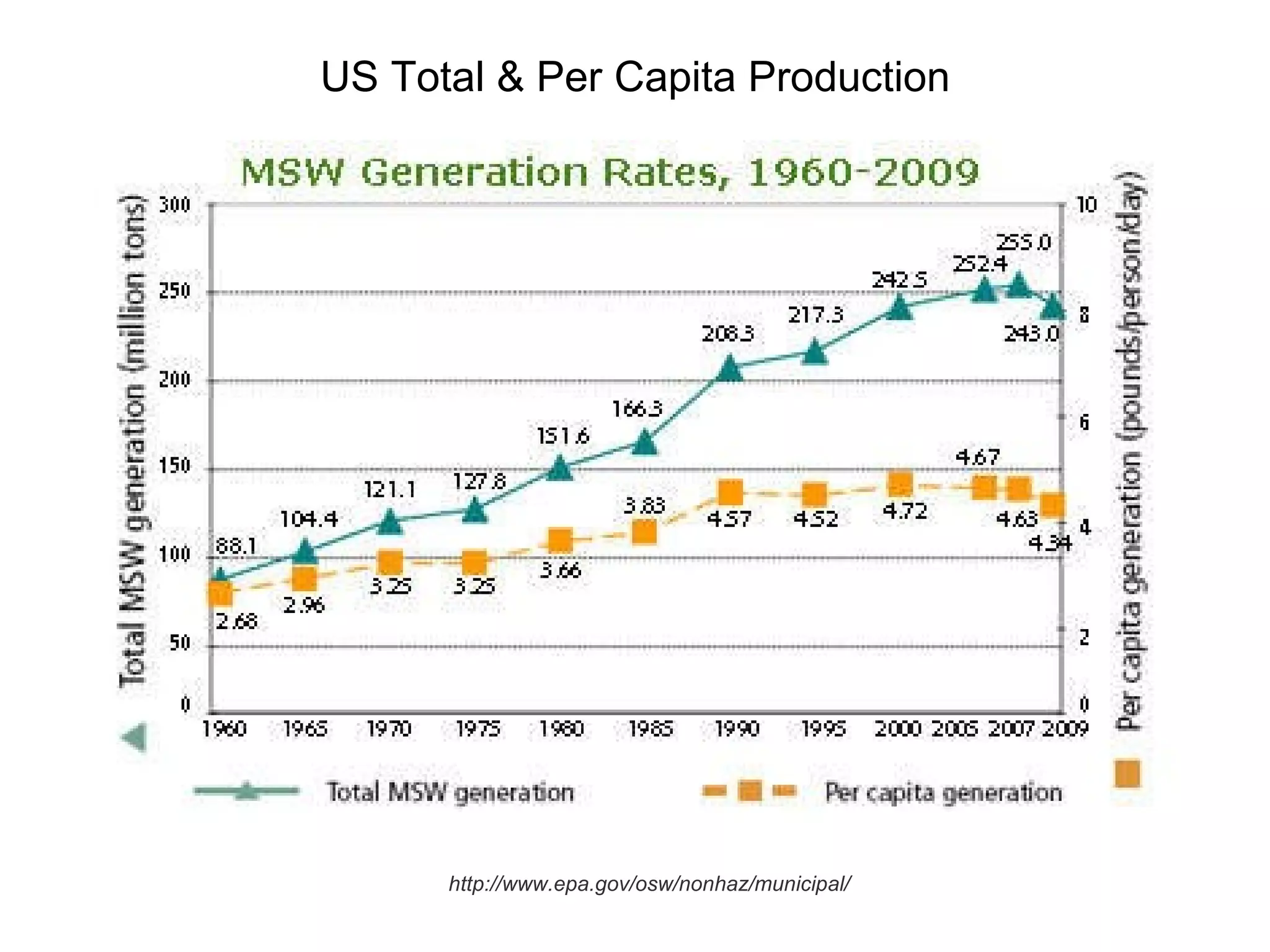
http://www.epa.gov/osw/nonhaz/municipal/ US Total & Per Capita Production
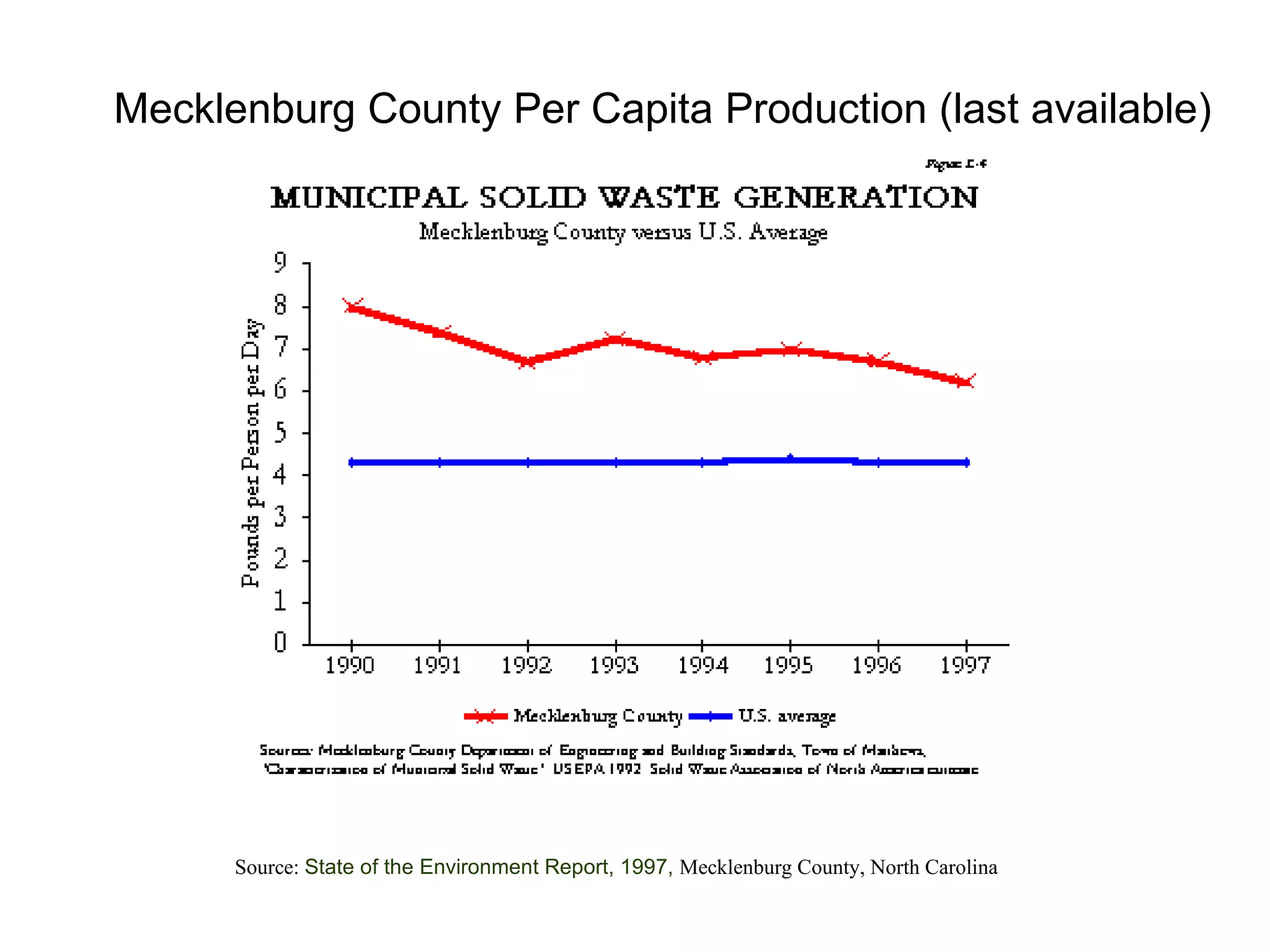
Source:  State of the Environment Report, 1997,  Mecklenburg County, North Carolina Mecklenburg County Per Capita Production (last available)
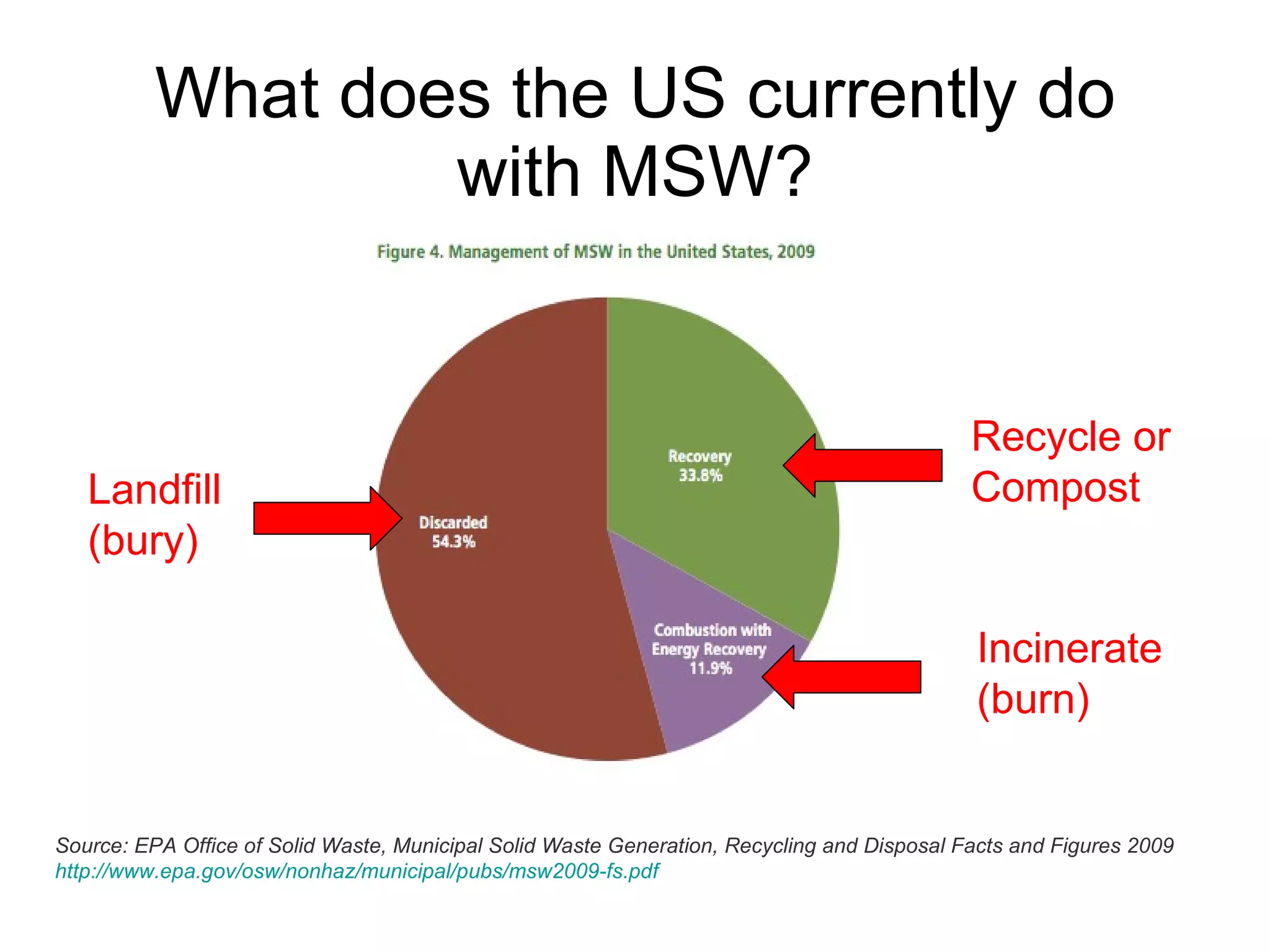
What does the US currently do with MSW? Source: EPA Office of Solid Waste, Municipal Solid Waste Generation, Recycling and Disposal Facts and Figures 2009 http://www.epa.gov/osw/nonhaz/municipal/pubs/msw2009-fs.pdf Landfill (bury) Recycle or  Compost Incinerate (burn)
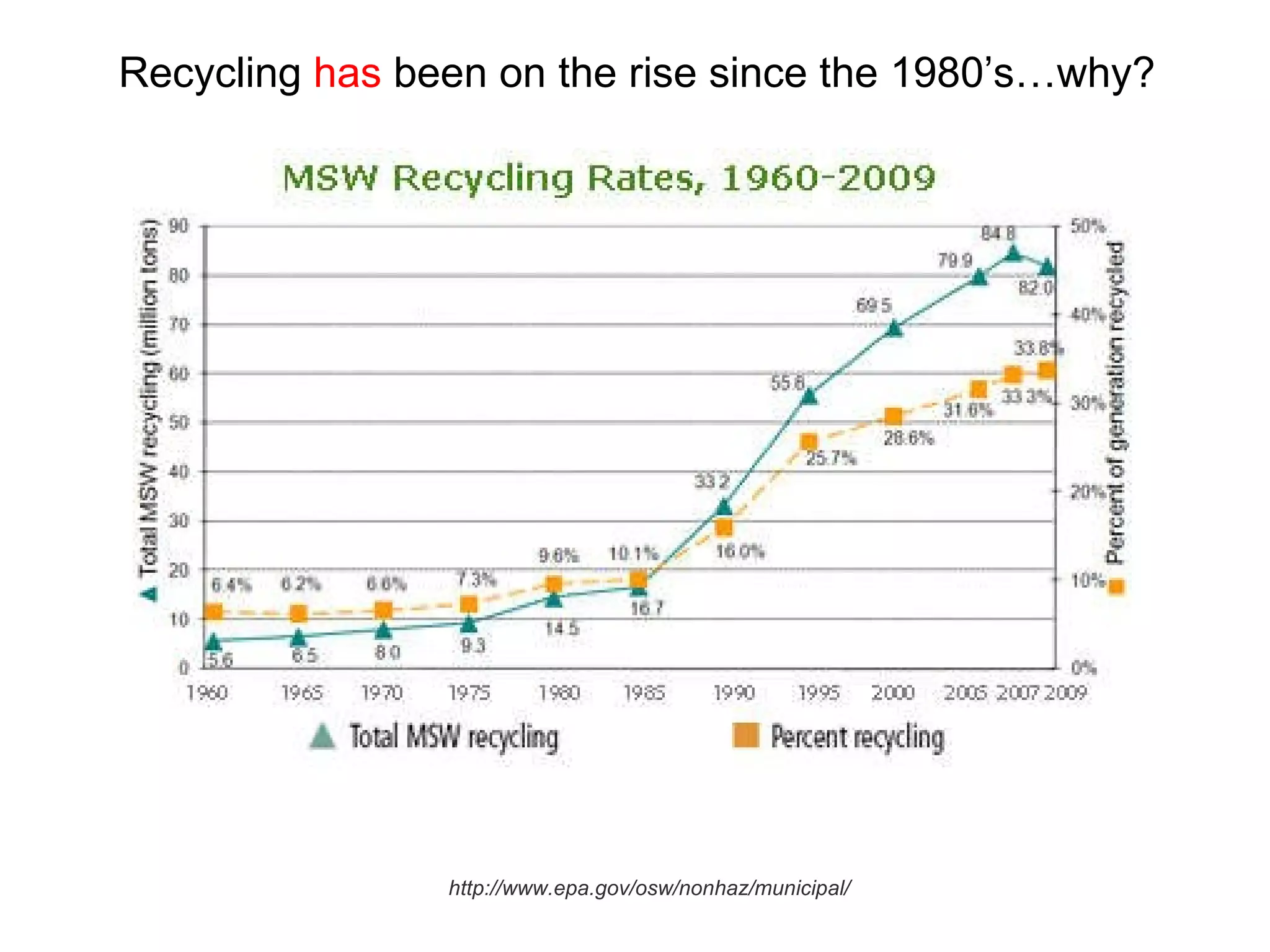
Recycling  has  been on the rise since the 1980’s…why? http://www.epa.gov/osw/nonhaz/municipal/
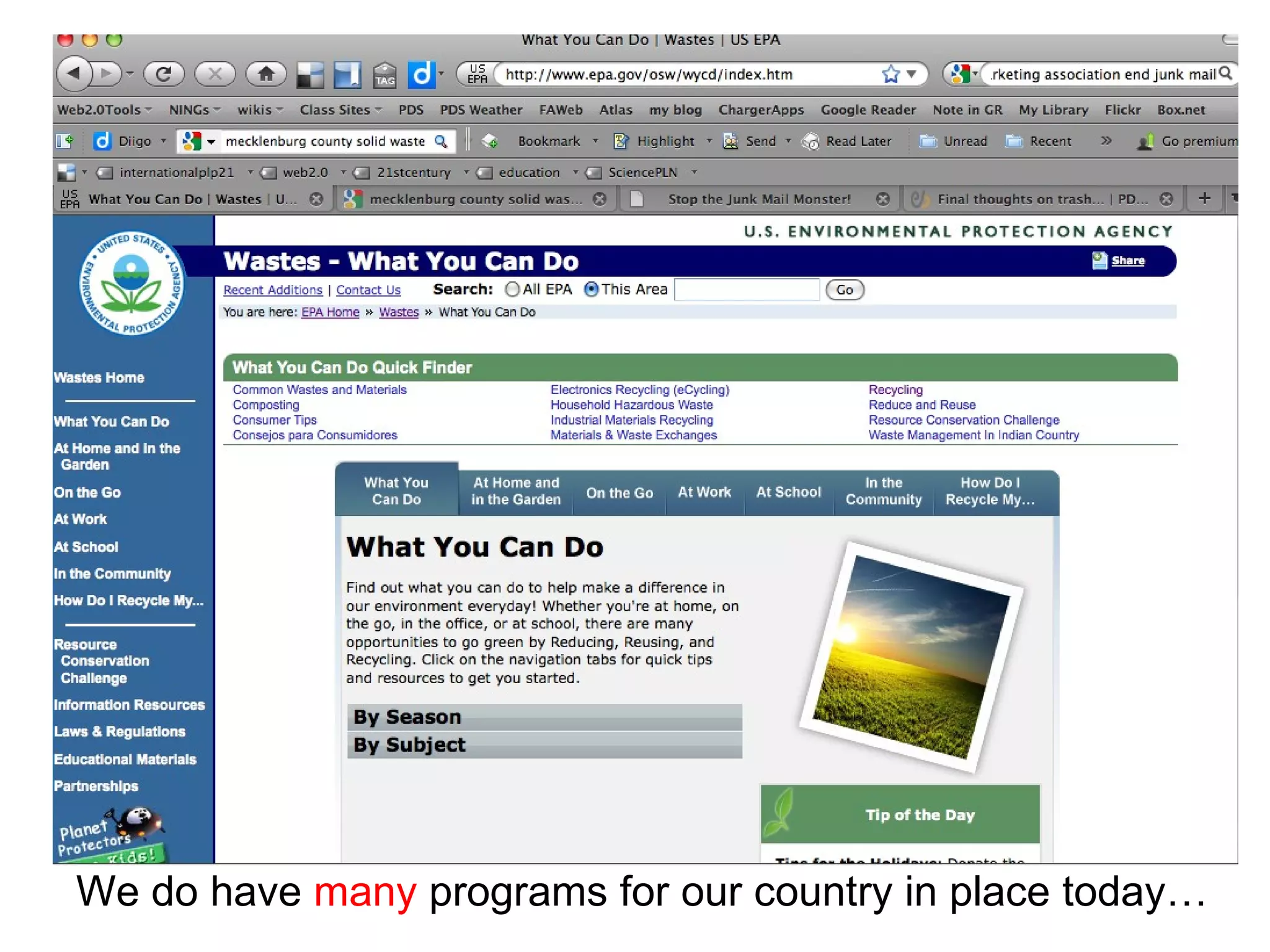
We do have  many  programs for our country in place today…
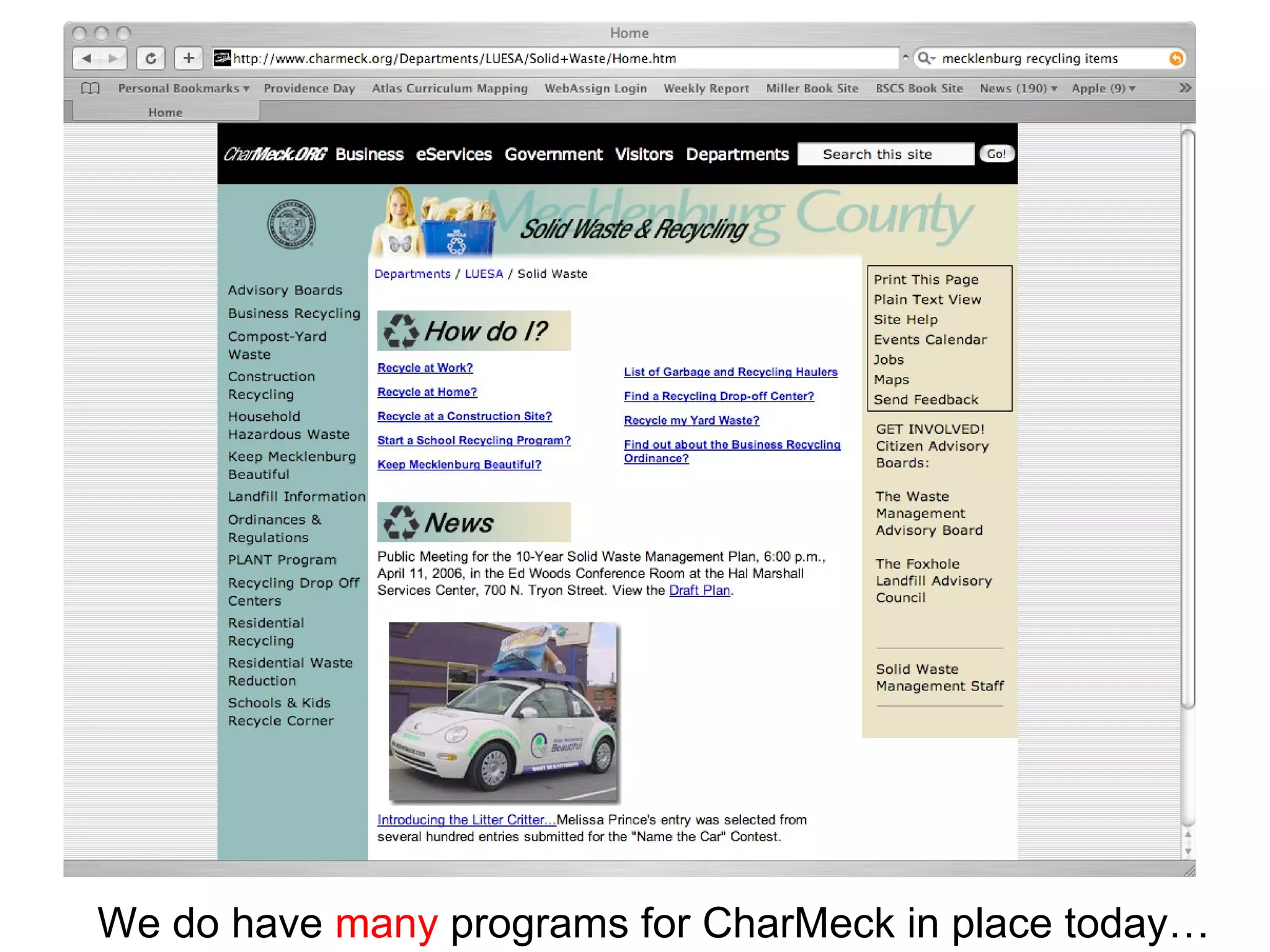
We do have  many  programs for CharMeck in place today…
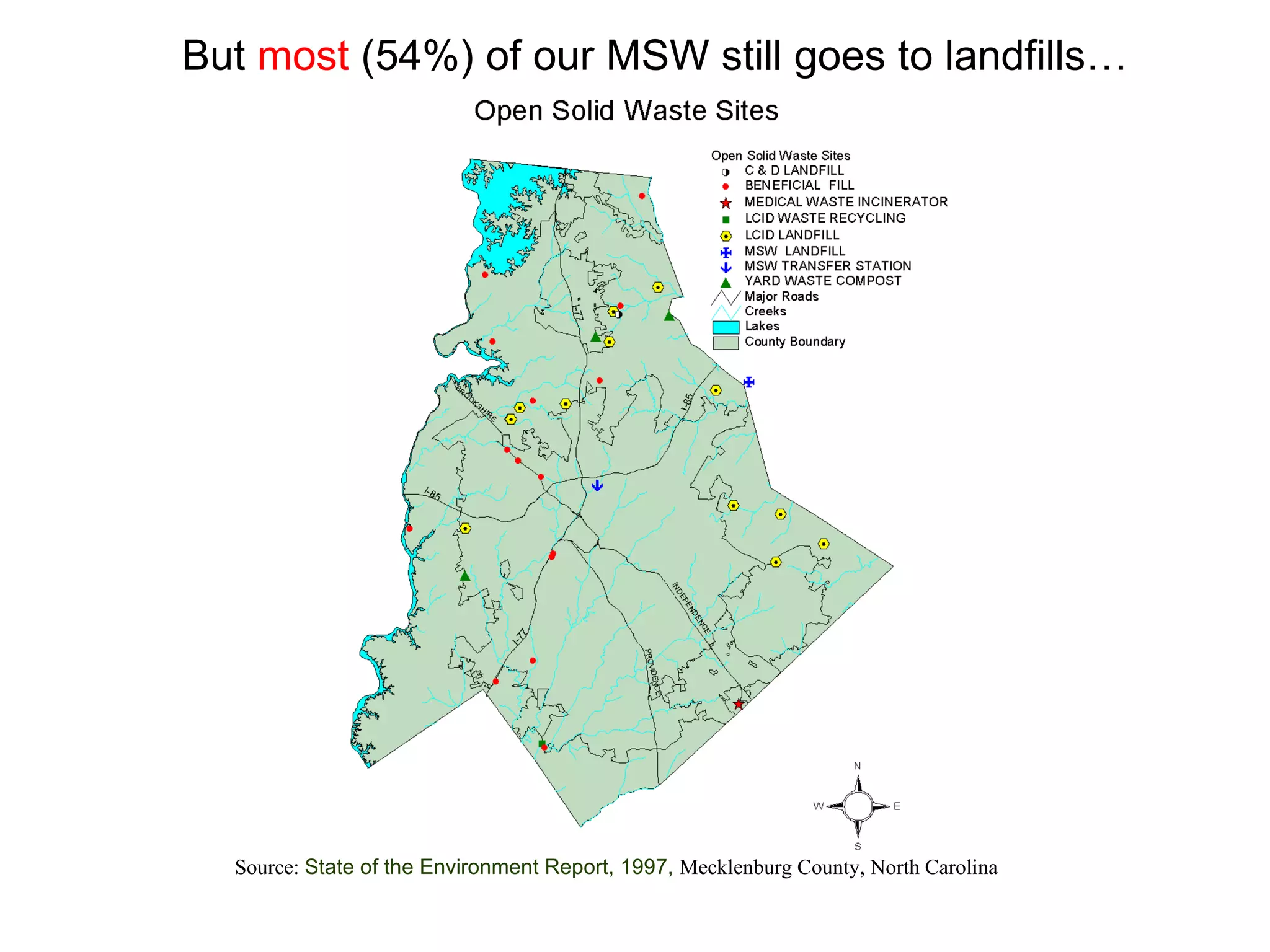
Source:  State of the Environment Report, 1997,  Mecklenburg County, North Carolina But  most  (54%) of our MSW still goes to landfills…
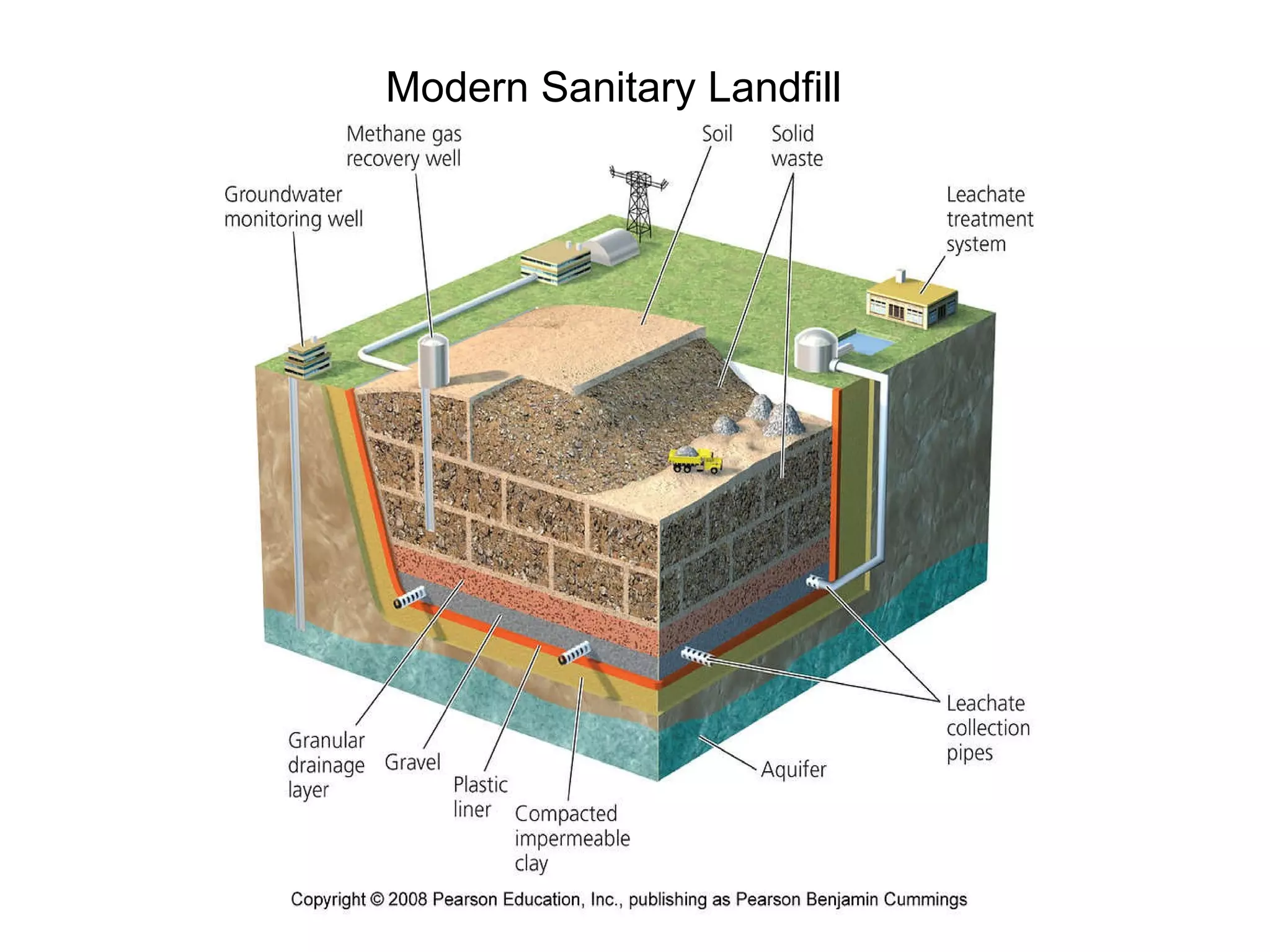
Modern Sanitary Landfill
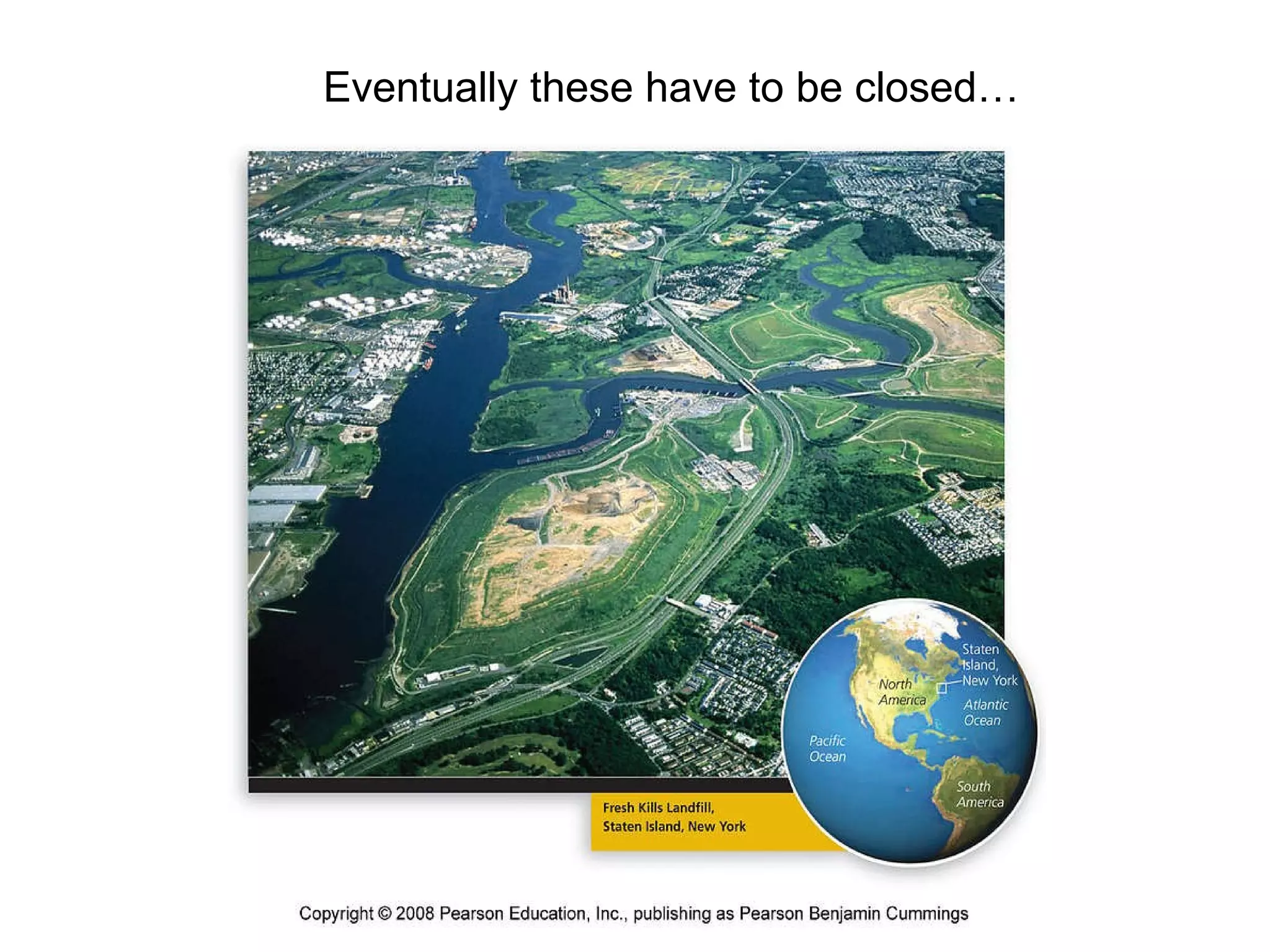
Eventually these have to be closed…
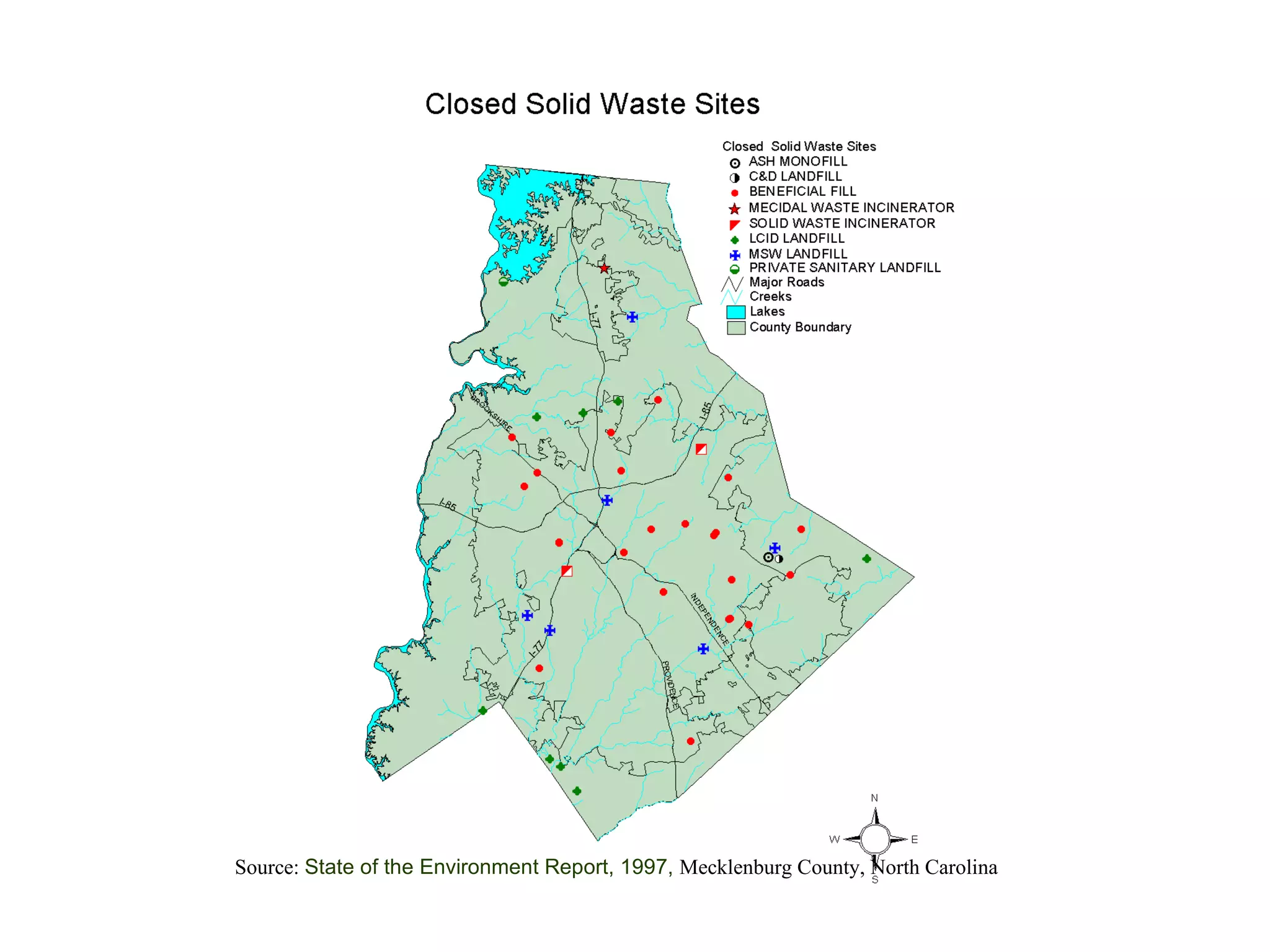
Source:  State of the Environment Report, 1997,  Mecklenburg County, North Carolina
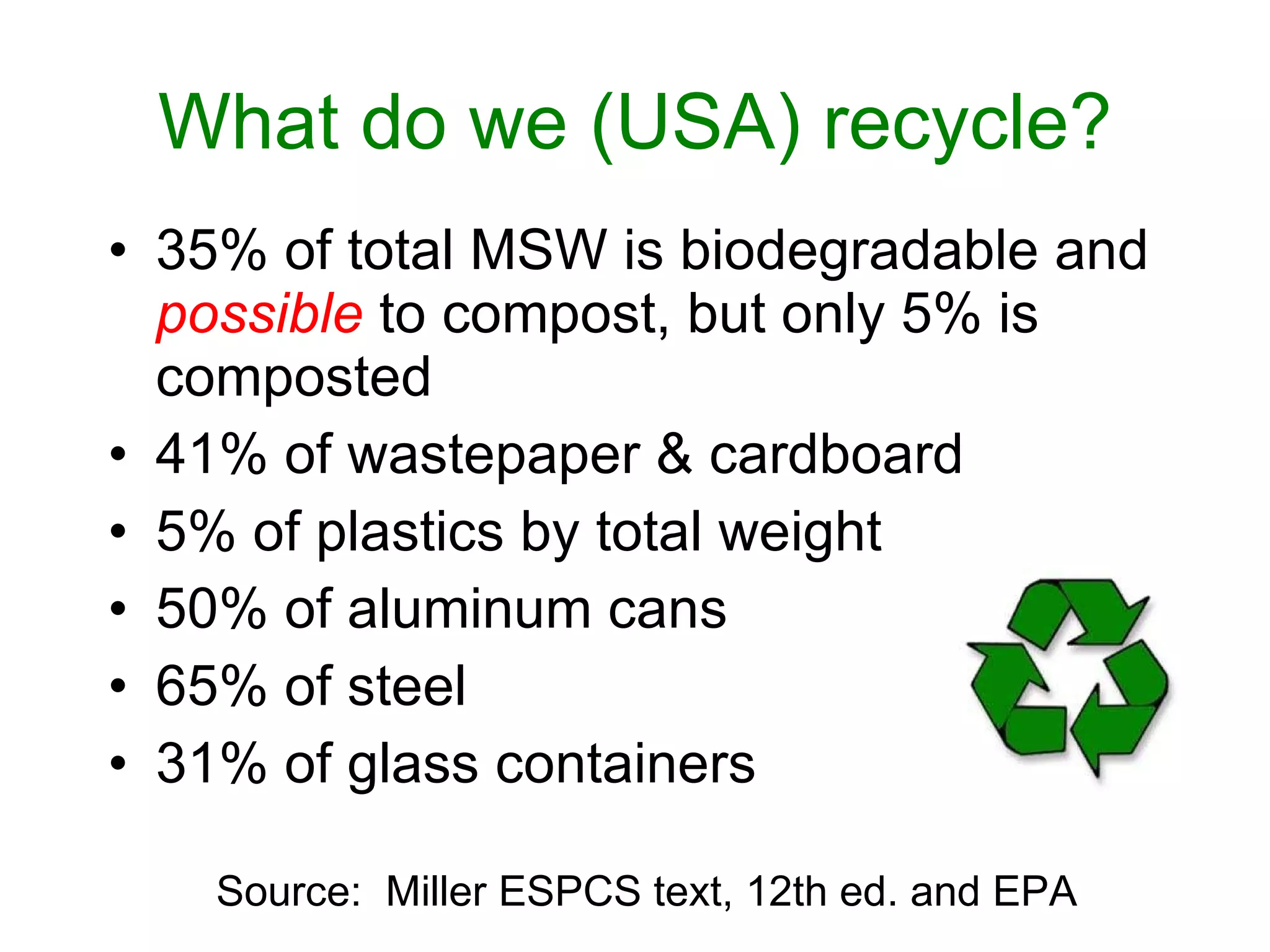
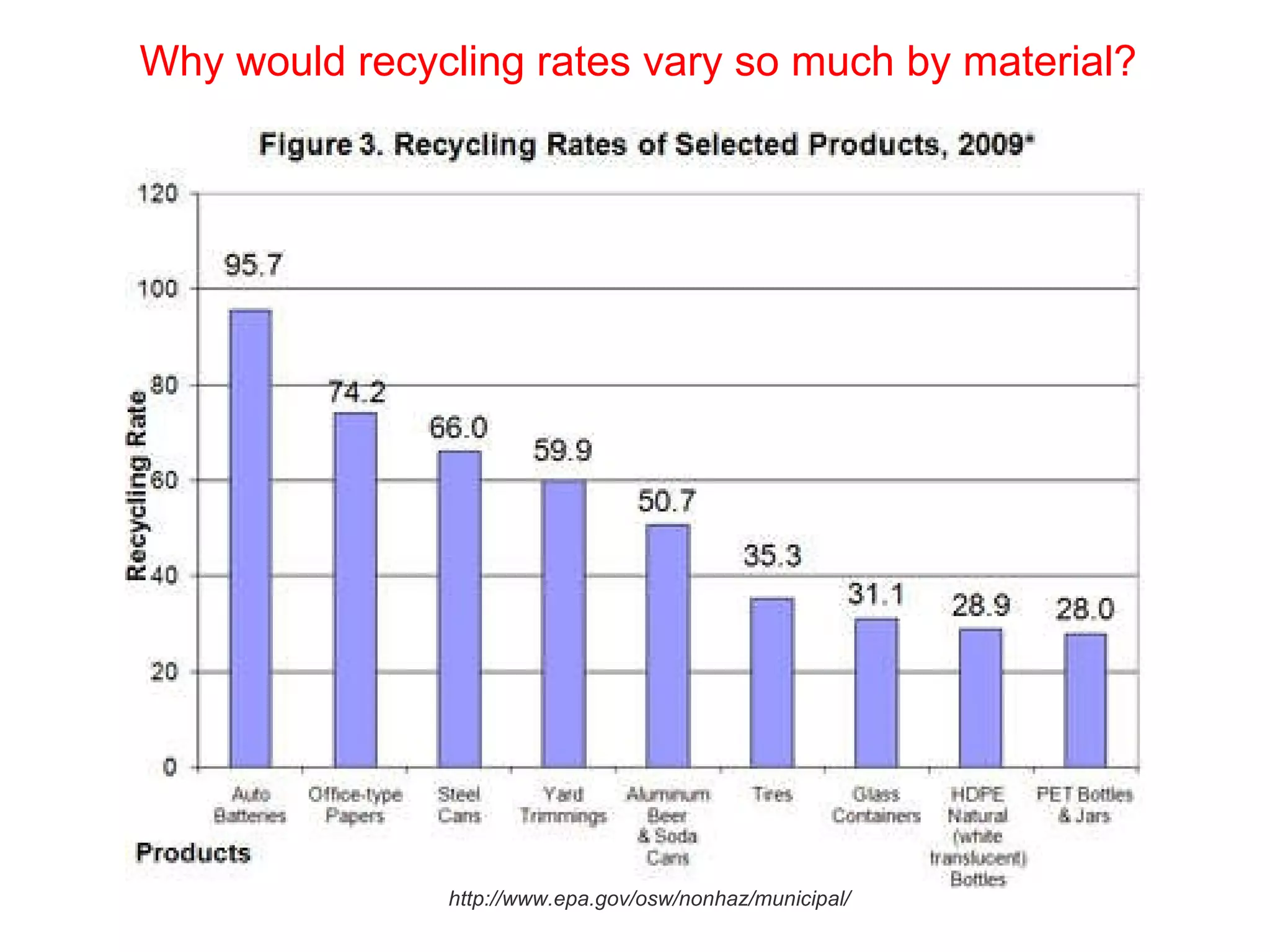
What do we (USA) recycle? 35% of total MSW is biodegradable and  possible  to compost, but only 5% is composted 41% of wastepaper & cardboard 5% of plastics by total weight 50% of aluminum cans 65% of steel 31% of glass containers Source:  Miller ESPCS text, 12th ed. and EPA
Why would recycling rates vary so much by material? http://www.epa.gov/osw/nonhaz/municipal/
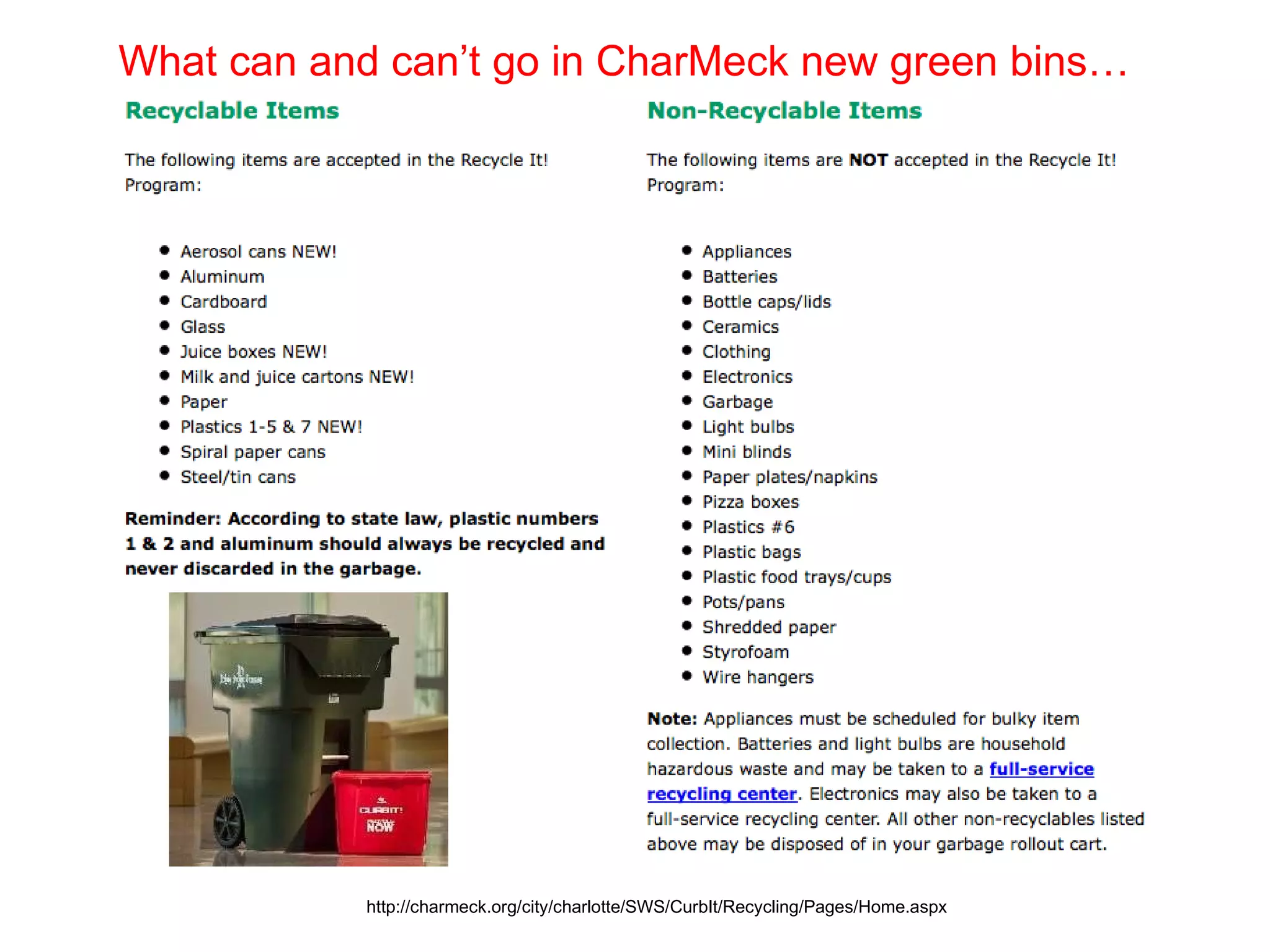
What can and can’t go in CharMeck new green bins… http://charmeck.org/city/charlotte/SWS/CurbIt/Recycling/Pages/Home.aspx
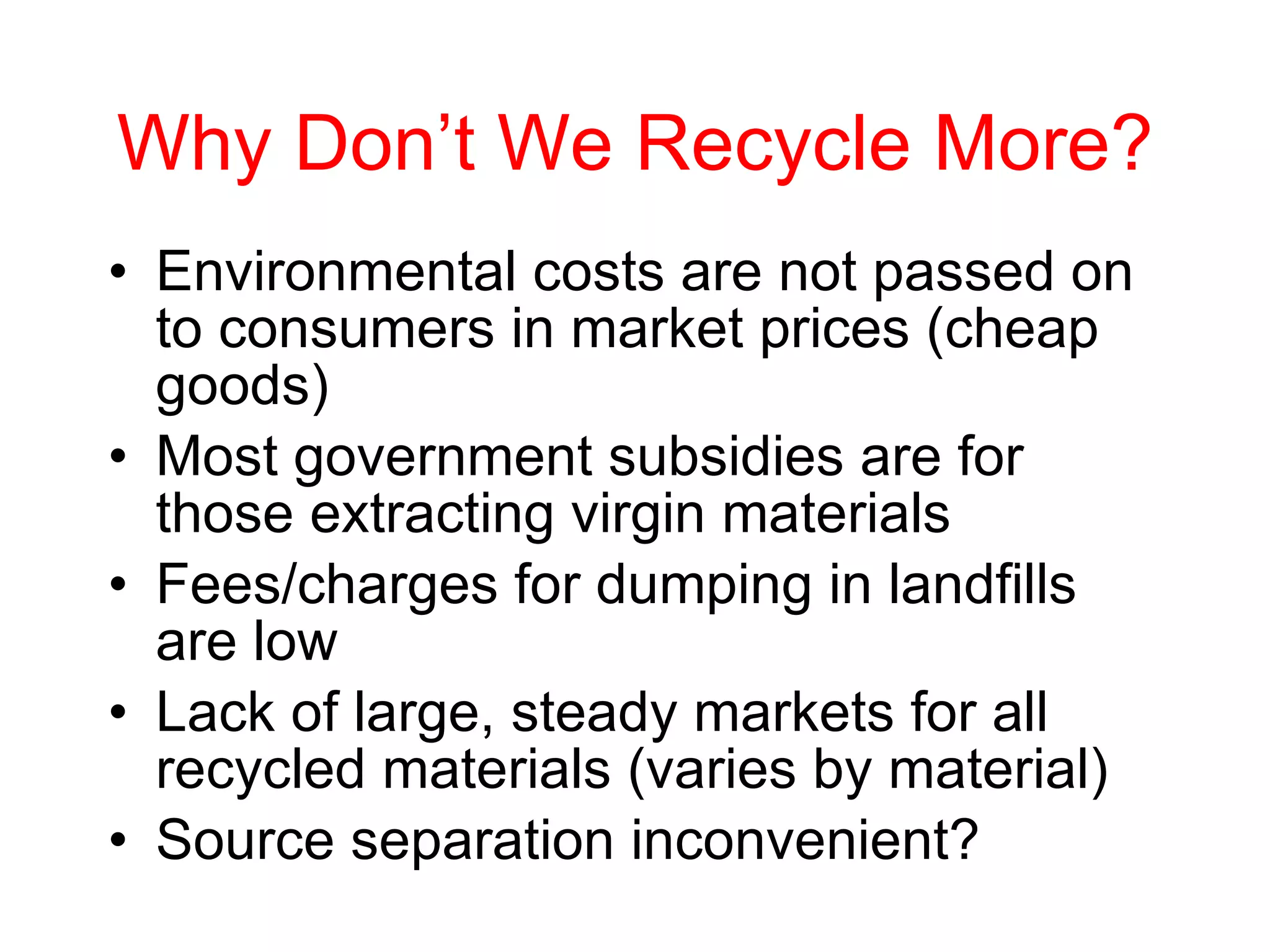
Why Don’t We Recycle More? Environmental costs are not passed on to consumers in market prices (cheap goods) Most government subsidies are for those extracting virgin materials Fees/charges for dumping in landfills are low Lack of large, steady markets for all recycled materials (varies by material) Source separation inconvenient?
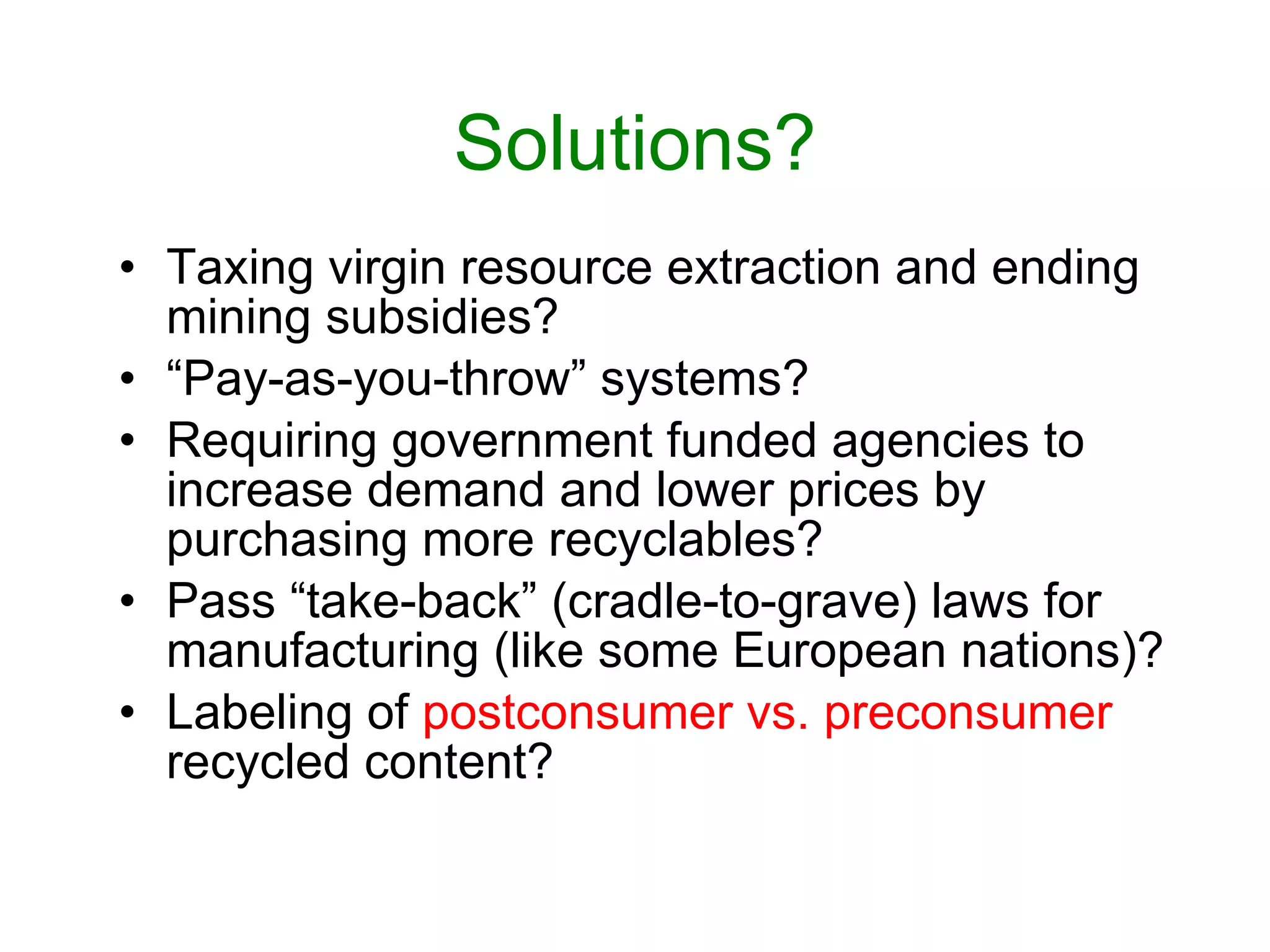
Solutions? Taxing virgin resource extraction and ending mining subsidies? “ Pay-as-you-throw” systems? Requiring government funded agencies to increase demand and lower prices by purchasing more recyclables? Pass “take-back” (cradle-to-grave) laws for manufacturing (like some European nations)? Labeling of  postconsumer vs. preconsumer  recycled content?
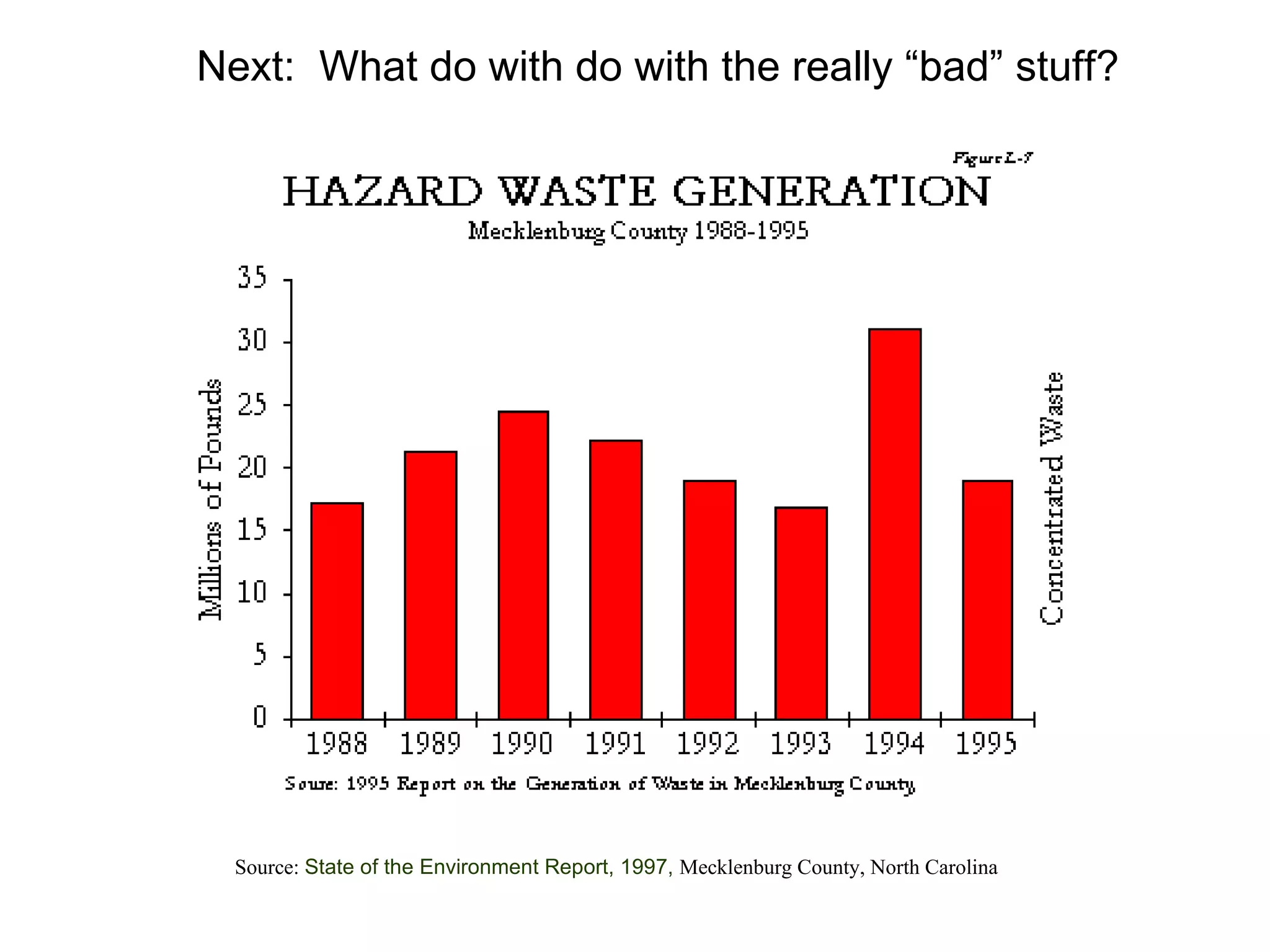
Source:  State of the Environment Report, 1997,  Mecklenburg County, North Carolina Next:  What do with do with the really “bad” stuff?

Examining MSW

  • 1.
    Wasting Resources: ExaminingOur MSW Selected U.S. and CharMeck Data from 1997-2009 Derrick Willard Providence Day School
  • 2.
    From Miller, WWE10th ed., Figure 15-2 (pg. 348). U.S. Environmental Protection Agency and U.S. Bureau of Mines Sources of 12 Billion Tons of U.S. Solid Wastes Each Year… *Note MSW is low! Municipal 1.5% Sewage sludge 1% Mining and oil and gas production 75% Industry 9.5% Agriculture 13%
  • 3.
    What material dominates our MSW waste stream in the USA? http://www.epa.gov/osw/nonhaz/municipal/
  • 4.
    Contact the Direct Marketing Association (DMA) . DMA is the oldest and largest trade association for the users and suppliers in the direct, database and interactive marketing field. You can use the DMA website to request their no cost Mail Preference Service (MPS). With DMA's MPS you can remove your name from DMA member prospect lists. Please note that signing up with MPS may prevent you from receiving mail you want, such as new catalogs, coupons, announcements about new businesses in your community, and notices of special offers. But, this can significantly reduce your “junk mail” load (at least 75%). If you want to REDUCE your paper MSW, here is an easy first step: https:// www.dmachoice.org/dma/member/regist.action
  • 5.
    Source: Stateof the Environment Report, 1997, Mecklenburg County, North Carolina Mecklenburg County (last available)
  • 6.
  • 7.
    Source: Stateof the Environment Report, 1997, Mecklenburg County, North Carolina Mecklenburg County Per Capita Production (last available)
  • 8.
    What does theUS currently do with MSW? Source: EPA Office of Solid Waste, Municipal Solid Waste Generation, Recycling and Disposal Facts and Figures 2009 http://www.epa.gov/osw/nonhaz/municipal/pubs/msw2009-fs.pdf Landfill (bury) Recycle or Compost Incinerate (burn)
  • 9.
    Recycling has been on the rise since the 1980’s…why? http://www.epa.gov/osw/nonhaz/municipal/
  • 10.
    We do have many programs for our country in place today…
  • 11.
    We do have many programs for CharMeck in place today…
  • 12.
    Source: Stateof the Environment Report, 1997, Mecklenburg County, North Carolina But most (54%) of our MSW still goes to landfills…
  • 13.
  • 14.
    Eventually these haveto be closed…
  • 15.
    Source: Stateof the Environment Report, 1997, Mecklenburg County, North Carolina
  • 16.
    What do we(USA) recycle? 35% of total MSW is biodegradable and possible to compost, but only 5% is composted 41% of wastepaper & cardboard 5% of plastics by total weight 50% of aluminum cans 65% of steel 31% of glass containers Source: Miller ESPCS text, 12th ed. and EPA
  • 17.
    Why would recyclingrates vary so much by material? http://www.epa.gov/osw/nonhaz/municipal/
  • 18.
    What can andcan’t go in CharMeck new green bins… http://charmeck.org/city/charlotte/SWS/CurbIt/Recycling/Pages/Home.aspx
  • 19.
    Why Don’t WeRecycle More? Environmental costs are not passed on to consumers in market prices (cheap goods) Most government subsidies are for those extracting virgin materials Fees/charges for dumping in landfills are low Lack of large, steady markets for all recycled materials (varies by material) Source separation inconvenient?
  • 20.
    Solutions? Taxing virginresource extraction and ending mining subsidies? “ Pay-as-you-throw” systems? Requiring government funded agencies to increase demand and lower prices by purchasing more recyclables? Pass “take-back” (cradle-to-grave) laws for manufacturing (like some European nations)? Labeling of postconsumer vs. preconsumer recycled content?
  • 21.
    Source: Stateof the Environment Report, 1997, Mecklenburg County, North Carolina Next: What do with do with the really “bad” stuff?