Ecological Succession
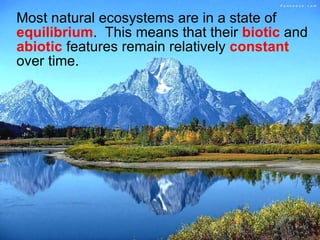
Most natural ecosystems are in a state of  equilibrium .  This means that their  biotic  and  abiotic  features remain relatively  constant  over time.
The major  biomes , for example, usually maintain a characteristic set of  species  over hundreds of thousands of years.
Changes on a large scale occur  slowly  and are caused by changes in  climatic  conditions.
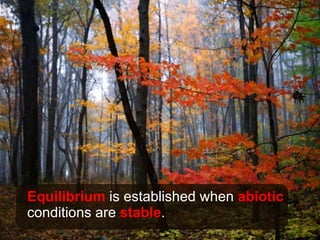
Equilibrium  is established when  abiotic  conditions are  stable .
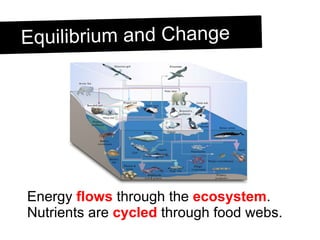
Equilibrium and Change Energy  flows  through the  ecosystem .  Nutrients are  cycled  through food webs.
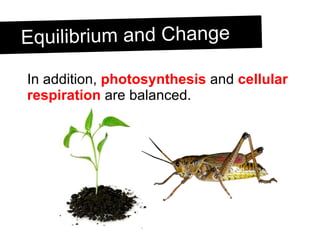
Equilibrium and Change In addition,  photosynthesis  and  cellular respiration  are balanced.
When ecosystems are in  equilibrium , populations are healthy and  stable .
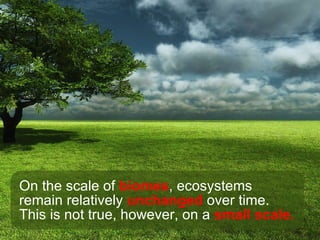
On the scale of  biomes , ecosystems remain relatively  unchanged  over time.  This is not true, however, on a  small scale.
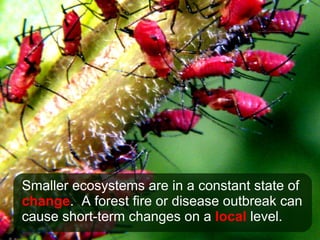
Smaller ecosystems are in a constant state of  change .  A forest fire or disease outbreak can cause short-term changes on a  local  level.
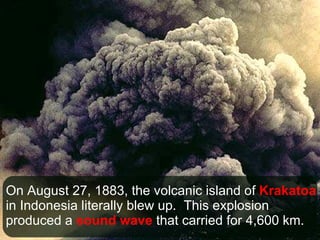
On August 27, 1883, the volcanic island of  Krakatoa  in Indonesia literally blew up.  This explosion produced a  sound wave  that carried for 4,600 km.
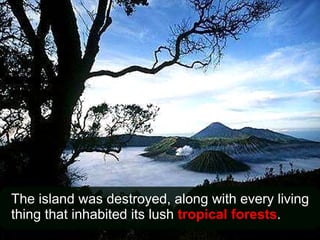
The island was destroyed, along with every living thing that inhabited its lush  tropical forests .
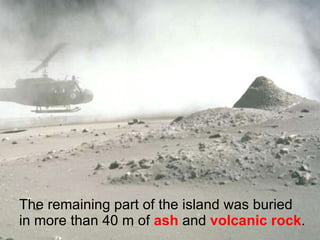
The remaining part of the island was buried in more than 40 m of  ash  and  volcanic rock .
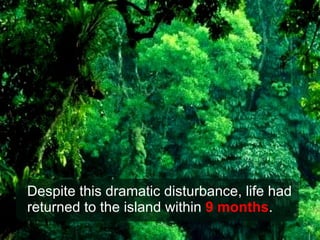
Despite this dramatic disturbance, life had returned to the island within  9 months .
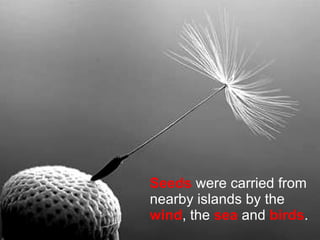
Seeds  were carried from nearby islands by the  wind , the  sea  and  birds .
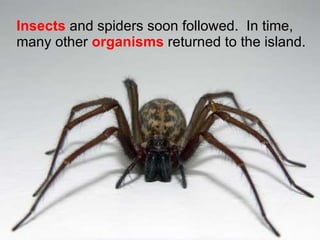
Insects  and spiders soon followed.  In time, many other  organisms  returned to the island.
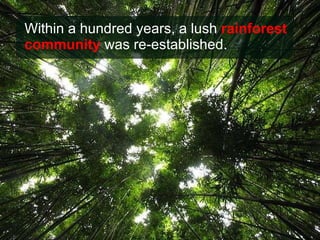
Within a hundred years, a lush  rainforest community  was re-established.
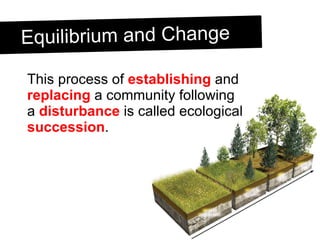
Equilibrium and Change This process of  establishing  and  replacing  a community following a  disturbance  is called ecological  succession .
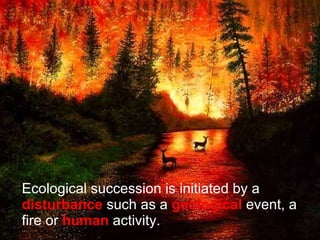
Ecological succession is initiated by a  disturbance  such as a  geological  event, a fire or  human  activity.
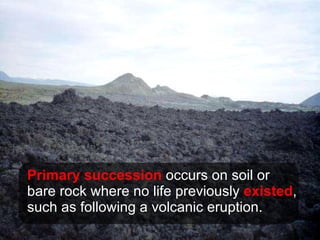
Primary succession  occurs on soil or bare rock where no life previously  existed , such as following a volcanic eruption.
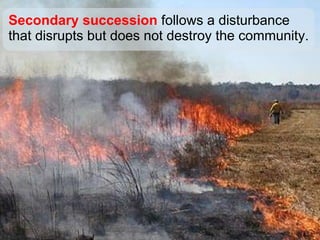
Secondary succession  follows a disturbance that disrupts but does not destroy the community.
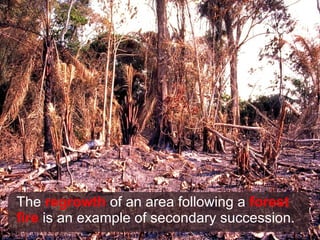
The  regrowth  of an area following a  forest fire  is an example of secondary succession.
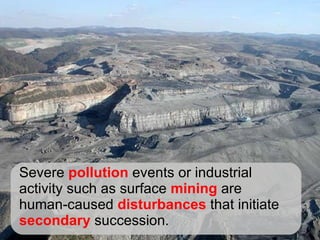
Severe  pollution  events or industrial activity such as surface  mining  are human-caused  disturbances  that initiate  secondary  succession.
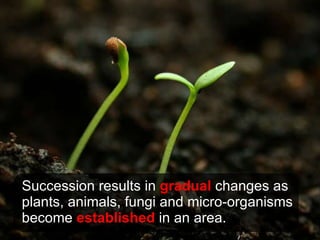
Succession results in  gradual  changes as plants, animals, fungi and micro-organisms become  established  in an area.
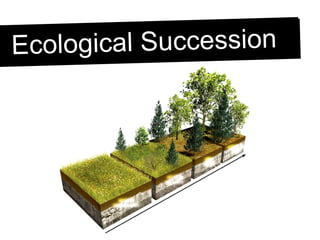
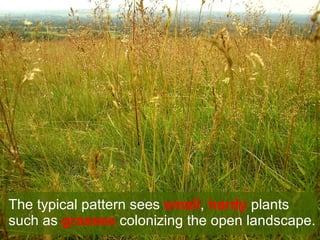
The typical pattern sees  small ,  hardy  plants such as  grasses  colonizing the open landscape.
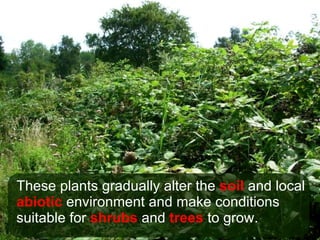
These plants gradually alter the  soil  and local  abiotic  environment and make conditions suitable for  shrubs  and  trees  to grow.
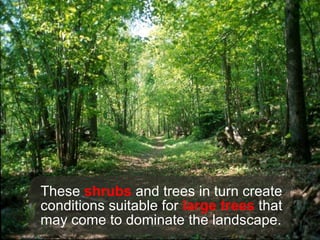
These  shrubs  and trees in turn create conditions suitable for  large trees  that may come to dominate the landscape.
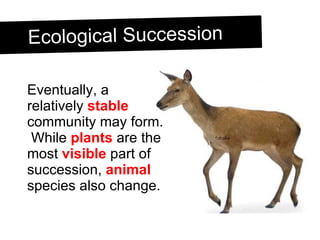
Ecological Succession Eventually, a relatively  stable  community may form.  While  plants  are the most  visible  part of succession,  animal  species also change.
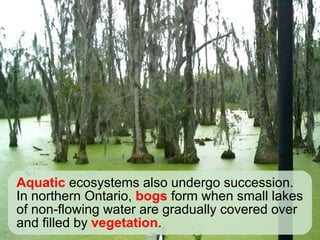
Aquatic  ecosystems also undergo succession.  In northern Ontario,  bogs  form when small lakes of non-flowing water are gradually covered over and filled by  vegetation .
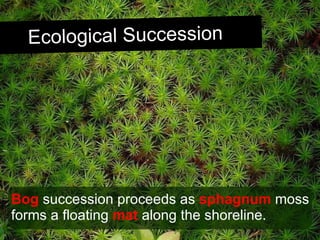
Ecological Succession Bog  succession proceeds as  sphagnum  moss forms a floating  mat  along the shoreline.
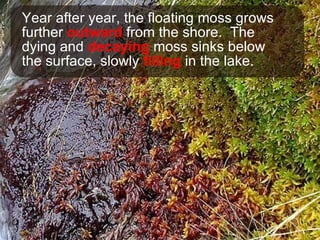
Year after year, the floating moss grows further  outward  from the shore.  The dying and  decaying  moss sinks below the surface, slowly  filling  in the lake.
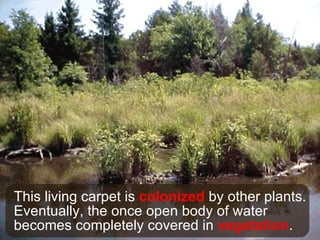
This living carpet is  colonized  by other plants.  Eventually, the once open body of water becomes completely covered in  vegetation .
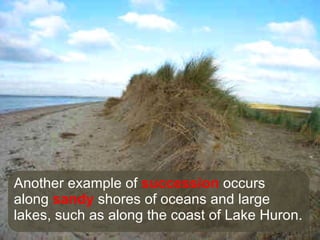
Another example of  succession  occurs along  sandy  shores of oceans and large lakes, such as along the coast of Lake Huron.
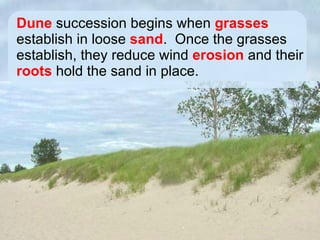
Dune  succession begins when  grasses  establish in loose  sand .  Once the grasses establish, they reduce wind  erosion  and their  roots  hold the sand in place.
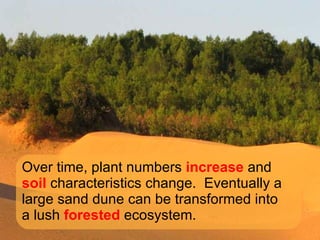
Over time, plant numbers  increase  and  soil  characteristics change.  Eventually a large sand dune can be transformed into a lush  forested  ecosystem.
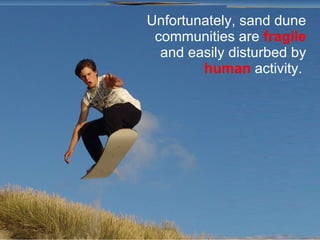
Unfortunately, sand dune communities are  fragile  and easily disturbed by  human  activity.
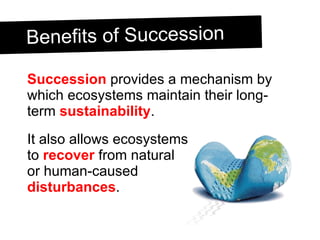
Benefits of Succession Succession  provides a mechanism by which ecosystems maintain their long-term  sustainability . It also allows ecosystems to  recover  from natural  or human-caused  disturbances .
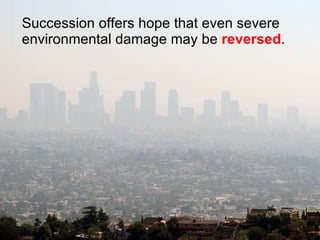
Succession offers hope that even severe environmental damage may be  reversed .
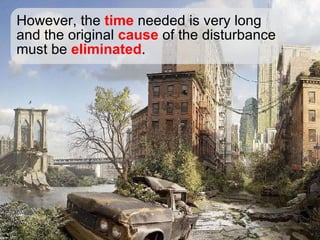
However, the  time  needed is very long and the original  cause  of the disturbance must be  eliminated .
 

Ecological Succession

  • 1.
  • 2.
    Most natural ecosystemsare in a state of equilibrium . This means that their biotic and abiotic features remain relatively constant over time.
  • 3.
    The major biomes , for example, usually maintain a characteristic set of species over hundreds of thousands of years.
  • 4.
    Changes on alarge scale occur slowly and are caused by changes in climatic conditions.
  • 5.
    Equilibrium isestablished when abiotic conditions are stable .
  • 6.
    Equilibrium and ChangeEnergy flows through the ecosystem . Nutrients are cycled through food webs.
  • 7.
    Equilibrium and ChangeIn addition, photosynthesis and cellular respiration are balanced.
  • 8.
    When ecosystems arein equilibrium , populations are healthy and stable .
  • 9.
    On the scaleof biomes , ecosystems remain relatively unchanged over time. This is not true, however, on a small scale.
  • 10.
    Smaller ecosystems arein a constant state of change . A forest fire or disease outbreak can cause short-term changes on a local level.
  • 11.
    On August 27,1883, the volcanic island of Krakatoa in Indonesia literally blew up. This explosion produced a sound wave that carried for 4,600 km.
  • 12.
    The island wasdestroyed, along with every living thing that inhabited its lush tropical forests .
  • 13.
    The remaining partof the island was buried in more than 40 m of ash and volcanic rock .
  • 14.
    Despite this dramaticdisturbance, life had returned to the island within 9 months .
  • 15.
    Seeds werecarried from nearby islands by the wind , the sea and birds .
  • 16.
    Insects andspiders soon followed. In time, many other organisms returned to the island.
  • 17.
    Within a hundredyears, a lush rainforest community was re-established.
  • 18.
    Equilibrium and ChangeThis process of establishing and replacing a community following a disturbance is called ecological succession .
  • 19.
    Ecological succession isinitiated by a disturbance such as a geological event, a fire or human activity.
  • 20.
    Primary succession occurs on soil or bare rock where no life previously existed , such as following a volcanic eruption.
  • 21.
    Secondary succession follows a disturbance that disrupts but does not destroy the community.
  • 22.
    The regrowth of an area following a forest fire is an example of secondary succession.
  • 23.
    Severe pollution events or industrial activity such as surface mining are human-caused disturbances that initiate secondary succession.
  • 24.
    Succession results in gradual changes as plants, animals, fungi and micro-organisms become established in an area.
  • 25.
    The typical patternsees small , hardy plants such as grasses colonizing the open landscape.
  • 26.
    These plants graduallyalter the soil and local abiotic environment and make conditions suitable for shrubs and trees to grow.
  • 27.
    These shrubs and trees in turn create conditions suitable for large trees that may come to dominate the landscape.
  • 28.
    Ecological Succession Eventually,a relatively stable community may form. While plants are the most visible part of succession, animal species also change.
  • 29.
    Aquatic ecosystemsalso undergo succession. In northern Ontario, bogs form when small lakes of non-flowing water are gradually covered over and filled by vegetation .
  • 30.
    Ecological Succession Bog succession proceeds as sphagnum moss forms a floating mat along the shoreline.
  • 31.
    Year after year,the floating moss grows further outward from the shore. The dying and decaying moss sinks below the surface, slowly filling in the lake.
  • 32.
    This living carpetis colonized by other plants. Eventually, the once open body of water becomes completely covered in vegetation .
  • 33.
    Another example of succession occurs along sandy shores of oceans and large lakes, such as along the coast of Lake Huron.
  • 34.
    Dune successionbegins when grasses establish in loose sand . Once the grasses establish, they reduce wind erosion and their roots hold the sand in place.
  • 35.
    Over time, plantnumbers increase and soil characteristics change. Eventually a large sand dune can be transformed into a lush forested ecosystem.
  • 36.
    Unfortunately, sand dunecommunities are fragile and easily disturbed by human activity.
  • 37.
    Benefits of SuccessionSuccession provides a mechanism by which ecosystems maintain their long-term sustainability . It also allows ecosystems to recover from natural or human-caused disturbances .
  • 38.
    Succession offers hopethat even severe environmental damage may be reversed .
  • 39.
    However, the time needed is very long and the original cause of the disturbance must be eliminated .
  • 40.