Charlotte’s Future: Growth and the
           Environment

        Providence Day School
           January 13, 2012
Presentation Overview

 Land Use Planning
 Growth Trends
 Growth Framework
 Group Activity
 Impacts of Growth on the
  Environment
 Looking to the Future
Planning Department
Mission: Provide integrated planning
services that promote sustainable growth to
improve our community’s quality of life
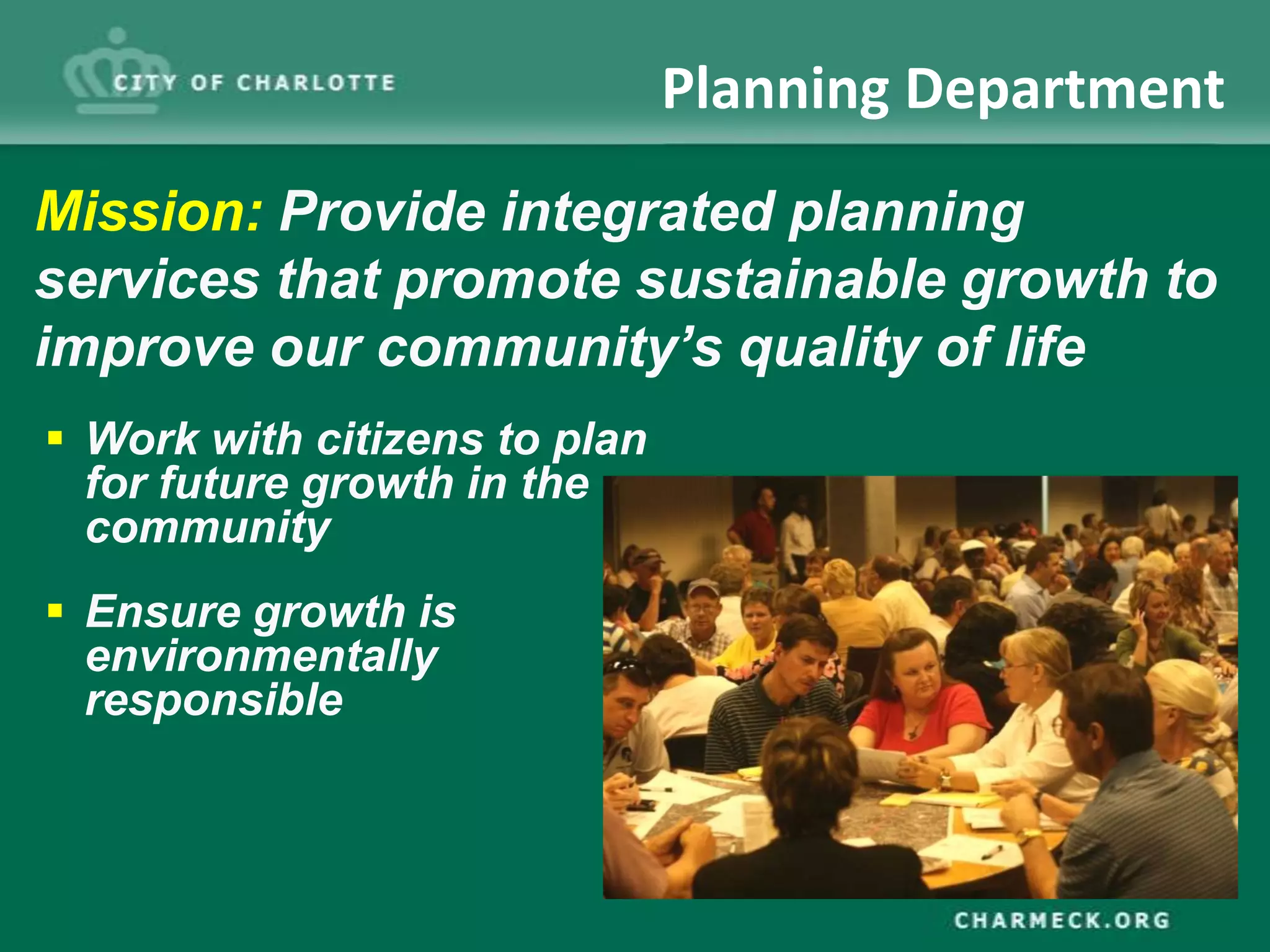
 Work with citizens to plan
  for future growth in the
  community
 Ensure growth is
  environmentally
  responsible
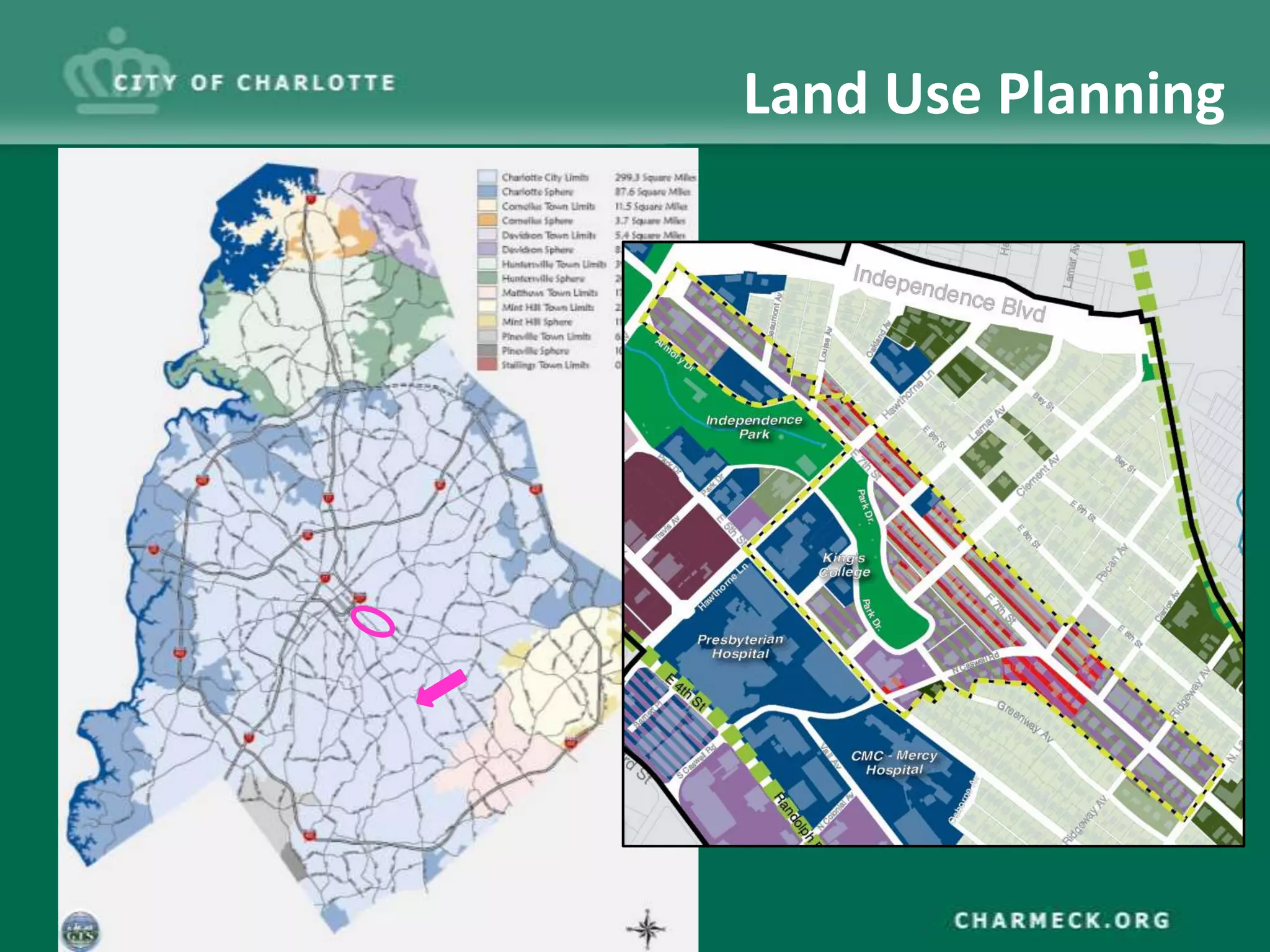
Land Use Planning
What is Land Use Planning?
• Key tool to manage how and where we grow in the community
• Organizing of types of land uses (ie. commercial, residential,
  industrial) and their resources to best meet people’s needs over time
• Provides guidance for what types of development go where

Types of Land Uses
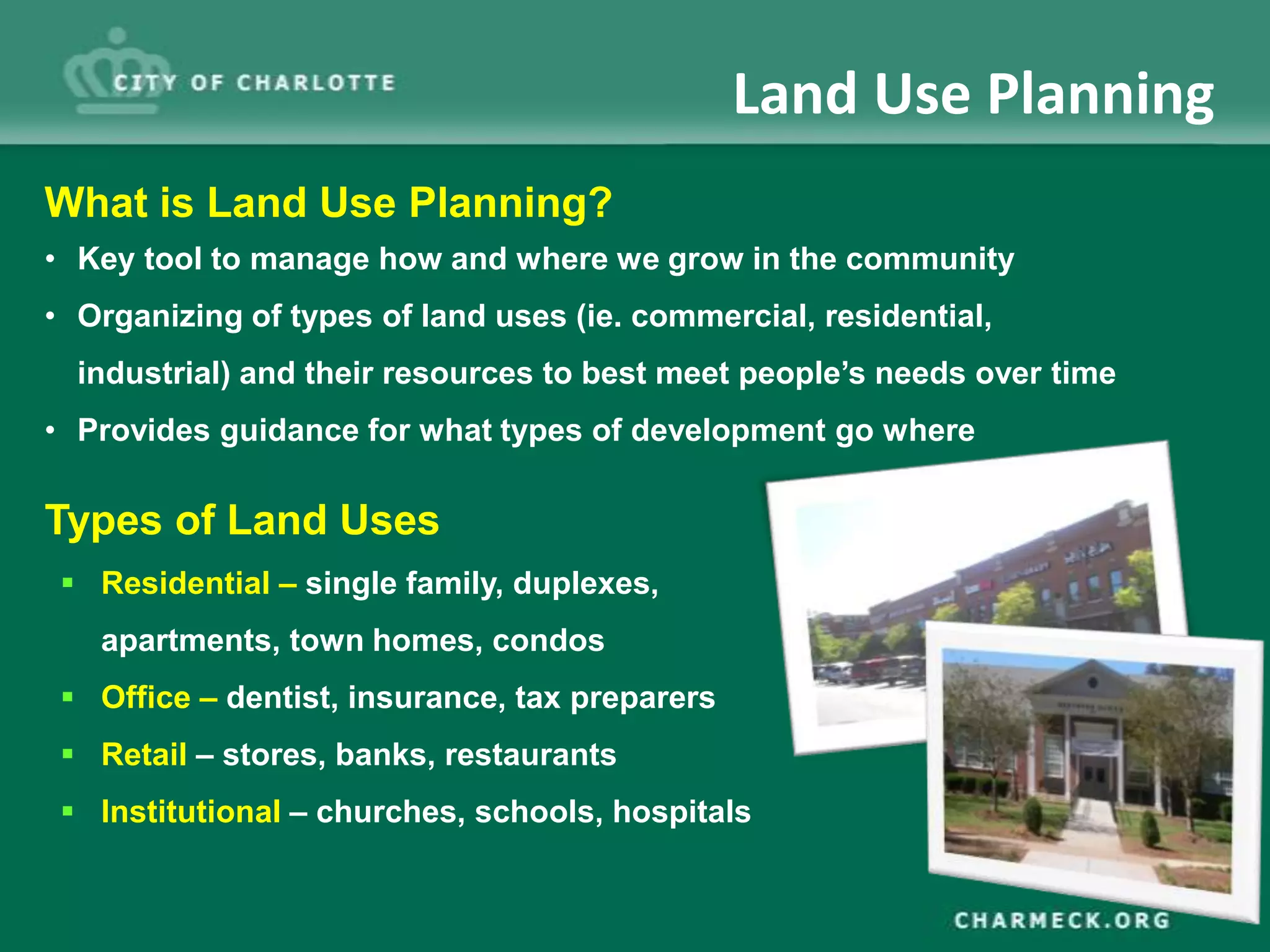
  Residential – single family, duplexes,
   apartments, town homes, condos
  Office – dentist, insurance, tax preparers
  Retail – stores, banks, restaurants
  Institutional – churches, schools, hospitals
Land Use Planning
Land Use Planning
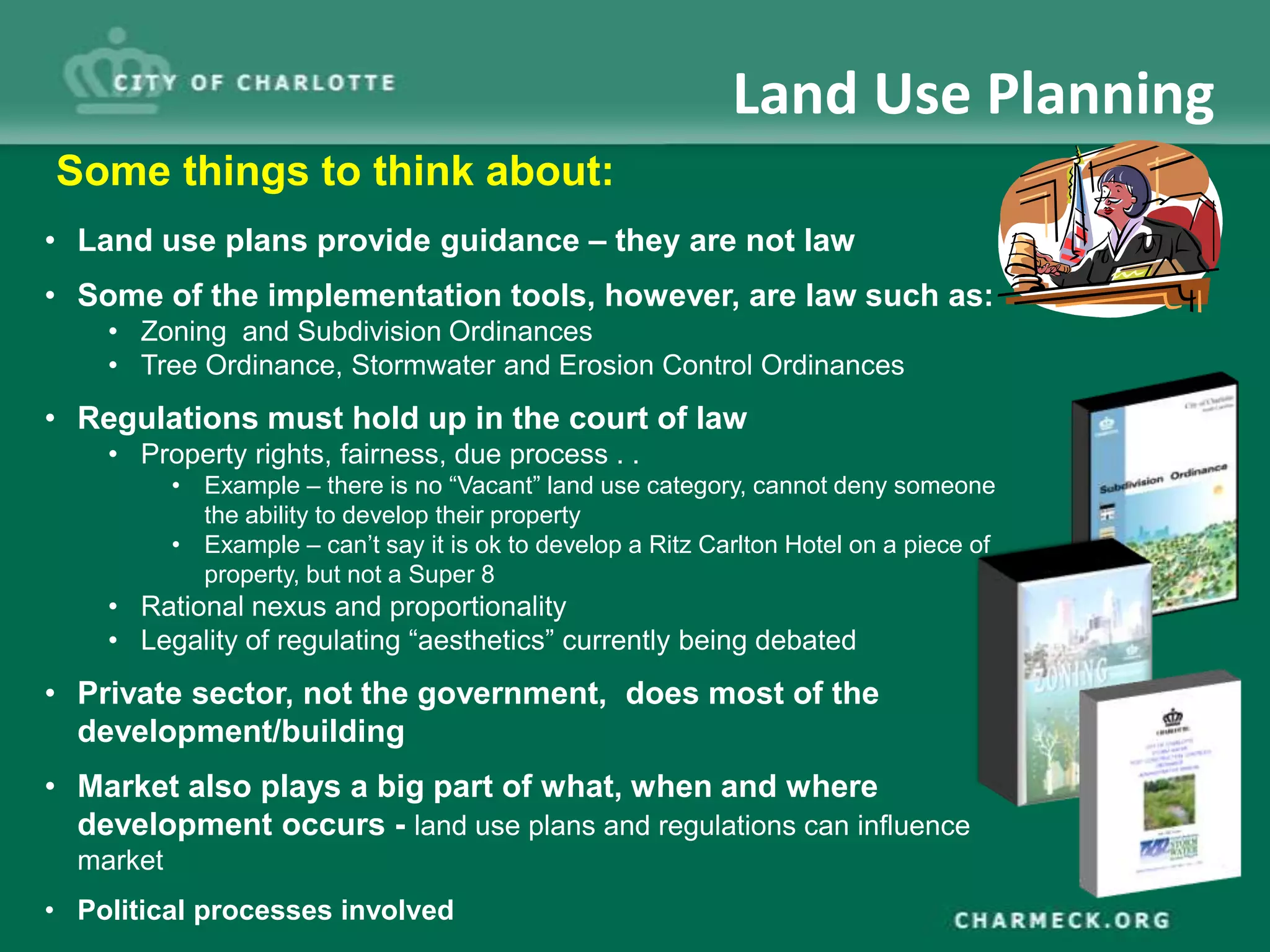
Some things to think about:
• Land use plans provide guidance – they are not law
• Some of the implementation tools, however, are law such as:
    • Zoning and Subdivision Ordinances
    • Tree Ordinance, Stormwater and Erosion Control Ordinances
• Regulations must hold up in the court of law
    • Property rights, fairness, due process . .
           • Example – there is no “Vacant” land use category, cannot deny someone
             the ability to develop their property
           • Example – can’t say it is ok to develop a Ritz Carlton Hotel on a piece of
             property, but not a Super 8
    • Rational nexus and proportionality
    • Legality of regulating “aesthetics” currently being debated
• Private sector, not the government, does most of the
  development/building
• Market also plays a big part of what, when and where
  development occurs - land use plans and regulations can influence
  market
• Political processes involved
• Good plans shape good decisions. That's why good planning helps
  to make elusive dreams come true. (Lester Robert Bittel writer)
• Have a plan. Follow the plan, and you'll be surprised how successful
  you can be. Most people don't have a plan. That's why it's is easy to
  beat most folks. (Paul "Bear" Bryant, football coach)
• Man who does not plan long ahead will find trouble at his door.
  (Confucius, Chinese philosopher and religious leader)

• Where there is no vision, the people perish. (The Bible, Proverbs 29:18)

• If you can dream it, you can do it. (Walt Disney, animator, film producer)

• In Houston, a person walking is someone on his way to his car.
  (Anthony Downs, writer)

• You got to be careful if you don't know where you're going, because
  you might not get there. (Yogi Berra, baseball catcher)
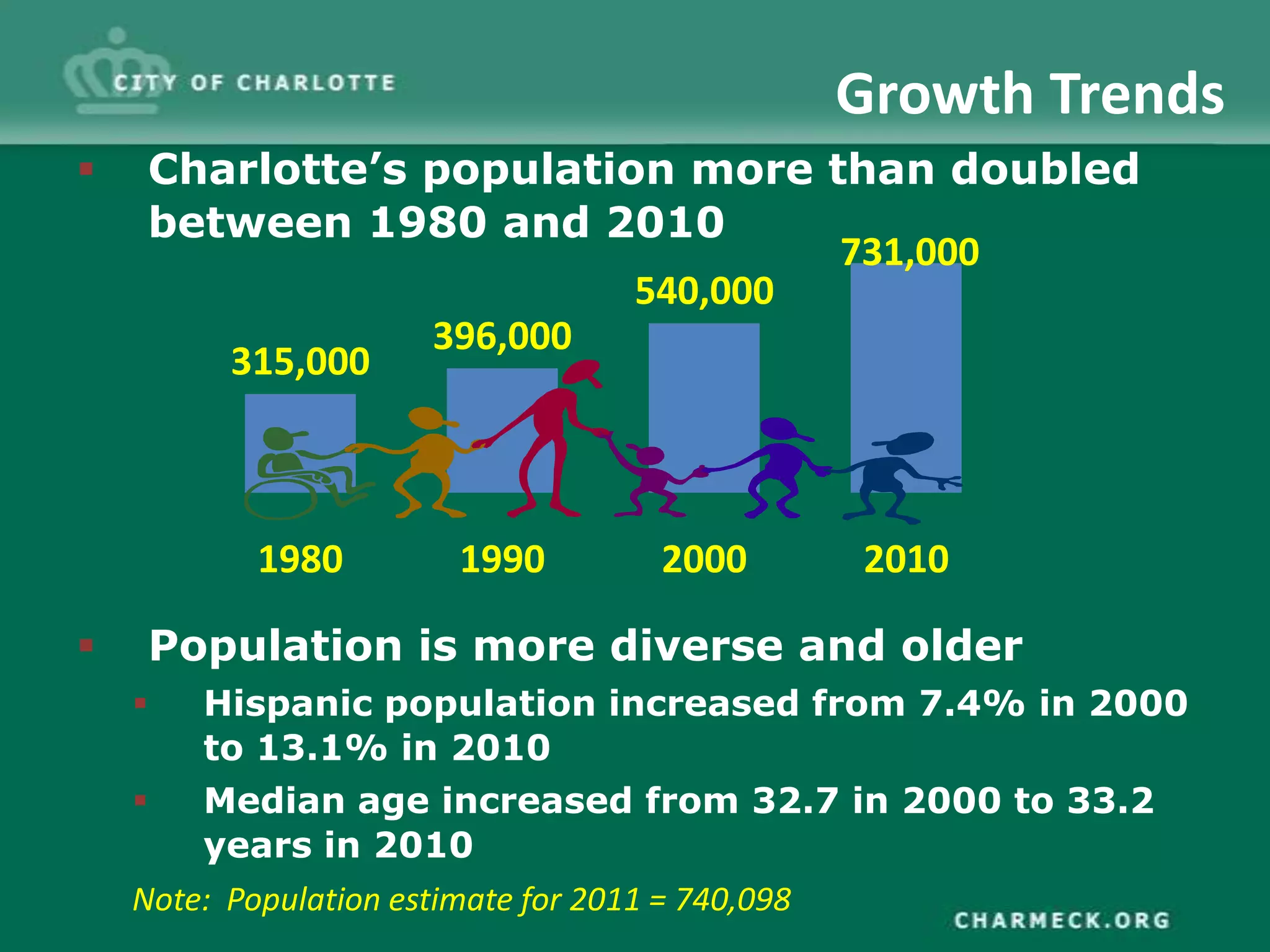
Growth Trends
   Charlotte’s population more than doubled
    between 1980 and 2010
                                 731,000
                         540,000
                396,000
       315,000


          1980     1990      2000      2010

   Population is more diverse and older
       Hispanic population increased from 7.4% in 2000
        to 13.1% in 2010
       Median age increased from 32.7 in 2000 to 33.2
        years in 2010
    Note: Population estimate for 2011 = 740,098
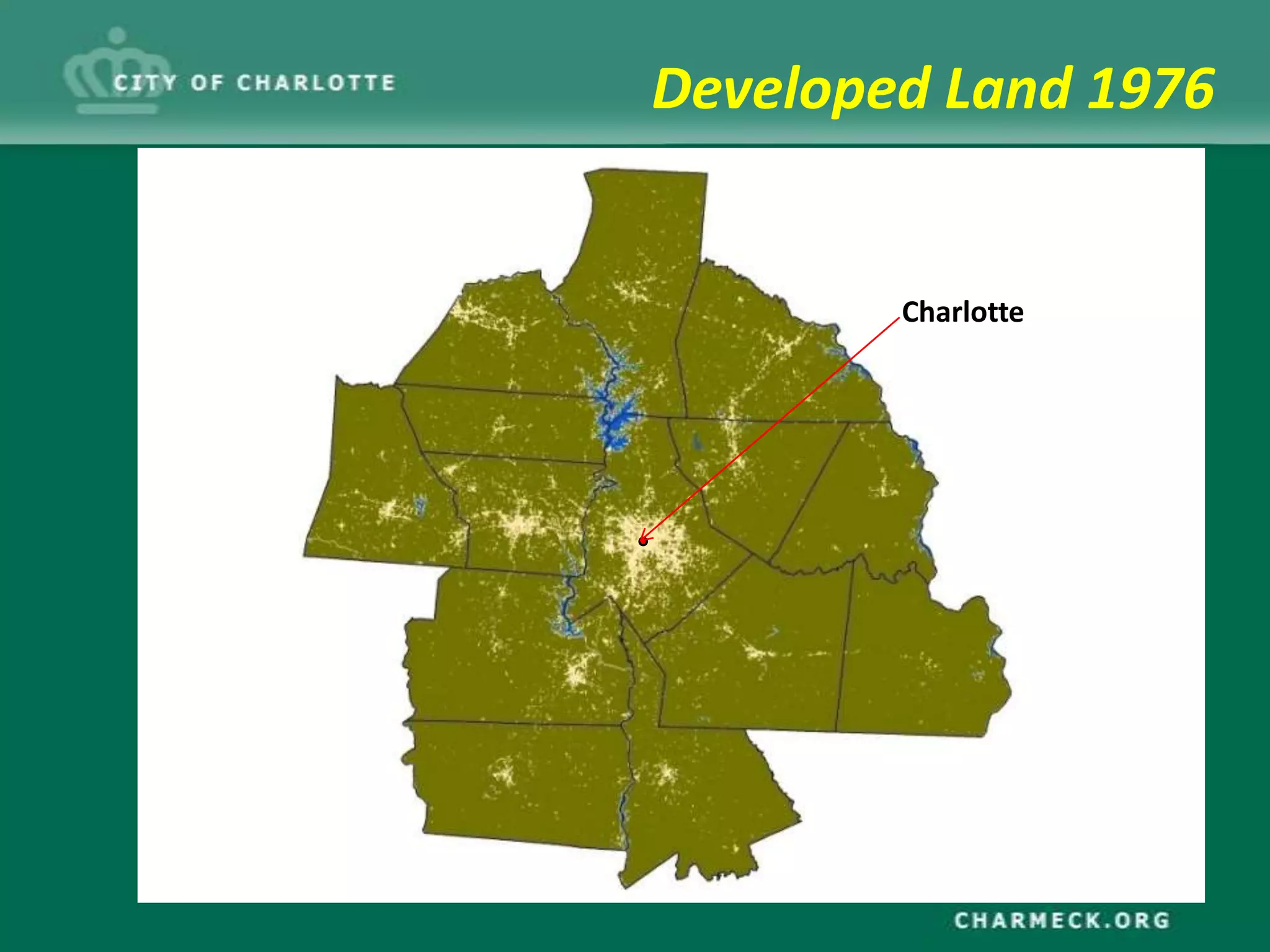
Developed Land 1976


        Charlotte
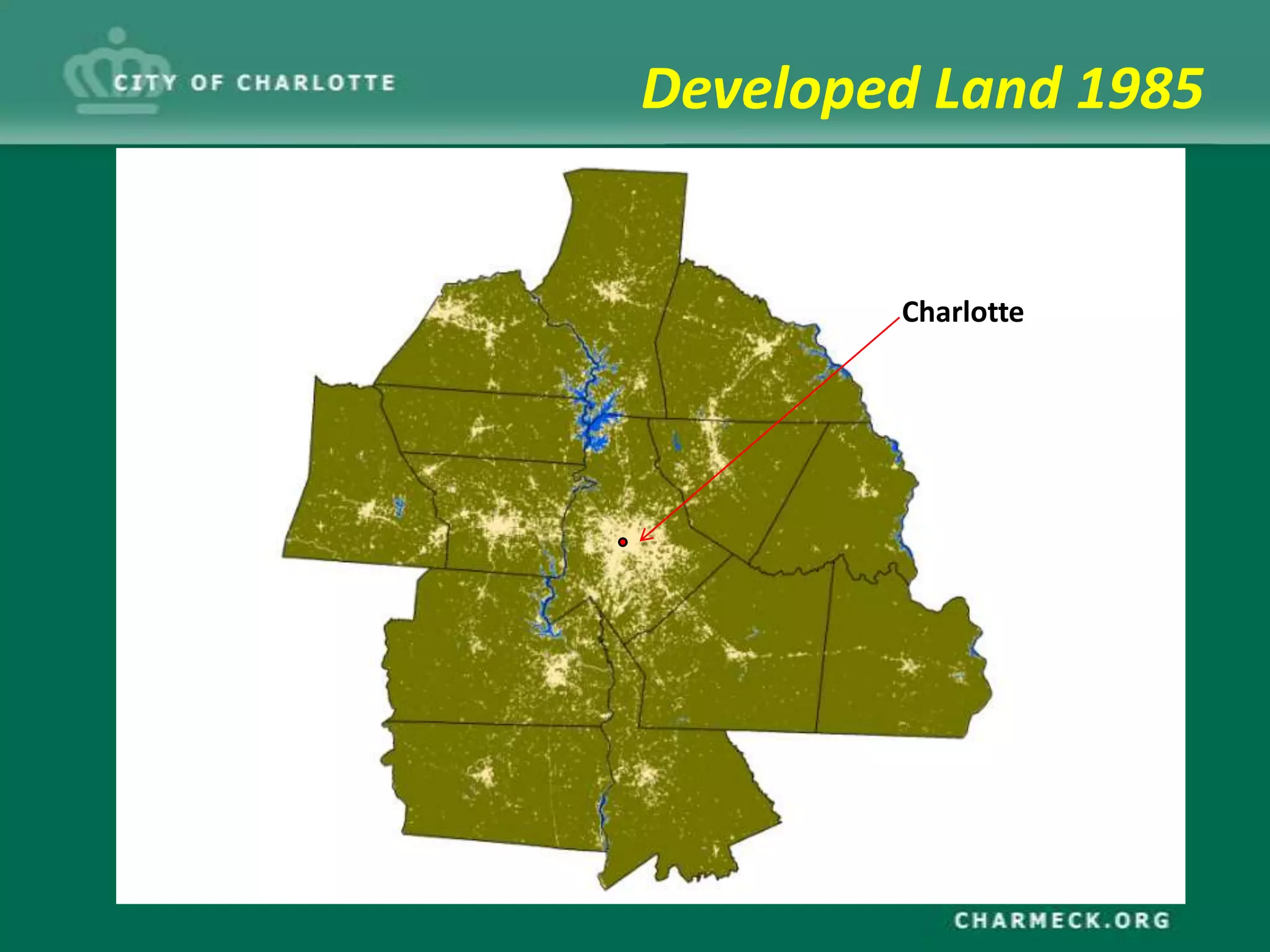
Developed Land 1985


        Charlotte
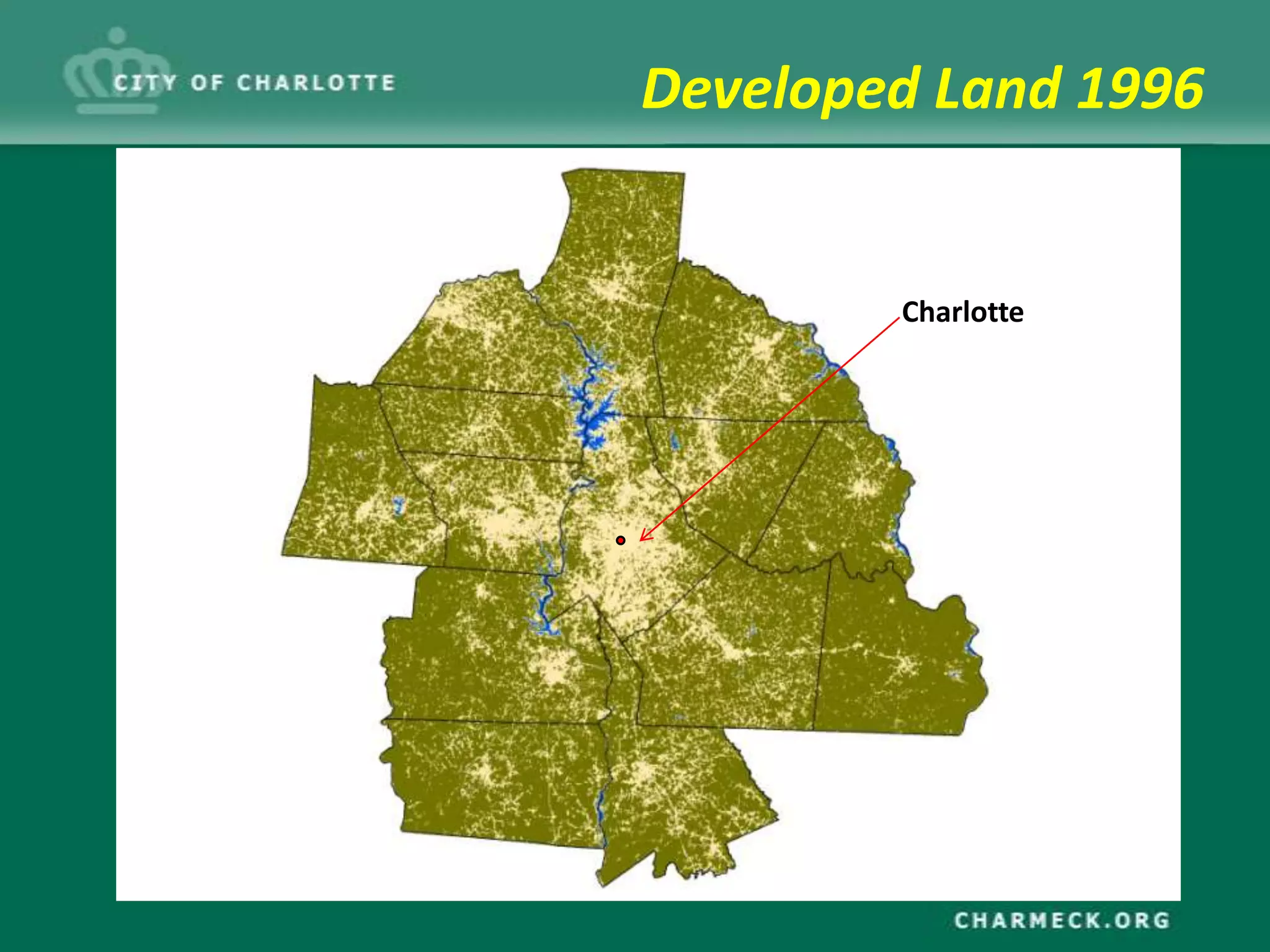
Developed Land 1996


        Charlotte
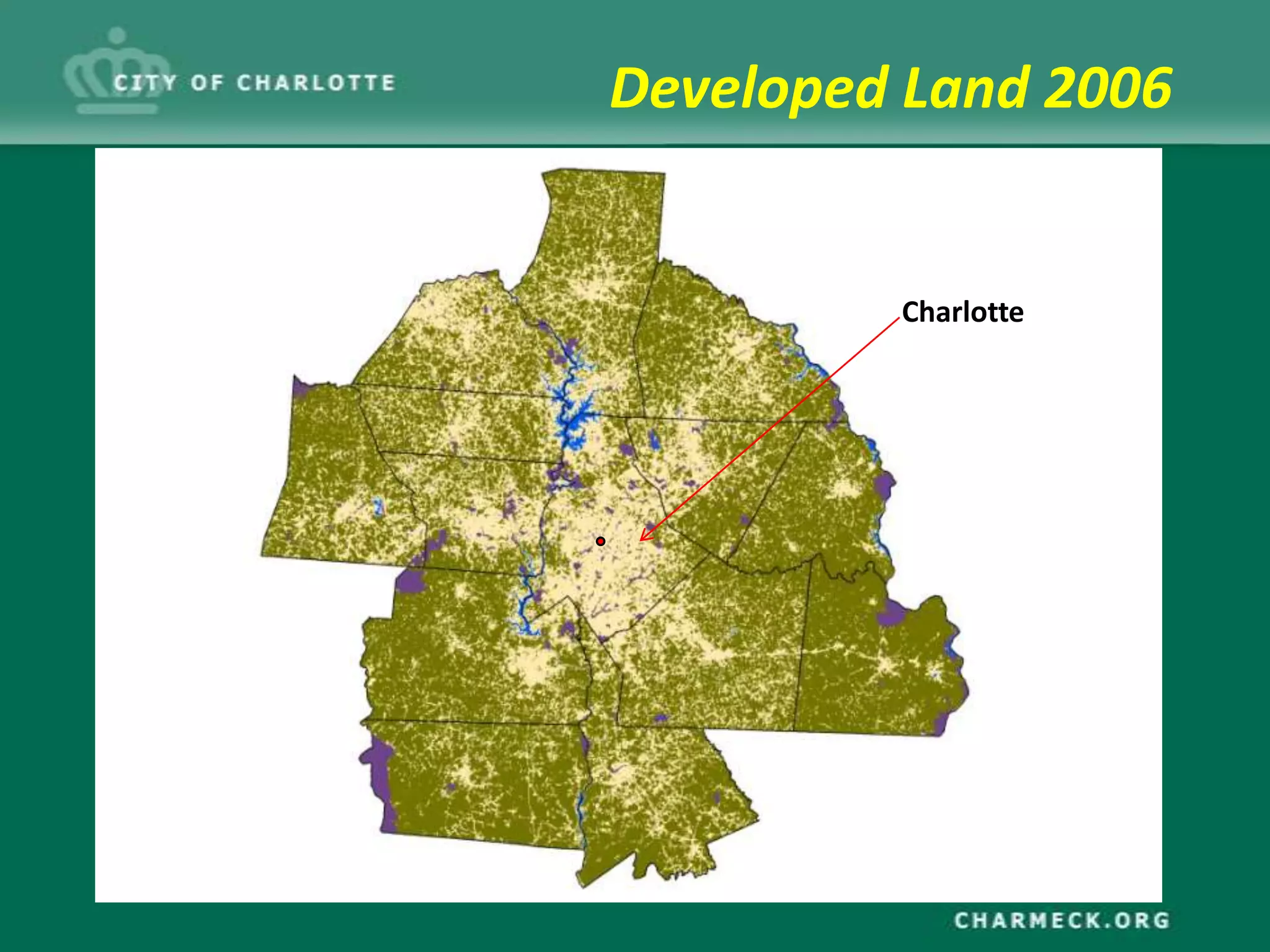
Developed Land 2006


         Charlotte
Growth Trends

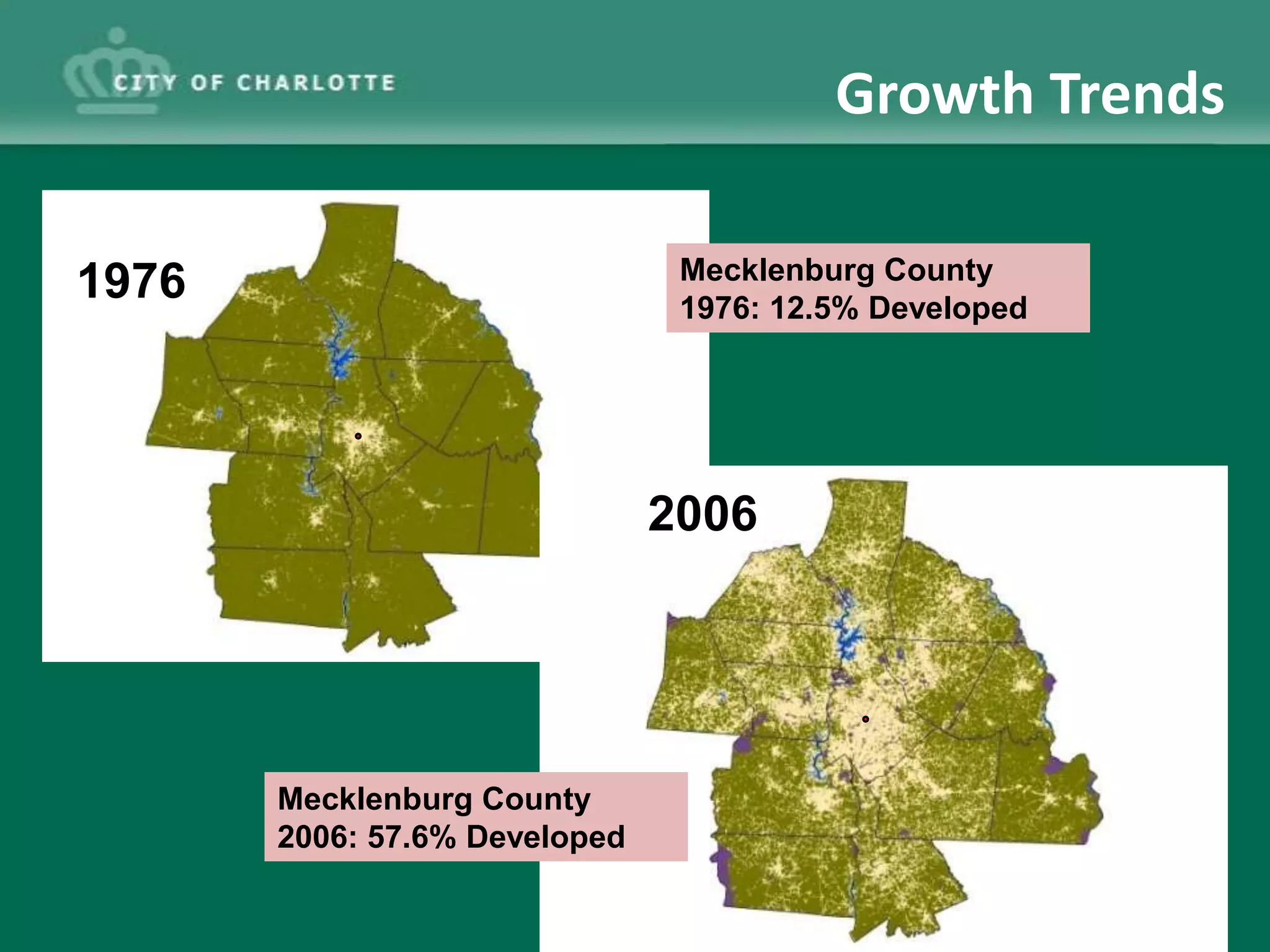
                                Mecklenburg County
1976                            1976: 12.5% Developed


                               2006


       Mecklenburg County
       2006: 57.6% Developed
Growth Trends
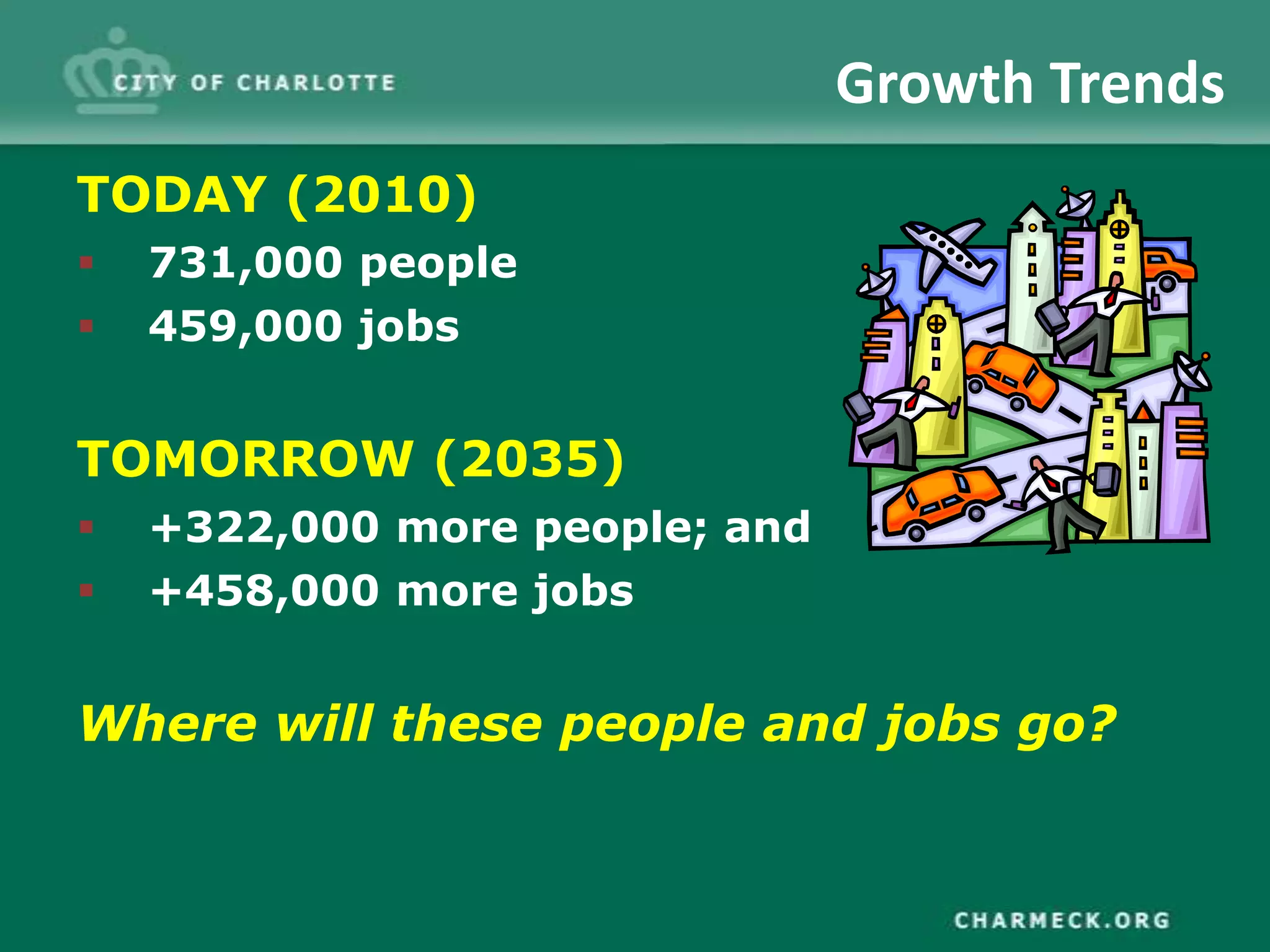
TODAY (2010)
   731,000 people
   459,000 jobs


TOMORROW (2035)
   +322,000 more people; and
   +458,000 more jobs


Where will these people and jobs go?
Growth Framework
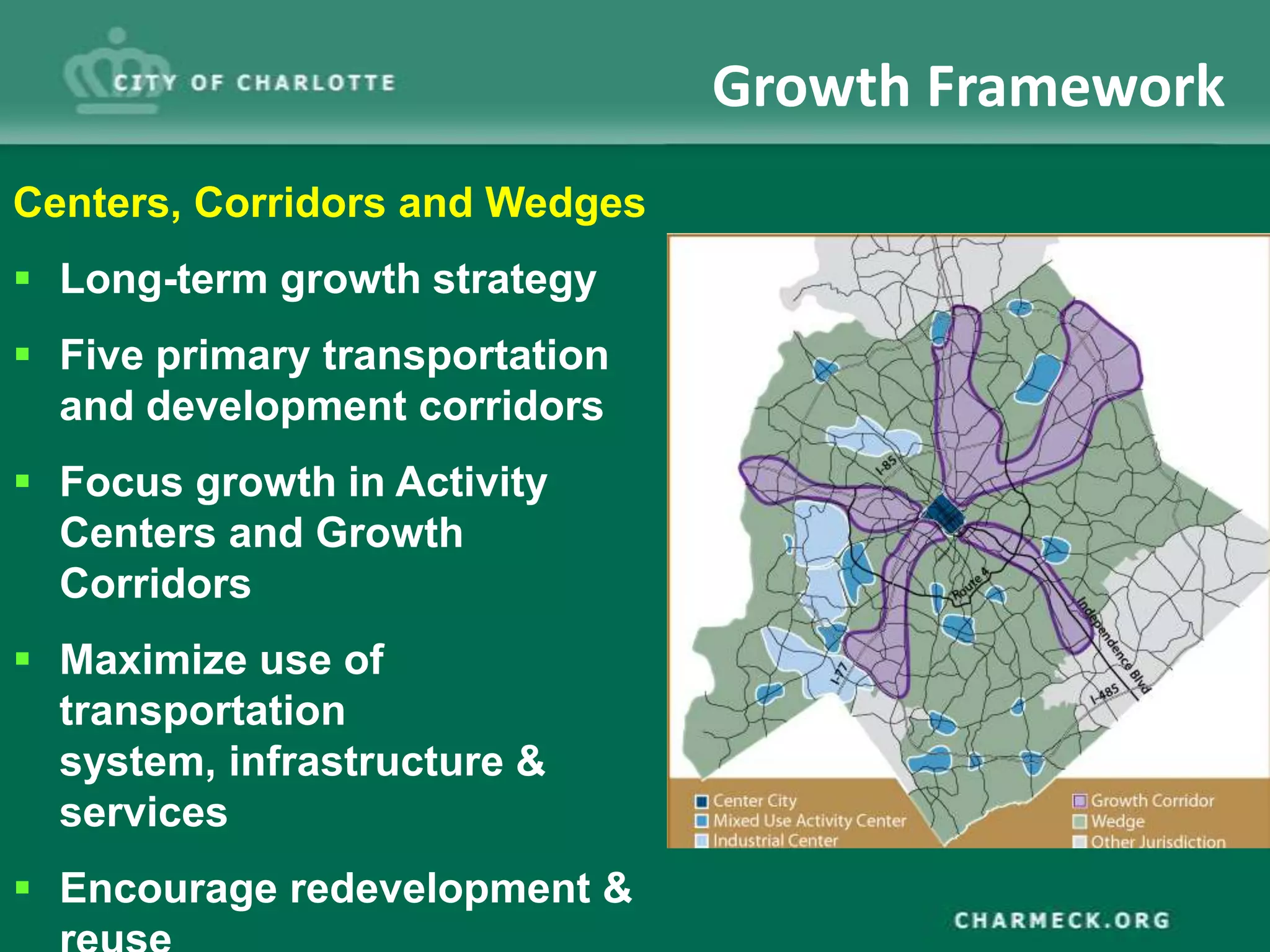
Centers, Corridors and Wedges
 Long-term growth strategy
 Five primary transportation
  and development corridors
 Focus growth in Activity
  Centers and Growth
  Corridors
 Maximize use of
  transportation
  system, infrastructure &
  services
 Encourage redevelopment &
Growth Framework
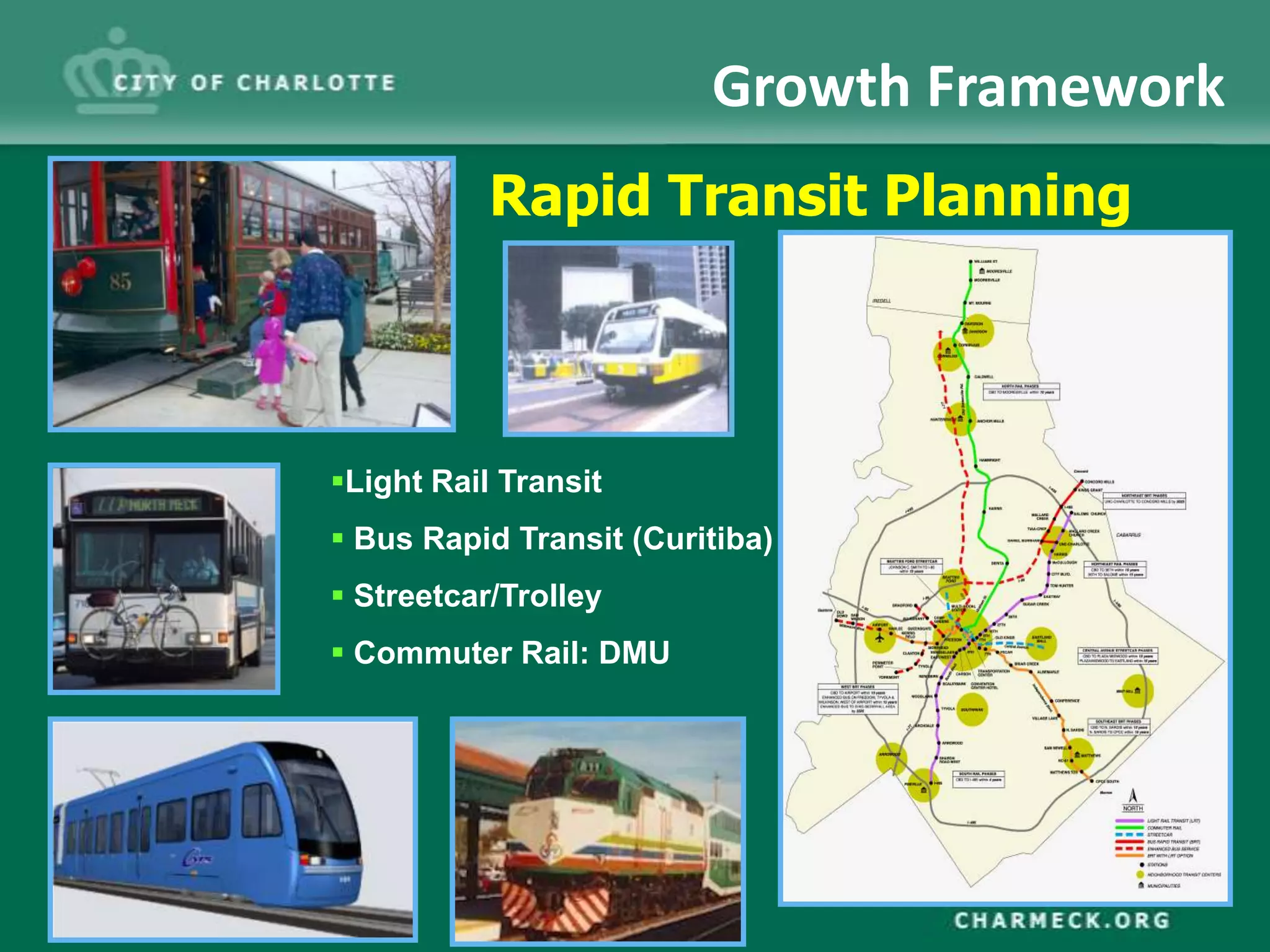
           Rapid Transit Planning


Light Rail Transit
 Bus Rapid Transit (Curitiba)
 Streetcar/Trolley
 Commuter Rail: DMU
Group Activity (15 mins)

 You are an urban planner, planning for the
  future of 2 sites in Charlotte

 Your job is to help accommodate some of
  the growth that is coming, but also to
  mitigate the negative impacts that can come
  along with this growth

 Here are the 2 sites you will be planning for:
Group Activity (15 mins)


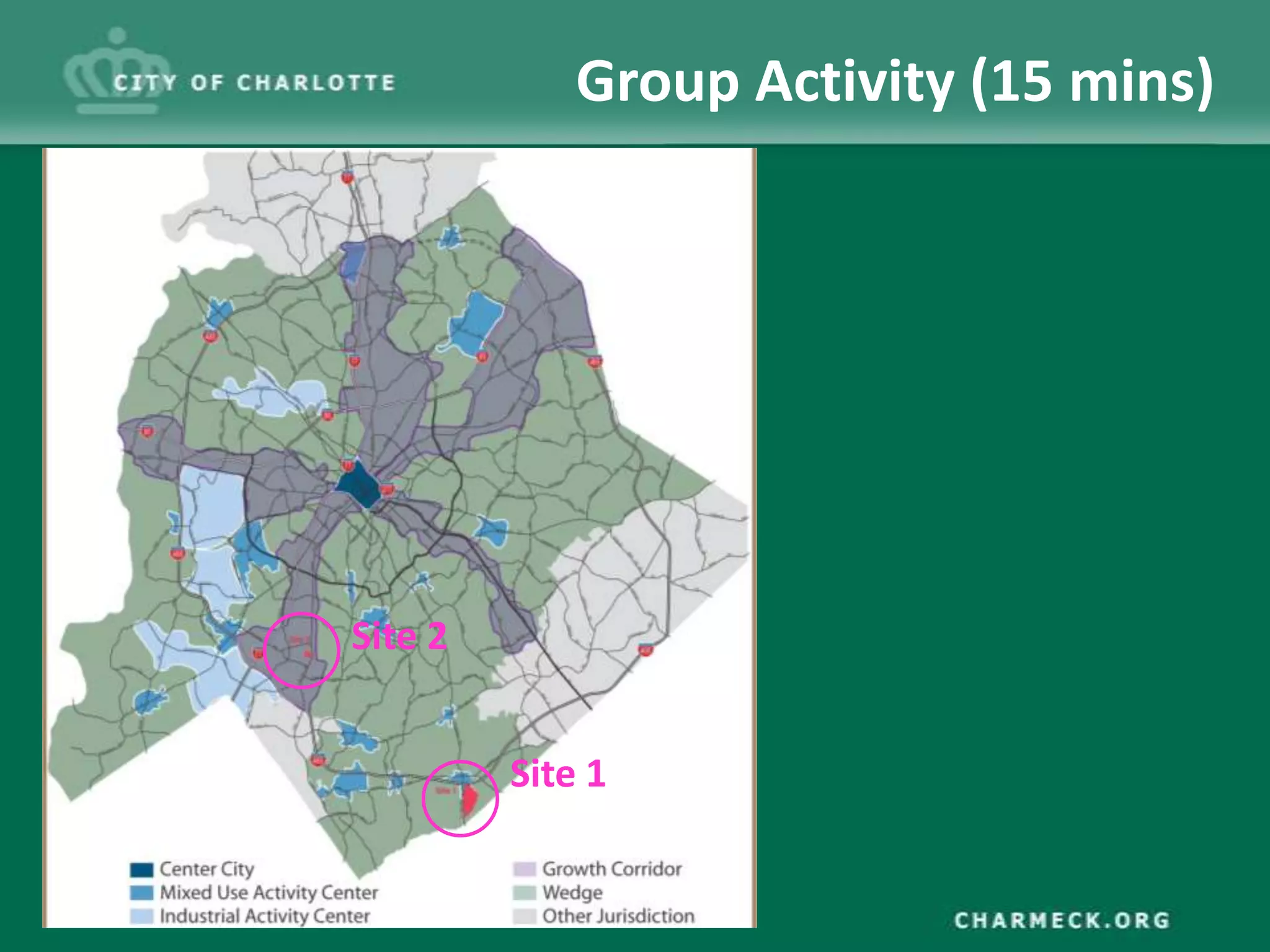
Site 2


         Site 1
Group Activity (15 mins)


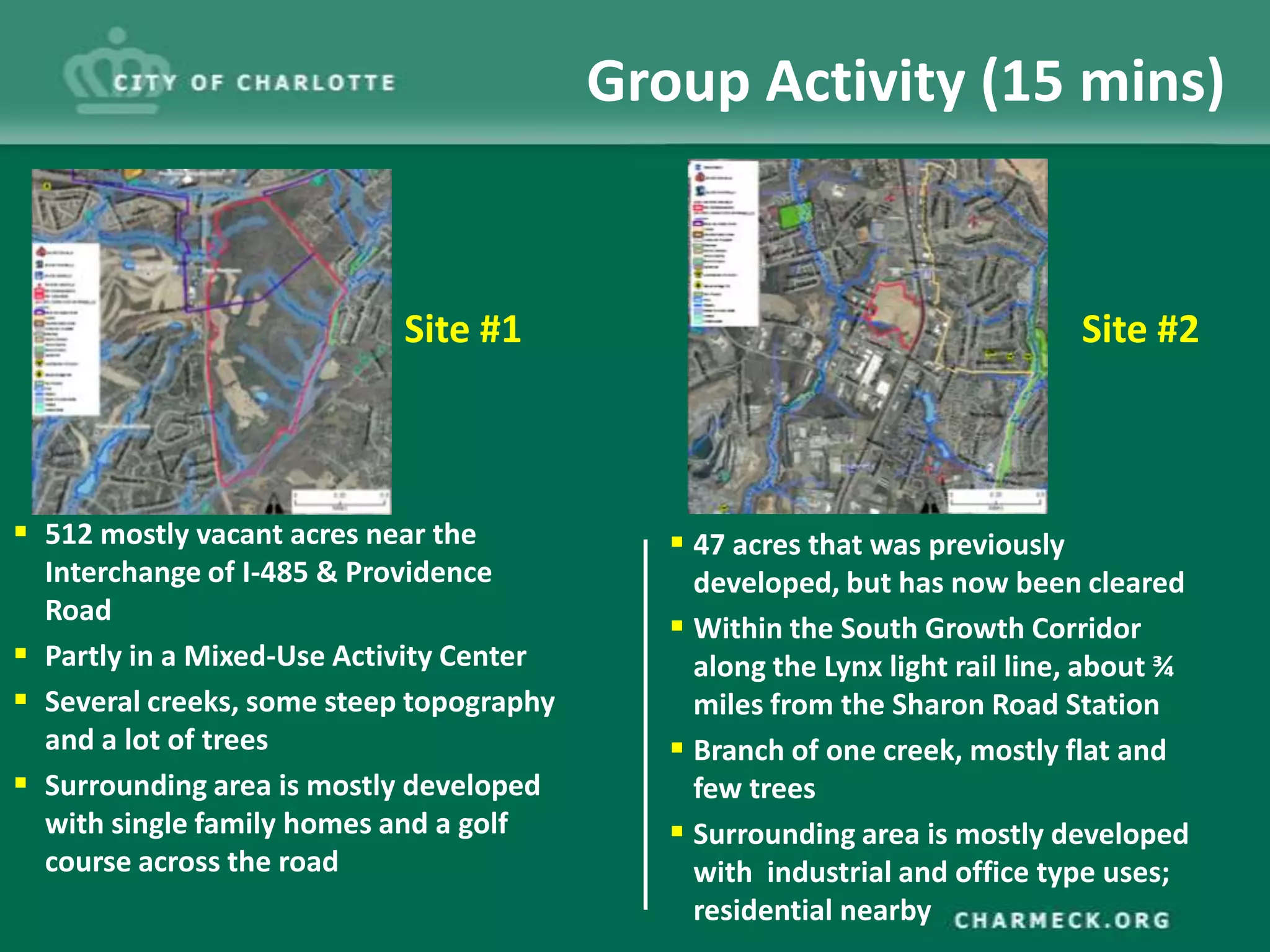
                            Site #1                                           Site #2


 512 mostly vacant acres near the            47 acres that was previously
  Interchange of I-485 & Providence            developed, but has now been cleared
  Road
                                              Within the South Growth Corridor
 Partly in a Mixed-Use Activity Center        along the Lynx light rail line, about ¾
 Several creeks, some steep topography        miles from the Sharon Road Station
  and a lot of trees                          Branch of one creek, mostly flat and
 Surrounding area is mostly developed         few trees
  with single family homes and a golf         Surrounding area is mostly developed
  course across the road                       with industrial and office type uses;
                                               residential nearby
Group Activity (15 mins)
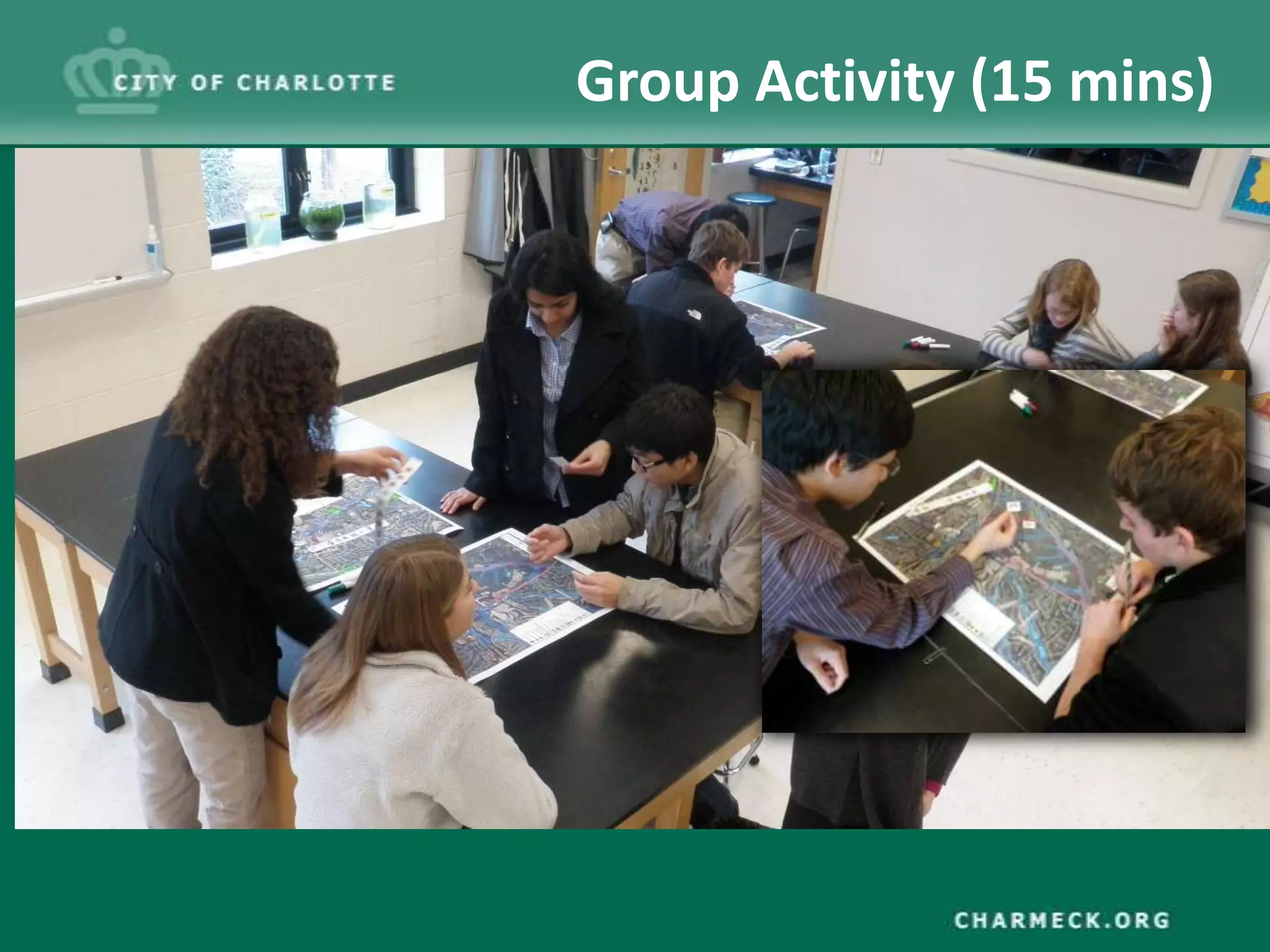
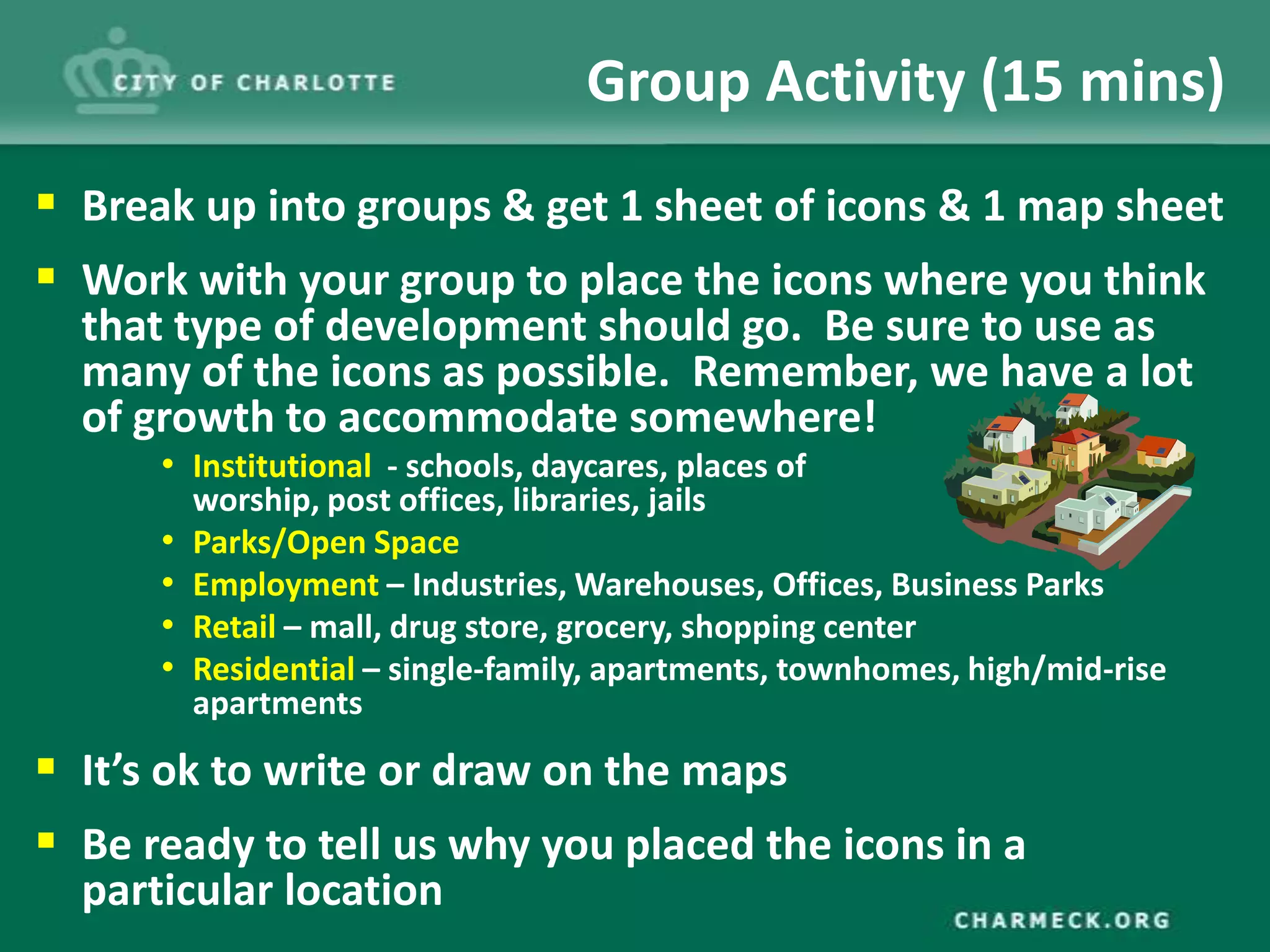
 Break up into groups & get 1 sheet of icons & 1 map sheet
 Work with your group to place the icons where you think
  that type of development should go. Be sure to use as
  many of the icons as possible. Remember, we have a lot
  of growth to accommodate somewhere!
      • Institutional - schools, daycares, places of
          worship, post offices, libraries, jails
      •   Parks/Open Space
      •   Employment – Industries, Warehouses, Offices, Business Parks
      •   Retail – mall, drug store, grocery, shopping center
      •   Residential – single-family, apartments, townhomes, high/mid-rise
          apartments

 It’s ok to write or draw on the maps
 Be ready to tell us why you placed the icons in a
  particular location
Impacts of Growth

 Air Quality

 Water Quality

 Scarcity of Land (Open Space, Trees)
Impervious Surfaces


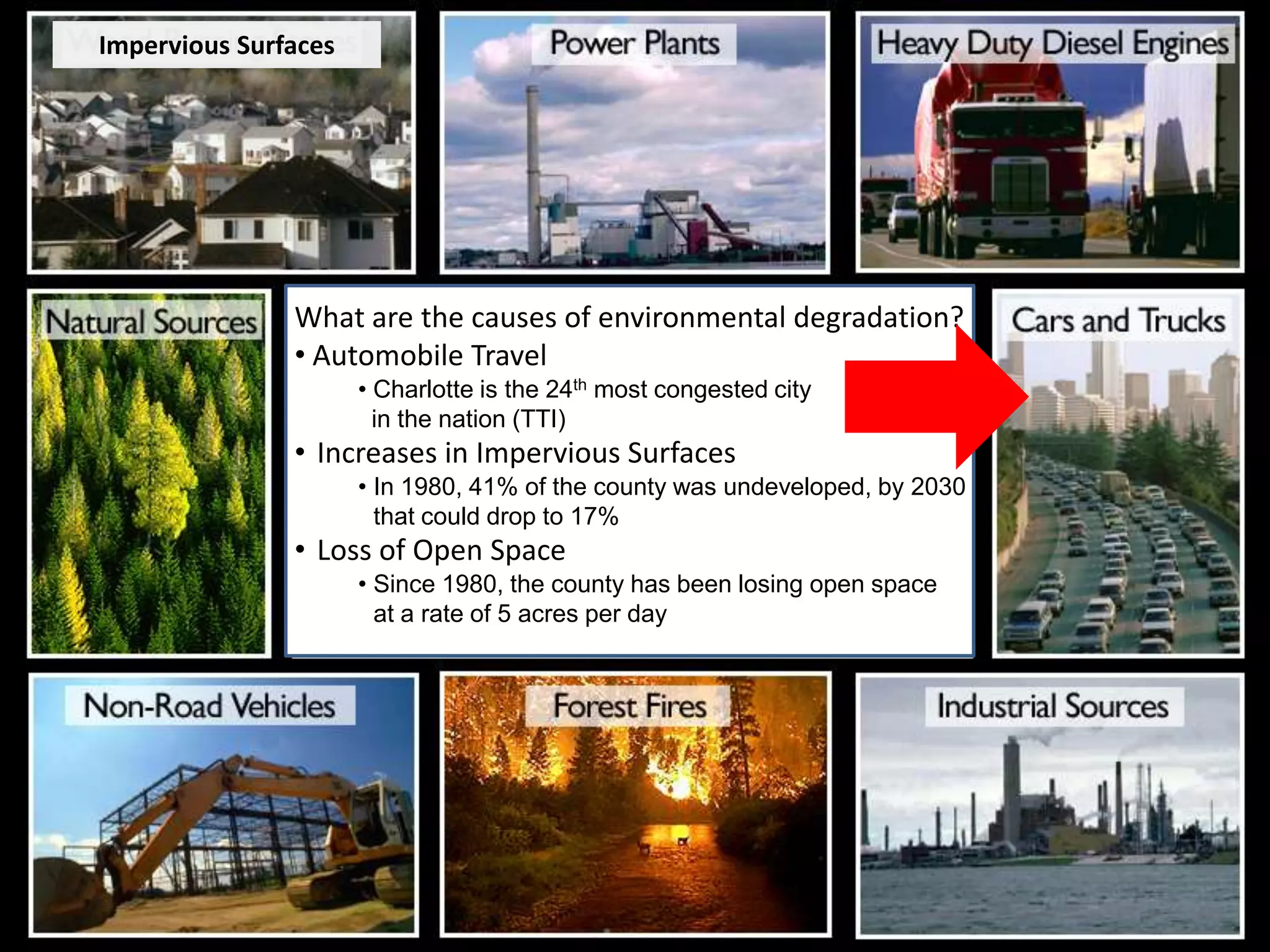
               What are the causes of environmental degradation?
               • Automobile Travel
                      • Charlotte is the 24th most congested city
                        in the nation (TTI)
               • Increases in Impervious Surfaces
                      • In 1980, 41% of the county was undeveloped, by 2030
                        that could drop to 17%
               • Loss of Open Space
                      • Since 1980, the county has been losing open space
                        at a rate of 5 acres per day
Looking to the Future
Sustainable Land Use Planning Checklist
 Use land efficiently – compact development, shared facilities, infill
    & redevelopment
 Balance & integrate land uses – range of
    housing, employment, service, leisure & educational opportunities;
    mix of uses
 Provide transportation choices –
    sidewalks, bikeways, transit, connectivity
 Provide infrastructure to support development –
    schools, sewer, water, fire, police, transportation, libraries
 Respect the natural and social environment –
    trees, streams, wetlands, floodplains, habitats, green space, historic
    properties, neighborhoods
 Design for quality – details, site layout
 Plan for the long term – quality, function, change, re-use
Outcomes
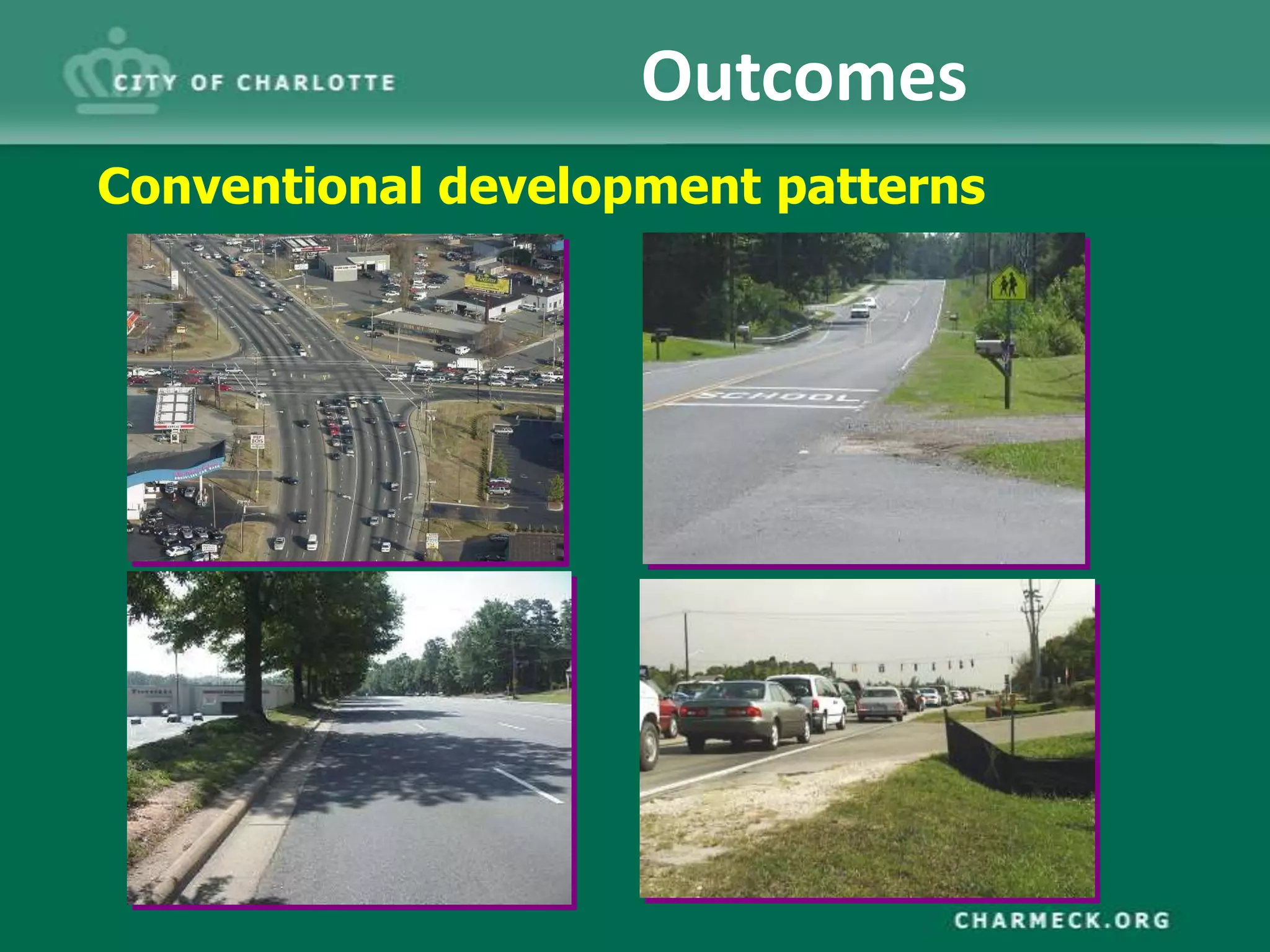
Conventional development patterns
Outcomes
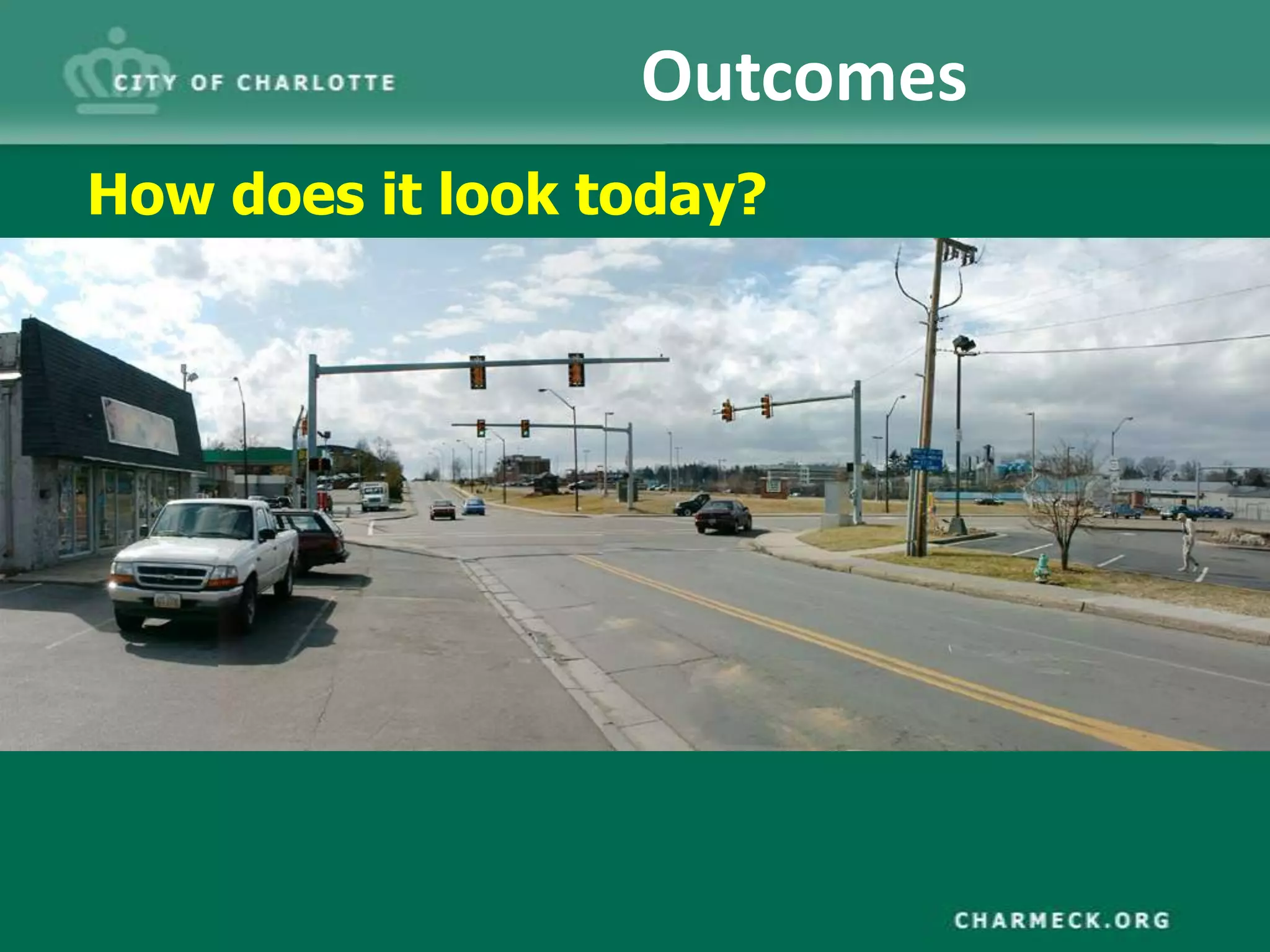
How does it look today?
Outcomes
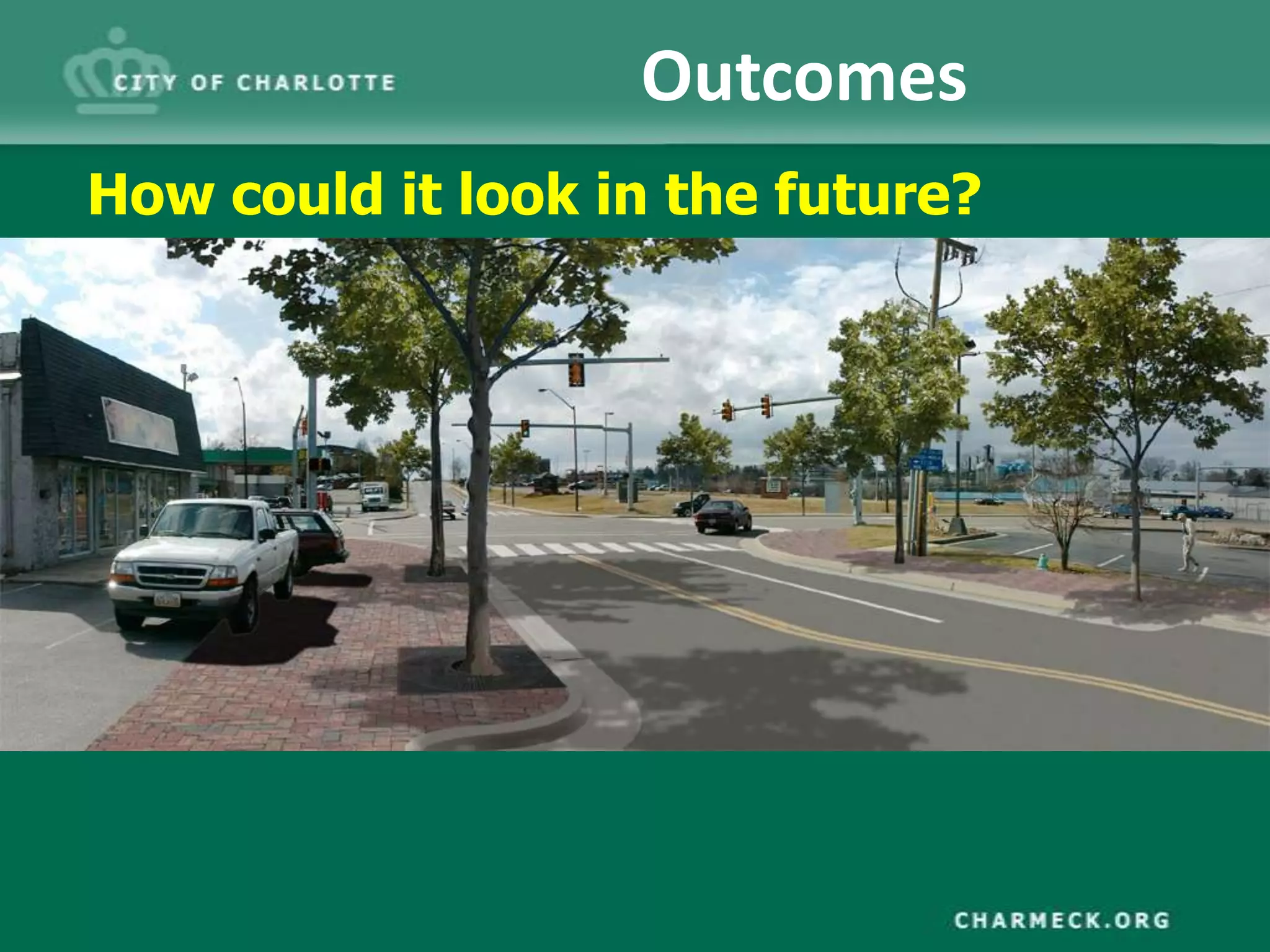
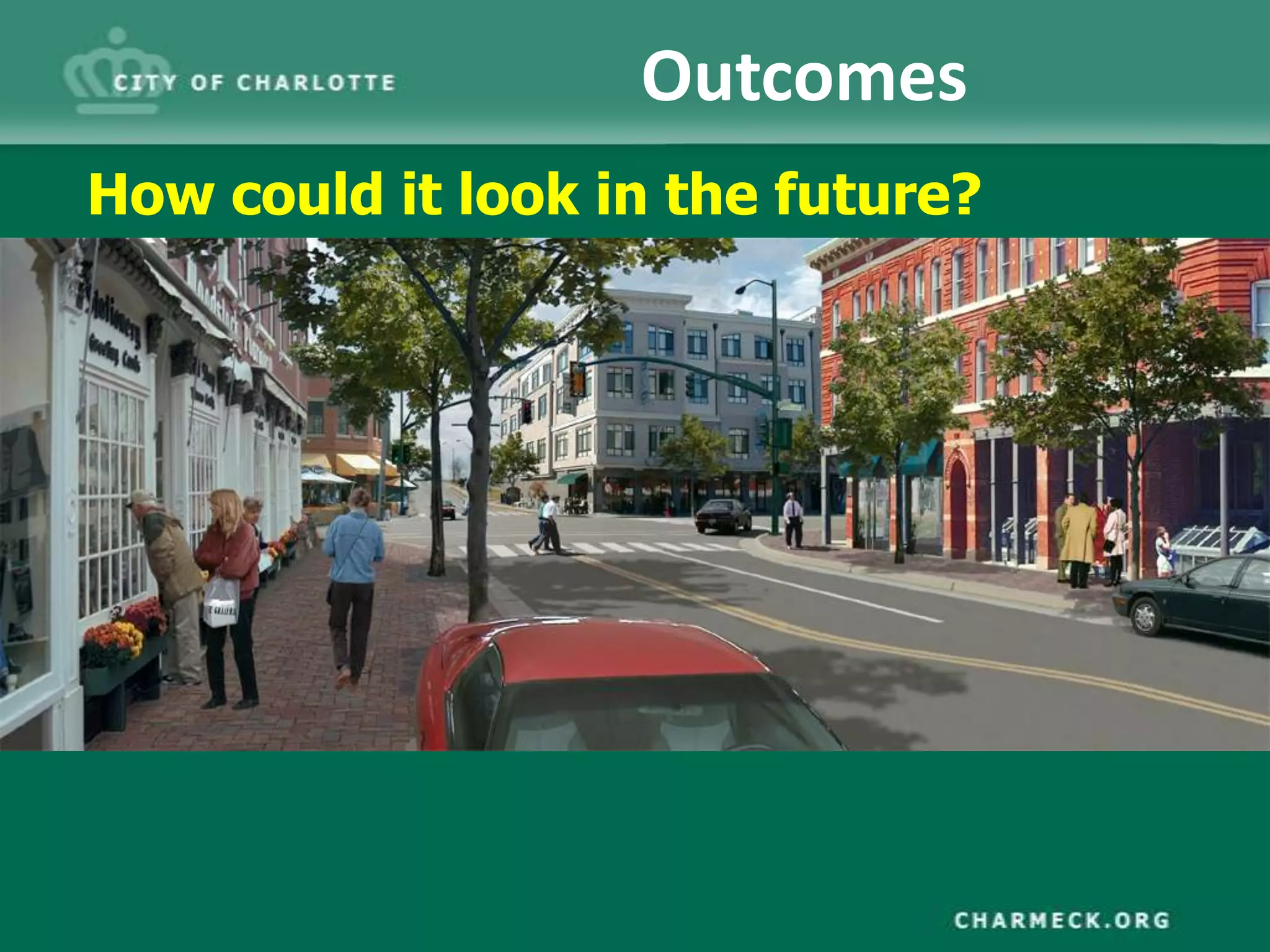
How could it look in the future?
Outcomes
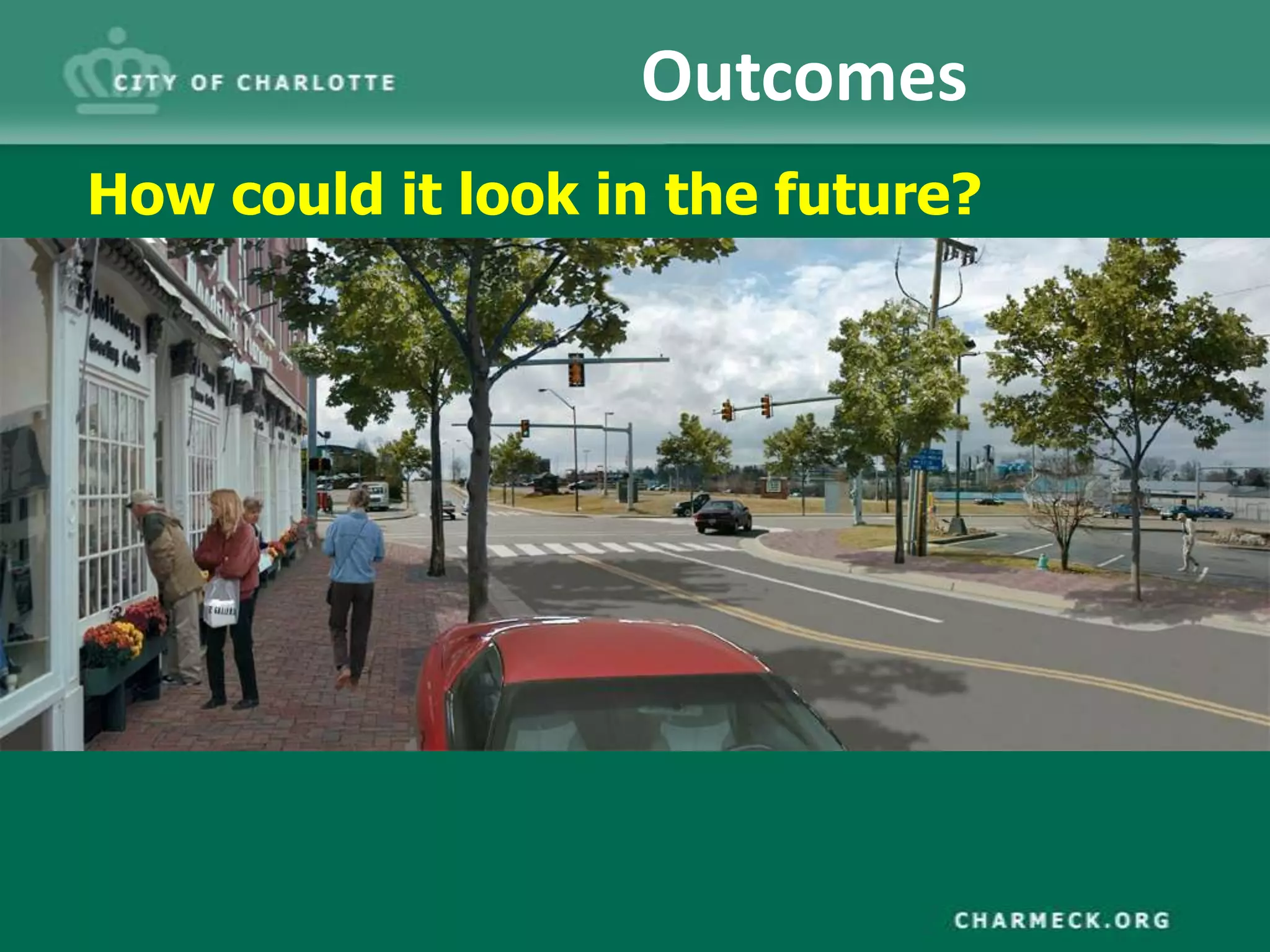
How could it look in the future?
Outcomes
How could it look in the future?
Conclusions
 Take a look back at your maps

 What would you change? What would
   you keep the same?

 Are there other ways you can think of
   to accomodate growth and protect
   the environment?
Thanks!
www.charlotteplanning.org

Charlotte’s Future: Growth and the Environment

  • 1.
    Charlotte’s Future: Growthand the Environment Providence Day School January 13, 2012
  • 2.
    Presentation Overview  LandUse Planning  Growth Trends  Growth Framework  Group Activity  Impacts of Growth on the Environment  Looking to the Future
  • 3.
    Planning Department Mission: Provideintegrated planning services that promote sustainable growth to improve our community’s quality of life  Work with citizens to plan for future growth in the community  Ensure growth is environmentally responsible
  • 4.
    Land Use Planning Whatis Land Use Planning? • Key tool to manage how and where we grow in the community • Organizing of types of land uses (ie. commercial, residential, industrial) and their resources to best meet people’s needs over time • Provides guidance for what types of development go where Types of Land Uses  Residential – single family, duplexes, apartments, town homes, condos  Office – dentist, insurance, tax preparers  Retail – stores, banks, restaurants  Institutional – churches, schools, hospitals
  • 5.
  • 6.
    Land Use Planning Somethings to think about: • Land use plans provide guidance – they are not law • Some of the implementation tools, however, are law such as: • Zoning and Subdivision Ordinances • Tree Ordinance, Stormwater and Erosion Control Ordinances • Regulations must hold up in the court of law • Property rights, fairness, due process . . • Example – there is no “Vacant” land use category, cannot deny someone the ability to develop their property • Example – can’t say it is ok to develop a Ritz Carlton Hotel on a piece of property, but not a Super 8 • Rational nexus and proportionality • Legality of regulating “aesthetics” currently being debated • Private sector, not the government, does most of the development/building • Market also plays a big part of what, when and where development occurs - land use plans and regulations can influence market • Political processes involved
  • 7.
    • Good plansshape good decisions. That's why good planning helps to make elusive dreams come true. (Lester Robert Bittel writer) • Have a plan. Follow the plan, and you'll be surprised how successful you can be. Most people don't have a plan. That's why it's is easy to beat most folks. (Paul "Bear" Bryant, football coach) • Man who does not plan long ahead will find trouble at his door. (Confucius, Chinese philosopher and religious leader) • Where there is no vision, the people perish. (The Bible, Proverbs 29:18) • If you can dream it, you can do it. (Walt Disney, animator, film producer) • In Houston, a person walking is someone on his way to his car. (Anthony Downs, writer) • You got to be careful if you don't know where you're going, because you might not get there. (Yogi Berra, baseball catcher)
  • 8.
    Growth Trends  Charlotte’s population more than doubled between 1980 and 2010 731,000 540,000 396,000 315,000 1980 1990 2000 2010  Population is more diverse and older  Hispanic population increased from 7.4% in 2000 to 13.1% in 2010  Median age increased from 32.7 in 2000 to 33.2 years in 2010 Note: Population estimate for 2011 = 740,098
  • 9.
  • 10.
  • 11.
  • 12.
  • 13.
    Growth Trends Mecklenburg County 1976 1976: 12.5% Developed 2006 Mecklenburg County 2006: 57.6% Developed
  • 14.
    Growth Trends TODAY (2010)  731,000 people  459,000 jobs TOMORROW (2035)  +322,000 more people; and  +458,000 more jobs Where will these people and jobs go?
  • 15.
    Growth Framework Centers, Corridorsand Wedges  Long-term growth strategy  Five primary transportation and development corridors  Focus growth in Activity Centers and Growth Corridors  Maximize use of transportation system, infrastructure & services  Encourage redevelopment &
  • 16.
    Growth Framework Rapid Transit Planning Light Rail Transit  Bus Rapid Transit (Curitiba)  Streetcar/Trolley  Commuter Rail: DMU
  • 17.
  • 18.
    Group Activity (15mins)  You are an urban planner, planning for the future of 2 sites in Charlotte  Your job is to help accommodate some of the growth that is coming, but also to mitigate the negative impacts that can come along with this growth  Here are the 2 sites you will be planning for:
  • 19.
    Group Activity (15mins) Site 2 Site 1
  • 20.
    Group Activity (15mins) Site #1 Site #2  512 mostly vacant acres near the  47 acres that was previously Interchange of I-485 & Providence developed, but has now been cleared Road  Within the South Growth Corridor  Partly in a Mixed-Use Activity Center along the Lynx light rail line, about ¾  Several creeks, some steep topography miles from the Sharon Road Station and a lot of trees  Branch of one creek, mostly flat and  Surrounding area is mostly developed few trees with single family homes and a golf  Surrounding area is mostly developed course across the road with industrial and office type uses; residential nearby
  • 21.
    Group Activity (15mins)  Break up into groups & get 1 sheet of icons & 1 map sheet  Work with your group to place the icons where you think that type of development should go. Be sure to use as many of the icons as possible. Remember, we have a lot of growth to accommodate somewhere! • Institutional - schools, daycares, places of worship, post offices, libraries, jails • Parks/Open Space • Employment – Industries, Warehouses, Offices, Business Parks • Retail – mall, drug store, grocery, shopping center • Residential – single-family, apartments, townhomes, high/mid-rise apartments  It’s ok to write or draw on the maps  Be ready to tell us why you placed the icons in a particular location
  • 22.
    Impacts of Growth Air Quality  Water Quality  Scarcity of Land (Open Space, Trees)
  • 23.
    Impervious Surfaces What are the causes of environmental degradation? • Automobile Travel • Charlotte is the 24th most congested city in the nation (TTI) • Increases in Impervious Surfaces • In 1980, 41% of the county was undeveloped, by 2030 that could drop to 17% • Loss of Open Space • Since 1980, the county has been losing open space at a rate of 5 acres per day
  • 24.
    Looking to theFuture Sustainable Land Use Planning Checklist  Use land efficiently – compact development, shared facilities, infill & redevelopment  Balance & integrate land uses – range of housing, employment, service, leisure & educational opportunities; mix of uses  Provide transportation choices – sidewalks, bikeways, transit, connectivity  Provide infrastructure to support development – schools, sewer, water, fire, police, transportation, libraries  Respect the natural and social environment – trees, streams, wetlands, floodplains, habitats, green space, historic properties, neighborhoods  Design for quality – details, site layout  Plan for the long term – quality, function, change, re-use
  • 25.
  • 26.
  • 27.
    Outcomes How could itlook in the future?
  • 28.
    Outcomes How could itlook in the future?
  • 29.
    Outcomes How could itlook in the future?
  • 30.
    Conclusions  Take alook back at your maps  What would you change? What would you keep the same?  Are there other ways you can think of to accomodate growth and protect the environment?
  • 31.

Editor's Notes

  • #16 As a planner, we go through a similar process as you just have of determining where various types of development will be located throughout the city. Roads and transit play a big role in decided where to located different land uses and the city actually has a framework called Centers, Corridors and Wedges that determines how and where to accommodate growth throughout the City of Charlotte.
  • #20 Break students up into groups (count off) and have them work together on a base map to talk through and decide where they think various types of development should go. Have them circle or color in these areas with the colors that represent the different uses then go around the room and have them briefly discuss their rationale.
  • #21 Break students up into groups (count off) and have them work together on a base map to talk through and decide where they think various types of development should go. Have them circle or color in these areas with the colors that represent the different uses then go around the room and have them briefly discuss their rationale.