STROKE CLINICAL MANIFESTATION
- NITHIN NAIR
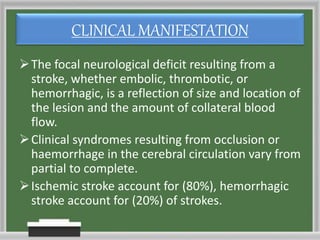
CLINICAL MANIFESTATION
The focal neurological deficit resulting from a
stroke, whether embolic, thrombotic, or
hemorrhagic, is a reflection of size and location of
the lesion and the amount of collateral blood
flow.
Clinical syndromes resulting from occlusion or
haemorrhage in the cerebral circulation vary from
partial to complete.
Ischemic stroke account for (80%), hemorrhagic
stroke account for (20%) of strokes.
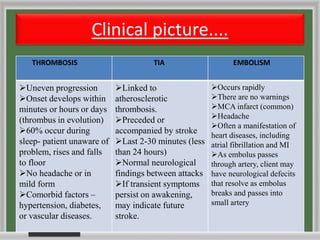
Clinical picture....
THROMBOSIS TIA EMBOLISM
Uneven progression
Onset develops within
minutes or hours or days
(thrombus in evolution)
60% occur during
sleep- patient unaware of
problem, rises and falls
to floor
No headache or in
mild form
Comorbid factors –
hypertension, diabetes,
or vascular diseases.
Linked to
atherosclerotic
thrombosis.
Preceded or
accompanied by stroke
Last 2-30 minutes (less
than 24 hours)
Normal neurological
findings between attacks
If transient symptoms
persist on awakening,
may indicate future
stroke.
Occurs rapidly
There are no warnings
MCA infarct (common)
Headache
Often a manifestation of
heart diseases, including
atrial fibrillation and MI
As embolus passes
through artery, client may
have neurological defecits
that resolve as embolus
breaks and passes into
small artery
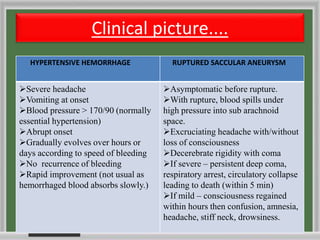
Clinical picture....
HYPERTENSIVE HEMORRHAGE RUPTURED SACCULAR ANEURYSM
Severe headache
Vomiting at onset
Blood pressure > 170/90 (normally
essential hypertension)
Abrupt onset
Gradually evolves over hours or
days according to speed of bleeding
No recurrence of bleeding
Rapid improvement (not usual as
hemorrhaged blood absorbs slowly.)
Asymptomatic before rupture.
With rupture, blood spills under
high pressure into sub arachnoid
space.
Excruciating headache with/without
loss of consciousness
Decerebrate rigidity with coma
If severe – persistent deep coma,
respiratory arrest, circulatory collapse
leading to death (within 5 min)
If mild – consciousness regained
within hours then confusion, amnesia,
headache, stiff neck, drowsiness.
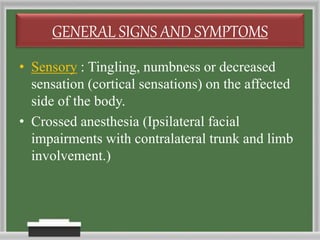
GENERAL SIGNS AND SYMPTOMS
• Sensory : Tingling, numbness or decreased
sensation (cortical sensations) on the affected
side of the body.
• Crossed anesthesia (Ipsilateral facial
impairments with contralateral trunk and limb
involvement.)
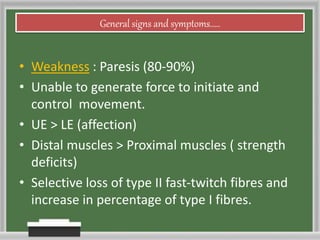
General signs and symptoms.....
• Weakness : Paresis (80-90%)
• Unable to generate force to initiate and
control movement.
• UE > LE (affection)
• Distal muscles > Proximal muscles ( strength
deficits)
• Selective loss of type II fast-twitch fibres and
increase in percentage of type I fibres.
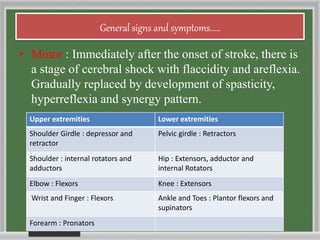
General signs and symptoms.....
• Motor : Immediately after the onset of stroke, there is
a stage of cerebral shock with flaccidity and areflexia.
Gradually replaced by development of spasticity,
hyperreflexia and synergy pattern.
Upper extremities Lower extremities
Shoulder Girdle : depressor and
retractor
Pelvic girdle : Retractors
Shoulder : internal rotators and
adductors
Hip : Extensors, adductor and
internal Rotators
Elbow : Flexors Knee : Extensors
Wrist and Finger : Flexors Ankle and Toes : Plantor flexors and
supinators
Forearm : Pronators
General signs and symptoms.....
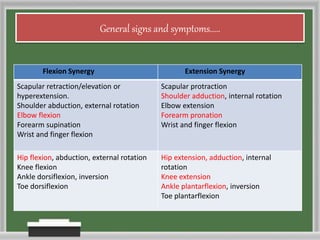
Flexion Synergy Extension Synergy
Scapular retraction/elevation or
hyperextension.
Shoulder abduction, external rotation
Elbow flexion
Forearm supination
Wrist and finger flexion
Scapular protraction
Shoulder adduction, internal rotation
Elbow extension
Forearm pronation
Wrist and finger flexion
Hip flexion, abduction, external rotation
Knee flexion
Ankle dorsiflexion, inversion
Toe dorsiflexion
Hip extension, adduction, internal
rotation
Knee extension
Ankle plantarflexion, inversion
Toe plantarflexion
General signs and symptoms.....
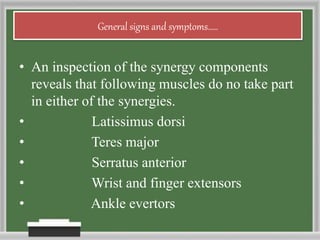
• An inspection of the synergy components
reveals that following muscles do no take part
in either of the synergies.
• Latissimus dorsi
• Teres major
• Serratus anterior
• Wrist and finger extensors
• Ankle evertors
General signs and symptoms.....
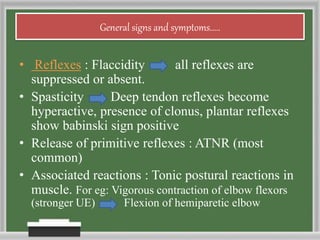
• Reflexes : Flaccidity all reflexes are
suppressed or absent.
• Spasticity Deep tendon reflexes become
hyperactive, presence of clonus, plantar reflexes
show babinski sign positive
• Release of primitive reflexes : ATNR (most
common)
• Associated reactions : Tonic postural reactions in
muscle. For eg: Vigorous contraction of elbow flexors
(stronger UE) Flexion of hemiparetic elbow
General signs and symptoms.....
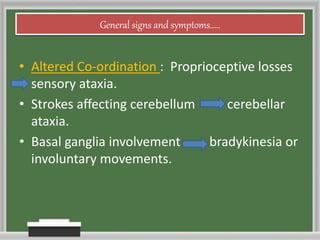
• Altered Co-ordination : Proprioceptive losses
sensory ataxia.
• Strokes affecting cerebellum cerebellar
ataxia.
• Basal ganglia involvement bradykinesia or
involuntary movements.
General signs and symptoms.....
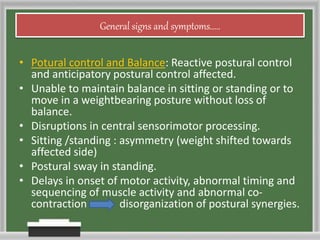
• Potural control and Balance: Reactive postural control
and anticipatory postural control affected.
• Unable to maintain balance in sitting or standing or to
move in a weightbearing posture without loss of
balance.
• Disruptions in central sensorimotor processing.
• Sitting /standing : asymmetry (weight shifted towards
affected side)
• Postural sway in standing.
• Delays in onset of motor activity, abnormal timing and
sequencing of muscle activity and abnormal co-
contraction disorganization of postural synergies.
General signs and symptoms.....
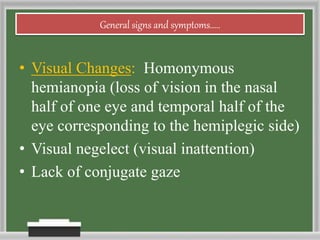
• Visual Changes: Homonymous
hemianopia (loss of vision in the nasal
half of one eye and temporal half of the
eye corresponding to the hemiplegic side)
• Visual negelect (visual inattention)
• Lack of conjugate gaze
General signs and symptoms.....
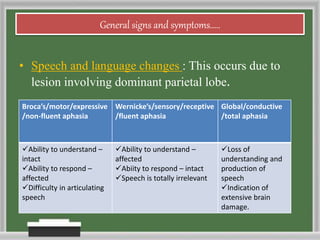
• Speech and language changes : This occurs due to
lesion involving dominant parietal lobe.
Broca’s/motor/expressive
/non-fluent aphasia
Wernicke’s/sensory/receptive
/fluent aphasia
Global/conductive
/total aphasia
Ability to understand –
intact
Ability to respond –
affected
Difficulty in articulating
speech
Ability to understand –
affected
Abiity to respond – intact
Speech is totally irrelevant
Loss of
understanding and
production of
speech
Indication of
extensive brain
damage.
General signs and symptoms.....
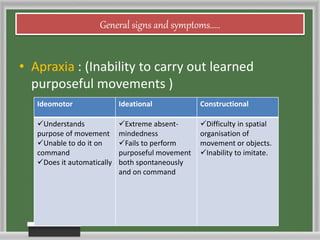
• Apraxia : (Inability to carry out learned
purposeful movements )
Ideomotor Ideational Constructional
Understands
purpose of movement
Unable to do it on
command
Does it automatically
Extreme absent-
mindedness
Fails to perform
purposeful movement
both spontaneously
and on command
Difficulty in spatial
organisation of
movement or objects.
Inability to imitate.
General signs and symptoms.....
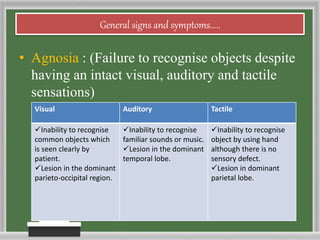
• Agnosia : (Failure to recognise objects despite
having an intact visual, auditory and tactile
sensations)
Visual Auditory Tactile
Inability to recognise
common objects which
is seen clearly by
patient.
Lesion in the dominant
parieto-occipital region.
Inability to recognise
familiar sounds or music.
Lesion in the dominant
temporal lobe.
Inability to recognise
object by using hand
although there is no
sensory defect.
Lesion in dominant
parietal lobe.
General signs and symptoms.....
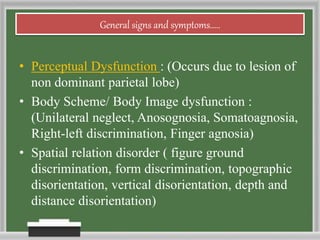
• Perceptual Dysfunction : (Occurs due to lesion of
non dominant parietal lobe)
• Body Scheme/ Body Image dysfunction :
(Unilateral neglect, Anosognosia, Somatoagnosia,
Right-left discrimination, Finger agnosia)
• Spatial relation disorder ( figure ground
discrimination, form discrimination, topographic
disorientation, vertical disorientation, depth and
distance disorientation)
General signs and symptoms.....
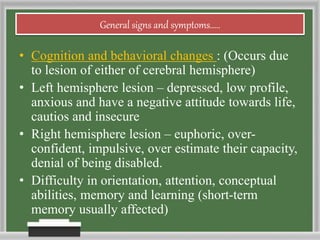
• Cognition and behavioral changes : (Occurs due
to lesion of either of cerebral hemisphere)
• Left hemisphere lesion – depressed, low profile,
anxious and have a negative attitude towards life,
cautios and insecure
• Right hemisphere lesion – euphoric, over-
confident, impulsive, over estimate their capacity,
denial of being disabled.
• Difficulty in orientation, attention, conceptual
abilities, memory and learning (short-term
memory usually affected)
General signs and symptoms.....
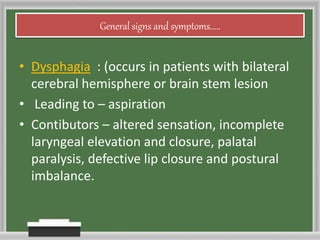
• Dysphagia : (occurs in patients with bilateral
cerebral hemisphere or brain stem lesion
• Leading to – aspiration
• Contibutors – altered sensation, incomplete
laryngeal elevation and closure, palatal
paralysis, defective lip closure and postural
imbalance.
General signs and symptoms.....
• Bowel and bladder dysfunction: (Common in
acute phase. In flaccid state – overflow
incontinence. Disturbance in bowel functions
– incontinence and diarrhoea or constipation
and impaction.)
• Sexual dysfunction : Affects individual desire,
libido, erectile or lubrication, orgasm or
ejaculation. It could be due to depressed state
or sensorimotor dysfunction.
Secondary manifestations
• Psychological dysfunction : Depression, social
withdrawal, anxiety, insomnia, emotional
liability, aggressiveness, verbal abusing, over
dependancy)
• Deep Vein Thrombosis : ( occurs in hemiplegia
due to immobilization)
• Cardiac and Respiratory deconditioning:
occurs due to decreased physical activity.
Endurance level is drastically reduced.
Secondary manifestations
• Pain : Common in stroke affecting thalamus (
thalamic syndrome). Intense burning pain on
the opposite side of body.
• Musculoskeletal complications : Pain and joint
stiffness (common), Subluxation of GH joint
on affected side ( due to decreased tone in
flaccid stage), loss of ROM and contractures,
disuse atrophy, osteoporosis.
REFERENCE....
PHYSICAL REHABILITATION –
SUSAN O’B SULLIVAN
NEUROLOGICAL
REHABILITATION – DARCY
UMPHRED
PHYSIOTHERAPY IN NEURO
CONDITIONS – GLADY SAMUEL
RAJ

STROKE CLINICAL MANIFESTATION

  • 1.
  • 2.
    CLINICAL MANIFESTATION The focalneurological deficit resulting from a stroke, whether embolic, thrombotic, or hemorrhagic, is a reflection of size and location of the lesion and the amount of collateral blood flow. Clinical syndromes resulting from occlusion or haemorrhage in the cerebral circulation vary from partial to complete. Ischemic stroke account for (80%), hemorrhagic stroke account for (20%) of strokes.
  • 3.
    Clinical picture.... THROMBOSIS TIAEMBOLISM Uneven progression Onset develops within minutes or hours or days (thrombus in evolution) 60% occur during sleep- patient unaware of problem, rises and falls to floor No headache or in mild form Comorbid factors – hypertension, diabetes, or vascular diseases. Linked to atherosclerotic thrombosis. Preceded or accompanied by stroke Last 2-30 minutes (less than 24 hours) Normal neurological findings between attacks If transient symptoms persist on awakening, may indicate future stroke. Occurs rapidly There are no warnings MCA infarct (common) Headache Often a manifestation of heart diseases, including atrial fibrillation and MI As embolus passes through artery, client may have neurological defecits that resolve as embolus breaks and passes into small artery
  • 4.
    Clinical picture.... HYPERTENSIVE HEMORRHAGERUPTURED SACCULAR ANEURYSM Severe headache Vomiting at onset Blood pressure > 170/90 (normally essential hypertension) Abrupt onset Gradually evolves over hours or days according to speed of bleeding No recurrence of bleeding Rapid improvement (not usual as hemorrhaged blood absorbs slowly.) Asymptomatic before rupture. With rupture, blood spills under high pressure into sub arachnoid space. Excruciating headache with/without loss of consciousness Decerebrate rigidity with coma If severe – persistent deep coma, respiratory arrest, circulatory collapse leading to death (within 5 min) If mild – consciousness regained within hours then confusion, amnesia, headache, stiff neck, drowsiness.
  • 5.
    GENERAL SIGNS ANDSYMPTOMS • Sensory : Tingling, numbness or decreased sensation (cortical sensations) on the affected side of the body. • Crossed anesthesia (Ipsilateral facial impairments with contralateral trunk and limb involvement.)
  • 6.
    General signs andsymptoms..... • Weakness : Paresis (80-90%) • Unable to generate force to initiate and control movement. • UE > LE (affection) • Distal muscles > Proximal muscles ( strength deficits) • Selective loss of type II fast-twitch fibres and increase in percentage of type I fibres.
  • 7.
    General signs andsymptoms..... • Motor : Immediately after the onset of stroke, there is a stage of cerebral shock with flaccidity and areflexia. Gradually replaced by development of spasticity, hyperreflexia and synergy pattern. Upper extremities Lower extremities Shoulder Girdle : depressor and retractor Pelvic girdle : Retractors Shoulder : internal rotators and adductors Hip : Extensors, adductor and internal Rotators Elbow : Flexors Knee : Extensors Wrist and Finger : Flexors Ankle and Toes : Plantor flexors and supinators Forearm : Pronators
  • 8.
    General signs andsymptoms..... Flexion Synergy Extension Synergy Scapular retraction/elevation or hyperextension. Shoulder abduction, external rotation Elbow flexion Forearm supination Wrist and finger flexion Scapular protraction Shoulder adduction, internal rotation Elbow extension Forearm pronation Wrist and finger flexion Hip flexion, abduction, external rotation Knee flexion Ankle dorsiflexion, inversion Toe dorsiflexion Hip extension, adduction, internal rotation Knee extension Ankle plantarflexion, inversion Toe plantarflexion
  • 9.
    General signs andsymptoms..... • An inspection of the synergy components reveals that following muscles do no take part in either of the synergies. • Latissimus dorsi • Teres major • Serratus anterior • Wrist and finger extensors • Ankle evertors
  • 10.
    General signs andsymptoms..... • Reflexes : Flaccidity all reflexes are suppressed or absent. • Spasticity Deep tendon reflexes become hyperactive, presence of clonus, plantar reflexes show babinski sign positive • Release of primitive reflexes : ATNR (most common) • Associated reactions : Tonic postural reactions in muscle. For eg: Vigorous contraction of elbow flexors (stronger UE) Flexion of hemiparetic elbow
  • 11.
    General signs andsymptoms..... • Altered Co-ordination : Proprioceptive losses sensory ataxia. • Strokes affecting cerebellum cerebellar ataxia. • Basal ganglia involvement bradykinesia or involuntary movements.
  • 12.
    General signs andsymptoms..... • Potural control and Balance: Reactive postural control and anticipatory postural control affected. • Unable to maintain balance in sitting or standing or to move in a weightbearing posture without loss of balance. • Disruptions in central sensorimotor processing. • Sitting /standing : asymmetry (weight shifted towards affected side) • Postural sway in standing. • Delays in onset of motor activity, abnormal timing and sequencing of muscle activity and abnormal co- contraction disorganization of postural synergies.
  • 13.
    General signs andsymptoms..... • Visual Changes: Homonymous hemianopia (loss of vision in the nasal half of one eye and temporal half of the eye corresponding to the hemiplegic side) • Visual negelect (visual inattention) • Lack of conjugate gaze
  • 14.
    General signs andsymptoms..... • Speech and language changes : This occurs due to lesion involving dominant parietal lobe. Broca’s/motor/expressive /non-fluent aphasia Wernicke’s/sensory/receptive /fluent aphasia Global/conductive /total aphasia Ability to understand – intact Ability to respond – affected Difficulty in articulating speech Ability to understand – affected Abiity to respond – intact Speech is totally irrelevant Loss of understanding and production of speech Indication of extensive brain damage.
  • 15.
    General signs andsymptoms..... • Apraxia : (Inability to carry out learned purposeful movements ) Ideomotor Ideational Constructional Understands purpose of movement Unable to do it on command Does it automatically Extreme absent- mindedness Fails to perform purposeful movement both spontaneously and on command Difficulty in spatial organisation of movement or objects. Inability to imitate.
  • 16.
    General signs andsymptoms..... • Agnosia : (Failure to recognise objects despite having an intact visual, auditory and tactile sensations) Visual Auditory Tactile Inability to recognise common objects which is seen clearly by patient. Lesion in the dominant parieto-occipital region. Inability to recognise familiar sounds or music. Lesion in the dominant temporal lobe. Inability to recognise object by using hand although there is no sensory defect. Lesion in dominant parietal lobe.
  • 17.
    General signs andsymptoms..... • Perceptual Dysfunction : (Occurs due to lesion of non dominant parietal lobe) • Body Scheme/ Body Image dysfunction : (Unilateral neglect, Anosognosia, Somatoagnosia, Right-left discrimination, Finger agnosia) • Spatial relation disorder ( figure ground discrimination, form discrimination, topographic disorientation, vertical disorientation, depth and distance disorientation)
  • 18.
    General signs andsymptoms..... • Cognition and behavioral changes : (Occurs due to lesion of either of cerebral hemisphere) • Left hemisphere lesion – depressed, low profile, anxious and have a negative attitude towards life, cautios and insecure • Right hemisphere lesion – euphoric, over- confident, impulsive, over estimate their capacity, denial of being disabled. • Difficulty in orientation, attention, conceptual abilities, memory and learning (short-term memory usually affected)
  • 19.
    General signs andsymptoms..... • Dysphagia : (occurs in patients with bilateral cerebral hemisphere or brain stem lesion • Leading to – aspiration • Contibutors – altered sensation, incomplete laryngeal elevation and closure, palatal paralysis, defective lip closure and postural imbalance.
  • 20.
    General signs andsymptoms..... • Bowel and bladder dysfunction: (Common in acute phase. In flaccid state – overflow incontinence. Disturbance in bowel functions – incontinence and diarrhoea or constipation and impaction.) • Sexual dysfunction : Affects individual desire, libido, erectile or lubrication, orgasm or ejaculation. It could be due to depressed state or sensorimotor dysfunction.
  • 21.
    Secondary manifestations • Psychologicaldysfunction : Depression, social withdrawal, anxiety, insomnia, emotional liability, aggressiveness, verbal abusing, over dependancy) • Deep Vein Thrombosis : ( occurs in hemiplegia due to immobilization) • Cardiac and Respiratory deconditioning: occurs due to decreased physical activity. Endurance level is drastically reduced.
  • 22.
    Secondary manifestations • Pain: Common in stroke affecting thalamus ( thalamic syndrome). Intense burning pain on the opposite side of body. • Musculoskeletal complications : Pain and joint stiffness (common), Subluxation of GH joint on affected side ( due to decreased tone in flaccid stage), loss of ROM and contractures, disuse atrophy, osteoporosis.
  • 23.
    REFERENCE.... PHYSICAL REHABILITATION – SUSANO’B SULLIVAN NEUROLOGICAL REHABILITATION – DARCY UMPHRED PHYSIOTHERAPY IN NEURO CONDITIONS – GLADY SAMUEL RAJ