STROKE SYNDROMES
DR. Ratul Das
1st year pg student,Dept.of PMR,SMS medical college,jaipur
PG training class
Definitions
• Ancient writers of history, science, and poetry used the word apoplexia
• The more modern term cerebrovascular accident (CVA)
• Stroke is defined as a nontraumatic brain injury caused by occlusion or
rupture of cerebral blood vessels that results in sudden neurologic deficit
characterized by loss of motor control, altered sensation, cognitive or
language impairment, disequilibrium, or coma
• excludes nonvascular conditions that can present with stroke like symptoms,
such as seizure, syncope, hypoxemia, traumatic brain injury, or brain tumor
EPIDEMIOLOGY
• After heart disease and cancer, stroke is the third leading cause of
death in the United States
• The American Heart Association (AHA) estimates 780,000 strokes
annually: 600,000 new cases and 180,000 recurrent cases
• A sharp decline noted in the 1970s, possibly related to improved
diagnosis and treatment of hypertension
• In the first 30 days after stroke, 90% of deaths were due to direct
effects of the brain lesion or complications of immobility resulting
from the stroke
RISK FACTORS
Nonmodifiable Risk Factors:
• Age—the single most important risk factor for stroke worldwide
• After age 55, incidence increases for both males and females
• Sex (male > female)
• Race (African Americans > whites > Asians)
• Family history of stroke
Modifiable (Treatable) Risk Factors:
• Hypertension
• History of TIA: ~ 5% of patients with TIA will develop a
completed stroke within 1 month if untreated; 14% within
1 year
• Heart disease:
– Congestive heart failure (CHF) , coronary artery
disease (CAD), Valvular heart disease, arrhythmias increase
risk of embolic stroke, Atrial fibrillation
• Diabetes: two fold increase in risk. Good blood sugar
control has not been shown to alter the risk of stroke
• Cigarette smoking
Cont.
• cocaine use, < 2 drinks/day relative risk 0.51; > 7
drinks/day relative risk 2.96
• High-dose estrogens (birth control pills)
• Systemic diseases associated with hypercoagulable states
• Elevated RBC count, hematocrit, fibrinogen
• Protein S and C deficiencies
• Sickle-cell anemia
• Hyperlipidemia
• Migraine headaches
• Sleep apnea
Stroke Pathophysiology
• Normal cerebral auto regulation maintains a cerebral
perfusion rate of 50 mL/100 g cerebral tissue/min, which
remains constant regardless of acute changes in systemic
mean arterial pressure
• During cerebrovascular compromise, normal neural
activity can be sustained with a CBF as low as 20mL/100
g/min, but a rate below 10 mL/100 g/min results in
cellular death
• CBF range between 10 and 20mL/100 g/min, the basic
cellular functions are supported but the sodium–
potassium pump fails, rendering the neural cells
“electrically silent”
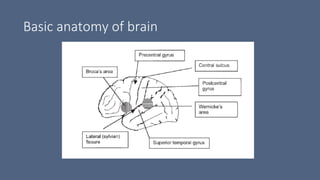
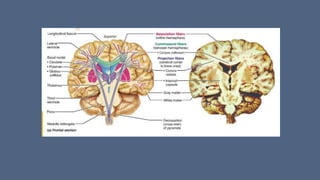
Basic anatomy of brain
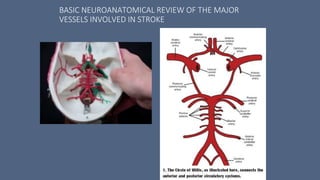
BASIC NEUROANATOMICAL REVIEW OF THE MAJOR
VESSELS INVOLVED IN STROKE
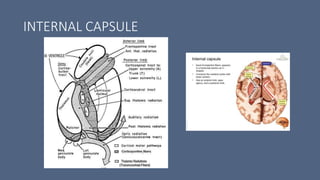
INTERNAL CAPSULE
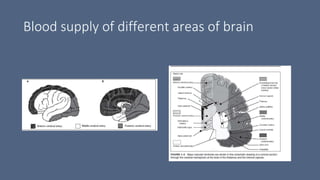
Blood supply of different areas of brain
TYPES OF STROKE
• ischemic stroke
• hemorrhagic stroke
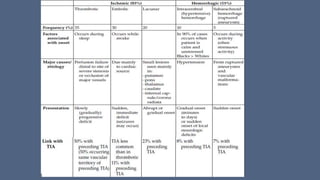
ISCHEMIC STROKES(85%)
1)Thrombotic (large artery thrombosis):
• 35% of all strokes Usually occurs during sleep (patient often awakens
unaware of deficits)
• May have “stuttering,” intermittent progression of neurologic deficits,
or be slowly progressive (over 24–48 hours)
• Neurologic deficit varies according to cerebral territory affected
• Perfusion failure distal to site of severe stenosis or occlusion of major
vessels
2)Embolic:
30% of all strokes
• Immediate onset of neurologic deficits
• Usually occurs during working hours
• Seizures may occur at onset of stroke
• Most commonly due to cardiac source: mural thrombi and
platelet aggregates
• cardiac thrombus caused by atrial fibrillation, rheumatic
heart disease (eg, mitral stenosis), post-MI, and
vegetations on heart valves in bacterial or marantic
endocarditis or prosthetic heart valves
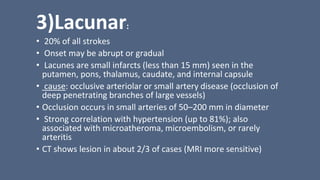
3)Lacunar:
• 20% of all strokes
• Onset may be abrupt or gradual
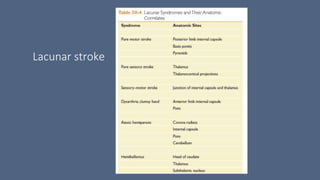
• Lacunes are small infarcts (less than 15 mm) seen in the
putamen, pons, thalamus, caudate, and internal capsule
• cause: occlusive arteriolar or small artery disease (occlusion of
deep penetrating branches of large vessels)
• Occlusion occurs in small arteries of 50–200 mm in diameter
• Strong correlation with hypertension (up to 81%); also
associated with microatheroma, microembolism, or rarely
arteritis
• CT shows lesion in about 2/3 of cases (MRI more sensitive)
Lacunar stroke
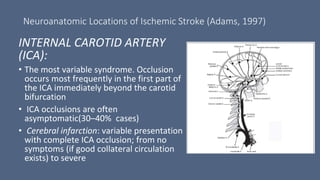
Neuroanatomic Locations of Ischemic Stroke (Adams, 1997)
INTERNAL CAROTID ARTERY
(ICA):
• The most variable syndrome. Occlusion
occurs most frequently in the first part of
the ICA immediately beyond the carotid
bifurcation
• ICA occlusions are often
asymptomatic(30–40% cases)
• Cerebral infarction: variable presentation
with complete ICA occlusion; from no
symptoms (if good collateral circulation
exists) to severe
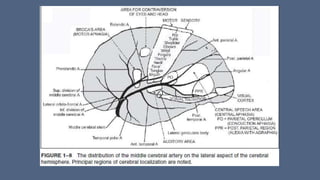
MIDDLE CEREBRAL ARTERY (MCA)
• Occlusion occurs at stem of middle cerebral artery or at one of the 2
main divisions (superior or inferior) of the artery in the Sylvian sulcus
•Superior Division of the MCA:
• The superior division of MCA supplies rolandic and
prerolandic areas
• Most common cause of occlusion of superior division of
MCA is an embolus
• Sensory and motor deficits on contralateral face and arm >
leg
• Head and eyes deviated toward side of infarct
• With left side lesion (dominant hemisphere)—global
aphasia initially, then turns into Broca’s aphasia (motor
speech disorder)
• Right side lesion (nondominant hemisphere)—deficits on
spatial perception, hemineglect,constructional apraxia,
dressing apraxia– Muscle tone usually decreased initially
and gradually increases over days or weeks to spasticity
• Inferior Division of the MCA
• – The inferior division of the MCA is the blood supply to the lateral
temporal and inferior parietal lobes
• With lesion on either side—superior quadrantanopia or homonymous
hemianopsia
• Left side lesion → Wernicke’s aphasia
• Right side lesion → left visual neglect
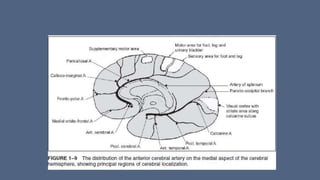
ANTERIOR CEREBRAL ARTERY (ACA)
• Contralateral weakness and sensory loss, affecting
mainly distal contralateral leg (foot/leg more affected
than thigh)
• Mild or no involvement of upper extremity
• Head and eyes may be deviated toward side of lesion
acutely
• Urinary incontinence
• contralateral grasp reflex
• paratonic rigidity
• motor aphasia if left side is affected
• Disturbances in gait and stance = gait apraxia
POSTERIOR CEREBRAL ARTERY (PCA):
• Clinical presentation:
• Visual field cuts (when bilateral, may have denial of cortical blindness =
Anton syndrome)
• prosopagnosia (can’t read faces)
• Palinopsia (abnormal recurring visual imagery)
• Alexia (can’t read)
• Trans cortical sensory aphasia (loss of power to comprehend written or
spoken words; patient can repeat)
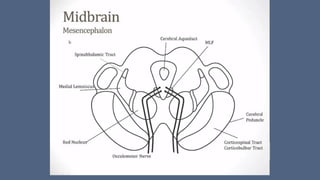
• Structures supplied by the interpeduncular branches of the PCA include
the oculomotor cranial nerve (CN3) and trochlear (CN4) nuclei and nerves
• Clinical syndromes caused by the occlusion of these branches include
Weber syndrome
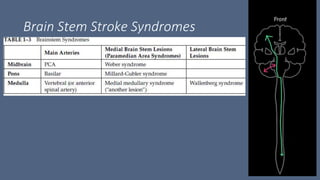
Brain Stem Stroke Syndromes
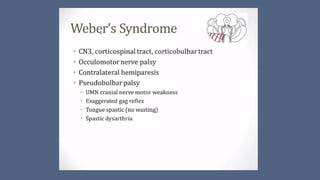
• Weber Syndrome (Base of Midbrain):
• Obstruction of interpeduncular branches of posterior
cerebral artery or posterior choroidal artery or both
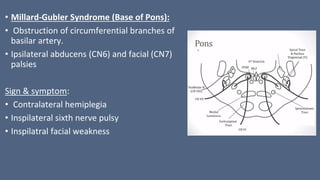
• Millard-Gubler Syndrome (Base of Pons):
• Obstruction of circumferential branches of
basilar artery.
• Ipsilateral abducens (CN6) and facial (CN7)
palsies
Sign & symptom:
• Contralateral hemiplegia
• Inspilateral sixth nerve pulsy
• Inspilatral facial weakness
• HEMORRHAGIC STROKES
• 15% of all strokes
• secondary to hypertension, ruptured aneurysm, arteriovenous
• malformation (AVM), blood dyscrasias/bleeding disorders,
anticoagulants, bleeding into tumor
• I. Hypertensive Intracerebral Hemorrhage (ICH)
• Linked to chronic HTN (> 1/3 occur in normotensives)
Symptoms
• – Sudden onset of headache (HA) and/or LOC
• – Vomiting at onset in 22–44%.
• – Seizures occur in 10% of cases (first few days after
onset).
• – Nuchal rigidity is common
Cont.
• Locations : putamen, thalamus, pons, cerebellum, and cerebrum:
• 1. Putamen (internal capsule ):
• Hemiplegia
• Vomiting in ~ 50%
• headache
• With smaller hemorrhages: Headache leading to aphasia, hemiplegia,
eyes deviate away from paretic limbs
2. Thalamus:
.Hemiplegia by compression of adjacent internal capsule
.Contralateral sensory deficits
.Aphasia present with lesions of the dominant side
.Contralateral hemineglect with involvement on the
nondominant side. Ocular disturbances with extension of
hemorrhage into subthalamus
3. Pons:
.Deep coma results in a few minutes
.Total paralysis, small pupils (1 mm) that react to light
. Decerebrate rigidity → death occurs in few hours
4. Cerebellum: develops over several hours.
• Coma/LOC unusual vomiting
• Occipital headache
• Vertigo
• Inability to sit, stand, or walk,
• Eyes deviate to opposite side (ipsilateral CN6 palsy);
• Dysarthria,
• Dysphagia
• II. Subarachnoid Hemorrhage (SAH)
• Typically due to a ruptured saccular arterial aneurysm
• Arterial dilations found at bifurcations of larger arteries
at the base of the brain (Circle of Willis or major
branches
• 90–95% of saccular aneurysms occur on the anterior part
of the Circle of Willis
• Peak age for rupture = fifth and sixth decade
• Clinical Presentations of SAH:
• severe Headace classically described as “worst Headache
of my life”
• Sudden, transient LOC in 20–45% at onset
• Seizures: 4% at onset/25% overall
Compression of adjacent structures such as the oculomotor
nerve (CN3)
• Signs of CN3 involvement:
• Deviation of ipsilateral eye to lateral side (lateral or
divergent strabismus) because of unopposed action of
lateral rectus muscle
• Ptosis,mydriasis (dilated pupil) and paralysis of
accommodation due to interruption ofparasympathetic
fibers in CN3
• Risk of rebleeding within one month 30%; 2.2% per year
during first decade
• Mortality from rebleeding in the early weeks after initial
event: 50–60%
• Vasospasm: common complication occurring in ~ 25% of
cases; caused by the presence of blood breakdown
products (vasoactive amines)
• III. Vascular Malformations/AVMs
A vascular malformation in the brain consisting of a tangled
mass of dilated vessels that forms an abnormal
communication between the arterial and venous systems is
known as an arteriovenous malformation (AVM).
Beeding May be:
• parenchymal (41%)
• Subarachnoid (23%)
• Intraventricular (17%) hemorrhage
References:
• Physical medicine and rehabilitation by Board review 2nd edition
• Physical medicine and rehabilitation by Braddom
Thank you

Stroke syndromes

  • 1.
    STROKE SYNDROMES DR. RatulDas 1st year pg student,Dept.of PMR,SMS medical college,jaipur PG training class
  • 2.
    Definitions • Ancient writersof history, science, and poetry used the word apoplexia • The more modern term cerebrovascular accident (CVA) • Stroke is defined as a nontraumatic brain injury caused by occlusion or rupture of cerebral blood vessels that results in sudden neurologic deficit characterized by loss of motor control, altered sensation, cognitive or language impairment, disequilibrium, or coma • excludes nonvascular conditions that can present with stroke like symptoms, such as seizure, syncope, hypoxemia, traumatic brain injury, or brain tumor
  • 3.
    EPIDEMIOLOGY • After heartdisease and cancer, stroke is the third leading cause of death in the United States • The American Heart Association (AHA) estimates 780,000 strokes annually: 600,000 new cases and 180,000 recurrent cases • A sharp decline noted in the 1970s, possibly related to improved diagnosis and treatment of hypertension • In the first 30 days after stroke, 90% of deaths were due to direct effects of the brain lesion or complications of immobility resulting from the stroke
  • 4.
    RISK FACTORS Nonmodifiable RiskFactors: • Age—the single most important risk factor for stroke worldwide • After age 55, incidence increases for both males and females • Sex (male > female) • Race (African Americans > whites > Asians) • Family history of stroke
  • 5.
    Modifiable (Treatable) RiskFactors: • Hypertension • History of TIA: ~ 5% of patients with TIA will develop a completed stroke within 1 month if untreated; 14% within 1 year • Heart disease: – Congestive heart failure (CHF) , coronary artery disease (CAD), Valvular heart disease, arrhythmias increase risk of embolic stroke, Atrial fibrillation • Diabetes: two fold increase in risk. Good blood sugar control has not been shown to alter the risk of stroke • Cigarette smoking
  • 6.
    Cont. • cocaine use,< 2 drinks/day relative risk 0.51; > 7 drinks/day relative risk 2.96 • High-dose estrogens (birth control pills) • Systemic diseases associated with hypercoagulable states • Elevated RBC count, hematocrit, fibrinogen • Protein S and C deficiencies • Sickle-cell anemia • Hyperlipidemia • Migraine headaches • Sleep apnea
  • 7.
    Stroke Pathophysiology • Normalcerebral auto regulation maintains a cerebral perfusion rate of 50 mL/100 g cerebral tissue/min, which remains constant regardless of acute changes in systemic mean arterial pressure • During cerebrovascular compromise, normal neural activity can be sustained with a CBF as low as 20mL/100 g/min, but a rate below 10 mL/100 g/min results in cellular death • CBF range between 10 and 20mL/100 g/min, the basic cellular functions are supported but the sodium– potassium pump fails, rendering the neural cells “electrically silent”
  • 8.
  • 10.
    BASIC NEUROANATOMICAL REVIEWOF THE MAJOR VESSELS INVOLVED IN STROKE
  • 11.
  • 12.
    Blood supply ofdifferent areas of brain
  • 13.
    TYPES OF STROKE •ischemic stroke • hemorrhagic stroke
  • 15.
    ISCHEMIC STROKES(85%) 1)Thrombotic (largeartery thrombosis): • 35% of all strokes Usually occurs during sleep (patient often awakens unaware of deficits) • May have “stuttering,” intermittent progression of neurologic deficits, or be slowly progressive (over 24–48 hours) • Neurologic deficit varies according to cerebral territory affected • Perfusion failure distal to site of severe stenosis or occlusion of major vessels
  • 16.
    2)Embolic: 30% of allstrokes • Immediate onset of neurologic deficits • Usually occurs during working hours • Seizures may occur at onset of stroke • Most commonly due to cardiac source: mural thrombi and platelet aggregates • cardiac thrombus caused by atrial fibrillation, rheumatic heart disease (eg, mitral stenosis), post-MI, and vegetations on heart valves in bacterial or marantic endocarditis or prosthetic heart valves
  • 17.
    3)Lacunar: • 20% ofall strokes • Onset may be abrupt or gradual • Lacunes are small infarcts (less than 15 mm) seen in the putamen, pons, thalamus, caudate, and internal capsule • cause: occlusive arteriolar or small artery disease (occlusion of deep penetrating branches of large vessels) • Occlusion occurs in small arteries of 50–200 mm in diameter • Strong correlation with hypertension (up to 81%); also associated with microatheroma, microembolism, or rarely arteritis • CT shows lesion in about 2/3 of cases (MRI more sensitive)
  • 18.
  • 19.
    Neuroanatomic Locations ofIschemic Stroke (Adams, 1997) INTERNAL CAROTID ARTERY (ICA): • The most variable syndrome. Occlusion occurs most frequently in the first part of the ICA immediately beyond the carotid bifurcation • ICA occlusions are often asymptomatic(30–40% cases) • Cerebral infarction: variable presentation with complete ICA occlusion; from no symptoms (if good collateral circulation exists) to severe
  • 21.
    MIDDLE CEREBRAL ARTERY(MCA) • Occlusion occurs at stem of middle cerebral artery or at one of the 2 main divisions (superior or inferior) of the artery in the Sylvian sulcus
  • 22.
    •Superior Division ofthe MCA: • The superior division of MCA supplies rolandic and prerolandic areas • Most common cause of occlusion of superior division of MCA is an embolus • Sensory and motor deficits on contralateral face and arm > leg • Head and eyes deviated toward side of infarct • With left side lesion (dominant hemisphere)—global aphasia initially, then turns into Broca’s aphasia (motor speech disorder) • Right side lesion (nondominant hemisphere)—deficits on spatial perception, hemineglect,constructional apraxia, dressing apraxia– Muscle tone usually decreased initially and gradually increases over days or weeks to spasticity
  • 23.
    • Inferior Divisionof the MCA • – The inferior division of the MCA is the blood supply to the lateral temporal and inferior parietal lobes • With lesion on either side—superior quadrantanopia or homonymous hemianopsia • Left side lesion → Wernicke’s aphasia • Right side lesion → left visual neglect
  • 25.
    ANTERIOR CEREBRAL ARTERY(ACA) • Contralateral weakness and sensory loss, affecting mainly distal contralateral leg (foot/leg more affected than thigh) • Mild or no involvement of upper extremity • Head and eyes may be deviated toward side of lesion acutely • Urinary incontinence • contralateral grasp reflex • paratonic rigidity • motor aphasia if left side is affected • Disturbances in gait and stance = gait apraxia
  • 26.
    POSTERIOR CEREBRAL ARTERY(PCA): • Clinical presentation: • Visual field cuts (when bilateral, may have denial of cortical blindness = Anton syndrome) • prosopagnosia (can’t read faces) • Palinopsia (abnormal recurring visual imagery) • Alexia (can’t read) • Trans cortical sensory aphasia (loss of power to comprehend written or spoken words; patient can repeat) • Structures supplied by the interpeduncular branches of the PCA include the oculomotor cranial nerve (CN3) and trochlear (CN4) nuclei and nerves • Clinical syndromes caused by the occlusion of these branches include Weber syndrome
  • 27.
  • 31.
    • Weber Syndrome(Base of Midbrain): • Obstruction of interpeduncular branches of posterior cerebral artery or posterior choroidal artery or both
  • 33.
    • Millard-Gubler Syndrome(Base of Pons): • Obstruction of circumferential branches of basilar artery. • Ipsilateral abducens (CN6) and facial (CN7) palsies Sign & symptom: • Contralateral hemiplegia • Inspilateral sixth nerve pulsy • Inspilatral facial weakness
  • 37.
    • HEMORRHAGIC STROKES •15% of all strokes • secondary to hypertension, ruptured aneurysm, arteriovenous • malformation (AVM), blood dyscrasias/bleeding disorders, anticoagulants, bleeding into tumor
  • 38.
    • I. HypertensiveIntracerebral Hemorrhage (ICH) • Linked to chronic HTN (> 1/3 occur in normotensives) Symptoms • – Sudden onset of headache (HA) and/or LOC • – Vomiting at onset in 22–44%. • – Seizures occur in 10% of cases (first few days after onset). • – Nuchal rigidity is common
  • 39.
    Cont. • Locations :putamen, thalamus, pons, cerebellum, and cerebrum: • 1. Putamen (internal capsule ): • Hemiplegia • Vomiting in ~ 50% • headache • With smaller hemorrhages: Headache leading to aphasia, hemiplegia, eyes deviate away from paretic limbs
  • 40.
    2. Thalamus: .Hemiplegia bycompression of adjacent internal capsule .Contralateral sensory deficits .Aphasia present with lesions of the dominant side .Contralateral hemineglect with involvement on the nondominant side. Ocular disturbances with extension of hemorrhage into subthalamus 3. Pons: .Deep coma results in a few minutes .Total paralysis, small pupils (1 mm) that react to light . Decerebrate rigidity → death occurs in few hours
  • 41.
    4. Cerebellum: developsover several hours. • Coma/LOC unusual vomiting • Occipital headache • Vertigo • Inability to sit, stand, or walk, • Eyes deviate to opposite side (ipsilateral CN6 palsy); • Dysarthria, • Dysphagia
  • 42.
    • II. SubarachnoidHemorrhage (SAH) • Typically due to a ruptured saccular arterial aneurysm • Arterial dilations found at bifurcations of larger arteries at the base of the brain (Circle of Willis or major branches • 90–95% of saccular aneurysms occur on the anterior part of the Circle of Willis • Peak age for rupture = fifth and sixth decade
  • 43.
    • Clinical Presentationsof SAH: • severe Headace classically described as “worst Headache of my life” • Sudden, transient LOC in 20–45% at onset • Seizures: 4% at onset/25% overall Compression of adjacent structures such as the oculomotor nerve (CN3) • Signs of CN3 involvement: • Deviation of ipsilateral eye to lateral side (lateral or divergent strabismus) because of unopposed action of lateral rectus muscle • Ptosis,mydriasis (dilated pupil) and paralysis of accommodation due to interruption ofparasympathetic fibers in CN3
  • 44.
    • Risk ofrebleeding within one month 30%; 2.2% per year during first decade • Mortality from rebleeding in the early weeks after initial event: 50–60% • Vasospasm: common complication occurring in ~ 25% of cases; caused by the presence of blood breakdown products (vasoactive amines)
  • 45.
    • III. VascularMalformations/AVMs A vascular malformation in the brain consisting of a tangled mass of dilated vessels that forms an abnormal communication between the arterial and venous systems is known as an arteriovenous malformation (AVM). Beeding May be: • parenchymal (41%) • Subarachnoid (23%) • Intraventricular (17%) hemorrhage
  • 46.
    References: • Physical medicineand rehabilitation by Board review 2nd edition • Physical medicine and rehabilitation by Braddom
  • 47.