Amr Hassan, M.D.
Associate professor of Neurology - Cairo
University
CEREBELLUM
CEREBELLUM
1) Vermis and hemispheres, and 2) three lobes.
Vermis and hemispheres: The midline area is called the vermis, because it
resembles a worm. Spreading out on either side from the vermis are the
cerebellar hemispheres.
Three lobes: The cerebellum is divided into three lobes by two fissures.
The posterolateral fissure separates the flocculonodular lobe from the rest of the
cerebellum that is further divided by the primary fissure into an anterior lobe
and a posterior lobe. The anterior lobe is rostral to the primary fissure while
the posterior lobe, the largest cerebellar lobe, is caudal to the primary fissure.
The flocculonodular lobe is composed of the small nodulus ,which is part of the
midline vermis, and the left and right flocculi, which are small lobules of the
hemispheres.
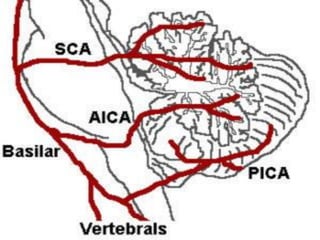
Blood Supply: the cerebellum is supplied by:
 Superior cerebellar artery (branch of the basilar
artery).
 Anterior inferior cerebellar artery (branch of the
basilar artery).
 Posterior inferior cerebellar artery (branch of the
vertebral artery).
Spinocerebellum
Pontocerebellum
Vestibulocerebellum
Archicerebellum
(nodulus)
Archicerebellum
(flocculus)
Paleocerebellum
Neocerebellum
Cerebellar divisions
 ARCHICEREBELLUM=the flocculonodular
lobe = vestibulocerebellum = its primary
connections are with the vestibular nuclei,
 Responsible
for equilibrium
PALEOCEREBELLUM= anterior lobe=spinocerebellum
 It receives proprioception input from the dorsal columns
of the spinal cord (including the spinocerebellar tract)
 It sends fibres to deep cerebellar nuclei thatboth the
cerebral cortex and the brain stem providing
modulation of descending
motor systems
 mainenance of tone
Cerebellar divisions
 NEOCEREBELLUM = The lateral zone = the
cerebrocerebellum
 It receives input exclusively from the cerebral cortex
(especially the parietal lobe) via the pontine nuclei
(forming cortico-ponto-cerebellar pathways).
 It sends output mainly to the ventrolateral thalamus 
premotor cortex and primary motor area of the
cerebral cortex) and to the red nucleus providing
modulation of descending motor systems
Coordination of movement
Spinocerebellum
Pontocerebellum
Vestibulocerebellum
Classification by Phylogenetic and Ontogenic Development
Archicerebellum
Paleocerebllum
Neocerebellum
Classification by Afferent Connection
Vestibulocerebellum
Spinocerebellum
Pontocerebellum
Classification by Efferent Connection
Vermis
Paravermal Region
Cerebellar Hemisphere
Cerebellum
Classifications
Funcions of the cerebellum
Equilibrium
Maintenance of tone
Coordination of movement
Ataxia
 Incoordination of voluntary motor activity with or
without disequilibriation in the absence of motor
weakness.
 Types:
 Cerebellar ataxia
 Sensory ataxia
 Vestibular ataxia
 Combined ataxia
Cerebellar lobes Lesion Main clinical features
Flocculo-nodular lobe
(Archicerebellum=
vestibulocerebellum):
Loss of
equilibrium
Archicerebellar syndrome:
 Standing: trukal ataxia
(swaying)
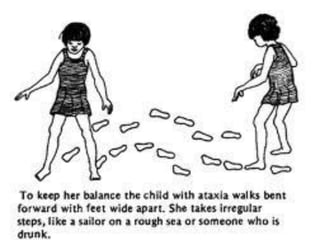
 Walking: wide base gait or
drunken gait.
Anterior lobe
(paleocerebellum=spinocerebellum)
:
Impairment of
tone
Hypotonia and hyporeflexia that
occur in both Archicerebellar
and Neocerebellar syndromes
Posterior lobe (Neocerebellum=
cerebro cerebellum):
Incoordination
of movement
Neocerebellar syndrome:
 Eye movement disorders :
nystagmus
 Staccato speech (explosive
interrupted speech).
 Head nodding.
 Trunk titubation.
 Intention kinetic tremors.
 Positive tests of Cerebellar functions
 Finger to nose
 Heel to knee
 Dysdiadokokinesia (inability to adequately terminate
each phase of the movement)
 Rebound
 Buttoning and unbuttoning
 Tandem gait.
Congenital:
 Arnold Chiari
 Basilar impression
Hereditary:
I.Without biochemical defect
 Autosomal Recessivee.g. Friedreich ataxia
 Autosomal Dominant cerebellar ataxia= ADCA
 X-linked
 DNA repair defects e.g. Xeroderma pigmentosa.
II.With biochemical defect= Metabolic
A.Intermittent:
 Hyperammonaemia
 Disorders of amino acid metabolism
B.Progressive
 Mitochondrial disorders
 Vitamin E deficiency
 Refsum disease
 Leukodystrophies
 Niemann Pick Syndrome
Infections:
 Meningitis
 Encephalitis
 Abscess
 Tubeculoma
Systemic diseases
 Amyloidosis
 Celiac disease
 Whipple's disease
Endocrinal disorders:
e.g.Hypothyroidism&Hypoparath-yroidism
Mass lesion:
 Neoplasm e.g. medulloblastoma
 Sarcoidosis
Toxins & Drugs: e.g.Phenytion &Lithium
Trauma
Vascular
 Cerebellar infarction
Symptomatic ataxia
 Vascular ataxia
 Cerebellar haemorrhage
 Cerebellar infarction
 Tumours
 Medulloblastoma
 Astrocytoma
 Metastasis
 Multiple sclerosis
Friedreich ataxia
Genetics:
 AR disorder, chromosome 9.
 Repeat expansion disorder in gene encoding for protein
called frataxin→ mitochondrial dysfunction→ neuronal
loss and degeneration.
 Epidemiology:
 1st decade of life, boys > girls.
Friedreich ataxia
Cerebellar Ataxia
Pyramidal tracts--------Babiniski sign
Posterior column-----lost deep sensation,diminshed
reflexes
Peripheral neuropathy----stock and glove hypoesthesia
Friedreich ataxia
Clinical picture:
 Ataxia: archicerebellar type.
 Pyramidal signs: +ve Babiniski sign.
 Deep sensory loss.
 Peripheral neuropathy: stock and glove hypothesia.
 Hypotonia and hyporeflexia due cerebellar affection, deep
sensory loss and peripheral neuropathy.
 Other features :skeletal deformities e.g. pes cavus,
scoliosis and ♥cardiomyopathy.
Friedreich ataxia
Investigations:
 MRI cervical: atrophic cord.
 Genetic study.
 EMG and NC study: peripheral neuropathy.
 ECG,echocardiography.
Friedreich ataxia
Treatment: Supportive treatment and physiotherapy.
Prognosis:
 Progressive disease, patient lose ambulance after 15 years.
 Mean age of death 40 -60 y from infection or cardiac
disease.
The autosomal dominant
cerebellar ataxias
 Incidence: 1 to 5 per 100,000
 Average age of onset: 3rd decade.
 Classification:
 ADCA has 3 main categories I, II& III under each of which there are
many spinocerebellar ataxias (SCA)
 ADCA I
 Cerebellar syndrome + other CNS (pyramidal, extrapyramidal,
ophthalmoplegia, & dementia).
 SCA1; SCA2; SCA3; SCA4; SCA8; SCA12; SCA17; SCA27; SCA28.
 ADCA II
 Cerebellar syndrome + pigmentary retinopathy.
 SCA7.
 ADCA III
 "Pure" cerebellar syndrome.
 SCA5; SCA6; SCA10; SCA11; SCA14; SCA15; SCA22; SCA26
Sensory ataxia
Definition: It is ataxia due to loss of the proprioceptive
(deep) sensations, at any point in their pathway (see
fig. 9).
Causes:
 Peripheral nerve: peripheral neuropathy specially
diabetic, alcoholic and nutritional.
 Posterior root: tabes dorsalis.
 Posterior column: subacute combined degeneration of
the cord.
 Medial lemniscus: brain stem lesions.
 Thalamus: thalamic syndrome.
 Cortical sensory area: parietal lobe lesions.
Sensory ataxia
Clinical picture:
 Kinetic tremors appear only on closure of the eyes.
 Rhomberg's test: when the patient stands with his
feet close together & his eyes closed, his body sways &
he may fall if not supported.
 Stamping gait: heavy strike of the ground on walking
due to lost deep sensation.
 Deep sensory loss.
 Hypotonia
 Hyporeflexia
Vestibular ataxia
Definition: It is ataxia due to lesions of the vestibular
division of the vestibulocochlear nerve .
Causes:
 Meniere's disease.
 Labyrinthitis.
 Acoustic neuroma.
Clinical picture:
 Vertigo, tinnitus, deafness & vestibular nystagmus.
Thank you

Cerebellum & ataxia

  • 1.
    Amr Hassan, M.D. Associateprofessor of Neurology - Cairo University CEREBELLUM
  • 5.
    CEREBELLUM 1) Vermis andhemispheres, and 2) three lobes. Vermis and hemispheres: The midline area is called the vermis, because it resembles a worm. Spreading out on either side from the vermis are the cerebellar hemispheres. Three lobes: The cerebellum is divided into three lobes by two fissures. The posterolateral fissure separates the flocculonodular lobe from the rest of the cerebellum that is further divided by the primary fissure into an anterior lobe and a posterior lobe. The anterior lobe is rostral to the primary fissure while the posterior lobe, the largest cerebellar lobe, is caudal to the primary fissure. The flocculonodular lobe is composed of the small nodulus ,which is part of the midline vermis, and the left and right flocculi, which are small lobules of the hemispheres.
  • 7.
    Blood Supply: thecerebellum is supplied by:  Superior cerebellar artery (branch of the basilar artery).  Anterior inferior cerebellar artery (branch of the basilar artery).  Posterior inferior cerebellar artery (branch of the vertebral artery).
  • 10.
  • 11.
  • 12.
    Cerebellar divisions  ARCHICEREBELLUM=theflocculonodular lobe = vestibulocerebellum = its primary connections are with the vestibular nuclei,  Responsible for equilibrium
  • 13.
    PALEOCEREBELLUM= anterior lobe=spinocerebellum It receives proprioception input from the dorsal columns of the spinal cord (including the spinocerebellar tract)  It sends fibres to deep cerebellar nuclei thatboth the cerebral cortex and the brain stem providing modulation of descending motor systems  mainenance of tone Cerebellar divisions
  • 14.
    Cerebellar divisions  NEOCEREBELLUM= The lateral zone = the cerebrocerebellum  It receives input exclusively from the cerebral cortex (especially the parietal lobe) via the pontine nuclei (forming cortico-ponto-cerebellar pathways).  It sends output mainly to the ventrolateral thalamus  premotor cortex and primary motor area of the cerebral cortex) and to the red nucleus providing modulation of descending motor systems Coordination of movement
  • 15.
  • 16.
    Classification by Phylogeneticand Ontogenic Development Archicerebellum Paleocerebllum Neocerebellum Classification by Afferent Connection Vestibulocerebellum Spinocerebellum Pontocerebellum Classification by Efferent Connection Vermis Paravermal Region Cerebellar Hemisphere Cerebellum Classifications
  • 17.
    Funcions of thecerebellum Equilibrium Maintenance of tone Coordination of movement
  • 19.
    Ataxia  Incoordination ofvoluntary motor activity with or without disequilibriation in the absence of motor weakness.  Types:  Cerebellar ataxia  Sensory ataxia  Vestibular ataxia  Combined ataxia
  • 20.
    Cerebellar lobes LesionMain clinical features Flocculo-nodular lobe (Archicerebellum= vestibulocerebellum): Loss of equilibrium Archicerebellar syndrome:  Standing: trukal ataxia (swaying)  Walking: wide base gait or drunken gait. Anterior lobe (paleocerebellum=spinocerebellum) : Impairment of tone Hypotonia and hyporeflexia that occur in both Archicerebellar and Neocerebellar syndromes Posterior lobe (Neocerebellum= cerebro cerebellum): Incoordination of movement Neocerebellar syndrome:  Eye movement disorders : nystagmus  Staccato speech (explosive interrupted speech).  Head nodding.  Trunk titubation.  Intention kinetic tremors.
  • 21.
     Positive testsof Cerebellar functions  Finger to nose  Heel to knee  Dysdiadokokinesia (inability to adequately terminate each phase of the movement)  Rebound  Buttoning and unbuttoning  Tandem gait.
  • 26.
    Congenital:  Arnold Chiari Basilar impression Hereditary: I.Without biochemical defect  Autosomal Recessivee.g. Friedreich ataxia  Autosomal Dominant cerebellar ataxia= ADCA  X-linked  DNA repair defects e.g. Xeroderma pigmentosa. II.With biochemical defect= Metabolic A.Intermittent:  Hyperammonaemia  Disorders of amino acid metabolism B.Progressive  Mitochondrial disorders  Vitamin E deficiency  Refsum disease  Leukodystrophies  Niemann Pick Syndrome Infections:  Meningitis  Encephalitis  Abscess  Tubeculoma Systemic diseases  Amyloidosis  Celiac disease  Whipple's disease Endocrinal disorders: e.g.Hypothyroidism&Hypoparath-yroidism Mass lesion:  Neoplasm e.g. medulloblastoma  Sarcoidosis Toxins & Drugs: e.g.Phenytion &Lithium Trauma Vascular  Cerebellar infarction
  • 27.
    Symptomatic ataxia  Vascularataxia  Cerebellar haemorrhage  Cerebellar infarction  Tumours  Medulloblastoma  Astrocytoma  Metastasis  Multiple sclerosis
  • 29.
    Friedreich ataxia Genetics:  ARdisorder, chromosome 9.  Repeat expansion disorder in gene encoding for protein called frataxin→ mitochondrial dysfunction→ neuronal loss and degeneration.  Epidemiology:  1st decade of life, boys > girls.
  • 30.
    Friedreich ataxia Cerebellar Ataxia Pyramidaltracts--------Babiniski sign Posterior column-----lost deep sensation,diminshed reflexes Peripheral neuropathy----stock and glove hypoesthesia
  • 31.
    Friedreich ataxia Clinical picture: Ataxia: archicerebellar type.  Pyramidal signs: +ve Babiniski sign.  Deep sensory loss.  Peripheral neuropathy: stock and glove hypothesia.  Hypotonia and hyporeflexia due cerebellar affection, deep sensory loss and peripheral neuropathy.  Other features :skeletal deformities e.g. pes cavus, scoliosis and ♥cardiomyopathy.
  • 32.
    Friedreich ataxia Investigations:  MRIcervical: atrophic cord.  Genetic study.  EMG and NC study: peripheral neuropathy.  ECG,echocardiography.
  • 33.
    Friedreich ataxia Treatment: Supportivetreatment and physiotherapy. Prognosis:  Progressive disease, patient lose ambulance after 15 years.  Mean age of death 40 -60 y from infection or cardiac disease.
  • 34.
    The autosomal dominant cerebellarataxias  Incidence: 1 to 5 per 100,000  Average age of onset: 3rd decade.  Classification:  ADCA has 3 main categories I, II& III under each of which there are many spinocerebellar ataxias (SCA)  ADCA I  Cerebellar syndrome + other CNS (pyramidal, extrapyramidal, ophthalmoplegia, & dementia).  SCA1; SCA2; SCA3; SCA4; SCA8; SCA12; SCA17; SCA27; SCA28.  ADCA II  Cerebellar syndrome + pigmentary retinopathy.  SCA7.  ADCA III  "Pure" cerebellar syndrome.  SCA5; SCA6; SCA10; SCA11; SCA14; SCA15; SCA22; SCA26
  • 35.
    Sensory ataxia Definition: Itis ataxia due to loss of the proprioceptive (deep) sensations, at any point in their pathway (see fig. 9). Causes:  Peripheral nerve: peripheral neuropathy specially diabetic, alcoholic and nutritional.  Posterior root: tabes dorsalis.  Posterior column: subacute combined degeneration of the cord.  Medial lemniscus: brain stem lesions.  Thalamus: thalamic syndrome.  Cortical sensory area: parietal lobe lesions.
  • 37.
    Sensory ataxia Clinical picture: Kinetic tremors appear only on closure of the eyes.  Rhomberg's test: when the patient stands with his feet close together & his eyes closed, his body sways & he may fall if not supported.  Stamping gait: heavy strike of the ground on walking due to lost deep sensation.  Deep sensory loss.  Hypotonia  Hyporeflexia
  • 38.
    Vestibular ataxia Definition: Itis ataxia due to lesions of the vestibular division of the vestibulocochlear nerve . Causes:  Meniere's disease.  Labyrinthitis.  Acoustic neuroma. Clinical picture:  Vertigo, tinnitus, deafness & vestibular nystagmus.
  • 39.