Quadriplegia & Paraplegia
Defination
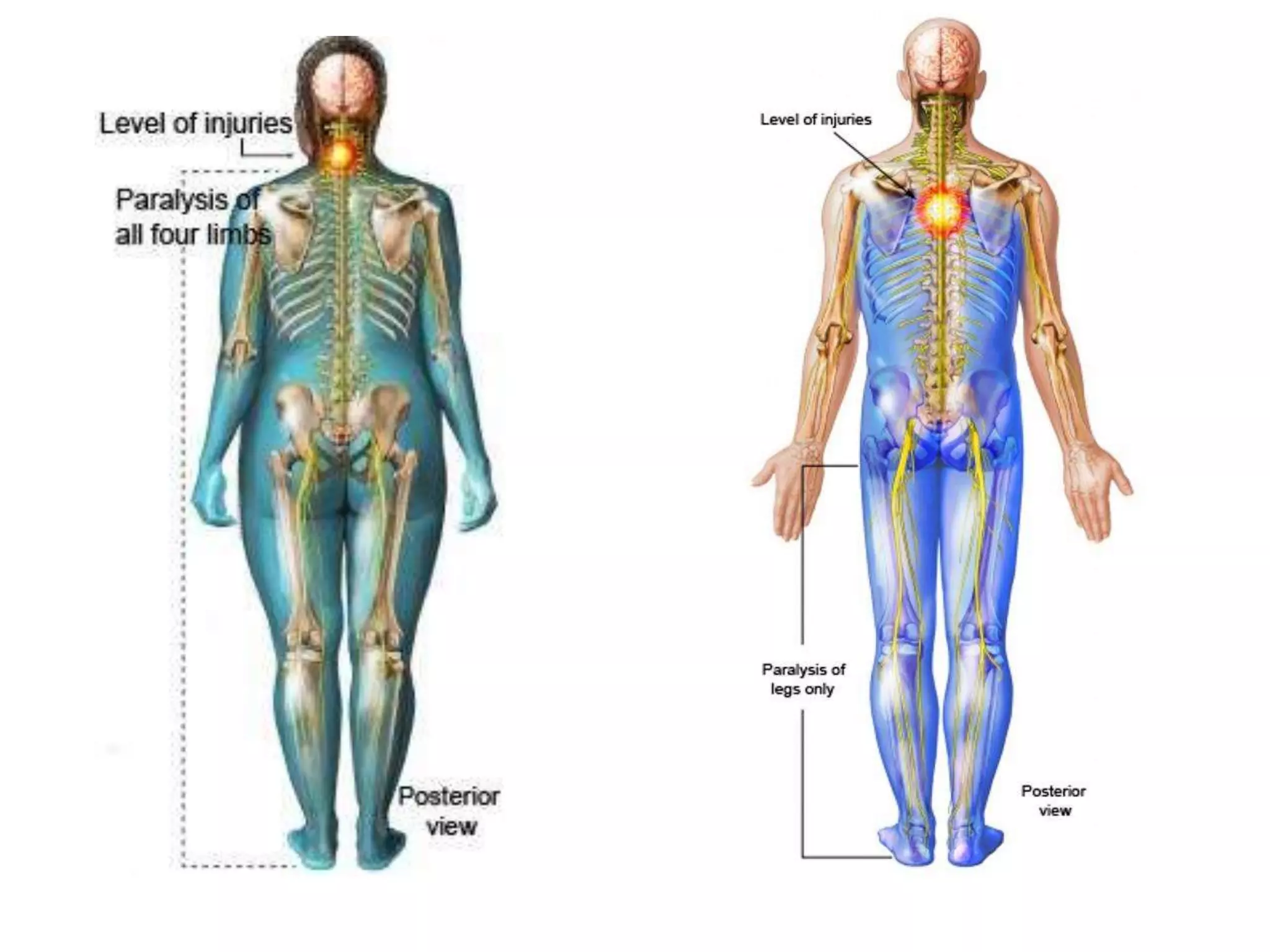
• Quadriplegia/tetraplegia (quad = 4)
– Paralysis of both the arms and legs
– Occur when cervical segment of spinal cord
injured
• Paraplegia
– Complete paralysis of the lower half of the body
including both legs.
– Occur when thoracic and lumbar segment injured
Quadriplegia
• C1-4 Quadriplegia
– C1 & C2 - may have functional phrenic nerves.
– C3 – impaired breathing, ventilator dependent
– C4 – may be free from advanced respiratory support
but require functional equipment need as C3
*C1-4 Quadriplegics require assistance for all
personal care, turning, and transfer functions.*
• C-5 Quadriplegia
– Have functional deltoid and/or biceps musculature.
– can feed themselves, perform oral facial hygienic and
upper body dressing activities.
– Require assistance to perform bathing , bowel and
bladder care, and for transfers.
• C-6 Quadriplegia
– have musculature that permits most shoulder motion,
elbow bending, but not straightening and active wrist
extension.
– can perform upper & lower body dressing without
assistance.
– can perform some transfers independently with a
transfer board.
• C7-8 Quadriplegia
– have functional triceps, they can bend and
straighten their elbows
– may also have enhanced finger extension and
wrist flexion.
– They can turn and perform most transfers
independently.
Paraplegia
• arms and hands not affected.
• T-1 to T-8 - retain control of the arms and hands
- poor trunk control and balance due
to poor abdominal muscle control.
• T-9 to T-12 - retain good truck control and good
abdominal muscle control.
• The sitting balance of people with lower spinal cord injuries is
usually very good.
• Lumbar and Sacral injuries result in decreased control of the hip
flexors and legs.
Pathophysiology
Mechanism of injury
• Destruction of cord parenchyma from direct trauma.
• Compression by bone fragments, heamatoma or disc
material.
• Ischaemia from damage or impingement on spinal
arteries.
Damage to the spinal cord parenchyma is
classified as:
• Concussion: transient neurological signs with rapid
resolutions of deficits.
• Contusion: as a result of compression, gross structural
continuity of cord is intact.
• Laceration: discruption of s. c. as a result of severe
displacements of the vertebral column.
Causes
• Traumatic causes
– Car accidents, sports accidents gunshot and
stabbing injuries.
– falls from high, electric shock injuries, diving
accidents related to sudden depressurization.
– Other causes:
• arachnoiditis (inflammation of arachnoid mater)
• pathologic fractures due to rheumatic diseases
• Medical causes
– Infectious or parasitic causes: spinal cord abscess,
Pott's disease (tuberculous abcess), tuberculous
epiduritis, schistosomiasis or bilharziosis (parasitic
disease).
– Vascular causes: ischemic softening of the spinal
cord (spinal cord infarction or myelomalacia),
spontaneous spinal extradural hematomas, spinal
arteriovenous malformations (angioma), aortic
aneurysms.
– Tumor-related causes: neurilemmomas,
metastases of spine, neurofibromatoses,
Hodgkin's disease and myeloma.
Signs
• Loss of movement.
• Loss of sensation
• Loss of bowel or bladder control.
• Exaggerated reflex activities or spasms.
• Changes in sexual function, sexual sensitivity and
fertility.
• Pain & tingling
• Difficulty breathing, coughing or clearing
secretions from your lungs.
Complications
• Pain.
• Blood clots.
• Pressure sores.
• Related injuries.
• Spastic muscles.
• Respiratory problems.
• Autonomic dysreflexia.
• Loss of bladder and bowel control.
Doctor Management
• Medications
– Methylprednisolone (Medrol) is a treatment
option for an acute spinal cord injury.
– If given within eight hours of injury, some people
experience mild improvement.
– reducing damage to nerve cells and decreasing
inflammation near the site of injury.
– not a cure for a spinal cord injury.
• Surgery
– remove fragments of bones, foreign objects,
herniated disks or fractured vertebrae.
– needed to stabilize the spine to prevent future
pain or deformity.
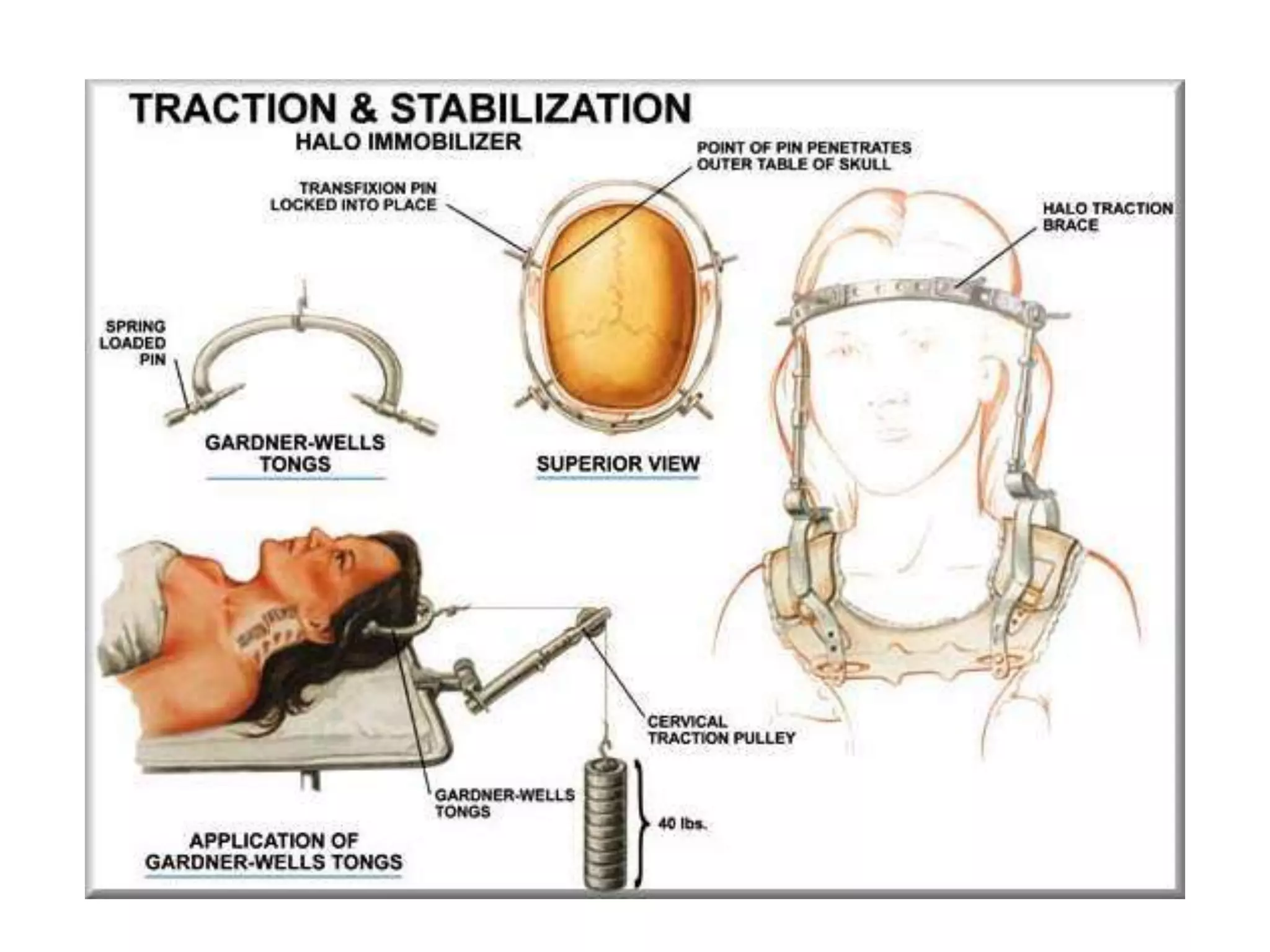
• Immobilization
– traction to stabilize spine and correct alignment
– traction is accomplished by securing metal braces,
or a body harness.
– In some cases, a rigid neck collar may needed to
keep head from moving.
– A special bed also may help immobilize body.
• Healing Broken Bones Without Surgery
– A more conservative and less invasive approach is
by using halo traction.
– This approach may mean up to two months
complete bed rest.
PT Management
• Range of Motion
– Active ROM exs.
– Passive stretching
– Ankle boots and nights splints
• Contraindications
– Quadriplegia :stretching shoulder
– Paraplegia :SLR above 60°, hip flex. beyond 90°
• Strengthening
– Exs for UL
– Functional strengthening: under water walking,
static bicycling.
• Muscle Tone
– ES of paralysed ms.
– Facilitation and inhibition technique.
– Emphasis on weight bearing activities.
– PNF
• Pain
– Traumatic: TENS
– Nerve root: TENS
• Orientation to upright position
– Tilt table
– Abdominal binders & stockings can be used
• Pressure sores
– Turning and positioning for prevention
• Bowel and Bladder retraining
– Kegel Exs.
• Gait training
FES
• Functional Electric Stimulation has been
applied to various nerves in the LL to facilitate
a more normal gait.
• Theory is that FES applies the appropriate
sensory input necessary to normalize reflex
output of the spinal cord.
• Therefore the disruption caused by the SCI is
removed.
Reference
• http://www.spinal injury.net/quadriplegia.htm
• http://cirrie.buffalo.edu/encyclopedia/en/article/359/
• http://www.spinal-injury.net/treatment-of-spinal-cord-
injury.htm
• www.apparelyzed.com/paraplegia-paraplegic.html
• http://www.apparelyzed.com/quadriplegia-
quadriplegic.html
• http://www.mayoclinic.com/health/spinal-cord-
injury/DS00460/DSECTION
• http://www.scribd.com/doc/8557448/Spinal-Cord-
Injury-Physical-Therapy-Management

Quadriplegia & Paraplegia

  • 1.
  • 4.
    Defination • Quadriplegia/tetraplegia (quad= 4) – Paralysis of both the arms and legs – Occur when cervical segment of spinal cord injured • Paraplegia – Complete paralysis of the lower half of the body including both legs. – Occur when thoracic and lumbar segment injured
  • 5.
    Quadriplegia • C1-4 Quadriplegia –C1 & C2 - may have functional phrenic nerves. – C3 – impaired breathing, ventilator dependent – C4 – may be free from advanced respiratory support but require functional equipment need as C3 *C1-4 Quadriplegics require assistance for all personal care, turning, and transfer functions.*
  • 6.
    • C-5 Quadriplegia –Have functional deltoid and/or biceps musculature. – can feed themselves, perform oral facial hygienic and upper body dressing activities. – Require assistance to perform bathing , bowel and bladder care, and for transfers. • C-6 Quadriplegia – have musculature that permits most shoulder motion, elbow bending, but not straightening and active wrist extension. – can perform upper & lower body dressing without assistance. – can perform some transfers independently with a transfer board.
  • 7.
    • C7-8 Quadriplegia –have functional triceps, they can bend and straighten their elbows – may also have enhanced finger extension and wrist flexion. – They can turn and perform most transfers independently.
  • 8.
    Paraplegia • arms andhands not affected. • T-1 to T-8 - retain control of the arms and hands - poor trunk control and balance due to poor abdominal muscle control. • T-9 to T-12 - retain good truck control and good abdominal muscle control. • The sitting balance of people with lower spinal cord injuries is usually very good. • Lumbar and Sacral injuries result in decreased control of the hip flexors and legs.
  • 9.
    Pathophysiology Mechanism of injury •Destruction of cord parenchyma from direct trauma. • Compression by bone fragments, heamatoma or disc material. • Ischaemia from damage or impingement on spinal arteries.
  • 10.
    Damage to thespinal cord parenchyma is classified as: • Concussion: transient neurological signs with rapid resolutions of deficits. • Contusion: as a result of compression, gross structural continuity of cord is intact. • Laceration: discruption of s. c. as a result of severe displacements of the vertebral column.
  • 11.
    Causes • Traumatic causes –Car accidents, sports accidents gunshot and stabbing injuries. – falls from high, electric shock injuries, diving accidents related to sudden depressurization. – Other causes: • arachnoiditis (inflammation of arachnoid mater) • pathologic fractures due to rheumatic diseases
  • 12.
    • Medical causes –Infectious or parasitic causes: spinal cord abscess, Pott's disease (tuberculous abcess), tuberculous epiduritis, schistosomiasis or bilharziosis (parasitic disease). – Vascular causes: ischemic softening of the spinal cord (spinal cord infarction or myelomalacia), spontaneous spinal extradural hematomas, spinal arteriovenous malformations (angioma), aortic aneurysms. – Tumor-related causes: neurilemmomas, metastases of spine, neurofibromatoses, Hodgkin's disease and myeloma.
  • 13.
    Signs • Loss ofmovement. • Loss of sensation • Loss of bowel or bladder control. • Exaggerated reflex activities or spasms. • Changes in sexual function, sexual sensitivity and fertility. • Pain & tingling • Difficulty breathing, coughing or clearing secretions from your lungs.
  • 14.
    Complications • Pain. • Bloodclots. • Pressure sores. • Related injuries. • Spastic muscles. • Respiratory problems. • Autonomic dysreflexia. • Loss of bladder and bowel control.
  • 15.
    Doctor Management • Medications –Methylprednisolone (Medrol) is a treatment option for an acute spinal cord injury. – If given within eight hours of injury, some people experience mild improvement. – reducing damage to nerve cells and decreasing inflammation near the site of injury. – not a cure for a spinal cord injury.
  • 16.
    • Surgery – removefragments of bones, foreign objects, herniated disks or fractured vertebrae. – needed to stabilize the spine to prevent future pain or deformity. • Immobilization – traction to stabilize spine and correct alignment – traction is accomplished by securing metal braces, or a body harness. – In some cases, a rigid neck collar may needed to keep head from moving. – A special bed also may help immobilize body.
  • 17.
    • Healing BrokenBones Without Surgery – A more conservative and less invasive approach is by using halo traction. – This approach may mean up to two months complete bed rest.
  • 19.
    PT Management • Rangeof Motion – Active ROM exs. – Passive stretching – Ankle boots and nights splints • Contraindications – Quadriplegia :stretching shoulder – Paraplegia :SLR above 60°, hip flex. beyond 90°
  • 20.
    • Strengthening – Exsfor UL – Functional strengthening: under water walking, static bicycling. • Muscle Tone – ES of paralysed ms. – Facilitation and inhibition technique. – Emphasis on weight bearing activities. – PNF
  • 21.
    • Pain – Traumatic:TENS – Nerve root: TENS • Orientation to upright position – Tilt table – Abdominal binders & stockings can be used • Pressure sores – Turning and positioning for prevention • Bowel and Bladder retraining – Kegel Exs. • Gait training
  • 22.
    FES • Functional ElectricStimulation has been applied to various nerves in the LL to facilitate a more normal gait. • Theory is that FES applies the appropriate sensory input necessary to normalize reflex output of the spinal cord. • Therefore the disruption caused by the SCI is removed.
  • 23.
    Reference • http://www.spinal injury.net/quadriplegia.htm •http://cirrie.buffalo.edu/encyclopedia/en/article/359/ • http://www.spinal-injury.net/treatment-of-spinal-cord- injury.htm • www.apparelyzed.com/paraplegia-paraplegic.html • http://www.apparelyzed.com/quadriplegia- quadriplegic.html • http://www.mayoclinic.com/health/spinal-cord- injury/DS00460/DSECTION • http://www.scribd.com/doc/8557448/Spinal-Cord- Injury-Physical-Therapy-Management

Editor's Notes

  • #13  Pott disease is a presentation of extrapulmonary tuberculosis which is called so when tuberculosis bacillus is seen in any other organ other than lung.Extrapulmonary tuberculosis can affect the spine, a kind of tuberculous arthritis of the intervertebral joints. Schistosomiasis a chronic anemia and organ infection caused by parasitic flukes of the genus Schistosoma, transmitted through feces-contaminated river snails. http://www.nlm.nih.gov/medlineplus/ency/article/001321.htm Angiomas are benign tumors derived from cells of the vascular or lymphatic vessel walls (epithelium) or derived from cells of the tissues surrounding these vessels Neurilemmomas are benign, encapsulated tumors of the nerve sheath. Their cells of origin are thought to be Schwann cells derived from the neural crest. These masses usually arise from the side of a nerve, are well encapsulated, and have a unique histologic pattern. Neurofibromatosis (commonly abbreviated NF; neurofibromatosis type 1 is also known as von Recklinghausen disease) is a genetically-inherited disorder in which the nerve tissue grows tumors (neurofibromas) that may be benign and may cause serious damage by compressing nerves and other tissues Hodgkin disease is a type of lymphoma. Lymphoma is cancer of lymph tissue found in the lymph nodes, spleen, liver, and bone marrow. The first sign of Hodgkin disease is often an enlarged lymph node. The disease can spread to nearby lymph nodes. Later it may spread to the lungs, liver or bone marrow. The cause is unknown.
  • #15 Loss of bladder and bowel control. Because the spinal cord nerves control the function of the bladder and bowels, people with quadriplegia have various degrees of loss of control in this area. Without proper management these problems can lead to urinary tract infections and to constipation. Urinary tract infections can be fatal if not treated in time, particularly if the patient is in a weakened condition. Your health care team will help you deal with bladder and bowel control so that you will not develop an infection. Pressure sores. When you are immobile for long periods of time, pressure from the weight of the body can cause your skin to develop sores. If you have quadriplegia you are at great risk of developing pressure sores, because you cannot shift your body weight on your own. Pressure sores can become infected and lead to serious complications, even death. For this reason, once your injuries are stable, nurses and nurse’s aides will turn you at regular intervals in the hospital and your caregivers at home will need to do the same thing. Special mattresses and cushions also help to prevent pressure sores. Blood clots. When you have quadriplegia, your blood circulation slows down since you are immobile. This can cause clots to develop. Clots are not always obvious; deep within the muscles are veins which can develop clots (a condition called deep vein thrombosis). An artery in the lungs can also be blocked by a clot (pulmonary embolism). Deep vein thrombosis and pulmonary embolism can be fatal. Your medical team will work to prevent clots. You may be given blood thinners to improve your circulation. Support hose and special inflatable pumps placed on the legs may also be used to increase circulation. Respiratory problems. The nerve signals to you chest and diaphragm may be weakened or distorted by a spinal cord injury, making breathing on your own difficult or impossible. If your diaphragm is wholly paralyzed, you will be intubated and placed on a ventilator. A special pacemaker is sometimes used to simulate the diaphragm’s nerves and allow the patient to breath without a ventilator. Some people are able to wean away from the ventilator by learning how to consciously control their breathing. People with quadriplegia are at increased risk for pneumonia and other respiratory infections even if they have not trouble breathing on their own. Medications and respiratory exercises are used to help prevent respiratory problems when mobility is a problem. Autonomic dysreflexia. A dangerous, occasionally fatal problem called autonomic dysreflexia can afflict people with spinal cord injuries located above the middle of the chest. This means that an irritation or pain below the site of your injury may send a signal which will not reach the brain, but will cause a nerve signal that disrupts your body’s functions. As your heart rate drops, your blood pressure may rise, putting you at risk for a stroke. Ironically, simple problems such as irritating clothes or a full bladder may trigger this reflex; fortunately, removing the cause of the irritation or changing position may relieve the negative effects. Spastic muscles. Some people with quadriplegia experience muscle spasms which cause the legs and arms to jerk. Although you may be tempted to think that this is a sign of regaining movement or sensation, it is simply a symptom of the damaged spinal cords inability to properly relay remaining nerve signals to the brain. Most people with quadriplegia will not develop spastic muscles. Related injuries. People with quadriplegia may experience an injury, such as a burn, without realizing it, since they have no sensation in their limbs. For this reason it is important that your caregivers do not place a heating pad or electric blanket on you. Pain. Although people with quadriplegia may not feel external sensations, it is possible to feel pain within your arms, legs, back, and other areas which do not respond to external stimuli. Pain medications prescribed by your doctor can relieve the pain.