GERIATRIC
MANAGEMENT
- NITHIN NAIR (MPT-1)
OVERVIEW
MANAGEMENT
INDIVIDUAL COMMUNITY
INDIVIDUAL MANAGEMENT
• PROBLEM LIST
• AIMS OF MANAGEMENT
ACUTE CARE MANAGEMENT
FUNCTIONAL RESTORATIVE MANAGEMENT
PREVENTIVE MANAGEMENT
ACUTE CARE MANAGEMENT
• Patient Education
• Relief of Pain
• Enhance healing (Reduce inflammation and swelling)
FUNCTIONAL RESTORATIVE
MANAGEMENT
• Maintenance of existing ROM and efforts to gently begin increasing
ROM
• Maintain joint mobility and soft tissue integrity
• Restore muscle strength & endurance
• Restore extensibility and flexibility of soft tissues
• Postural corrections
• Balance Training & Gait training
PREVENTIVE MANAGEMENT
• Maintenance and progression of previous exercise.
• Identify risk factors and comorbidity and frame the exercise protocol accordingly –
diabetes, hypertension, obesity, osteoporosis etc including life style modifications.
• Ergonomic advise & environmental modification.
• Prevention of Sarcopenia.
• Nutritional advise.
• Cardio respiratory endurance.
• Home programs
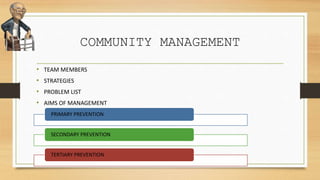
COMMUNITY MANAGEMENT
• TEAM MEMBERS
• STRATEGIES
• PROBLEM LIST
• AIMS OF MANAGEMENT
PRIMARY PREVENTION
SECONDARY PREVENTION
TERTIARY PREVENTION
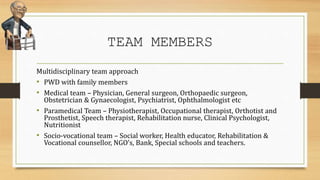
TEAM MEMBERS
Multidisciplinary team approach
• PWD with family members
• Medical team – Physician, General surgeon, Orthopaedic surgeon,
Obstetrician & Gynaecologist, Psychiatrist, Ophthalmologist etc
• Paramedical Team – Physiotherapist, Occupational therapist, Orthotist and
Prosthetist, Speech therapist, Rehabilitation nurse, Clinical Psychologist,
Nutritionist
• Socio-vocational team – Social worker, Health educator, Rehabilitation &
Vocational counsellor, NGO’s, Bank, Special schools and teachers.
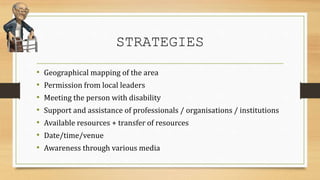
STRATEGIES
• Geographical mapping of the area
• Permission from local leaders
• Meeting the person with disability
• Support and assistance of professionals / organisations / institutions
• Available resources + transfer of resources
• Date/time/venue
• Awareness through various media
STRATEGIES
• Transfer of skills
• Physiotherapist role
• Maintenance of record
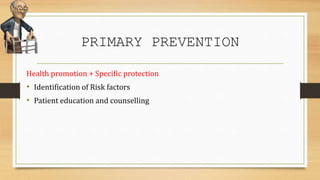
PRIMARY PREVENTION
Health promotion + Specific protection
• Identification of Risk factors
• Patient education and counselling
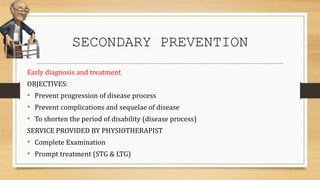
SECONDARY PREVENTION
Early diagnosis and treatment
OBJECTIVES:
• Prevent progression of disease process
• Prevent complications and sequelae of disease
• To shorten the period of disability (disease process)
SERVICE PROVIDED BY PHYSIOTHERAPIST
• Complete Examination
• Prompt treatment (STG & LTG)
TERTIARY PREVENTION
Late Pathogenesis Phase
MODE OF INTERVENTION
• Disability Limitation
• Rehabilitation: combined and co-ordinated use of medical, social,
educational, vocational measures of training the individuals to the highest
possible level of functional ability.
DISEASE IMPAIRMENT DISABILITY HANDICAP
ACSM RECOMMENDATION
An exercise regime for elderly should always include:
AEROBIC EXERCISE
FLEXIBILITY EXERCISE
STRENGTHENING EXERCISE
ENDURANCE EXERCISE
NEUROMOTOR EXERCISE
AEROBIC EXERCISE
• Frequency – ≥ 5 days / week (moderate intensity physical activity)
≥ 3 days / week (vigorous intensity physical activity)
3 – 5 days/ week (combination of both)
• Intensity – On scale 0-10 for level of physical exertion, 5 – 6 for moderate intensity and 7 –
8 for vigorous intensity.
• Type – Any modality that does not impose excessive orthopaedic stress
Walking, aquatic exercise, and stationary cycle exercise.
• Time – Moderate intensity : 30 – 60 minutes / day in bouts of 10 minutes each to total of
150 – 300 min / week
Vigorous intensity: 20 – 30 minutes / day to total 75 -100 minutes / week
ENDURANCE EXERCISE
• Frequency – ≥ 2 days / week
• Intensity – moderate intensity (5-6) Borg scale
• Type – Walking, stair climbing at self-selected comfortable pace.
• Time – It will be progressively increased according to the participant’s
performance.
• Instructions while starting an endurance training program: Start
out slowly and progress by increasing the time by 5 min or increasing
the speed. Monitor intensity with a Rating of Perceived Exertion Scale
(Modified Borg Scale). Wear shoes that offer support and are
appropriate for the type of activity.
FLEXIBILITY EXERCISE
• Frequency – ≥ 2 days / week with a goal of 5 days / week.
• Intensity – Stretch to the point of feeling tightness or slight
discomfort.
• Type - Any activities that maintain or increase flexibility using
sustained stretches for each major muscle group.
• Time – 10 - 15 second hold and 5 repetitions – progressively
increased till 30 – 60 seconds hold.
STRENGTHENING EXERCISE
• Frequency – ≥ 2 days / week
• Intensity – Light Intensity (40-50% of 1RM), Moderate Intensity (60-
70% of 1RM)
• Type – Progressive strengthening activities for major muscle group
(delorme/oxford/ Macqueen)
NEUROMOTOR EXERCISE
• Frequency – 2 – 3 days / week
• The ACSM exercise Prescription guidelines recommend following activities –
• Progressively difficult postures that gradually reduce the BOS (Two-legged
stand, semi tandem stand, tandem stand, one legged stand.)
• Dynamic movements that perturb the COG (tandem walk, circle turns)
• Stressing postural muscle groups (Heel stands, Toe Stands)
• Reducing sensory inputs (Standing with eyes closed)
NEUROMOTOR EXERCISE
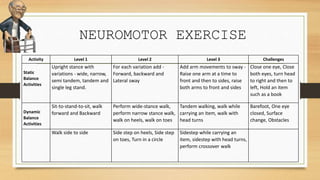
Activity Level 1 Level 2 Level 3 Challenges
Static
Balance
Activities
Upright stance with
variations - wide, narrow,
semi tandem, tandem and
single leg stand.
For each variation add -
Forward, backward and
Lateral sway
Add arm movements to sway -
Raise one arm at a time to
front and then to sides, raise
both arms to front and sides
Close one eye, Close
both eyes, turn head
to right and then to
left, Hold an item
such as a book
Dynamic
Balance
Activities
Sit-to-stand-to-sit, walk
forward and Backward
Perform wide-stance walk,
perform narrow stance walk,
walk on heels, walk on toes
Tandem walking, walk while
carrying an item, walk with
head turns
Barefoot, One eye
closed, Surface
change, Obstacles
Walk side to side Side step on heels, Side step
on toes, Turn in a circle
Sidestep while carrying an
item, sidestep with head turns,
perform crossover walk
REFERENCES
• Geriatric Physical Therapy – Andrew Guccione (2nd and 3rd ed)
• ACSM’s Guidelines for Exercise Testing & Prescription (9th ed)
• Textbook of Community Medicine and Rehabilitation – T Bhaskararao (3rd ed)
• Preventive and Social Medicine – K Park (23rd ed)
• Essentials of Community Based Rehabilitation – Satyabhushan Nagar (1st ed)
• Community Based Rehabilitation of Persons with Disabilities – S Pruthvish (1st ed)
• Therapeutic Exercise – Kisner Colby (6th ed)
• Physical Rehabilitation – O’Sullivan (6th ed)
• Management of Common Musculoskeletal disorders – Hertling & Kessler (4th ed)
• Rehabilitation Medicine for Elderly – Stefano Masierio (Springer Pub.) – (1st ed)
• Exercise for Aging Adults – Gail M Sullivan (Springer Pub.) – (1st ed)
Geriatric Physiotherapy Management

Geriatric Physiotherapy Management

  • 1.
  • 2.
  • 3.
    INDIVIDUAL MANAGEMENT • PROBLEMLIST • AIMS OF MANAGEMENT ACUTE CARE MANAGEMENT FUNCTIONAL RESTORATIVE MANAGEMENT PREVENTIVE MANAGEMENT
  • 4.
    ACUTE CARE MANAGEMENT •Patient Education • Relief of Pain • Enhance healing (Reduce inflammation and swelling)
  • 5.
    FUNCTIONAL RESTORATIVE MANAGEMENT • Maintenanceof existing ROM and efforts to gently begin increasing ROM • Maintain joint mobility and soft tissue integrity • Restore muscle strength & endurance • Restore extensibility and flexibility of soft tissues • Postural corrections • Balance Training & Gait training
  • 6.
    PREVENTIVE MANAGEMENT • Maintenanceand progression of previous exercise. • Identify risk factors and comorbidity and frame the exercise protocol accordingly – diabetes, hypertension, obesity, osteoporosis etc including life style modifications. • Ergonomic advise & environmental modification. • Prevention of Sarcopenia. • Nutritional advise. • Cardio respiratory endurance. • Home programs
  • 7.
    COMMUNITY MANAGEMENT • TEAMMEMBERS • STRATEGIES • PROBLEM LIST • AIMS OF MANAGEMENT PRIMARY PREVENTION SECONDARY PREVENTION TERTIARY PREVENTION
  • 8.
    TEAM MEMBERS Multidisciplinary teamapproach • PWD with family members • Medical team – Physician, General surgeon, Orthopaedic surgeon, Obstetrician & Gynaecologist, Psychiatrist, Ophthalmologist etc • Paramedical Team – Physiotherapist, Occupational therapist, Orthotist and Prosthetist, Speech therapist, Rehabilitation nurse, Clinical Psychologist, Nutritionist • Socio-vocational team – Social worker, Health educator, Rehabilitation & Vocational counsellor, NGO’s, Bank, Special schools and teachers.
  • 9.
    STRATEGIES • Geographical mappingof the area • Permission from local leaders • Meeting the person with disability • Support and assistance of professionals / organisations / institutions • Available resources + transfer of resources • Date/time/venue • Awareness through various media
  • 10.
    STRATEGIES • Transfer ofskills • Physiotherapist role • Maintenance of record
  • 11.
    PRIMARY PREVENTION Health promotion+ Specific protection • Identification of Risk factors • Patient education and counselling
  • 12.
    SECONDARY PREVENTION Early diagnosisand treatment OBJECTIVES: • Prevent progression of disease process • Prevent complications and sequelae of disease • To shorten the period of disability (disease process) SERVICE PROVIDED BY PHYSIOTHERAPIST • Complete Examination • Prompt treatment (STG & LTG)
  • 13.
    TERTIARY PREVENTION Late PathogenesisPhase MODE OF INTERVENTION • Disability Limitation • Rehabilitation: combined and co-ordinated use of medical, social, educational, vocational measures of training the individuals to the highest possible level of functional ability. DISEASE IMPAIRMENT DISABILITY HANDICAP
  • 14.
    ACSM RECOMMENDATION An exerciseregime for elderly should always include: AEROBIC EXERCISE FLEXIBILITY EXERCISE STRENGTHENING EXERCISE ENDURANCE EXERCISE NEUROMOTOR EXERCISE
  • 15.
    AEROBIC EXERCISE • Frequency– ≥ 5 days / week (moderate intensity physical activity) ≥ 3 days / week (vigorous intensity physical activity) 3 – 5 days/ week (combination of both) • Intensity – On scale 0-10 for level of physical exertion, 5 – 6 for moderate intensity and 7 – 8 for vigorous intensity. • Type – Any modality that does not impose excessive orthopaedic stress Walking, aquatic exercise, and stationary cycle exercise. • Time – Moderate intensity : 30 – 60 minutes / day in bouts of 10 minutes each to total of 150 – 300 min / week Vigorous intensity: 20 – 30 minutes / day to total 75 -100 minutes / week
  • 16.
    ENDURANCE EXERCISE • Frequency– ≥ 2 days / week • Intensity – moderate intensity (5-6) Borg scale • Type – Walking, stair climbing at self-selected comfortable pace. • Time – It will be progressively increased according to the participant’s performance. • Instructions while starting an endurance training program: Start out slowly and progress by increasing the time by 5 min or increasing the speed. Monitor intensity with a Rating of Perceived Exertion Scale (Modified Borg Scale). Wear shoes that offer support and are appropriate for the type of activity.
  • 17.
    FLEXIBILITY EXERCISE • Frequency– ≥ 2 days / week with a goal of 5 days / week. • Intensity – Stretch to the point of feeling tightness or slight discomfort. • Type - Any activities that maintain or increase flexibility using sustained stretches for each major muscle group. • Time – 10 - 15 second hold and 5 repetitions – progressively increased till 30 – 60 seconds hold.
  • 18.
    STRENGTHENING EXERCISE • Frequency– ≥ 2 days / week • Intensity – Light Intensity (40-50% of 1RM), Moderate Intensity (60- 70% of 1RM) • Type – Progressive strengthening activities for major muscle group (delorme/oxford/ Macqueen)
  • 19.
    NEUROMOTOR EXERCISE • Frequency– 2 – 3 days / week • The ACSM exercise Prescription guidelines recommend following activities – • Progressively difficult postures that gradually reduce the BOS (Two-legged stand, semi tandem stand, tandem stand, one legged stand.) • Dynamic movements that perturb the COG (tandem walk, circle turns) • Stressing postural muscle groups (Heel stands, Toe Stands) • Reducing sensory inputs (Standing with eyes closed)
  • 20.
    NEUROMOTOR EXERCISE Activity Level1 Level 2 Level 3 Challenges Static Balance Activities Upright stance with variations - wide, narrow, semi tandem, tandem and single leg stand. For each variation add - Forward, backward and Lateral sway Add arm movements to sway - Raise one arm at a time to front and then to sides, raise both arms to front and sides Close one eye, Close both eyes, turn head to right and then to left, Hold an item such as a book Dynamic Balance Activities Sit-to-stand-to-sit, walk forward and Backward Perform wide-stance walk, perform narrow stance walk, walk on heels, walk on toes Tandem walking, walk while carrying an item, walk with head turns Barefoot, One eye closed, Surface change, Obstacles Walk side to side Side step on heels, Side step on toes, Turn in a circle Sidestep while carrying an item, sidestep with head turns, perform crossover walk
  • 22.
    REFERENCES • Geriatric PhysicalTherapy – Andrew Guccione (2nd and 3rd ed) • ACSM’s Guidelines for Exercise Testing & Prescription (9th ed) • Textbook of Community Medicine and Rehabilitation – T Bhaskararao (3rd ed) • Preventive and Social Medicine – K Park (23rd ed) • Essentials of Community Based Rehabilitation – Satyabhushan Nagar (1st ed) • Community Based Rehabilitation of Persons with Disabilities – S Pruthvish (1st ed) • Therapeutic Exercise – Kisner Colby (6th ed) • Physical Rehabilitation – O’Sullivan (6th ed) • Management of Common Musculoskeletal disorders – Hertling & Kessler (4th ed) • Rehabilitation Medicine for Elderly – Stefano Masierio (Springer Pub.) – (1st ed) • Exercise for Aging Adults – Gail M Sullivan (Springer Pub.) – (1st ed)