Clinical Overview Director, Stanford Stroke Center  Stanford University Palo Alto, California Gregory W. Albers, MD
Ischemic Stroke 85% of strokes are ischemic Most ischemic strokes caused by atherosclerosis of extracranial or intracranial arteries Embolic or thrombotic occlusion of cerebral blood vessels by aggregated platelets, fibrin, and debris from atheromatous plaques
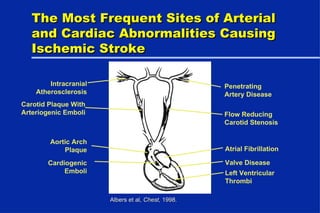
The Most Frequent Sites of Arterial and Cardiac Abnormalities Causing Ischemic Stroke Intracranial Atherosclerosis Carotid Plaque With Arteriogenic Emboli Aortic Arch Plaque Cardiogenic Emboli Penetrating Artery Disease Flow Reducing Carotid Stenosis Atrial Fibrillation Valve Disease Left Ventricular Thrombi Albers et al,  Chest,  1998.
Transient Ischemic Attack Transient occlusion of an intracranial artery due to thromboembolism Symptoms resolve following rapid fragmentation and dissolution of the microemboli/thrombus
Stroke Morbidity and Mortality Leading cause of serious, long-term disability Third leading cause of death in the U.S.; second leading cause worldwide Accounts for >50% of all hospitalizations for acute neurologic disease
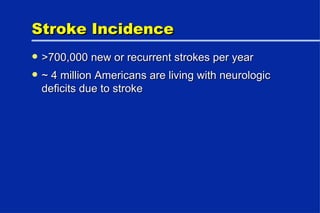
Stroke Incidence >700,000 new or recurrent strokes per year ~ 4 million Americans are living with neurologic deficits due to stroke
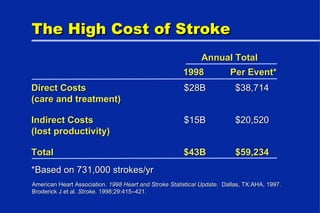
The High Cost of Stroke Annual Total 1998 Per Event* Direct Costs $28B $38,714 (care and treatment) Indirect Costs $15B $20,520 (lost productivity) Total $43B $59,234 *Based on 731,000 strokes/yr American Heart Association.  1998 Heart and Stroke Statistical Update .  Dallas, TX:AHA, 1997.  Broderick J et al.  Stroke.  1998;29:415–421.
Secondary Prevention of Ischemic Stroke Carotid endarterectomy: >50% stenosis Anticoagulation therapy: Cardioembolic stroke Antiplatelet therapy: Most common therapy
Antiplatelet Agents for Stroke Prevention Aspirin Ticlopidine Clopidogrel Dipyridamole
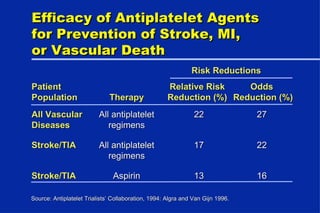
Efficacy of Antiplatelet Agents for Prevention of Stroke, MI, or Vascular Death Patient Relative Risk Odds Population Therapy Reduction (%)  Reduction (%) All Vascular All antiplatelet 22 27 Diseases regimens Stroke/TIA All antiplatelet 17 22 regimens Stroke/TIA Aspirin 13 16 Source: Antiplatelet Trialists’ Collaboration, 1994: Algra and Van Gijn 1996. Risk Reductions
Efficacy of Antiplatelet Agents vs Placebo for Prevention of Stroke, MI, or Vascular Death in Stroke/TIA Patients Aspirin (all doses) 10 13 Ticlopidine 1 23 Dipyridamole + ASA 4 30 All Antiplatelet Agents 18 17 Relative Risk  Antiplatelet Agent No. of Studies  Reduction (%) Source: Algra and Van Gijn 1996; Gent et al. 1989; Tijssen, 1998; Antiplatelet Trialists’ Collaboration, 1994.
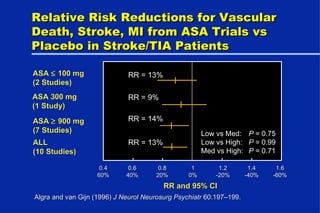
Relative Risk Reductions for Vascular Death, Stroke, MI from ASA Trials vs Placebo in Stroke/TIA Patients Algra and van Gijn (1996)  J Neurol Neurosurg Psychiatr  60:197–199. 0.4 60% 0.6 40% 0.8 20% 1 0% 1.2 -20% 1.4 -40% 1.6 -60% RR and 95% CI ASA    100 mg (2 Studies) ASA    900 mg (7 Studies) ASA 300 mg (1 Study) ALL (10 Studies) RR = 13% RR = 9% RR = 14% RR = 13% Low vs Med: P  = 0.75 Low vs High: P  = 0.99 Med vs High: P  = 0.71
ACE TRIAL Aspirin Efficacy by Dose Prevention of Vascular Events Following Carotid Endarterectomy Stroke or Death at 3 Months Stroke, MI, or Death at 3 Months 0 1 2 3 4 5 6 7 8 9 10 Low-Dose (N = 1395) (81 or 325 mg) High-Dose (N = 1409) (650 or 1300 mg) Event Rate (%) 5.7% 6.2% 7.1% 8.4% P  = 0.030 P  = 0.120 Taylor DW, Thorpe KE, for the ACE Trial Study Group. Presented at The Challenge of Stroke; The Lancet Conference; October 15–16, 1998. Montreal, Quebec, Canada; 1998.
FDA Recommends Low-Dose Aspirin FDA reviewed trials of aspirin vs placebo The  “positive findings at lower dosages are sufficient reason to lower the dosage of aspirin...for subjects with TIA and ischemic stroke.” For  “ischemic stroke and TIA: 50 to 325 mg  [aspirin] once a day. Continue therapy indefinitely.” FDA, Federal Register. 1998.63:56802–56819.
New Aspirin Dosing Guidelines  for Secondary Stroke Prevention FDA  New professional labeling for aspirin recommends 50 to 325 mg/day American College of Chest Physicians  Aspirin at 50 to 325 mg/day as an initial choice American Heart Association [50–325 mg/day proposed]
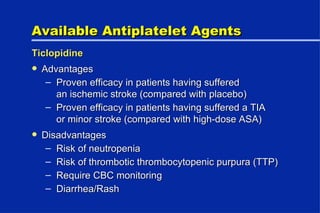
Available Antiplatelet Agents Ticlopidine Advantages Proven efficacy in patients having suffered an ischemic stroke (compared with placebo) Proven efficacy in patients having suffered a TIA or minor stroke (compared with high-dose ASA) Disadvantages Risk of neutropenia Risk of thrombotic thrombocytopenic purpura (TTP) Require CBC monitoring Diarrhea/Rash
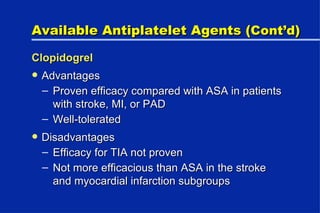
Available Antiplatelet Agents ( Cont’d ) Clopidogrel Advantages Proven efficacy compared with ASA in patients with stroke, MI, or PAD Well-tolerated Disadvantages Efficacy for TIA not proven Not more efficacious than ASA in the stroke and myocardial infarction subgroups
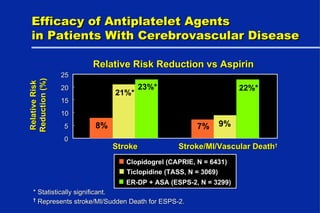
Efficacy of Antiplatelet Agents  in Patients With Cerebrovascular Disease Relative Risk Reduction vs Aspirin 7% 21%* 9% 23%* 22%* 8% 0 5 10 15 20 25 Stroke Stroke/MI/Vascular Death † Relative Risk Reduction (%) Clopidogrel (CAPRIE, N = 6431) Ticlopidine (TASS, N = 3069) ER-DP + ASA (ESPS-2, N = 3299) * Statistically significant. †   Represents stroke/MI/Sudden Death for ESPS-2.
ACCP Antiplatelet Guidelines “ Every patient who has experienced a [non-cardioembolic] stroke or TIA...should receive an antiplatelet agent.…” “ Aspirin, clopidogrel...ticlopidine..., and the combination of aspirin and dipyridamole are all acceptable options for initial therapy.” “ Clopidogrel is recommended in favor of ticlopidine because it has a lower incidence of significant adverse effects.” “ The combination of dipyridamole and aspirin b.i.d. may be more effective than clopidogrel and has a similarly favorable adverse effect profile.” Albers GW et al.  Chest . 1998;114:683S–698S.
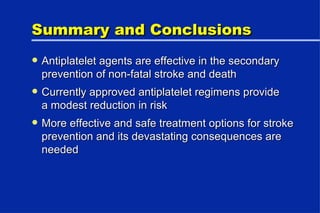
Summary and Conclusions Antiplatelet agents are effective in the secondary prevention of non-fatal stroke and death Currently approved antiplatelet regimens provide a modest reduction in risk More effective and safe treatment options for stroke prevention and its devastating consequences are needed
 
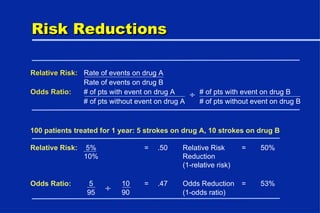
Risk Reductions Relative Risk:   Rate of events on drug A Rate of events on drug B Odds Ratio: # of pts with event on drug A # of pts with event on drug B  # of pts without event on drug A  # of pts without event on drug B 100 patients treated for 1 year: 5 strokes on drug A, 10 strokes on drug B Relative Risk: 5% = .50 Relative Risk  =  50% 10% Reduction (1-relative risk) Odds Ratio: 5 10  =  .47 Odds Reduction = 53% 95 90 (1-odds ratio)  

Stroke - clinical overview Stroke - clinical overview

  • 1.
    Clinical Overview Director,Stanford Stroke Center Stanford University Palo Alto, California Gregory W. Albers, MD
  • 2.
    Ischemic Stroke 85%of strokes are ischemic Most ischemic strokes caused by atherosclerosis of extracranial or intracranial arteries Embolic or thrombotic occlusion of cerebral blood vessels by aggregated platelets, fibrin, and debris from atheromatous plaques
  • 3.
    The Most FrequentSites of Arterial and Cardiac Abnormalities Causing Ischemic Stroke Intracranial Atherosclerosis Carotid Plaque With Arteriogenic Emboli Aortic Arch Plaque Cardiogenic Emboli Penetrating Artery Disease Flow Reducing Carotid Stenosis Atrial Fibrillation Valve Disease Left Ventricular Thrombi Albers et al, Chest, 1998.
  • 4.
    Transient Ischemic AttackTransient occlusion of an intracranial artery due to thromboembolism Symptoms resolve following rapid fragmentation and dissolution of the microemboli/thrombus
  • 5.
    Stroke Morbidity andMortality Leading cause of serious, long-term disability Third leading cause of death in the U.S.; second leading cause worldwide Accounts for >50% of all hospitalizations for acute neurologic disease
  • 6.
    Stroke Incidence >700,000new or recurrent strokes per year ~ 4 million Americans are living with neurologic deficits due to stroke
  • 7.
    The High Costof Stroke Annual Total 1998 Per Event* Direct Costs $28B $38,714 (care and treatment) Indirect Costs $15B $20,520 (lost productivity) Total $43B $59,234 *Based on 731,000 strokes/yr American Heart Association. 1998 Heart and Stroke Statistical Update . Dallas, TX:AHA, 1997. Broderick J et al. Stroke. 1998;29:415–421.
  • 8.
    Secondary Prevention ofIschemic Stroke Carotid endarterectomy: >50% stenosis Anticoagulation therapy: Cardioembolic stroke Antiplatelet therapy: Most common therapy
  • 9.
    Antiplatelet Agents forStroke Prevention Aspirin Ticlopidine Clopidogrel Dipyridamole
  • 10.
    Efficacy of AntiplateletAgents for Prevention of Stroke, MI, or Vascular Death Patient Relative Risk Odds Population Therapy Reduction (%) Reduction (%) All Vascular All antiplatelet 22 27 Diseases regimens Stroke/TIA All antiplatelet 17 22 regimens Stroke/TIA Aspirin 13 16 Source: Antiplatelet Trialists’ Collaboration, 1994: Algra and Van Gijn 1996. Risk Reductions
  • 11.
    Efficacy of AntiplateletAgents vs Placebo for Prevention of Stroke, MI, or Vascular Death in Stroke/TIA Patients Aspirin (all doses) 10 13 Ticlopidine 1 23 Dipyridamole + ASA 4 30 All Antiplatelet Agents 18 17 Relative Risk Antiplatelet Agent No. of Studies Reduction (%) Source: Algra and Van Gijn 1996; Gent et al. 1989; Tijssen, 1998; Antiplatelet Trialists’ Collaboration, 1994.
  • 12.
    Relative Risk Reductionsfor Vascular Death, Stroke, MI from ASA Trials vs Placebo in Stroke/TIA Patients Algra and van Gijn (1996) J Neurol Neurosurg Psychiatr 60:197–199. 0.4 60% 0.6 40% 0.8 20% 1 0% 1.2 -20% 1.4 -40% 1.6 -60% RR and 95% CI ASA  100 mg (2 Studies) ASA  900 mg (7 Studies) ASA 300 mg (1 Study) ALL (10 Studies) RR = 13% RR = 9% RR = 14% RR = 13% Low vs Med: P = 0.75 Low vs High: P = 0.99 Med vs High: P = 0.71
  • 13.
    ACE TRIAL AspirinEfficacy by Dose Prevention of Vascular Events Following Carotid Endarterectomy Stroke or Death at 3 Months Stroke, MI, or Death at 3 Months 0 1 2 3 4 5 6 7 8 9 10 Low-Dose (N = 1395) (81 or 325 mg) High-Dose (N = 1409) (650 or 1300 mg) Event Rate (%) 5.7% 6.2% 7.1% 8.4% P = 0.030 P = 0.120 Taylor DW, Thorpe KE, for the ACE Trial Study Group. Presented at The Challenge of Stroke; The Lancet Conference; October 15–16, 1998. Montreal, Quebec, Canada; 1998.
  • 14.
    FDA Recommends Low-DoseAspirin FDA reviewed trials of aspirin vs placebo The “positive findings at lower dosages are sufficient reason to lower the dosage of aspirin...for subjects with TIA and ischemic stroke.” For “ischemic stroke and TIA: 50 to 325 mg [aspirin] once a day. Continue therapy indefinitely.” FDA, Federal Register. 1998.63:56802–56819.
  • 15.
    New Aspirin DosingGuidelines for Secondary Stroke Prevention FDA New professional labeling for aspirin recommends 50 to 325 mg/day American College of Chest Physicians Aspirin at 50 to 325 mg/day as an initial choice American Heart Association [50–325 mg/day proposed]
  • 16.
    Available Antiplatelet AgentsTiclopidine Advantages Proven efficacy in patients having suffered an ischemic stroke (compared with placebo) Proven efficacy in patients having suffered a TIA or minor stroke (compared with high-dose ASA) Disadvantages Risk of neutropenia Risk of thrombotic thrombocytopenic purpura (TTP) Require CBC monitoring Diarrhea/Rash
  • 17.
    Available Antiplatelet Agents( Cont’d ) Clopidogrel Advantages Proven efficacy compared with ASA in patients with stroke, MI, or PAD Well-tolerated Disadvantages Efficacy for TIA not proven Not more efficacious than ASA in the stroke and myocardial infarction subgroups
  • 18.
    Efficacy of AntiplateletAgents in Patients With Cerebrovascular Disease Relative Risk Reduction vs Aspirin 7% 21%* 9% 23%* 22%* 8% 0 5 10 15 20 25 Stroke Stroke/MI/Vascular Death † Relative Risk Reduction (%) Clopidogrel (CAPRIE, N = 6431) Ticlopidine (TASS, N = 3069) ER-DP + ASA (ESPS-2, N = 3299) * Statistically significant. † Represents stroke/MI/Sudden Death for ESPS-2.
  • 19.
    ACCP Antiplatelet Guidelines“ Every patient who has experienced a [non-cardioembolic] stroke or TIA...should receive an antiplatelet agent.…” “ Aspirin, clopidogrel...ticlopidine..., and the combination of aspirin and dipyridamole are all acceptable options for initial therapy.” “ Clopidogrel is recommended in favor of ticlopidine because it has a lower incidence of significant adverse effects.” “ The combination of dipyridamole and aspirin b.i.d. may be more effective than clopidogrel and has a similarly favorable adverse effect profile.” Albers GW et al. Chest . 1998;114:683S–698S.
  • 20.
    Summary and ConclusionsAntiplatelet agents are effective in the secondary prevention of non-fatal stroke and death Currently approved antiplatelet regimens provide a modest reduction in risk More effective and safe treatment options for stroke prevention and its devastating consequences are needed
  • 21.
  • 22.
    Risk Reductions RelativeRisk: Rate of events on drug A Rate of events on drug B Odds Ratio: # of pts with event on drug A # of pts with event on drug B # of pts without event on drug A # of pts without event on drug B 100 patients treated for 1 year: 5 strokes on drug A, 10 strokes on drug B Relative Risk: 5% = .50 Relative Risk = 50% 10% Reduction (1-relative risk) Odds Ratio: 5 10 = .47 Odds Reduction = 53% 95 90 (1-odds ratio)  