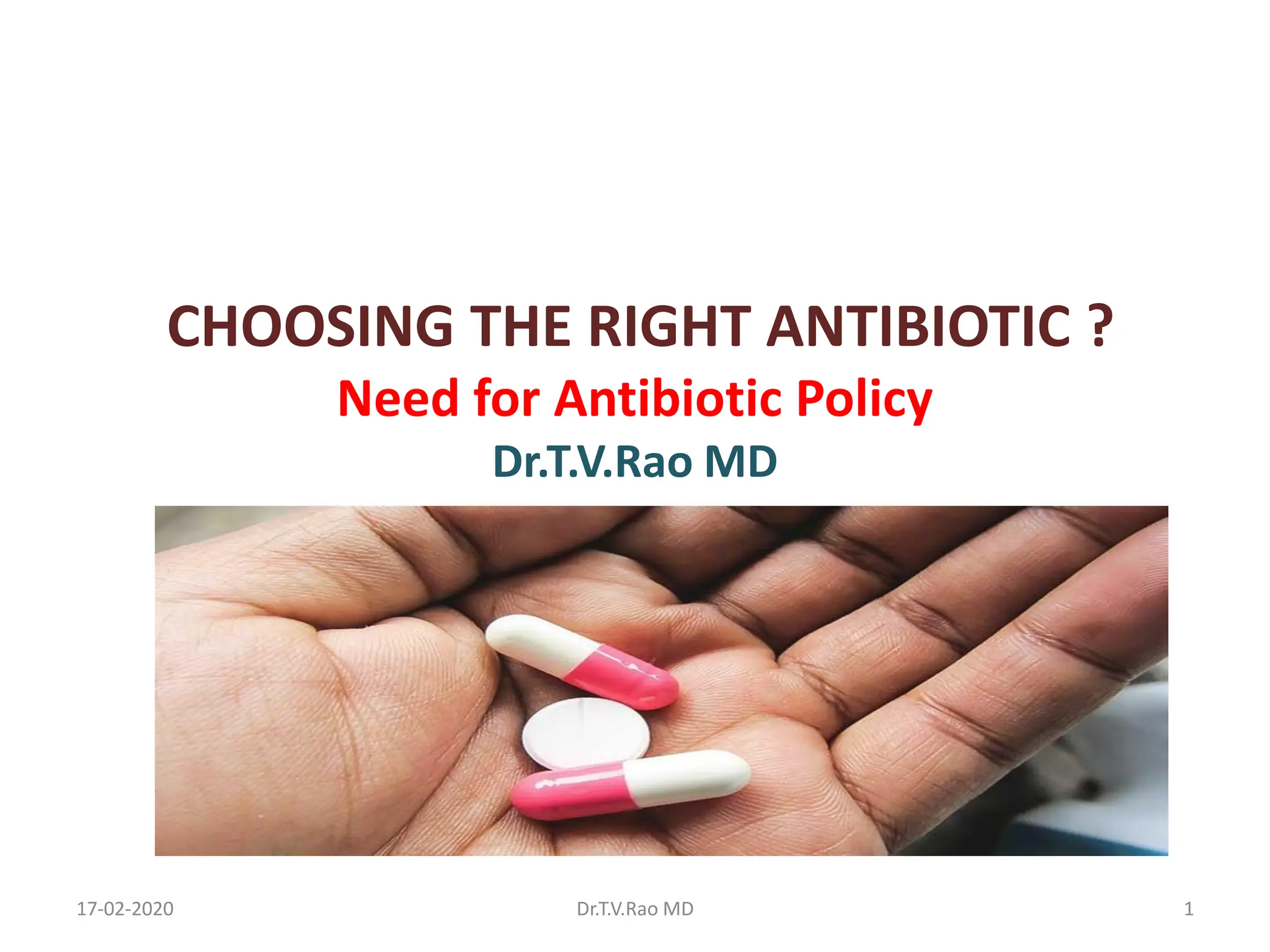
CHOOSING THE RIGHT ANTIBIOTIC ?
Need for Antibiotic Policy
Dr.T.V.Rao MD
17-02-2020 Dr.T.V.Rao MD 1
Antibiotic Pressure and Resistance
in Bacteria
• What is it and why is it important?
• How extensive is it?
• How does it happen?
• What factors promote the spread of resistant
bacteria ?
• How does it pertain to the development of
CA-MRSA infections?
• What can HCW do to curb this trend?
Why We Need to learn more about
Antibiotics
• Antibiotic resistance has developed in almost all
classes of bacteria of pathogenic potential.
• Resistance in organisms of low virulence can emerge
as important pathogens.
• The development of resistant bacteria has driven
pharmaceutical research to develop more potent,
broad-spectrum antibiotics.
• Use of these in turn, has fueled the appearance of
bacteria with newer modes of resistance.
World has Changed with
17-02-2020 Dr.T.V.Rao MD 4
Why take antibiotics?
William Osler, MD (1849 - 1919)
• "The desire to take
medicine is perhaps
the greatest feature
which distinguishes
man from animals."
• "One of the first duties
of the physician is to
educate the masses
not to take medicine"
H. Cushing, Life of Sir William Osler (1925)
Fleming Nobel Prize Speech
identifies
• In his Nobel Prize
acceptance speech,
Fleming identified the risk
of bacteria becoming
resistant to antibiotics. If
a bacterium carries
several resistance genes,
it is called multiresistant
or, informally, a
"superbug."
17-02-2020 Dr.T.V.Rao MD 6
1920 1930 1940 1950 1960 1970 1980 1990 2000
ertapenem
tigecyclin
daptomicin
linezolid
telithromicin
quinup./dalfop.
cefepime
ciprofloxacin
aztreonam
norfloxacin
imipenem
cefotaxime
clavulanic ac.
cefuroxime
gentamicin
cefalotina
nalidíxico ac.
ampicillin
methicilin
vancomicin
rifampin
chlortetracyclin
streptomycin
pencillin G
prontosil
The development
of anti-infectives …
Development of anti-microbials
Dr.T.V.Rao MD 7
17-02-2020
• 50 penicillin's
• 71 cephalosporins
• 12 tetracycline's
• 8 aminoglycosides
• 1 monobactam
• 5 Carbapenems
• 9 macrolides
• 2 streptogramins
• 3 dihydrofolate
reductase
inhibitors
• 1 oxazolidinone
• 5.5 quinolones
Antibiotic brands
17-02-2020 Dr.T.V.Rao MD 8
A Changing Landscape for
Numbers of Approved Antibacterial Agents
Bars represent number of new antimicrobial agents approved by the FDA during the period listed.
0
0
2
4
6
8
10
12
14
16
18
Number
of
agents
approved
1983-87 1988-92 1993-97 1998-02 2003-05 2008
InfectiousDiseases Society of America. Bad Bugs, No Drugs. July 2004; Spellberg B et al. Clin Infect Dis. 2004;38:1279-1286;
New antimicrobialagents. Antimicrob Agents Chemother. 2006;50:1912
Resistance
17-02-2020 Dr.T.V.Rao MD 9
17-02-2020 Dr.T.V.Rao MD 10
Chronology of Development of
Antibiotic Resistance
Antibiotic Year introduced Resistance identified
Penicillin 1942 1940
Streptomycin 1947 1947
Tetracycline 1952 1956
Erythromycin 1955 1956
Gentamicin 1967 1970
Vancomycin 1956 1987
17-02-2020 Dr.T.V.Rao MD 11
Scarcity of New Antibiotics
17-02-2020 Dr.T.V.Rao MD 12
What went wrong with
Antibiotic Usage
• Treating trivial infections / viral
Infections with Antibiotics has
become routine affair.
• Many use Antibiotics without
knowing the Basic principles of
Antibiotic therapy.
• Many Medical practioners are
under pressure for short term
solutions. Dr.T.V.Rao MD 13
17-02-2020
 Use of antibiotics with no clinical
indication (eg, for viral infections)
 Use of broad spectrum antibiotics
when not indicated
 Inappropriate choice of empiric
antibiotics
Inappropriate Antibiotic Use
Pharmaceutical industry
Pushes
• Commercial interests
of Pharmaceutical
industry pushing the
Antibiotics, more so
Broad spectrum and
Newer Generation
antibiotics. as every
Industry has become
profit oriented
17-02-2020 Dr.T.V.Rao MD 15
Poverty and Drug Resistance
• Poverty
encourages drug
resistance due
to under
utilization of
appropriate
Antibiotics.
17-02-2020 Dr.T.V.Rao MD 16
ANTIMICROBIAL RESISTANCE:
The role of animal feed antibiotic additives
• 48% of all antibiotics by weight is added to
animal feeds to promote growth. Results in
low, sub therapeutic levels which are
thought to promote resistance.
• Farm families who own chickens feed
tetracycline have an increased incidence of
tetracycline resistant fecal flora
17-02-2020 Dr.T.V.Rao MD 17
Antibiotics
• Biology and Society
About 50% of the antibiotics produced
today are used in the livestock industry.
What impact does this have on the
treatment of human diseases?
17-02-2020 Dr.T.V.Rao MD 18
Inappropriate use of antibiotics
is a worldwide problem
• More than 50% of all medicines are
prescribed, dispensed or sold inappropriately,
and half of all patients fail to take
medicines correctly.
• The overuse, underuse or misuse of medicines
harms people and wastes resources.
• More than 50% of all countries do not
implement basic policies to promote rational
use of medicines.
17-02-2020 Dr.T.V.Rao MD 19
Chemists real threat
Soaring sales of antibiotics at Indian
pharmacies are compounding drug-resistance
problems
17-02-2020 Dr.T.V.Rao MD 20
Carbapenems a real threat
Source ; Nature ( International Journal of Science)
17-02-2020 Dr.T.V.Rao MD 21
Contribute for Creating Drug
Resistance
• Every time a person
takes antibiotics,
sensitive bacteria are
killed, but resistant
microbes may be left to
grow and multiply.
Repeated and improper
uses of antibiotics are
primary causes of the
increase in drug-
resistant bacteria.
Dr.T.V.Rao MD 22
17-02-2020
Creation of SUPERBUGS
• Antimicrobial resistance is a serious
global challenge. Every continent and
country faces the menace of antibiotic
resistant “super bugs,” though the extent
and the severity of the problem varies.
There could be a return to the
pre-antibiotic era, where many people
could suffer or die from untreatable
bacterial infections
17-02-2020 Dr.T.V.Rao MD 23
Hospital
 Intensive care
units
 Oncology units
 Dialysis units
 Rehab units
 Transplant units
 Burn units
Settings that Foster Drug Resistance
17-02-2020 Dr.T.V.Rao MD 24
Treated without Coordination
• When the patients
to be treated by
several specialists,
multiple
antibiotics
prescribed,
• Drug Antagonism
17-02-2020 Dr.T.V.Rao MD 25
The Nature Magazine
• At the Tata Memorial Centre in Mumbai,
where the oncologist treat, at least half of
bacterial samples (50%) from patients with
infections are resistant to Carbapenems — a
class of ‘second-line’ anti­biotics used to treat
infections that are already resistant to other
Cephalosporin group of drugs. Just a few years
ago, the resistance rate in such samples was
only 30%
17-02-2020 Dr.T.V.Rao MD 26
New Delhi metallo-beta-lactamase 1
India’s Famous Superbug
• New Delhi Metallo-
beta-lactamase (NDM-
1) is a gene that makes
bacteria resistant to
antibiotics of the
Carbapenems family. It
encodes a type of beta-
lactamase enzyme
called a
carbapenemases
17-02-2020 Dr.T.V.Rao MD 27
Why inappropriate
use of antibiotics
contributes to
antibiotic resistance
– the “why”
Dr.T.V.Rao MD 28
17-02-2020
Our Indian Hospitals
• Indian hospitals have reported
very high Gram-negative
resistance rates, with very high
prevalence of ESBL (Extended
Spectrum Beta Lactamases)
producers and also high
carbapenem resistance rates.
17-02-2020 Dr.T.V.Rao MD 29
Pan Drug Resistant Infections
• Increasing carbapenem resistance
will invariably result in increased
usage of colistin, currently the
last line of defence, with a
potential for colistin-resistant and
Pan Drug Resistant bacterial
infections
17-02-2020 Dr.T.V.Rao MD 30
NABH DATA on Indian Hospitals
• As per data available
from NABH assessors
conclave most
accredited hospitals,
though having a well
written antibiotic
policy on paper, are
not compliant in
practice.
17-02-2020 Dr.T.V.Rao MD 31
Can we tackle the Problem
• India, with more than
20,000 hospitals, more
than a billion population,
wide cultural diversity,
socio-economic disparity,
and a large medical
community of more than
three-fourths of a million
doctors, will find the
resistance problem an
issue very difficult to
tackle
17-02-2020 Dr.T.V.Rao MD 32
Hospital Infection Control
Committee (HICC)
• All hospitals must have an infection control
committee and an antibiotic policy and should
initiate or augment efforts towards implementation.
• Those hospitals with an existing ICC and an antibiotic
policy should augment efforts to increase compliance
to the policy. Hospitals without a policy must
initiate efforts to formulate an ICC and an antibiotic
policy.
• ICC should define an annual target for achievement.
17-02-2020 Dr.T.V.Rao MD 33
An antibiotic policy will:
• Improve patient care by promoting the best
practice in antibiotic prophylaxis and therapy,
• Make better use of resources by using cheaper
drugs where possible
• Retard the emergence and spread of multiple
antibiotic-resistant bacteria.
• *Improve education of junior doctors by
providing guidelines for appropriate therapy
• Eliminate the use of unnecessary or ineffective
antibiotics and restrict the use of expensive or
unnecessarily powerful ones
17-02-2020 Dr.T.V.Rao MD 34
The following key persons should
be included in the committee:
• The Pharmacist who will report back
to the Antibiotic Committee at each
meeting on drug utilisation and cost.
• The Microbiologist who will report on
antibiotic susceptibility patterns of
bacteria isolated from major infections.
17-02-2020 Dr.T.V.Rao MD 35
Important Participants
• Clinical doctors and nurses responsible for
direct patient care who provide a link between
clinical practice and the Antibiotic Committee.
• Manger(s) who will ensure the
resources are available for
implementation of the antibiotic policy.
• Reciprocal Membership between the Infection
Control Committee and the Drugs Committee
should be ensured.
17-02-2020 Dr.T.V.Rao MD 36
In-patients are at high risk of antibiotic-
resistant infections
• Misuse of antibiotics in hospitals is one of the
main factors that drive development of
antibiotic resistance.
• Patients in hospitals have a high probability of
receiving an antibioticand 50% [adapt to
national figure where available] of all
antibiotic use in hospitals can be
inappropriate.
Dr.T.V.Rao MD 37
17-02-2020
Misuse of Antibiotics Drives
Antibiotic Resistance
• Studies prove that misuse of antibiotics may
cause patients to become colonized or
infected with antibiotic-resistant bacteria,
such as methicillin-resistant Staphylococcus
aureus (MRSA), vancomycin-resistant
enterococci (VRE) and highly-resistant Gram-
negative bacilli.
• Misuse of antibiotics is also associated with an
increased incidence of Clostridium difficle
infections. Dr.T.V.Rao MD 38
17-02-2020
Why we Need Antibiotic
Policy
Dr.T.V.Rao MD 39
17-02-2020
We are Under
Scanner for many reasons
17-02-2020 Dr.T.V.Rao MD 40
Aim of Antibiotic Policy
• Reduce the Antimicrobial resistance
• Initiate best efforts in the hospital area
as many resistance Bacteria are
generated in Hospital areas and in
particular critical care areas.
• Initiate good hygienic practices so
these bacteria do not spread to
others
• Practice best efforts, these
resistance strains do not spill into
critically ill patients in the Hospital
Dr.T.V.Rao MD 41
17-02-2020
Objectives of Antibiotic Policy.
• Antibiotics should not be used casually
• Policy emphasizes, avoiding the use of
powerful Antibiotics in the Initial
treatments.
• We should create awareness that we are
sparing the powerful Broad spectrum
Drugs for later treatment
Patient saves Money
Doctors save Lives.
Dr.T.V.Rao MD 42
17-02-2020
Aims of the Antibiotic Policy
• Create awareness on Antibiotics as misuse is
counterproductive.
• More effective treatments in serious Infections.
• Reduce Health care associated infections spilling
to society and increase of Community associated
Infections.
( A growing concern in Developing world )
Dr.T.V.Rao MD 43
17-02-2020
Policy Deals on Broad Basis
• Clinicians /
Microbiologists /
Pharmacists and Nurses
do take part.
• Policies are framed on
demands of the Clinical
areas, depending on
recent Infection
surveillance data
contributed from
Microbiology
Departments.
Dr.T.V.Rao MD 44
17-02-2020
The 3 Stratagecies
Will it Work ?
• Complete ban on OTC sale of antibiotics without
prescription throughout the country.
• Complete ban of OTC sale of antibiotics without
prescription in metros and larger cities with a
more liberal approach in smaller cities and
villages.
• A liberal approach throughout the country to
start with, with an initial list of antibiotics under
restriction and addition of other drugs to the list
in a phased manner.
17-02-2020 Dr.T.V.Rao MD 45
Education On Antibiotic policy
• Acton plan for Education to all
concerned clinical staff on Antibiotic
prescriptions.
• Evaluate the feed back of success and
failures of the policy.
• Create Infection surveillance Data
• Developing facilities in Microbiology
departments for auditing data and
guidance
• Restrictions in prescribing and Antibiotic
availability.
• A continuous education to Junior Doctors
Dr.T.V.Rao MD 46
17-02-2020
Ideal Sample Collection is Essential
Requirement
• Proper specimen collection is combined
responsibility of Clinical and Microbiological
Departments.
• Continuous training of junior staff on sample
collection, and is most neglected necessity
• A good clinical history is greatly helpful in
differentiating community acquired infections
from hospital acquired infections.
Dr.T.V.Rao MD 47
17-02-2020
Strategies to Address Antimicrobial
Resistance (STAAR) Act
• “It is critical that Congress protect its
investment in the development of new
antimicrobials by enacting the STAAR Act,
which will strengthen the federal
response to antimicrobial resistance
through enhanced leadership,
surveillance, research, and data
collection
17-02-2020 Dr.T.V.Rao MD 48
Role of Microbiology Departments
• Microbiology labs should issue hospital
Antibiogram at pre-defined intervals. Those
hospitals without good laboratory support should
be willing to outsource samples to better
laboratories. The system of notification of
communicable diseases is a popular,
established, though not strictly followed system
in the country. Multidrug-resistant bacteria,
especially pan-drug resistant bacteria, must be
considered as a notifiable entity. Such a reporting
system should complementnational antimicrobial
resistance surveillance studies.
17-02-2020 Dr.T.V.Rao MD 49
India needs “An implementable antibiotic policy” and
NOT “A perfect policy”
• However, asking for a complete and strict
antibiotic policy in a country where there is
currently no functioning antibiotic policy at all
may not be an intelligent or immediately
viable option without the political will to make
such a drastic change. A multidisciplinary
committee of eminent experts should explore
the options available to us. For example,
should
17-02-2020 Dr.T.V.Rao MD 50
• Antibiotics were
prescribed in 68% of
acute respiratory tract
visits – and of those, 80%
were unnecessary
according to CDC
guidelines
• Children are of particular
concern because they
have the highest rates of
antibiotic use.
Antibiotic Prescribing
Children real Concern
17-02-2020 Dr.T.V.Rao MD 51
Rationalism in Implementation
Many choices ?
• Introduce step- by-
step regulation of
antibiotic usage,
concentrating on
higher end
antibiotics first and
then slowly
extending the list to
second and first line
antibiotics?
17-02-2020 Dr.T.V.Rao MD 52
Monitoring on Colistin
• Strict monitoring on the usage of colistin,
currently the most precious antibiotic in
an era of increasing carbapenem resistance,
must be implemented on an urgent basis.
Colistin prescription should be induplicate,
with a copy to be sent to the pharmacy. The
prescription must be countersigned by a
consultant in 24 hours.
17-02-2020 Dr.T.V.Rao MD 53
Role of Microbiology Departments
• Microbiology labs should issue hospital
Antibiogram at pre-defined intervals. Those
hospitals without good laboratory support should
be willing to outsource samples to better
laboratories Multidrug-resistant bacteria,
especially pan-drug resistant bacteria, must be
considered as a notifiable entity. Such a reporting
system should complement national
antimicrobial resistance surveillance studies.
17-02-2020 Dr.T.V.Rao MD 54
Better services from Microbiology
Departments.
• Basic infrastructure
should be updated for
detection of MRSA
and ESBL producers.
• Documentation of all
Opportunistic
infections. and
Hospital infection
outbreaks
Dr.T.V.Rao MD 55
17-02-2020
Carbapenemases
• Ability to hydrolyze penicillins,cephalosporins,
monobactams, and carbapenems
• Resilient against inhibition by all commercially viable ß-
lactamase inhibitors
– Subgroup 2df: OXA (23 and 48) carbapenemases
– Subgroup 2f : serine carbapenemases from molecular class
A: GES and KPC
– Subgroup 3b contains a smaller group of MBLs that
preferentially hydrolyze carbapenems
• IMP and VIM enzymes that have appeared globally, most
frequently in non-fermentative bacteria but also in
Enterobacteriaceae
17-02-2020 Dr.T.V.Rao MD 56
Notifying Pan Resistant Microbes
Superbugs
• Pan-drug-resistant
Gram-negatives,
carbapenem-
resistant Gram-
Negatives,
Vancomycin-
resistant
Enterococcus and
MRSA should be
made notifiable
17-02-2020 Dr.T.V.Rao MD 57
MDR TB a Threat to Everyone
17-02-2020 Dr.T.V.Rao MD 58
Bedaquiline
• Bedaquilin was the first TB drug to be
discovered in more than 40 years, and the first
one specifically for multi-drug resistant TB (MDR-
TB). MDR-TB arises when the M. tuberculosis
bacteria become resistant to two commonly used
first-line TB drugs — isoniazid and rifampicin.
• But less than six months after FDA approved the
drug under its accelerated approval programme,
is the drug a potential candidate for misuse by
doctors in India? Will it in any way result in
patients developing drug resistance?
17-02-2020 Dr.T.V.Rao MD 59
Role of Medical Council of India
• One of the main reasons for the
inappropriate antibiotic usage by
Indian doctors is the lack of
adequate training on the subject
during undergraduate and post-
graduate courses. This deficit in the
basic training can only be overcome
if there is a change in the curriculum.
17-02-2020 Dr.T.V.Rao MD 60
Curriculum change
• Structured training in antibiotic usage and
infection control should be introduced in both
UG and PG curriculum.
• Infectious Diseases training in UG and PG
curriculum in all specialties.
• Antibiotic stewardship and infection
control one week rotation-3rd, 4th, and
final year MBBS.
17-02-2020 Dr.T.V.Rao MD 61
WHONET
Documentation
Why We Need It
17-02-2020 Dr.T.V.Rao MD 62
What is WHONET
Dr.T.V.Rao MD 63
• WHONET is a free software developed by the
WHO Collaborating Centre for Surveillance of
Antimicrobial Resistance for laboratory-based
surveillance of infectious diseases and antimicrobial
resistance.
• The principal goals of the software are:
• 1 to enhance local use of laboratory data; and
• 2 to promote national and international
collaboration through the exchange of data.
17-02-2020
• The understanding of
the local epidemiology
of microbial
populations; the
selection of
antimicrobial agents;
the identification of
hospital and community
outbreaks; and the
recognition of quality
assurance problems in
laboratory testing.
Whonet helps us in ……
Dr.T.V.Rao MD 64
17-02-2020
All the Documented results are analyzed
in WHONET
• The heart of WHONET is
a software package
designed to collect the
results of antibiotic
resistance tests.
Researchers /
Microbiologists feed
the results into a
computer and look for
trends
Dr.T.V.Rao MD 65
17-02-2020
Clinicians can access data of their patients anytime in
the computer just with click of the mouse
Dr.T.V.Rao MD 66
17-02-2020
• Legacy computer systems,
quality improvement teams,
and strategies for
optimizing antibiotic use
have the potential to
stabilize resistance and
reduce costs by encouraging
heterogeneous prescribing
patterns and use of local
susceptibility patterns to
inform empiric treatment.
Implementation of WHONET CAN HELP TO
MONITOR RESISTANCE
Dr.T.V.Rao MD 67
17-02-2020
No Private Firms Investing in New
Antibiotics
• Drug makers have poured huge
sums into applying genomics and
proteomics to the problem. It has
not worked. Despite the millions
spent,, in a paper in Nature a few
years ago, his firm and others came
up empty-handed: “
17-02-2020 Dr.T.V.Rao MD 68
Thirteen national science academies call
on G8 to act on drug resistance threat
A more responsible approach to drug prescription for
human use
Reduced use of antibiotics and other drugs in animal
husbandry
Incentives for pharmaceutical companies to develop
new drugs to fight infectious disease, especially new
antibiotics
Information and education programmes
A global system of control to combat the spread of
resistant microorganisms
17-02-2020 Dr.T.V.Rao MD 69
Physicians Can Impact
Other clinicians
Patients
Optimize patient evaluation
Adopt judicious antibiotic
prescribing practices
Immunize patients
Optimize consultations with
other clinicians
Use infection control measures
Educate others about
judicious use of antibiotics
17-02-2020 Dr.T.V.Rao MD 70
Best way to keep the matters in Order
Every Hospital should have a policy which
is practicable to their circumstances.
The *Seniors physician in the respective
departments will make the best policy
Rigid guidelines without coordination
will lead to greater failures
The only way to keep Antimicrobial
agents useful is to use them appropriately and
Judiciously
(Burke A.Cunha, MD,MACP Antimicrobial Therapy. Medical Clinics of
North America NOV 2006)
Dr.T.V.Rao MD 71
17-02-2020
Who is A *Senior Physicians
• The young physician
starts life with 20
drugs for each
disease, and the
old(Senior )
physician ends life
with one drug for 20
diseases.
• William Osler
17-02-2020 Dr.T.V.Rao MD 72
Our minimal Targets
• List of available antibiotics agreed by all
clinicians, indicating dosages, routes of
administration and toxicities.
Guidelines for therapy and prophylaxis.
• A regimen selection algorithm also might be
included in an antibiotic policy.
• CLSI guidelines are already followed
17-02-2020 Dr.T.V.Rao MD 73
IMAGINE A WORLD WITHOUT
ANTIBIOTICS
• A world without effective antibiotics is a
terrifying but real prospect. Overuse of
antibiotics has led to dangerous outbreaks of
drug resistant disease, and puts us in very real
danger of a global pandemic. In future we
have to use ???
17-02-2020 Dr.T.V.Rao MD 74
Conclusions
 Antibiotic resistance is a major
problem world-wide
 Resistance is inevitable with use
 Penicillin attained resistance before it is
used
 No new class of antibiotic introduced
over the last two decades
 Appropriate use is the only way of
prolonging the useful life of an antibiotic
17-02-2020 Dr.T.V.Rao MD 75
References
• The Chennai Declaration "Recommendations
of “A roadmap- to tackle the challenge of
antimicrobial resistance” – A joint meeting of
medical societies of India Ghafur etal, Indian
Journal of Cancer | October–December 2012 |
Volume 49 | Issue 4
• CDC, Atlanta USA Emerging Infectious
Diseases
• WHO guidelines on Antibiotic use
17-02-2020 Dr.T.V.Rao MD 76
• Program file Created by Dr.T.V.Rao
MD for awareness and resource
development for Antibiotic
Education
Email
doctortvrao@gmail.com
17-02-2020 Dr.T.V.Rao MD 77

antibioticpolicylecture-200217054132.pdf

  • 1.
    CHOOSING THE RIGHTANTIBIOTIC ? Need for Antibiotic Policy Dr.T.V.Rao MD 17-02-2020 Dr.T.V.Rao MD 1
  • 2.
    Antibiotic Pressure andResistance in Bacteria • What is it and why is it important? • How extensive is it? • How does it happen? • What factors promote the spread of resistant bacteria ? • How does it pertain to the development of CA-MRSA infections? • What can HCW do to curb this trend?
  • 3.
    Why We Needto learn more about Antibiotics • Antibiotic resistance has developed in almost all classes of bacteria of pathogenic potential. • Resistance in organisms of low virulence can emerge as important pathogens. • The development of resistant bacteria has driven pharmaceutical research to develop more potent, broad-spectrum antibiotics. • Use of these in turn, has fueled the appearance of bacteria with newer modes of resistance.
  • 4.
    World has Changedwith 17-02-2020 Dr.T.V.Rao MD 4
  • 5.
    Why take antibiotics? WilliamOsler, MD (1849 - 1919) • "The desire to take medicine is perhaps the greatest feature which distinguishes man from animals." • "One of the first duties of the physician is to educate the masses not to take medicine" H. Cushing, Life of Sir William Osler (1925)
  • 6.
    Fleming Nobel PrizeSpeech identifies • In his Nobel Prize acceptance speech, Fleming identified the risk of bacteria becoming resistant to antibiotics. If a bacterium carries several resistance genes, it is called multiresistant or, informally, a "superbug." 17-02-2020 Dr.T.V.Rao MD 6
  • 7.
    1920 1930 19401950 1960 1970 1980 1990 2000 ertapenem tigecyclin daptomicin linezolid telithromicin quinup./dalfop. cefepime ciprofloxacin aztreonam norfloxacin imipenem cefotaxime clavulanic ac. cefuroxime gentamicin cefalotina nalidíxico ac. ampicillin methicilin vancomicin rifampin chlortetracyclin streptomycin pencillin G prontosil The development of anti-infectives … Development of anti-microbials Dr.T.V.Rao MD 7 17-02-2020
  • 8.
    • 50 penicillin's •71 cephalosporins • 12 tetracycline's • 8 aminoglycosides • 1 monobactam • 5 Carbapenems • 9 macrolides • 2 streptogramins • 3 dihydrofolate reductase inhibitors • 1 oxazolidinone • 5.5 quinolones Antibiotic brands 17-02-2020 Dr.T.V.Rao MD 8
  • 9.
    A Changing Landscapefor Numbers of Approved Antibacterial Agents Bars represent number of new antimicrobial agents approved by the FDA during the period listed. 0 0 2 4 6 8 10 12 14 16 18 Number of agents approved 1983-87 1988-92 1993-97 1998-02 2003-05 2008 InfectiousDiseases Society of America. Bad Bugs, No Drugs. July 2004; Spellberg B et al. Clin Infect Dis. 2004;38:1279-1286; New antimicrobialagents. Antimicrob Agents Chemother. 2006;50:1912 Resistance 17-02-2020 Dr.T.V.Rao MD 9
  • 10.
  • 11.
    Chronology of Developmentof Antibiotic Resistance Antibiotic Year introduced Resistance identified Penicillin 1942 1940 Streptomycin 1947 1947 Tetracycline 1952 1956 Erythromycin 1955 1956 Gentamicin 1967 1970 Vancomycin 1956 1987 17-02-2020 Dr.T.V.Rao MD 11
  • 12.
    Scarcity of NewAntibiotics 17-02-2020 Dr.T.V.Rao MD 12
  • 13.
    What went wrongwith Antibiotic Usage • Treating trivial infections / viral Infections with Antibiotics has become routine affair. • Many use Antibiotics without knowing the Basic principles of Antibiotic therapy. • Many Medical practioners are under pressure for short term solutions. Dr.T.V.Rao MD 13 17-02-2020
  • 14.
     Use ofantibiotics with no clinical indication (eg, for viral infections)  Use of broad spectrum antibiotics when not indicated  Inappropriate choice of empiric antibiotics Inappropriate Antibiotic Use
  • 15.
    Pharmaceutical industry Pushes • Commercialinterests of Pharmaceutical industry pushing the Antibiotics, more so Broad spectrum and Newer Generation antibiotics. as every Industry has become profit oriented 17-02-2020 Dr.T.V.Rao MD 15
  • 16.
    Poverty and DrugResistance • Poverty encourages drug resistance due to under utilization of appropriate Antibiotics. 17-02-2020 Dr.T.V.Rao MD 16
  • 17.
    ANTIMICROBIAL RESISTANCE: The roleof animal feed antibiotic additives • 48% of all antibiotics by weight is added to animal feeds to promote growth. Results in low, sub therapeutic levels which are thought to promote resistance. • Farm families who own chickens feed tetracycline have an increased incidence of tetracycline resistant fecal flora 17-02-2020 Dr.T.V.Rao MD 17
  • 18.
    Antibiotics • Biology andSociety About 50% of the antibiotics produced today are used in the livestock industry. What impact does this have on the treatment of human diseases? 17-02-2020 Dr.T.V.Rao MD 18
  • 19.
    Inappropriate use ofantibiotics is a worldwide problem • More than 50% of all medicines are prescribed, dispensed or sold inappropriately, and half of all patients fail to take medicines correctly. • The overuse, underuse or misuse of medicines harms people and wastes resources. • More than 50% of all countries do not implement basic policies to promote rational use of medicines. 17-02-2020 Dr.T.V.Rao MD 19
  • 20.
    Chemists real threat Soaringsales of antibiotics at Indian pharmacies are compounding drug-resistance problems 17-02-2020 Dr.T.V.Rao MD 20
  • 21.
    Carbapenems a realthreat Source ; Nature ( International Journal of Science) 17-02-2020 Dr.T.V.Rao MD 21
  • 22.
    Contribute for CreatingDrug Resistance • Every time a person takes antibiotics, sensitive bacteria are killed, but resistant microbes may be left to grow and multiply. Repeated and improper uses of antibiotics are primary causes of the increase in drug- resistant bacteria. Dr.T.V.Rao MD 22 17-02-2020
  • 23.
    Creation of SUPERBUGS •Antimicrobial resistance is a serious global challenge. Every continent and country faces the menace of antibiotic resistant “super bugs,” though the extent and the severity of the problem varies. There could be a return to the pre-antibiotic era, where many people could suffer or die from untreatable bacterial infections 17-02-2020 Dr.T.V.Rao MD 23
  • 24.
    Hospital  Intensive care units Oncology units  Dialysis units  Rehab units  Transplant units  Burn units Settings that Foster Drug Resistance 17-02-2020 Dr.T.V.Rao MD 24
  • 25.
    Treated without Coordination •When the patients to be treated by several specialists, multiple antibiotics prescribed, • Drug Antagonism 17-02-2020 Dr.T.V.Rao MD 25
  • 26.
    The Nature Magazine •At the Tata Memorial Centre in Mumbai, where the oncologist treat, at least half of bacterial samples (50%) from patients with infections are resistant to Carbapenems — a class of ‘second-line’ anti­biotics used to treat infections that are already resistant to other Cephalosporin group of drugs. Just a few years ago, the resistance rate in such samples was only 30% 17-02-2020 Dr.T.V.Rao MD 26
  • 27.
    New Delhi metallo-beta-lactamase1 India’s Famous Superbug • New Delhi Metallo- beta-lactamase (NDM- 1) is a gene that makes bacteria resistant to antibiotics of the Carbapenems family. It encodes a type of beta- lactamase enzyme called a carbapenemases 17-02-2020 Dr.T.V.Rao MD 27
  • 28.
    Why inappropriate use ofantibiotics contributes to antibiotic resistance – the “why” Dr.T.V.Rao MD 28 17-02-2020
  • 29.
    Our Indian Hospitals •Indian hospitals have reported very high Gram-negative resistance rates, with very high prevalence of ESBL (Extended Spectrum Beta Lactamases) producers and also high carbapenem resistance rates. 17-02-2020 Dr.T.V.Rao MD 29
  • 30.
    Pan Drug ResistantInfections • Increasing carbapenem resistance will invariably result in increased usage of colistin, currently the last line of defence, with a potential for colistin-resistant and Pan Drug Resistant bacterial infections 17-02-2020 Dr.T.V.Rao MD 30
  • 31.
    NABH DATA onIndian Hospitals • As per data available from NABH assessors conclave most accredited hospitals, though having a well written antibiotic policy on paper, are not compliant in practice. 17-02-2020 Dr.T.V.Rao MD 31
  • 32.
    Can we tacklethe Problem • India, with more than 20,000 hospitals, more than a billion population, wide cultural diversity, socio-economic disparity, and a large medical community of more than three-fourths of a million doctors, will find the resistance problem an issue very difficult to tackle 17-02-2020 Dr.T.V.Rao MD 32
  • 33.
    Hospital Infection Control Committee(HICC) • All hospitals must have an infection control committee and an antibiotic policy and should initiate or augment efforts towards implementation. • Those hospitals with an existing ICC and an antibiotic policy should augment efforts to increase compliance to the policy. Hospitals without a policy must initiate efforts to formulate an ICC and an antibiotic policy. • ICC should define an annual target for achievement. 17-02-2020 Dr.T.V.Rao MD 33
  • 34.
    An antibiotic policywill: • Improve patient care by promoting the best practice in antibiotic prophylaxis and therapy, • Make better use of resources by using cheaper drugs where possible • Retard the emergence and spread of multiple antibiotic-resistant bacteria. • *Improve education of junior doctors by providing guidelines for appropriate therapy • Eliminate the use of unnecessary or ineffective antibiotics and restrict the use of expensive or unnecessarily powerful ones 17-02-2020 Dr.T.V.Rao MD 34
  • 35.
    The following keypersons should be included in the committee: • The Pharmacist who will report back to the Antibiotic Committee at each meeting on drug utilisation and cost. • The Microbiologist who will report on antibiotic susceptibility patterns of bacteria isolated from major infections. 17-02-2020 Dr.T.V.Rao MD 35
  • 36.
    Important Participants • Clinicaldoctors and nurses responsible for direct patient care who provide a link between clinical practice and the Antibiotic Committee. • Manger(s) who will ensure the resources are available for implementation of the antibiotic policy. • Reciprocal Membership between the Infection Control Committee and the Drugs Committee should be ensured. 17-02-2020 Dr.T.V.Rao MD 36
  • 37.
    In-patients are athigh risk of antibiotic- resistant infections • Misuse of antibiotics in hospitals is one of the main factors that drive development of antibiotic resistance. • Patients in hospitals have a high probability of receiving an antibioticand 50% [adapt to national figure where available] of all antibiotic use in hospitals can be inappropriate. Dr.T.V.Rao MD 37 17-02-2020
  • 38.
    Misuse of AntibioticsDrives Antibiotic Resistance • Studies prove that misuse of antibiotics may cause patients to become colonized or infected with antibiotic-resistant bacteria, such as methicillin-resistant Staphylococcus aureus (MRSA), vancomycin-resistant enterococci (VRE) and highly-resistant Gram- negative bacilli. • Misuse of antibiotics is also associated with an increased incidence of Clostridium difficle infections. Dr.T.V.Rao MD 38 17-02-2020
  • 39.
    Why we NeedAntibiotic Policy Dr.T.V.Rao MD 39 17-02-2020
  • 40.
    We are Under Scannerfor many reasons 17-02-2020 Dr.T.V.Rao MD 40
  • 41.
    Aim of AntibioticPolicy • Reduce the Antimicrobial resistance • Initiate best efforts in the hospital area as many resistance Bacteria are generated in Hospital areas and in particular critical care areas. • Initiate good hygienic practices so these bacteria do not spread to others • Practice best efforts, these resistance strains do not spill into critically ill patients in the Hospital Dr.T.V.Rao MD 41 17-02-2020
  • 42.
    Objectives of AntibioticPolicy. • Antibiotics should not be used casually • Policy emphasizes, avoiding the use of powerful Antibiotics in the Initial treatments. • We should create awareness that we are sparing the powerful Broad spectrum Drugs for later treatment Patient saves Money Doctors save Lives. Dr.T.V.Rao MD 42 17-02-2020
  • 43.
    Aims of theAntibiotic Policy • Create awareness on Antibiotics as misuse is counterproductive. • More effective treatments in serious Infections. • Reduce Health care associated infections spilling to society and increase of Community associated Infections. ( A growing concern in Developing world ) Dr.T.V.Rao MD 43 17-02-2020
  • 44.
    Policy Deals onBroad Basis • Clinicians / Microbiologists / Pharmacists and Nurses do take part. • Policies are framed on demands of the Clinical areas, depending on recent Infection surveillance data contributed from Microbiology Departments. Dr.T.V.Rao MD 44 17-02-2020
  • 45.
    The 3 Stratagecies Willit Work ? • Complete ban on OTC sale of antibiotics without prescription throughout the country. • Complete ban of OTC sale of antibiotics without prescription in metros and larger cities with a more liberal approach in smaller cities and villages. • A liberal approach throughout the country to start with, with an initial list of antibiotics under restriction and addition of other drugs to the list in a phased manner. 17-02-2020 Dr.T.V.Rao MD 45
  • 46.
    Education On Antibioticpolicy • Acton plan for Education to all concerned clinical staff on Antibiotic prescriptions. • Evaluate the feed back of success and failures of the policy. • Create Infection surveillance Data • Developing facilities in Microbiology departments for auditing data and guidance • Restrictions in prescribing and Antibiotic availability. • A continuous education to Junior Doctors Dr.T.V.Rao MD 46 17-02-2020
  • 47.
    Ideal Sample Collectionis Essential Requirement • Proper specimen collection is combined responsibility of Clinical and Microbiological Departments. • Continuous training of junior staff on sample collection, and is most neglected necessity • A good clinical history is greatly helpful in differentiating community acquired infections from hospital acquired infections. Dr.T.V.Rao MD 47 17-02-2020
  • 48.
    Strategies to AddressAntimicrobial Resistance (STAAR) Act • “It is critical that Congress protect its investment in the development of new antimicrobials by enacting the STAAR Act, which will strengthen the federal response to antimicrobial resistance through enhanced leadership, surveillance, research, and data collection 17-02-2020 Dr.T.V.Rao MD 48
  • 49.
    Role of MicrobiologyDepartments • Microbiology labs should issue hospital Antibiogram at pre-defined intervals. Those hospitals without good laboratory support should be willing to outsource samples to better laboratories. The system of notification of communicable diseases is a popular, established, though not strictly followed system in the country. Multidrug-resistant bacteria, especially pan-drug resistant bacteria, must be considered as a notifiable entity. Such a reporting system should complementnational antimicrobial resistance surveillance studies. 17-02-2020 Dr.T.V.Rao MD 49
  • 50.
    India needs “Animplementable antibiotic policy” and NOT “A perfect policy” • However, asking for a complete and strict antibiotic policy in a country where there is currently no functioning antibiotic policy at all may not be an intelligent or immediately viable option without the political will to make such a drastic change. A multidisciplinary committee of eminent experts should explore the options available to us. For example, should 17-02-2020 Dr.T.V.Rao MD 50
  • 51.
    • Antibiotics were prescribedin 68% of acute respiratory tract visits – and of those, 80% were unnecessary according to CDC guidelines • Children are of particular concern because they have the highest rates of antibiotic use. Antibiotic Prescribing Children real Concern 17-02-2020 Dr.T.V.Rao MD 51
  • 52.
    Rationalism in Implementation Manychoices ? • Introduce step- by- step regulation of antibiotic usage, concentrating on higher end antibiotics first and then slowly extending the list to second and first line antibiotics? 17-02-2020 Dr.T.V.Rao MD 52
  • 53.
    Monitoring on Colistin •Strict monitoring on the usage of colistin, currently the most precious antibiotic in an era of increasing carbapenem resistance, must be implemented on an urgent basis. Colistin prescription should be induplicate, with a copy to be sent to the pharmacy. The prescription must be countersigned by a consultant in 24 hours. 17-02-2020 Dr.T.V.Rao MD 53
  • 54.
    Role of MicrobiologyDepartments • Microbiology labs should issue hospital Antibiogram at pre-defined intervals. Those hospitals without good laboratory support should be willing to outsource samples to better laboratories Multidrug-resistant bacteria, especially pan-drug resistant bacteria, must be considered as a notifiable entity. Such a reporting system should complement national antimicrobial resistance surveillance studies. 17-02-2020 Dr.T.V.Rao MD 54
  • 55.
    Better services fromMicrobiology Departments. • Basic infrastructure should be updated for detection of MRSA and ESBL producers. • Documentation of all Opportunistic infections. and Hospital infection outbreaks Dr.T.V.Rao MD 55 17-02-2020
  • 56.
    Carbapenemases • Ability tohydrolyze penicillins,cephalosporins, monobactams, and carbapenems • Resilient against inhibition by all commercially viable ß- lactamase inhibitors – Subgroup 2df: OXA (23 and 48) carbapenemases – Subgroup 2f : serine carbapenemases from molecular class A: GES and KPC – Subgroup 3b contains a smaller group of MBLs that preferentially hydrolyze carbapenems • IMP and VIM enzymes that have appeared globally, most frequently in non-fermentative bacteria but also in Enterobacteriaceae 17-02-2020 Dr.T.V.Rao MD 56
  • 57.
    Notifying Pan ResistantMicrobes Superbugs • Pan-drug-resistant Gram-negatives, carbapenem- resistant Gram- Negatives, Vancomycin- resistant Enterococcus and MRSA should be made notifiable 17-02-2020 Dr.T.V.Rao MD 57
  • 58.
    MDR TB aThreat to Everyone 17-02-2020 Dr.T.V.Rao MD 58
  • 59.
    Bedaquiline • Bedaquilin wasthe first TB drug to be discovered in more than 40 years, and the first one specifically for multi-drug resistant TB (MDR- TB). MDR-TB arises when the M. tuberculosis bacteria become resistant to two commonly used first-line TB drugs — isoniazid and rifampicin. • But less than six months after FDA approved the drug under its accelerated approval programme, is the drug a potential candidate for misuse by doctors in India? Will it in any way result in patients developing drug resistance? 17-02-2020 Dr.T.V.Rao MD 59
  • 60.
    Role of MedicalCouncil of India • One of the main reasons for the inappropriate antibiotic usage by Indian doctors is the lack of adequate training on the subject during undergraduate and post- graduate courses. This deficit in the basic training can only be overcome if there is a change in the curriculum. 17-02-2020 Dr.T.V.Rao MD 60
  • 61.
    Curriculum change • Structuredtraining in antibiotic usage and infection control should be introduced in both UG and PG curriculum. • Infectious Diseases training in UG and PG curriculum in all specialties. • Antibiotic stewardship and infection control one week rotation-3rd, 4th, and final year MBBS. 17-02-2020 Dr.T.V.Rao MD 61
  • 62.
    WHONET Documentation Why We NeedIt 17-02-2020 Dr.T.V.Rao MD 62
  • 63.
    What is WHONET Dr.T.V.RaoMD 63 • WHONET is a free software developed by the WHO Collaborating Centre for Surveillance of Antimicrobial Resistance for laboratory-based surveillance of infectious diseases and antimicrobial resistance. • The principal goals of the software are: • 1 to enhance local use of laboratory data; and • 2 to promote national and international collaboration through the exchange of data. 17-02-2020
  • 64.
    • The understandingof the local epidemiology of microbial populations; the selection of antimicrobial agents; the identification of hospital and community outbreaks; and the recognition of quality assurance problems in laboratory testing. Whonet helps us in …… Dr.T.V.Rao MD 64 17-02-2020
  • 65.
    All the Documentedresults are analyzed in WHONET • The heart of WHONET is a software package designed to collect the results of antibiotic resistance tests. Researchers / Microbiologists feed the results into a computer and look for trends Dr.T.V.Rao MD 65 17-02-2020
  • 66.
    Clinicians can accessdata of their patients anytime in the computer just with click of the mouse Dr.T.V.Rao MD 66 17-02-2020
  • 67.
    • Legacy computersystems, quality improvement teams, and strategies for optimizing antibiotic use have the potential to stabilize resistance and reduce costs by encouraging heterogeneous prescribing patterns and use of local susceptibility patterns to inform empiric treatment. Implementation of WHONET CAN HELP TO MONITOR RESISTANCE Dr.T.V.Rao MD 67 17-02-2020
  • 68.
    No Private FirmsInvesting in New Antibiotics • Drug makers have poured huge sums into applying genomics and proteomics to the problem. It has not worked. Despite the millions spent,, in a paper in Nature a few years ago, his firm and others came up empty-handed: “ 17-02-2020 Dr.T.V.Rao MD 68
  • 69.
    Thirteen national scienceacademies call on G8 to act on drug resistance threat A more responsible approach to drug prescription for human use Reduced use of antibiotics and other drugs in animal husbandry Incentives for pharmaceutical companies to develop new drugs to fight infectious disease, especially new antibiotics Information and education programmes A global system of control to combat the spread of resistant microorganisms 17-02-2020 Dr.T.V.Rao MD 69
  • 70.
    Physicians Can Impact Otherclinicians Patients Optimize patient evaluation Adopt judicious antibiotic prescribing practices Immunize patients Optimize consultations with other clinicians Use infection control measures Educate others about judicious use of antibiotics 17-02-2020 Dr.T.V.Rao MD 70
  • 71.
    Best way tokeep the matters in Order Every Hospital should have a policy which is practicable to their circumstances. The *Seniors physician in the respective departments will make the best policy Rigid guidelines without coordination will lead to greater failures The only way to keep Antimicrobial agents useful is to use them appropriately and Judiciously (Burke A.Cunha, MD,MACP Antimicrobial Therapy. Medical Clinics of North America NOV 2006) Dr.T.V.Rao MD 71 17-02-2020
  • 72.
    Who is A*Senior Physicians • The young physician starts life with 20 drugs for each disease, and the old(Senior ) physician ends life with one drug for 20 diseases. • William Osler 17-02-2020 Dr.T.V.Rao MD 72
  • 73.
    Our minimal Targets •List of available antibiotics agreed by all clinicians, indicating dosages, routes of administration and toxicities. Guidelines for therapy and prophylaxis. • A regimen selection algorithm also might be included in an antibiotic policy. • CLSI guidelines are already followed 17-02-2020 Dr.T.V.Rao MD 73
  • 74.
    IMAGINE A WORLDWITHOUT ANTIBIOTICS • A world without effective antibiotics is a terrifying but real prospect. Overuse of antibiotics has led to dangerous outbreaks of drug resistant disease, and puts us in very real danger of a global pandemic. In future we have to use ??? 17-02-2020 Dr.T.V.Rao MD 74
  • 75.
    Conclusions  Antibiotic resistanceis a major problem world-wide  Resistance is inevitable with use  Penicillin attained resistance before it is used  No new class of antibiotic introduced over the last two decades  Appropriate use is the only way of prolonging the useful life of an antibiotic 17-02-2020 Dr.T.V.Rao MD 75
  • 76.
    References • The ChennaiDeclaration "Recommendations of “A roadmap- to tackle the challenge of antimicrobial resistance” – A joint meeting of medical societies of India Ghafur etal, Indian Journal of Cancer | October–December 2012 | Volume 49 | Issue 4 • CDC, Atlanta USA Emerging Infectious Diseases • WHO guidelines on Antibiotic use 17-02-2020 Dr.T.V.Rao MD 76
  • 77.
    • Program fileCreated by Dr.T.V.Rao MD for awareness and resource development for Antibiotic Education Email doctortvrao@gmail.com 17-02-2020 Dr.T.V.Rao MD 77