Name - Ankit Goel
Class – X D
Roll No. - 18
Submitted To:
Ms. Neeru
POLYNOMIAL – A polynomial in one
variable X is an algebraic expression in X of
the form
NOT A POLYNOMIAL – The expression
like 1x  1,x+2 etc are not polynomials .
Degree of polynomial - The highest power of x
in p(x) is called the degree of the polynomial
p(x).
EXAMPLE –
1. F(x) = 3x +½ is a polynomial in the variable
x of degree 1.
2. g(y) = 2y²  ⅜ y +7 is a polynomial in the
variable y of degree 2 .
CONSTANT POLYNOMIAL – A polynomial of
degree zero is called a constant polynomial.
EXAMPLE - F(x) = 7 etc .
1. It is also called zero polynomial.
2. The degree of the zero polynomial is not defined
.
LINEAR POLYNOMIAL – A polynomial
of degree 1 is called a linear polynomial .
EXAMPLE - 2x3 , 3x +5 etc .
The most general form of a linear
polynomial
is ax  b , a  0 ,a & b are real.
QUADRATIC POLYNOMIAL – A
polynomial of degree 2 is called quadratic
polynomial .
EXAMPLE – 2x²  3x  ⅔ , y²  2 etc .
More generally , any quadratic polynomial in x
with real coefficient is of the form ax² + bx + c,
where a, b, c are real numbers and a  0
CUBIC POLYNOMIAL – A polynomial of
degree 3 is called a cubic polynomial .
EXAMPLE = 2  x³ , x³, etc .
The most general form of a cubic polynomial
with coefficients as real numbers is ax³  bx² 
cx  d , a ,b ,c ,d are reals .
A real number k is said to a zero of a polynomial
p(x), if said to be a zero of a polynomial p(x), if
p(k) = 0 . For example, consider the polynomial
p(x) = x³  3x  4 . Then,
p(1) = (1)²  (3(1)  4 = 0
Also, p(4) = (4)²  (3 4)  4 = 0
Here,  1 and 4 are called the zeroes of the
quadratic polynomial x²  3x  4 .
We know that a real number k is a zero of the
polynomial p(x) if p(K) = 0 . But to understand
the importance of finding the zeroes of a
polynomial, first we shall see the geometrical
meaning of –
1) Linear polynomial .
2) Quadratic polynomial
3) Cubic polynomial
For a linear polynomial ax  b , a  0, the
graph of y = ax b is a straight line . Which
intersect the x axis and which intersect the x
axis exactly one point ( b  2 , 0 ) .
Therefore the linear polynomial ax  b , a 
0 has exactly one zero .
For any quadratic polynomial ax²  bx c, a 
0, the graph of the corresponding equation y =
ax²  bx  c has one of the two shapes either
open upwards or open downward depending on
whether a0 or a0 .these curves are called
parabolas .
The zeroes of a cubic polynomial p(x) are the x
coordinates of the points where the graph of y =
p(x) intersect the x – axis . Also , there are at most 3
zeroes for the cubic polynomials . In fact, any
polynomial of degree 3 can have at most three
zeroes .
For a quadratic polynomial – In general, if  and  are the
zeroes of a quadratic polynomial p(x) = ax²  bx  c , a  0 ,
then we know that x   and x  are the factors of p(x) .
Therefore ,
ax²  bx  c = k ( x  ) ( x   ) ,
Where k is a constant = k[x²  (  )x ]
= kx²  k(    ) x  k 
Comparing the coefficients of x² , x and constant term on
both the sides .
Therefore , sum of zeroes =  b  a
=  (coefficients of x)  coefficient of x²
Product of zeroes = c  a = constant term  coefficient of x²
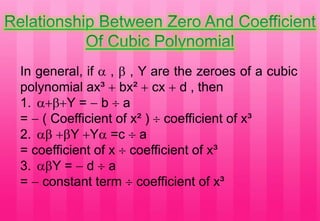
In general, if  ,  , Y are the zeroes of a cubic
polynomial ax³  bx²  cx  d , then
1. Y =  b  a
=  ( Coefficient of x² )  coefficient of x³
2.  Y Y =c  a
= coefficient of x  coefficient of x³
3. Y =  d  a
=  constant term  coefficient of x³
If p(x) and g(x) are any two polynomials with g(x)
 0, then we can find polynomials q(x) and r(x)
such that –
p(x) = q(x)  g(x)  r(x)
Where r(x) = 0 or degree of r(x)  degree of g(x) .
This result is taken as division algorithm for
polynomials .
Polynomials

Polynomials

  • 1.
    Name - AnkitGoel Class – X D Roll No. - 18 Submitted To: Ms. Neeru
  • 2.
    POLYNOMIAL – Apolynomial in one variable X is an algebraic expression in X of the form NOT A POLYNOMIAL – The expression like 1x  1,x+2 etc are not polynomials .
  • 3.
    Degree of polynomial- The highest power of x in p(x) is called the degree of the polynomial p(x). EXAMPLE – 1. F(x) = 3x +½ is a polynomial in the variable x of degree 1. 2. g(y) = 2y²  ⅜ y +7 is a polynomial in the variable y of degree 2 .
  • 4.
    CONSTANT POLYNOMIAL –A polynomial of degree zero is called a constant polynomial. EXAMPLE - F(x) = 7 etc . 1. It is also called zero polynomial. 2. The degree of the zero polynomial is not defined .
  • 5.
    LINEAR POLYNOMIAL –A polynomial of degree 1 is called a linear polynomial . EXAMPLE - 2x3 , 3x +5 etc . The most general form of a linear polynomial is ax  b , a  0 ,a & b are real.
  • 6.
    QUADRATIC POLYNOMIAL –A polynomial of degree 2 is called quadratic polynomial . EXAMPLE – 2x²  3x  ⅔ , y²  2 etc . More generally , any quadratic polynomial in x with real coefficient is of the form ax² + bx + c, where a, b, c are real numbers and a  0
  • 7.
    CUBIC POLYNOMIAL –A polynomial of degree 3 is called a cubic polynomial . EXAMPLE = 2  x³ , x³, etc . The most general form of a cubic polynomial with coefficients as real numbers is ax³  bx²  cx  d , a ,b ,c ,d are reals .
  • 8.
    A real numberk is said to a zero of a polynomial p(x), if said to be a zero of a polynomial p(x), if p(k) = 0 . For example, consider the polynomial p(x) = x³  3x  4 . Then, p(1) = (1)²  (3(1)  4 = 0 Also, p(4) = (4)²  (3 4)  4 = 0 Here,  1 and 4 are called the zeroes of the quadratic polynomial x²  3x  4 .
  • 9.
    We know thata real number k is a zero of the polynomial p(x) if p(K) = 0 . But to understand the importance of finding the zeroes of a polynomial, first we shall see the geometrical meaning of – 1) Linear polynomial . 2) Quadratic polynomial 3) Cubic polynomial
  • 10.
    For a linearpolynomial ax  b , a  0, the graph of y = ax b is a straight line . Which intersect the x axis and which intersect the x axis exactly one point ( b  2 , 0 ) . Therefore the linear polynomial ax  b , a  0 has exactly one zero .
  • 11.
    For any quadraticpolynomial ax²  bx c, a  0, the graph of the corresponding equation y = ax²  bx  c has one of the two shapes either open upwards or open downward depending on whether a0 or a0 .these curves are called parabolas .
  • 12.
    The zeroes ofa cubic polynomial p(x) are the x coordinates of the points where the graph of y = p(x) intersect the x – axis . Also , there are at most 3 zeroes for the cubic polynomials . In fact, any polynomial of degree 3 can have at most three zeroes .
  • 13.
    For a quadraticpolynomial – In general, if  and  are the zeroes of a quadratic polynomial p(x) = ax²  bx  c , a  0 , then we know that x   and x  are the factors of p(x) . Therefore , ax²  bx  c = k ( x  ) ( x   ) , Where k is a constant = k[x²  (  )x ] = kx²  k(    ) x  k  Comparing the coefficients of x² , x and constant term on both the sides . Therefore , sum of zeroes =  b  a =  (coefficients of x)  coefficient of x² Product of zeroes = c  a = constant term  coefficient of x²
  • 14.
    In general, if ,  , Y are the zeroes of a cubic polynomial ax³  bx²  cx  d , then 1. Y =  b  a =  ( Coefficient of x² )  coefficient of x³ 2.  Y Y =c  a = coefficient of x  coefficient of x³ 3. Y =  d  a =  constant term  coefficient of x³
  • 15.
    If p(x) andg(x) are any two polynomials with g(x)  0, then we can find polynomials q(x) and r(x) such that – p(x) = q(x)  g(x)  r(x) Where r(x) = 0 or degree of r(x)  degree of g(x) . This result is taken as division algorithm for polynomials .