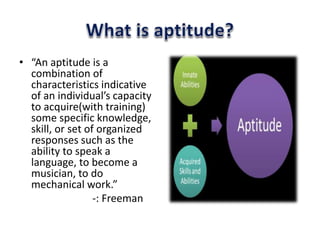

• “An aptitude is a
combination of
characteristics indicative
of an individual’s capacity
to acquire(with training)
some specific knowledge,
skill, or set of organized
responses such as the
ability to speak a
language, to become a
musician, to do
mechanical work.”
-: Freeman
“An aptitude test is
one designed to
measure a person’s
potential ability in
an activity of a
special kind &
within a restricted
range.”
:- Freeman
• To obtain a measure of
a person’s essential
teachability in a given
area.
• To asses one’s degree of
special bent.
• To estimate the extent
to which an individual
would profit or achieve
success from specific
course or training.
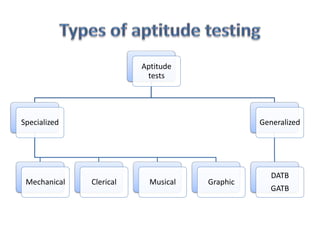
Aptitude
tests
Specialized
Mechanical Clerical Musical Graphic
Generalized
DATB
GATB
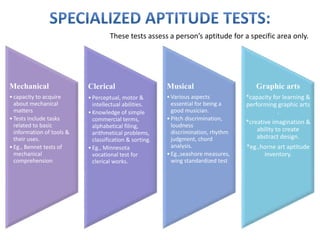
Mechanical
•capacity to acquire
about mechanical
matters
•Tests include tasks
related to basic
information of tools &
their uses.
•Eg., Bennet tests of
mechanical
comprehension
Clerical
•Perceptual, motor &
intellectual abilities.
•Knowledge of simple
commercial terms,
alphabetical filing,
arithmetical problems,
classification & sorting.
•Eg., Minnesota
vocational test for
clerical works.
Musical
•Various aspects
essential for being a
good musician.
•Pitch discrimination,
loudness
discrimination, rhythm
judgment, chord
analysis.
•Eg.,seashore measures,
wing standardized test
Graphic arts
*capacity for learning &
performing graphic arts
.
*creative imagination &
ability to create
abstract design.
*eg.,horne art aptitude
inventory.
These tests assess a person’s aptitude for a specific area only.
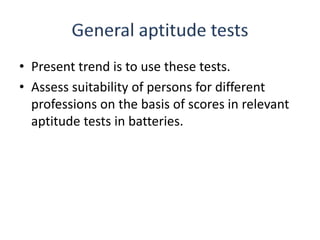
• Present trend is to use these tests.
• Assess suitability of persons for different
professions on the basis of scores in relevant
aptitude tests in batteries.
Some examples of aptitude tests
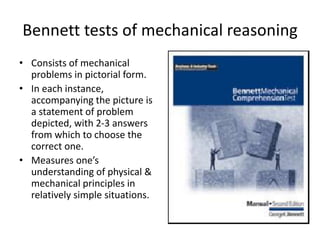
Bennett tests of mechanical reasoning
• Consists of mechanical
problems in pictorial form.
• In each instance,
accompanying the picture is
a statement of problem
depicted, with 2-3 answers
from which to choose the
correct one.
• Measures one’s
understanding of physical &
mechanical principles in
relatively simple situations.
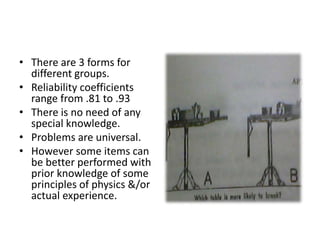
• There are 3 forms for
different groups.
• Reliability coefficients
range from .81 to .93
• There is no need of any
special knowledge.
• Problems are universal.
• However some items can
be better performed with
prior knowledge of some
principles of physics &/or
actual experience.
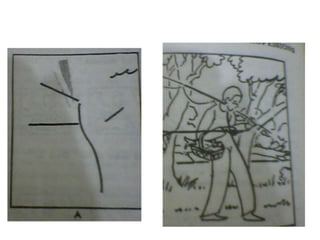
The Horne art aptitude inventory
• Was devised to use with applicants for
admissions to arts school.
• Creativeness test
• In the first part, subject requires to draw 20
familiar objects within short time limits.
Subject also has to create simple abstract
designs starting with given set of triangle,
rectangle, etc.
• In the second part, “imagery” there are 12
cards, each has several lines that must serve
as a basis of picture to be drawn.
• Scoring is done on the basis of creative
imagination & technical quality. Examples are
provided for rating good, excellent, average or
poor.
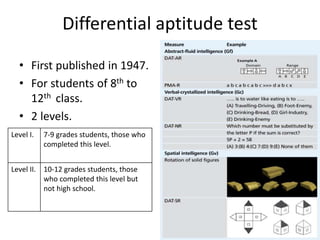
Differential aptitude test
• First published in 1947.
• For students of 8th to
12th class.
• 2 levels.
Level I. 7-9 grades students, those who
completed this level.
Level II. 10-12 grades students, those
who completed this level but
not high school.
• 8 tests in this battery.
1 Verbal reasoning
2 Numerical reasoning
3 Abstract reasoning
4 Mechanical reasoning
5 Perceptual speed & accuracy
6 Space relations
7 Spelling
8 Language usage
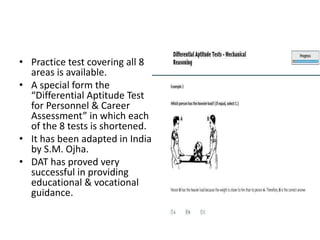
• Practice test covering all 8
areas is available.
• A special form the
“Differential Aptitude Test
for Personnel & Career
Assessment” in which each
of the 8 tests is shortened.
• It has been adapted in India
by S.M. Ojha.
• DAT has proved very
successful in providing
educational & vocational
guidance.
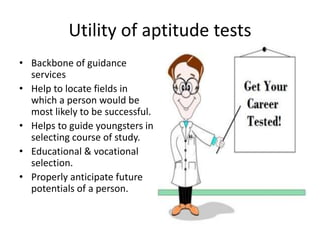
Utility of aptitude tests
• Backbone of guidance
services
• Help to locate fields in
which a person would be
most likely to be successful.
• Helps to guide youngsters in
selecting course of study.
• Educational & vocational
selection.
• Properly anticipate future
potentials of a person.
Resources
• Anastasi,A.,Urbania.S.(2004). Psychological
testing(7th ed.). India: PHI.
• Freeman F.S. Psychological testing, oxford &
IBH publishing Co.Pvt.Ltd.
Aptitesting

Aptitesting

  • 2.
    • “An aptitudeis a combination of characteristics indicative of an individual’s capacity to acquire(with training) some specific knowledge, skill, or set of organized responses such as the ability to speak a language, to become a musician, to do mechanical work.” -: Freeman
  • 3.
    “An aptitude testis one designed to measure a person’s potential ability in an activity of a special kind & within a restricted range.” :- Freeman
  • 4.
    • To obtaina measure of a person’s essential teachability in a given area. • To asses one’s degree of special bent. • To estimate the extent to which an individual would profit or achieve success from specific course or training.
  • 5.
  • 6.
    Mechanical •capacity to acquire aboutmechanical matters •Tests include tasks related to basic information of tools & their uses. •Eg., Bennet tests of mechanical comprehension Clerical •Perceptual, motor & intellectual abilities. •Knowledge of simple commercial terms, alphabetical filing, arithmetical problems, classification & sorting. •Eg., Minnesota vocational test for clerical works. Musical •Various aspects essential for being a good musician. •Pitch discrimination, loudness discrimination, rhythm judgment, chord analysis. •Eg.,seashore measures, wing standardized test Graphic arts *capacity for learning & performing graphic arts . *creative imagination & ability to create abstract design. *eg.,horne art aptitude inventory. These tests assess a person’s aptitude for a specific area only.
  • 7.
    • Present trendis to use these tests. • Assess suitability of persons for different professions on the basis of scores in relevant aptitude tests in batteries.
  • 8.
    Some examples ofaptitude tests
  • 9.
    Bennett tests ofmechanical reasoning • Consists of mechanical problems in pictorial form. • In each instance, accompanying the picture is a statement of problem depicted, with 2-3 answers from which to choose the correct one. • Measures one’s understanding of physical & mechanical principles in relatively simple situations.
  • 10.
    • There are3 forms for different groups. • Reliability coefficients range from .81 to .93 • There is no need of any special knowledge. • Problems are universal. • However some items can be better performed with prior knowledge of some principles of physics &/or actual experience.
  • 11.
    The Horne artaptitude inventory • Was devised to use with applicants for admissions to arts school. • Creativeness test • In the first part, subject requires to draw 20 familiar objects within short time limits. Subject also has to create simple abstract designs starting with given set of triangle, rectangle, etc.
  • 12.
    • In thesecond part, “imagery” there are 12 cards, each has several lines that must serve as a basis of picture to be drawn. • Scoring is done on the basis of creative imagination & technical quality. Examples are provided for rating good, excellent, average or poor.
  • 14.
    Differential aptitude test •First published in 1947. • For students of 8th to 12th class. • 2 levels. Level I. 7-9 grades students, those who completed this level. Level II. 10-12 grades students, those who completed this level but not high school.
  • 15.
    • 8 testsin this battery. 1 Verbal reasoning 2 Numerical reasoning 3 Abstract reasoning 4 Mechanical reasoning 5 Perceptual speed & accuracy 6 Space relations 7 Spelling 8 Language usage
  • 16.
    • Practice testcovering all 8 areas is available. • A special form the “Differential Aptitude Test for Personnel & Career Assessment” in which each of the 8 tests is shortened. • It has been adapted in India by S.M. Ojha. • DAT has proved very successful in providing educational & vocational guidance.
  • 17.
    Utility of aptitudetests • Backbone of guidance services • Help to locate fields in which a person would be most likely to be successful. • Helps to guide youngsters in selecting course of study. • Educational & vocational selection. • Properly anticipate future potentials of a person.
  • 18.
    Resources • Anastasi,A.,Urbania.S.(2004). Psychological testing(7thed.). India: PHI. • Freeman F.S. Psychological testing, oxford & IBH publishing Co.Pvt.Ltd.