GOA INSTITUTE OF
MANAGEMENT
SUBJECT: MANAGERIAL STATISTICS
ASSIGNMENT ON
INTRODUCTION TO PROBABILITY
THEORY
SUBMITTED TO: - SUBMITTED BY: -
Prof. ROHIT MUTKEKAR RACHNA GUPTA
Roll No. 2020046
PGP1 SECTION-A
SESSION- 2020-22
INTRODUCTION TO PROBABILITY THEORY
FATHER OF PROBABILITY-French mathematicians, Blaise Pascal and Pierre de Fermat.
MEANING: Probability is the ratio of favourable events to the total number of equally
likely events.
DEFINITION OF PROBABILITY:
Mathematical Definition- An event happens a times and does not happen b times and
all ways are equally likely then probability of happening of an event will be (a/a+b) and
probability of not happening of an event will be (b/a+b).
Statistical Definition: Probability is calculated on the basis of available data or
frequencies or pre- experiences.
P = r/n
r= Relative frequency
n= Number of the items
Importance of Probability Theory
 BASIS OF STATISTICAL LAWS
 IMPORTANCE IN GAMES OF CHANCE
 USE IN SAMPLING
 SPECIFIC IMPORTANCE IN INSURANCE BUSINESS
 USE IN ECONOMICS AND BUSINESS DECISIONS
 BASIS OF TESTS OF HYPOTHESIS AND TEST OF SIGNIFICANCE
RANDOM EXPERIMENT
Before rolling a die, you do not know the result. This is an example of a random
experiment. Experiments are of 2 types -those in which the outcome is definite
and others in which actual outcome may be any of all the possible outcomes. For
example -hydrogen is allowed to react with oxygen they react in a certain ratio and
produce water. The outcome is definite while if a coin is tossed it may turn up
showing either heads or tails. The outcome may be one of the 2 possible outcomes.
Experiment of second kind are called random experiment.
TRIAL
An experiment which, though repeated under essentially identical (or) same
conditions does not give unique results but may result in any one of the
several possible outcomes. Performing an experiment is known as
a trial and the outcomes of the experiment are known as events.
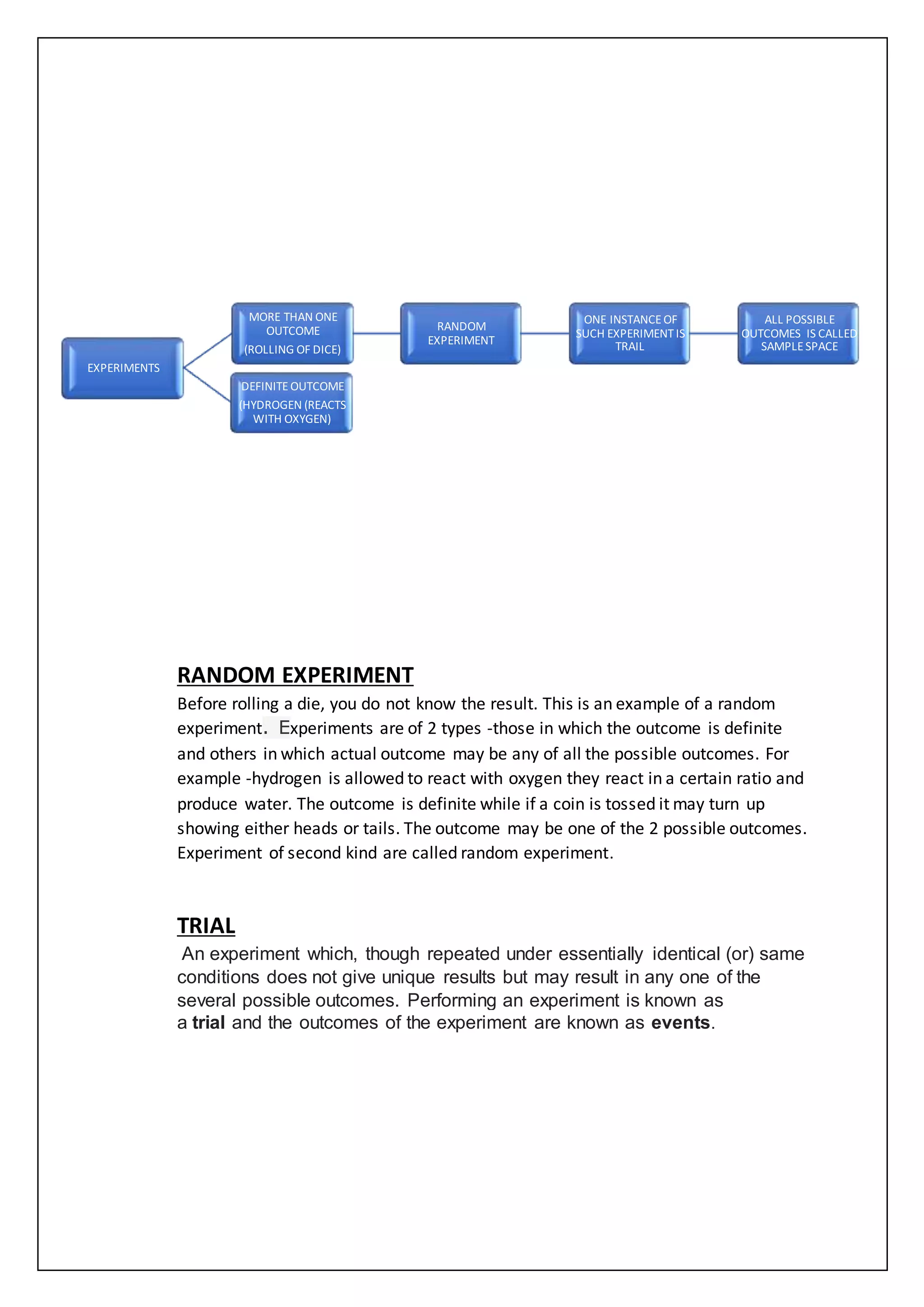
EXPERIMENTS
MORE THAN ONE
OUTCOME
(ROLLING OF DICE)
RANDOM
EXPERIMENT
ONE INSTANCE OF
SUCH EXPERIMENTIS
TRAIL
ALL POSSIBLE
OUTCOMES IS CALLED
SAMPLESPACE
DEFINITE OUTCOME
(HYDROGEN (REACTS
WITH OXYGEN)
SAMPLE SAPCE
The set of all possible outcomes for a particular random experiment is it sample space. It is
denoted by S. This corresponds to the concept of the universal set in set theory. Each
outcome is said to be a point in sample space.
EXAMPLE:
1- Random experiment: Toss a coin
Sample space: S= {heads, tails} or as we usually write it, {H,T}{H,T}.
2- Random experiment: Roll a die
Sample space: S= {1,2,3,4,5,6}
3- Random experiment: Observe the number of iPhones sold by an Apple store in Boston
in 2015
Sample space: S= {0,1,2,3,⋯}
4- Random experiment: Observe the number of goals in a soccer match
Sample space: S = {0,1,2,3,⋯}
CLASSICAL DEFINITION OF PROBABILITY
Classicalprobability is a simple form of probability that has equal odds of something
happening. P(A) means “probability of event A” (event A is whatever event you are looking
for, like winning the lottery).
“f” is the frequency, or number of possible times the event could happen.
N is the number of times the event could happen.
P(A) = f / N.
For example:
Rolling a fair die- It’s equally likely you would get a 1, 2, 3, 4, 5, or 6.
Selecting bingo balls-Each numbered ball has an equal chance of being chosen.
Guessing on a test- If you guessed on a multiple-choice test with four possible answer A B C
and D, each choice has the same odds of being picked (assuming you pick randomly and
don’t follow a pattern)
MUTUALLY EXCLUSIVE EVENTS:
If there is a set of events, such that if any one of them occurs, none of the events can occur,
the events are said to be mutually exclusive.
For Example:
Consider the Random Experiment of rolling a die and the following events-
E1= {1}
E2= {2,3}
E3= {4,5}
These three events are mutually exclusive.
ADDITIONAL THEORY OF PROBABILITY:
The addition rule for probabilities describes two formulas, one for the probability for either
of two mutually exclusive events happening and the other for the probability of two non-
mutually exclusive events happening.
The first formula is just the sum of the probabilities of the two events. The second formula
is the sum of the probabilities of the two events minus the probability that both will occur.
If A and B are two events, then: P(A U B) = P(A) + P(B) – P(A ∩ B)
FOR EXAMPPLE:
If I die is rolled what is the probability that the number that comes up is either even or
prime
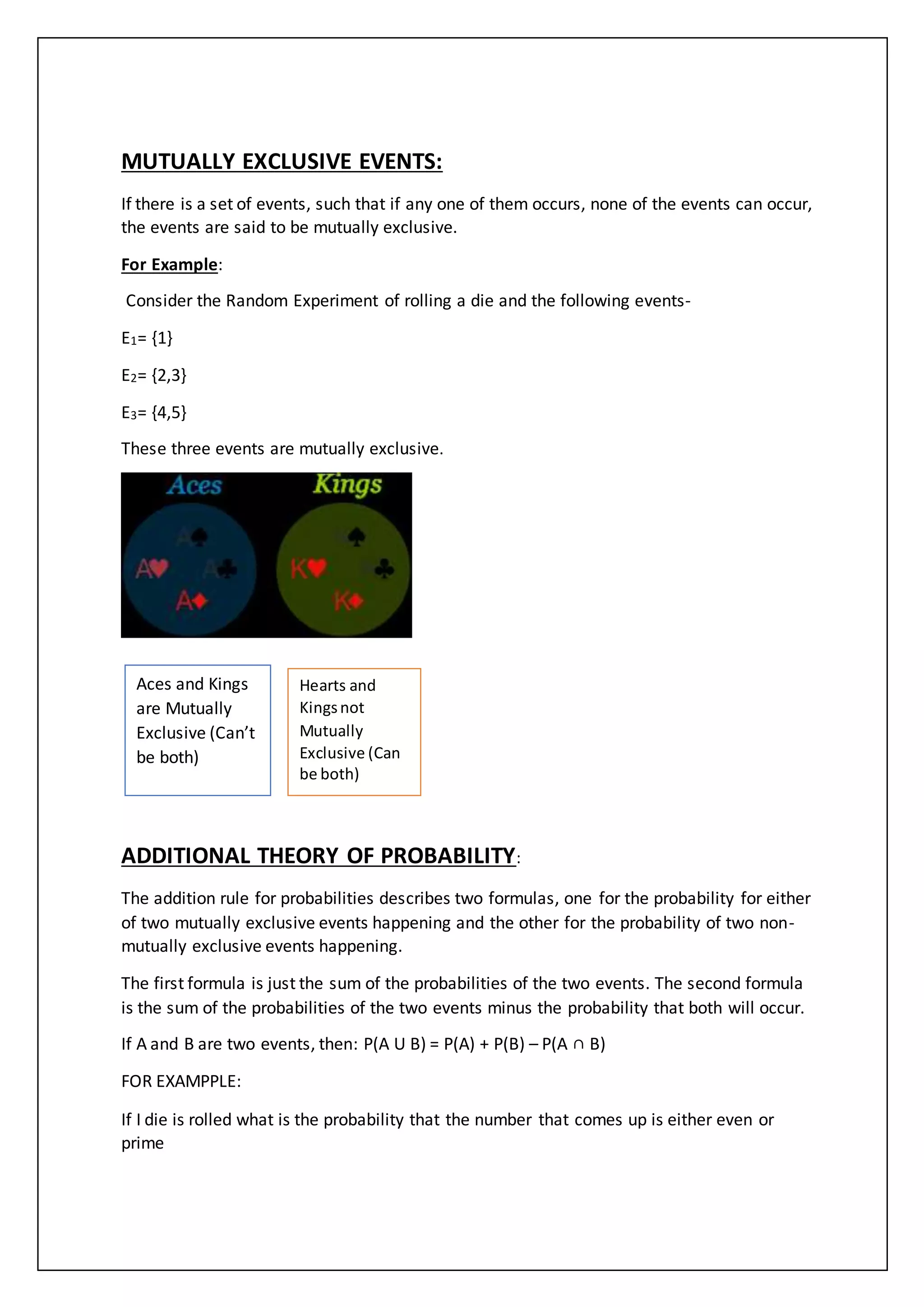
Aces and Kings
are Mutually
Exclusive (Can’t
be both)
Hearts and
Kingsnot
Mutually
Exclusive (Can
be both)
A= The event of getting an even number = {2,4,6}
B= The event of getting a prime number = {2,3,5}
A U B= {2,3,4,5,6}
A ∩ B = {2}
P (A U B) = P(A) + P(B) – P (A ∩ B)
P(A) =3/6, P(B) = 3/6, P (A U B) = 5/6, P (A ∩ B) = 1/6
Thus, (A U B) = 5/6
COMPLEMENT OF AN EVENT:
The complement of an event is the subset of outcomes in the sample space that
are not in the event. ... This means that in any given experiment, either
the event or its complement will happen, but not both. By consequence, the sum
of the probabilities of an event and its complement is
always equal to 1.
 When the event is Heads, the complement
is Tails E’= 1/2
 When the event is {Monday, Wednesday} the
complement is {Tuesday, Thursday, Friday,
Saturday, Sunday} E’=5/7
 When the event is {Hearts} the complement
is {Spades, Clubs, Diamonds, Jokers}
E’=4/5
CONDITIONAL PROBABILITY:
The conditional probability of an event B is the probability that the event will occur given
the knowledge that an event A has already occurred. This probability is written P(B|A),
notation for the probability of B given A. In the case where
events A and B are independent (where event A has no effect on the probability of
event B), the conditional probability of event B given event A is simply the probability of
event B, that is P(B).
If events A and B are not independent, then the probability of the intersection of A and
B (the probability that both events occur) is defined by
P(A and B) = P(A)P(B|A).
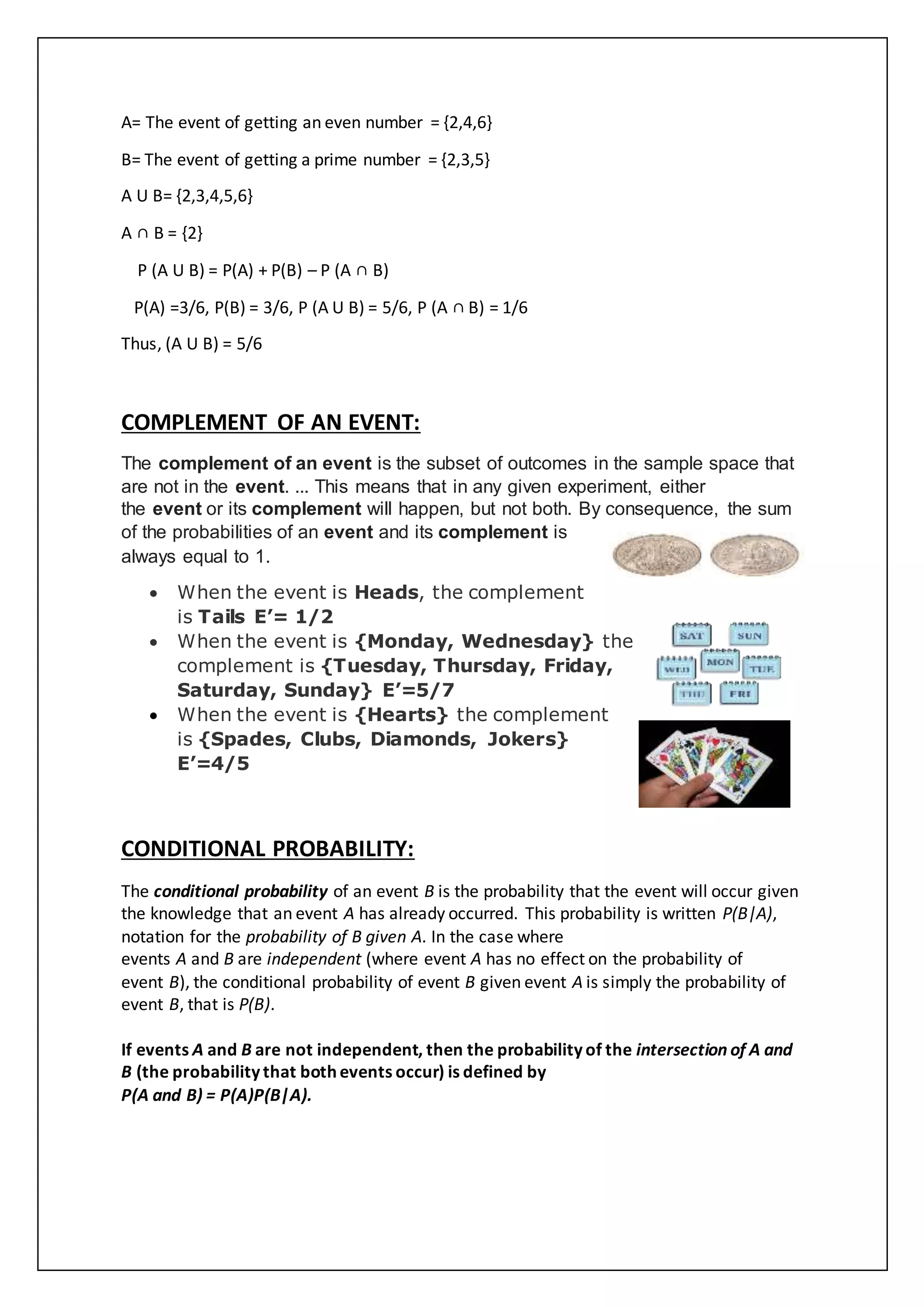
From this definition, the conditional probability P(B|A) is easily obtained by dividing
by P(A):
*This expression is only valid when P(A) is greater than 0.
FOR EXAMPLE:
In a card game, suppose a player needs to draw two cards of the same suit in order to win.
Of the 52 cards, there are 13 cards in each suit. Suppose first the player draws a heart. Now
the player wishes to draw a second heart. Since one heart has already been chosen, there
are now 12 hearts remaining in a deck of 51 cards. So, the conditional probability P (Draw
second heart|First card a heart) = 12/51.
MULTIPLICATION THEOREM OF PROBABILITY:
If A and B are two independent events, then the probability that both will occur is
equal to the product of their individual probabilities. Now, combine the successful
event of A with successful event of B.
In other words, If A and B are two independent events, then the
probability that both will occur is equal to the product of their individual
probabilities.
P(A∩B) =P(A) x P(B)
Let event
A can happen is n1ways of which p are successful
B can happen is n2ways of which q are successful
Now, combine the successful event of A with successful event of B.
Thus, the total number of successful cases = p x q
We have, total number of cases = n1 x n2.
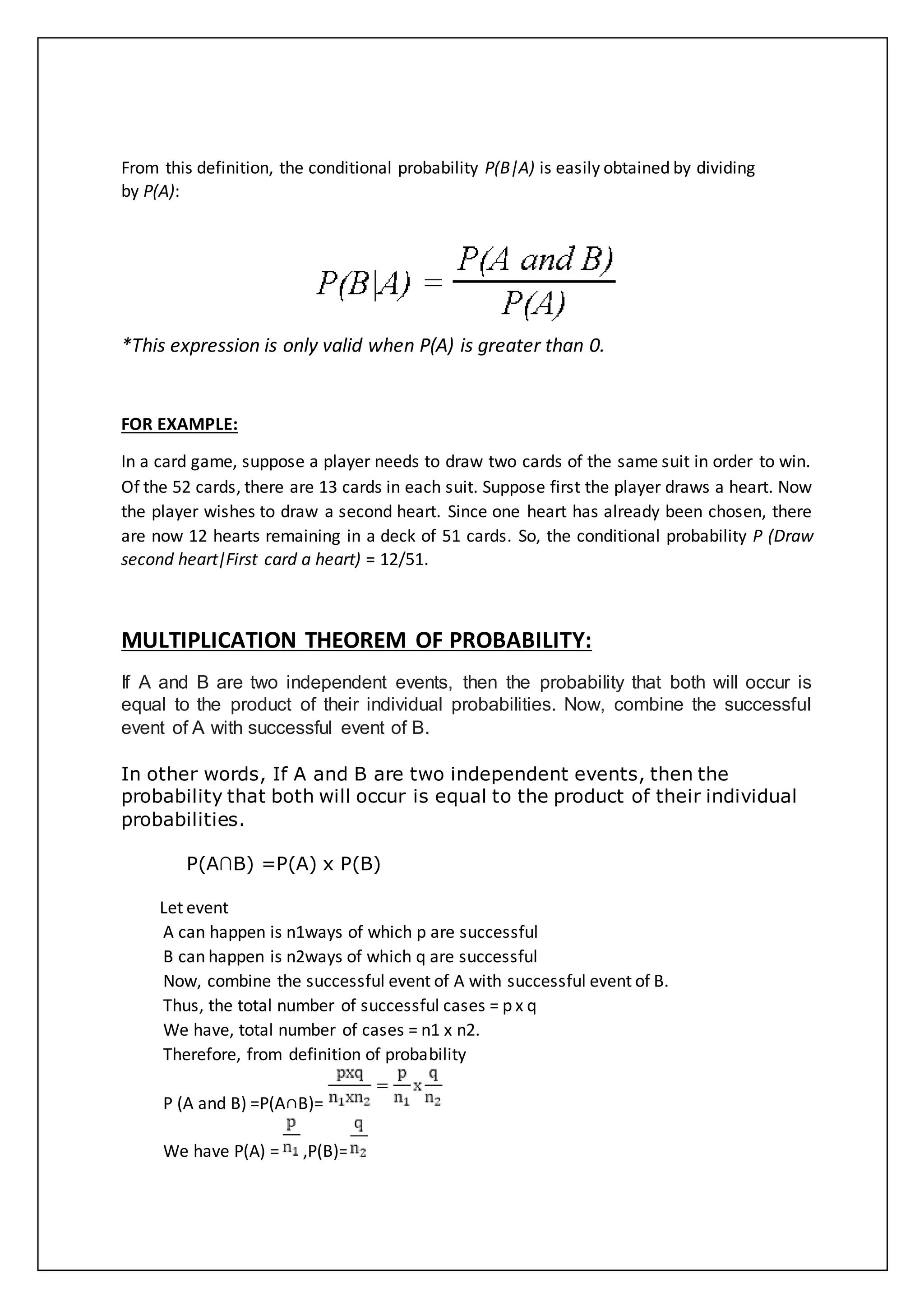
Therefore, from definition of probability
P (A and B) =P(A∩B)=
We have P(A) = ,P(B)=
Example: A bag contains 5 green and 7 red balls. Two balls are drawn. Find the probability
that one is green and the other is red.
Solution: P(A) =P(a green ball) =1/5
P(B) =P(a red ball) =1/7
By Multiplication Theorem:
P(A) and P(B) = P(A) x P(B) =1/5 * 1/7 = 1/35

introduction to Probability theory

  • 1.
    GOA INSTITUTE OF MANAGEMENT SUBJECT:MANAGERIAL STATISTICS ASSIGNMENT ON INTRODUCTION TO PROBABILITY THEORY SUBMITTED TO: - SUBMITTED BY: - Prof. ROHIT MUTKEKAR RACHNA GUPTA Roll No. 2020046 PGP1 SECTION-A SESSION- 2020-22
  • 2.
    INTRODUCTION TO PROBABILITYTHEORY FATHER OF PROBABILITY-French mathematicians, Blaise Pascal and Pierre de Fermat. MEANING: Probability is the ratio of favourable events to the total number of equally likely events. DEFINITION OF PROBABILITY: Mathematical Definition- An event happens a times and does not happen b times and all ways are equally likely then probability of happening of an event will be (a/a+b) and probability of not happening of an event will be (b/a+b). Statistical Definition: Probability is calculated on the basis of available data or frequencies or pre- experiences. P = r/n r= Relative frequency n= Number of the items Importance of Probability Theory  BASIS OF STATISTICAL LAWS  IMPORTANCE IN GAMES OF CHANCE  USE IN SAMPLING  SPECIFIC IMPORTANCE IN INSURANCE BUSINESS  USE IN ECONOMICS AND BUSINESS DECISIONS  BASIS OF TESTS OF HYPOTHESIS AND TEST OF SIGNIFICANCE
  • 3.
    RANDOM EXPERIMENT Before rollinga die, you do not know the result. This is an example of a random experiment. Experiments are of 2 types -those in which the outcome is definite and others in which actual outcome may be any of all the possible outcomes. For example -hydrogen is allowed to react with oxygen they react in a certain ratio and produce water. The outcome is definite while if a coin is tossed it may turn up showing either heads or tails. The outcome may be one of the 2 possible outcomes. Experiment of second kind are called random experiment. TRIAL An experiment which, though repeated under essentially identical (or) same conditions does not give unique results but may result in any one of the several possible outcomes. Performing an experiment is known as a trial and the outcomes of the experiment are known as events. EXPERIMENTS MORE THAN ONE OUTCOME (ROLLING OF DICE) RANDOM EXPERIMENT ONE INSTANCE OF SUCH EXPERIMENTIS TRAIL ALL POSSIBLE OUTCOMES IS CALLED SAMPLESPACE DEFINITE OUTCOME (HYDROGEN (REACTS WITH OXYGEN)
  • 4.
    SAMPLE SAPCE The setof all possible outcomes for a particular random experiment is it sample space. It is denoted by S. This corresponds to the concept of the universal set in set theory. Each outcome is said to be a point in sample space. EXAMPLE: 1- Random experiment: Toss a coin Sample space: S= {heads, tails} or as we usually write it, {H,T}{H,T}. 2- Random experiment: Roll a die Sample space: S= {1,2,3,4,5,6} 3- Random experiment: Observe the number of iPhones sold by an Apple store in Boston in 2015 Sample space: S= {0,1,2,3,⋯} 4- Random experiment: Observe the number of goals in a soccer match Sample space: S = {0,1,2,3,⋯} CLASSICAL DEFINITION OF PROBABILITY Classicalprobability is a simple form of probability that has equal odds of something happening. P(A) means “probability of event A” (event A is whatever event you are looking for, like winning the lottery). “f” is the frequency, or number of possible times the event could happen. N is the number of times the event could happen. P(A) = f / N. For example: Rolling a fair die- It’s equally likely you would get a 1, 2, 3, 4, 5, or 6. Selecting bingo balls-Each numbered ball has an equal chance of being chosen. Guessing on a test- If you guessed on a multiple-choice test with four possible answer A B C and D, each choice has the same odds of being picked (assuming you pick randomly and don’t follow a pattern)
  • 5.
    MUTUALLY EXCLUSIVE EVENTS: Ifthere is a set of events, such that if any one of them occurs, none of the events can occur, the events are said to be mutually exclusive. For Example: Consider the Random Experiment of rolling a die and the following events- E1= {1} E2= {2,3} E3= {4,5} These three events are mutually exclusive. ADDITIONAL THEORY OF PROBABILITY: The addition rule for probabilities describes two formulas, one for the probability for either of two mutually exclusive events happening and the other for the probability of two non- mutually exclusive events happening. The first formula is just the sum of the probabilities of the two events. The second formula is the sum of the probabilities of the two events minus the probability that both will occur. If A and B are two events, then: P(A U B) = P(A) + P(B) – P(A ∩ B) FOR EXAMPPLE: If I die is rolled what is the probability that the number that comes up is either even or prime Aces and Kings are Mutually Exclusive (Can’t be both) Hearts and Kingsnot Mutually Exclusive (Can be both)
  • 6.
    A= The eventof getting an even number = {2,4,6} B= The event of getting a prime number = {2,3,5} A U B= {2,3,4,5,6} A ∩ B = {2} P (A U B) = P(A) + P(B) – P (A ∩ B) P(A) =3/6, P(B) = 3/6, P (A U B) = 5/6, P (A ∩ B) = 1/6 Thus, (A U B) = 5/6 COMPLEMENT OF AN EVENT: The complement of an event is the subset of outcomes in the sample space that are not in the event. ... This means that in any given experiment, either the event or its complement will happen, but not both. By consequence, the sum of the probabilities of an event and its complement is always equal to 1.  When the event is Heads, the complement is Tails E’= 1/2  When the event is {Monday, Wednesday} the complement is {Tuesday, Thursday, Friday, Saturday, Sunday} E’=5/7  When the event is {Hearts} the complement is {Spades, Clubs, Diamonds, Jokers} E’=4/5 CONDITIONAL PROBABILITY: The conditional probability of an event B is the probability that the event will occur given the knowledge that an event A has already occurred. This probability is written P(B|A), notation for the probability of B given A. In the case where events A and B are independent (where event A has no effect on the probability of event B), the conditional probability of event B given event A is simply the probability of event B, that is P(B). If events A and B are not independent, then the probability of the intersection of A and B (the probability that both events occur) is defined by P(A and B) = P(A)P(B|A).
  • 7.
    From this definition,the conditional probability P(B|A) is easily obtained by dividing by P(A): *This expression is only valid when P(A) is greater than 0. FOR EXAMPLE: In a card game, suppose a player needs to draw two cards of the same suit in order to win. Of the 52 cards, there are 13 cards in each suit. Suppose first the player draws a heart. Now the player wishes to draw a second heart. Since one heart has already been chosen, there are now 12 hearts remaining in a deck of 51 cards. So, the conditional probability P (Draw second heart|First card a heart) = 12/51. MULTIPLICATION THEOREM OF PROBABILITY: If A and B are two independent events, then the probability that both will occur is equal to the product of their individual probabilities. Now, combine the successful event of A with successful event of B. In other words, If A and B are two independent events, then the probability that both will occur is equal to the product of their individual probabilities. P(A∩B) =P(A) x P(B) Let event A can happen is n1ways of which p are successful B can happen is n2ways of which q are successful Now, combine the successful event of A with successful event of B. Thus, the total number of successful cases = p x q We have, total number of cases = n1 x n2. Therefore, from definition of probability P (A and B) =P(A∩B)= We have P(A) = ,P(B)=
  • 8.
    Example: A bagcontains 5 green and 7 red balls. Two balls are drawn. Find the probability that one is green and the other is red. Solution: P(A) =P(a green ball) =1/5 P(B) =P(a red ball) =1/7 By Multiplication Theorem: P(A) and P(B) = P(A) x P(B) =1/5 * 1/7 = 1/35