Quality Assurance (Statistical Process Control) By Dr. Debadyuti Das
Overview of Quality What does the term  quality  mean? Quality  is the ability of a product or service to consistently meet  or exceed customer expectations.  Fitness for use (Juran) Conformance to requirements (Crosby)
Three Broad dimensions of Quality Design quality:  Quality inherent in product design. Examples, Leather vs Vinyl seats for a car,  Wider choice on the menu for an airlineโ€™s first-class passengers,  Superior workmanship for increased precision,  Tighter Engg. Specifications etc.
Three Broad dimensions of Quality Conformance Quality:  Degree to which the product or service design specifications are met. Performance Quality:  Productโ€™s reliability and the ease of maintenance and repair service when required.
Another Dimensions of Quality Performance  - main characteristics of the product/service Aesthetics  - appearance, feel, smell, taste Special Features  - extra characteristics Conformance  - how well product/service conforms to customerโ€™s expectations
Dimensions of Quality (Contโ€™d) Durability  -  useful life of the product/service Perceived Quality -  indirect evaluation of quality (e.g. reputation) Serviceability โ€“  how difficult and expensive it is to repair   Reliability  - consistency of performance
Quality Assurance vs. Quality Management Quality Assurance Emphasis on finding and correcting defects before reaching market Quality Management Proactive, focusing on preventing mistakes from occurring Greater emphasis on customer satisfaction
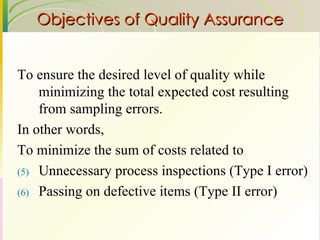
Objectives of Quality Assurance To ensure the desired level of quality while minimizing the total expected cost resulting from sampling errors. In other words, To minimize the sum of costs related to  Unnecessary process inspections (Type I error) Passing on defective items (Type II error)
QA system decision variables What to inspect How to inspect When to inspect Where to inspect
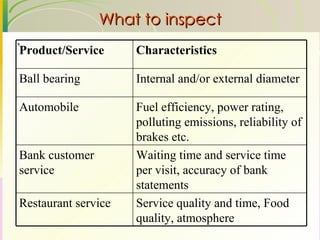
What to inspect ` Service quality and time, Food quality, atmosphere Restaurant service Waiting time and service time per visit, accuracy of bank statements Bank customer service Fuel efficiency, power rating, polluting emissions, reliability of brakes etc. Automobile Internal and/or external diameter Ball bearing Characteristics Product/Service
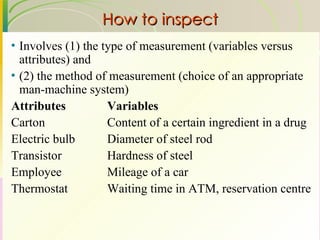
How to inspect Involves (1) the type of measurement (variables versus attributes) and  (2) the method of measurement (choice of an appropriate man-machine system) Attributes Variables Carton Content of a certain ingredient in a drug Electric bulb Diameter of steel rod Transistor Hardness of steel Employee Mileage of a car Thermostat Waiting time in ATM, reservation centre
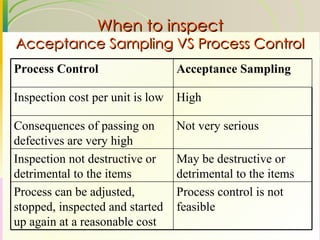
When to inspect Acceptance Sampling VS Process Control Process control is not feasible Process can be adjusted, stopped, inspected and started up again at a reasonable cost May be destructive or detrimental to the items Inspection not destructive or detrimental to the items Not very serious Consequences of passing on defectives are very high High Inspection cost per unit is low Acceptance Sampling Process Control
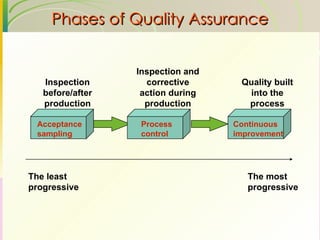
Phases of Quality Assurance Inspection before/after production Inspection and corrective action during production Quality built into the process The least progressive The most progressive Acceptance sampling Process control Continuous improvement
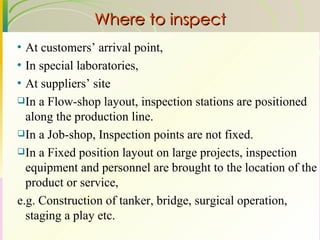
Where to inspect At customersโ€™ arrival point, In special laboratories, At suppliersโ€™ site In a Flow-shop layout, inspection stations are positioned along the production line. In a Job-shop, Inspection points are not fixed. In a Fixed position layout on large projects, inspection equipment and personnel are brought to the location of the product or service,  e.g. Construction of tanker, bridge, surgical operation, staging a play etc.
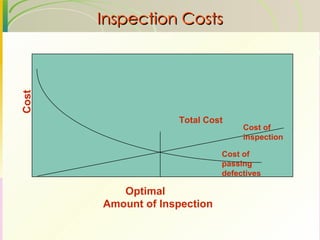
Inspection Costs Cost of  inspection Cost of  passing defectives Total Cost Cost Optimal Amount of Inspection
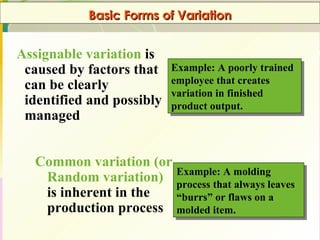
Basic Forms of Variation Assignable variation   is caused by factors that can be clearly identified and possibly managed Common variation (or Random variation)   is inherent in the production process   Example: A poorly trained employee that creates variation in finished product output. Example: A molding process that always leaves โ€œburrsโ€ or flaws on a molded item.
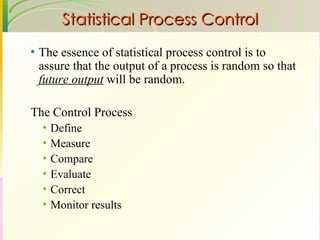
Statistical Process Control The essence of statistical process control is to assure that the output of a process is random so that  future output  will be random.   The Control Process Define Measure Compare Evaluate Correct Monitor results
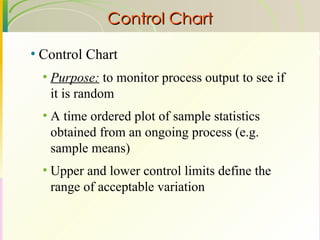
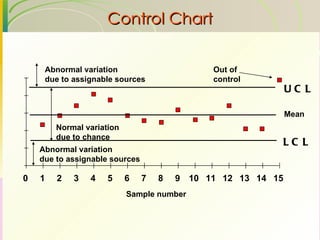
Control Chart Control Chart Purpose:  to monitor process output to see if it is random A time ordered plot of sample statistics obtained from an ongoing process (e.g. sample means) Upper and lower control limits define the range of acceptable variation
Control Chart 0 1 2 3 4 5 6 7 8 9 10 11 12 13 14 15 UCL LCL Sample number Mean Out of control Normal variation due to chance Abnormal variation due to assignable sources Abnormal variation due to assignable sources
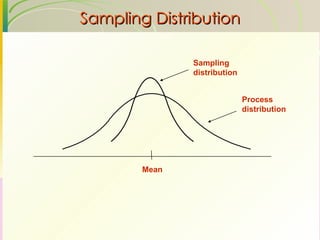
Sampling Distribution Sampling distribution Process distribution Mean
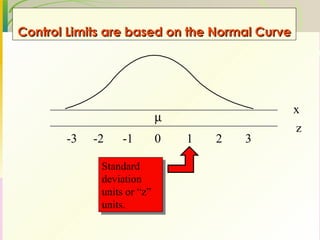
Control Limits are based on the Normal Curve x 0 1 2 3 -3 -2 -1 z ๏ญ Standard deviation units or โ€œzโ€ units.
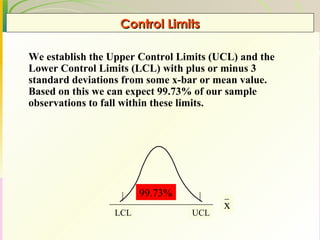
Control Limits We establish the Upper Control Limits (UCL) and the Lower Control Limits (LCL) with plus or minus 3 standard deviations from some x-bar or mean value.  Based on this we can expect 99.73% of our sample observations to fall within these limits.   LCL UCL 99.73% x
SPC Errors Type I error Concluding a process is not in control when it actually is. Type II error Concluding a process is in control when it is not.
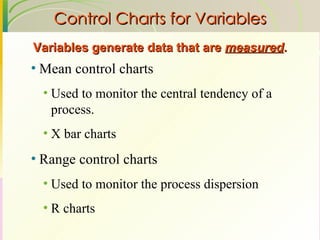
Control Charts for Variables Mean control charts Used to monitor the central tendency of a process. X bar charts Range control charts Used to monitor the process dispersion R charts Variables generate data that are  measured .
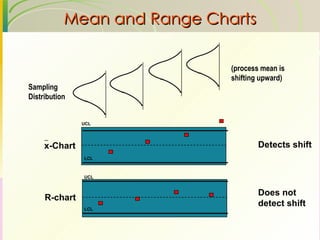
Mean and Range Charts UCL LCL UCL LCL R-chart Detects shift Does not detect shift (process mean is  shifting upward) Sampling Distribution x-Chart
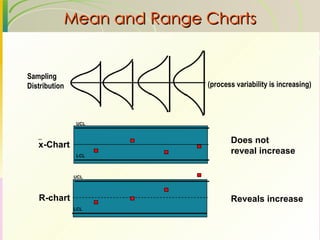
Mean and Range Charts UCL Does not reveal increase UCL LCL LCL R-chart Reveals increase (process variability is increasing) Sampling Distribution x-Chart
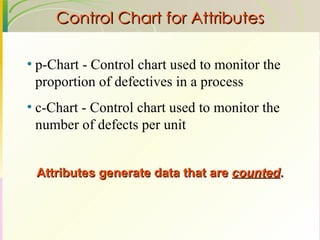
Control Chart for Attributes p-Chart - Control chart used to monitor the proportion of defectives in a process c-Chart - Control chart used to monitor the number of defects per unit Attributes generate data that are  counted .
Use of p-Charts When observations can be placed into two categories. Good or bad Pass or fail Operate or donโ€™t operate
Use of c-Charts Used only when the number of occurrences per unit of measure can be counted; non-occurrences cannot be counted. Scratches, chips, dents, or errors per item Cracks or faults per unit of distance Breaks or Tears per unit of area Bacteria or pollutants per unit of volume Calls, complaints, failures per unit of time
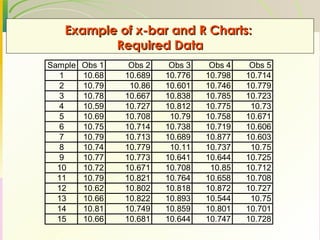
Example of x-bar and R Charts:  Required Data
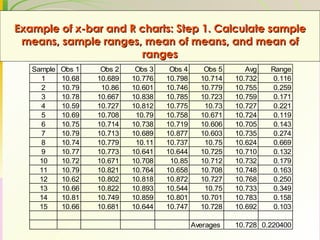
Example of x-bar and R charts: Step 1. Calculate sample means, sample ranges, mean of means, and mean of ranges
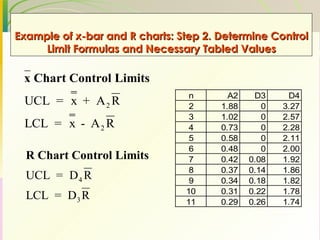
Example of x-bar and R charts: Step 2. Determine Control Limit Formulas and Necessary Tabled Values
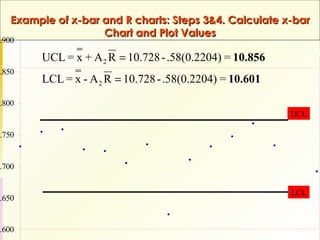
Example of x-bar and R charts: Steps 3&4. Calculate x-bar Chart and Plot Values UCL LCL
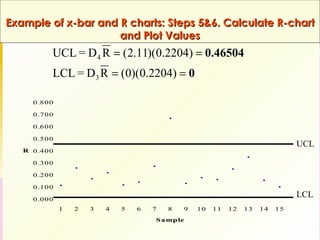
Example of x-bar and R charts: Steps 5&6. Calculate R-chart and Plot Values UCL LCL
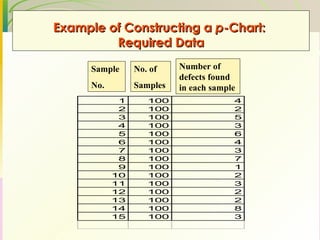
Example of Constructing a  p -Chart:  Required Data Sample  No. No. of Samples Number of defects found in each sample
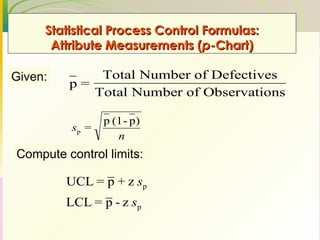
Statistical Process Control Formulas: Attribute Measurements ( p -Chart) Given: Compute control limits:
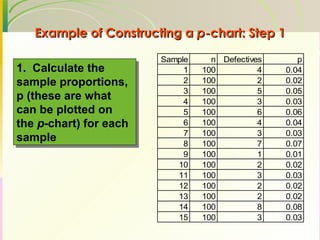
Example of Constructing a  p -chart: Step 1 1.  Calculate the sample proportions, p (these are what can be plotted on the  p -chart) for each sample
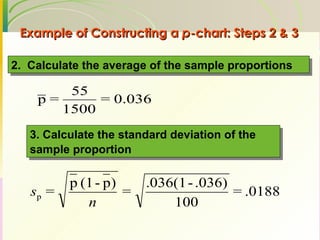
Example of Constructing a  p -chart: Steps 2 & 3 2.  Calculate the average of the sample proportions 3. Calculate the standard deviation of the sample proportion
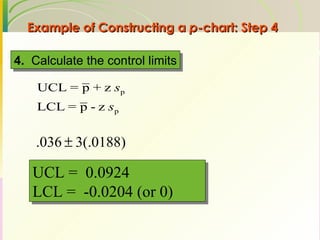
Example of Constructing a  p -chart: Step 4 4.   Calculate the control limits UCL =  0.0924 LCL =  -0.0204 (or 0)
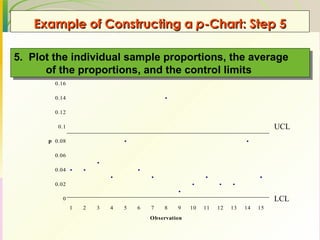
Example of Constructing a  p -Chart: Step 5 5.  Plot the individual sample proportions, the average  of the proportions, and the control limits  UCL LCL
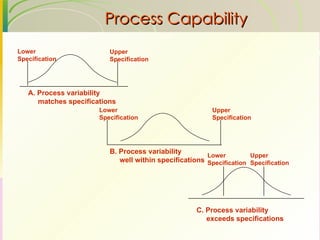
Tolerances or specifications (Specification limit) Range of acceptable values established by engineering design or customer requirements Process variability (Process limit) Natural variability in a process Process capability Process variability relative to specification Process Capability
Process Capability C. Process variability    exceeds specifications Lower Specification Upper Specification A. Process variability    matches specifications Lower Specification Upper Specification B. Process variability   well within specifications Lower Specification Upper Specification
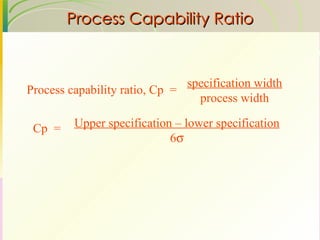
Process Capability Ratio Process capability ratio, Cp  = specification width process width Upper specification โ€“ lower specification 6 ๏ณ Cp  =
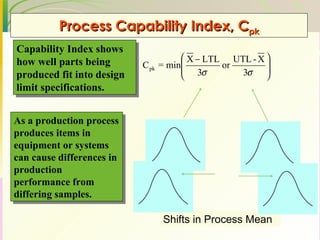
Process Capability Index, C pk Shifts in Process Mean Capability Index shows how well parts being produced fit into design limit specifications. As a production process produces items in equipment or systems can cause differences in production performance from differing samples.

Qa.spc

  • 1.
    Quality Assurance (StatisticalProcess Control) By Dr. Debadyuti Das
  • 2.
    Overview of QualityWhat does the term quality mean? Quality is the ability of a product or service to consistently meet or exceed customer expectations. Fitness for use (Juran) Conformance to requirements (Crosby)
  • 3.
    Three Broad dimensionsof Quality Design quality: Quality inherent in product design. Examples, Leather vs Vinyl seats for a car, Wider choice on the menu for an airlineโ€™s first-class passengers, Superior workmanship for increased precision, Tighter Engg. Specifications etc.
  • 4.
    Three Broad dimensionsof Quality Conformance Quality: Degree to which the product or service design specifications are met. Performance Quality: Productโ€™s reliability and the ease of maintenance and repair service when required.
  • 5.
    Another Dimensions ofQuality Performance - main characteristics of the product/service Aesthetics - appearance, feel, smell, taste Special Features - extra characteristics Conformance - how well product/service conforms to customerโ€™s expectations
  • 6.
    Dimensions of Quality(Contโ€™d) Durability - useful life of the product/service Perceived Quality - indirect evaluation of quality (e.g. reputation) Serviceability โ€“ how difficult and expensive it is to repair Reliability - consistency of performance
  • 7.
    Quality Assurance vs.Quality Management Quality Assurance Emphasis on finding and correcting defects before reaching market Quality Management Proactive, focusing on preventing mistakes from occurring Greater emphasis on customer satisfaction
  • 8.
    Objectives of QualityAssurance To ensure the desired level of quality while minimizing the total expected cost resulting from sampling errors. In other words, To minimize the sum of costs related to Unnecessary process inspections (Type I error) Passing on defective items (Type II error)
  • 9.
    QA system decisionvariables What to inspect How to inspect When to inspect Where to inspect
  • 10.
    What to inspect` Service quality and time, Food quality, atmosphere Restaurant service Waiting time and service time per visit, accuracy of bank statements Bank customer service Fuel efficiency, power rating, polluting emissions, reliability of brakes etc. Automobile Internal and/or external diameter Ball bearing Characteristics Product/Service
  • 11.
    How to inspectInvolves (1) the type of measurement (variables versus attributes) and (2) the method of measurement (choice of an appropriate man-machine system) Attributes Variables Carton Content of a certain ingredient in a drug Electric bulb Diameter of steel rod Transistor Hardness of steel Employee Mileage of a car Thermostat Waiting time in ATM, reservation centre
  • 12.
    When to inspectAcceptance Sampling VS Process Control Process control is not feasible Process can be adjusted, stopped, inspected and started up again at a reasonable cost May be destructive or detrimental to the items Inspection not destructive or detrimental to the items Not very serious Consequences of passing on defectives are very high High Inspection cost per unit is low Acceptance Sampling Process Control
  • 13.
    Phases of QualityAssurance Inspection before/after production Inspection and corrective action during production Quality built into the process The least progressive The most progressive Acceptance sampling Process control Continuous improvement
  • 14.
    Where to inspectAt customersโ€™ arrival point, In special laboratories, At suppliersโ€™ site In a Flow-shop layout, inspection stations are positioned along the production line. In a Job-shop, Inspection points are not fixed. In a Fixed position layout on large projects, inspection equipment and personnel are brought to the location of the product or service, e.g. Construction of tanker, bridge, surgical operation, staging a play etc.
  • 15.
    Inspection Costs Costof inspection Cost of passing defectives Total Cost Cost Optimal Amount of Inspection
  • 16.
    Basic Forms ofVariation Assignable variation is caused by factors that can be clearly identified and possibly managed Common variation (or Random variation) is inherent in the production process Example: A poorly trained employee that creates variation in finished product output. Example: A molding process that always leaves โ€œburrsโ€ or flaws on a molded item.
  • 17.
    Statistical Process ControlThe essence of statistical process control is to assure that the output of a process is random so that future output will be random. The Control Process Define Measure Compare Evaluate Correct Monitor results
  • 18.
    Control Chart ControlChart Purpose: to monitor process output to see if it is random A time ordered plot of sample statistics obtained from an ongoing process (e.g. sample means) Upper and lower control limits define the range of acceptable variation
  • 19.
    Control Chart 01 2 3 4 5 6 7 8 9 10 11 12 13 14 15 UCL LCL Sample number Mean Out of control Normal variation due to chance Abnormal variation due to assignable sources Abnormal variation due to assignable sources
  • 20.
    Sampling Distribution Samplingdistribution Process distribution Mean
  • 21.
    Control Limits arebased on the Normal Curve x 0 1 2 3 -3 -2 -1 z ๏ญ Standard deviation units or โ€œzโ€ units.
  • 22.
    Control Limits Weestablish the Upper Control Limits (UCL) and the Lower Control Limits (LCL) with plus or minus 3 standard deviations from some x-bar or mean value. Based on this we can expect 99.73% of our sample observations to fall within these limits. LCL UCL 99.73% x
  • 23.
    SPC Errors TypeI error Concluding a process is not in control when it actually is. Type II error Concluding a process is in control when it is not.
  • 24.
    Control Charts forVariables Mean control charts Used to monitor the central tendency of a process. X bar charts Range control charts Used to monitor the process dispersion R charts Variables generate data that are measured .
  • 25.
    Mean and RangeCharts UCL LCL UCL LCL R-chart Detects shift Does not detect shift (process mean is shifting upward) Sampling Distribution x-Chart
  • 26.
    Mean and RangeCharts UCL Does not reveal increase UCL LCL LCL R-chart Reveals increase (process variability is increasing) Sampling Distribution x-Chart
  • 27.
    Control Chart forAttributes p-Chart - Control chart used to monitor the proportion of defectives in a process c-Chart - Control chart used to monitor the number of defects per unit Attributes generate data that are counted .
  • 28.
    Use of p-ChartsWhen observations can be placed into two categories. Good or bad Pass or fail Operate or donโ€™t operate
  • 29.
    Use of c-ChartsUsed only when the number of occurrences per unit of measure can be counted; non-occurrences cannot be counted. Scratches, chips, dents, or errors per item Cracks or faults per unit of distance Breaks or Tears per unit of area Bacteria or pollutants per unit of volume Calls, complaints, failures per unit of time
  • 30.
    Example of x-barand R Charts: Required Data
  • 31.
    Example of x-barand R charts: Step 1. Calculate sample means, sample ranges, mean of means, and mean of ranges
  • 32.
    Example of x-barand R charts: Step 2. Determine Control Limit Formulas and Necessary Tabled Values
  • 33.
    Example of x-barand R charts: Steps 3&4. Calculate x-bar Chart and Plot Values UCL LCL
  • 34.
    Example of x-barand R charts: Steps 5&6. Calculate R-chart and Plot Values UCL LCL
  • 35.
    Example of Constructinga p -Chart: Required Data Sample No. No. of Samples Number of defects found in each sample
  • 36.
    Statistical Process ControlFormulas: Attribute Measurements ( p -Chart) Given: Compute control limits:
  • 37.
    Example of Constructinga p -chart: Step 1 1. Calculate the sample proportions, p (these are what can be plotted on the p -chart) for each sample
  • 38.
    Example of Constructinga p -chart: Steps 2 & 3 2. Calculate the average of the sample proportions 3. Calculate the standard deviation of the sample proportion
  • 39.
    Example of Constructinga p -chart: Step 4 4. Calculate the control limits UCL = 0.0924 LCL = -0.0204 (or 0)
  • 40.
    Example of Constructinga p -Chart: Step 5 5. Plot the individual sample proportions, the average of the proportions, and the control limits UCL LCL
  • 41.
    Tolerances or specifications(Specification limit) Range of acceptable values established by engineering design or customer requirements Process variability (Process limit) Natural variability in a process Process capability Process variability relative to specification Process Capability
  • 42.
    Process Capability C.Process variability exceeds specifications Lower Specification Upper Specification A. Process variability matches specifications Lower Specification Upper Specification B. Process variability well within specifications Lower Specification Upper Specification
  • 43.
    Process Capability RatioProcess capability ratio, Cp = specification width process width Upper specification โ€“ lower specification 6 ๏ณ Cp =
  • 44.
    Process Capability Index,C pk Shifts in Process Mean Capability Index shows how well parts being produced fit into design limit specifications. As a production process produces items in equipment or systems can cause differences in production performance from differing samples.