Introduction to  Statistical Process Control
Statistical Process Control SPC is a family of tools used to monitor, control, and improve processes.   It involves tabulating, depicting, and describing data sets by applying the seven basic tools of quality and a formalized body of techniques.   Understanding and using SPC does not require knowledge of statistics.  Rather one uses applied general math and a reliable software program such as Excel.
The Seven Basic Tools of Quality include Flowchart/process map  Check sheet  Cause-effect diagram  Pareto chart  Histogram   Control chart/Run Chart  Scatter diagrams   Scattergram
Ensuring successful delivery An essential element of producing a high quality product or service is insuring that the characteristics of that product remain constant over time.  Product quality is directly dependent on the process capability. Two key process requirements are – Capability and Stability SPC charts are widely used to determine whether a process is capable and stable over time. Process Inputs Outputs
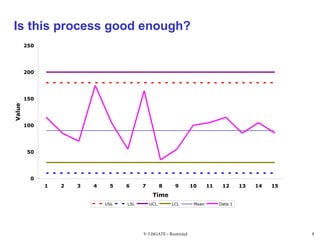
Understanding Control Charts Control charts are graphical representation of product / process performance over time with Control Limits. It may or may not have Specification limits. They are widely used to determine whether a process is capable and stable over time. Control Limit – The actual performance of the process Specification Limits – What the process is required to perform Capable – Process Performance well within Specification Limits Stable – Process does not have special causes and have no trends/cycles
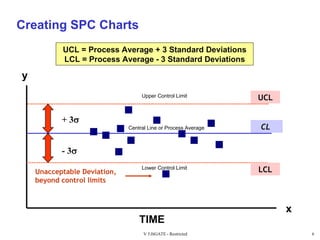
Creating SPC Charts Central Line or Process Average CL  UCL LCL x + 3  - 3    TIME y Upper Control Limit Lower Control Limit UCL = Process Average + 3 Standard Deviations LCL = Process Average - 3 Standard Deviations Unacceptable Deviation, beyond control limits
Is this process good enough?
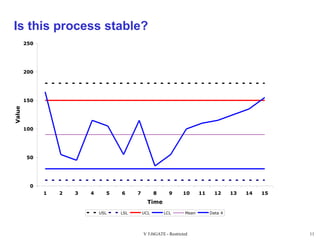
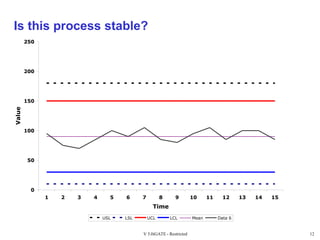
Is this process stable?
Spotting instabilities Data points beyond control limits 5 points in a up or down trend Data points hugging center line Data points hugging upper and control limits
Summarizing SPC Charts Determining if the long term process average is rising, falling, or  remaining the same. Identifying common causes of variation in our processes.  Common cause refers to that fact that the processes we use contain sources of variation.  We should seek to reduce or limit common causes of variation [i.e. improve the process capability]. Calling attention to data points which falls beyond the statistically determined control limits.  Such points generally represent special causes of variation.  Sometimes these data points can be attributed to individuals.  By changing the behavior of some individuals we can improve results.
Any Questions?

Introduction To SPC

  • 1.
    Introduction to Statistical Process Control
  • 2.
    Statistical Process ControlSPC is a family of tools used to monitor, control, and improve processes.  It involves tabulating, depicting, and describing data sets by applying the seven basic tools of quality and a formalized body of techniques.  Understanding and using SPC does not require knowledge of statistics.  Rather one uses applied general math and a reliable software program such as Excel.
  • 3.
    The Seven BasicTools of Quality include Flowchart/process map Check sheet Cause-effect diagram Pareto chart Histogram Control chart/Run Chart Scatter diagrams Scattergram
  • 4.
    Ensuring successful deliveryAn essential element of producing a high quality product or service is insuring that the characteristics of that product remain constant over time. Product quality is directly dependent on the process capability. Two key process requirements are – Capability and Stability SPC charts are widely used to determine whether a process is capable and stable over time. Process Inputs Outputs
  • 5.
    Understanding Control ChartsControl charts are graphical representation of product / process performance over time with Control Limits. It may or may not have Specification limits. They are widely used to determine whether a process is capable and stable over time. Control Limit – The actual performance of the process Specification Limits – What the process is required to perform Capable – Process Performance well within Specification Limits Stable – Process does not have special causes and have no trends/cycles
  • 6.
    Creating SPC ChartsCentral Line or Process Average CL UCL LCL x + 3  - 3  TIME y Upper Control Limit Lower Control Limit UCL = Process Average + 3 Standard Deviations LCL = Process Average - 3 Standard Deviations Unacceptable Deviation, beyond control limits
  • 7.
    Is this processgood enough?
  • 8.
    Is this processgood enough?
  • 9.
    Is this processgood enough?
  • 10.
  • 11.
  • 12.
  • 13.
  • 14.
    Spotting instabilities Datapoints beyond control limits 5 points in a up or down trend Data points hugging center line Data points hugging upper and control limits
  • 15.
    Summarizing SPC ChartsDetermining if the long term process average is rising, falling, or remaining the same. Identifying common causes of variation in our processes. Common cause refers to that fact that the processes we use contain sources of variation. We should seek to reduce or limit common causes of variation [i.e. improve the process capability]. Calling attention to data points which falls beyond the statistically determined control limits. Such points generally represent special causes of variation. Sometimes these data points can be attributed to individuals. By changing the behavior of some individuals we can improve results.
  • 16.