I Made Gatot Karohika ST. MT.
Mechanical Engineering
Udayana university
3 - 2
Introduction
• Treatment of a body as a single particle is not always possible. In
general, the size of the body and the specific points of application of the
forces must be considered.
• Most bodies in elementary mechanics are assumed to be rigid, i.e., the
actual deformations are small and do not affect the conditions of
equilibrium or motion of the body.
• Current chapter describes the effect of forces exerted on a rigid body and
how to replace a given system of forces with a simpler equivalent system.
• moment of a force about a point
• moment of a force about an axis
• moment due to a couple
• Any system of forces acting on a rigid body can be replaced by an
equivalent system consisting of one force acting at a given point and one
couple.
3 - 3
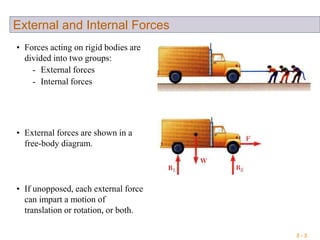
External and Internal Forces
• Forces acting on rigid bodies are
divided into two groups:
- External forces
- Internal forces
• External forces are shown in a
free-body diagram.
• If unopposed, each external force
can impart a motion of
translation or rotation, or both.
3 - 4
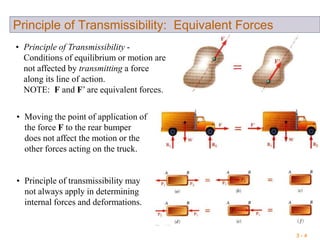
Principle of Transmissibility: Equivalent Forces
• Principle of Transmissibility -
Conditions of equilibrium or motion are
not affected by transmitting a force
along its line of action.
NOTE: F and F’ are equivalent forces.
• Moving the point of application of
the force F to the rear bumper
does not affect the motion or the
other forces acting on the truck.
• Principle of transmissibility may
not always apply in determining
internal forces and deformations.
3 - 5
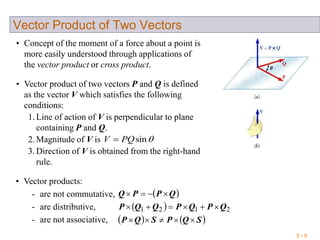
Vector Product of Two Vectors
• Concept of the moment of a force about a point is
more easily understood through applications of
the vector product or cross product.
• Vector product of two vectors P and Q is defined
as the vector V which satisfies the following
conditions:
1. Line of action of V is perpendicular to plane
containing P and Q.
2. Magnitude of V is
3. Direction of V is obtained from the right-hand
rule.
sinQPV 
• Vector products:
- are not commutative,
- are distributive,
- are not associative,
 QPPQ 
  2121 QPQPQQP 
   SQPSQP 
3 - 6
Vector Products: Rectangular Components
• Vector products of Cartesian unit vectors,
0
0
0



kkikjjki
ijkjjkji
jikkijii



• Vector products in terms of rectangular
coordinates
   kQjQiQkPjPiPV zyxzyx


   
 kQPQP
jQPQPiQPQP
xyyx
zxxzyzzy




zyx
zyx
QQQ
PPP
kji


+
3 - 7
Moment of a Force About a Point
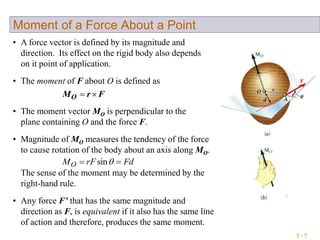
• A force vector is defined by its magnitude and
direction. Its effect on the rigid body also depends
on it point of application.
• The moment of F about O is defined as
FrMO 
• The moment vector MO is perpendicular to the
plane containing O and the force F.
• Any force F’ that has the same magnitude and
direction as F, is equivalent if it also has the same line
of action and therefore, produces the same moment.
• Magnitude of MO measures the tendency of the force
to cause rotation of the body about an axis along MO.
The sense of the moment may be determined by the
right-hand rule.
FdrFMO  sin
3 - 8
Moment of a Force About a Point
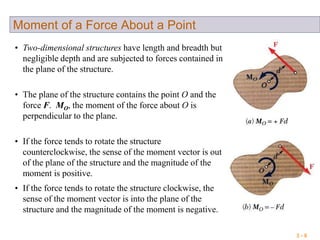
• Two-dimensional structures have length and breadth but
negligible depth and are subjected to forces contained in
the plane of the structure.
• The plane of the structure contains the point O and the
force F. MO, the moment of the force about O is
perpendicular to the plane.
• If the force tends to rotate the structure
counterclockwise, the sense of the moment vector is out
of the plane of the structure and the magnitude of the
moment is positive.
• If the force tends to rotate the structure clockwise, the
sense of the moment vector is into the plane of the
structure and the magnitude of the moment is negative.
3 - 9
Varignon’s Theorem
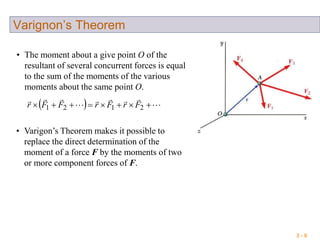
• The moment about a give point O of the
resultant of several concurrent forces is equal
to the sum of the moments of the various
moments about the same point O.
• Varigon’s Theorem makes it possible to
replace the direct determination of the
moment of a force F by the moments of two
or more component forces of F.
  



 2121 FrFrFFr
3 - 10
Rectangular Components of the Moment of a Force
     kyFxFjxFzFizFyF
FFF
zyx
kji
kMjMiMM
xyzxyz
zyx
zyxO






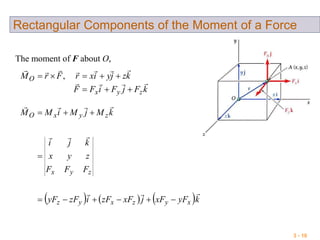
The moment of F about O,
kFjFiFF
kzjyixrFrM
zyx
O



 ,
3 - 11
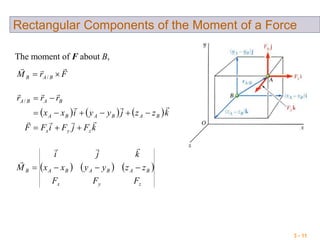
Rectangular Components of the Moment of a Force
The moment of F about B,
FrM BAB

 /
     
kFjFiFF
kzzjyyixx
rrr
zyx
BABABA
BABA





/
     
zyx
BABABAB
FFF
zzyyxx
kji
M 


3 - 12
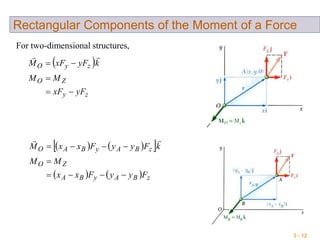
Rectangular Components of the Moment of a Force
For two-dimensional structures,
 
zy
ZO
zyO
yFxF
MM
kyFxFM




    
    zBAyBA
ZO
zBAyBAO
FyyFxx
MM
kFyyFxxM




3 - 13
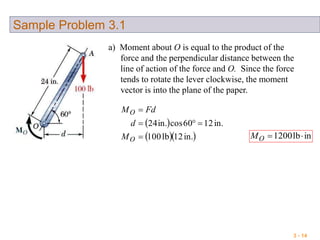
Sample Problem 3.1
A 100-lb vertical force is applied to the end of a
lever which is attached to a shaft at O.
Determine:
a) moment about O,
b) horizontal force at A which creates the same
moment,
c) smallest force at A which produces the same
moment,
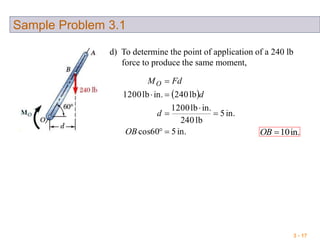
d) location for a 240-lb vertical force to produce
the same moment,
e) whether any of the forces from b, c, and d is
equivalent to the original force.
3 - 14
Sample Problem 3.1
a) Moment about O is equal to the product of the
force and the perpendicular distance between the
line of action of the force and O. Since the force
tends to rotate the lever clockwise, the moment
vector is into the plane of the paper.
 
  in.12lb100
in.1260cosin.24



O
O
M
d
FdM
inlb1200 OM
3 - 15
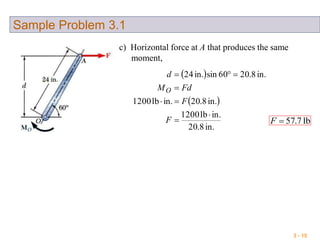
Sample Problem 3.1
c) Horizontal force at A that produces the same
moment,
 
 
in.8.20
in.lb1200
in.8.20in.lb1200
in.8.2060sinin.24





F
F
FdM
d
O
lb7.57F
3 - 16
Sample Problem 3.1
c) The smallest force A to produce the same moment
occurs when the perpendicular distance is a
maximum or when F is perpendicular to OA.
 
in.42
in.lb1200
in.42in.lb1200




F
F
FdMO
lb50F
3 - 17
Sample Problem 3.1
d) To determine the point of application of a 240 lb
force to produce the same moment,
 
in.5cos60
in.5
lb402
in.lb1200
lb240in.lb1200






OB
d
d
FdMO
in.10OB
3 - 18
Sample Problem 3.1
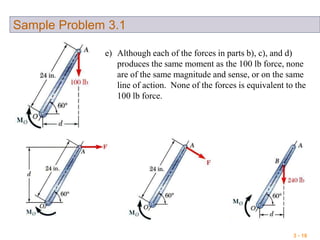
e) Although each of the forces in parts b), c), and d)
produces the same moment as the 100 lb force, none
are of the same magnitude and sense, or on the same
line of action. None of the forces is equivalent to the
100 lb force.
3 - 19
Sample Problem 3.4
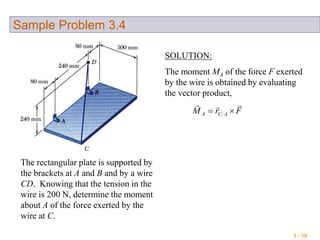
The rectangular plate is supported by
the brackets at A and B and by a wire
CD. Knowing that the tension in the
wire is 200 N, determine the moment
about A of the force exerted by the
wire at C.
SOLUTION:
The moment MA of the force F exerted
by the wire is obtained by evaluating
the vector product,
FrM ACA


3 - 20
Sample Problem 3.4
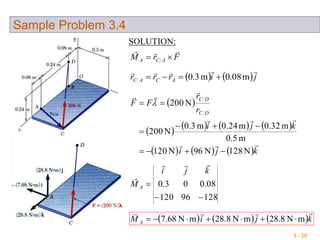
SOLUTION:
12896120
08.003.0


kji
M A


     kjiM A

mN8.82mN8.82mN68.7 
   jirrr ACAC

m08.0m3.0 
FrM ACA


 
       
     kji
kji
r
r
FF
DC
DC




N128N69N120
m5.0
m32.0m0.24m3.0
N200
N200



 
3 - 21
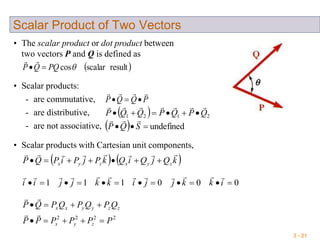
Scalar Product of Two Vectors
• The scalar product or dot product between
two vectors P and Q is defined as
 resultscalarcosPQQP 

• Scalar products:
- are commutative,
- are distributive,
- are not associative,
PQQP


  2121 QPQPQQP


  undefined SQP

• Scalar products with Cartesian unit components,
000111  ikkjjikkjjii

   kQjQiQkPjPiPQP zyxzyx


2222
PPPPPP
QPQPQPQP
zyx
zzyyxx




3 - 22
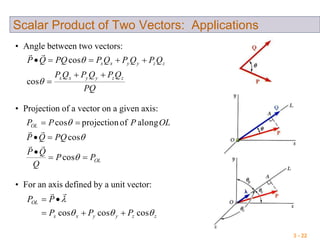
Scalar Product of Two Vectors: Applications
• Angle between two vectors:
PQ
QPQPQP
QPQPQPPQQP
zzyyxx
zzyyxx





cos
cos

• Projection of a vector on a given axis:
OL
OL
PP
Q
QP
PQQP
OLPPP







cos
cos
alongofprojectioncos


zzyyxx
OL
PPP
PP


coscoscos 


• For an axis defined by a unit vector:
3 - 23
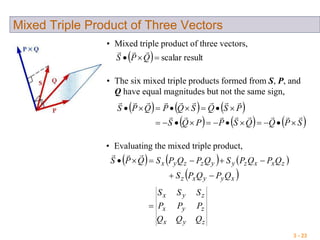
Mixed Triple Product of Three Vectors
• Mixed triple product of three vectors,
  resultscalar QPS

• The six mixed triple products formed from S, P, and
Q have equal magnitudes but not the same sign,
     
     SPQQSPPQS
PSQSQPQPS




     
 
zyx
zyx
zyx
xyyxz
zxxzyyzzyx
QQQ
PPP
SSS
QPQPS
QPQPSQPQPSQPS




• Evaluating the mixed triple product,
3 - 24
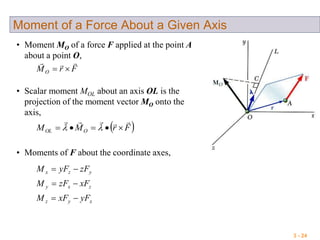
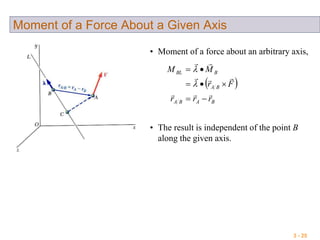
Moment of a Force About a Given Axis
• Moment MO of a force F applied at the point A
about a point O,
FrMO


• Scalar moment MOL about an axis OL is the
projection of the moment vector MO onto the
axis,
 FrMM OOL

 
• Moments of F about the coordinate axes,
xyz
zxy
yzx
yFxFM
xFzFM
zFyFM



3 - 25
Moment of a Force About a Given Axis
• Moment of a force about an arbitrary axis,
 
BABA
BA
BBL
rrr
Fr
MM








• The result is independent of the point B
along the given axis.
3 - 26
Sample Problem 3.5
a) about A
b) about the edge AB and
c) about the diagonal AG of the cube.
d) Determine the perpendicular distance
between AG and FC.
A cube is acted on by a force P as
shown. Determine the moment of P
3 - 27
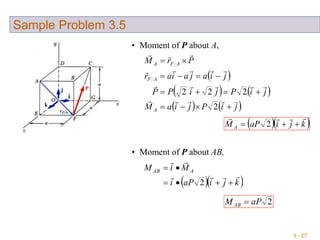
Sample Problem 3.5
• Moment of P about A,
 
   
   jiPjiaM
jiPjiPP
jiajaiar
PrM
A
AF
AFA








2
222
  kjiaPM A

 2
• Moment of P about AB,
  kjiaPi
MiM AAB




2
2aPM AB 
3 - 28
Sample Problem 3.5
• Moment of P about the diagonal AG,
 
 
   
 111
6
23
1
2
3
1
3







aP
kji
aP
kjiM
kji
aP
M
kji
a
kajaia
r
r
MM
AG
A
GA
GA
AAG








6
aP
M AG 
3 - 29
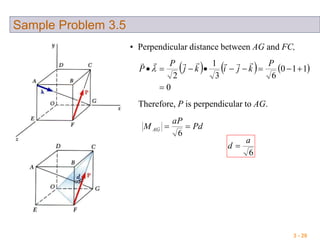
Sample Problem 3.5
• Perpendicular distance between AG and FC,
     
0
110
63
1
2


P
kjikj
P
P


Therefore, P is perpendicular to AG.
Pd
aP
M AG 
6
6
a
d 
3 - 30
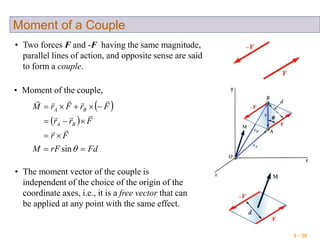
Moment of a Couple
• Two forces F and -F having the same magnitude,
parallel lines of action, and opposite sense are said
to form a couple.
• Moment of the couple,
 
 
FdrFM
Fr
Frr
FrFrM
BA
BA




sin



• The moment vector of the couple is
independent of the choice of the origin of the
coordinate axes, i.e., it is a free vector that can
be applied at any point with the same effect.
3 - 31
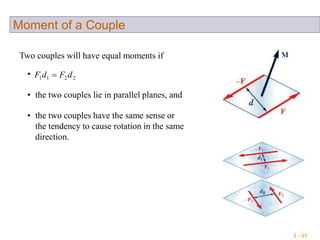
Moment of a Couple
Two couples will have equal moments if
• 2211 dFdF 
• the two couples lie in parallel planes, and
• the two couples have the same sense or
the tendency to cause rotation in the same
direction.
3 - 32
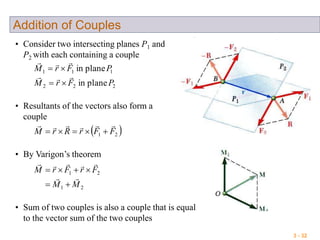
Addition of Couples
• Consider two intersecting planes P1 and
P2 with each containing a couple
222
111
planein
planein
PFrM
PFrM




• Resultants of the vectors also form a
couple
 21 FFrRrM


• By Varigon’s theorem
21
21
MM
FrFrM




• Sum of two couples is also a couple that is equal
to the vector sum of the two couples
3 - 33
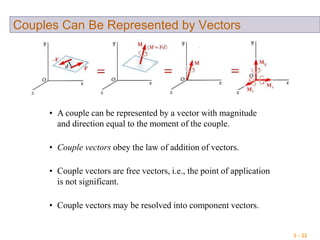
Couples Can Be Represented by Vectors
• A couple can be represented by a vector with magnitude
and direction equal to the moment of the couple.
• Couple vectors obey the law of addition of vectors.
• Couple vectors are free vectors, i.e., the point of application
is not significant.
• Couple vectors may be resolved into component vectors.
3 - 34
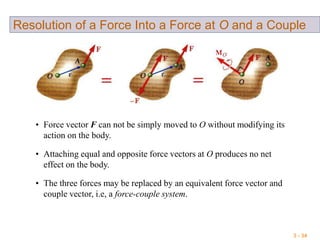
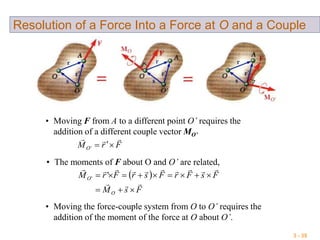
Resolution of a Force Into a Force at O and a Couple
• Force vector F can not be simply moved to O without modifying its
action on the body.
• Attaching equal and opposite force vectors at O produces no net
effect on the body.
• The three forces may be replaced by an equivalent force vector and
couple vector, i.e, a force-couple system.
3 - 35
Resolution of a Force Into a Force at O and a Couple
• Moving F from A to a different point O’ requires the
addition of a different couple vector MO’
FrMO

'
• The moments of F about O and O’ are related,
 
FsM
FsFrFsrFrM
O
O



 ''
• Moving the force-couple system from O to O’ requires the
addition of the moment of the force at O about O’.
3 - 36
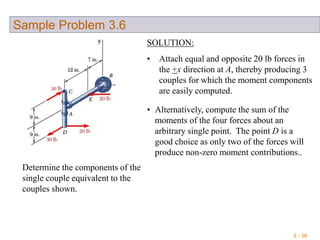
Sample Problem 3.6
Determine the components of the
single couple equivalent to the
couples shown.
SOLUTION:
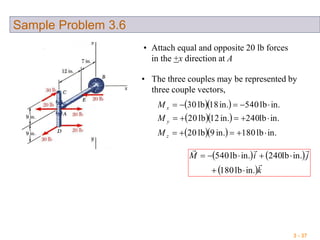
• Attach equal and opposite 20 lb forces in
the +x direction at A, thereby producing 3
couples for which the moment components
are easily computed.
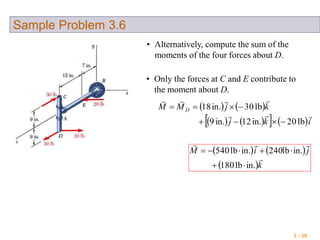
• Alternatively, compute the sum of the
moments of the four forces about an
arbitrary single point. The point D is a
good choice as only two of the forces will
produce non-zero moment contributions..
3 - 37
Sample Problem 3.6
• Attach equal and opposite 20 lb forces
in the +x direction at A
• The three couples may be represented by
three couple vectors,
  
  
   in.lb180in.9lb20
in.lb240in.12lb20
in.lb540in.18lb30



z
y
x
M
M
M
   
 k
jiM


in.lb180
in.lb240in.lb540


3 - 38
Sample Problem 3.6
• Alternatively, compute the sum of the
moments of the four forces about D.
• Only the forces at C and E contribute to
the moment about D.
   
      ikj
kjMM D


lb20in.12in.9
lb30in.18


   
 k
jiM


in.lb180
in.lb240in.lb540


3 - 39
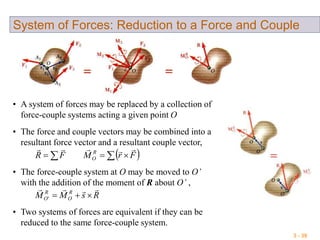
System of Forces: Reduction to a Force and Couple
• A system of forces may be replaced by a collection of
force-couple systems acting a given point O
• The force and couple vectors may be combined into a
resultant force vector and a resultant couple vector,
   FrMFR R
O

• The force-couple system at O may be moved to O’
with the addition of the moment of R about O’ ,
RsMM R
O
R
O

'
• Two systems of forces are equivalent if they can be
reduced to the same force-couple system.
3 - 40
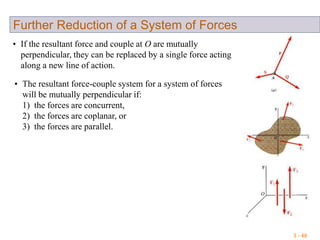
Further Reduction of a System of Forces
• If the resultant force and couple at O are mutually
perpendicular, they can be replaced by a single force acting
along a new line of action.
• The resultant force-couple system for a system of forces
will be mutually perpendicular if:
1) the forces are concurrent,
2) the forces are coplanar, or
3) the forces are parallel.
3 - 41
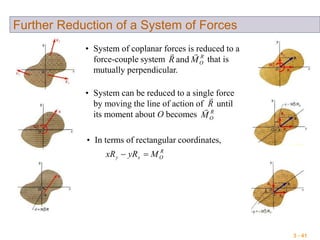
Further Reduction of a System of Forces
• System of coplanar forces is reduced to a
force-couple system that is
mutually perpendicular.
R
OMR

and
• System can be reduced to a single force
by moving the line of action of until
its moment about O becomes R
OM
R

• In terms of rectangular coordinates,
R
Oxy MyRxR 
3 - 42
Sample Problem 3.8
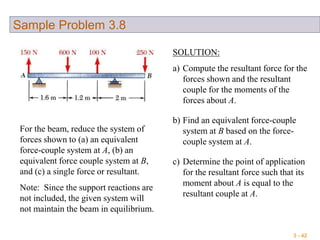
For the beam, reduce the system of
forces shown to (a) an equivalent
force-couple system at A, (b) an
equivalent force couple system at B,
and (c) a single force or resultant.
Note: Since the support reactions are
not included, the given system will
not maintain the beam in equilibrium.
SOLUTION:
a) Compute the resultant force for the
forces shown and the resultant
couple for the moments of the
forces about A.
b) Find an equivalent force-couple
system at B based on the force-
couple system at A.
c) Determine the point of application
for the resultant force such that its
moment about A is equal to the
resultant couple at A.
3 - 43
Sample Problem 3.8
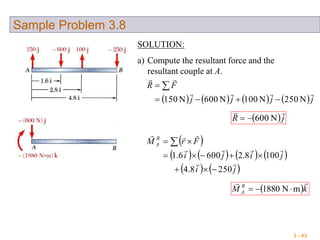
SOLUTION:
a) Compute the resultant force and the
resultant couple at A.
       jjjj
FR


N250N100N600N150 
 
 jR

N600
 
       
   ji
jiji
FrM R
A



2508.4
1008.26006.1


 
 kM R
A

mN1880 
3 - 44
Sample Problem 3.8
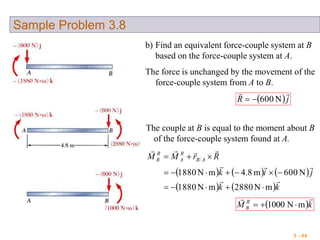
b) Find an equivalent force-couple system at B
based on the force-couple system at A.
The force is unchanged by the movement of the
force-couple system from A to B.
 jR

N600
The couple at B is equal to the moment about B
of the force-couple system found at A.
     
   kk
jik
RrMM AB
R
A
R
B



mN2880mN1880
N600m8.4mN1880



 kM R
B

mN1000 
3 - 45
Sample Problem 3.10
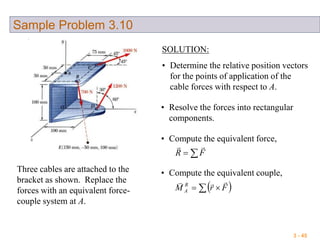
Three cables are attached to the
bracket as shown. Replace the
forces with an equivalent force-
couple system at A.
SOLUTION:
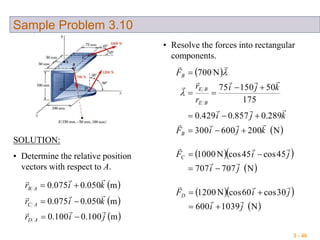
• Determine the relative position vectors
for the points of application of the
cable forces with respect to A.
• Resolve the forces into rectangular
components.
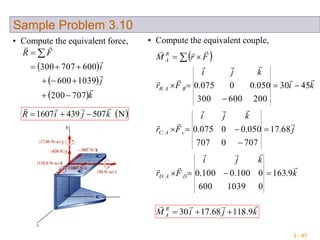
• Compute the equivalent force,
 FR

• Compute the equivalent couple,
   FrM R
A

3 - 46
Sample Problem 3.10
SOLUTION:
• Determine the relative position
vectors with respect to A.
 
 
 m100.0100.0
m050.0075.0
m050.0075.0
jir
kir
kir
AD
AC
AB






• Resolve the forces into rectangular
components.
 
 N200600300
289.0857.0429.0
175
5015075
N700
kjiF
kji
kji
r
r
F
B
BE
BE
B












  
 N1039600
30cos60cosN1200
ji
jiFD




  
 N707707
45cos45cosN1000
ji
jiFC




3 - 47
Sample Problem 3.10
• Compute the equivalent force,
 
 
 k
j
i
FR




707200
1039600
600707300



 
 N5074391607 kjiR


• Compute the equivalent couple,
 
k
kji
Fr
j
kji
Fr
ki
kji
Fr
FrM
DAD
cAC
BAB
R
A










9.163
01039600
0100.0100.0
68.17
7070707
050.00075.0
4530
200600300
050.00075.0







 
kjiM R
A

9.11868.1730 

statika struktur "rigid-body"

  • 1.
    I Made GatotKarohika ST. MT. Mechanical Engineering Udayana university
  • 2.
    3 - 2 Introduction •Treatment of a body as a single particle is not always possible. In general, the size of the body and the specific points of application of the forces must be considered. • Most bodies in elementary mechanics are assumed to be rigid, i.e., the actual deformations are small and do not affect the conditions of equilibrium or motion of the body. • Current chapter describes the effect of forces exerted on a rigid body and how to replace a given system of forces with a simpler equivalent system. • moment of a force about a point • moment of a force about an axis • moment due to a couple • Any system of forces acting on a rigid body can be replaced by an equivalent system consisting of one force acting at a given point and one couple.
  • 3.
    3 - 3 Externaland Internal Forces • Forces acting on rigid bodies are divided into two groups: - External forces - Internal forces • External forces are shown in a free-body diagram. • If unopposed, each external force can impart a motion of translation or rotation, or both.
  • 4.
    3 - 4 Principleof Transmissibility: Equivalent Forces • Principle of Transmissibility - Conditions of equilibrium or motion are not affected by transmitting a force along its line of action. NOTE: F and F’ are equivalent forces. • Moving the point of application of the force F to the rear bumper does not affect the motion or the other forces acting on the truck. • Principle of transmissibility may not always apply in determining internal forces and deformations.
  • 5.
    3 - 5 VectorProduct of Two Vectors • Concept of the moment of a force about a point is more easily understood through applications of the vector product or cross product. • Vector product of two vectors P and Q is defined as the vector V which satisfies the following conditions: 1. Line of action of V is perpendicular to plane containing P and Q. 2. Magnitude of V is 3. Direction of V is obtained from the right-hand rule. sinQPV  • Vector products: - are not commutative, - are distributive, - are not associative,  QPPQ    2121 QPQPQQP     SQPSQP 
  • 6.
    3 - 6 VectorProducts: Rectangular Components • Vector products of Cartesian unit vectors, 0 0 0    kkikjjki ijkjjkji jikkijii    • Vector products in terms of rectangular coordinates    kQjQiQkPjPiPV zyxzyx        kQPQP jQPQPiQPQP xyyx zxxzyzzy     zyx zyx QQQ PPP kji   +
  • 7.
    3 - 7 Momentof a Force About a Point • A force vector is defined by its magnitude and direction. Its effect on the rigid body also depends on it point of application. • The moment of F about O is defined as FrMO  • The moment vector MO is perpendicular to the plane containing O and the force F. • Any force F’ that has the same magnitude and direction as F, is equivalent if it also has the same line of action and therefore, produces the same moment. • Magnitude of MO measures the tendency of the force to cause rotation of the body about an axis along MO. The sense of the moment may be determined by the right-hand rule. FdrFMO  sin
  • 8.
    3 - 8 Momentof a Force About a Point • Two-dimensional structures have length and breadth but negligible depth and are subjected to forces contained in the plane of the structure. • The plane of the structure contains the point O and the force F. MO, the moment of the force about O is perpendicular to the plane. • If the force tends to rotate the structure counterclockwise, the sense of the moment vector is out of the plane of the structure and the magnitude of the moment is positive. • If the force tends to rotate the structure clockwise, the sense of the moment vector is into the plane of the structure and the magnitude of the moment is negative.
  • 9.
    3 - 9 Varignon’sTheorem • The moment about a give point O of the resultant of several concurrent forces is equal to the sum of the moments of the various moments about the same point O. • Varigon’s Theorem makes it possible to replace the direct determination of the moment of a force F by the moments of two or more component forces of F.        2121 FrFrFFr
  • 10.
    3 - 10 RectangularComponents of the Moment of a Force      kyFxFjxFzFizFyF FFF zyx kji kMjMiMM xyzxyz zyx zyxO       The moment of F about O, kFjFiFF kzjyixrFrM zyx O     ,
  • 11.
    3 - 11 RectangularComponents of the Moment of a Force The moment of F about B, FrM BAB   /       kFjFiFF kzzjyyixx rrr zyx BABABA BABA      /       zyx BABABAB FFF zzyyxx kji M   
  • 12.
    3 - 12 RectangularComponents of the Moment of a Force For two-dimensional structures,   zy ZO zyO yFxF MM kyFxFM              zBAyBA ZO zBAyBAO FyyFxx MM kFyyFxxM    
  • 13.
    3 - 13 SampleProblem 3.1 A 100-lb vertical force is applied to the end of a lever which is attached to a shaft at O. Determine: a) moment about O, b) horizontal force at A which creates the same moment, c) smallest force at A which produces the same moment, d) location for a 240-lb vertical force to produce the same moment, e) whether any of the forces from b, c, and d is equivalent to the original force.
  • 14.
    3 - 14 SampleProblem 3.1 a) Moment about O is equal to the product of the force and the perpendicular distance between the line of action of the force and O. Since the force tends to rotate the lever clockwise, the moment vector is into the plane of the paper.     in.12lb100 in.1260cosin.24    O O M d FdM inlb1200 OM
  • 15.
    3 - 15 SampleProblem 3.1 c) Horizontal force at A that produces the same moment,     in.8.20 in.lb1200 in.8.20in.lb1200 in.8.2060sinin.24      F F FdM d O lb7.57F
  • 16.
    3 - 16 SampleProblem 3.1 c) The smallest force A to produce the same moment occurs when the perpendicular distance is a maximum or when F is perpendicular to OA.   in.42 in.lb1200 in.42in.lb1200     F F FdMO lb50F
  • 17.
    3 - 17 SampleProblem 3.1 d) To determine the point of application of a 240 lb force to produce the same moment,   in.5cos60 in.5 lb402 in.lb1200 lb240in.lb1200       OB d d FdMO in.10OB
  • 18.
    3 - 18 SampleProblem 3.1 e) Although each of the forces in parts b), c), and d) produces the same moment as the 100 lb force, none are of the same magnitude and sense, or on the same line of action. None of the forces is equivalent to the 100 lb force.
  • 19.
    3 - 19 SampleProblem 3.4 The rectangular plate is supported by the brackets at A and B and by a wire CD. Knowing that the tension in the wire is 200 N, determine the moment about A of the force exerted by the wire at C. SOLUTION: The moment MA of the force F exerted by the wire is obtained by evaluating the vector product, FrM ACA  
  • 20.
    3 - 20 SampleProblem 3.4 SOLUTION: 12896120 08.003.0   kji M A        kjiM A  mN8.82mN8.82mN68.7     jirrr ACAC  m08.0m3.0  FrM ACA                  kji kji r r FF DC DC     N128N69N120 m5.0 m32.0m0.24m3.0 N200 N200     
  • 21.
    3 - 21 ScalarProduct of Two Vectors • The scalar product or dot product between two vectors P and Q is defined as  resultscalarcosPQQP   • Scalar products: - are commutative, - are distributive, - are not associative, PQQP     2121 QPQPQQP     undefined SQP  • Scalar products with Cartesian unit components, 000111  ikkjjikkjjii     kQjQiQkPjPiPQP zyxzyx   2222 PPPPPP QPQPQPQP zyx zzyyxx    
  • 22.
    3 - 22 ScalarProduct of Two Vectors: Applications • Angle between two vectors: PQ QPQPQP QPQPQPPQQP zzyyxx zzyyxx      cos cos  • Projection of a vector on a given axis: OL OL PP Q QP PQQP OLPPP        cos cos alongofprojectioncos   zzyyxx OL PPP PP   coscoscos    • For an axis defined by a unit vector:
  • 23.
    3 - 23 MixedTriple Product of Three Vectors • Mixed triple product of three vectors,   resultscalar QPS  • The six mixed triple products formed from S, P, and Q have equal magnitudes but not the same sign,            SPQQSPPQS PSQSQPQPS             zyx zyx zyx xyyxz zxxzyyzzyx QQQ PPP SSS QPQPS QPQPSQPQPSQPS     • Evaluating the mixed triple product,
  • 24.
    3 - 24 Momentof a Force About a Given Axis • Moment MO of a force F applied at the point A about a point O, FrMO   • Scalar moment MOL about an axis OL is the projection of the moment vector MO onto the axis,  FrMM OOL    • Moments of F about the coordinate axes, xyz zxy yzx yFxFM xFzFM zFyFM   
  • 25.
    3 - 25 Momentof a Force About a Given Axis • Moment of a force about an arbitrary axis,   BABA BA BBL rrr Fr MM         • The result is independent of the point B along the given axis.
  • 26.
    3 - 26 SampleProblem 3.5 a) about A b) about the edge AB and c) about the diagonal AG of the cube. d) Determine the perpendicular distance between AG and FC. A cube is acted on by a force P as shown. Determine the moment of P
  • 27.
    3 - 27 SampleProblem 3.5 • Moment of P about A,          jiPjiaM jiPjiPP jiajaiar PrM A AF AFA         2 222   kjiaPM A   2 • Moment of P about AB,   kjiaPi MiM AAB     2 2aPM AB 
  • 28.
    3 - 28 SampleProblem 3.5 • Moment of P about the diagonal AG,          111 6 23 1 2 3 1 3        aP kji aP kjiM kji aP M kji a kajaia r r MM AG A GA GA AAG         6 aP M AG 
  • 29.
    3 - 29 SampleProblem 3.5 • Perpendicular distance between AG and FC,       0 110 63 1 2   P kjikj P P   Therefore, P is perpendicular to AG. Pd aP M AG  6 6 a d 
  • 30.
    3 - 30 Momentof a Couple • Two forces F and -F having the same magnitude, parallel lines of action, and opposite sense are said to form a couple. • Moment of the couple,     FdrFM Fr Frr FrFrM BA BA     sin    • The moment vector of the couple is independent of the choice of the origin of the coordinate axes, i.e., it is a free vector that can be applied at any point with the same effect.
  • 31.
    3 - 31 Momentof a Couple Two couples will have equal moments if • 2211 dFdF  • the two couples lie in parallel planes, and • the two couples have the same sense or the tendency to cause rotation in the same direction.
  • 32.
    3 - 32 Additionof Couples • Consider two intersecting planes P1 and P2 with each containing a couple 222 111 planein planein PFrM PFrM     • Resultants of the vectors also form a couple  21 FFrRrM   • By Varigon’s theorem 21 21 MM FrFrM     • Sum of two couples is also a couple that is equal to the vector sum of the two couples
  • 33.
    3 - 33 CouplesCan Be Represented by Vectors • A couple can be represented by a vector with magnitude and direction equal to the moment of the couple. • Couple vectors obey the law of addition of vectors. • Couple vectors are free vectors, i.e., the point of application is not significant. • Couple vectors may be resolved into component vectors.
  • 34.
    3 - 34 Resolutionof a Force Into a Force at O and a Couple • Force vector F can not be simply moved to O without modifying its action on the body. • Attaching equal and opposite force vectors at O produces no net effect on the body. • The three forces may be replaced by an equivalent force vector and couple vector, i.e, a force-couple system.
  • 35.
    3 - 35 Resolutionof a Force Into a Force at O and a Couple • Moving F from A to a different point O’ requires the addition of a different couple vector MO’ FrMO  ' • The moments of F about O and O’ are related,   FsM FsFrFsrFrM O O     '' • Moving the force-couple system from O to O’ requires the addition of the moment of the force at O about O’.
  • 36.
    3 - 36 SampleProblem 3.6 Determine the components of the single couple equivalent to the couples shown. SOLUTION: • Attach equal and opposite 20 lb forces in the +x direction at A, thereby producing 3 couples for which the moment components are easily computed. • Alternatively, compute the sum of the moments of the four forces about an arbitrary single point. The point D is a good choice as only two of the forces will produce non-zero moment contributions..
  • 37.
    3 - 37 SampleProblem 3.6 • Attach equal and opposite 20 lb forces in the +x direction at A • The three couples may be represented by three couple vectors,          in.lb180in.9lb20 in.lb240in.12lb20 in.lb540in.18lb30    z y x M M M      k jiM   in.lb180 in.lb240in.lb540  
  • 38.
    3 - 38 SampleProblem 3.6 • Alternatively, compute the sum of the moments of the four forces about D. • Only the forces at C and E contribute to the moment about D.           ikj kjMM D   lb20in.12in.9 lb30in.18        k jiM   in.lb180 in.lb240in.lb540  
  • 39.
    3 - 39 Systemof Forces: Reduction to a Force and Couple • A system of forces may be replaced by a collection of force-couple systems acting a given point O • The force and couple vectors may be combined into a resultant force vector and a resultant couple vector,    FrMFR R O  • The force-couple system at O may be moved to O’ with the addition of the moment of R about O’ , RsMM R O R O  ' • Two systems of forces are equivalent if they can be reduced to the same force-couple system.
  • 40.
    3 - 40 FurtherReduction of a System of Forces • If the resultant force and couple at O are mutually perpendicular, they can be replaced by a single force acting along a new line of action. • The resultant force-couple system for a system of forces will be mutually perpendicular if: 1) the forces are concurrent, 2) the forces are coplanar, or 3) the forces are parallel.
  • 41.
    3 - 41 FurtherReduction of a System of Forces • System of coplanar forces is reduced to a force-couple system that is mutually perpendicular. R OMR  and • System can be reduced to a single force by moving the line of action of until its moment about O becomes R OM R  • In terms of rectangular coordinates, R Oxy MyRxR 
  • 42.
    3 - 42 SampleProblem 3.8 For the beam, reduce the system of forces shown to (a) an equivalent force-couple system at A, (b) an equivalent force couple system at B, and (c) a single force or resultant. Note: Since the support reactions are not included, the given system will not maintain the beam in equilibrium. SOLUTION: a) Compute the resultant force for the forces shown and the resultant couple for the moments of the forces about A. b) Find an equivalent force-couple system at B based on the force- couple system at A. c) Determine the point of application for the resultant force such that its moment about A is equal to the resultant couple at A.
  • 43.
    3 - 43 SampleProblem 3.8 SOLUTION: a) Compute the resultant force and the resultant couple at A.        jjjj FR   N250N100N600N150     jR  N600              ji jiji FrM R A    2508.4 1008.26006.1      kM R A  mN1880 
  • 44.
    3 - 44 SampleProblem 3.8 b) Find an equivalent force-couple system at B based on the force-couple system at A. The force is unchanged by the movement of the force-couple system from A to B.  jR  N600 The couple at B is equal to the moment about B of the force-couple system found at A.          kk jik RrMM AB R A R B    mN2880mN1880 N600m8.4mN1880     kM R B  mN1000 
  • 45.
    3 - 45 SampleProblem 3.10 Three cables are attached to the bracket as shown. Replace the forces with an equivalent force- couple system at A. SOLUTION: • Determine the relative position vectors for the points of application of the cable forces with respect to A. • Resolve the forces into rectangular components. • Compute the equivalent force,  FR  • Compute the equivalent couple,    FrM R A 
  • 46.
    3 - 46 SampleProblem 3.10 SOLUTION: • Determine the relative position vectors with respect to A.      m100.0100.0 m050.0075.0 m050.0075.0 jir kir kir AD AC AB       • Resolve the forces into rectangular components.    N200600300 289.0857.0429.0 175 5015075 N700 kjiF kji kji r r F B BE BE B                 N1039600 30cos60cosN1200 ji jiFD         N707707 45cos45cosN1000 ji jiFC    
  • 47.
    3 - 47 SampleProblem 3.10 • Compute the equivalent force,      k j i FR     707200 1039600 600707300       N5074391607 kjiR   • Compute the equivalent couple,   k kji Fr j kji Fr ki kji Fr FrM DAD cAC BAB R A           9.163 01039600 0100.0100.0 68.17 7070707 050.00075.0 4530 200600300 050.00075.0          kjiM R A  9.11868.1730 