1. Fundamentals statics of rigid body
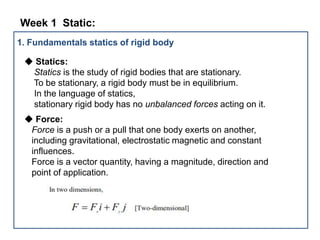
◆ Statics:
Statics is the study of rigid bodies that are stationary.
To be stationary, a rigid body must be in equilibrium.
In the language of statics,
stationary rigid body has no unbalanced forces acting on it.
◆ Force:
Force is a push or a pull that one body exerts on another,
including gravitational, electrostatic magnetic and constant
influences.
Force is a vector quantity, having a magnitude, direction and
point of application.
Week 1 Static:
1. Fundamentals statics of rigid body
Week 1 Static:
1. Fundamentals statics of rigid body
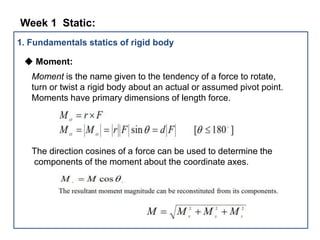
◆ Moment:
Moment is the name given to the tendency of a force to rotate,
turn or twist a rigid body about an actual or assumed pivot point.
Moments have primary dimensions of length force.
The direction cosines of a force can be used to determine the
components of the moment about the coordinate axes.
Week 1 Static:
1. Fundamentals statics of rigid body
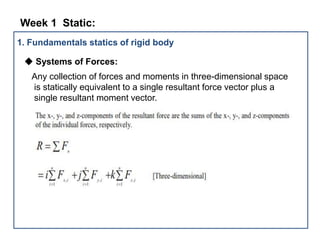
◆ Systems of Forces:
Any collection of forces and moments in three-dimensional space
is statically equivalent to a single resultant force vector plus a
single resultant moment vector.
Week 1 Static:
1. Fundamentals statics of rigid body
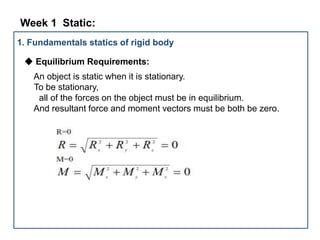
◆ Equilibrium Requirements:
An object is static when it is stationary.
To be stationary,
all of the forces on the object must be in equilibrium.
And resultant force and moment vectors must be both be zero.
Week 1 Static:

Rigid body

  • 1.
    1. Fundamentals staticsof rigid body ◆ Statics: Statics is the study of rigid bodies that are stationary. To be stationary, a rigid body must be in equilibrium. In the language of statics, stationary rigid body has no unbalanced forces acting on it. ◆ Force: Force is a push or a pull that one body exerts on another, including gravitational, electrostatic magnetic and constant influences. Force is a vector quantity, having a magnitude, direction and point of application. Week 1 Static:
  • 2.
    1. Fundamentals staticsof rigid body Week 1 Static:
  • 3.
    1. Fundamentals staticsof rigid body ◆ Moment: Moment is the name given to the tendency of a force to rotate, turn or twist a rigid body about an actual or assumed pivot point. Moments have primary dimensions of length force. The direction cosines of a force can be used to determine the components of the moment about the coordinate axes. Week 1 Static:
  • 4.
    1. Fundamentals staticsof rigid body ◆ Systems of Forces: Any collection of forces and moments in three-dimensional space is statically equivalent to a single resultant force vector plus a single resultant moment vector. Week 1 Static:
  • 5.
    1. Fundamentals staticsof rigid body ◆ Equilibrium Requirements: An object is static when it is stationary. To be stationary, all of the forces on the object must be in equilibrium. And resultant force and moment vectors must be both be zero. Week 1 Static: