19GES28 - Engineering Mechanics
Dr S.Sudhagar M.E., PhD.
Assistant Professor
Mechanical Engineering
Unit I- Basics & Statics of Particles
 Introduction
 Units and Dimensions
 Laws of mechanics
 Lami`s Theorem
 Parallelogram law and Triangle law
 Principle of transmissibility
 Vector operations
 Equilibrium of a particle in space
 Single Equivalent Force
Introduction
 Mechanics is the study of forces that act on
bodies and the resultant motion that those
bodies experience.
 Engineering Mechanics is the application of
mechanics to solve problems involving
common engineering elements.
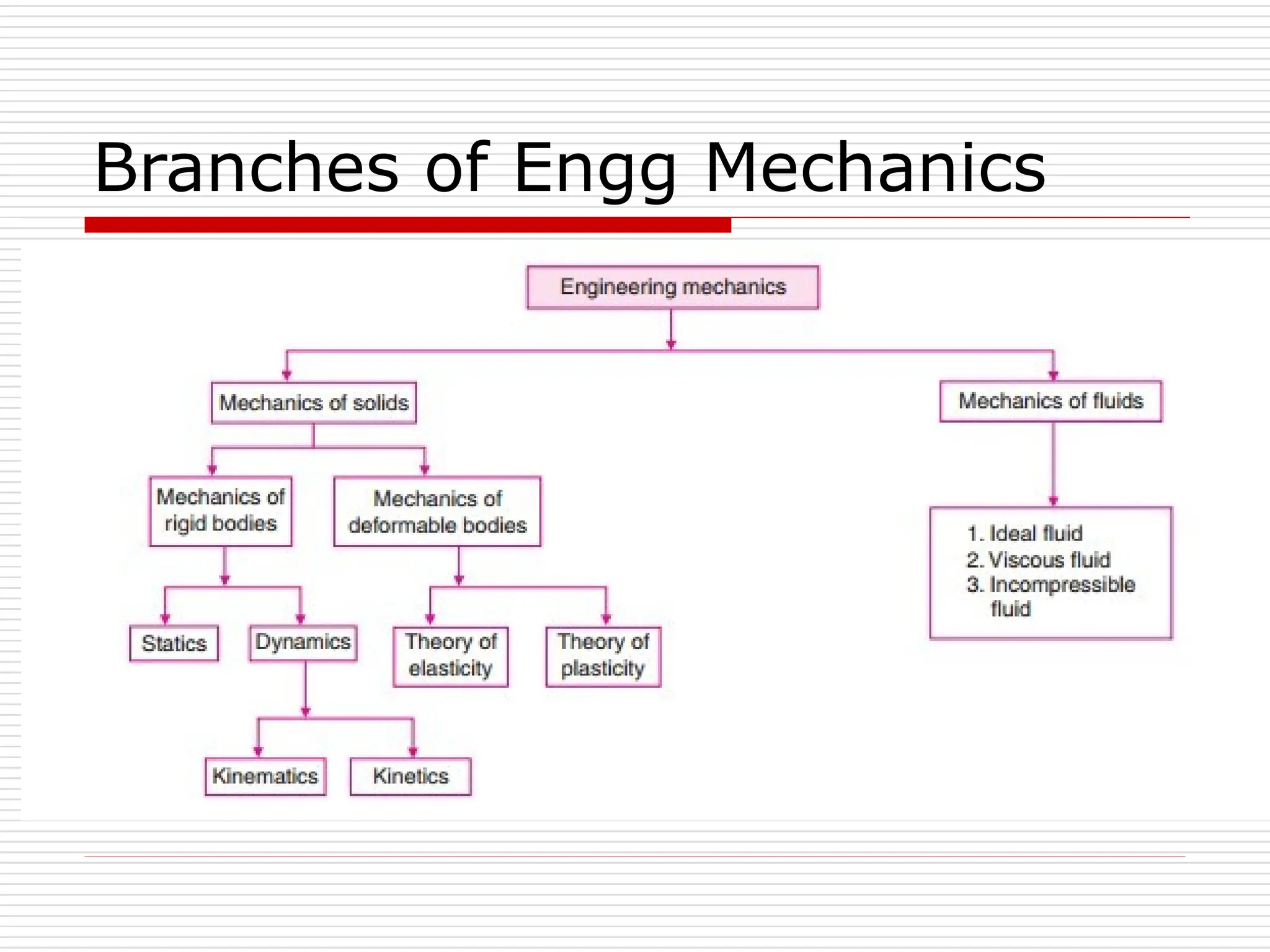
Branches of Engg Mechanics
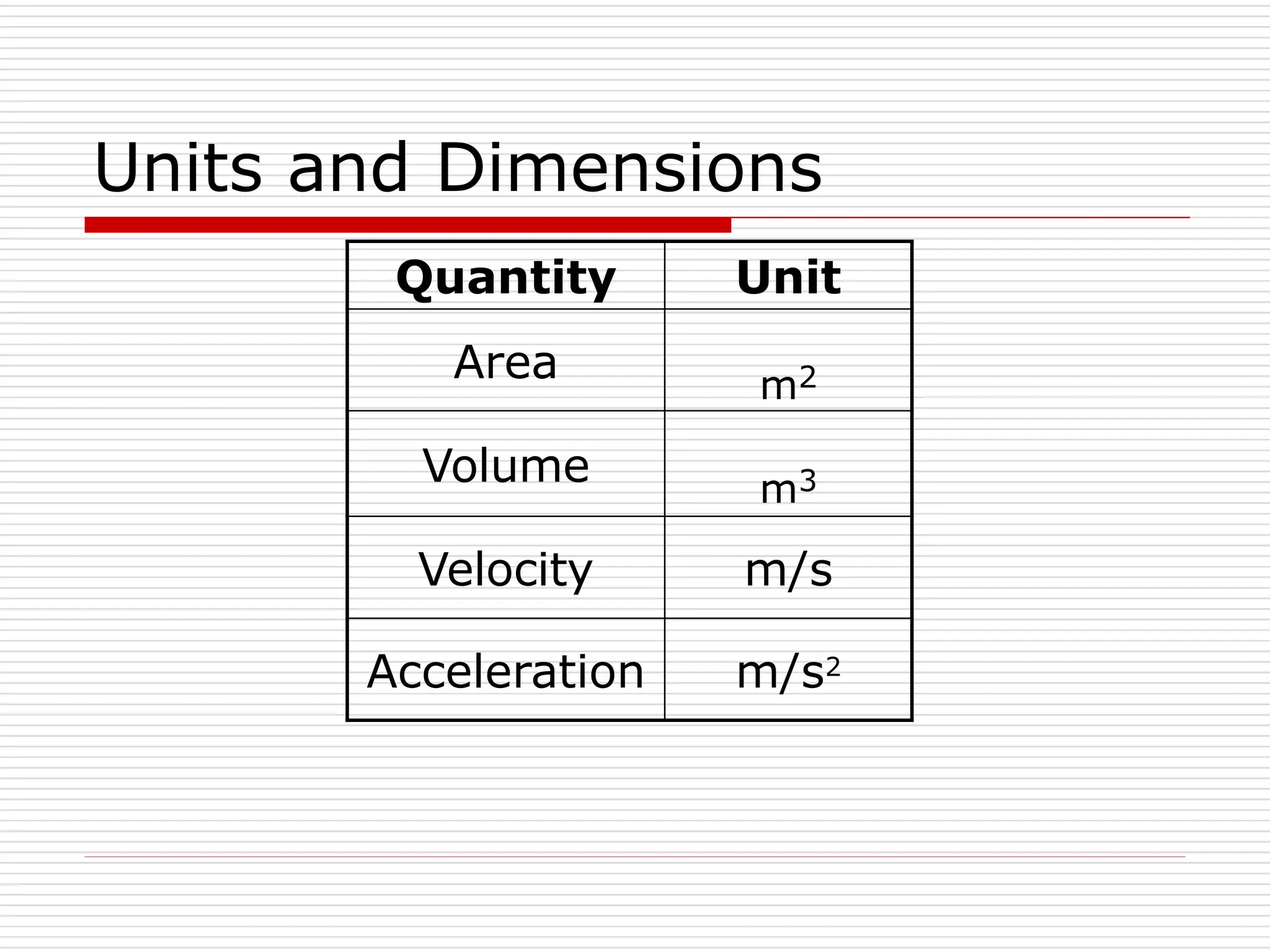
Units and Dimensions
Quantity Unit
Area m2
Volume m3
Velocity m/s
Acceleration m/s2
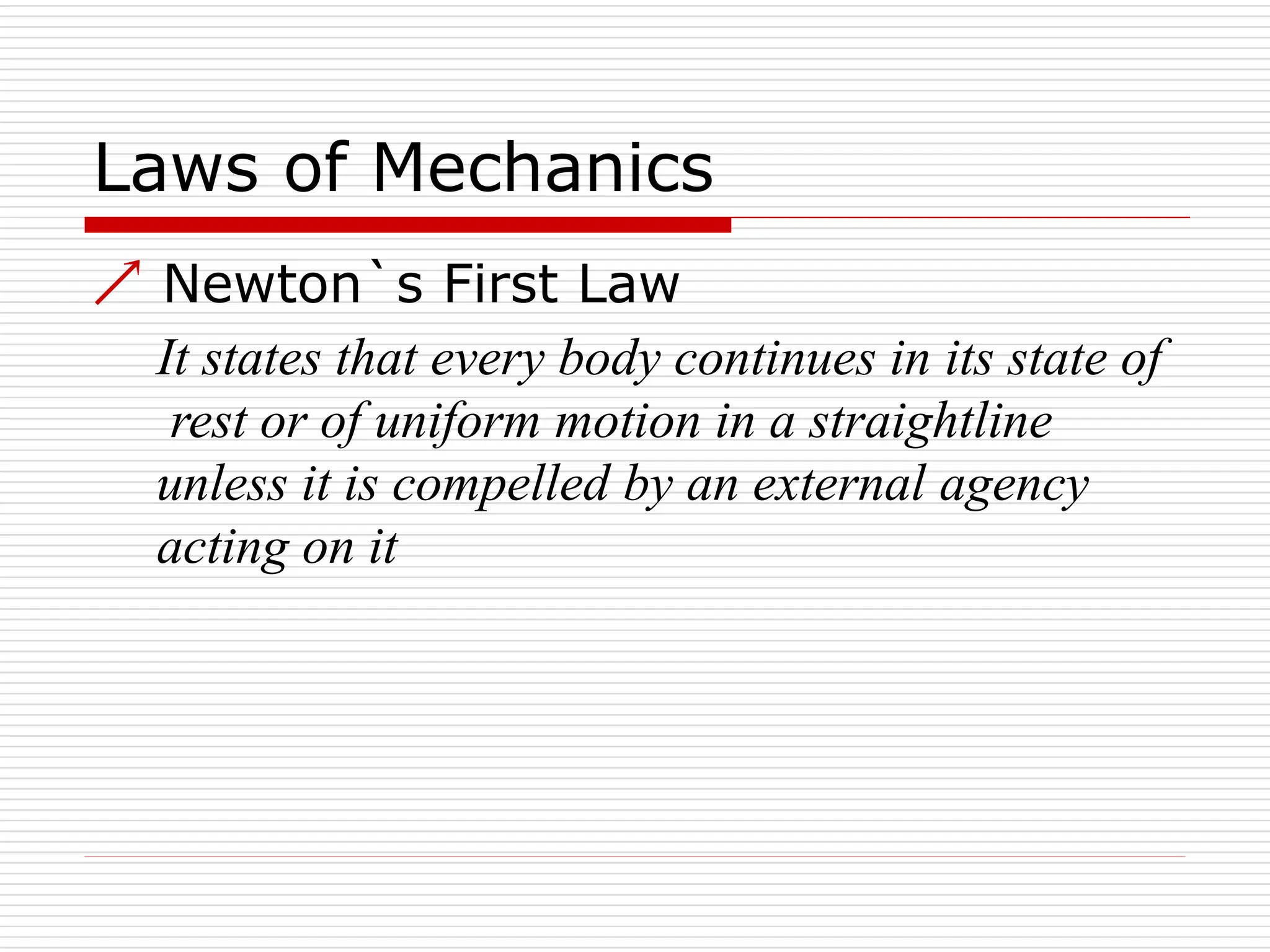
Laws of Mechanics
 Newton`s First Law
It states that every body continues in its state of
rest or of uniform motion in a straightline
unless it is compelled by an external agency
acting on it
Laws of Mechanics
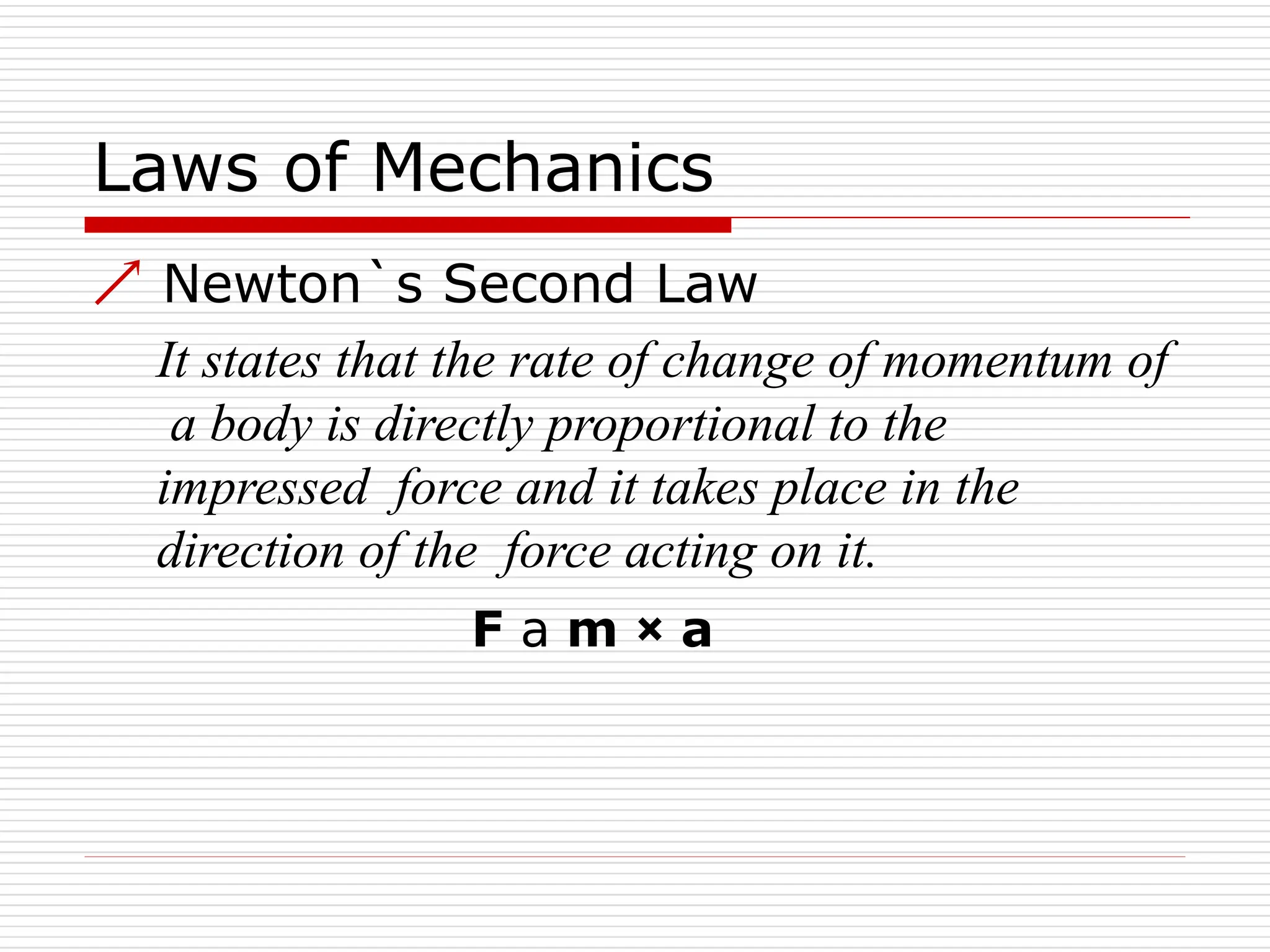
 Newton`s Second Law
It states that the rate of change of momentum of
a body is directly proportional to the
impressed force and it takes place in the
direction of the force acting on it.
F 𝖺 m × a
Laws of Mechanics
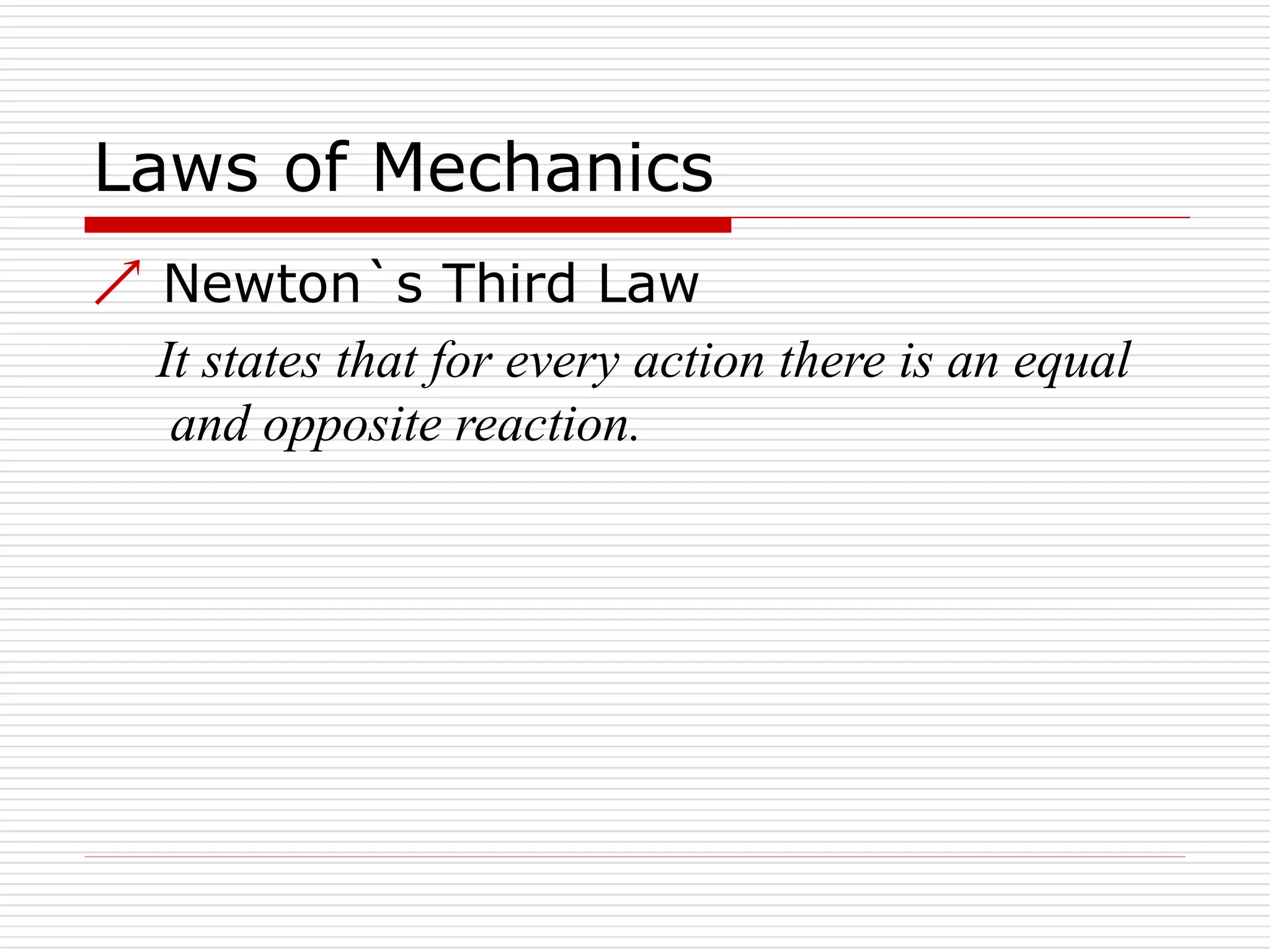
 Newton`s Third Law
It states that for every action there is an equal
and opposite reaction.
Lami`s theorem
 If a particle acted upon by three forces remains
in equilibrium then, each force acting on the
particle bears the same proportionality with the
since of the angle between the other two
forces”. Lami’s theorem is also known as
law of sines.
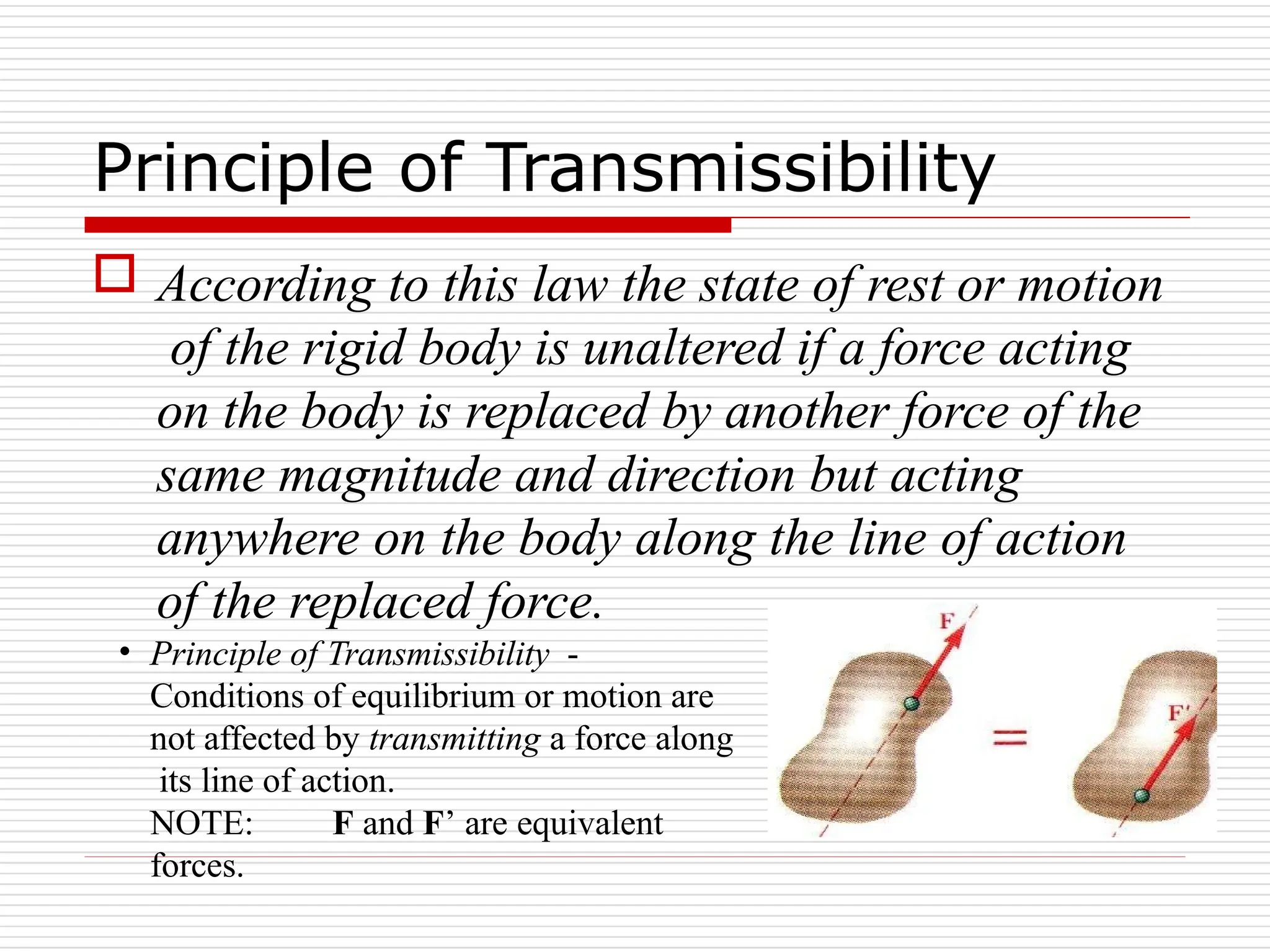
Principle of Transmissibility
 According to this law the state of rest or motion
of the rigid body is unaltered if a force acting
on the body is replaced by another force of the
same magnitude and direction but acting
anywhere on the body along the line of action
of the replaced force.
• Principle of Transmissibility -
Conditions of equilibrium or motion are
not affected by transmitting a force along
its line of action.
NOTE: F and F’ are equivalent
forces.
Parallelogram Law
 According to this law the state of rest or motion
of the rigid body is unaltered if a force acting
on the body is replaced by another force of the
same magnitude and direction but acting
anywhere on the body along the line of action
of the replaced force.
Triangle Law
 If two forces acting on a body are represented
one after another by the sides of a triangle,
their resultant is represented by the closing side
of the triangle taken from first point to the last
point.
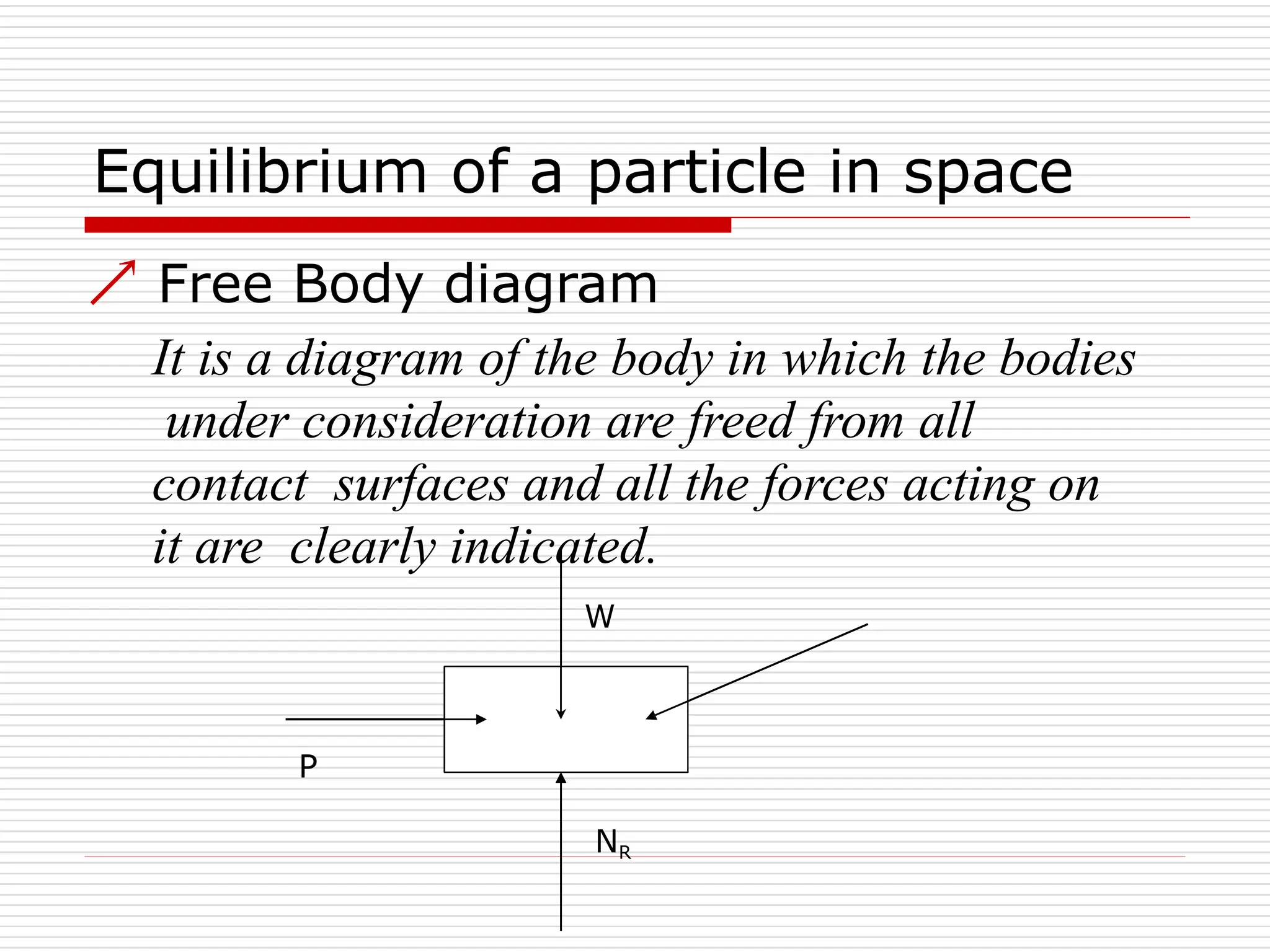
Equilibrium of a particle in space
NR
 Free Body diagram
It is a diagram of the body in which the bodies
under consideration are freed from all
contact surfaces and all the forces acting on
it are clearly indicated.
W
Q
P
Problems
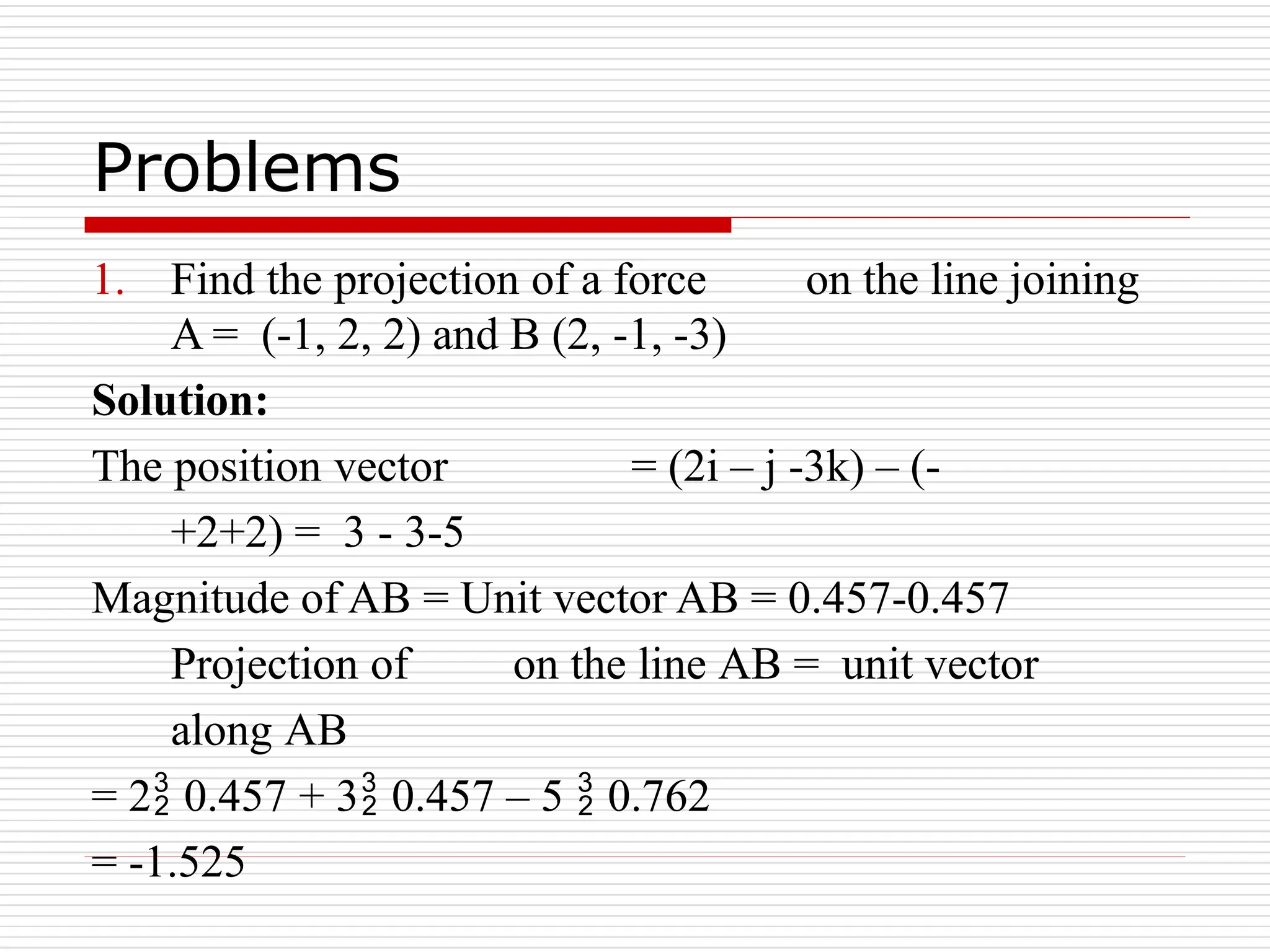
1. Find the projection of a force on the line joining
A = (-1, 2, 2) and B (2, -1, -3)
Solution:
The position vector = (2i – j -3k) – (-
+2+2) = 3 - 3-5
Magnitude of AB = Unit vector AB = 0.457-0.457
Projection of on the line AB = unit vector
along AB
= 2 0.457 + 3 0.457 – 5  0.762
= -1.525
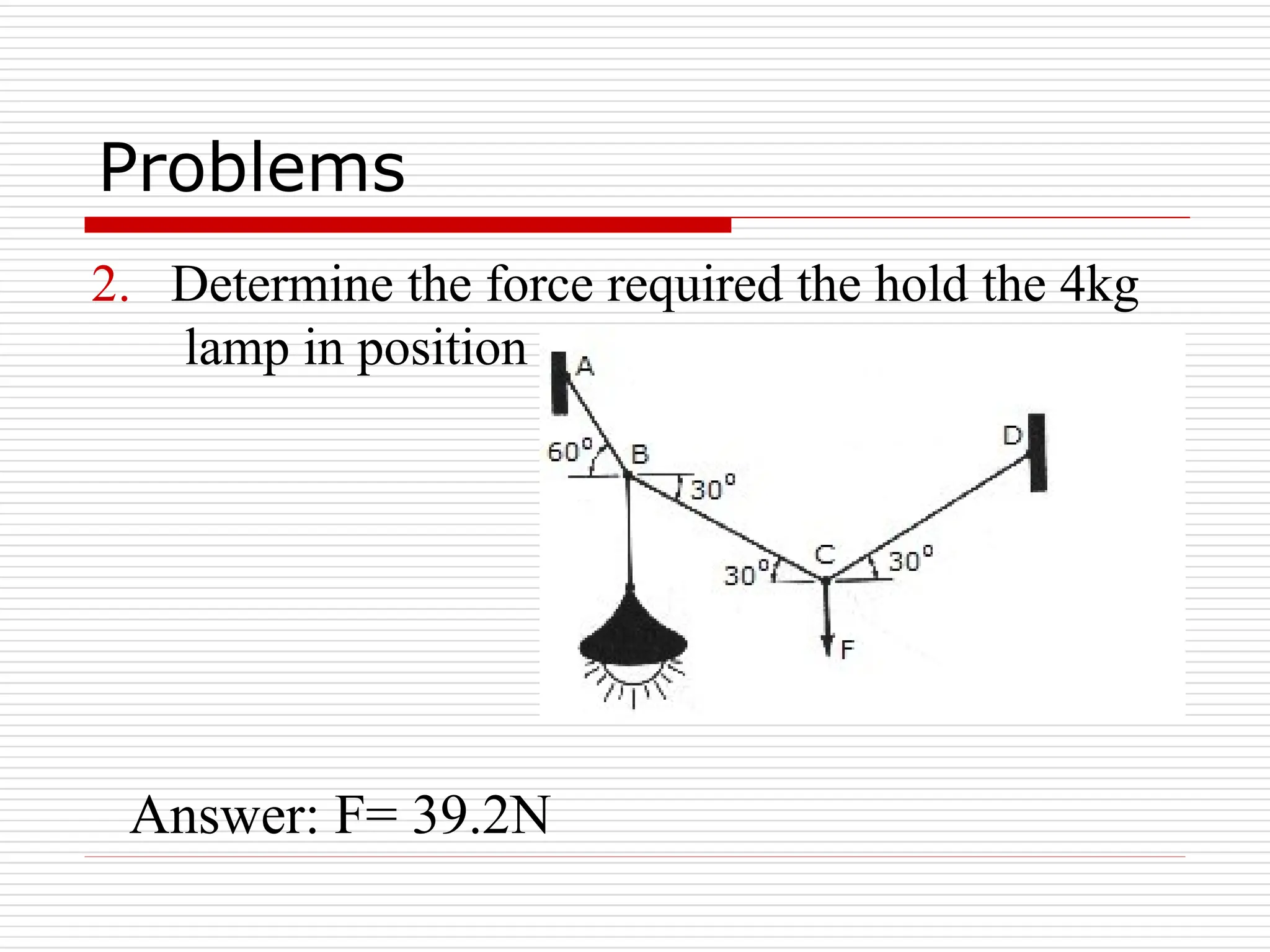
2. Determine the force required the hold the 4kg
lamp in position
Answer: F= 39.2N
Problems
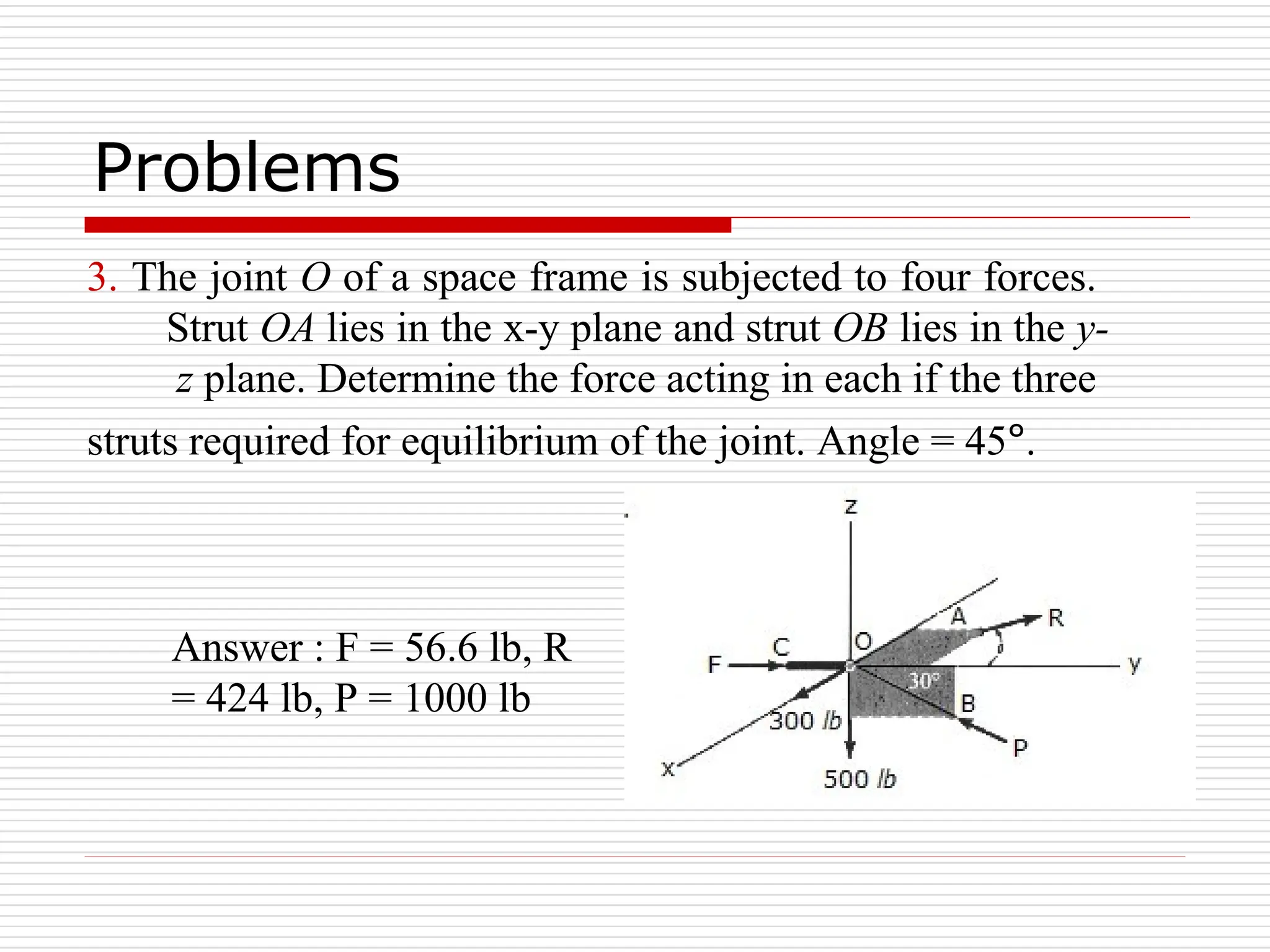
3. The joint O of a space frame is subjected to four forces.
Strut OA lies in the x-y plane and strut OB lies in the y-
z plane. Determine the force acting in each if the three
struts required for equilibrium of the joint. Angle = 45°.
Answer : F = 56.6 lb, R
= 424 lb, P = 1000 lb
Problems
Unit II- Equilibrium of Rigid bodies
 Free body diagram
 Types of supports and their reactions
 Moments and Couples
 Moment of a force about a point and about
an axis
 Varignon’s theorem
 Equilibrium of Rigid bodies in two
dimensions
 Equilibrium of Rigid bodies in three
dimensions
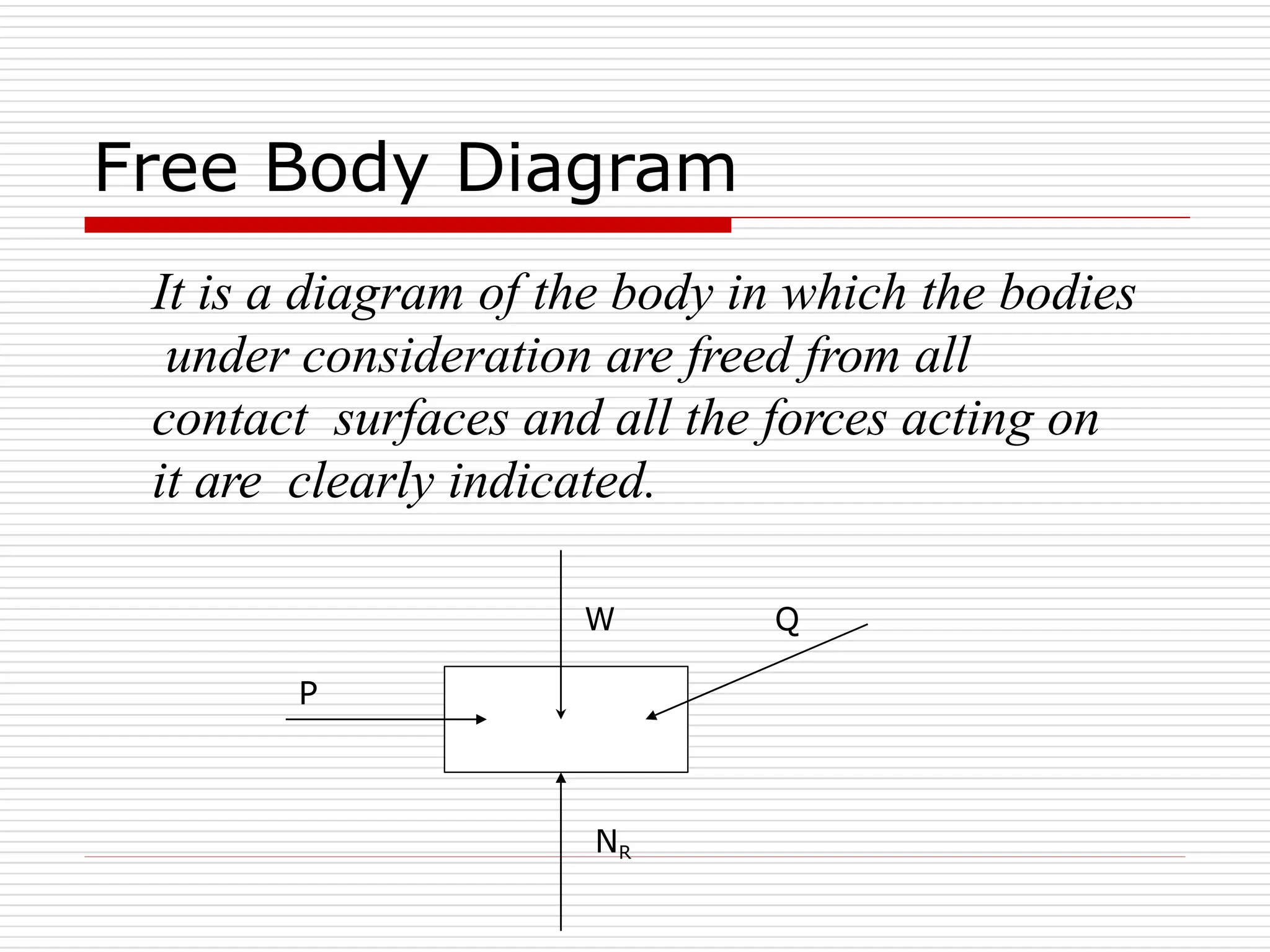
Free Body Diagram
It is a diagram of the body in which the bodies
under consideration are freed from all
contact surfaces and all the forces acting on
it are clearly indicated.
NR
Q
W
P
Beam
 A beam is a structural member
used to support loads applied at
various points along its length
Types of supports
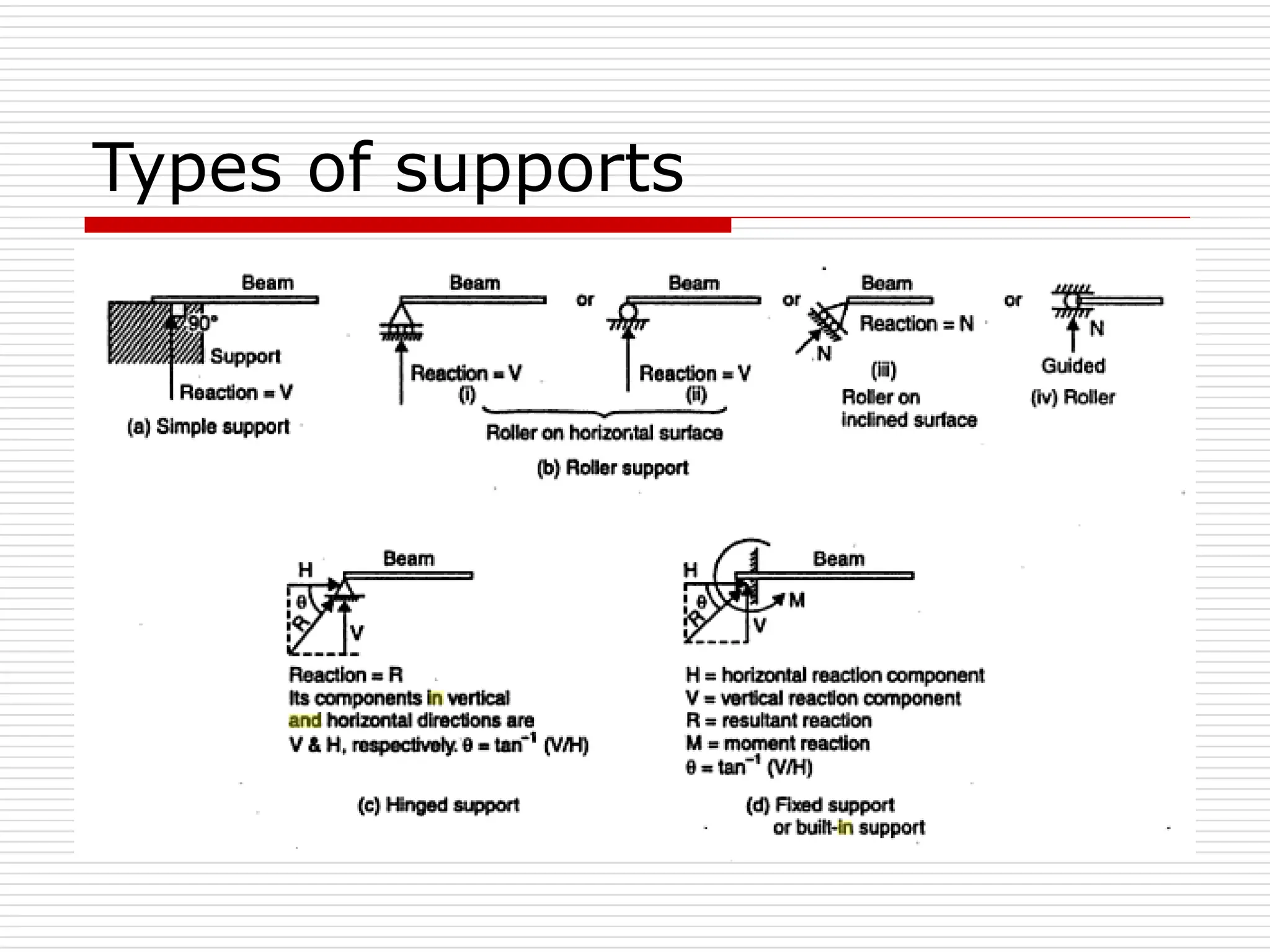
 Simple Support
If one end of the beam rests on a fixed support,
the support is known as simple support
 Roller Support
Here one end of the beam is supported on a
roller
 Hinged Support
The beam does not move either along or normal
to the axis but can rotate.
Types of supports
 Fixed support
The beam is not free to rotate or slide along the
length of the beam or in the direction normal
to the beam. Therefore three reaction
components can be observed. Also known as
bulit-in support
Types of supports
Types of beams
 Simply supported beam
 Fixed beam
 Overhanging beam
 Cantilever beam
 Continuous beam
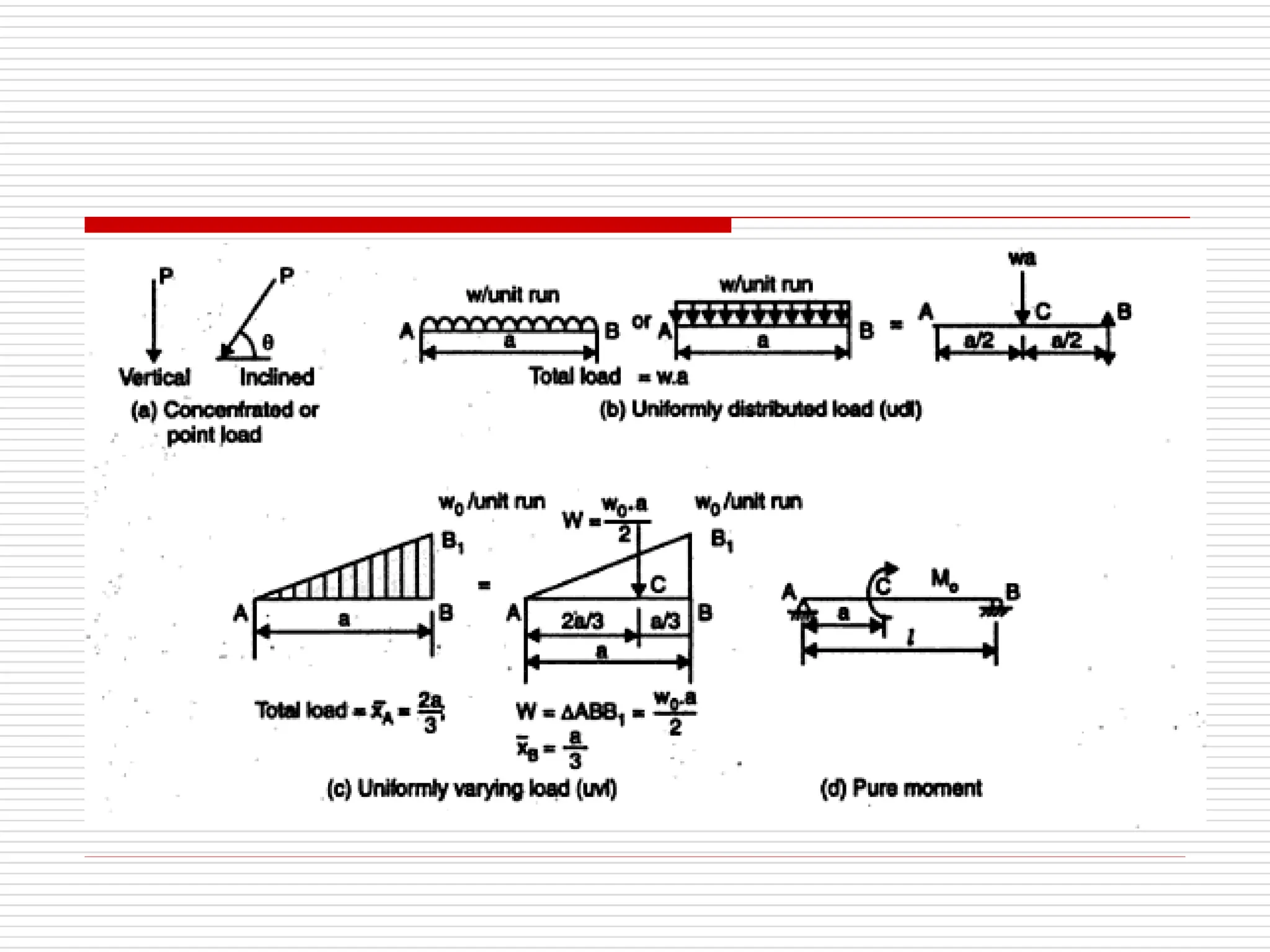
Types of Loading
 Concentrated load or point load
 Uniformly distributed load(udl)
 Uniformly Varying load(uvl)
 Pure moment
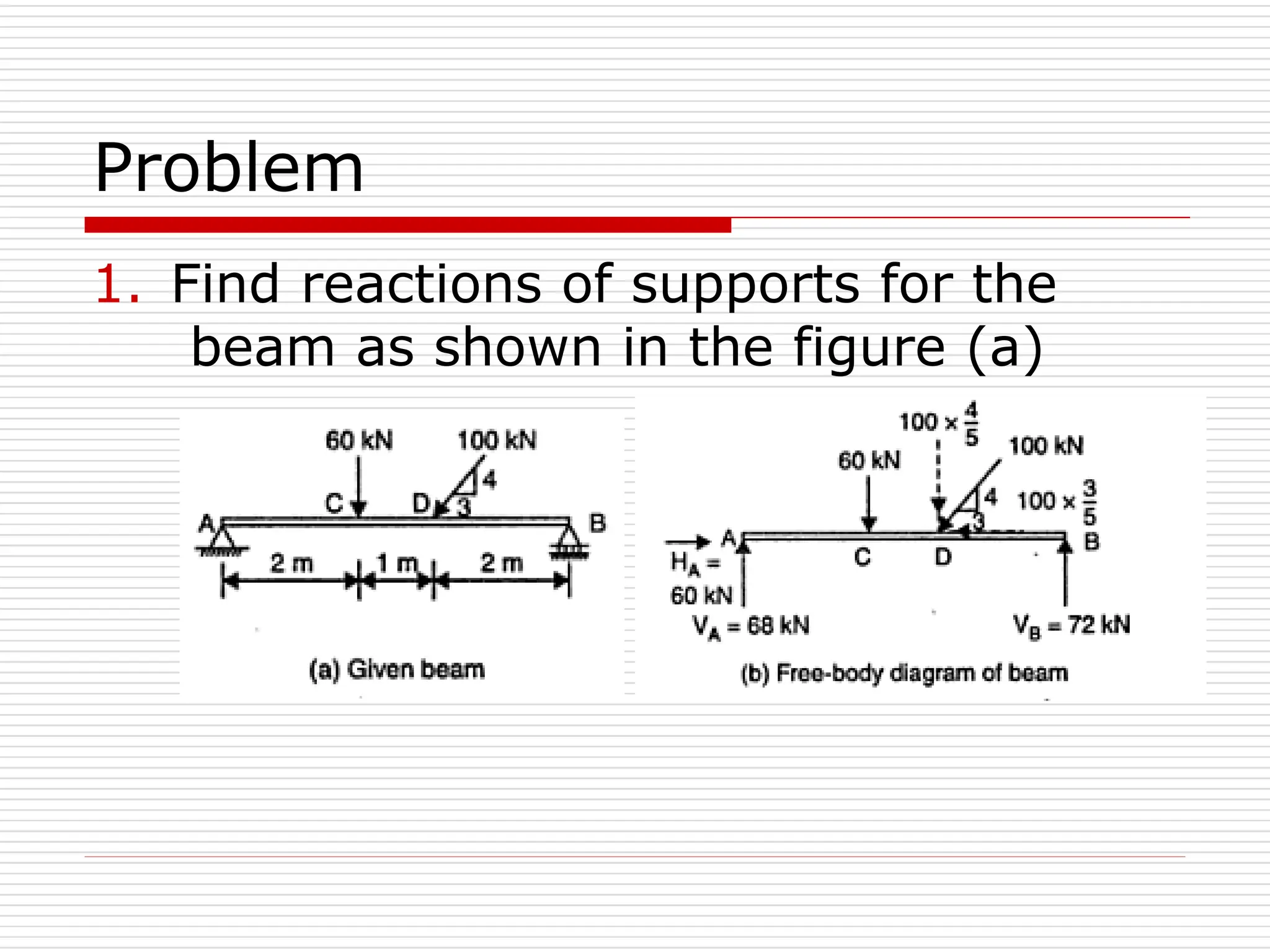
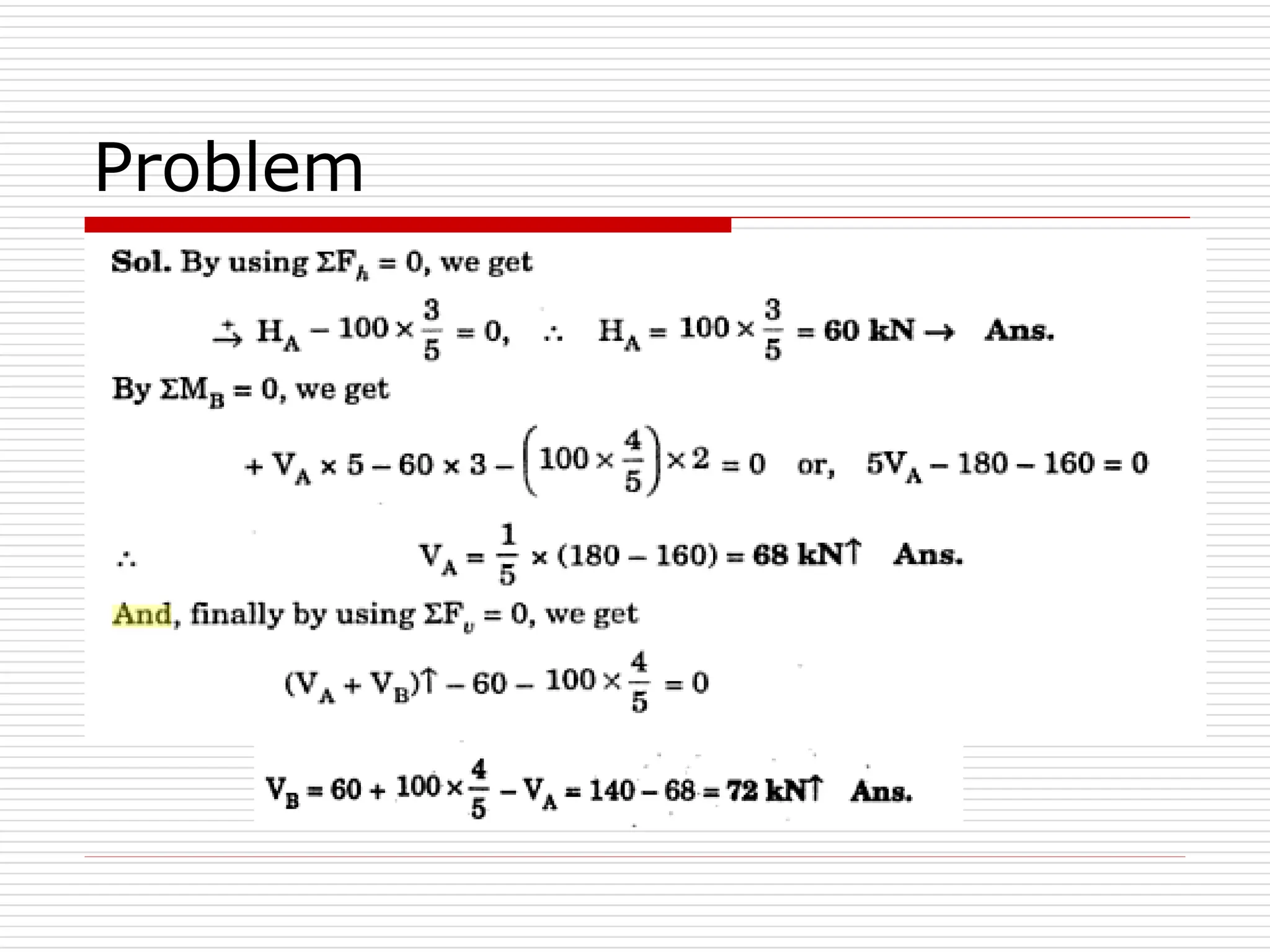
Problem
1. Find reactions of supports for the
beam as shown in the figure (a)
Problem
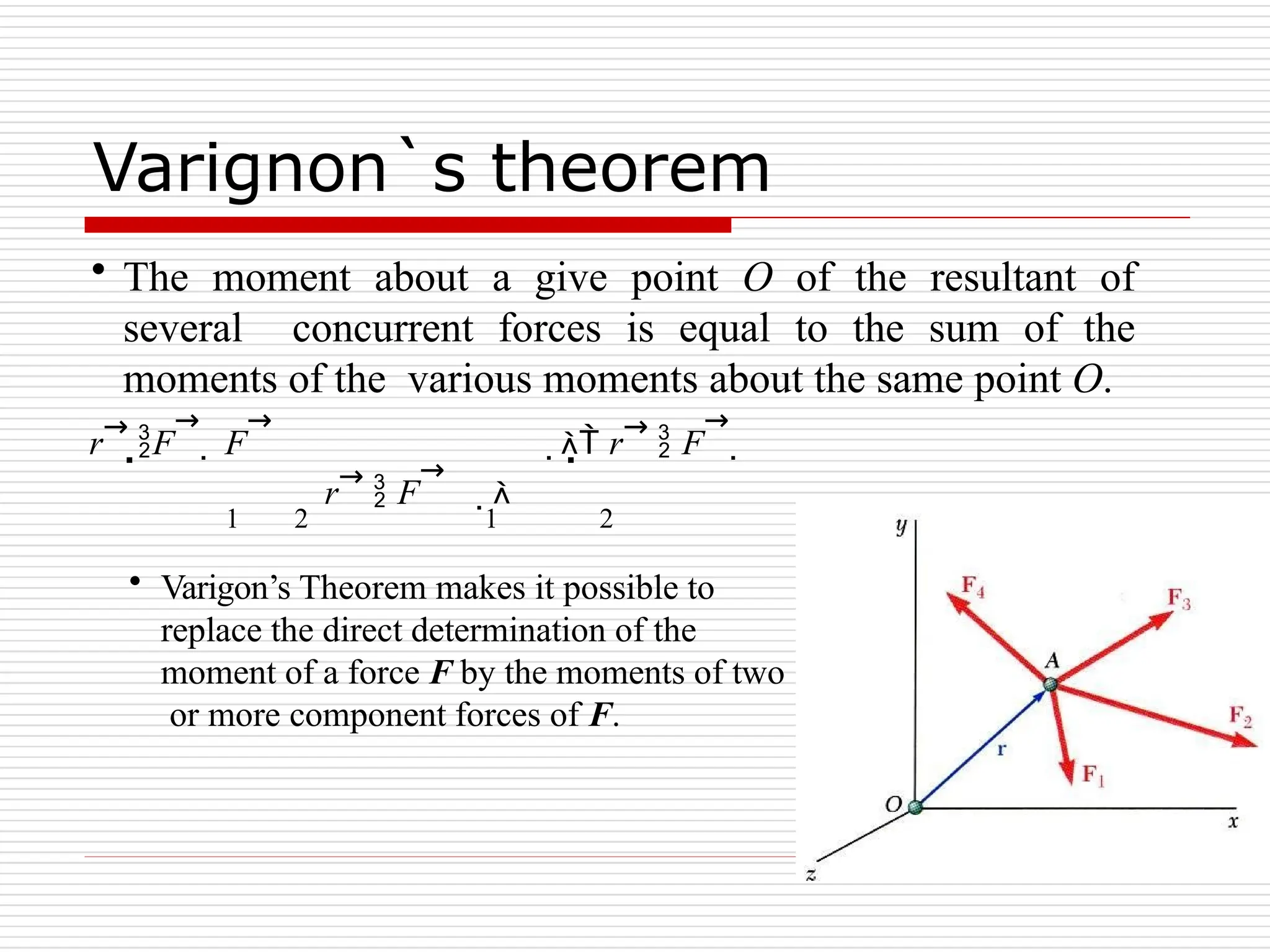
Varignon`s theorem
• The moment about a give point O of the resultant of
several concurrent forces is equal to the sum of the
moments of the various moments about the same point O.
r→
F
→
 F
→
 r→
 F
→

r→
 F
→

1 2 1 2
• Varigon’s Theorem makes it possible to
replace the direct determination of the
moment of a force F by the moments of two
or more component forces of F.
Moment
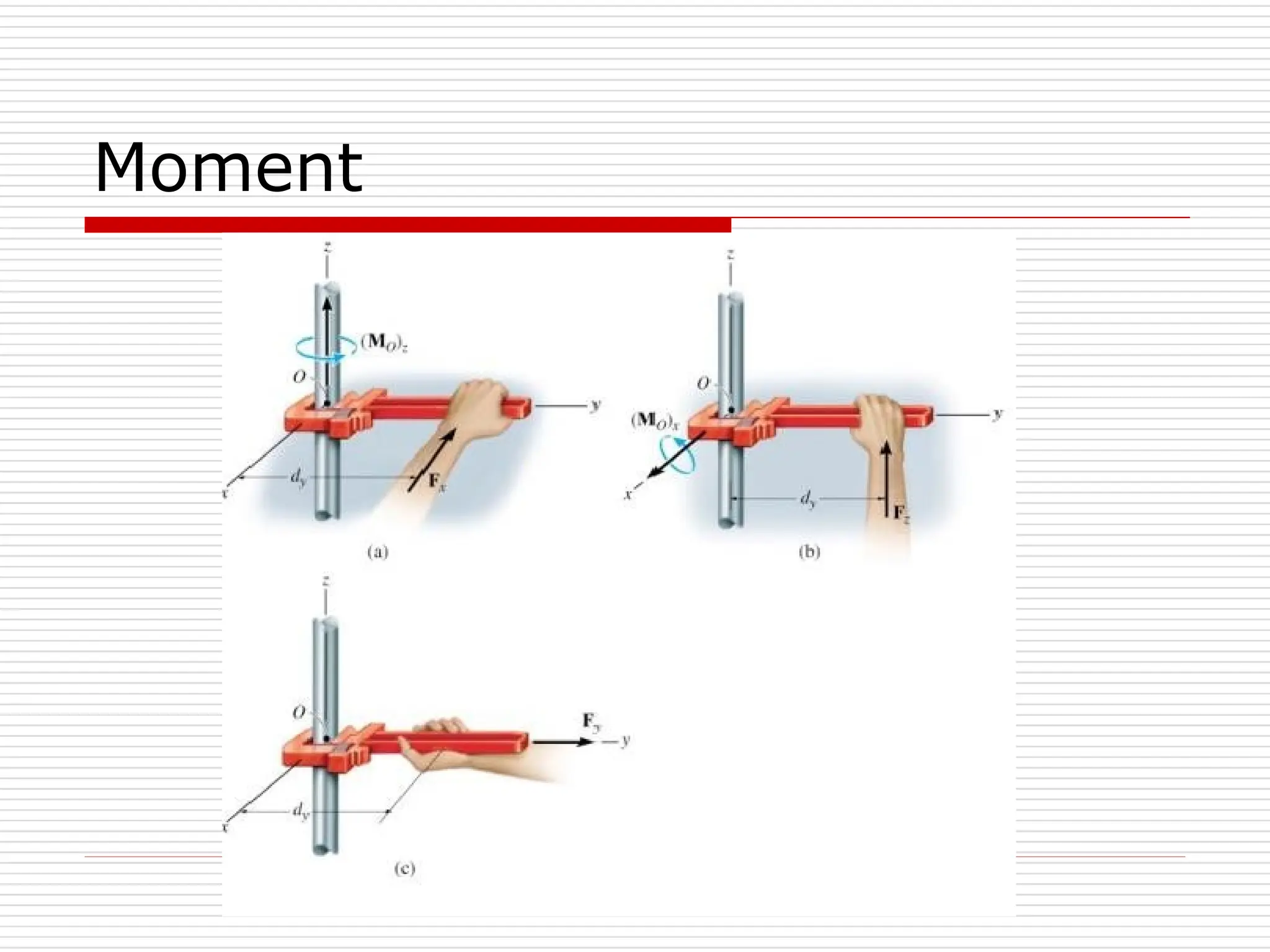
 The moment of a force about a point or axis
measures of the tendency of the force to cause
the body to rotate about the point or axis.
M = F d
Moment
Problem
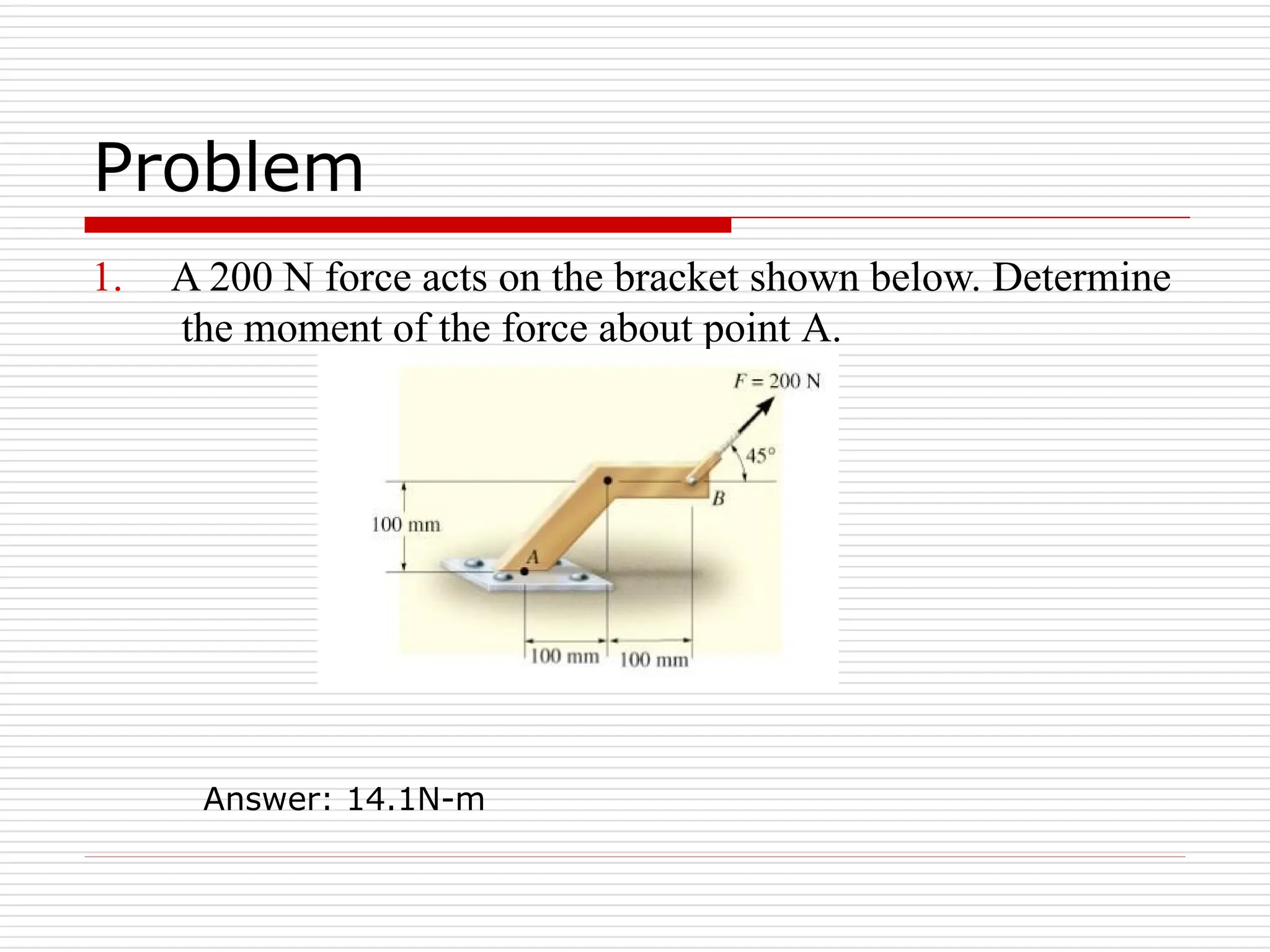
1. A 200 N force acts on the bracket shown below. Determine
the moment of the force about point A.
Answer: 14.1N-m
Problem
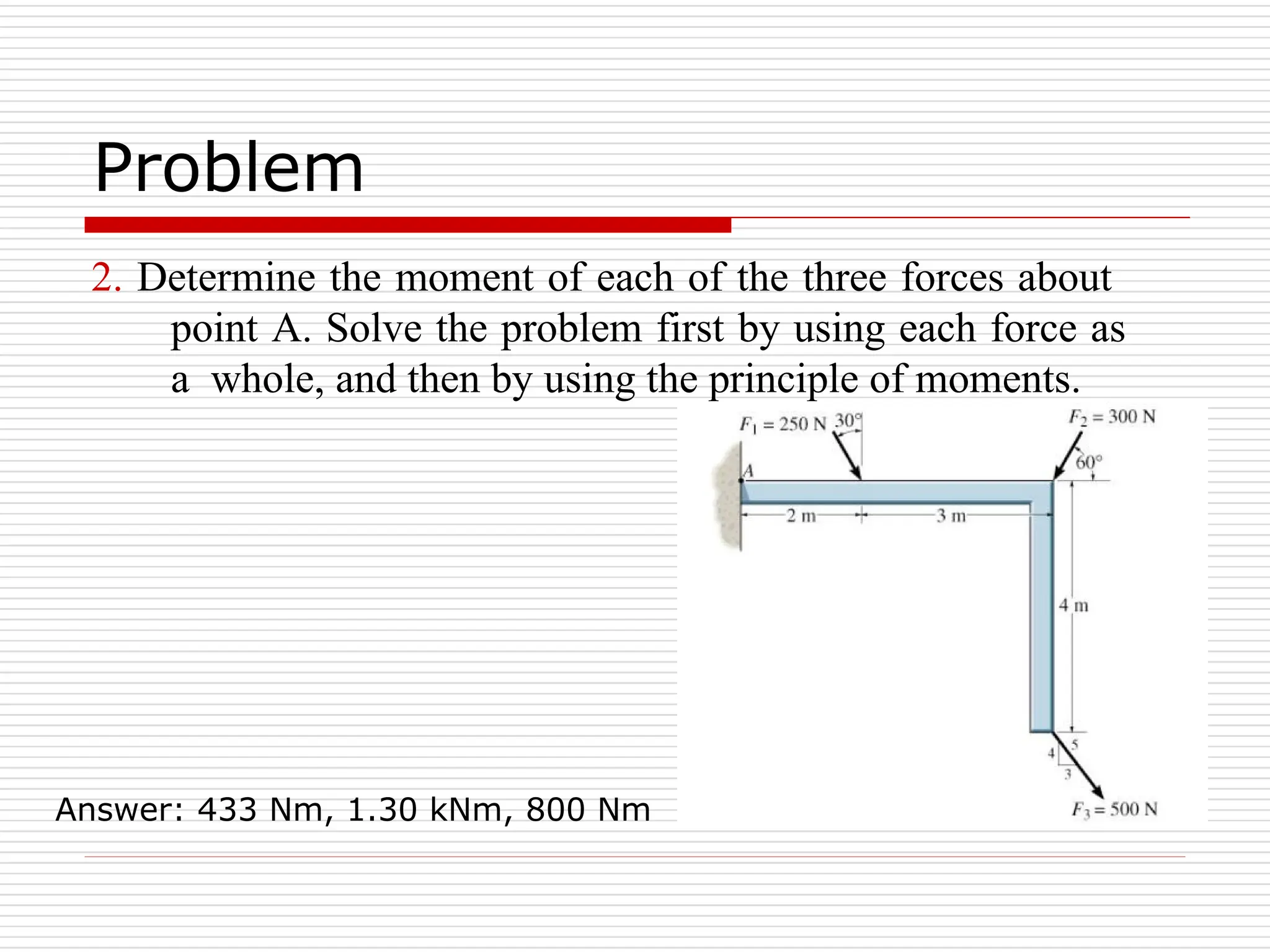
2. Determine the moment of each of the three forces about
point A. Solve the problem first by using each force as
a whole, and then by using the principle of moments.
Answer: 433 Nm, 1.30 kNm, 800 Nm
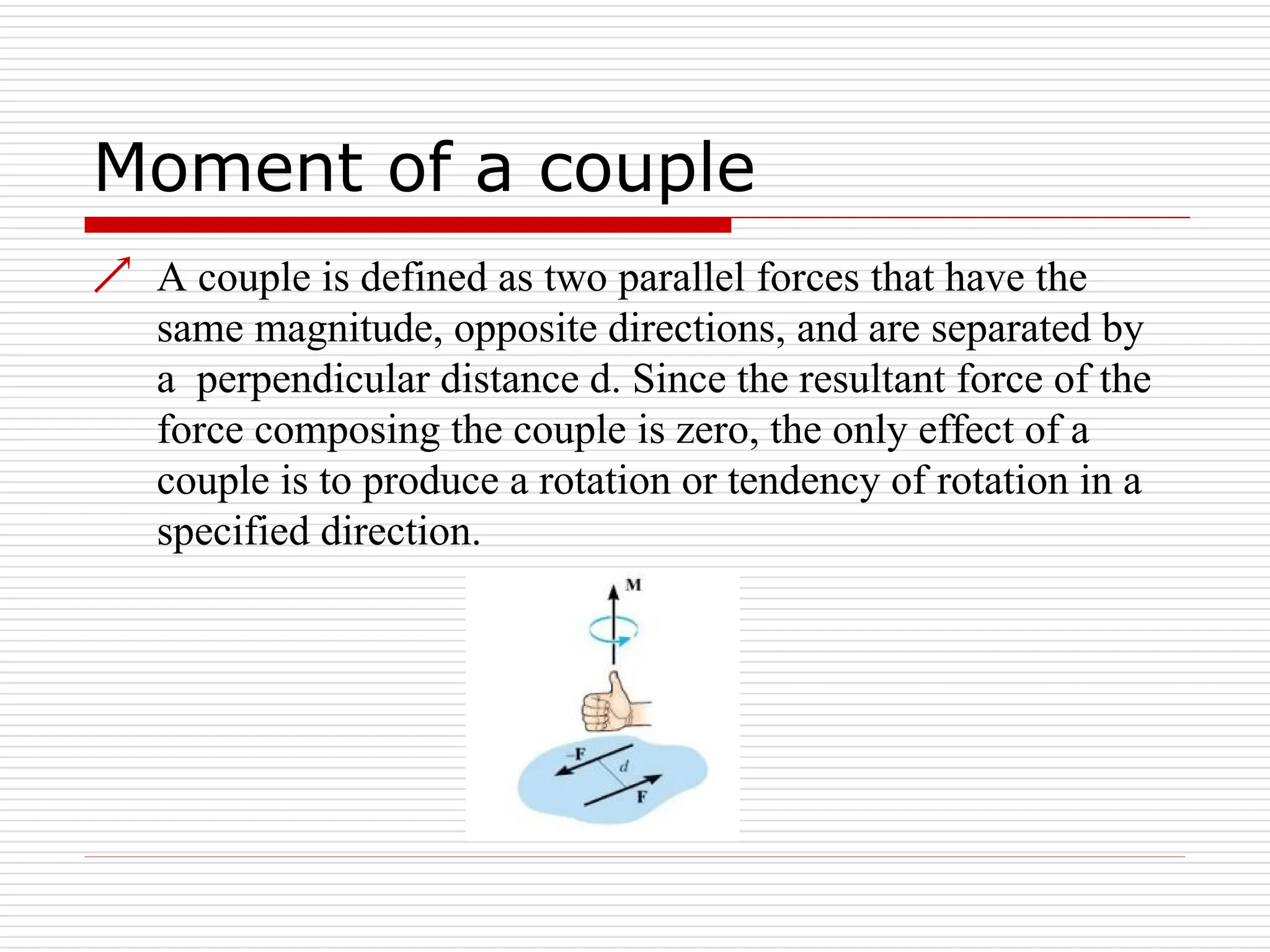
Moment of a couple
 A couple is defined as two parallel forces that have the
same magnitude, opposite directions, and are separated by
a perpendicular distance d. Since the resultant force of the
force composing the couple is zero, the only effect of a
couple is to produce a rotation or tendency of rotation in a
specified direction.
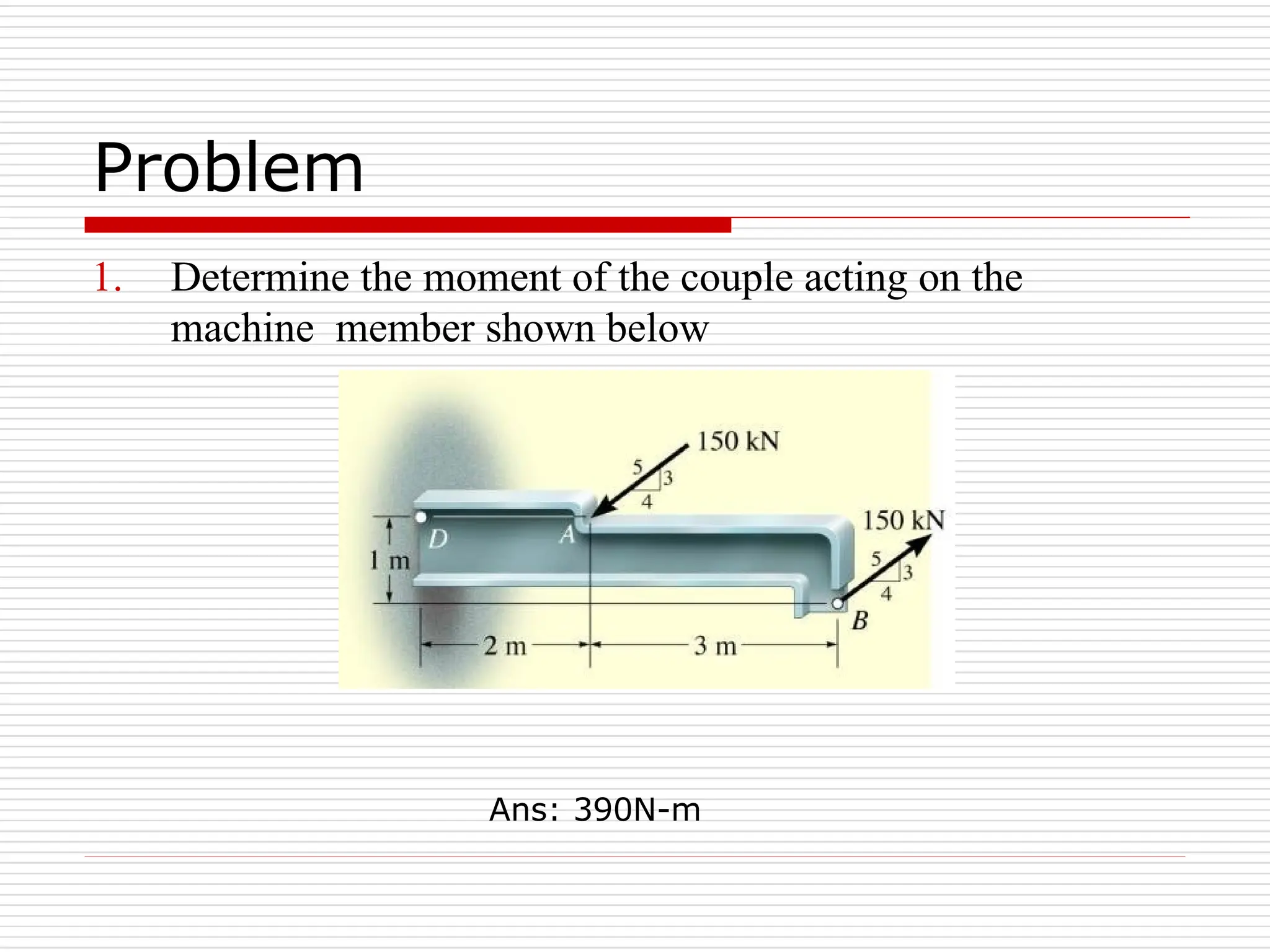
Problem
1. Determine the moment of the couple acting on the
machine member shown below
Ans: 390N-m
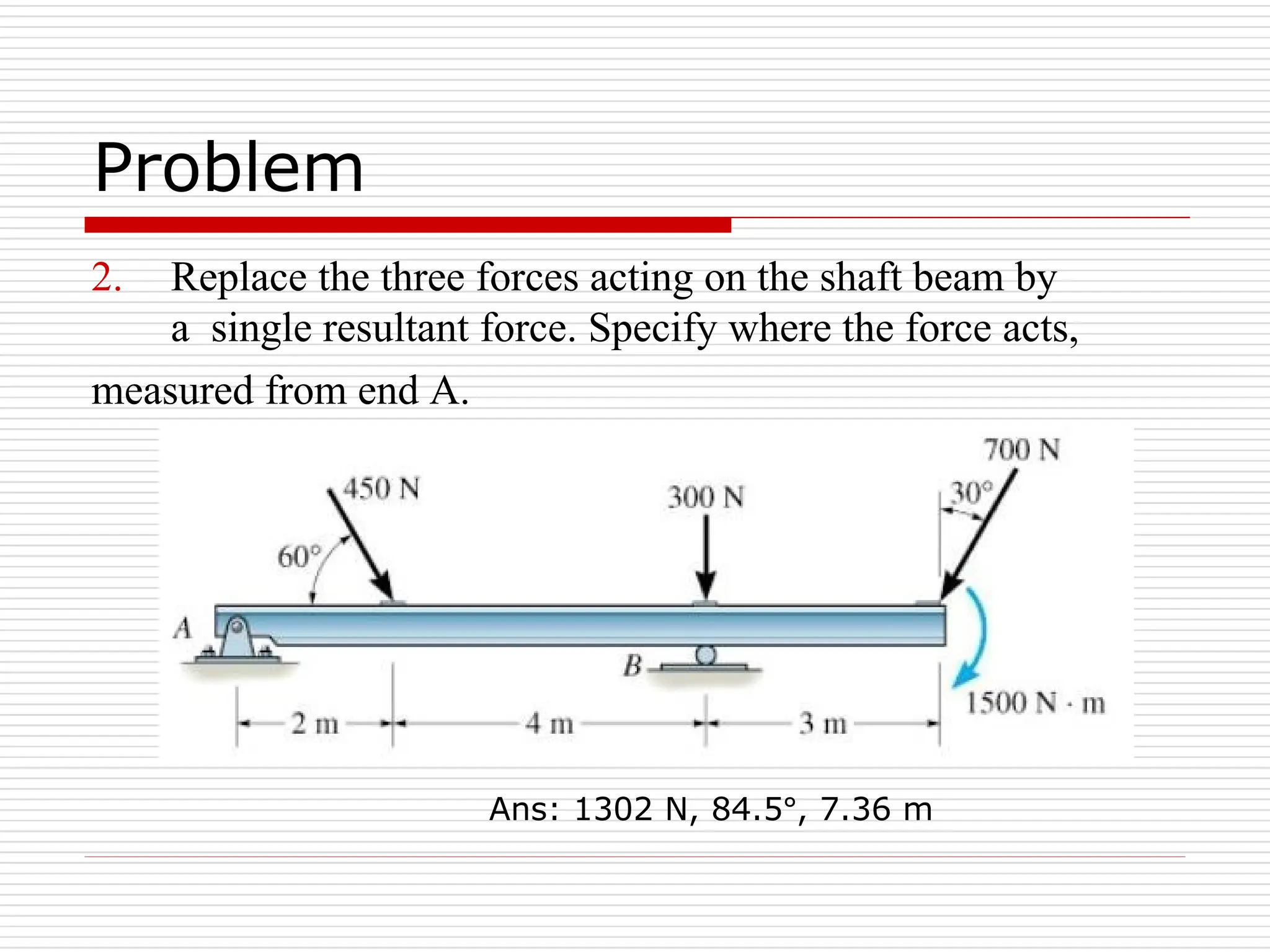
Problem
2. Replace the three forces acting on the shaft beam by
a single resultant force. Specify where the force acts,
measured from end A.
Ans: 1302 N, 84.5°, 7.36 m
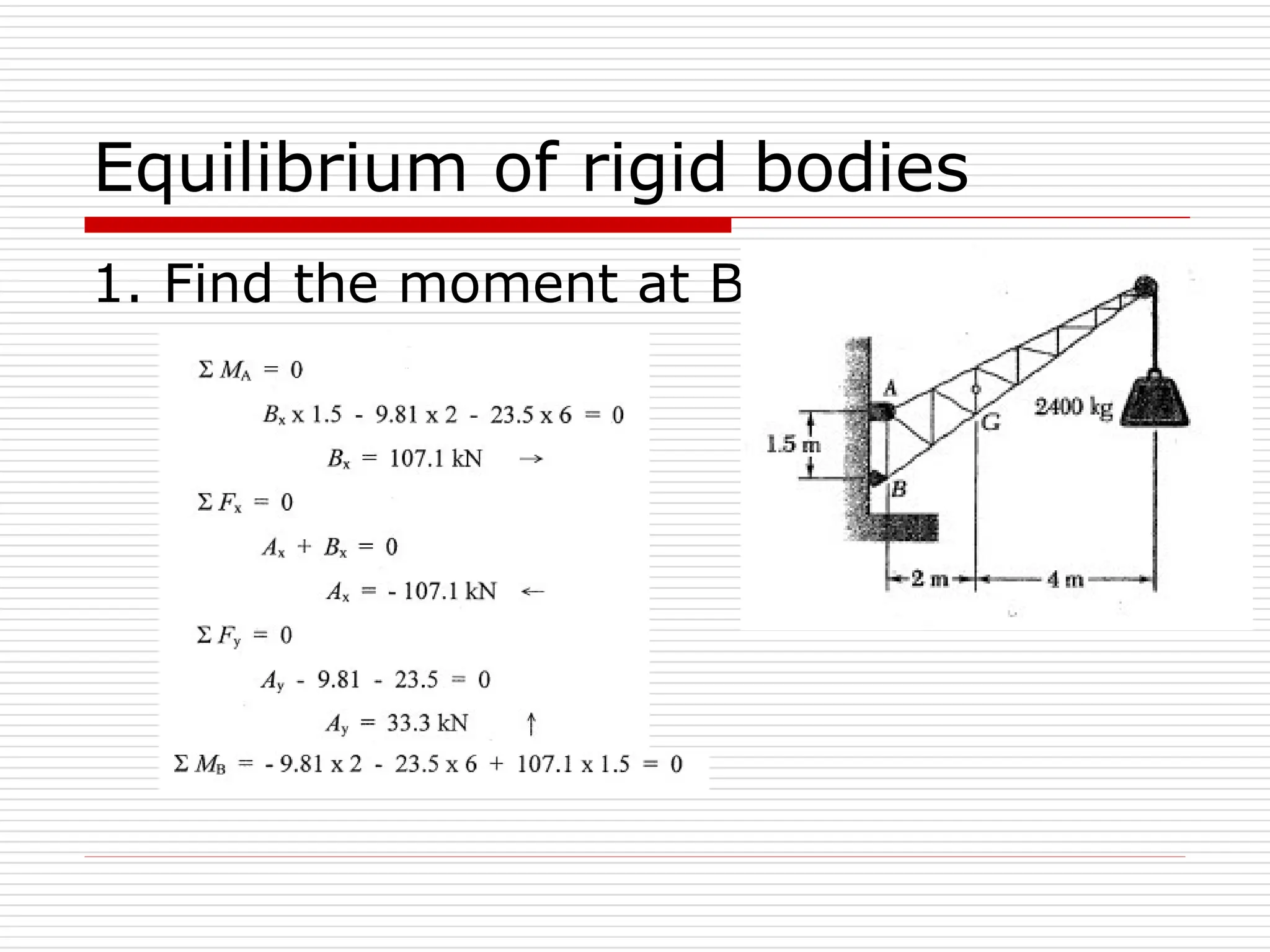
Equilibrium of rigid bodies
1. Find the moment at B
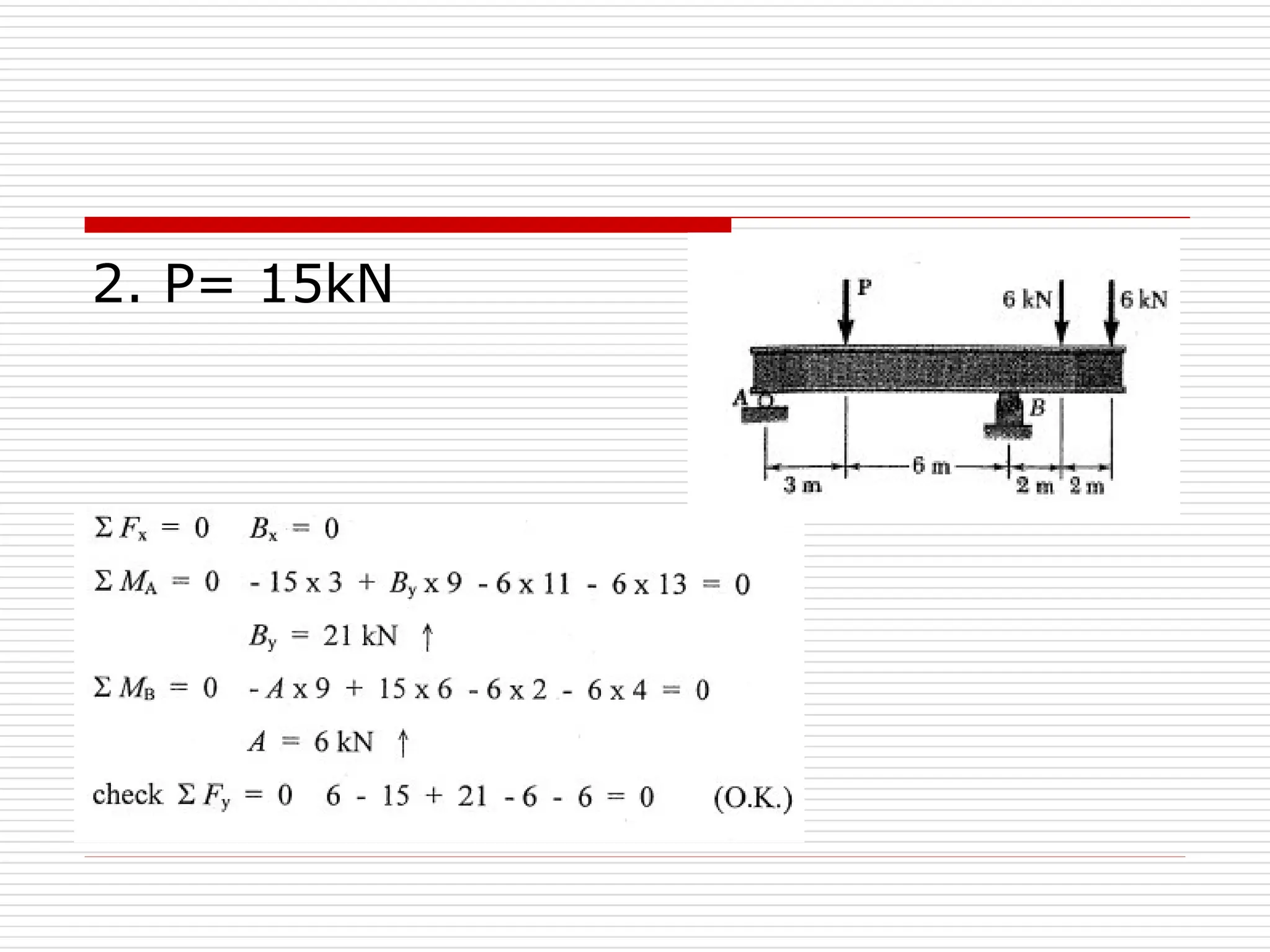
2. P= 15kN
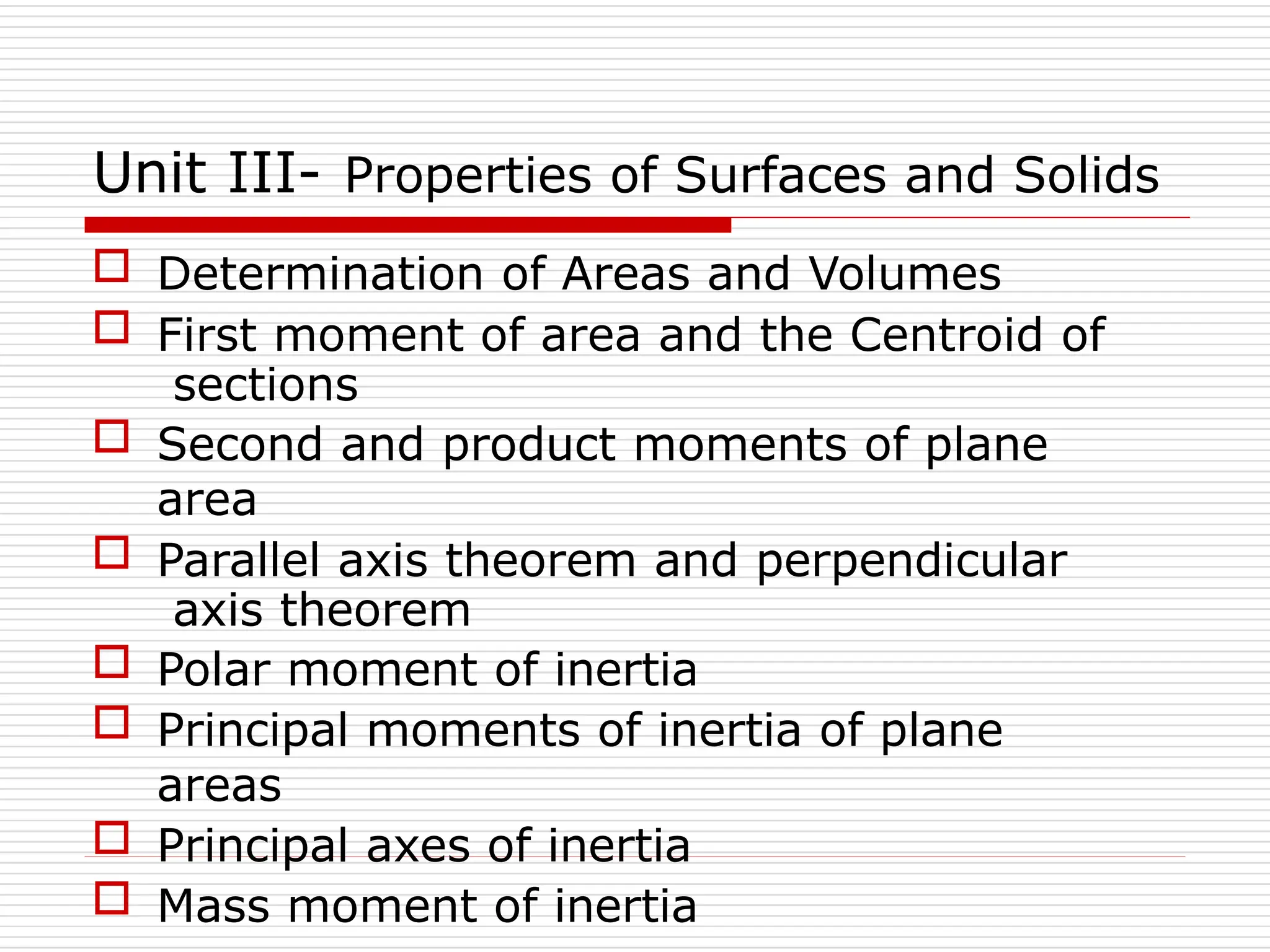
Unit III- Properties of Surfaces and Solids
 Determination of Areas and Volumes
 First moment of area and the Centroid of
sections
 Second and product moments of plane
area
 Parallel axis theorem and perpendicular
axis theorem
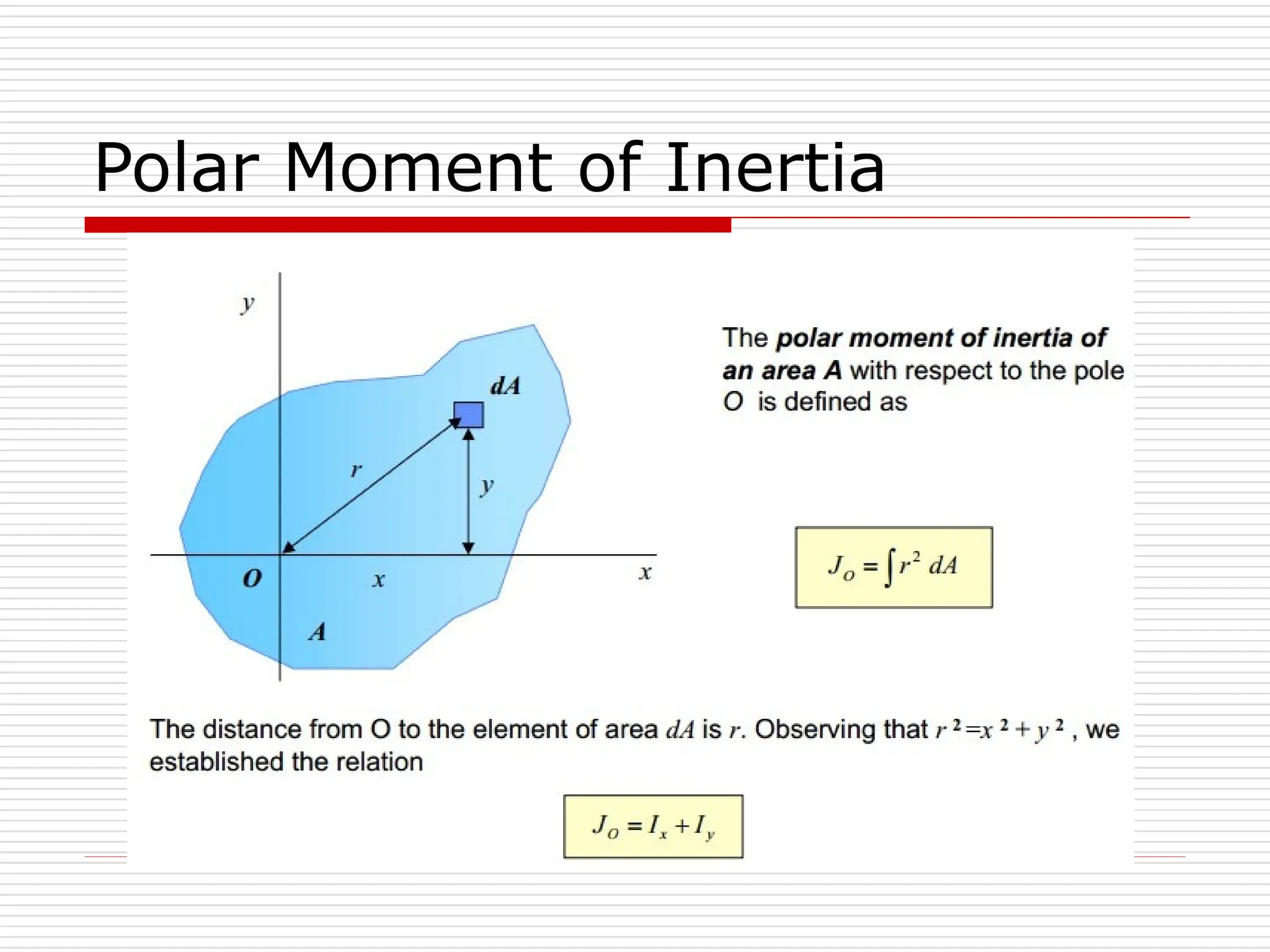
 Polar moment of inertia
 Principal moments of inertia of plane
areas
 Principal axes of inertia
 Mass moment of inertia
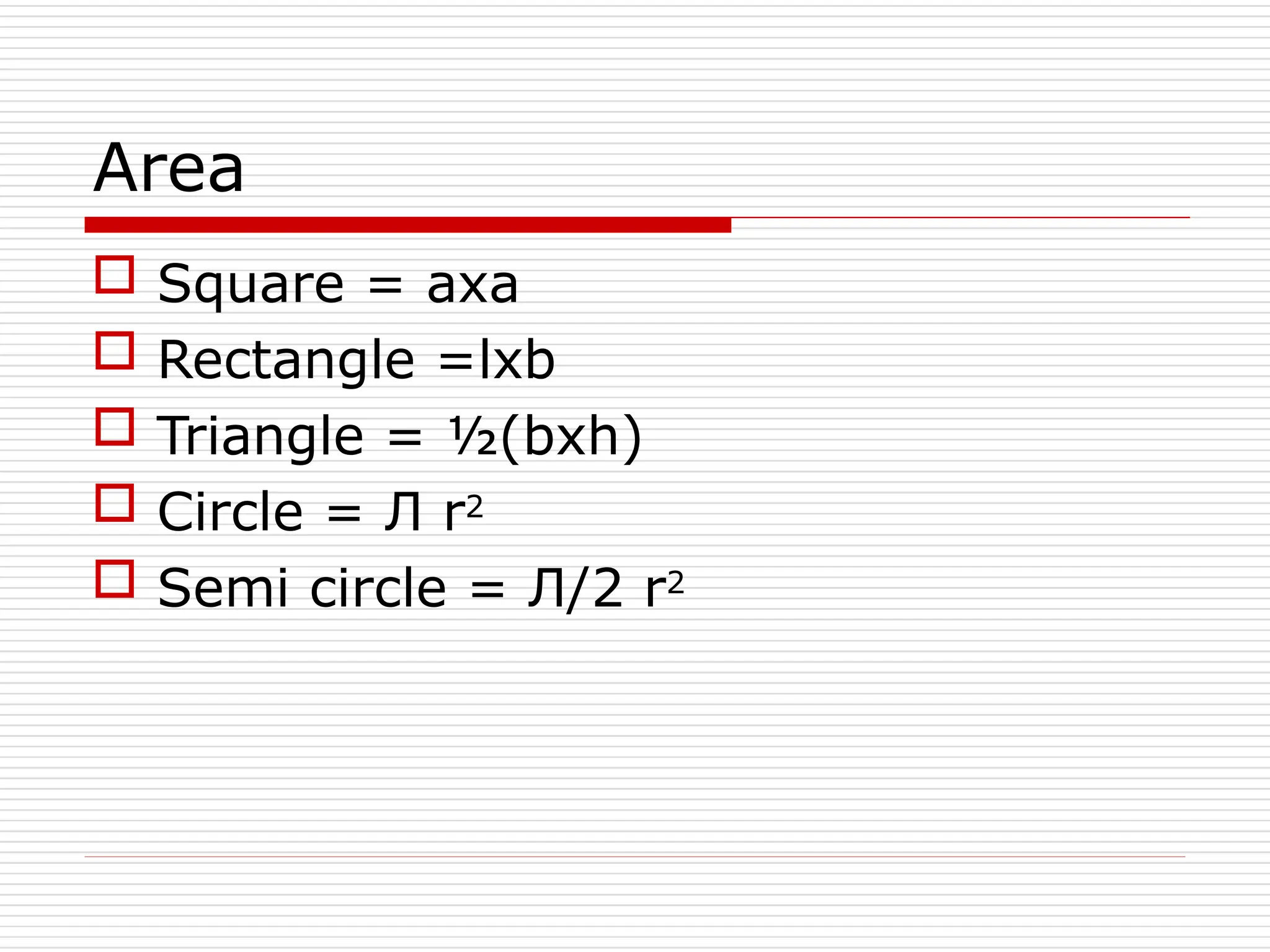
Area
 Square = axa
 Rectangle =lxb
 Triangle = ½(bxh)
 Circle = Л r2
 Semi circle = Л/2 r2
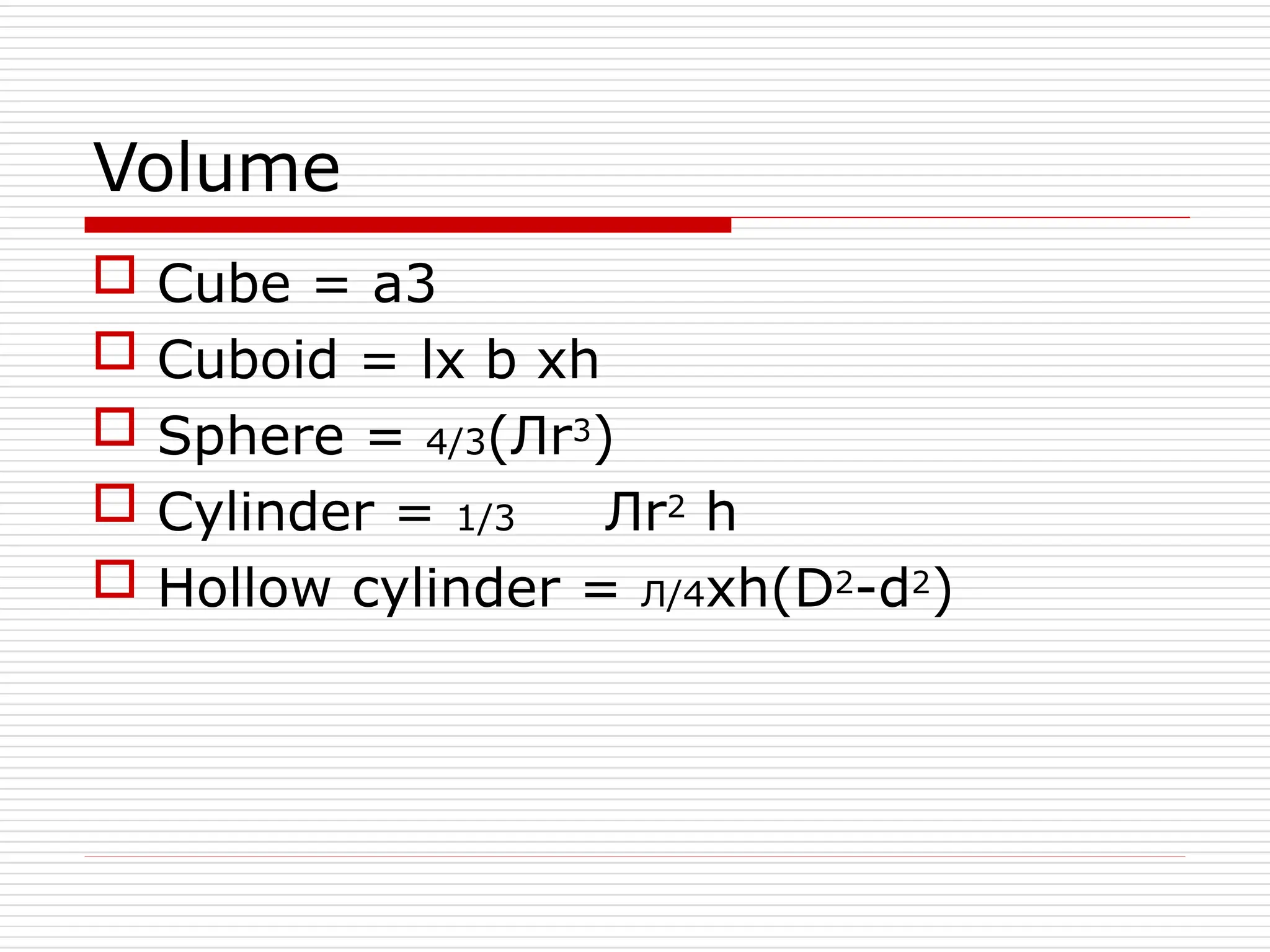
Volume
 Cube = a3
 Cuboid = lx b xh
 Sphere = 4/3(Лr3)
 Cylinder = 1/3 Лr2 h
 Hollow cylinder = Л/4xh(D2-d2)
Moment
 A moment about a given axis is something multiplied by the
distance from that axis measured at 90o to the axis.
 The moment of force is hence force times distance from
an axis.
 The moment of mass is mass times distance from an axis.
 The moment of area is area times the distance from an
axis.
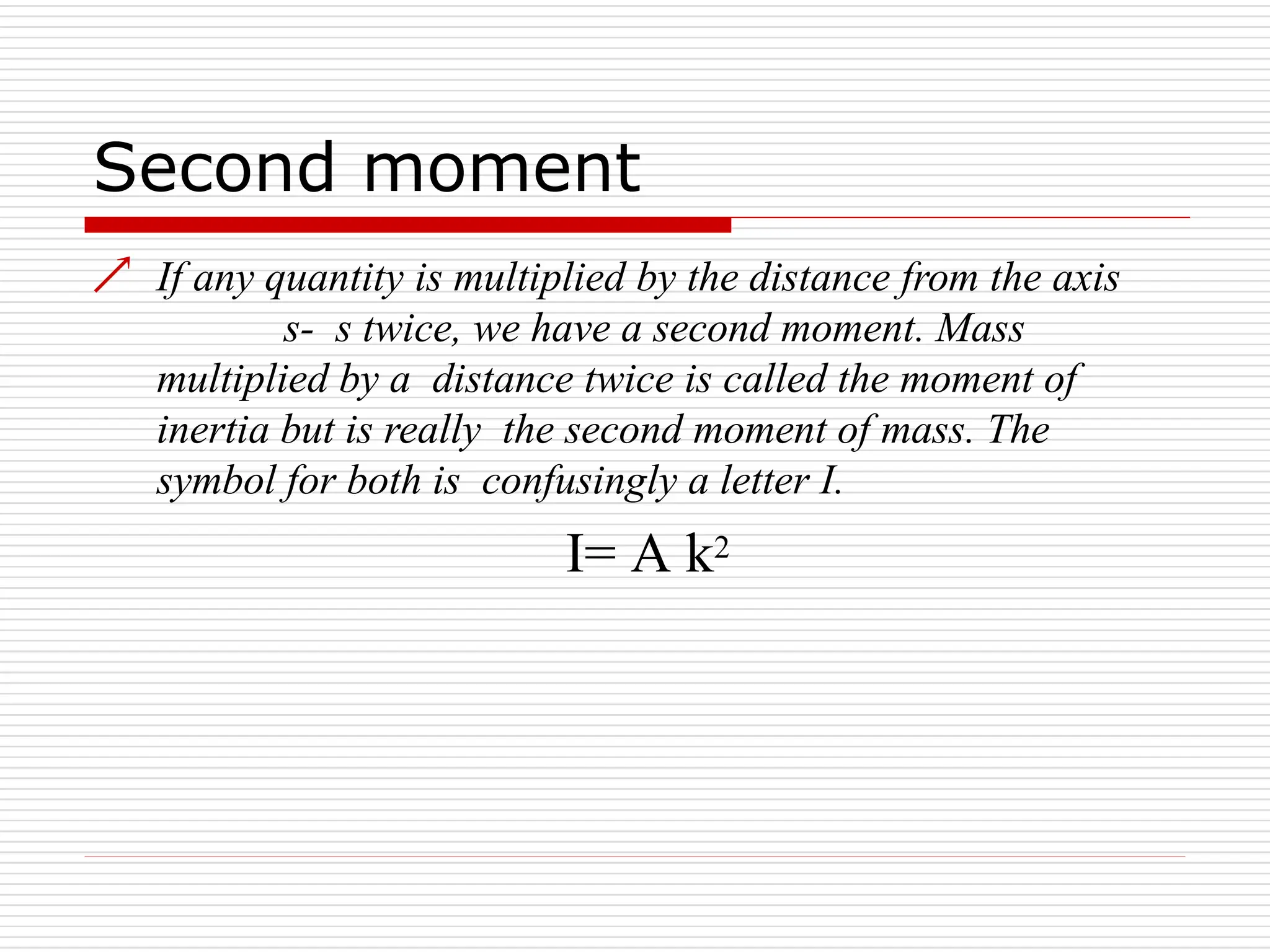
Second moment
 If any quantity is multiplied by the distance from the axis
s- s twice, we have a second moment. Mass
multiplied by a distance twice is called the moment of
inertia but is really the second moment of mass. The
symbol for both is confusingly a letter I.
I= A k2
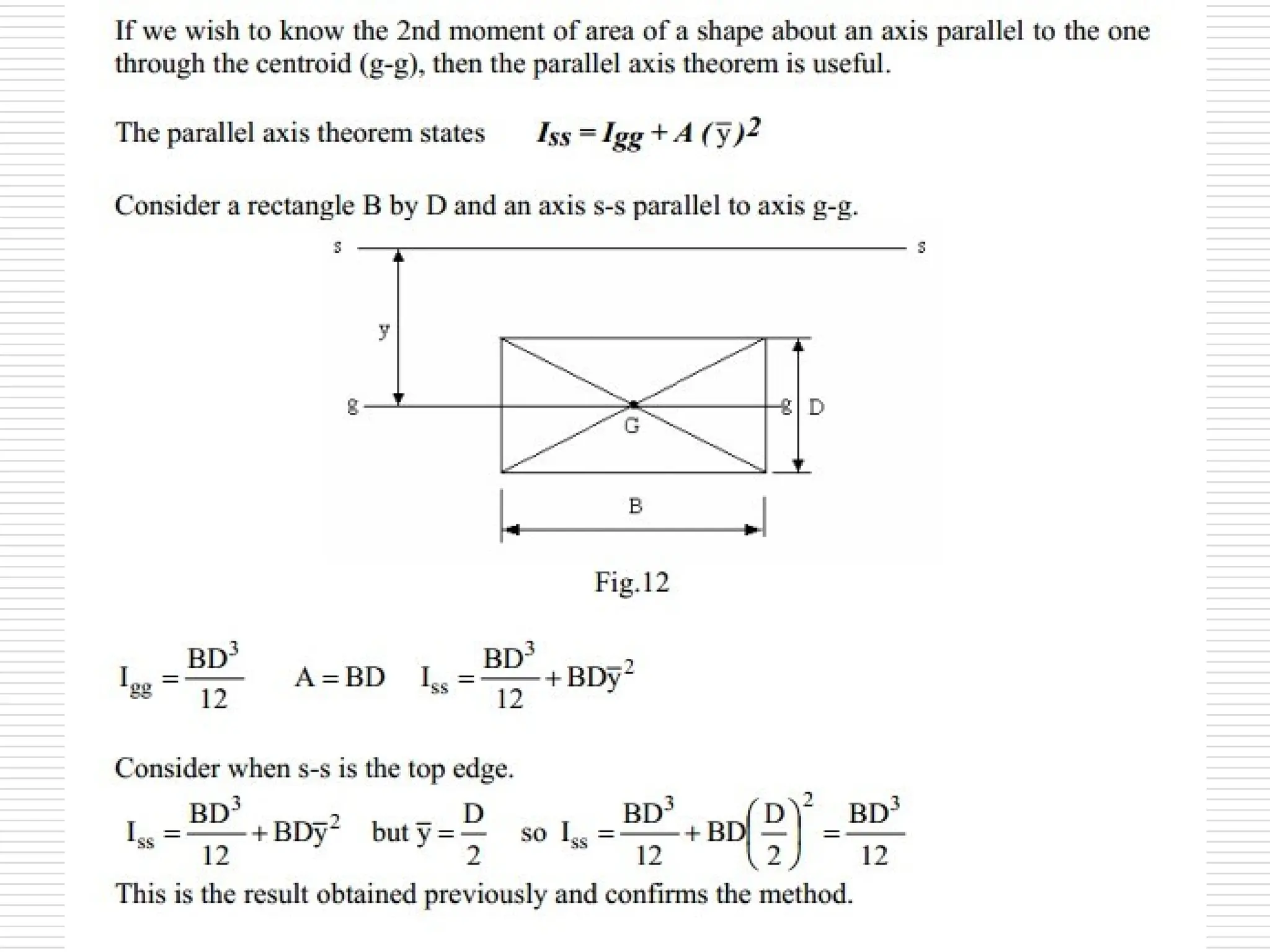
Parallel Axis theorem
 The moment of inertia of any object about an axis through
its center of mass is the minimum moment of inertia for an
axis in that direction in space. The moment of inertia about
any axis parallel to that axis through the center of mass
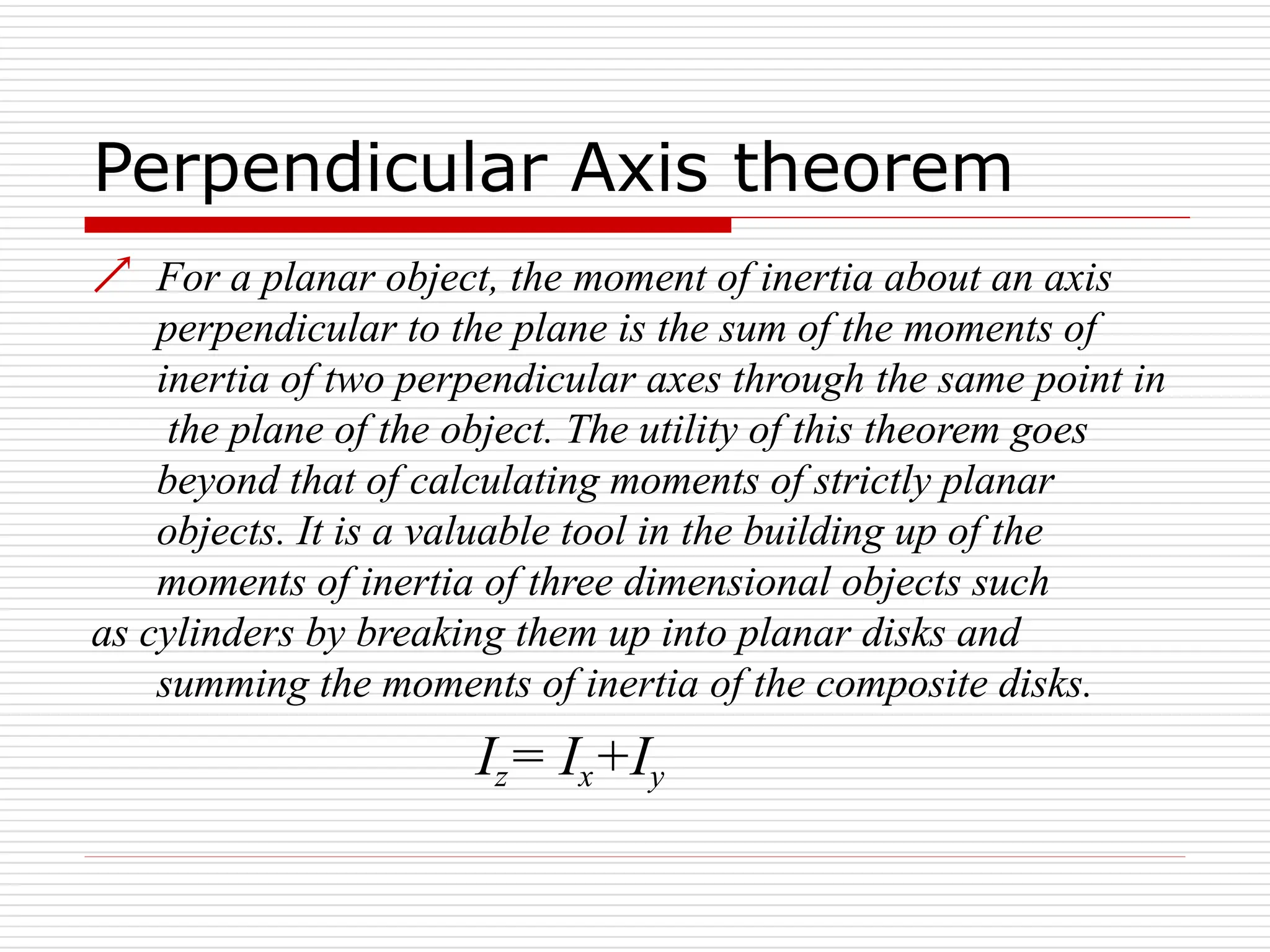
Perpendicular Axis theorem
 For a planar object, the moment of inertia about an axis
perpendicular to the plane is the sum of the moments of
inertia of two perpendicular axes through the same point in
the plane of the object. The utility of this theorem goes
beyond that of calculating moments of strictly planar
objects. It is a valuable tool in the building up of the
moments of inertia of three dimensional objects such
as cylinders by breaking them up into planar disks and
summing the moments of inertia of the composite disks.
Iz= Ix+Iy
Polar Moment of Inertia
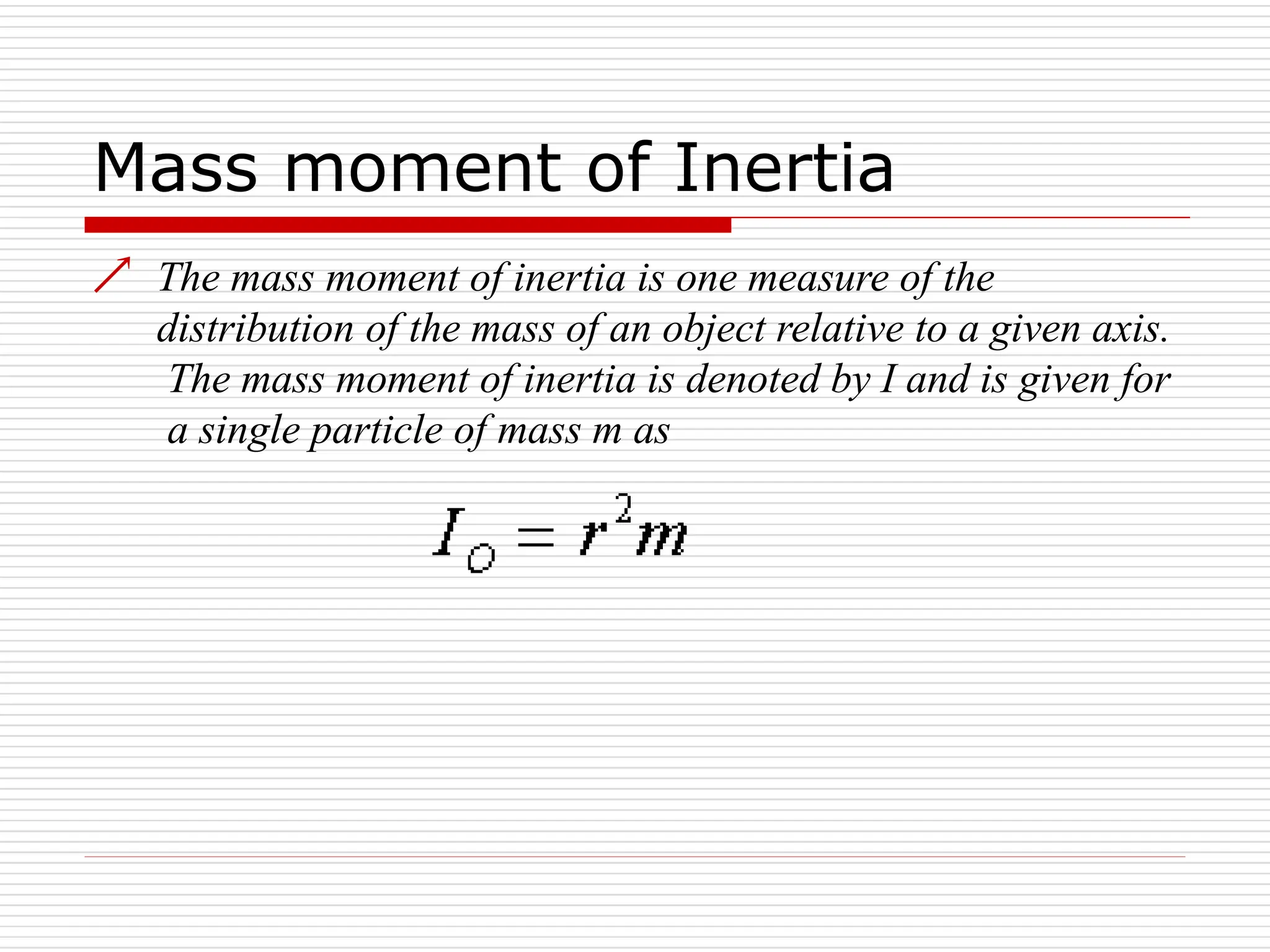
Mass moment of Inertia
 The mass moment of inertia is one measure of the
distribution of the mass of an object relative to a given axis.
The mass moment of inertia is denoted by I and is given for
a single particle of mass m as
Unit IV- Friction and Dynamics of
RigidBody
 Frictional force
 Laws of Coloumb friction
 simple contact friction
 Belt friction.
 Translation and Rotation of Rigid
Bodies
 Velocity and acceleration
 General Plane motion.
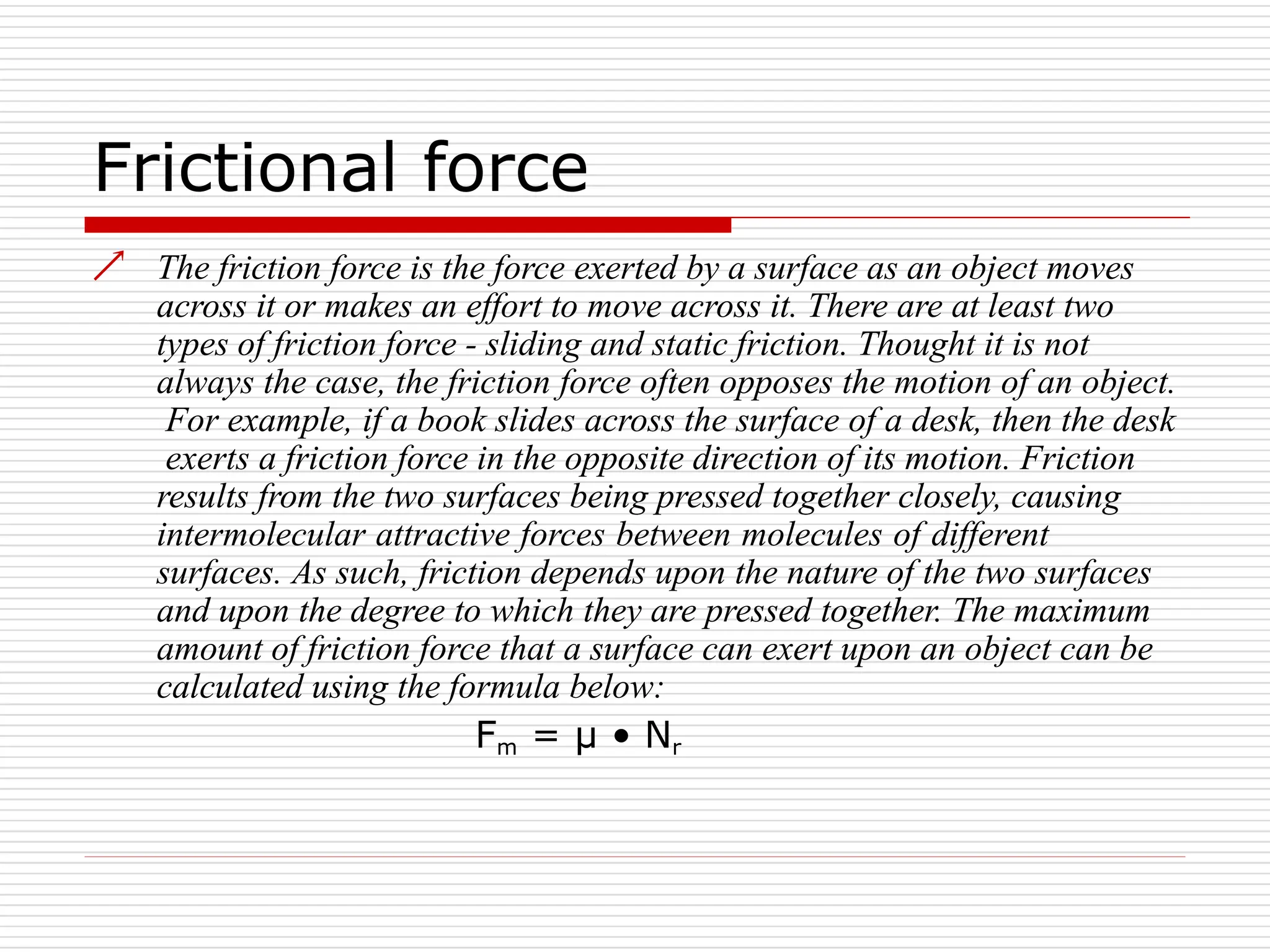
Frictional force
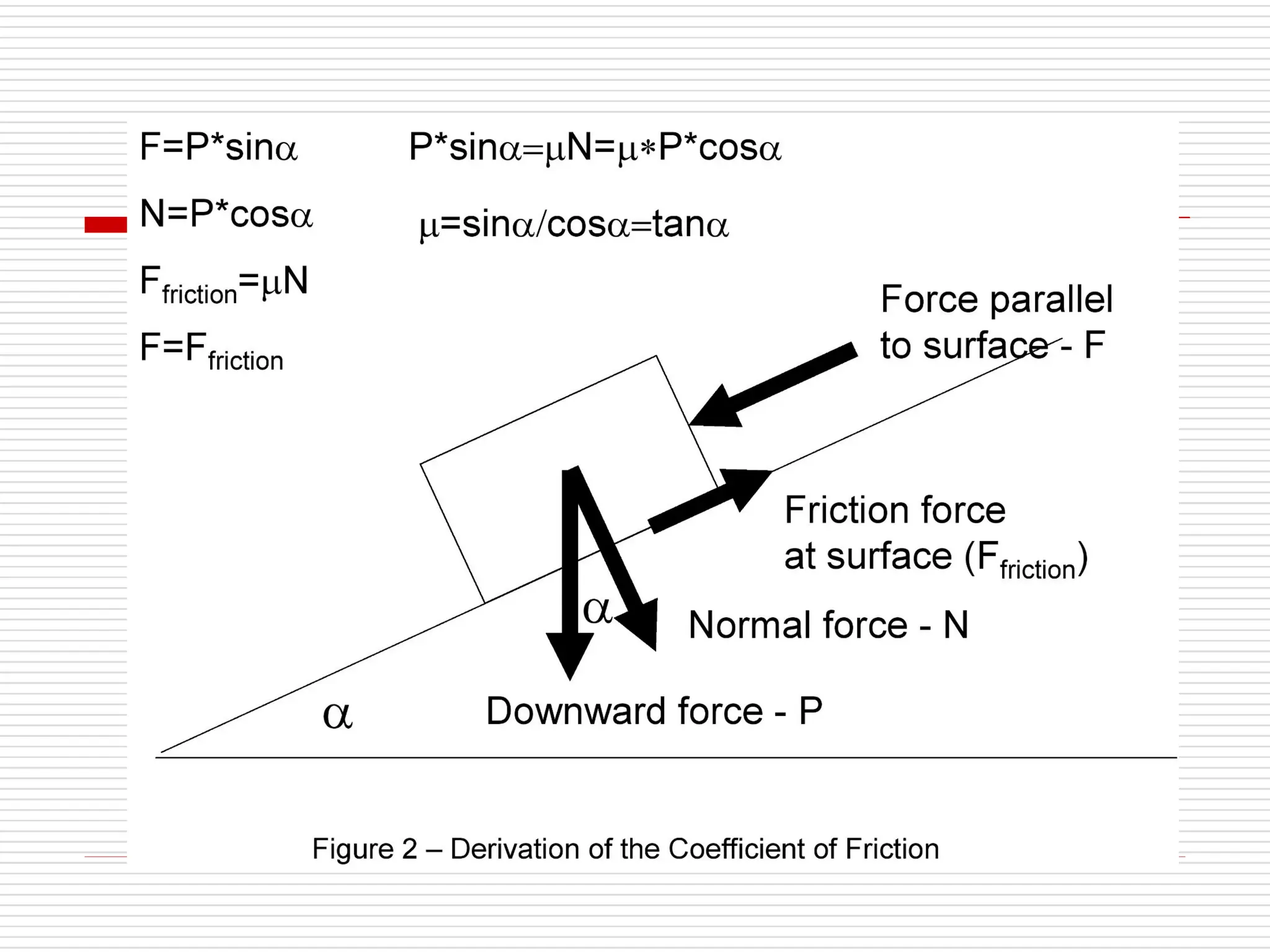
 The friction force is the force exerted by a surface as an object moves
across it or makes an effort to move across it. There are at least two
types of friction force - sliding and static friction. Thought it is not
always the case, the friction force often opposes the motion of an object.
For example, if a book slides across the surface of a desk, then the desk
exerts a friction force in the opposite direction of its motion. Friction
results from the two surfaces being pressed together closely, causing
intermolecular attractive forces between molecules of different
surfaces. As such, friction depends upon the nature of the two surfaces
and upon the degree to which they are pressed together. The maximum
amount of friction force that a surface can exert upon an object can be
calculated using the formula below:
Fm = µ • Nr
Laws of Coulomb
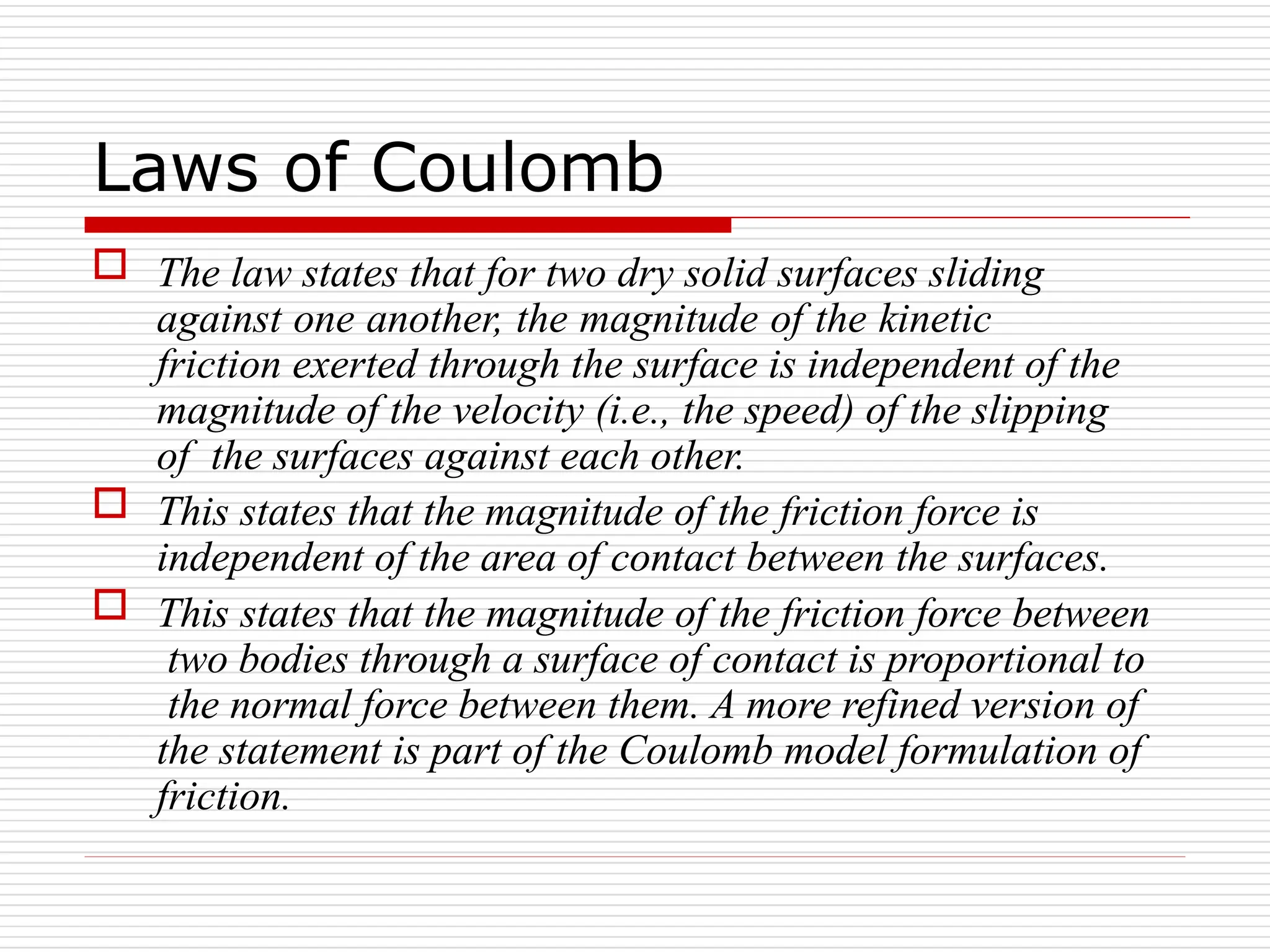
 The law states that for two dry solid surfaces sliding
against one another, the magnitude of the kinetic
friction exerted through the surface is independent of the
magnitude of the velocity (i.e., the speed) of the slipping
of the surfaces against each other.
 This states that the magnitude of the friction force is
independent of the area of contact between the surfaces.
 This states that the magnitude of the friction force between
two bodies through a surface of contact is proportional to
the normal force between them. A more refined version of
the statement is part of the Coulomb model formulation of
friction.
Simple contact friction
 Types of contact
friction
 Ladder Friction
 Screw Friction
 Belt Friction
 Rolling Friction
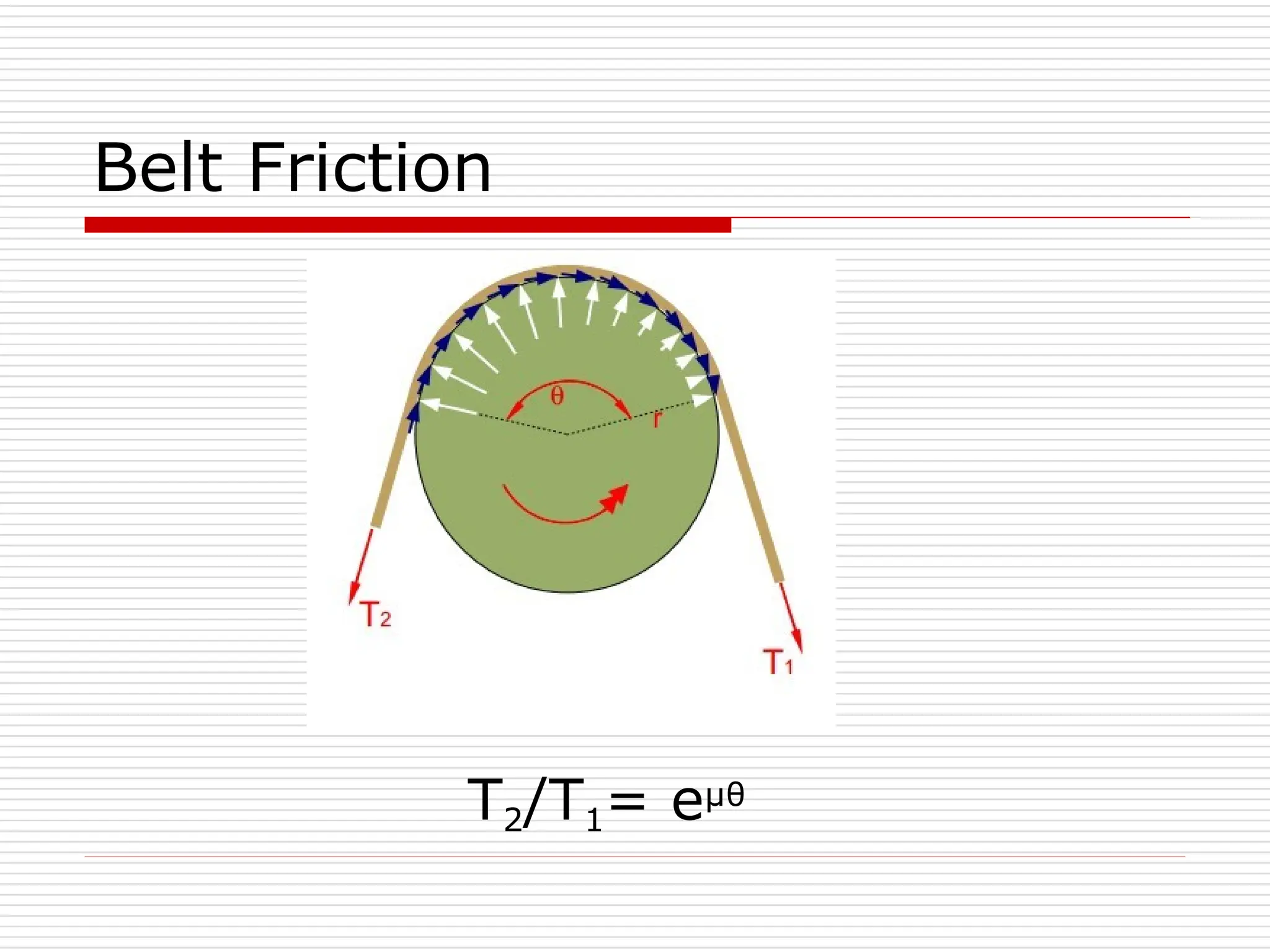
Belt Friction
T2/T1= eμθ
Problem
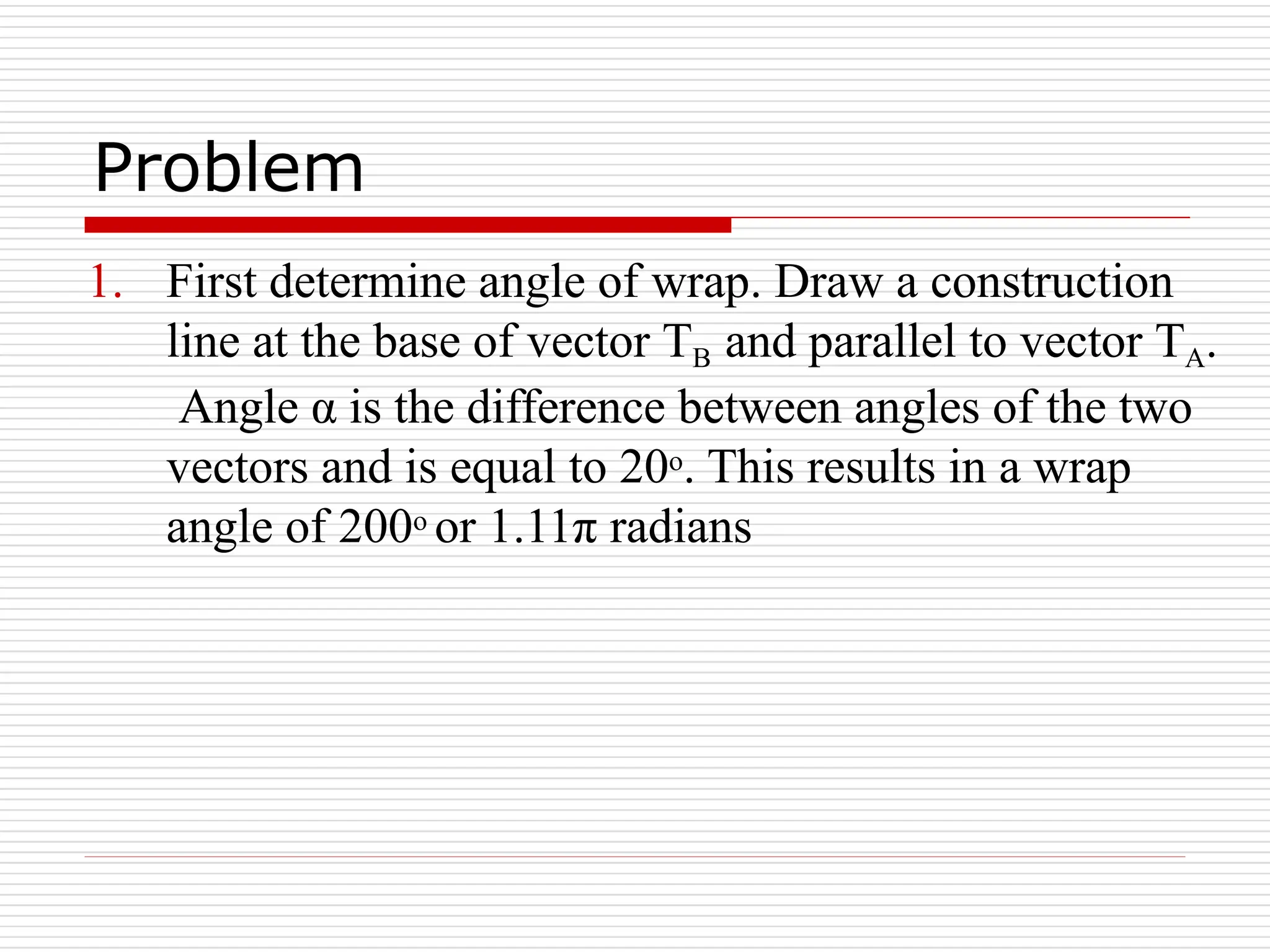
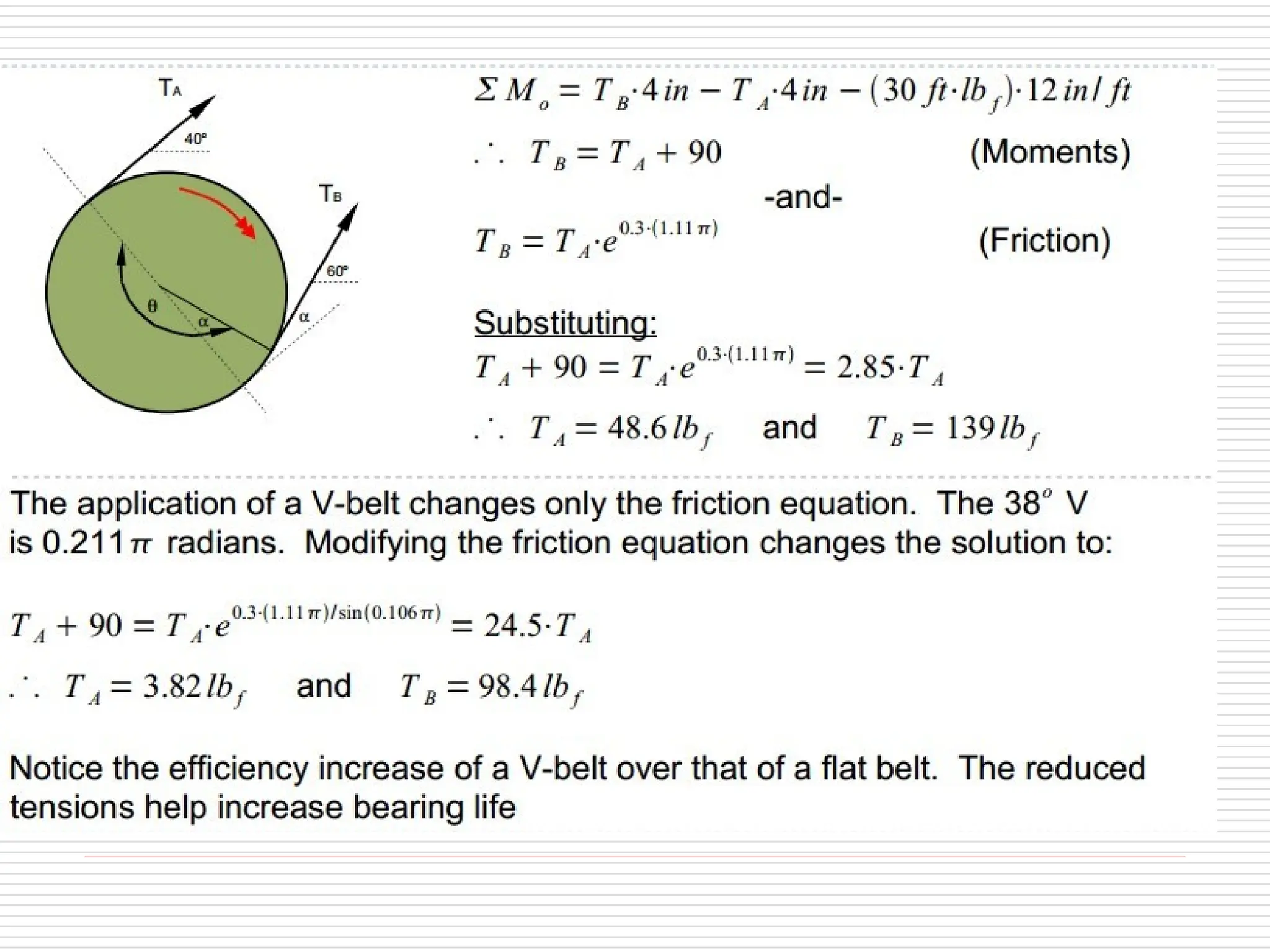
1. First determine angle of wrap. Draw a construction
line at the base of vector TB and parallel to vector TA.
Angle α is the difference between angles of the two
vectors and is equal to 20o. This results in a wrap
angle of 200o or 1.11π radians
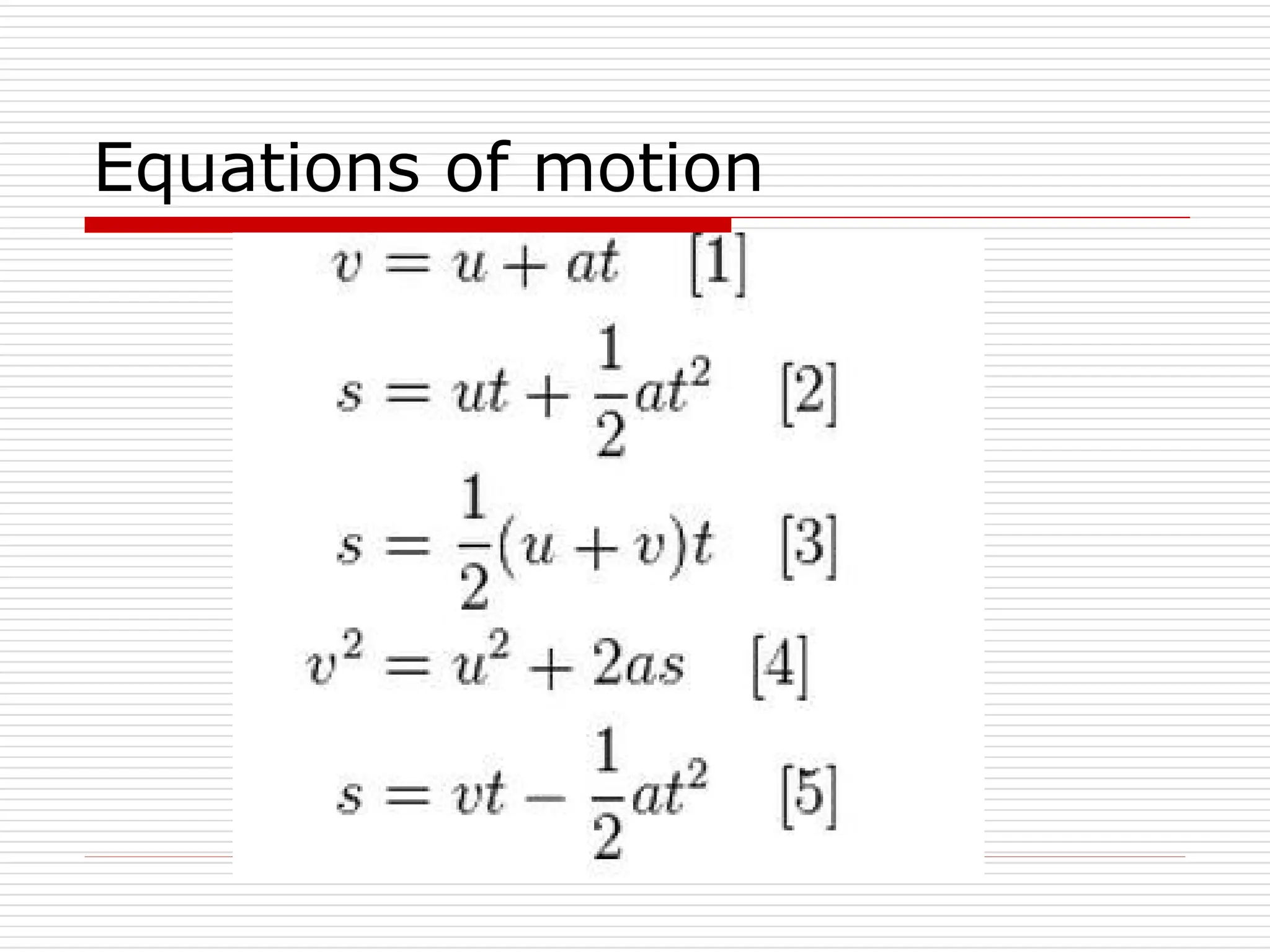
Equations of motion
Problem
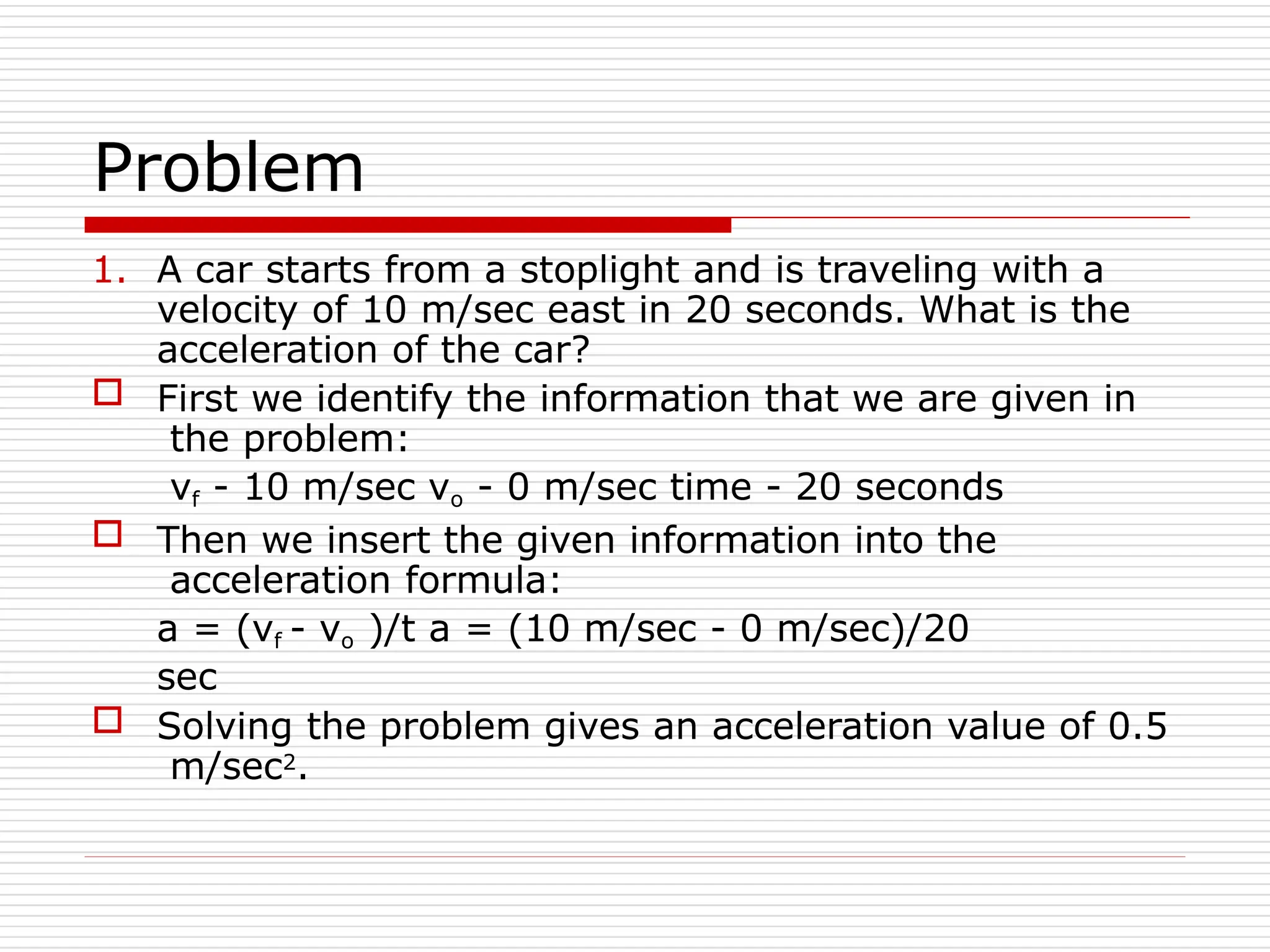
1. A car starts from a stoplight and is traveling with a
velocity of 10 m/sec east in 20 seconds. What is the
acceleration of the car?
 First we identify the information that we are given in
the problem:
vf - 10 m/sec vo - 0 m/sec time - 20 seconds
 Then we insert the given information into the
acceleration formula:
a = (vf - vo )/t a = (10 m/sec - 0 m/sec)/20
sec
 Solving the problem gives an acceleration value of 0.5
m/sec2.
Problems
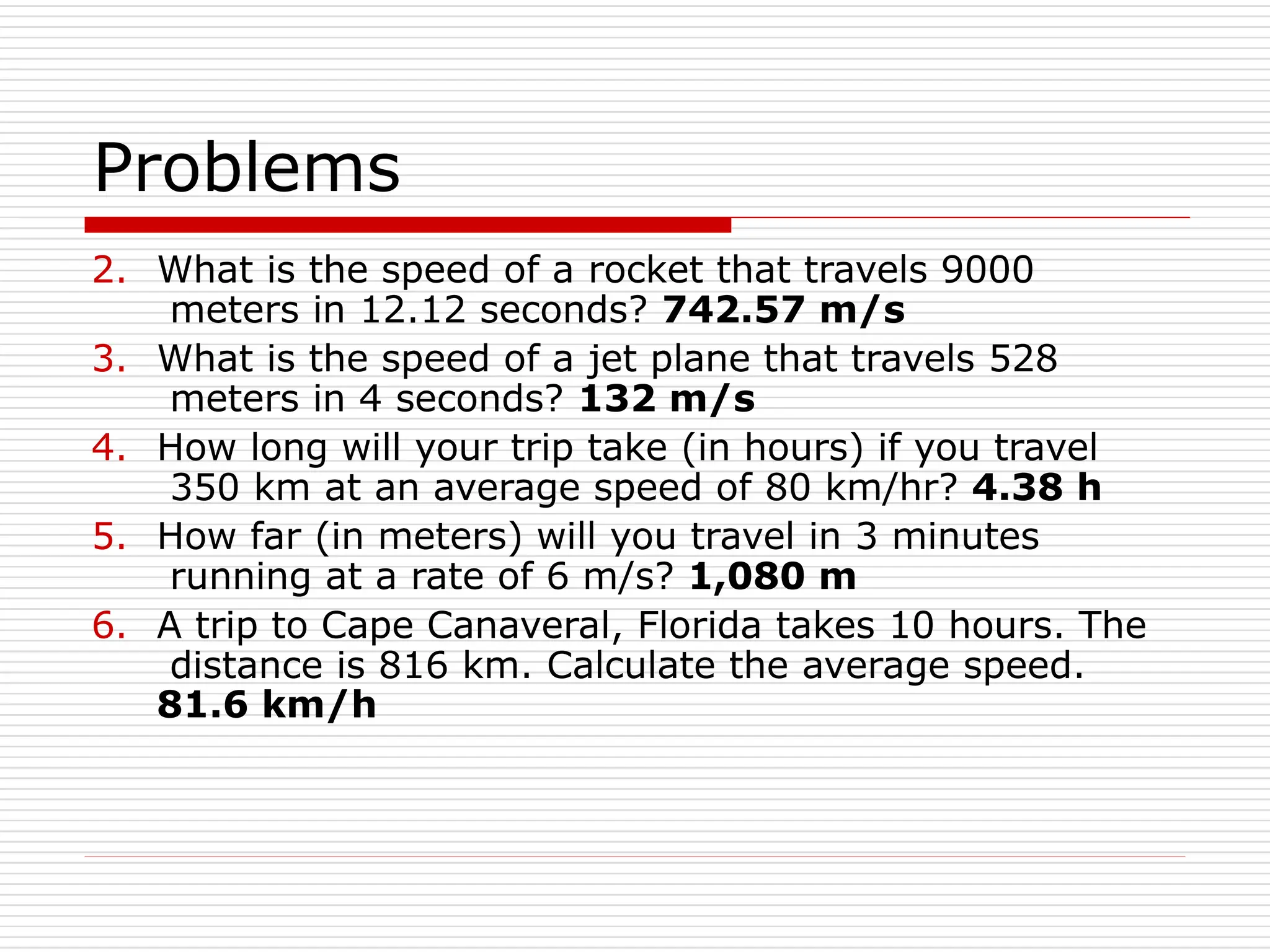
2. What is the speed of a rocket that travels 9000
meters in 12.12 seconds? 742.57 m/s
3. What is the speed of a jet plane that travels 528
meters in 4 seconds? 132 m/s
4. How long will your trip take (in hours) if you travel
350 km at an average speed of 80 km/hr? 4.38 h
5. How far (in meters) will you travel in 3 minutes
running at a rate of 6 m/s? 1,080 m
6. A trip to Cape Canaveral, Florida takes 10 hours. The
distance is 816 km. Calculate the average speed.
81.6 km/h
Unit V – Dynamics of Particles
 Displacements
 Velocity and acceleration, their relationship
 Relative motion
 Curvilinear motion
 Newton’s law
 Work Energy Equation of particles
 Impulse and Momentum
 Impact of elastic bodies.
Rectilinear motion
 The particle is classically represented as a
point placed somewhere in space. A rectilinear
motion is a straight-line motion.
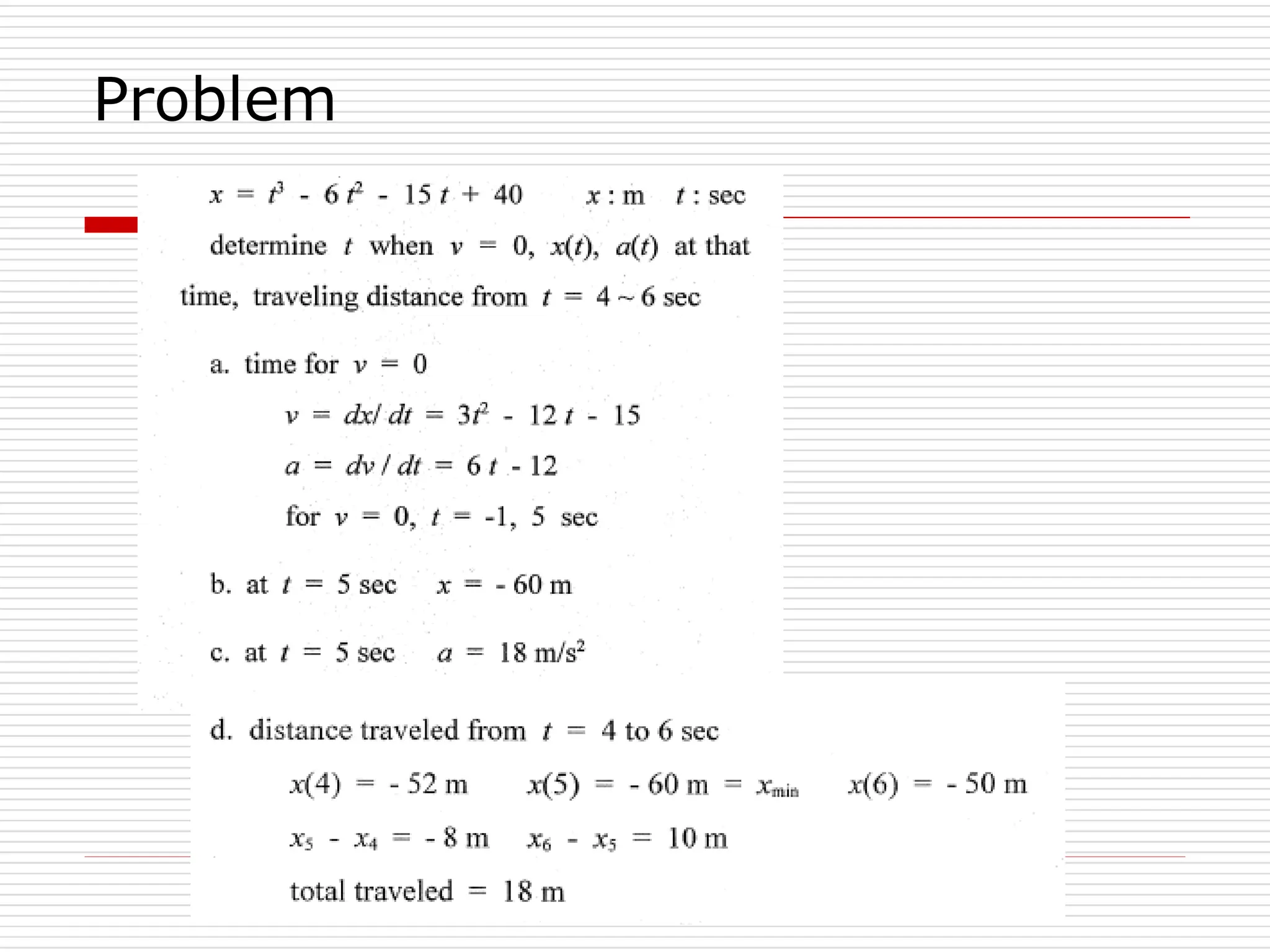
Problem
Curvilinear motion
 The particle is classically represented as a
point placed somewhere in space. A curvilinear
motion is a motion along a curved path.
Newton`s law problems
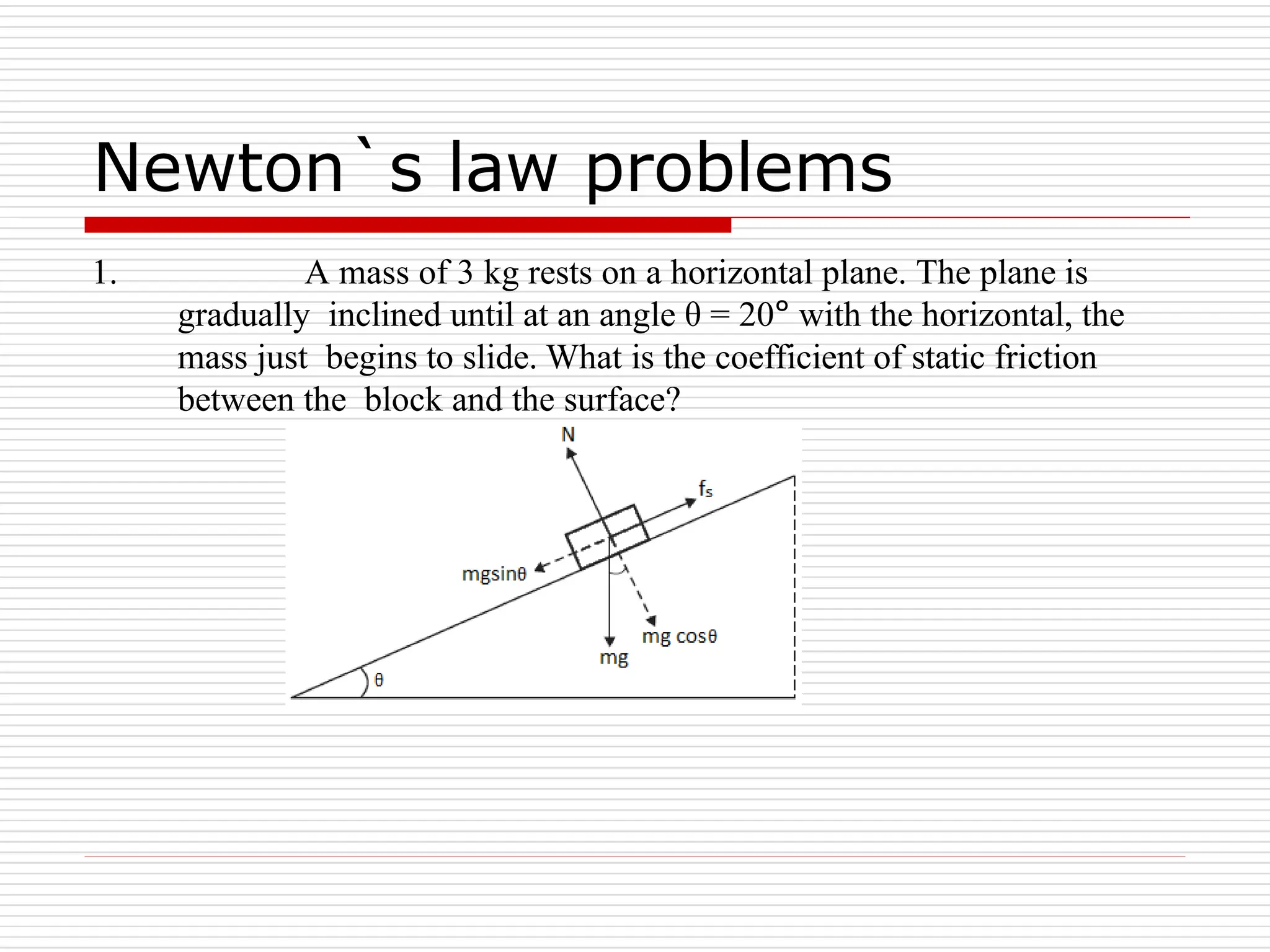
1. A mass of 3 kg rests on a horizontal plane. The plane is
gradually inclined until at an angle θ = 20° with the horizontal, the
mass just begins to slide. What is the coefficient of static friction
between the block and the surface?
Again we begin by drawing a figure containing all the
forces acting on the mass. Now, instead of drawing another
free body diagram, we should be able to see it in this
figure itself.An important thing to keep in mind here is
that we have resolved the force of gravity into its
components and we must not consider mg during
calculations if we are taking its components into account.
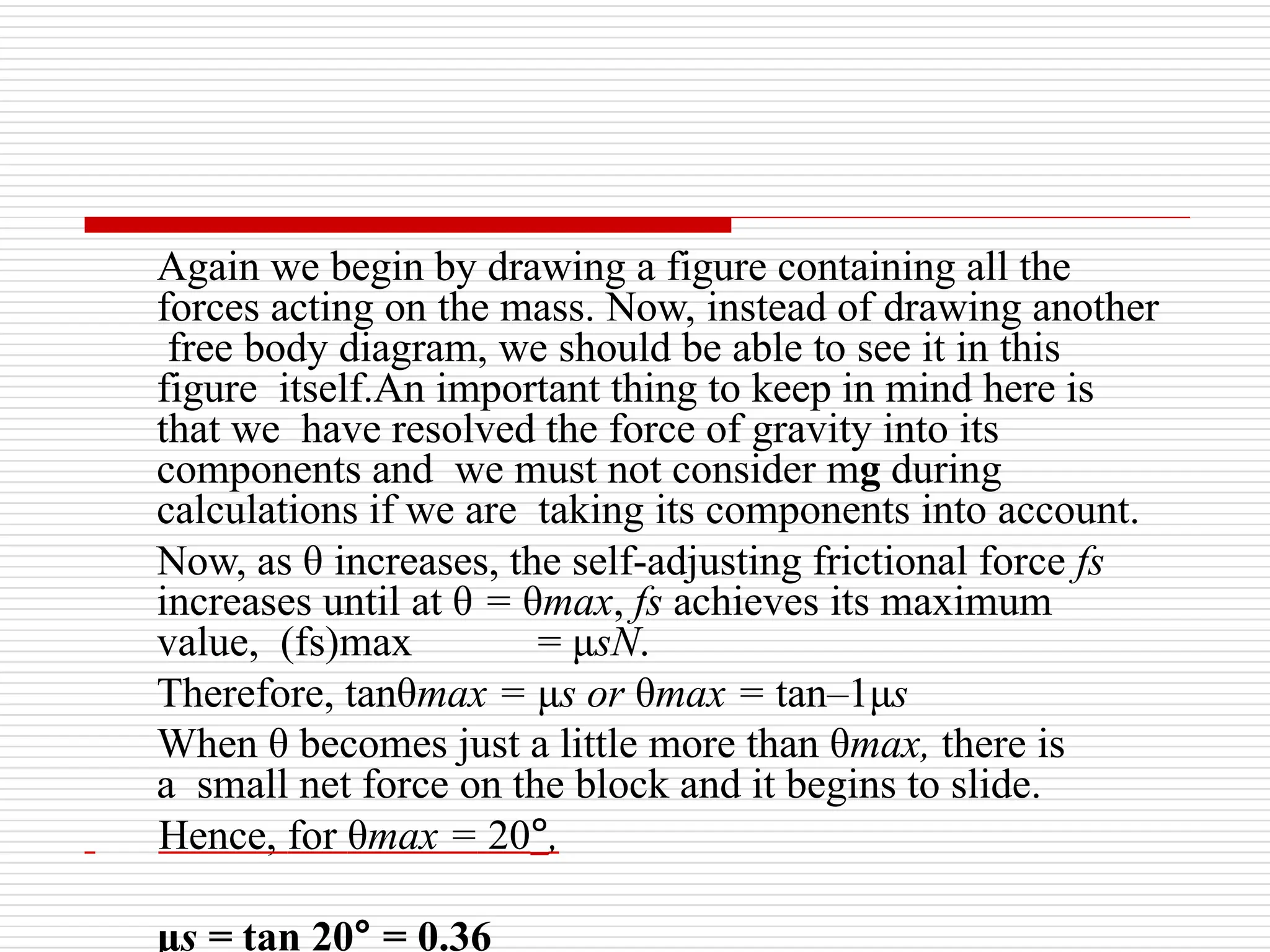
Now, as θ increases, the self-adjusting frictional force fs
increases until at θ = θmax, fs achieves its maximum
value, (fs)max = μsN.
Therefore, tanθmax = μs or θmax = tan–1μs
When θ becomes just a little more than θmax, there is
a small net force on the block and it begins to slide.
Hence, for θmax = 20°,
μs = tan 20° = 0.36
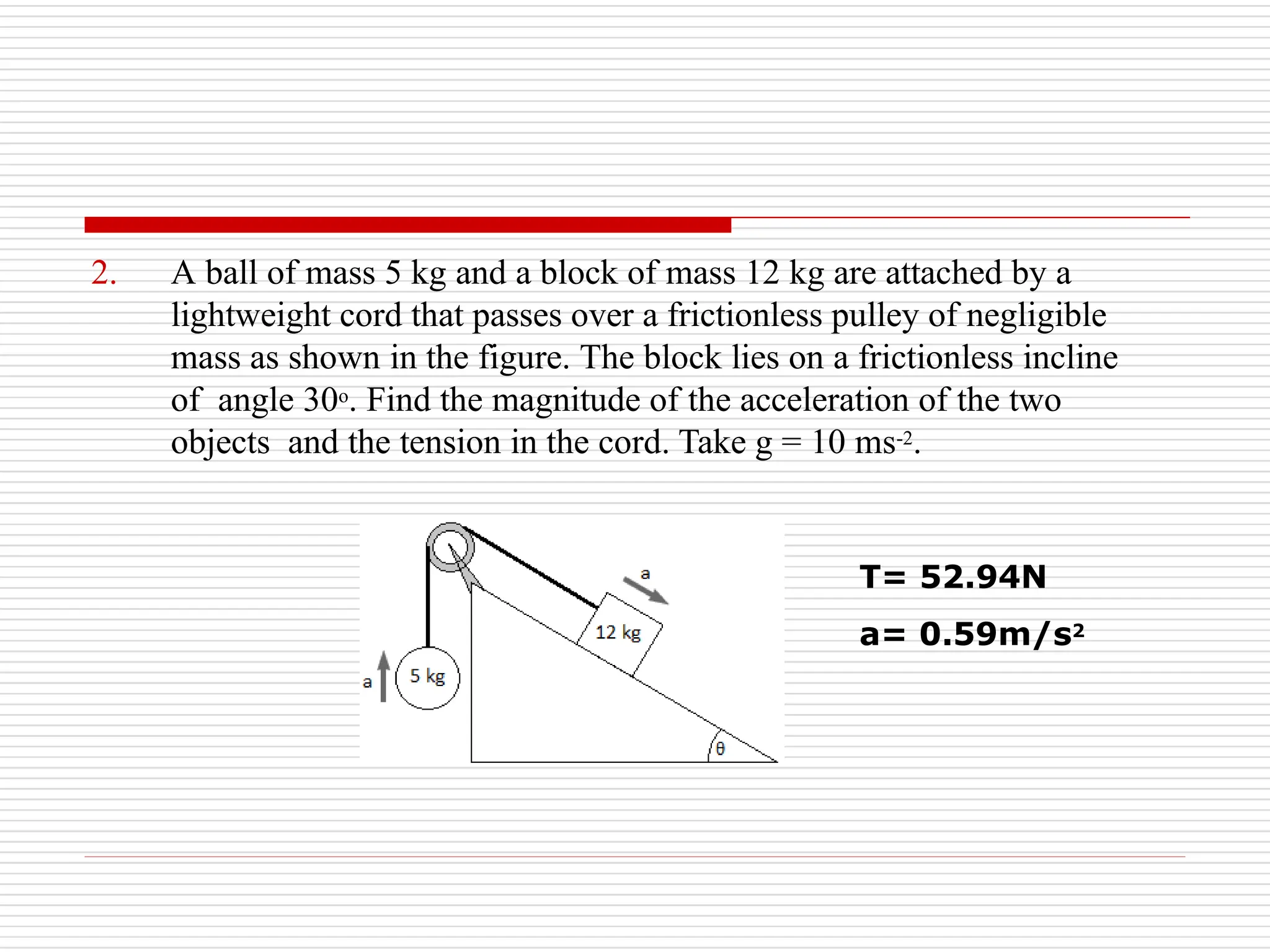
2. A ball of mass 5 kg and a block of mass 12 kg are attached by a
lightweight cord that passes over a frictionless pulley of negligible
mass as shown in the figure. The block lies on a frictionless incline
of angle 30o. Find the magnitude of the acceleration of the two
objects and the tension in the cord. Take g = 10 ms-2.
T= 52.94N
a= 0.59m/s2
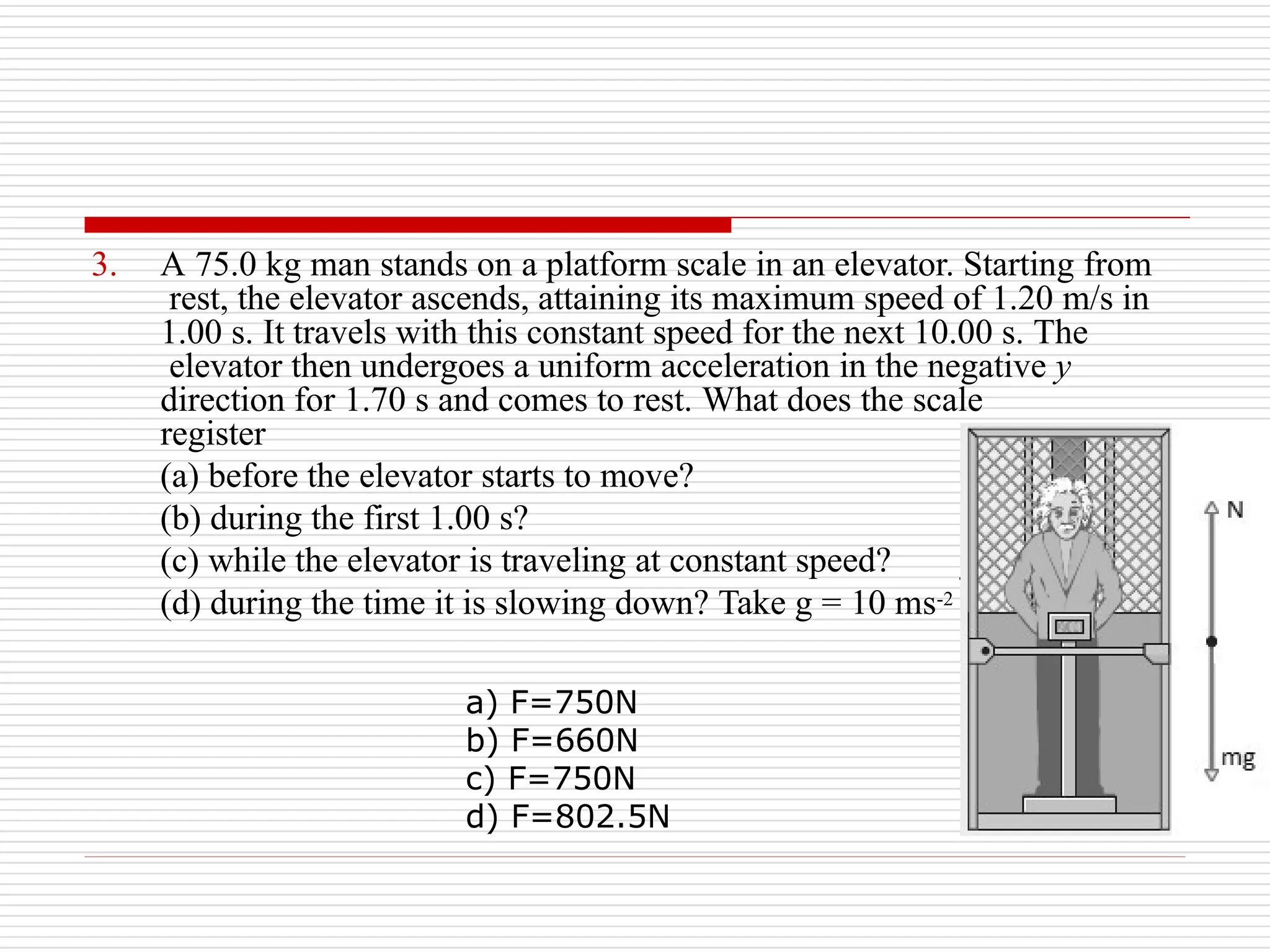
3. A 75.0 kg man stands on a platform scale in an elevator. Starting from
rest, the elevator ascends, attaining its maximum speed of 1.20 m/s in
.
1.00 s. It travels with this constant speed for the next 10.00 s. The
elevator then undergoes a uniform acceleration in the negative y
direction for 1.70 s and comes to rest. What does the scale
register
(a) before the elevator starts to move?
(b) during the first 1.00 s?
(c) while the elevator is traveling at constant speed?
(d) during the time it is slowing down? Take g = 10 ms-2
a) F=750N
b) F=660N
c) F=750N
d) F=802.5N
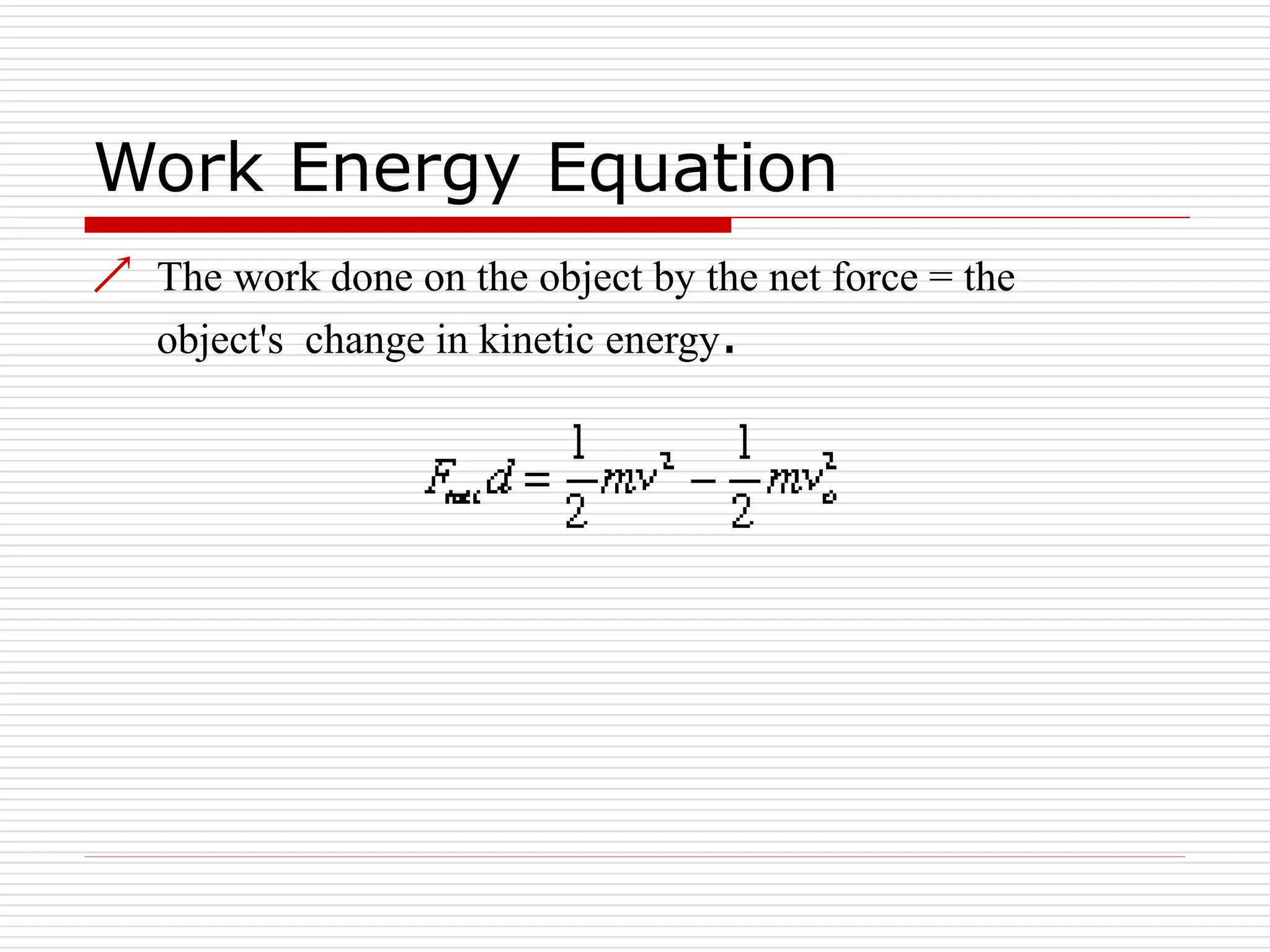
Work Energy Equation
 The work done on the object by the net force = the
object's change in kinetic energy.
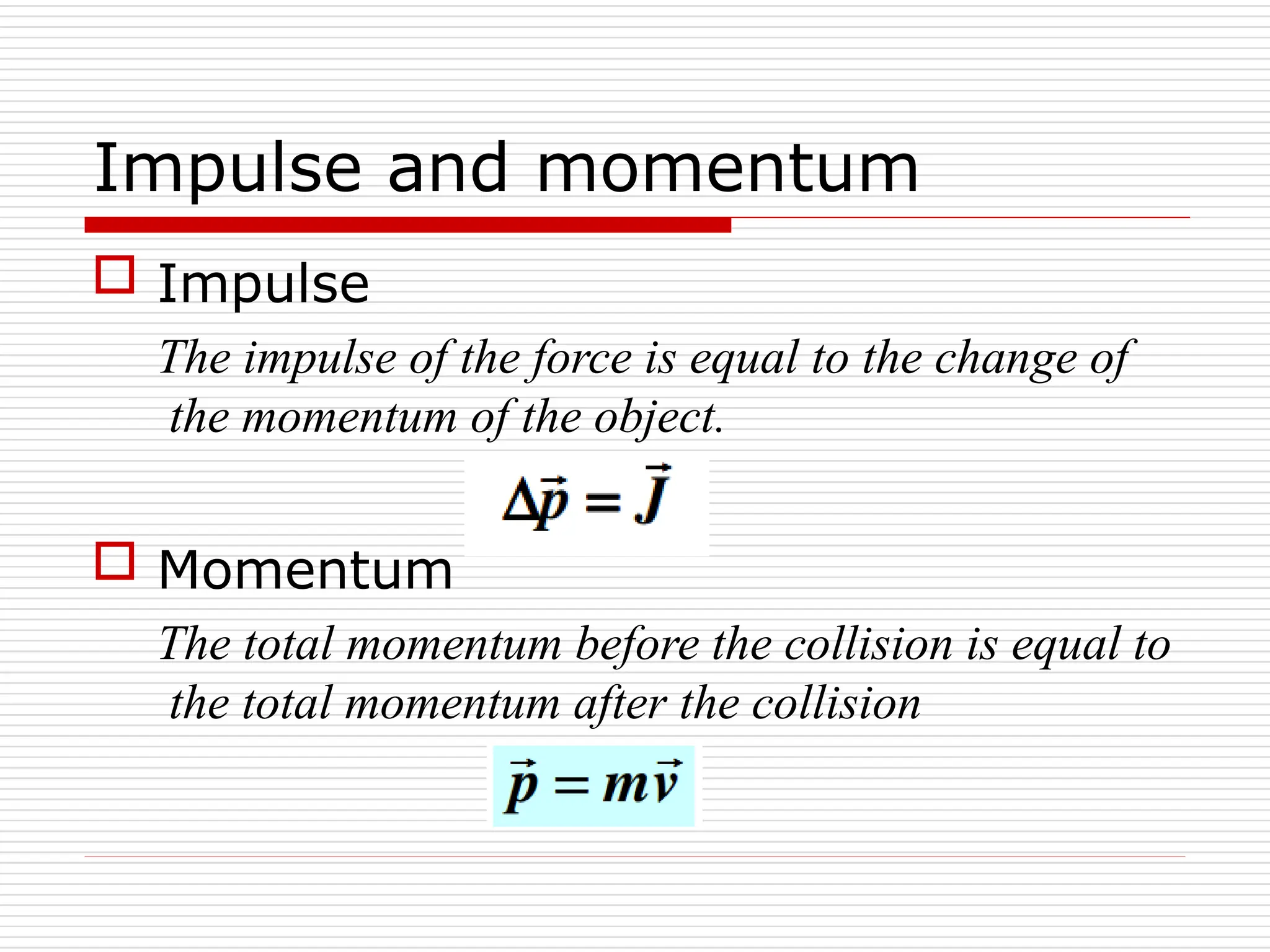
Impulse and momentum
 Impulse
The impulse of the force is equal to the change of
the momentum of the object.
 Momentum
The total momentum before the collision is equal to
the total momentum after the collision
The
End

Mechanics is a branch o Science ppt_mechanics.pptx

  • 1.
    19GES28 - EngineeringMechanics Dr S.Sudhagar M.E., PhD. Assistant Professor Mechanical Engineering
  • 2.
    Unit I- Basics& Statics of Particles  Introduction  Units and Dimensions  Laws of mechanics  Lami`s Theorem  Parallelogram law and Triangle law  Principle of transmissibility  Vector operations  Equilibrium of a particle in space  Single Equivalent Force
  • 3.
    Introduction  Mechanics isthe study of forces that act on bodies and the resultant motion that those bodies experience.  Engineering Mechanics is the application of mechanics to solve problems involving common engineering elements.
  • 4.
  • 5.
    Units and Dimensions QuantityUnit Area m2 Volume m3 Velocity m/s Acceleration m/s2
  • 6.
    Laws of Mechanics Newton`s First Law It states that every body continues in its state of rest or of uniform motion in a straightline unless it is compelled by an external agency acting on it
  • 7.
    Laws of Mechanics Newton`s Second Law It states that the rate of change of momentum of a body is directly proportional to the impressed force and it takes place in the direction of the force acting on it. F 𝖺 m × a
  • 8.
    Laws of Mechanics Newton`s Third Law It states that for every action there is an equal and opposite reaction.
  • 9.
    Lami`s theorem  Ifa particle acted upon by three forces remains in equilibrium then, each force acting on the particle bears the same proportionality with the since of the angle between the other two forces”. Lami’s theorem is also known as law of sines.
  • 10.
    Principle of Transmissibility According to this law the state of rest or motion of the rigid body is unaltered if a force acting on the body is replaced by another force of the same magnitude and direction but acting anywhere on the body along the line of action of the replaced force. • Principle of Transmissibility - Conditions of equilibrium or motion are not affected by transmitting a force along its line of action. NOTE: F and F’ are equivalent forces.
  • 11.
    Parallelogram Law  Accordingto this law the state of rest or motion of the rigid body is unaltered if a force acting on the body is replaced by another force of the same magnitude and direction but acting anywhere on the body along the line of action of the replaced force.
  • 12.
    Triangle Law  Iftwo forces acting on a body are represented one after another by the sides of a triangle, their resultant is represented by the closing side of the triangle taken from first point to the last point.
  • 13.
    Equilibrium of aparticle in space NR  Free Body diagram It is a diagram of the body in which the bodies under consideration are freed from all contact surfaces and all the forces acting on it are clearly indicated. W Q P
  • 14.
    Problems 1. Find theprojection of a force on the line joining A = (-1, 2, 2) and B (2, -1, -3) Solution: The position vector = (2i – j -3k) – (- +2+2) = 3 - 3-5 Magnitude of AB = Unit vector AB = 0.457-0.457 Projection of on the line AB = unit vector along AB = 2 0.457 + 3 0.457 – 5  0.762 = -1.525
  • 15.
    2. Determine theforce required the hold the 4kg lamp in position Answer: F= 39.2N Problems
  • 16.
    3. The jointO of a space frame is subjected to four forces. Strut OA lies in the x-y plane and strut OB lies in the y- z plane. Determine the force acting in each if the three struts required for equilibrium of the joint. Angle = 45°. Answer : F = 56.6 lb, R = 424 lb, P = 1000 lb Problems
  • 17.
    Unit II- Equilibriumof Rigid bodies  Free body diagram  Types of supports and their reactions  Moments and Couples  Moment of a force about a point and about an axis  Varignon’s theorem  Equilibrium of Rigid bodies in two dimensions  Equilibrium of Rigid bodies in three dimensions
  • 18.
    Free Body Diagram Itis a diagram of the body in which the bodies under consideration are freed from all contact surfaces and all the forces acting on it are clearly indicated. NR Q W P
  • 19.
    Beam  A beamis a structural member used to support loads applied at various points along its length
  • 20.
    Types of supports Simple Support If one end of the beam rests on a fixed support, the support is known as simple support  Roller Support Here one end of the beam is supported on a roller  Hinged Support The beam does not move either along or normal to the axis but can rotate.
  • 21.
    Types of supports Fixed support The beam is not free to rotate or slide along the length of the beam or in the direction normal to the beam. Therefore three reaction components can be observed. Also known as bulit-in support
  • 22.
  • 23.
    Types of beams Simply supported beam  Fixed beam  Overhanging beam  Cantilever beam  Continuous beam
  • 24.
    Types of Loading Concentrated load or point load  Uniformly distributed load(udl)  Uniformly Varying load(uvl)  Pure moment
  • 26.
    Problem 1. Find reactionsof supports for the beam as shown in the figure (a)
  • 27.
  • 28.
    Varignon`s theorem • Themoment about a give point O of the resultant of several concurrent forces is equal to the sum of the moments of the various moments about the same point O. r→ F →  F →  r→  F →  r→  F →  1 2 1 2 • Varigon’s Theorem makes it possible to replace the direct determination of the moment of a force F by the moments of two or more component forces of F.
  • 29.
    Moment  The momentof a force about a point or axis measures of the tendency of the force to cause the body to rotate about the point or axis. M = F d
  • 30.
  • 31.
    Problem 1. A 200N force acts on the bracket shown below. Determine the moment of the force about point A. Answer: 14.1N-m
  • 32.
    Problem 2. Determine themoment of each of the three forces about point A. Solve the problem first by using each force as a whole, and then by using the principle of moments. Answer: 433 Nm, 1.30 kNm, 800 Nm
  • 33.
    Moment of acouple  A couple is defined as two parallel forces that have the same magnitude, opposite directions, and are separated by a perpendicular distance d. Since the resultant force of the force composing the couple is zero, the only effect of a couple is to produce a rotation or tendency of rotation in a specified direction.
  • 34.
    Problem 1. Determine themoment of the couple acting on the machine member shown below Ans: 390N-m
  • 35.
    Problem 2. Replace thethree forces acting on the shaft beam by a single resultant force. Specify where the force acts, measured from end A. Ans: 1302 N, 84.5°, 7.36 m
  • 36.
    Equilibrium of rigidbodies 1. Find the moment at B
  • 37.
  • 38.
    Unit III- Propertiesof Surfaces and Solids  Determination of Areas and Volumes  First moment of area and the Centroid of sections  Second and product moments of plane area  Parallel axis theorem and perpendicular axis theorem  Polar moment of inertia  Principal moments of inertia of plane areas  Principal axes of inertia  Mass moment of inertia
  • 39.
    Area  Square =axa  Rectangle =lxb  Triangle = ½(bxh)  Circle = Л r2  Semi circle = Л/2 r2
  • 40.
    Volume  Cube =a3  Cuboid = lx b xh  Sphere = 4/3(Лr3)  Cylinder = 1/3 Лr2 h  Hollow cylinder = Л/4xh(D2-d2)
  • 41.
    Moment  A momentabout a given axis is something multiplied by the distance from that axis measured at 90o to the axis.  The moment of force is hence force times distance from an axis.  The moment of mass is mass times distance from an axis.  The moment of area is area times the distance from an axis.
  • 43.
    Second moment  Ifany quantity is multiplied by the distance from the axis s- s twice, we have a second moment. Mass multiplied by a distance twice is called the moment of inertia but is really the second moment of mass. The symbol for both is confusingly a letter I. I= A k2
  • 44.
    Parallel Axis theorem The moment of inertia of any object about an axis through its center of mass is the minimum moment of inertia for an axis in that direction in space. The moment of inertia about any axis parallel to that axis through the center of mass
  • 46.
    Perpendicular Axis theorem For a planar object, the moment of inertia about an axis perpendicular to the plane is the sum of the moments of inertia of two perpendicular axes through the same point in the plane of the object. The utility of this theorem goes beyond that of calculating moments of strictly planar objects. It is a valuable tool in the building up of the moments of inertia of three dimensional objects such as cylinders by breaking them up into planar disks and summing the moments of inertia of the composite disks. Iz= Ix+Iy
  • 47.
  • 48.
    Mass moment ofInertia  The mass moment of inertia is one measure of the distribution of the mass of an object relative to a given axis. The mass moment of inertia is denoted by I and is given for a single particle of mass m as
  • 49.
    Unit IV- Frictionand Dynamics of RigidBody  Frictional force  Laws of Coloumb friction  simple contact friction  Belt friction.  Translation and Rotation of Rigid Bodies  Velocity and acceleration  General Plane motion.
  • 50.
    Frictional force  Thefriction force is the force exerted by a surface as an object moves across it or makes an effort to move across it. There are at least two types of friction force - sliding and static friction. Thought it is not always the case, the friction force often opposes the motion of an object. For example, if a book slides across the surface of a desk, then the desk exerts a friction force in the opposite direction of its motion. Friction results from the two surfaces being pressed together closely, causing intermolecular attractive forces between molecules of different surfaces. As such, friction depends upon the nature of the two surfaces and upon the degree to which they are pressed together. The maximum amount of friction force that a surface can exert upon an object can be calculated using the formula below: Fm = µ • Nr
  • 52.
    Laws of Coulomb The law states that for two dry solid surfaces sliding against one another, the magnitude of the kinetic friction exerted through the surface is independent of the magnitude of the velocity (i.e., the speed) of the slipping of the surfaces against each other.  This states that the magnitude of the friction force is independent of the area of contact between the surfaces.  This states that the magnitude of the friction force between two bodies through a surface of contact is proportional to the normal force between them. A more refined version of the statement is part of the Coulomb model formulation of friction.
  • 53.
    Simple contact friction Types of contact friction  Ladder Friction  Screw Friction  Belt Friction  Rolling Friction
  • 54.
  • 55.
    Problem 1. First determineangle of wrap. Draw a construction line at the base of vector TB and parallel to vector TA. Angle α is the difference between angles of the two vectors and is equal to 20o. This results in a wrap angle of 200o or 1.11π radians
  • 57.
  • 58.
    Problem 1. A carstarts from a stoplight and is traveling with a velocity of 10 m/sec east in 20 seconds. What is the acceleration of the car?  First we identify the information that we are given in the problem: vf - 10 m/sec vo - 0 m/sec time - 20 seconds  Then we insert the given information into the acceleration formula: a = (vf - vo )/t a = (10 m/sec - 0 m/sec)/20 sec  Solving the problem gives an acceleration value of 0.5 m/sec2.
  • 59.
    Problems 2. What isthe speed of a rocket that travels 9000 meters in 12.12 seconds? 742.57 m/s 3. What is the speed of a jet plane that travels 528 meters in 4 seconds? 132 m/s 4. How long will your trip take (in hours) if you travel 350 km at an average speed of 80 km/hr? 4.38 h 5. How far (in meters) will you travel in 3 minutes running at a rate of 6 m/s? 1,080 m 6. A trip to Cape Canaveral, Florida takes 10 hours. The distance is 816 km. Calculate the average speed. 81.6 km/h
  • 60.
    Unit V –Dynamics of Particles  Displacements  Velocity and acceleration, their relationship  Relative motion  Curvilinear motion  Newton’s law  Work Energy Equation of particles  Impulse and Momentum  Impact of elastic bodies.
  • 61.
    Rectilinear motion  Theparticle is classically represented as a point placed somewhere in space. A rectilinear motion is a straight-line motion.
  • 62.
  • 63.
    Curvilinear motion  Theparticle is classically represented as a point placed somewhere in space. A curvilinear motion is a motion along a curved path.
  • 65.
    Newton`s law problems 1.A mass of 3 kg rests on a horizontal plane. The plane is gradually inclined until at an angle θ = 20° with the horizontal, the mass just begins to slide. What is the coefficient of static friction between the block and the surface?
  • 66.
    Again we beginby drawing a figure containing all the forces acting on the mass. Now, instead of drawing another free body diagram, we should be able to see it in this figure itself.An important thing to keep in mind here is that we have resolved the force of gravity into its components and we must not consider mg during calculations if we are taking its components into account. Now, as θ increases, the self-adjusting frictional force fs increases until at θ = θmax, fs achieves its maximum value, (fs)max = μsN. Therefore, tanθmax = μs or θmax = tan–1μs When θ becomes just a little more than θmax, there is a small net force on the block and it begins to slide. Hence, for θmax = 20°, μs = tan 20° = 0.36
  • 67.
    2. A ballof mass 5 kg and a block of mass 12 kg are attached by a lightweight cord that passes over a frictionless pulley of negligible mass as shown in the figure. The block lies on a frictionless incline of angle 30o. Find the magnitude of the acceleration of the two objects and the tension in the cord. Take g = 10 ms-2. T= 52.94N a= 0.59m/s2
  • 68.
    3. A 75.0kg man stands on a platform scale in an elevator. Starting from rest, the elevator ascends, attaining its maximum speed of 1.20 m/s in . 1.00 s. It travels with this constant speed for the next 10.00 s. The elevator then undergoes a uniform acceleration in the negative y direction for 1.70 s and comes to rest. What does the scale register (a) before the elevator starts to move? (b) during the first 1.00 s? (c) while the elevator is traveling at constant speed? (d) during the time it is slowing down? Take g = 10 ms-2 a) F=750N b) F=660N c) F=750N d) F=802.5N
  • 69.
    Work Energy Equation The work done on the object by the net force = the object's change in kinetic energy.
  • 70.
    Impulse and momentum Impulse The impulse of the force is equal to the change of the momentum of the object.  Momentum The total momentum before the collision is equal to the total momentum after the collision
  • 71.