
Yersinia, Pasteurella, Francisella
Dr. Kanwal Deep Singh Lyall
M.D. Microbiology
General properties
• GNB, showing bipolar staining with M. blue
• NM – except Y. pseudotuberculosis & Y.
enterocolitica
• 1° rodent pathogens, accidental infection in
humans
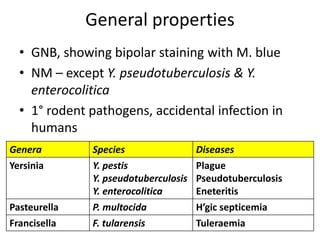
Genera Species Diseases
Yersinia Y. pestis
Y. pseudotuberculosis
Y. enterocolitica
Plague
Pseudotuberculosis
Eneteritis
Pasteurella P. multocida H’gic septicemia
Francisella F. tularensis Tuleraemia
Y. pestis
• Family Enterobacteriaceae, tribe Yersiniae
• Causes – Plague – Pasteurella pestis
• Isolated independently by Yersin & Kitasato
(1894)
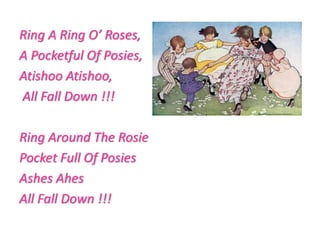
Ring A Ring O’ Roses,
A Pocketful Of Posies,
Atishoo Atishoo,
All Fall Down !!!
Ring Around The Rosie
Pocket Full Of Posies
Ashes Ahes
All Fall Down !!!
Morphology
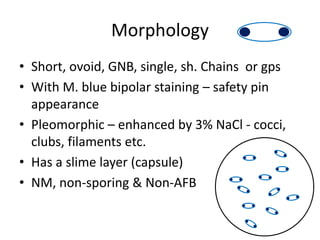
• Short, ovoid, GNB, single, sh. Chains or gps
• With M. blue bipolar staining – safety pin
appearance
• Pleomorphic – enhanced by 3% NaCl - cocci,
clubs, filaments etc.
• Has a slime layer (capsule)
• NM, non-sporing & Non-AFB
Culture
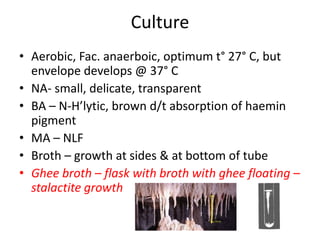
• Aerobic, Fac. anaerboic, optimum t° 27° C, but
envelope develops @ 37° C
• NA- small, delicate, transparent
• BA – N-H’lytic, brown d/t absorption of haemin
pigment
• MA – NLF
• Broth – growth at sides & at bottom of tube
• Ghee broth – flask with broth with ghee floating –
stalactite growth
Biochemical reactions
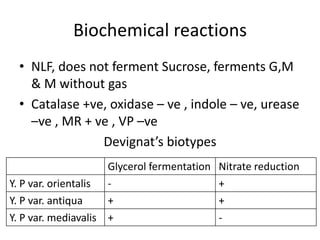
• NLF, does not ferment Sucrose, ferments G,M
& M without gas
• Catalase +ve, oxidase – ve , indole – ve, urease
–ve , MR + ve , VP –ve
Devignat’s biotypes
Glycerol fermentation Nitrate reduction
Y. P var. orientalis - +
Y. P var. antiqua + +
Y. P var. mediavalis + -
Resistance
• Die in heat @ 55 C x 15 minutes
• Survive for months in soil of rodent burrows
Antigenic structure
• No serotypes but ≈ 20 different Ags
Antigenic structure
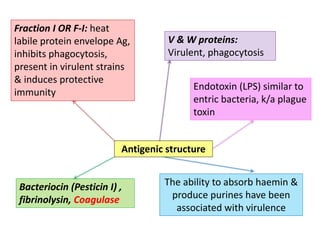
Fraction I OR F-I: heat
labile protein envelope Ag,
inhibits phagocytosis,
present in virulent strains
& induces protective
immunity
Bacteriocin (Pesticin I) ,
fibrinolysin, Coagulase
V & W proteins:
Virulent, phagocytosis
Endotoxin (LPS) similar to
entric bacteria, k/a plague
toxin
The ability to absorb haemin &
produce purines have been
associated with virulence
Epidemiology
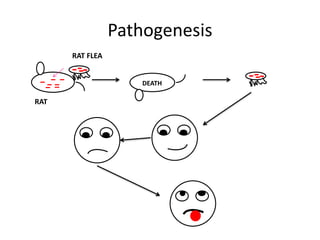
• Zoonotic infection – rats – may become
epidemic – flea – one rat to another
• Rat flea – Xenopsiella cheopis, X. astia,
Ceratphylus
• Black death – extreme deprssion
• Killed millions in past
• 1994 outbreak in Surat (Gujrat) & Beed
(Maharashtra) – bubonic & pneumonic
RAT
Pathogenesis
DEATH
RAT FLEA
Plague
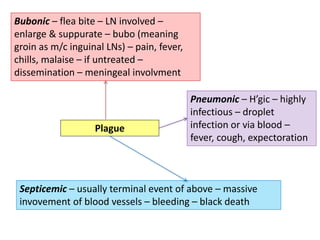
Bubonic – flea bite – LN involved –
enlarge & suppurate – bubo (meaning
groin as m/c inguinal LNs) – pain, fever,
chills, malaise – if untreated –
dissemination – meningeal involvment
Pneumonic – H’gic – highly
infectious – droplet
infection or via blood –
fever, cough, expectoration
Septicemic – usually terminal event of above – massive
invovement of blood vessels – bleeding – black death
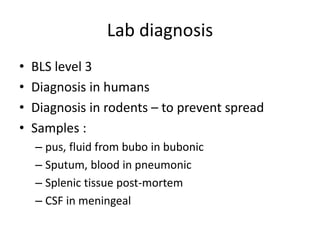
Lab diagnosis
• BLS level 3
• Diagnosis in humans
• Diagnosis in rodents – to prevent spread
• Samples :
– pus, fluid from bubo in bubonic
– Sputum, blood in pneumonic
– Splenic tissue post-mortem
– CSF in meningeal
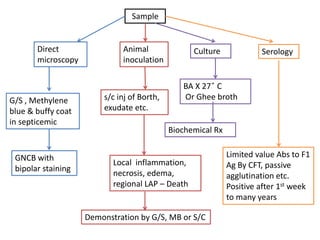
Sample
G/S , Methylene
blue & buffy coat
in septicemic
GNCB with
bipolar staining
CultureDirect
microscopy
BA X 27 ̊ C
Or Ghee broth
Animal
inoculation
s/c inj of Borth,
exudate etc.
Local inflammation,
necrosis, edema,
regional LAP – Death
Demonstration by G/S, MB or S/C
Serology
Limited value Abs to F1
Ag By CFT, passive
agglutination etc.
Positive after 1st week
to many years
Biochemical Rx
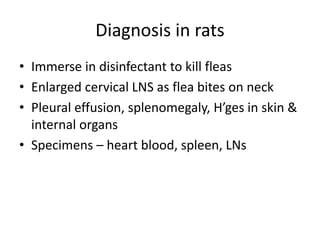
Diagnosis in rats
• Immerse in disinfectant to kill fleas
• Enlarged cervical LNS as flea bites on neck
• Pleural effusion, splenomegaly, H’ges in skin &
internal organs
• Specimens – heart blood, spleen, LNs
Treatment & prophylaxis
• TET (DOC), STM, CPC, Kanamycin
• Flea & rodent control
• Kill fleas 1st
• Insecticides in rodent burrows & houses
• f/b rodenticides
Vaccine
• Killed whole bacterial culture Ag – Haffkine
Institute, Mumbai – Sokhey’s modification –
0.05 ml s/c f/b 1ml 7-14 days latter – 6m-
Immunity 6m – not very effective
• Live vaccine – two avirulent strains of Y. pestis
– Otten’s Tjiwidej strain from Jawa & Girard’s
EV 76 strain from Malagasey – difficult to
prepare & impracticle
Y. Pseudo-tuberculosis & Y. enterocolitica
• Resemble Y. pestis – small GNB with bipolar
staining
• Reservoirs in rodents, wild & domestic animals
• Differ from Y. pestis by their motility @ 22 °C
& not @ 37°C
• Yersiniosis = infection other than Y. pestis
Y. Pseudo-tuberculosis
• 6 serological gps & 9 serotypes – based on
somatic & flagellar Ags
• Zonotic infection – GPs, rabbit, birds etc.
• Multiple nodules resembling Tb in liver, spleen
& lungs of infected animals – hence pseudo-Tb
• Human infection – ingestion of food
contaminated with animal faeces – leading to
mesenteric lymphadenitis or sever gen. Ds
Lab diagnosis
• Isolation from mensenteric LNs
• Serology – AB detection
• Non-sucrose fermenting
Y. enterocolitica
• Also motile @ 22° C but sucrose fermenting &
decarboxilating ornithinie, NLF, Non-H’tic
• Some strains Indole & VP + ve
• 60 O-Agic gps & 20 heat-labile H-Ags
• Most human infections – O3, O8 , O9
• Zonotic infection – faeco-oral route
• GE, mesenteric LAP, septocaemia
• Diarrhoea d/t enterotoxin or mucosal invasion
• Dx – culture & Ab detection
Pasteurella multocida (P. septica)
• Pasteur developed 1st attenuated vaccine from
P. aviseptica – hence Pasteurella
• P. boviseptica, P. letiseptica, P.aviseptica = all
k/a P. multocida
• GNB, oxidase +ve, does not grow on MA
• Dogs, rats. Cats – bite – septic wound or
meningitis following head injury
• Haemorrhagic septicaemia
Francisella tularensis
• NM. GNB, capsulated
• Zoonotic Ds – rabbits & other rodents
• Tulare County, California
• Human infection – handling or eating infected
meat, contaminated water or tick bites
• Francis blood dextrose cysteine agar – minute
transparent colonies x 3 – 5 days
• Highly infectious, lab infection is common
• Local ulceration, LAP, PUO, bacteremia, pulm.
Infections
• Lab Dx
– Pus, blood, sputum
– Smear, culture, GP inoculation
– Serology for agglutinating Abs - >1:80 +ve
– Cross Rx with Brucellosis
• STM is DOC, attenuated vaccine
X

Yersinia, pasteurella, francisella

  • 1.
    Yersinia, Pasteurella, Francisella Dr.Kanwal Deep Singh Lyall M.D. Microbiology
  • 2.
    General properties • GNB,showing bipolar staining with M. blue • NM – except Y. pseudotuberculosis & Y. enterocolitica • 1° rodent pathogens, accidental infection in humans Genera Species Diseases Yersinia Y. pestis Y. pseudotuberculosis Y. enterocolitica Plague Pseudotuberculosis Eneteritis Pasteurella P. multocida H’gic septicemia Francisella F. tularensis Tuleraemia
  • 3.
    Y. pestis • FamilyEnterobacteriaceae, tribe Yersiniae • Causes – Plague – Pasteurella pestis • Isolated independently by Yersin & Kitasato (1894)
  • 4.
    Ring A RingO’ Roses, A Pocketful Of Posies, Atishoo Atishoo, All Fall Down !!! Ring Around The Rosie Pocket Full Of Posies Ashes Ahes All Fall Down !!!
  • 5.
    Morphology • Short, ovoid,GNB, single, sh. Chains or gps • With M. blue bipolar staining – safety pin appearance • Pleomorphic – enhanced by 3% NaCl - cocci, clubs, filaments etc. • Has a slime layer (capsule) • NM, non-sporing & Non-AFB
  • 6.
    Culture • Aerobic, Fac.anaerboic, optimum t° 27° C, but envelope develops @ 37° C • NA- small, delicate, transparent • BA – N-H’lytic, brown d/t absorption of haemin pigment • MA – NLF • Broth – growth at sides & at bottom of tube • Ghee broth – flask with broth with ghee floating – stalactite growth
  • 7.
    Biochemical reactions • NLF,does not ferment Sucrose, ferments G,M & M without gas • Catalase +ve, oxidase – ve , indole – ve, urease –ve , MR + ve , VP –ve Devignat’s biotypes Glycerol fermentation Nitrate reduction Y. P var. orientalis - + Y. P var. antiqua + + Y. P var. mediavalis + -
  • 8.
    Resistance • Die inheat @ 55 C x 15 minutes • Survive for months in soil of rodent burrows
  • 9.
    Antigenic structure • Noserotypes but ≈ 20 different Ags
  • 10.
    Antigenic structure Fraction IOR F-I: heat labile protein envelope Ag, inhibits phagocytosis, present in virulent strains & induces protective immunity Bacteriocin (Pesticin I) , fibrinolysin, Coagulase V & W proteins: Virulent, phagocytosis Endotoxin (LPS) similar to entric bacteria, k/a plague toxin The ability to absorb haemin & produce purines have been associated with virulence
  • 11.
    Epidemiology • Zoonotic infection– rats – may become epidemic – flea – one rat to another • Rat flea – Xenopsiella cheopis, X. astia, Ceratphylus • Black death – extreme deprssion • Killed millions in past • 1994 outbreak in Surat (Gujrat) & Beed (Maharashtra) – bubonic & pneumonic
  • 12.
  • 13.
    Plague Bubonic – fleabite – LN involved – enlarge & suppurate – bubo (meaning groin as m/c inguinal LNs) – pain, fever, chills, malaise – if untreated – dissemination – meningeal involvment Pneumonic – H’gic – highly infectious – droplet infection or via blood – fever, cough, expectoration Septicemic – usually terminal event of above – massive invovement of blood vessels – bleeding – black death
  • 14.
    Lab diagnosis • BLSlevel 3 • Diagnosis in humans • Diagnosis in rodents – to prevent spread • Samples : – pus, fluid from bubo in bubonic – Sputum, blood in pneumonic – Splenic tissue post-mortem – CSF in meningeal
  • 15.
    Sample G/S , Methylene blue& buffy coat in septicemic GNCB with bipolar staining CultureDirect microscopy BA X 27 ̊ C Or Ghee broth Animal inoculation s/c inj of Borth, exudate etc. Local inflammation, necrosis, edema, regional LAP – Death Demonstration by G/S, MB or S/C Serology Limited value Abs to F1 Ag By CFT, passive agglutination etc. Positive after 1st week to many years Biochemical Rx
  • 16.
    Diagnosis in rats •Immerse in disinfectant to kill fleas • Enlarged cervical LNS as flea bites on neck • Pleural effusion, splenomegaly, H’ges in skin & internal organs • Specimens – heart blood, spleen, LNs
  • 17.
    Treatment & prophylaxis •TET (DOC), STM, CPC, Kanamycin • Flea & rodent control • Kill fleas 1st • Insecticides in rodent burrows & houses • f/b rodenticides
  • 18.
    Vaccine • Killed wholebacterial culture Ag – Haffkine Institute, Mumbai – Sokhey’s modification – 0.05 ml s/c f/b 1ml 7-14 days latter – 6m- Immunity 6m – not very effective • Live vaccine – two avirulent strains of Y. pestis – Otten’s Tjiwidej strain from Jawa & Girard’s EV 76 strain from Malagasey – difficult to prepare & impracticle
  • 19.
    Y. Pseudo-tuberculosis &Y. enterocolitica • Resemble Y. pestis – small GNB with bipolar staining • Reservoirs in rodents, wild & domestic animals • Differ from Y. pestis by their motility @ 22 °C & not @ 37°C • Yersiniosis = infection other than Y. pestis
  • 20.
    Y. Pseudo-tuberculosis • 6serological gps & 9 serotypes – based on somatic & flagellar Ags • Zonotic infection – GPs, rabbit, birds etc. • Multiple nodules resembling Tb in liver, spleen & lungs of infected animals – hence pseudo-Tb • Human infection – ingestion of food contaminated with animal faeces – leading to mesenteric lymphadenitis or sever gen. Ds
  • 21.
    Lab diagnosis • Isolationfrom mensenteric LNs • Serology – AB detection • Non-sucrose fermenting
  • 22.
    Y. enterocolitica • Alsomotile @ 22° C but sucrose fermenting & decarboxilating ornithinie, NLF, Non-H’tic • Some strains Indole & VP + ve • 60 O-Agic gps & 20 heat-labile H-Ags • Most human infections – O3, O8 , O9 • Zonotic infection – faeco-oral route • GE, mesenteric LAP, septocaemia • Diarrhoea d/t enterotoxin or mucosal invasion • Dx – culture & Ab detection
  • 23.
    Pasteurella multocida (P.septica) • Pasteur developed 1st attenuated vaccine from P. aviseptica – hence Pasteurella • P. boviseptica, P. letiseptica, P.aviseptica = all k/a P. multocida • GNB, oxidase +ve, does not grow on MA • Dogs, rats. Cats – bite – septic wound or meningitis following head injury • Haemorrhagic septicaemia
  • 24.
    Francisella tularensis • NM.GNB, capsulated • Zoonotic Ds – rabbits & other rodents • Tulare County, California • Human infection – handling or eating infected meat, contaminated water or tick bites • Francis blood dextrose cysteine agar – minute transparent colonies x 3 – 5 days
  • 25.
    • Highly infectious,lab infection is common • Local ulceration, LAP, PUO, bacteremia, pulm. Infections • Lab Dx – Pus, blood, sputum – Smear, culture, GP inoculation – Serology for agglutinating Abs - >1:80 +ve – Cross Rx with Brucellosis • STM is DOC, attenuated vaccine
  • 26.

Editor's Notes

  • #8 All enterobacteriace reduce nitrate except Y. pestis var mediavalis