Vancomycin Resistance In
Staphylococci
Dr. Kanwal Deep Singh Lyall
M.D. Microbiology
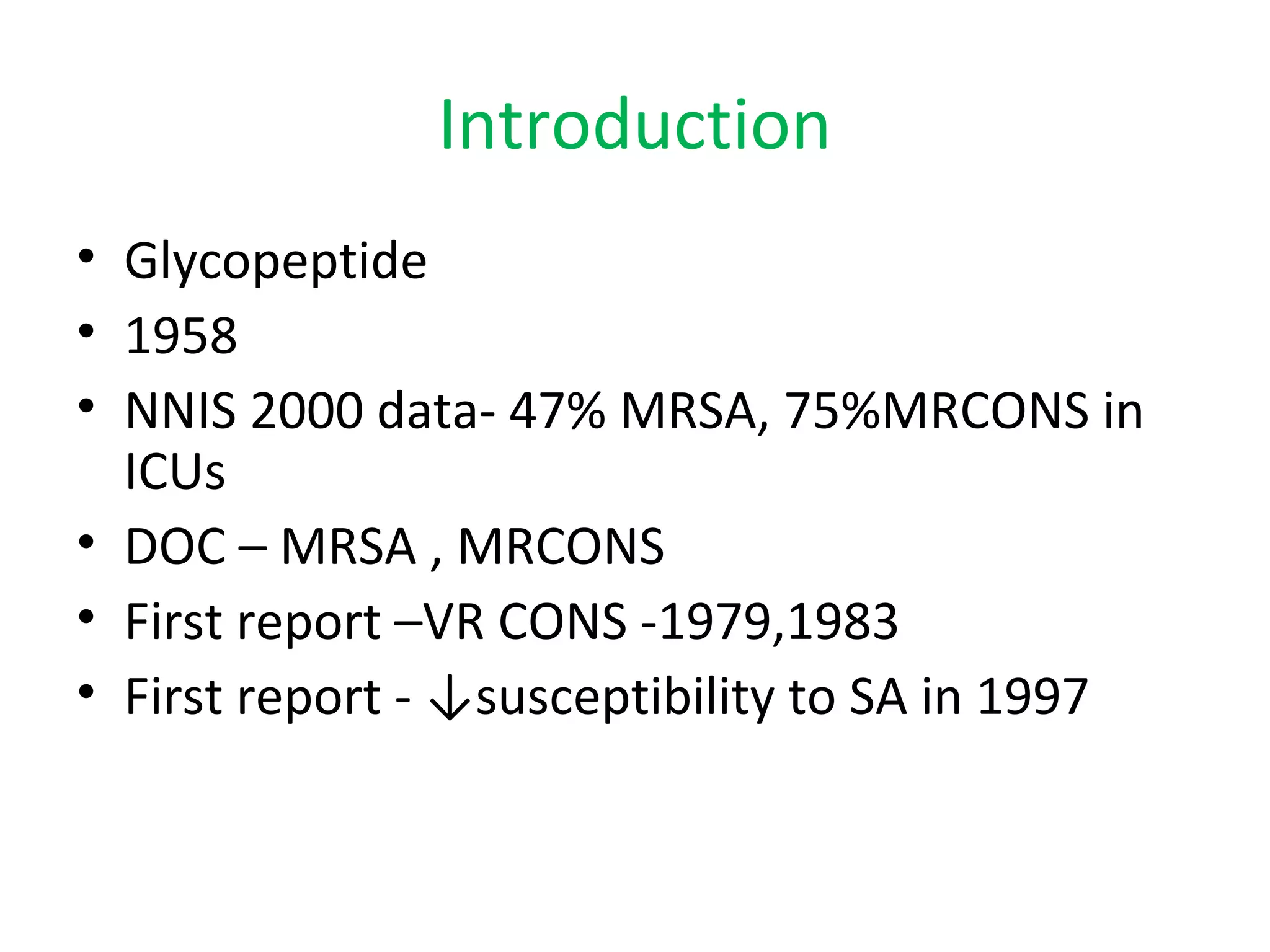
Introduction
• Glycopeptide
• 1958
• NNIS 2000 data- 47% MRSA, 75%MRCONS in
ICUs
• DOC – MRSA , MRCONS
• First report –VR CONS -1979,1983
• First report - ↓susceptibility to SA in 1997
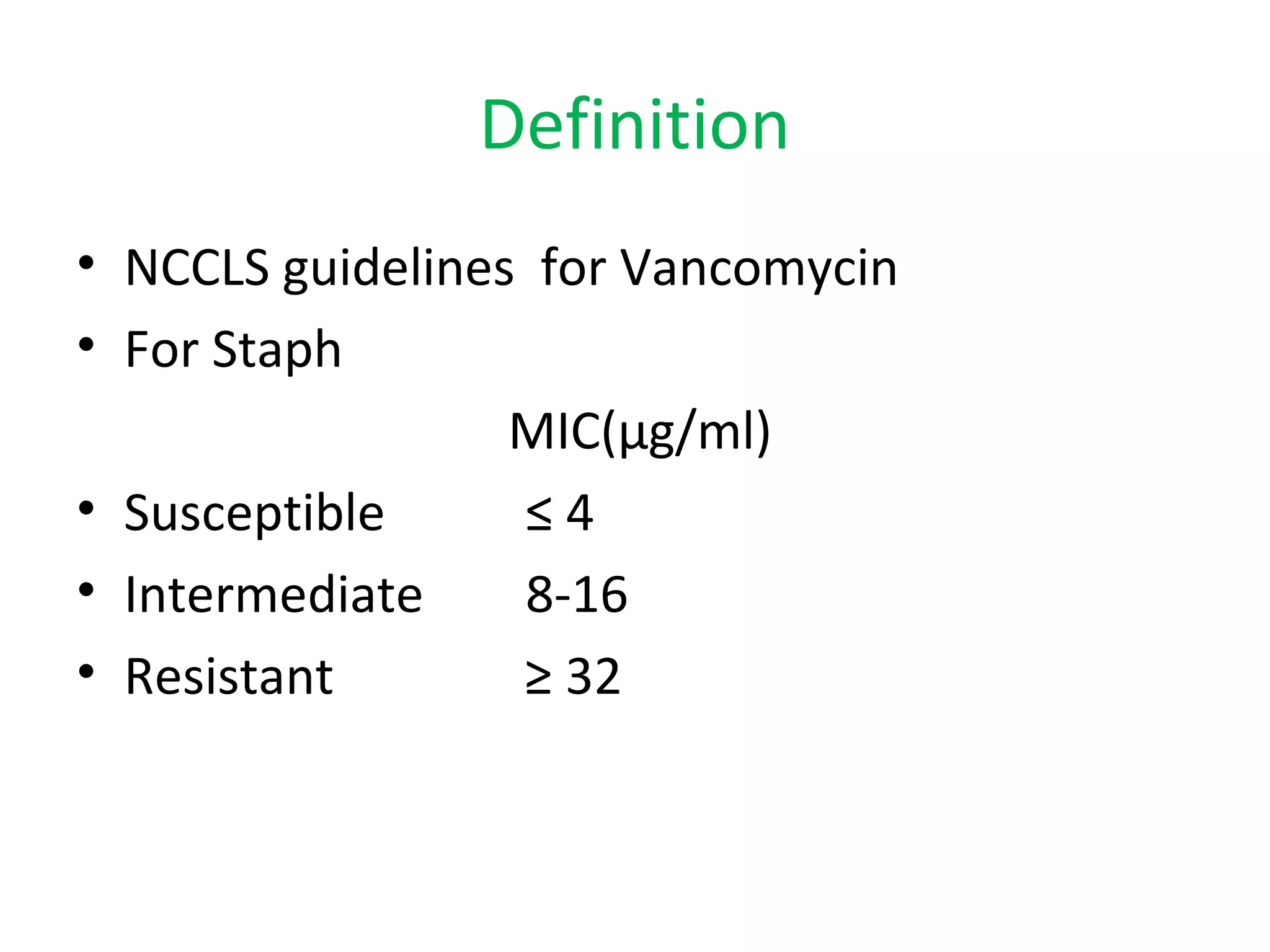
Definition
• NCCLS guidelines for Vancomycin
• For Staph
MIC(µg/ml)
• Susceptible ≤ 4
• Intermediate 8-16
• Resistant ≥ 32
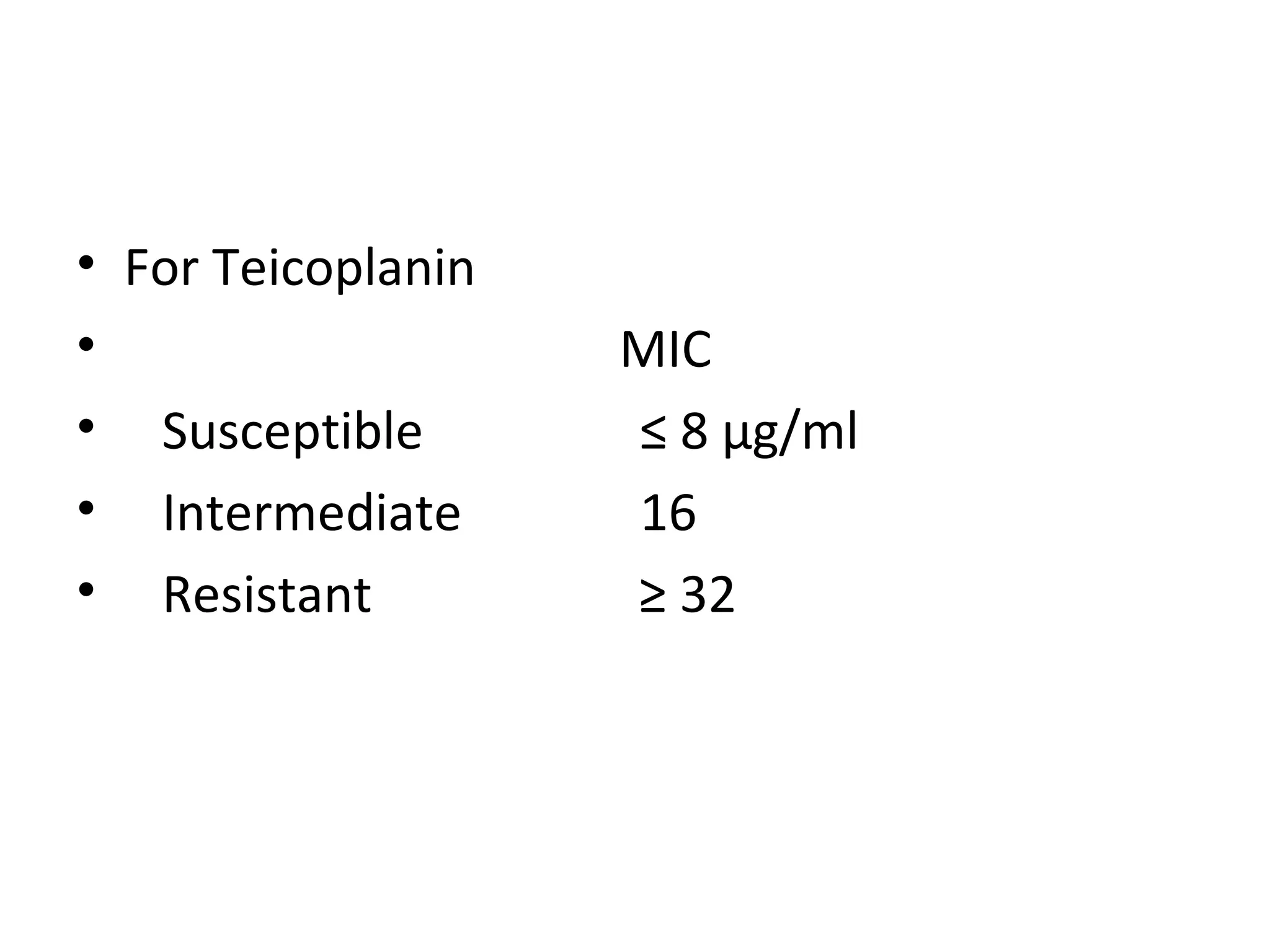
• For Teicoplanin
• MIC
• Susceptible ≤ 8 µg/ml
• Intermediate 16
• Resistant ≥ 32
Heteroresistance
• Both in CoNS and SA
• Variability of Vancomycin susceptibilities among
subpopulations of single isolate
• two populations of cells
• Majority Vanco susceptible
• Minority Vanco resistant
• more common than pure resistance
• In Japan – 20% SA isolates
• In US- 0.3%
Laboratory Detection
• MIC by broth or agar dilution
• Etest
• Agar based methods -advantages
• more sensitive
Detect resistant subpopulations
• Single colonies visualized
• NCCLS – inoculum density of 5 x 10⁵ CFU/ml
• Growth conditions- ↑Nacl
- ↓temp
• Inducing agent- Aztreonam
CDC Recommendations
• For S. aureus
(i) primary testing of S. aureus requires at least 24 h
of incubation,
(ii) susceptibility determination with disk diffusion
is not an acceptable method,
(iii) an MIC testing method should be used to confirm
vancomycin susceptibility
• Any S. aureus isolate for which the MIC is 4 µg/ml
should be sent to the CDC for confirmatory testing.
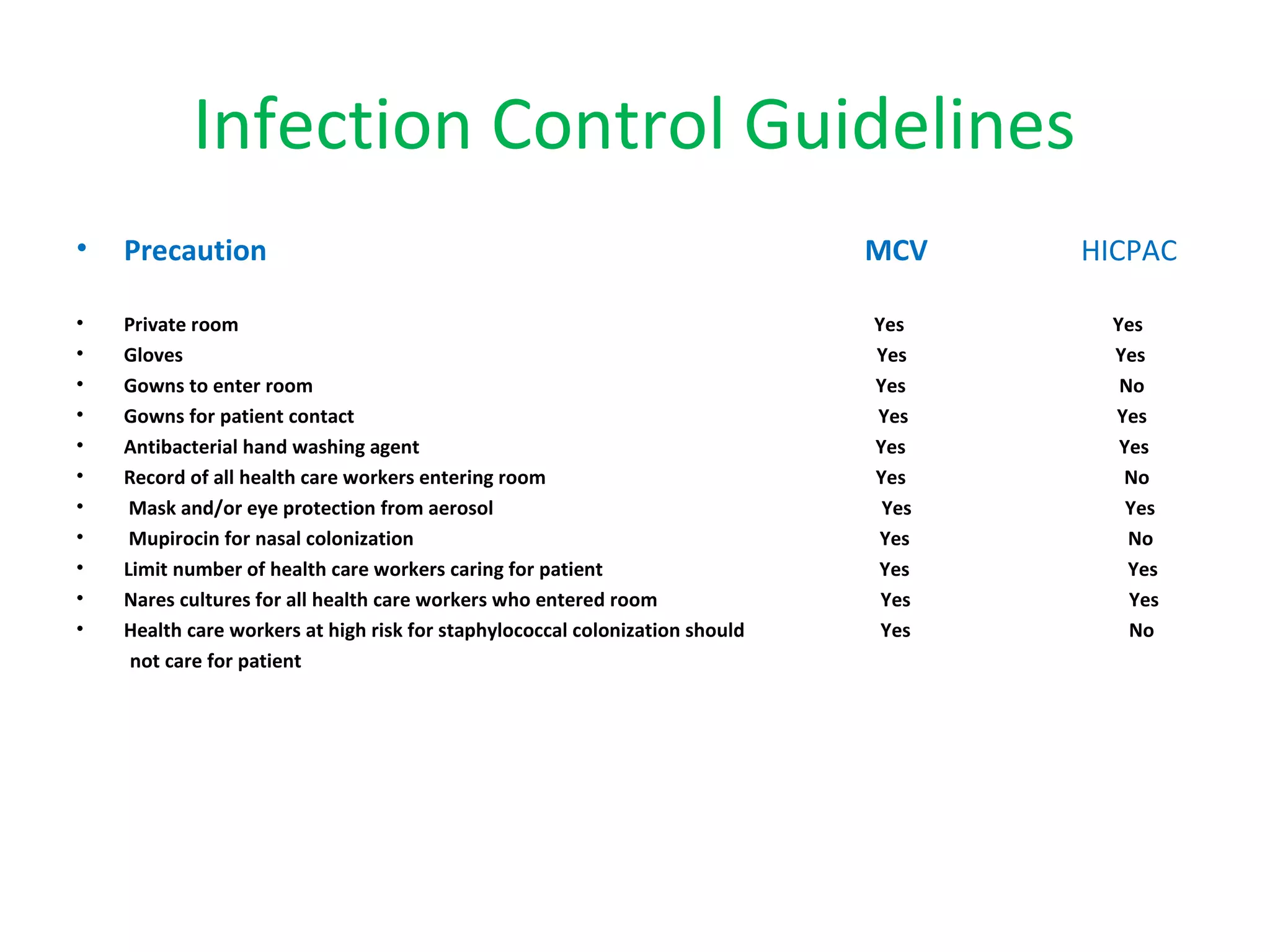
Infection Control Guidelines
• Precaution MCV
• Private room Yes Yes
• Gloves Yes Yes
• Gowns to enter room Yes No
• Gowns for patient contact Yes Yes
• Antibacterial hand washing agent Yes Yes
• Record of all health care workers entering room Yes No
• Mask and/or eye protection from aerosol Yes Yes
• Mupirocin for nasal colonization Yes No
• Limit number of health care workers caring for patient Yes Yes
• Nares cultures for all health care workers who entered room Yes Yes
• Health care workers at high risk for staphylococcal colonization should Yes No
not care for patient
HICPAC
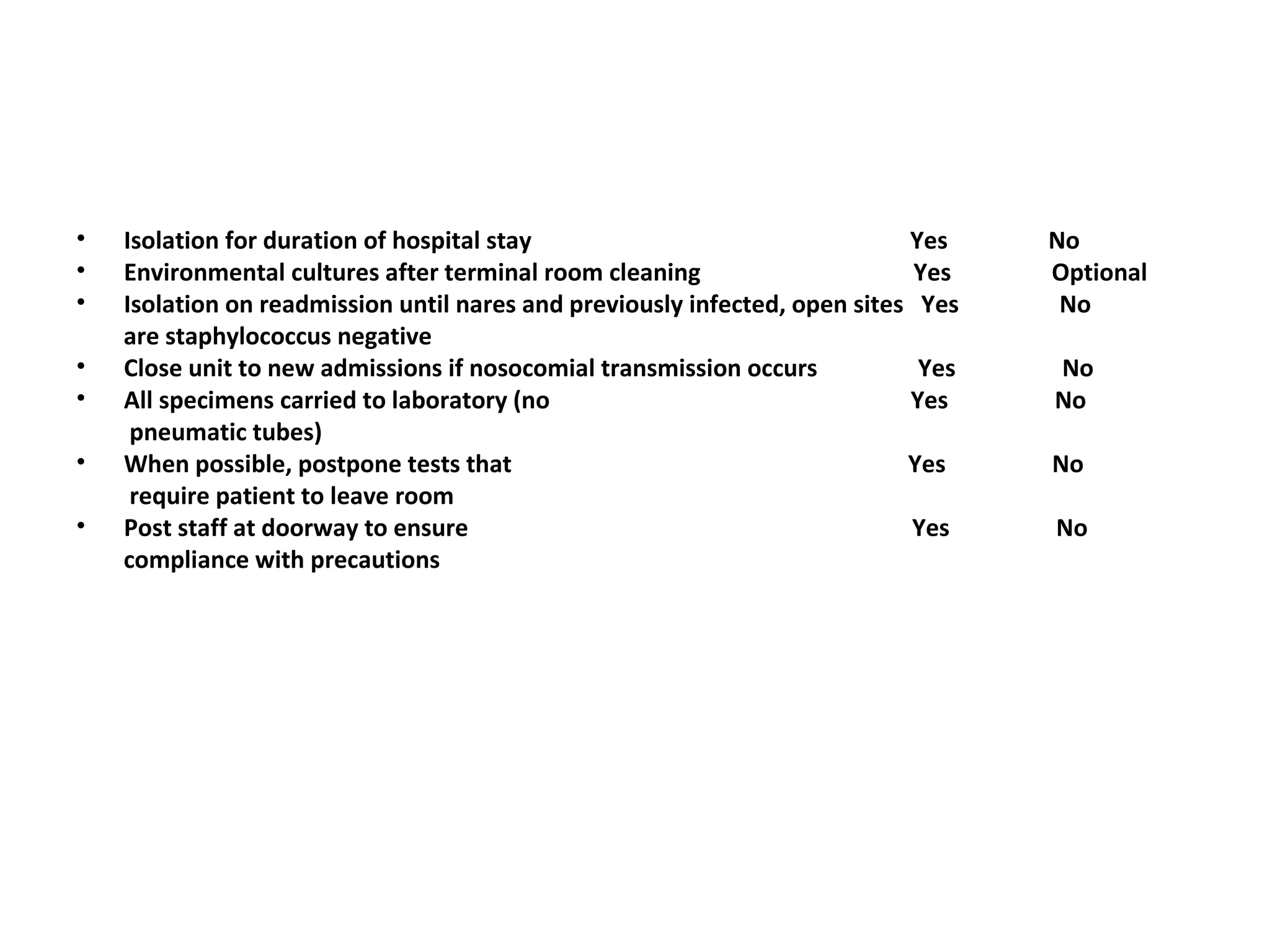
• Isolation for duration of hospital stay Yes No
• Environmental cultures after terminal room cleaning Yes Optional
• Isolation on readmission until nares and previously infected, open sites Yes No
are staphylococcus negative
• Close unit to new admissions if nosocomial transmission occurs Yes No
• All specimens carried to laboratory (no Yes No
pneumatic tubes)
• When possible, postpone tests that Yes No
require patient to leave room
• Post staff at doorway to ensure Yes No
compliance with precautions
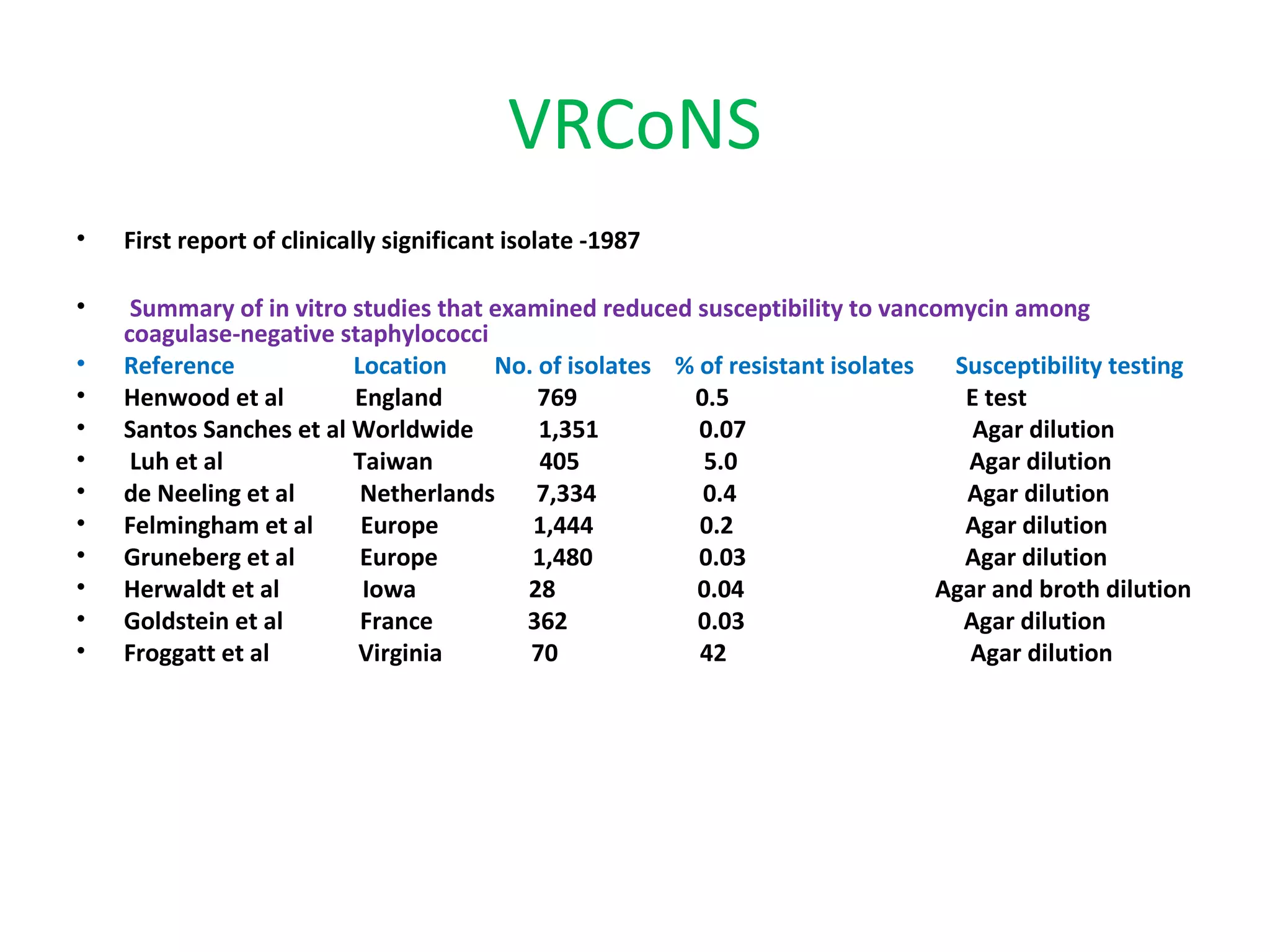
VRCoNS
• First report of clinically significant isolate -1987
• Summary of in vitro studies that examined reduced susceptibility to vancomycin among
coagulase-negative staphylococci
• Reference Location No. of isolates % of resistant isolates Susceptibility testing
• Henwood et al England 769 0.5 E test
• Santos Sanches et al Worldwide 1,351 0.07 Agar dilution
• Luh et al Taiwan 405 5.0 Agar dilution
• de Neeling et al Netherlands 7,334 0.4 Agar dilution
• Felmingham et al Europe 1,444 0.2 Agar dilution
• Gruneberg et al Europe 1,480 0.03 Agar dilution
• Herwaldt et al Iowa 28 0.04 Agar and broth dilution
• Goldstein et al France 362 0.03 Agar dilution
• Froggatt et al Virginia 70 42 Agar dilution
Risk Factors
• Peritoneal Dialysis
• Glycopeptide exposure – vancomycin
Teicoplanin
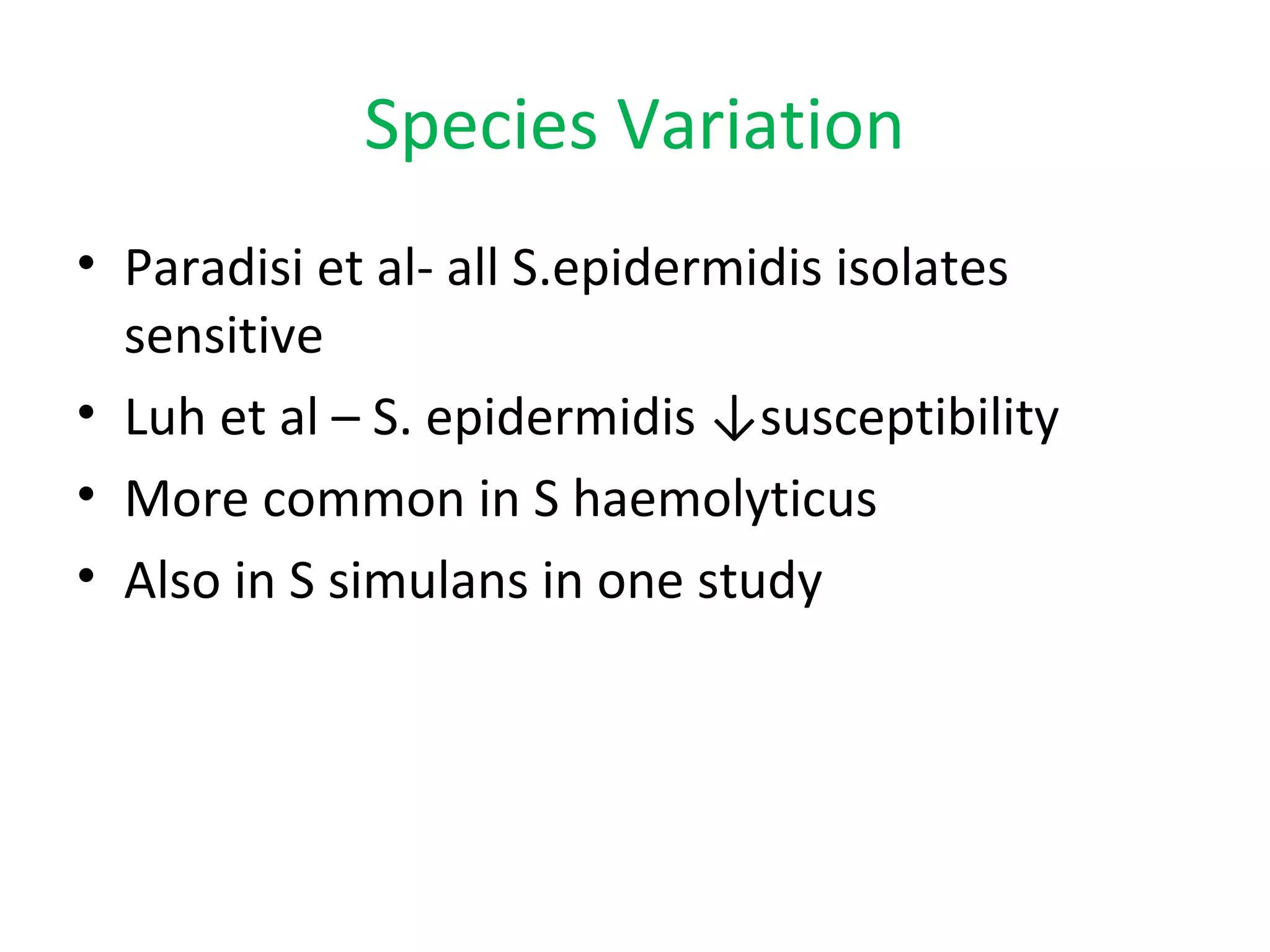
Species Variation
• Paradisi et al- all S.epidermidis isolates
sensitive
• Luh et al – S. epidermidis ↓susceptibility
• More common in S haemolyticus
• Also in S simulans in one study
Mechanism of resistance
• Vancomycin - binds irreversibly to the
terminal
D- alanyl –D alanine of cell wall
• Inhibits bacterial cell wall synthesis
• In VRCONS- altered cross links inhibit binding
to peptides
• Exact mechanism
not known
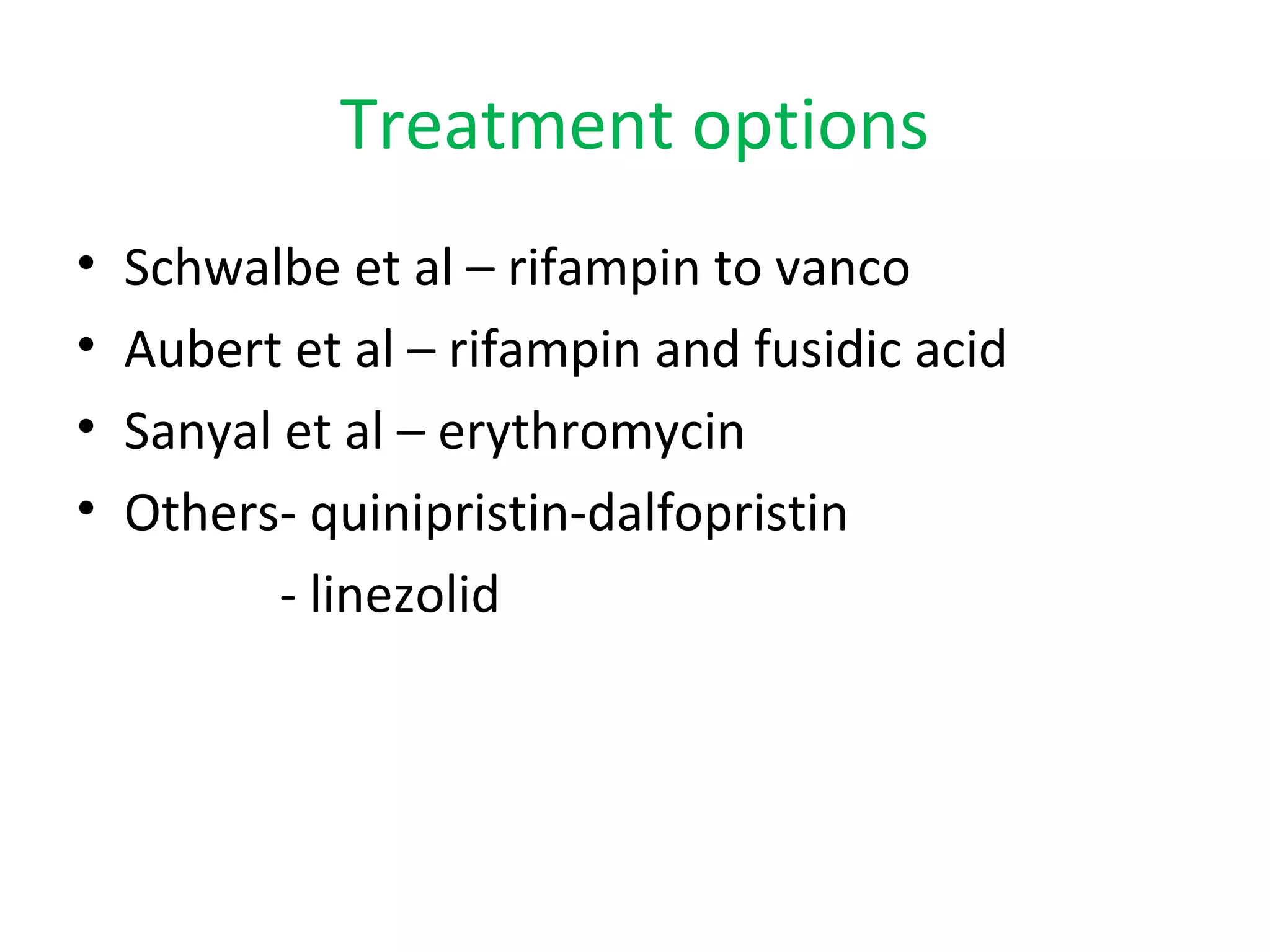
Treatment options
• Schwalbe et al – rifampin to vanco
• Aubert et al – rifampin and fusidic acid
• Sanyal et al – erythromycin
• Others- quinipristin-dalfopristin
- linezolid
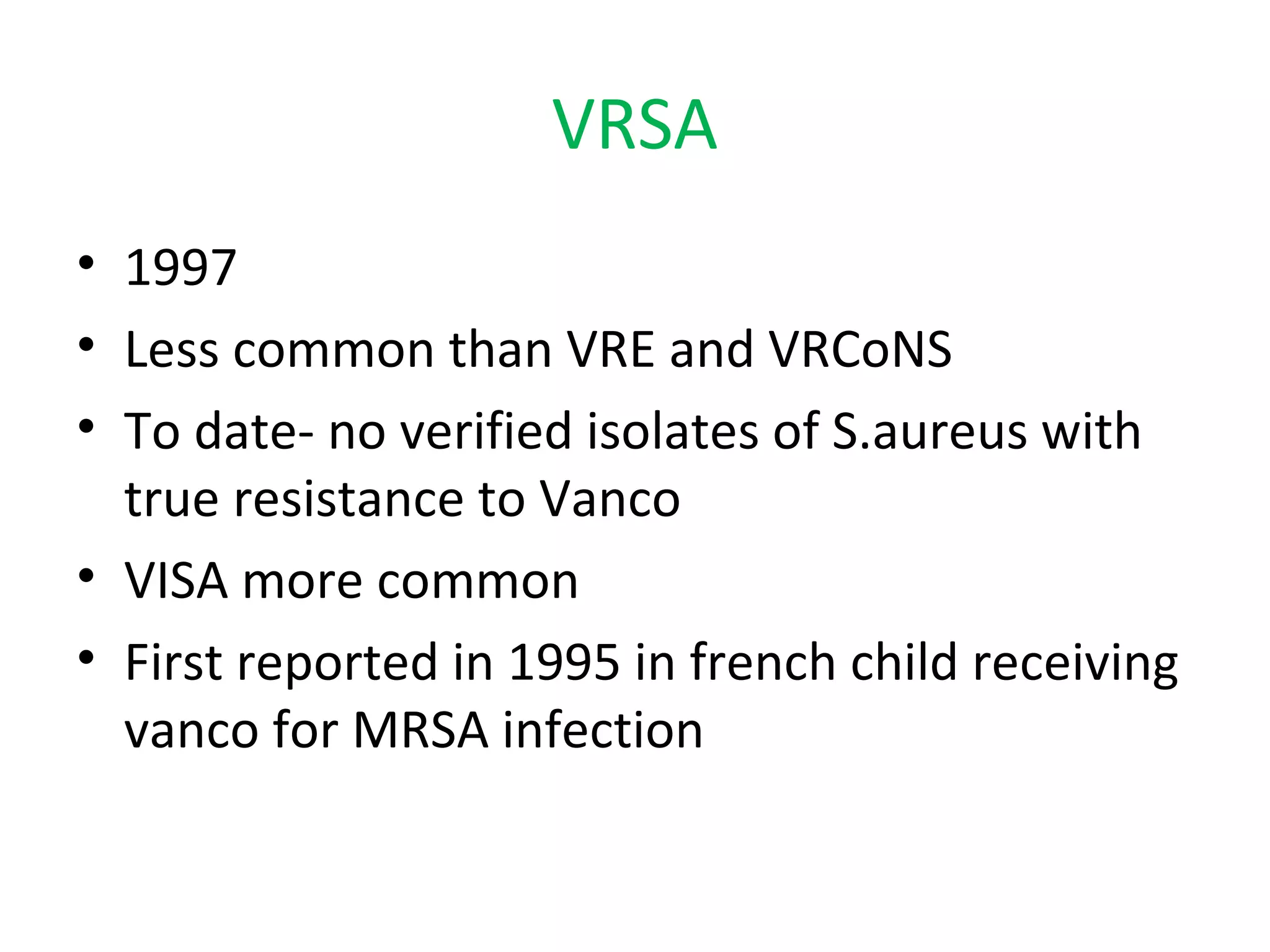
VRSA
• 1997
• Less common than VRE and VRCoNS
• To date- no verified isolates of S.aureus with
true resistance to Vanco
• VISA more common
• First reported in 1995 in french child receiving
vanco for MRSA infection
Risk Factors
• Exposure to Glycopeptides
• MRSA infection
• Renal Failure
• VISA cases in the United States
• State ,yr Source Underlying illness Vancomycin
• Michigan, 1997 Peritoneal fluid Renal failure, 18
• MRSA peritonitis, cancer
• New Jersey, 1997 Blood ARF, MRSA bacteremia
18
• New York, 1998 Blood Renal failure, MRSA bacteremia 6
• Illinois, 1999 Blood Renal failure, MRSA endocarditis 3.5
• Minnesota, 2000 Blood Renal failure, MRSA osteomyelitis 18
• Nevada, 2000 Abscess fluid Complicated cholecystectomy with
10
polymicrobial
intrahepatic abscess (including MRSA)
• Maryland, 2000 Blood MRSA endocarditis
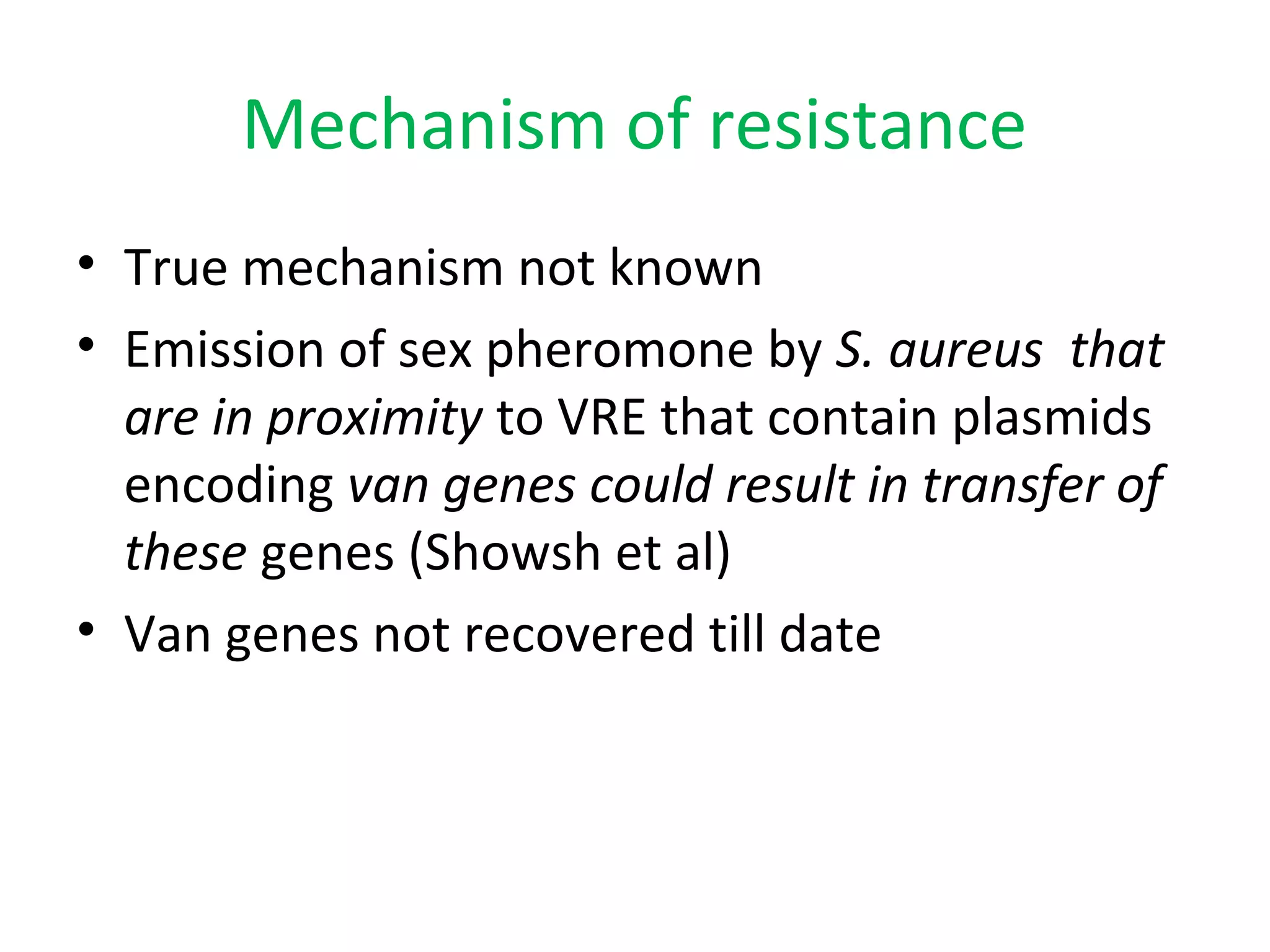
Mechanism of resistance
• True mechanism not known
• Emission of sex pheromone by S. aureus that
are in proximity to VRE that contain plasmids
encoding van genes could result in transfer of
these genes (Showsh et al)
• Van genes not recovered till date
• Other-
• Thicker and disorganized cell wall(Hanaki et
al)
• Less cross linking in peptidoglycans(Sieradzki K
et al)
• Thick cell wall trap vanco at periphery
• Altered cell wall - ↓affinity
• Role of PBPs unclear
• VRSA and VISA – colonies smaller
• Require more incubation time for coagulase –
more than 4 hours
• Misclassified as CONS
Treatment options
• TMP-SMX
• Tetracycline
• Quinipristin –Dalfopristin
• Linezolid
NCCLS Recommendations for VRSA
MIC (µg/ml)
Susceptible ≤ 4
Intermediate 8-16
Resistant ≥ 32
BSAC Recommendations for VRSA
MIC (µg/ml)
Susceptible ≤ 4
Resistant ≥ 32
CLSI
Int J Antimicrob Agents. 2007 Nov ;30(5):398-408
MIC (µg/ml)
• VISA 4-8
• VRSA ≥ 16
• Broth microdilution vancomycin MIC of 8-
16μg/ml
• E test vancomycin MIC of >6μg/ml
• growth on BHI agar containing 6μg/ml
vancomycin within 24 hours.
CDC criteria to identify VISA
• NCCLS disk-diffusion method and the Stokes
method are not accurate predictors of
reduced vancomycin susceptibility in
staphylococci
Screening of VRSA strains
Indian Journal of Medical Microbiology, (2005) 23 (1):52-55
• Hiramatshu method:
• Overnight grown cultures adjusted to 0.5
McFarland
• 10 μl spot inoculated on BHI agar (4 μg/ml)
of vancomycin
• incubated at 35°C for 24-48 hours
• CDC method:
• Overnight grown cultures adjusted to 0.5
McFarland
• diluted 100 times
• Spots 10 μl of the cultures inoculated on BHI
agar (6 μg/ml) of vancomycin.
• Incubated at 35°C for 24-48 hours.
• Method by Tenover et al:
• Overnight grown cultures adjusted to 0.5
McFarland
• diluted 100 times
• Spot 10μL of both the inoculums
• inoculated on MHA agar containing 5μg/ml
of vancomycin.
• Incubated at 35°C for 24-48 hours.
• Sensitivity Specificity
• CDC method 1 1
• MHA method 1 0.98
• Hiramatshu 1 0.85
Heteroresistant VRSA
• produce colonies on vancomycin-containing
BHI agar with vancomycin MICs of < 4 µg/ml
• Such strains were first reported from Japan in
1996
• Hanaki et al.
• hetero-VRSA -
• 3 to 5 fold greater quantities of PBP 2 and 2‘
• and ↑ quantities of cell-wall precursors, trap
vancomycin extracellularly . J Antimicrob Chemother
1998;42:199-209.
• amidation of glutamine residues in cell-wall
muropeptides , reduces the cross-linking within
the cell walls, reducing the number of
intracellular vancomycin target molecules J
Antimicrob Chemother. 1998 Sep;42(3):315–320.
Emergence of vancomycin resistant Staphylococcus aureus (VRSA) from a tertiary care hospital
from northern part of India
H K Tiwari, M R Sen
BMC Infect Dis. 2006; 6: 156
• 783 S aureus 93 CoNS
↓
• MIC testing ( vanco,teico, oxacillin)
• Brain Heart Infusion (BHI) vancomycin screen
agar test
• Disc diffusion testing
• PCR for mecA, vanA and vanB genes
• Results
• 2 - S. aureus - Vanco and teico resistant
• 6 - S. aureus – Vanco intermediate
• 2 - S. aureus – teico intermediate
• 1 – CoNS – Vanco and teico resistant
• 2 - CoNS strains –Vanco and teico
intermediate
• All VRSA, VISA and VRCoNS had shown growth
on BHI vancomycin screen agar (vancomycin 6
μg/ml) and were mecA PCR positive.
• None of these isolates have demonstrated
vanA/vanB gene by PCR.
Emergence of vancomycin resistance in Staphylococcus aureus. Glycopeptide-Intermediate
Staphylococcus aureus Working Group
Smith TL et al
N Engl J Med. 1999 Feb 18;340(7):493-501
• 2 patients with GISA (MIC Vanco 8-16µg/ml)
• 59 yr-old man DM and CRF.
• 18 weeks of vancomycin treatment for
recurrent MRSA peritonitis associated with
dialysis.
• Peritonitis due to GISA
• Removal of peritoneal catheter plus treatment
with rifampin and TMP-SMX eradicated the
infection.
• 66 yr old man with DM
• 18 weeks of vancomycin for recurrent MRSA
bacteremia.
• Bloodstream infection due to GISA
• This infection was eradicated with
vancomycin, gentamicin, and rifampin
• On electron microscopy, the isolates from the
infected patients had thicker extracellular
matrixes than control MRSA strains.

Vancomycin resistance in staphylococci

  • 1.
    Vancomycin Resistance In Staphylococci Dr.Kanwal Deep Singh Lyall M.D. Microbiology
  • 2.
    Introduction • Glycopeptide • 1958 •NNIS 2000 data- 47% MRSA, 75%MRCONS in ICUs • DOC – MRSA , MRCONS • First report –VR CONS -1979,1983 • First report - ↓susceptibility to SA in 1997
  • 3.
    Definition • NCCLS guidelinesfor Vancomycin • For Staph MIC(µg/ml) • Susceptible ≤ 4 • Intermediate 8-16 • Resistant ≥ 32
  • 4.
    • For Teicoplanin •MIC • Susceptible ≤ 8 µg/ml • Intermediate 16 • Resistant ≥ 32
  • 5.
    Heteroresistance • Both inCoNS and SA • Variability of Vancomycin susceptibilities among subpopulations of single isolate • two populations of cells • Majority Vanco susceptible • Minority Vanco resistant • more common than pure resistance • In Japan – 20% SA isolates • In US- 0.3%
  • 6.
    Laboratory Detection • MICby broth or agar dilution • Etest • Agar based methods -advantages • more sensitive Detect resistant subpopulations • Single colonies visualized
  • 7.
    • NCCLS –inoculum density of 5 x 10⁵ CFU/ml • Growth conditions- ↑Nacl - ↓temp • Inducing agent- Aztreonam
  • 8.
    CDC Recommendations • ForS. aureus (i) primary testing of S. aureus requires at least 24 h of incubation, (ii) susceptibility determination with disk diffusion is not an acceptable method, (iii) an MIC testing method should be used to confirm vancomycin susceptibility • Any S. aureus isolate for which the MIC is 4 µg/ml should be sent to the CDC for confirmatory testing.
  • 9.
    Infection Control Guidelines •Precaution MCV • Private room Yes Yes • Gloves Yes Yes • Gowns to enter room Yes No • Gowns for patient contact Yes Yes • Antibacterial hand washing agent Yes Yes • Record of all health care workers entering room Yes No • Mask and/or eye protection from aerosol Yes Yes • Mupirocin for nasal colonization Yes No • Limit number of health care workers caring for patient Yes Yes • Nares cultures for all health care workers who entered room Yes Yes • Health care workers at high risk for staphylococcal colonization should Yes No not care for patient HICPAC
  • 10.
    • Isolation forduration of hospital stay Yes No • Environmental cultures after terminal room cleaning Yes Optional • Isolation on readmission until nares and previously infected, open sites Yes No are staphylococcus negative • Close unit to new admissions if nosocomial transmission occurs Yes No • All specimens carried to laboratory (no Yes No pneumatic tubes) • When possible, postpone tests that Yes No require patient to leave room • Post staff at doorway to ensure Yes No compliance with precautions
  • 11.
    VRCoNS • First reportof clinically significant isolate -1987 • Summary of in vitro studies that examined reduced susceptibility to vancomycin among coagulase-negative staphylococci • Reference Location No. of isolates % of resistant isolates Susceptibility testing • Henwood et al England 769 0.5 E test • Santos Sanches et al Worldwide 1,351 0.07 Agar dilution • Luh et al Taiwan 405 5.0 Agar dilution • de Neeling et al Netherlands 7,334 0.4 Agar dilution • Felmingham et al Europe 1,444 0.2 Agar dilution • Gruneberg et al Europe 1,480 0.03 Agar dilution • Herwaldt et al Iowa 28 0.04 Agar and broth dilution • Goldstein et al France 362 0.03 Agar dilution • Froggatt et al Virginia 70 42 Agar dilution
  • 12.
    Risk Factors • PeritonealDialysis • Glycopeptide exposure – vancomycin Teicoplanin
  • 13.
    Species Variation • Paradisiet al- all S.epidermidis isolates sensitive • Luh et al – S. epidermidis ↓susceptibility • More common in S haemolyticus • Also in S simulans in one study
  • 14.
    Mechanism of resistance •Vancomycin - binds irreversibly to the terminal D- alanyl –D alanine of cell wall • Inhibits bacterial cell wall synthesis • In VRCONS- altered cross links inhibit binding to peptides • Exact mechanism not known
  • 15.
    Treatment options • Schwalbeet al – rifampin to vanco • Aubert et al – rifampin and fusidic acid • Sanyal et al – erythromycin • Others- quinipristin-dalfopristin - linezolid
  • 16.
    VRSA • 1997 • Lesscommon than VRE and VRCoNS • To date- no verified isolates of S.aureus with true resistance to Vanco • VISA more common • First reported in 1995 in french child receiving vanco for MRSA infection
  • 17.
    Risk Factors • Exposureto Glycopeptides • MRSA infection • Renal Failure
  • 18.
    • VISA casesin the United States • State ,yr Source Underlying illness Vancomycin • Michigan, 1997 Peritoneal fluid Renal failure, 18 • MRSA peritonitis, cancer • New Jersey, 1997 Blood ARF, MRSA bacteremia 18 • New York, 1998 Blood Renal failure, MRSA bacteremia 6 • Illinois, 1999 Blood Renal failure, MRSA endocarditis 3.5 • Minnesota, 2000 Blood Renal failure, MRSA osteomyelitis 18 • Nevada, 2000 Abscess fluid Complicated cholecystectomy with 10 polymicrobial intrahepatic abscess (including MRSA) • Maryland, 2000 Blood MRSA endocarditis
  • 19.
    Mechanism of resistance •True mechanism not known • Emission of sex pheromone by S. aureus that are in proximity to VRE that contain plasmids encoding van genes could result in transfer of these genes (Showsh et al) • Van genes not recovered till date
  • 20.
    • Other- • Thickerand disorganized cell wall(Hanaki et al) • Less cross linking in peptidoglycans(Sieradzki K et al) • Thick cell wall trap vanco at periphery • Altered cell wall - ↓affinity • Role of PBPs unclear
  • 21.
    • VRSA andVISA – colonies smaller • Require more incubation time for coagulase – more than 4 hours • Misclassified as CONS
  • 22.
    Treatment options • TMP-SMX •Tetracycline • Quinipristin –Dalfopristin • Linezolid
  • 23.
    NCCLS Recommendations forVRSA MIC (µg/ml) Susceptible ≤ 4 Intermediate 8-16 Resistant ≥ 32
  • 24.
    BSAC Recommendations forVRSA MIC (µg/ml) Susceptible ≤ 4 Resistant ≥ 32
  • 25.
    CLSI Int J AntimicrobAgents. 2007 Nov ;30(5):398-408 MIC (µg/ml) • VISA 4-8 • VRSA ≥ 16
  • 26.
    • Broth microdilutionvancomycin MIC of 8- 16μg/ml • E test vancomycin MIC of >6μg/ml • growth on BHI agar containing 6μg/ml vancomycin within 24 hours. CDC criteria to identify VISA
  • 27.
    • NCCLS disk-diffusionmethod and the Stokes method are not accurate predictors of reduced vancomycin susceptibility in staphylococci
  • 28.
    Screening of VRSAstrains Indian Journal of Medical Microbiology, (2005) 23 (1):52-55 • Hiramatshu method: • Overnight grown cultures adjusted to 0.5 McFarland • 10 μl spot inoculated on BHI agar (4 μg/ml) of vancomycin • incubated at 35°C for 24-48 hours
  • 29.
    • CDC method: •Overnight grown cultures adjusted to 0.5 McFarland • diluted 100 times • Spots 10 μl of the cultures inoculated on BHI agar (6 μg/ml) of vancomycin. • Incubated at 35°C for 24-48 hours.
  • 30.
    • Method byTenover et al: • Overnight grown cultures adjusted to 0.5 McFarland • diluted 100 times • Spot 10μL of both the inoculums • inoculated on MHA agar containing 5μg/ml of vancomycin. • Incubated at 35°C for 24-48 hours.
  • 31.
    • Sensitivity Specificity •CDC method 1 1 • MHA method 1 0.98 • Hiramatshu 1 0.85
  • 32.
    Heteroresistant VRSA • producecolonies on vancomycin-containing BHI agar with vancomycin MICs of < 4 µg/ml • Such strains were first reported from Japan in 1996
  • 33.
    • Hanaki etal. • hetero-VRSA - • 3 to 5 fold greater quantities of PBP 2 and 2‘ • and ↑ quantities of cell-wall precursors, trap vancomycin extracellularly . J Antimicrob Chemother 1998;42:199-209. • amidation of glutamine residues in cell-wall muropeptides , reduces the cross-linking within the cell walls, reducing the number of intracellular vancomycin target molecules J Antimicrob Chemother. 1998 Sep;42(3):315–320.
  • 34.
    Emergence of vancomycinresistant Staphylococcus aureus (VRSA) from a tertiary care hospital from northern part of India H K Tiwari, M R Sen BMC Infect Dis. 2006; 6: 156 • 783 S aureus 93 CoNS ↓ • MIC testing ( vanco,teico, oxacillin) • Brain Heart Infusion (BHI) vancomycin screen agar test • Disc diffusion testing • PCR for mecA, vanA and vanB genes
  • 35.
    • Results • 2- S. aureus - Vanco and teico resistant • 6 - S. aureus – Vanco intermediate • 2 - S. aureus – teico intermediate • 1 – CoNS – Vanco and teico resistant • 2 - CoNS strains –Vanco and teico intermediate
  • 36.
    • All VRSA,VISA and VRCoNS had shown growth on BHI vancomycin screen agar (vancomycin 6 μg/ml) and were mecA PCR positive. • None of these isolates have demonstrated vanA/vanB gene by PCR.
  • 37.
    Emergence of vancomycinresistance in Staphylococcus aureus. Glycopeptide-Intermediate Staphylococcus aureus Working Group Smith TL et al N Engl J Med. 1999 Feb 18;340(7):493-501 • 2 patients with GISA (MIC Vanco 8-16µg/ml) • 59 yr-old man DM and CRF. • 18 weeks of vancomycin treatment for recurrent MRSA peritonitis associated with dialysis. • Peritonitis due to GISA • Removal of peritoneal catheter plus treatment with rifampin and TMP-SMX eradicated the infection.
  • 38.
    • 66 yrold man with DM • 18 weeks of vancomycin for recurrent MRSA bacteremia. • Bloodstream infection due to GISA • This infection was eradicated with vancomycin, gentamicin, and rifampin
  • 39.
    • On electronmicroscopy, the isolates from the infected patients had thicker extracellular matrixes than control MRSA strains.