Species InteractionsSpecies Interactions
BellringerBellringer
ObjectivesObjectives
 DescribeDescribe the five major types of interactions betweenthe five major types of interactions between
species.species.
 ExplainExplain the difference between parasitism andthe difference between parasitism and
predation.predation.
 ExplainExplain how symbiotic relationships may evolve.how symbiotic relationships may evolve.
Graphic OrganizerGraphic Organizer
Ways in Which SpeciesWays in Which Species
InteractInteract
 Interactions between species are categorized at theInteractions between species are categorized at the
level where one population interacts with another.level where one population interacts with another.
 The five major types of species interactions are:The five major types of species interactions are:
• CompetitionCompetition
• PredationPredation
• ParasitismParasitism
• MutualismMutualism
• CommensalismCommensalism
Species InteractionsSpecies Interactions
Ways in Which SpeciesWays in Which Species
InteractInteract
 These categories are based on whether each speciesThese categories are based on whether each species
causes benefit or harm to the other species in a givencauses benefit or harm to the other species in a given
relationships in terms of total effects over time.relationships in terms of total effects over time.
CompetitionCompetition
 CompetitionCompetition is the relationship between two speciesis the relationship between two species
(or individuals) in which both species (or individuals)(or individuals) in which both species (or individuals)
attempt to use the same limited resource such thatattempt to use the same limited resource such that
both are negatively affected by the relationship.both are negatively affected by the relationship.
 Members of the same species must compete with eachMembers of the same species must compete with each
other because they require the same resources.other because they require the same resources.
 When members of different species compete eachWhen members of different species compete each
species uses some of the same resources in a habitat.species uses some of the same resources in a habitat.
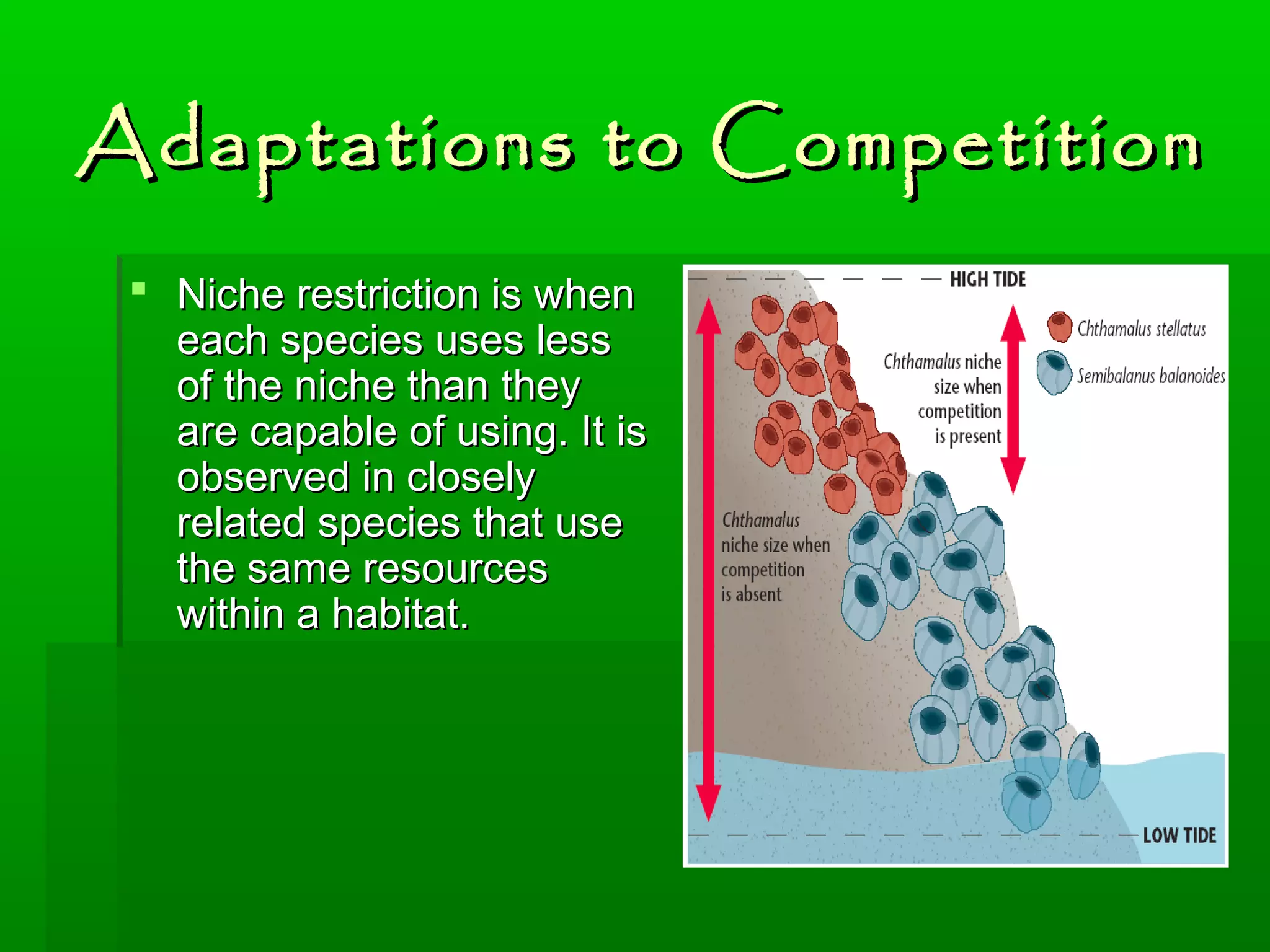
Adaptations to CompetitionAdaptations to Competition
 Niche restriction is whenNiche restriction is when
each species uses lesseach species uses less
of the niche than theyof the niche than they
are capable of using. It isare capable of using. It is
observed in closelyobserved in closely
related species that userelated species that use
the same resourcesthe same resources
within a habitat.within a habitat.
PredationPredation
 PredationPredation is anis an
interaction between twointeraction between two
species in which onespecies in which one
species, the predator,species, the predator,
feeds on the otherfeeds on the other
species, the prey.species, the prey.
 In complex food webs, aIn complex food webs, a
predator may also be thepredator may also be the
prey of another species.prey of another species.
PredatorsPredators
 Some predators eat only specific types of prey. In thisSome predators eat only specific types of prey. In this
kind of close relationship, the sizes of each populationkind of close relationship, the sizes of each population
tend to increase and decrease in linked patterns, astend to increase and decrease in linked patterns, as
shown below.shown below.
ParasitismParasitism
 ParasitismParasitism is a relationship between two species, theis a relationship between two species, the
parasite, benefits from the other species, the host, andparasite, benefits from the other species, the host, and
usually harms the host.usually harms the host.
 Examples:Examples:
ticksticks
fleasfleas
tapewormstapeworms
bloodsucking leechesbloodsucking leeches
ParasitismParasitism
 The differences between a parasite and a predator areThe differences between a parasite and a predator are
that a parasite spends some of its life in or on the host,that a parasite spends some of its life in or on the host,
and that the parasites do not usually kill their hosts.and that the parasites do not usually kill their hosts.
 However, the host is often weakened or exposed toHowever, the host is often weakened or exposed to
disease by the parasite.disease by the parasite.
MutualismMutualism
 Many species depend onMany species depend on
another species foranother species for
survival. In some cases,survival. In some cases,
neither organism canneither organism can
survive alone.survive alone.
 MutualismMutualism is ais a
relationship between tworelationship between two
species in which bothspecies in which both
species benefit.species benefit.
CommensalismCommensalism
 CommensalismCommensalism is ais a
relationship between tworelationship between two
organisms in which oneorganisms in which one
organism benefits andorganism benefits and
the other in unaffected.the other in unaffected.
SymbiosisSymbiosis
 SymbiosisSymbiosis is a relationship in which two differentis a relationship in which two different
organisms live in close association with each other.organisms live in close association with each other.
 Symbiosis is most often used to describe a relationshipSymbiosis is most often used to describe a relationship
in which at least one species benefits.in which at least one species benefits.
CoevolutionCoevolution
 Overtime, species in close relationships mayOvertime, species in close relationships may coevolvecoevolve..
These species may evolve adaptations that reduce theThese species may evolve adaptations that reduce the
harm or improve the benefit of the relationship.harm or improve the benefit of the relationship.
ReferencesReferences
 www.unitedstreaming.comwww.unitedstreaming.com
 Holt Environmental ScienceHolt Environmental Science
 http://www.physicalgeography.net/fundamentals/images/bee_flower.jpghttp://www.physicalgeography.net/fundamentals/images/bee_flower.jpg
 http://www.cs.umbc.edu/201/fall06/projects/p1/fox-http://www.cs.umbc.edu/201/fall06/projects/p1/fox-
rabbit.jpg&imgrefurlrabbit.jpg&imgrefurl
 http://64.143.176.9/library/healthguide/en-http://64.143.176.9/library/healthguide/en-
us/images/media/medical/hw/h9991388_001.jpg&imgrefurlus/images/media/medical/hw/h9991388_001.jpg&imgrefurl
 http://www.geology.iupui.edu/academics/CLASSES/g130/reefs/imhttp://www.geology.iupui.edu/academics/CLASSES/g130/reefs/im
ages/f1523th.gif&imgrefurlages/f1523th.gif&imgrefurl
 http://king.portlandschools.org/files/houses/y7/animalmaineia/files/http://king.portlandschools.org/files/houses/y7/animalmaineia/files/
species/coyotebq/Ecology/Commensalism.jpg&imgrefurlspecies/coyotebq/Ecology/Commensalism.jpg&imgrefurl
 http://www.clemson.edu/public/scbg/images/birds_nest.jpg&imgrefhttp://www.clemson.edu/public/scbg/images/birds_nest.jpg&imgref
urlurl
 http://farm4.static.flickr.com/3142/2743531144_a7464a0ba6.jpghttp://farm4.static.flickr.com/3142/2743531144_a7464a0ba6.jpg
%3Fv%3D0&imgrefurl%3Fv%3D0&imgrefurl

Species Interactions

  • 1.
  • 2.
  • 3.
    ObjectivesObjectives  DescribeDescribe thefive major types of interactions betweenthe five major types of interactions between species.species.  ExplainExplain the difference between parasitism andthe difference between parasitism and predation.predation.  ExplainExplain how symbiotic relationships may evolve.how symbiotic relationships may evolve.
  • 4.
  • 5.
    Ways in WhichSpeciesWays in Which Species InteractInteract  Interactions between species are categorized at theInteractions between species are categorized at the level where one population interacts with another.level where one population interacts with another.  The five major types of species interactions are:The five major types of species interactions are: • CompetitionCompetition • PredationPredation • ParasitismParasitism • MutualismMutualism • CommensalismCommensalism
  • 6.
  • 7.
    Ways in WhichSpeciesWays in Which Species InteractInteract  These categories are based on whether each speciesThese categories are based on whether each species causes benefit or harm to the other species in a givencauses benefit or harm to the other species in a given relationships in terms of total effects over time.relationships in terms of total effects over time.
  • 8.
    CompetitionCompetition  CompetitionCompetition isthe relationship between two speciesis the relationship between two species (or individuals) in which both species (or individuals)(or individuals) in which both species (or individuals) attempt to use the same limited resource such thatattempt to use the same limited resource such that both are negatively affected by the relationship.both are negatively affected by the relationship.  Members of the same species must compete with eachMembers of the same species must compete with each other because they require the same resources.other because they require the same resources.  When members of different species compete eachWhen members of different species compete each species uses some of the same resources in a habitat.species uses some of the same resources in a habitat.
  • 9.
    Adaptations to CompetitionAdaptationsto Competition  Niche restriction is whenNiche restriction is when each species uses lesseach species uses less of the niche than theyof the niche than they are capable of using. It isare capable of using. It is observed in closelyobserved in closely related species that userelated species that use the same resourcesthe same resources within a habitat.within a habitat.
  • 10.
    PredationPredation  PredationPredation isanis an interaction between twointeraction between two species in which onespecies in which one species, the predator,species, the predator, feeds on the otherfeeds on the other species, the prey.species, the prey.  In complex food webs, aIn complex food webs, a predator may also be thepredator may also be the prey of another species.prey of another species.
  • 11.
    PredatorsPredators  Some predatorseat only specific types of prey. In thisSome predators eat only specific types of prey. In this kind of close relationship, the sizes of each populationkind of close relationship, the sizes of each population tend to increase and decrease in linked patterns, astend to increase and decrease in linked patterns, as shown below.shown below.
  • 12.
    ParasitismParasitism  ParasitismParasitism isa relationship between two species, theis a relationship between two species, the parasite, benefits from the other species, the host, andparasite, benefits from the other species, the host, and usually harms the host.usually harms the host.  Examples:Examples: ticksticks fleasfleas tapewormstapeworms bloodsucking leechesbloodsucking leeches
  • 13.
    ParasitismParasitism  The differencesbetween a parasite and a predator areThe differences between a parasite and a predator are that a parasite spends some of its life in or on the host,that a parasite spends some of its life in or on the host, and that the parasites do not usually kill their hosts.and that the parasites do not usually kill their hosts.  However, the host is often weakened or exposed toHowever, the host is often weakened or exposed to disease by the parasite.disease by the parasite.
  • 14.
    MutualismMutualism  Many speciesdepend onMany species depend on another species foranother species for survival. In some cases,survival. In some cases, neither organism canneither organism can survive alone.survive alone.  MutualismMutualism is ais a relationship between tworelationship between two species in which bothspecies in which both species benefit.species benefit.
  • 15.
    CommensalismCommensalism  CommensalismCommensalism isais a relationship between tworelationship between two organisms in which oneorganisms in which one organism benefits andorganism benefits and the other in unaffected.the other in unaffected.
  • 16.
    SymbiosisSymbiosis  SymbiosisSymbiosis isa relationship in which two differentis a relationship in which two different organisms live in close association with each other.organisms live in close association with each other.  Symbiosis is most often used to describe a relationshipSymbiosis is most often used to describe a relationship in which at least one species benefits.in which at least one species benefits.
  • 17.
    CoevolutionCoevolution  Overtime, speciesin close relationships mayOvertime, species in close relationships may coevolvecoevolve.. These species may evolve adaptations that reduce theThese species may evolve adaptations that reduce the harm or improve the benefit of the relationship.harm or improve the benefit of the relationship.
  • 18.
    ReferencesReferences  www.unitedstreaming.comwww.unitedstreaming.com  HoltEnvironmental ScienceHolt Environmental Science  http://www.physicalgeography.net/fundamentals/images/bee_flower.jpghttp://www.physicalgeography.net/fundamentals/images/bee_flower.jpg  http://www.cs.umbc.edu/201/fall06/projects/p1/fox-http://www.cs.umbc.edu/201/fall06/projects/p1/fox- rabbit.jpg&imgrefurlrabbit.jpg&imgrefurl  http://64.143.176.9/library/healthguide/en-http://64.143.176.9/library/healthguide/en- us/images/media/medical/hw/h9991388_001.jpg&imgrefurlus/images/media/medical/hw/h9991388_001.jpg&imgrefurl  http://www.geology.iupui.edu/academics/CLASSES/g130/reefs/imhttp://www.geology.iupui.edu/academics/CLASSES/g130/reefs/im ages/f1523th.gif&imgrefurlages/f1523th.gif&imgrefurl  http://king.portlandschools.org/files/houses/y7/animalmaineia/files/http://king.portlandschools.org/files/houses/y7/animalmaineia/files/ species/coyotebq/Ecology/Commensalism.jpg&imgrefurlspecies/coyotebq/Ecology/Commensalism.jpg&imgrefurl  http://www.clemson.edu/public/scbg/images/birds_nest.jpg&imgrefhttp://www.clemson.edu/public/scbg/images/birds_nest.jpg&imgref urlurl  http://farm4.static.flickr.com/3142/2743531144_a7464a0ba6.jpghttp://farm4.static.flickr.com/3142/2743531144_a7464a0ba6.jpg %3Fv%3D0&imgrefurl%3Fv%3D0&imgrefurl