 
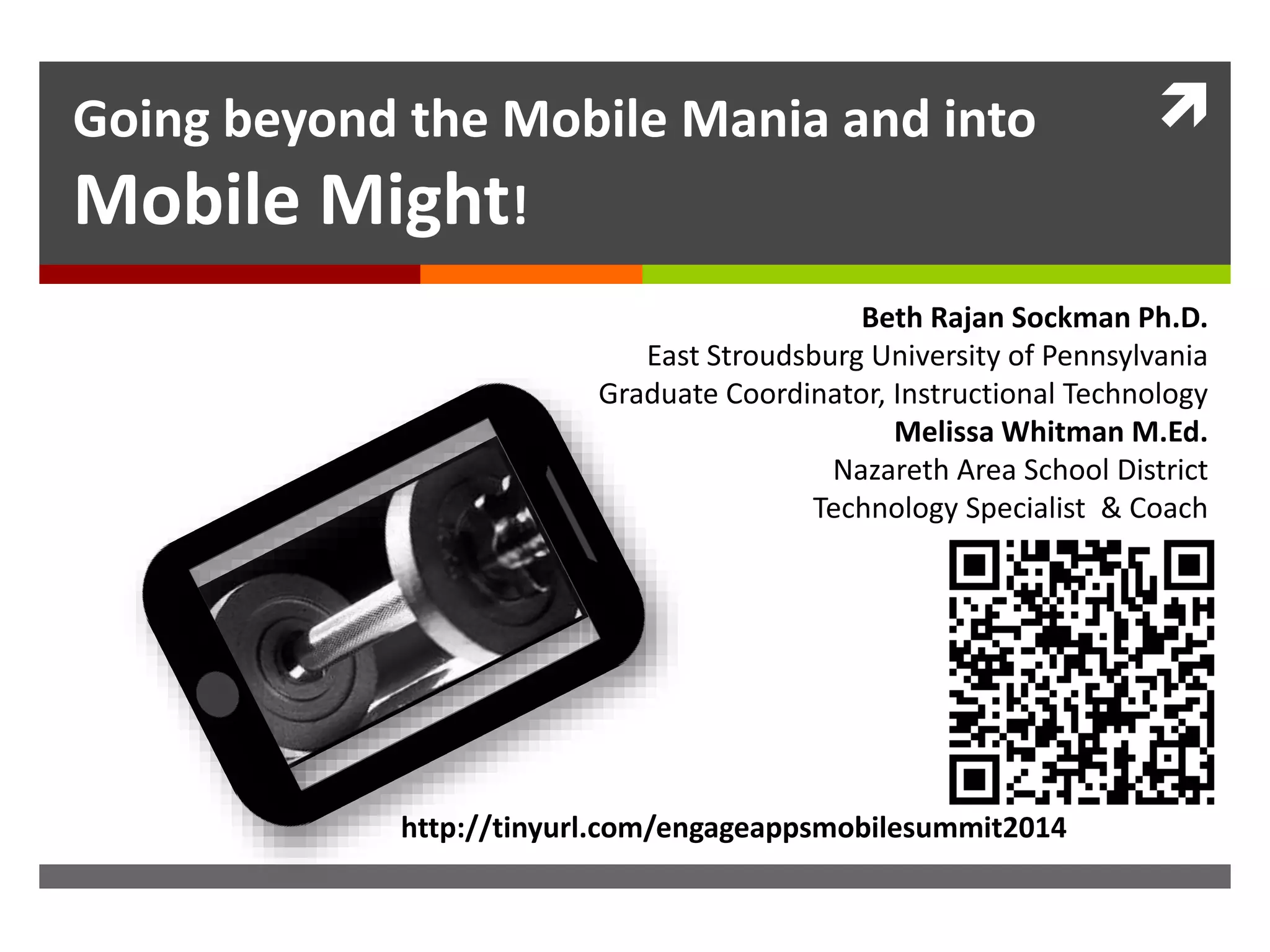
Going beyond the Mobile Mania and into 
Mobile Might! 
Beth Rajan Sockman Ph.D. 
East Stroudsburg University of Pennsylvania 
Graduate Coordinator, Instructional Technology 
Melissa Whitman M.Ed. 
Nazareth Area School District 
Technology Specialist & Coach 
http://tinyurl.com/engageappsmobilesummit2014
Take Aways (Goals) 
• Explain learner-centered and learning 
centered with value to education 
• Describe ways that you can increase 
engagement 
• Identify evaluation tools for Apps (to 
begin to look) for potential engagement & 
learning centeredness 
• Recognize strategies for engagement 
• 4 apps and use in a learner - centered way 
• Pinpoint key management tactics for the 
mobile devices for those apps or Web 2.0 
tools. 
QR code for Backchannel 
http://padlet.com/bsockman/ 
v44v98mxbath
 
What is the problem?
Most App use (Jahnke & Kumar, 2014) 
• Use of traditional classrooms - 
didactic-traditional 
teaching/instruction (most)
Most App use (Jahnke & Kumar, 2014) 
• Students get distracted 
with other things to do on 
devices (even visually 
more distractions!)
Most App use (Jahnke & Kumar, 2014) 
• Challenging for teachers to find the appropriate 
app or combination of apps
 What is learner centered? 
Why is it valuable?
Learner-Centered 
Evolved from Psychological principles 
• “teacher empathy (understanding), unconditional positive 
regard (warmth), genuineness (self-awareness), non-directivity 
(student-initiated and student-regulated activities) 
and the encouragement of critical thinking (as opposed to 
traditional memory emphasis)” (Cornelius-White, 2007) 
• Learner-centered model refers to a “perspective that couples a 
focus on individual learners . . . with a focus on learning” 
(McCombs & Whisler, 1997, p. 9 in Cornelius-White, 2007).
Difference (ACOT 1995) 
	 
Traditional		 Extended	Knowledge	 
Construction	 
Activity	 Teacher	centered	and	 
didactic	 
Learner	centered-Interactive	 
Teacher	Role	 Fact	teller	and	expert	 Collaborator	and	sometimes	 
learner	 
Student	role	 Listener	learner	 Collaborator	and	sometimes	 
expert	 
Learning	emphasis	 Facts	and	replication	 Relationships	and	Inquiry	 
Concept	Knowledge	 Accumulation	 Transformation	 
Demonstration	of	Success	 Quantity	 Quality	 
Assessment	 Norm-referenced	and	 
multiple	choice	 
Criteria-referenced	and	 
performance	portfolios.	 
Technology	Use	 Seat	work	 Communication,	 
collaboration,	information	 
access	and	expression
 
Value 
Learner Centered = + correlated to behavior + cognitive outcomes = 
increased student participation 
> drop-out rates > resistant behavior 
Meta–analysis 
of Learner- 
Centered 
Instruction 
examined 119 
studies - 
355,325 
students 
(Cornelius- 
White, 2007)
 
What is Engagement?
Engagement? 
The Engaged Classroom - 
http://edglossary.org/student-engagement/ 
• “In education, student engagement refers to the degree of 
attention, curiosity, interest, optimism, and passion that students 
show when they are learning or being taught, which extends to the 
level of motivation they have to learn and progress in their 
education. Generally speaking, the concept of “student 
engagement” is predicated on the belief that learning improves 
when students are inquisitive, interested, or inspired,
Engagement? 
• …..and that learning tends to suffer when students are 
bored, dispassionate, disaffected, or otherwise 
“disengaged.” Stronger student engagement or improved 
student engagement are common instructional objectives 
expressed by educators.” 
The Engaged Classroom - 
http://edglossary.org/student-engagement/
 
Recognizing Engagement…
How can you recognize 
engagement? 
• In the engaged classroom you will observe that all students are 
authentically engaged at least some of the time or that most 
students are authentically engaged most of the time. Passive 
compliance and retreatism is rarely observed and rebellion is non-existent. 
- from http://www.readinghorizons.com/blog/seven-ways-to- 
increase-student-engagement-in-the-classroom
5 Levels of Engagement 
Rebellion 
Retreatism 
Passive 
Compliance 
Ritual 
Compliance 
Authentic 
Engagement 
5 Levels of students engagement - based on Schlechty (2002) - from 
http://www.readinghorizons.com/blog/seven-ways-to-increase-student-engagement- 
in-the-classroom
 
Ways that you can increase 
engagement …
Increase Engagement! 
• Academic 
Intellectual 
• SOCIAL 
(ASCD - http://www.ascd.org/publications/educational-leadership/ 
sept95/vol53/num01/Strengthening-Student-Engagement@- 
What-Do-Students-Want.aspx)
Increase Engagement - Academic 
• SKILLS: Just in time learning - 
to the individual differentiate 
& customization 
• AUTHENTIC- Real world 
tasks- engaging tasks - creativity - 
individual Expression & individual 
Design 
(ASCD - http://www.ascd.org/publications/educational-leadership/ 
sept95/vol53/num01/Strengthening-Student-Engagement@- 
What-Do-Students-Want.aspx)
Increase Engagement – Social 
• SOCIAL aspects 
• Personal attention from the 
teacher 
• Attention from other students 
(ASCD - http://www.ascd.org/publications/educational-leadership/ 
sept95/vol53/num01/Strengthening-Student-Engagement@- 
What-Do-Students-Want.aspx)
 How do you purposefully use apps 
for engagement?
Why Mobile? Not this….
Tools for App evaluation for learner 
centeredness - SCALE 
Academic - Intellectual : Authentic - 
engaging tasks 
• Skills Applications - Content Driven 
• Remembering, understanding, applying, analyzing, evaluating : Just in time 
learning - to the individual (skills), just in time learning, individualization or 
customization 
• Creation Applications - Used across many content areas. Real world tasks-engaging 
tasks - creativity - individual Expression & individual Design 
Management - SOCIAL aspects 
• Feedback & Assessment 
• Personal attention from the teacher 
• Attention from other students 
• Hardware/Software
Rubric to Evaluate Different tools 
for App evaluation (BEFORE USE) 
• Content Based App’s _ Kathy Shrock 
http://www.ipads4teaching.net/uploads/3/9/2/2/392267/evalipad_content.pdf 
• Creation Based Apps _ Kathy Shrock-http:// 
www.ipads4teaching.net/uploads/3/9/2/2/392267/evalipad_creation.pdf 
• General App Evaluation Rubrics 
SKILL 
Creation APPS 
• http://static.squarespace.com/static/50eca855e4b0939ae8bb12d9/50ecb58ee4b0b16f176a9e7d/ 
50ecb593e4b0b16f176aa974/1330908312793/Vincent-App-Rubric.pdf 
• http://www.edudemic.com/app-review-rubric/ 
• http://eskillslearning.net/uploads/Selection%20Rubric_Scoring%20Rubric.pdf 
• http://www.ipads4teaching.net/uploads/3/9/2/2/392267/walker_rubric_2012.pdf 
• Using Guiding Questions - 
https://ipad2educate.wikispaces.com/file/view/iPad%20Evaluation%20Questions.pdf 
• Report Card - https://www.appolearning.com/report_card 
• Student App review - https://docs.google.com/file/d/0BzJdStH5bG1sdlM3MUdUbVRfcms/edit
App for Engagement Assessment 
• http://tinyurl.com/engageapps
Engagement Checklist - Background
Engagement Checklist – Skills App
Engagement Checklist – Creation App
Engagement Checklist – Social - Feedback
Engagement Checklist – Organization
 
APPs
Manage & 
Assess 
Socrative let’s a user interact and engage 
learners while assessing through short 
quizzes, student paced or teacher paced to 
evaluate learning!
Padlet 
QR code for Backchannel 
http://padlet.com/bsockman/v44v98mxbath
Discuss & Engage 
Padlet allows a user to post a thought, comment 
or more, anonymously or by name to a 
discussion question or brainstorming board. It 
also allows for media and image posts to really 
make responses impactful. It brings the shy 
student out of the corner and equal with the rest 
of the class.
Assistive & Individualized 
PaperPort Notes allows immediate notetaking 
on PDFs, web images, documents and more 
using typing, writing or through voice and 
shared back through various media!
Create & Evaluate 
Educanon takes showing videos in the 
classroom to a higher learning level, as you 
stop a video, ask a question to assess the 
learning and keep going! Interactive Video-unleashed 
with evaluative results!
Create & 
Have Fun Sock puppets lets a 
user create a story 
with virtual sock 
puppets to bring a 
story alive.
APP review - Go over the following for 
each app 
• Skills Applications 
• Creation Applications 
• Academic - Intellectual : Authentic - engaging tasks 
• SOCIAL aspects 
• Feedback & Assessment 
• Personal attention from the teacher 
• Attention from other students 
• Organization
Images – Thank you for the use! 
• https://www.flickr.com/photos/mott/3926331434/ 
• https://www.flickr.com/photos/michaelgallagher/8 
589166885/in/photostream/ 
• http://blog.calicospanish.com/2013/11/05/7- 
questions-you-should-be-asking-about-language-speaking- 
assessments.html
References 
• Blackwell, L. B., Trzesniewski, K. H., & Dweck, C. S. (2007). Implicit theories of intelligence predict achievement across an 
adolescent transition: A longitudinal study and an intervention. Child Development, 78(1), 246-263. 
• Cornelius-White, J. (2007). Learner-centered teacher-centered relationships are effective: A meta-analysis. Review of 
Educational Research, 77(1), 113-143. 
• Donovan, S. M., & Bransford, J. D. (2005). Chapter 6: The Design of Learning Environments. How Students Learn: History, 
Mathematics, Science in the Classroom. Retrieved April 24, 2006, from http://newton.nap.edu/html/howpeople1/ch6.html 
• Gardner, H. (1999). Multiple approaches to learning. In C. M. Reigeluth (Ed.), Instructional-design theories and models: A new 
paradigm of instructional theory (Vol. 2, pp. 69-90). Mahwah, NJ: Lawrence Erlbaum Associates, Publishers. 
• Jahnke, I., & Kumar, S. (2014). Digital Didactical Designs: Teachers’ Integration of iPads for Learning-Centered Processes. Journal 
of Digital Learning in Teacher Education, 30(3), 81-88. doi: 10.1080/21532974.2014.891876 
• Jonassen. (1999). Designing constructivist learning environments. In C. M. Reigeluth (Ed.), Instructional theories and models: A 
new paradigm of instructional design (Vol. 2, pp. 215-240). Mahwah, NJ: Lawrence Elbalum Associates, Publishers. 
• Joyce, H. (2007). The world is getting smarter. Retrieved September 25, 2011, from http://moreintelligentlife.com/story/the-world- 
is-getting-smarter 
• Oliver, K., Kellogg, S., Townsend, L., & Brady, K. (2010). Needs of elementary and middle school teachers developing online 
courses for a virtual school. Distance Education, 31(1), 55-75. doi: 10.1080/01587911003725022 
• Patrick, S., Edwards, D., Watson, J., & Wicks, M. (2012). National Quality Standards: Measuring quality from inputs to Outcomes: 
creating student learning performance metrics and quality assurance for online schools. http://www.inacol.org/wp-content/ 
uploads/2012/11/iNACOL_Quality_Metrics.pdf 
• Prensky, M. (2013). Our brains extended. Educational Leadership, 70(6), 22-27. 
• Thomas, K., & O'Bannon, B. (2013). Cell phones in the classroom: Preservice teachers' perceptions. Journal of Digital Learning in 
Teacher Education, 30(1), 11-20. 
• Tomlinson, C. A., & McTighe, J. (2006). What really matters in teaching? Integrating Differentiated Instruction and 
Understanding by Design: Connecting Content and Kids. Retrieved April 24, 2006, from 
http://www.joinup.org/ascdexpress/sample/teaching.asp?code=X5S071
 
May you all stay engaged! 
QR code for Backchannel 
http://padlet.com/bsockman/ 
v44v98mxbath

Going beyond the Mobile Mania and into Mobile Might!

  • 1.
     Going beyondthe Mobile Mania and into Mobile Might! Beth Rajan Sockman Ph.D. East Stroudsburg University of Pennsylvania Graduate Coordinator, Instructional Technology Melissa Whitman M.Ed. Nazareth Area School District Technology Specialist & Coach http://tinyurl.com/engageappsmobilesummit2014
  • 2.
    Take Aways (Goals) • Explain learner-centered and learning centered with value to education • Describe ways that you can increase engagement • Identify evaluation tools for Apps (to begin to look) for potential engagement & learning centeredness • Recognize strategies for engagement • 4 apps and use in a learner - centered way • Pinpoint key management tactics for the mobile devices for those apps or Web 2.0 tools. QR code for Backchannel http://padlet.com/bsockman/ v44v98mxbath
  • 3.
     What isthe problem?
  • 4.
    Most App use(Jahnke & Kumar, 2014) • Use of traditional classrooms - didactic-traditional teaching/instruction (most)
  • 5.
    Most App use(Jahnke & Kumar, 2014) • Students get distracted with other things to do on devices (even visually more distractions!)
  • 6.
    Most App use(Jahnke & Kumar, 2014) • Challenging for teachers to find the appropriate app or combination of apps
  • 7.
     What islearner centered? Why is it valuable?
  • 8.
    Learner-Centered Evolved fromPsychological principles • “teacher empathy (understanding), unconditional positive regard (warmth), genuineness (self-awareness), non-directivity (student-initiated and student-regulated activities) and the encouragement of critical thinking (as opposed to traditional memory emphasis)” (Cornelius-White, 2007) • Learner-centered model refers to a “perspective that couples a focus on individual learners . . . with a focus on learning” (McCombs & Whisler, 1997, p. 9 in Cornelius-White, 2007).
  • 9.
    Difference (ACOT 1995) Traditional Extended Knowledge Construction Activity Teacher centered and didactic Learner centered-Interactive Teacher Role Fact teller and expert Collaborator and sometimes learner Student role Listener learner Collaborator and sometimes expert Learning emphasis Facts and replication Relationships and Inquiry Concept Knowledge Accumulation Transformation Demonstration of Success Quantity Quality Assessment Norm-referenced and multiple choice Criteria-referenced and performance portfolios. Technology Use Seat work Communication, collaboration, information access and expression
  • 10.
     Value LearnerCentered = + correlated to behavior + cognitive outcomes = increased student participation > drop-out rates > resistant behavior Meta–analysis of Learner- Centered Instruction examined 119 studies - 355,325 students (Cornelius- White, 2007)
  • 11.
     What isEngagement?
  • 12.
    Engagement? The EngagedClassroom - http://edglossary.org/student-engagement/ • “In education, student engagement refers to the degree of attention, curiosity, interest, optimism, and passion that students show when they are learning or being taught, which extends to the level of motivation they have to learn and progress in their education. Generally speaking, the concept of “student engagement” is predicated on the belief that learning improves when students are inquisitive, interested, or inspired,
  • 13.
    Engagement? • …..andthat learning tends to suffer when students are bored, dispassionate, disaffected, or otherwise “disengaged.” Stronger student engagement or improved student engagement are common instructional objectives expressed by educators.” The Engaged Classroom - http://edglossary.org/student-engagement/
  • 14.
  • 15.
    How can yourecognize engagement? • In the engaged classroom you will observe that all students are authentically engaged at least some of the time or that most students are authentically engaged most of the time. Passive compliance and retreatism is rarely observed and rebellion is non-existent. - from http://www.readinghorizons.com/blog/seven-ways-to- increase-student-engagement-in-the-classroom
  • 16.
    5 Levels ofEngagement Rebellion Retreatism Passive Compliance Ritual Compliance Authentic Engagement 5 Levels of students engagement - based on Schlechty (2002) - from http://www.readinghorizons.com/blog/seven-ways-to-increase-student-engagement- in-the-classroom
  • 18.
     Ways thatyou can increase engagement …
  • 19.
    Increase Engagement! •Academic Intellectual • SOCIAL (ASCD - http://www.ascd.org/publications/educational-leadership/ sept95/vol53/num01/Strengthening-Student-Engagement@- What-Do-Students-Want.aspx)
  • 20.
    Increase Engagement -Academic • SKILLS: Just in time learning - to the individual differentiate & customization • AUTHENTIC- Real world tasks- engaging tasks - creativity - individual Expression & individual Design (ASCD - http://www.ascd.org/publications/educational-leadership/ sept95/vol53/num01/Strengthening-Student-Engagement@- What-Do-Students-Want.aspx)
  • 22.
    Increase Engagement –Social • SOCIAL aspects • Personal attention from the teacher • Attention from other students (ASCD - http://www.ascd.org/publications/educational-leadership/ sept95/vol53/num01/Strengthening-Student-Engagement@- What-Do-Students-Want.aspx)
  • 23.
     How doyou purposefully use apps for engagement?
  • 24.
  • 25.
    Tools for Appevaluation for learner centeredness - SCALE Academic - Intellectual : Authentic - engaging tasks • Skills Applications - Content Driven • Remembering, understanding, applying, analyzing, evaluating : Just in time learning - to the individual (skills), just in time learning, individualization or customization • Creation Applications - Used across many content areas. Real world tasks-engaging tasks - creativity - individual Expression & individual Design Management - SOCIAL aspects • Feedback & Assessment • Personal attention from the teacher • Attention from other students • Hardware/Software
  • 26.
    Rubric to EvaluateDifferent tools for App evaluation (BEFORE USE) • Content Based App’s _ Kathy Shrock http://www.ipads4teaching.net/uploads/3/9/2/2/392267/evalipad_content.pdf • Creation Based Apps _ Kathy Shrock-http:// www.ipads4teaching.net/uploads/3/9/2/2/392267/evalipad_creation.pdf • General App Evaluation Rubrics SKILL Creation APPS • http://static.squarespace.com/static/50eca855e4b0939ae8bb12d9/50ecb58ee4b0b16f176a9e7d/ 50ecb593e4b0b16f176aa974/1330908312793/Vincent-App-Rubric.pdf • http://www.edudemic.com/app-review-rubric/ • http://eskillslearning.net/uploads/Selection%20Rubric_Scoring%20Rubric.pdf • http://www.ipads4teaching.net/uploads/3/9/2/2/392267/walker_rubric_2012.pdf • Using Guiding Questions - https://ipad2educate.wikispaces.com/file/view/iPad%20Evaluation%20Questions.pdf • Report Card - https://www.appolearning.com/report_card • Student App review - https://docs.google.com/file/d/0BzJdStH5bG1sdlM3MUdUbVRfcms/edit
  • 27.
    App for EngagementAssessment • http://tinyurl.com/engageapps
  • 28.
  • 29.
  • 30.
  • 31.
    Engagement Checklist –Social - Feedback
  • 32.
  • 33.
  • 34.
    Manage & Assess Socrative let’s a user interact and engage learners while assessing through short quizzes, student paced or teacher paced to evaluate learning!
  • 35.
    Padlet QR codefor Backchannel http://padlet.com/bsockman/v44v98mxbath
  • 36.
    Discuss & Engage Padlet allows a user to post a thought, comment or more, anonymously or by name to a discussion question or brainstorming board. It also allows for media and image posts to really make responses impactful. It brings the shy student out of the corner and equal with the rest of the class.
  • 37.
    Assistive & Individualized PaperPort Notes allows immediate notetaking on PDFs, web images, documents and more using typing, writing or through voice and shared back through various media!
  • 38.
    Create & Evaluate Educanon takes showing videos in the classroom to a higher learning level, as you stop a video, ask a question to assess the learning and keep going! Interactive Video-unleashed with evaluative results!
  • 39.
    Create & HaveFun Sock puppets lets a user create a story with virtual sock puppets to bring a story alive.
  • 40.
    APP review -Go over the following for each app • Skills Applications • Creation Applications • Academic - Intellectual : Authentic - engaging tasks • SOCIAL aspects • Feedback & Assessment • Personal attention from the teacher • Attention from other students • Organization
  • 42.
    Images – Thankyou for the use! • https://www.flickr.com/photos/mott/3926331434/ • https://www.flickr.com/photos/michaelgallagher/8 589166885/in/photostream/ • http://blog.calicospanish.com/2013/11/05/7- questions-you-should-be-asking-about-language-speaking- assessments.html
  • 43.
    References • Blackwell,L. B., Trzesniewski, K. H., & Dweck, C. S. (2007). Implicit theories of intelligence predict achievement across an adolescent transition: A longitudinal study and an intervention. Child Development, 78(1), 246-263. • Cornelius-White, J. (2007). Learner-centered teacher-centered relationships are effective: A meta-analysis. Review of Educational Research, 77(1), 113-143. • Donovan, S. M., & Bransford, J. D. (2005). Chapter 6: The Design of Learning Environments. How Students Learn: History, Mathematics, Science in the Classroom. Retrieved April 24, 2006, from http://newton.nap.edu/html/howpeople1/ch6.html • Gardner, H. (1999). Multiple approaches to learning. In C. M. Reigeluth (Ed.), Instructional-design theories and models: A new paradigm of instructional theory (Vol. 2, pp. 69-90). Mahwah, NJ: Lawrence Erlbaum Associates, Publishers. • Jahnke, I., & Kumar, S. (2014). Digital Didactical Designs: Teachers’ Integration of iPads for Learning-Centered Processes. Journal of Digital Learning in Teacher Education, 30(3), 81-88. doi: 10.1080/21532974.2014.891876 • Jonassen. (1999). Designing constructivist learning environments. In C. M. Reigeluth (Ed.), Instructional theories and models: A new paradigm of instructional design (Vol. 2, pp. 215-240). Mahwah, NJ: Lawrence Elbalum Associates, Publishers. • Joyce, H. (2007). The world is getting smarter. Retrieved September 25, 2011, from http://moreintelligentlife.com/story/the-world- is-getting-smarter • Oliver, K., Kellogg, S., Townsend, L., & Brady, K. (2010). Needs of elementary and middle school teachers developing online courses for a virtual school. Distance Education, 31(1), 55-75. doi: 10.1080/01587911003725022 • Patrick, S., Edwards, D., Watson, J., & Wicks, M. (2012). National Quality Standards: Measuring quality from inputs to Outcomes: creating student learning performance metrics and quality assurance for online schools. http://www.inacol.org/wp-content/ uploads/2012/11/iNACOL_Quality_Metrics.pdf • Prensky, M. (2013). Our brains extended. Educational Leadership, 70(6), 22-27. • Thomas, K., & O'Bannon, B. (2013). Cell phones in the classroom: Preservice teachers' perceptions. Journal of Digital Learning in Teacher Education, 30(1), 11-20. • Tomlinson, C. A., & McTighe, J. (2006). What really matters in teaching? Integrating Differentiated Instruction and Understanding by Design: Connecting Content and Kids. Retrieved April 24, 2006, from http://www.joinup.org/ascdexpress/sample/teaching.asp?code=X5S071
  • 44.
     May youall stay engaged! QR code for Backchannel http://padlet.com/bsockman/ v44v98mxbath