Lab#5: Predator Prey Interaction
Asian University For Women
BIOL/ENVS 3003: ECOLOGY (Lab)
Fall 2022
Syed Mohammad Lokman
Instructor
Asian University for Women
BIOL/ENVS 3003: ECOLOGY (Lab) Syed Mohammad Lokman (syed.lokman@auw.edu.bd)
Objectives:
● To understand the basic concept of Prey-Predator dynamics using the
established Mathematical model of Lotka-Volterra Equations, i.e., how
predators affect prey populations, and vice-versa.
BIOL/ENVS 3003: ECOLOGY (Lab) Syed Mohammad Lokman (syed.lokman@auw.edu.bd)
Predator-Prey Relationship
● The predator-prey relationship is substantial in maintaining the equilibrium
between various animal species.
● Without predators, certain species of prey would force other species to
extinction as a result of competition.
● Without prey, there would be no predators! The key feature of predation
thus is the predator's direct impact on the prey population.
BIOL/ENVS 3003: ECOLOGY (Lab) Syed Mohammad Lokman (syed.lokman@auw.edu.bd)
Predator-Prey Relationship
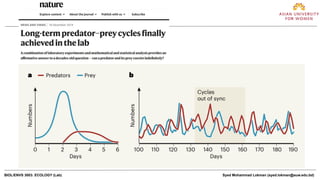
● Many studies on the population ecology of predators have demonstrated
that predator numbers rise-and-fall cyclically with those of their
preferred prey - albeit that there is a synchronicity between the populations.
● This scenario -- where the predator populations crash shortly after their
prey populations experience a crash; this is known as predator-prey
cycle.
BIOL/ENVS 3003: ECOLOGY (Lab) Syed Mohammad Lokman (syed.lokman@auw.edu.bd)
Predator-Prey Relationship
BIOL/ENVS 3003: ECOLOGY (Lab) Syed Mohammad Lokman (syed.lokman@auw.edu.bd)
Predator-Prey Relationship
BIOL/ENVS 3003: ECOLOGY (Lab) Syed Mohammad Lokman (syed.lokman@auw.edu.bd)
Lotka−Volterra Equations
● In order to simulate these dynamics, Mathematical models need to be
incorporated.
● The population dynamics of predator-prey interactions can be modeled
using the Lotka−Volterra equations, which is based on differential
equations.
BIOL/ENVS 3003: ECOLOGY (Lab) Syed Mohammad Lokman (syed.lokman@auw.edu.bd)
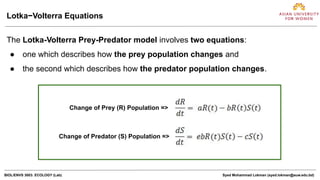
The Lotka-Volterra Prey-Predator model involves two equations:
● one which describes how the prey population changes and
● the second which describes how the predator population changes.
Lotka−Volterra Equations
Change of Prey (R) Population =>
Change of Predator (S) Population =>
BIOL/ENVS 3003: ECOLOGY (Lab) Syed Mohammad Lokman (syed.lokman@auw.edu.bd)
Lotka−Volterra Equations
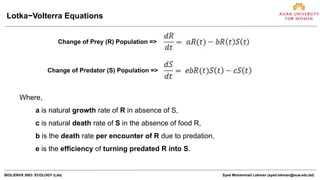
Change of Prey (R) Population =>
Change of Predator (S) Population =>
Where,
a is natural growth rate of R in absence of S,
c is natural death rate of S in the absence of food R,
b is the death rate per encounter of R due to predation,
e is the efficiency of turning predated R into S.
BIOL/ENVS 3003: ECOLOGY (Lab) Syed Mohammad Lokman (syed.lokman@auw.edu.bd)
Lotka−Volterra Equations
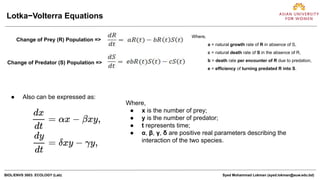
Change of Prey (R) Population =>
Change of Predator (S) Population =>
Where,
a = natural growth rate of R in absence of S,
c = natural death rate of S in the absence of R,
b = death rate per encounter of R due to predation,
e = efficiency of turning predated R into S.
● Also can be expressed as:
Where,
● x is the number of prey;
● y is the number of predator;
● t represents time;
● α, β, γ, δ are positive real parameters describing the
interaction of the two species.
BIOL/ENVS 3003: ECOLOGY (Lab) Syed Mohammad Lokman (syed.lokman@auw.edu.bd)
To simplify the complexity of the Dynamic models being studied,
we make some (unrealistic) assumptions:
● The predator species is totally dependent on a single prey
species as its only food supply,
● The prey species has an unlimited food supply and
● There is no threat to the prey other than the specific predator.
Lotka−Volterra Equations
BIOL/ENVS 3003: ECOLOGY (Lab) Syed Mohammad Lokman (syed.lokman@auw.edu.bd)
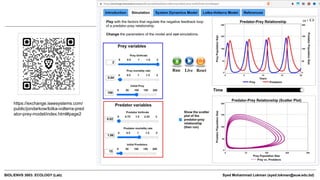
https://exchange.iseesystems.com/
public/jondarkow/lotka-volterra-pred
ator-prey-model/index.html#page2
BIOL/ENVS 3003: ECOLOGY (Lab) Syed Mohammad Lokman (syed.lokman@auw.edu.bd)
Exercise
Lab#5: Predator Prey Interaction