By: Zeinab M. Klaab
Submitted to: Dr. Mai Elobeid
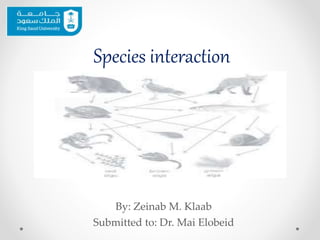
Species interaction
2- Types of Species
interactions
1-Introduction
Types of Species interactions
Neutralism
Competition
Amensalism
symbiotic
relationships
Antagonism
Introduction
 In ecology, a biological interaction is the effect
that a pair of organisms living together in a
community have on each other.
•Ecologists call relationships between
species in a community interspecific
interactions , inter-means "between.“
Between
species
•Relationships between same species
called intraspecific interactions, intra-
means “inside or within”.
Same
species
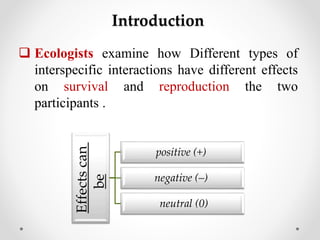
 Ecologists examine how Different types of
interspecific interactions have different effects
on survival and reproduction the two
participants .
Effectscan
be
positive (+)
negative (–)
neutral (0)
Introduction
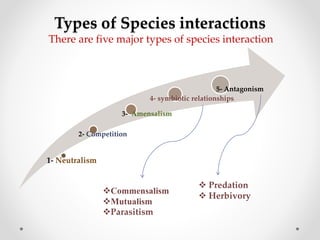
Types of Species interactions
There are five major types of species interaction
1- Neutralism
2- Competition
3- Amensalism
4- symbiotic relationships
5- Antagonism
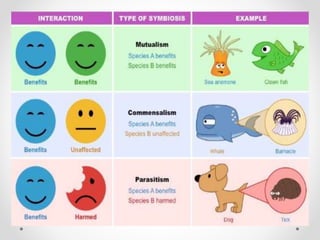
Commensalism
Mutualism
Parasitism
 Predation
 Herbivory
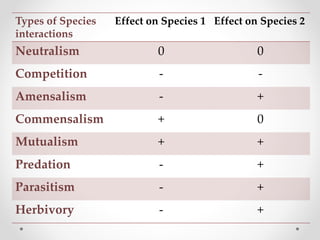
Effect on Species 2Effect on Species 1Types of Species
interactions
00Neutralism
--Competition
+-Amensalism
0+Commensalism
++Mutualism
+-Predation
+-Parasitism
+-Herbivory
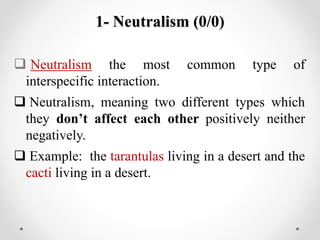
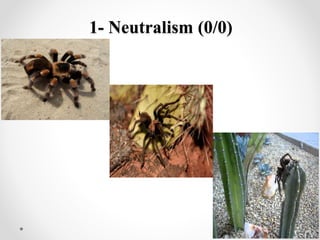
1- Neutralism (0/0)
 Neutralism the most common type of
interspecific interaction.
 Neutralism, meaning two different types which
they don’t affect each other positively neither
negatively.
 Example: the tarantulas living in a desert and the
cacti living in a desert.
1- Neutralism (0/0)
2- Competition (-/-)
 Competition occurs when organisms in the same
community require the same limiting resource.
This resource may be prey, water, light, nutrients,
etc.
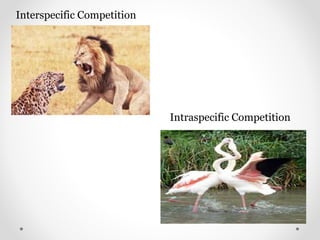
 Competition among members of the same species
is intraspecific.
 Competition among individuals of different
species is interspecific.
Interspecific Competition
Intraspecific Competition
Factors that can make a species strong
competitive are:
1- Aggression behavioral where one species
remove the other.
2- High production rate.
3- Disease tolerance.
4- Big success in finding food, home and
mating.
5- More ability in using working relations.
2- Competition (-/-)
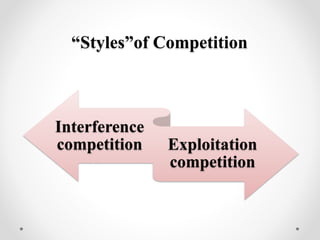
“Styles”of Competition
Interference
competition Exploitation
competition
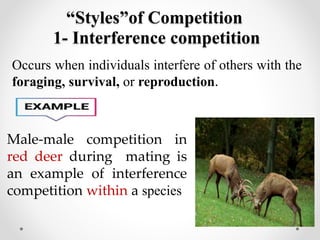
1- Interference competition
Occurs when individuals interfere of others with the
foraging, survival, or reproduction.
Male-male competition in
red deer during mating is
an example of interference
competition within a species
“Styles”of Competition
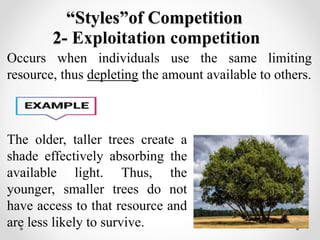
2- Exploitation competition
Occurs when individuals use the same limiting
resource, thus depleting the amount available to others.
The older, taller trees create a
shade effectively absorbing the
available light. Thus, the
younger, smaller trees do not
have access to that resource and
are less likely to survive.
“Styles”of Competition
Resource Dividing
Competition may cause the exclusion of one species,
but does not always. They may coexist, with a
decrease in their potential for growth.
For this to occur, they must division the resource through
different ways:
1. Use only portions of resources
2- Use at different times
3. Use in different ways
For example: Some birds eat
the same insects, but look for
them in different places.
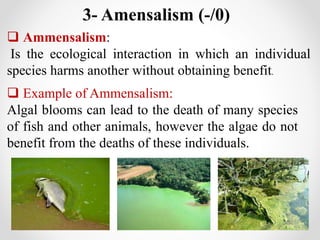
3- Amensalism (-/0)
 Ammensalism:
Is the ecological interaction in which an individual
species harms another without obtaining benefit.
 Example of Ammensalism:
Algal blooms can lead to the death of many species
of fish and other animals, however the algae do not
benefit from the deaths of these individuals.
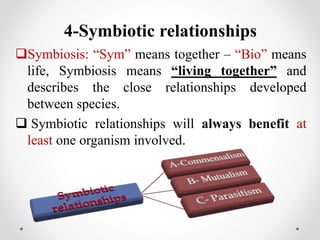
4-Symbiotic relationships
Symbiosis: “Sym” means together – “Bio” means
life, Symbiosis means “living together” and
describes the close relationships developed
between species.
 Symbiotic relationships will always benefit at
least one organism involved.
A- Commensalism (+/0)
Commensalism:
Is an interspecific interaction where one species
benefits and the other is unaffected.
Commensalisms found everywhere in nature: birds
nesting in trees are commensal.
Examples of Commensalism
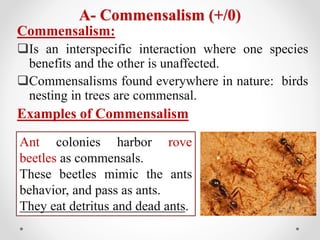
Ant colonies harbor rove
beetles as commensals.
These beetles mimic the ants
behavior, and pass as ants.
They eat detritus and dead ants.
B- Mutualism (+/+)
 Mutualism is a type of symbiosis describes any
relationship between two organisms or more (a host
and a symbiont) where both benefit in some way.
 Mutualisms are widespread in nature, and occur
among many different types of organisms.
There are two main types of mutualistic
relationships:
1. Obligate mutualism
2. Facultative mutualism.
Obligate mutualism
In obligate mutualism, one organism cannot survive
without the other.
 An example of obligate mutualism is the relationship
between ants and the Acacia plant. The plant provides
food for the ant, as well as shelter. In return, the ants
defend the plant from other herbivores
Facultative mutualism
In facultative mutualism, each organism can survive
independently, but it benefits both to remain together.
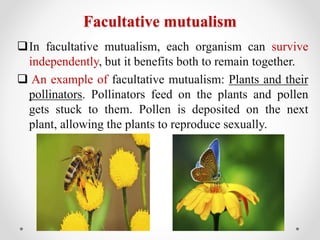
 An example of facultative mutualism: Plants and their
pollinators. Pollinators feed on the plants and pollen
gets stuck to them. Pollen is deposited on the next
plant, allowing the plants to reproduce sexually.
C- Parasitism (- /+)
The relationship between the parasite and the host causing
it some harm , but do not usually kill hosts..
Parasitism is thought to be the most common way of life
Kinds of Parasitism based on place of presence of parasite:
 Ectoparasites: Parasites that live on the surface of the host
(e.g. some mites).
 Endoparasite: live inside the host (e.g. all parasitic worms)
5- Antagonism (+/-)
In antagonistic interaction one species benefits at the
expense of another.
One way of understanding the diversity of antagonistic
interactions is through the kinds of hosts or prey that
species attack.
Carnivores attack animals, herbivores attack plants, and
fungivores attack fungi. Other species are omnivorous
attacking a wide range of plants, animals, and fungi.
Antagonism
Herbivory Predation
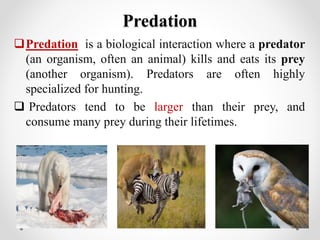
Predation
Predation is a biological interaction where a predator
(an organism, often an animal) kills and eats its prey
(another organism). Predators are often highly
specialized for hunting.
 Predators tend to be larger than their prey, and
consume many prey during their lifetimes.
Camouflage
It helps animals hide from predators and catch prey
This built-in protection is key to surviving in the wild.
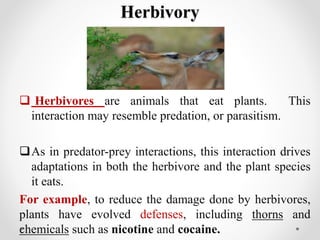
Herbivory
 Herbivores are animals that eat plants. This
interaction may resemble predation, or parasitism.
As in predator-prey interactions, this interaction drives
adaptations in both the herbivore and the plant species
it eats.
For example, to reduce the damage done by herbivores,
plants have evolved defenses, including thorns and
chemicals such as nicotine and cocaine.
Species interaction  between organism.

Species interaction between organism.

  • 1.
    By: Zeinab M.Klaab Submitted to: Dr. Mai Elobeid Species interaction
  • 2.
    2- Types ofSpecies interactions 1-Introduction
  • 3.
    Types of Speciesinteractions Neutralism Competition Amensalism symbiotic relationships Antagonism
  • 4.
    Introduction  In ecology,a biological interaction is the effect that a pair of organisms living together in a community have on each other. •Ecologists call relationships between species in a community interspecific interactions , inter-means "between.“ Between species •Relationships between same species called intraspecific interactions, intra- means “inside or within”. Same species
  • 5.
     Ecologists examinehow Different types of interspecific interactions have different effects on survival and reproduction the two participants . Effectscan be positive (+) negative (–) neutral (0) Introduction
  • 6.
    Types of Speciesinteractions There are five major types of species interaction 1- Neutralism 2- Competition 3- Amensalism 4- symbiotic relationships 5- Antagonism Commensalism Mutualism Parasitism  Predation  Herbivory
  • 7.
    Effect on Species2Effect on Species 1Types of Species interactions 00Neutralism --Competition +-Amensalism 0+Commensalism ++Mutualism +-Predation +-Parasitism +-Herbivory
  • 8.
    1- Neutralism (0/0) Neutralism the most common type of interspecific interaction.  Neutralism, meaning two different types which they don’t affect each other positively neither negatively.  Example: the tarantulas living in a desert and the cacti living in a desert.
  • 9.
  • 10.
    2- Competition (-/-) Competition occurs when organisms in the same community require the same limiting resource. This resource may be prey, water, light, nutrients, etc.  Competition among members of the same species is intraspecific.  Competition among individuals of different species is interspecific.
  • 11.
  • 12.
    Factors that canmake a species strong competitive are: 1- Aggression behavioral where one species remove the other. 2- High production rate. 3- Disease tolerance. 4- Big success in finding food, home and mating. 5- More ability in using working relations. 2- Competition (-/-)
  • 13.
  • 14.
    1- Interference competition Occurswhen individuals interfere of others with the foraging, survival, or reproduction. Male-male competition in red deer during mating is an example of interference competition within a species “Styles”of Competition
  • 15.
    2- Exploitation competition Occurswhen individuals use the same limiting resource, thus depleting the amount available to others. The older, taller trees create a shade effectively absorbing the available light. Thus, the younger, smaller trees do not have access to that resource and are less likely to survive. “Styles”of Competition
  • 16.
    Resource Dividing Competition maycause the exclusion of one species, but does not always. They may coexist, with a decrease in their potential for growth. For this to occur, they must division the resource through different ways: 1. Use only portions of resources 2- Use at different times 3. Use in different ways For example: Some birds eat the same insects, but look for them in different places.
  • 17.
    3- Amensalism (-/0) Ammensalism: Is the ecological interaction in which an individual species harms another without obtaining benefit.  Example of Ammensalism: Algal blooms can lead to the death of many species of fish and other animals, however the algae do not benefit from the deaths of these individuals.
  • 18.
    4-Symbiotic relationships Symbiosis: “Sym”means together – “Bio” means life, Symbiosis means “living together” and describes the close relationships developed between species.  Symbiotic relationships will always benefit at least one organism involved.
  • 19.
    A- Commensalism (+/0) Commensalism: Isan interspecific interaction where one species benefits and the other is unaffected. Commensalisms found everywhere in nature: birds nesting in trees are commensal. Examples of Commensalism Ant colonies harbor rove beetles as commensals. These beetles mimic the ants behavior, and pass as ants. They eat detritus and dead ants.
  • 20.
    B- Mutualism (+/+) Mutualism is a type of symbiosis describes any relationship between two organisms or more (a host and a symbiont) where both benefit in some way.  Mutualisms are widespread in nature, and occur among many different types of organisms. There are two main types of mutualistic relationships: 1. Obligate mutualism 2. Facultative mutualism.
  • 21.
    Obligate mutualism In obligatemutualism, one organism cannot survive without the other.  An example of obligate mutualism is the relationship between ants and the Acacia plant. The plant provides food for the ant, as well as shelter. In return, the ants defend the plant from other herbivores
  • 22.
    Facultative mutualism In facultativemutualism, each organism can survive independently, but it benefits both to remain together.  An example of facultative mutualism: Plants and their pollinators. Pollinators feed on the plants and pollen gets stuck to them. Pollen is deposited on the next plant, allowing the plants to reproduce sexually.
  • 23.
    C- Parasitism (-/+) The relationship between the parasite and the host causing it some harm , but do not usually kill hosts.. Parasitism is thought to be the most common way of life Kinds of Parasitism based on place of presence of parasite:  Ectoparasites: Parasites that live on the surface of the host (e.g. some mites).  Endoparasite: live inside the host (e.g. all parasitic worms)
  • 25.
    5- Antagonism (+/-) Inantagonistic interaction one species benefits at the expense of another. One way of understanding the diversity of antagonistic interactions is through the kinds of hosts or prey that species attack. Carnivores attack animals, herbivores attack plants, and fungivores attack fungi. Other species are omnivorous attacking a wide range of plants, animals, and fungi.
  • 26.
  • 27.
    Predation Predation is abiological interaction where a predator (an organism, often an animal) kills and eats its prey (another organism). Predators are often highly specialized for hunting.  Predators tend to be larger than their prey, and consume many prey during their lifetimes.
  • 28.
    Camouflage It helps animalshide from predators and catch prey This built-in protection is key to surviving in the wild.
  • 29.
    Herbivory  Herbivores areanimals that eat plants. This interaction may resemble predation, or parasitism. As in predator-prey interactions, this interaction drives adaptations in both the herbivore and the plant species it eats. For example, to reduce the damage done by herbivores, plants have evolved defenses, including thorns and chemicals such as nicotine and cocaine.