Community Interactions
Community Interactions Powerfully affect an ecosystem Include: Competition Predation Symbiosis Herbivory Disease
 
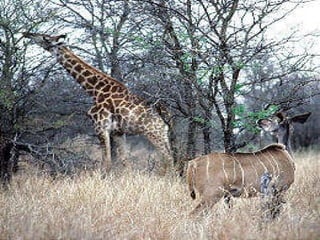
Interspecific Competition When organisms of the same or different species attempt to use an ecological resource at the same place and the same time Resource   any necessity to life Plants and animals compete Winner and losers Grass hoppers and bison Lynx and fox
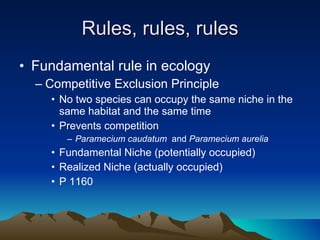
Rules, rules, rules Fundamental rule in ecology Competitive Exclusion Principle No two species can occupy the same niche in the same habitat and the same time Prevents competition Paramecium caudatum  and  Paramecium aurelia Fundamental Niche (potentially occupied) Realized Niche (actually occupied) P 1160
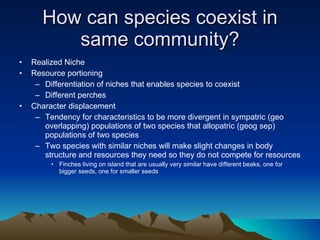
How can species coexist in same community? Realized Niche Resource portioning Differentiation of niches that enables species to coexist Different perches Character displacement Tendency for characteristics to be more divergent in sympatric (geo overlapping) populations of two species that allopatric (geog sep) populations of two species Two species with similar niches will make slight changes in body structure and resources they need so they do not compete for resources Finches living on island that are usually very similar have different beaks, one for bigger seeds, one for smaller seeds


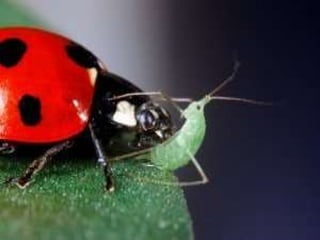
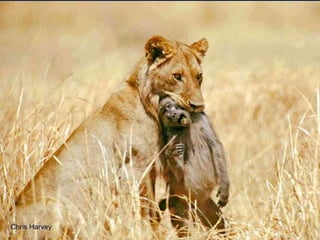
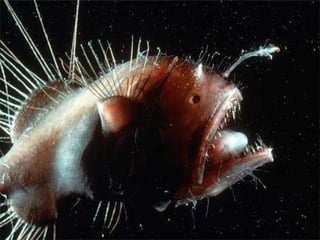
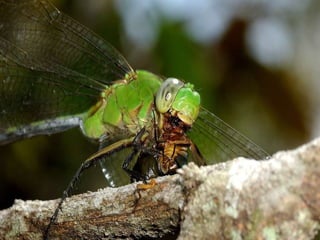
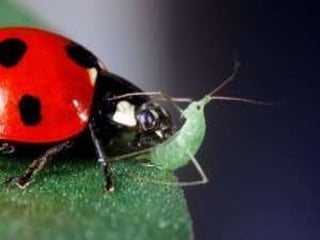
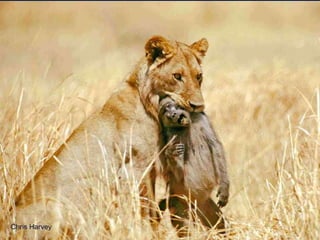
Predation Interaction where an organism captures and feeds on another organism (+/-) Predator Organism that does the killing and eating Prey Organism that is being killed and eaten (victim)
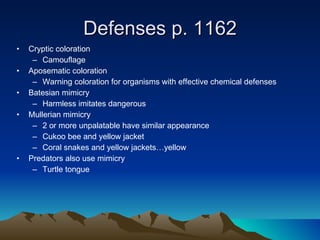
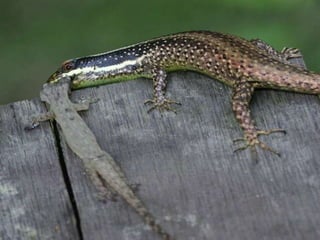
Defenses p. 1162 Cryptic coloration Camouflage  Aposematic coloration Warning coloration for organisms with effective chemical defenses Batesian mimicry Harmless imitates dangerous Mullerian mimicry 2 or more unpalatable have similar appearance Cukoo bee and yellow jacket Coral snakes and yellow jackets…yellow  Predators also use mimicry Turtle tongue


Herbivory When a herbivore eats plant or algae (+/-) Large mammals, small invertebrates (insects), marine organisms (sea urchins, snails, fish) Toxic and nontoxic plants Chemical sensors olfactory Specialized teeth and digestive systems Plants defenses Toxins: tannins, nicotine, strychnine Not harmful to humans
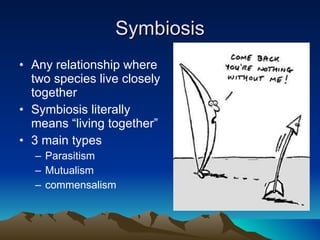
Symbiosis Any relationship where two species live closely together  Symbiosis literally means “living together” 3 main types Parasitism Mutualism commensalism
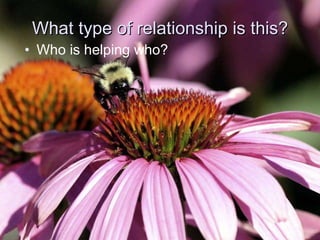
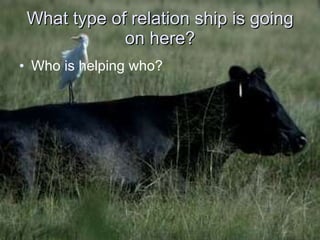
What type of relationship is this? Who is helping who?
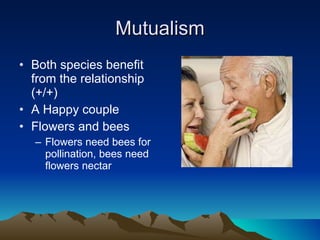
Mutualism Both species benefit from the relationship (+/+) A Happy couple Flowers and bees Flowers need bees for pollination, bees need flowers nectar
 
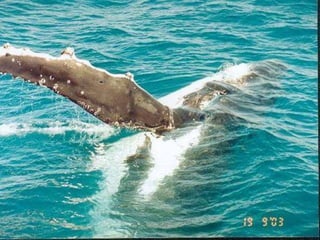
Commensalism One member of the relationship benefits while the other is neither harmed nor helped (+/0) One-sided Food or shelter Barnacles on whale
 
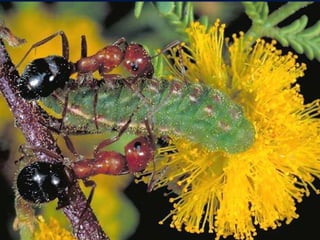
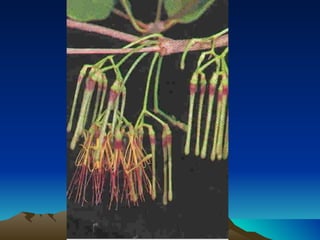
What type of relation ship is going on here? Who is helping who?
 
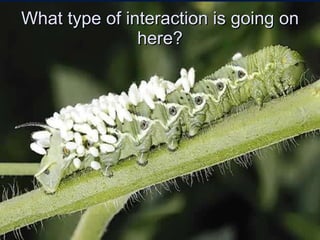
What type of interaction is going on here?
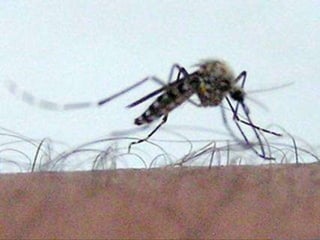
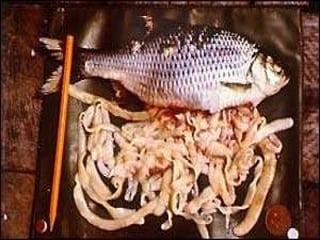
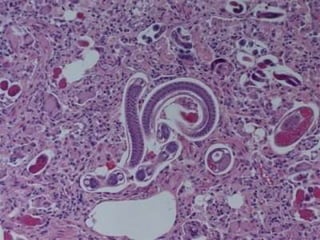
Parasitism One organism lives on or inside another organism and harms it (+/-) Endoparasitism Ectoparasitim Parasitoidism Usually large and multicellular Parasite obtains all or part of its nutrients from the other organism Host Organism that is harmed in relation ship; the one that provides the nutrients to the parasite Parasite Organism that gets its nutrients from the host Do they want to kill their host? No, because they need them…mostly annoying


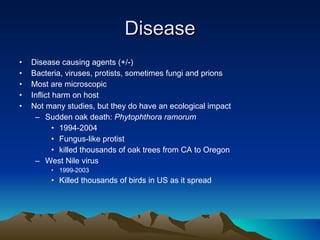
Disease Disease causing agents (+/-) Bacteria, viruses, protists, sometimes fungi and prions Most are microscopic Inflict harm on host Not many studies, but they do have an ecological impact Sudden oak death:  Phytophthora ramorum  1994-2004 Fungus-like protist killed thousands of oak trees from CA to Oregon West Nile virus 1999-2003 Killed thousands of birds in US as it spread
 
Recap What are the three types of interactions in a community? Competition Predation Herbivory Disease Symbiosis What types do we have? Mutualism Commensalism Parasitism
Interspecific Interactions and Adaptation Coevolution Reciprocal evolutionary adaptations of 2 interacting species Genetic change in one sp. influences genetic change in another sp. Ex. Gene-for-gene recognition in plant and pathogen Aposematic coloration and predators reactions NOT coevolution Across multiple species, not 2 linked population Current hypothesis is that Predation and competition are key factors that control community structure and drive community dynamics Base on temperate and not tropical communities Hypothesis is being challenged
Species Diversity Variety of different organisms in a community…dependent on both: Species richness Total # of diff. sp in comm. Relative abundance Portion each sp represent of the total individuals in comm. Example Forest 1 and forest 2, 100 individual Forest 1 Tree  A  25% Tree B 25% Tree C 25% Tree D 25% Forest 2 Tree A 80% Tree B 5% Tree C 5% Tree D 10% Forest 1 is  more diverse,  even thought both contain 4 types of trees…
Limits on Food Webs Charles Elton 1920 Oxford Biologist Food chains are not isolated units but linked in food web Each food chain in food web is only a few links long…most hardly more than 5 links from any producer to top-level consumer
Why are they short? 2 hypotheses Energetic Hypothesis  Food chain limited by inefficiency of energy transfer along chain (10%) Longer in habitats of high photosynthetic productivity Dynamic Stability Hypothesis Long chains less stable than short ones Longer chains have harder time recovering from setbacks like harsh winter, especially at the higher-level Shorter chains in unpredictable environments Another possibility for short food chains Animals tend to be larger at successive trophic levels (except parasites) Size of animal and feeding mechanism put limit on food it can put in its mouth  Mostly, large carnivores cannot live on small organisms because they cannot get sufficent energy from them Exception is  baleen whales
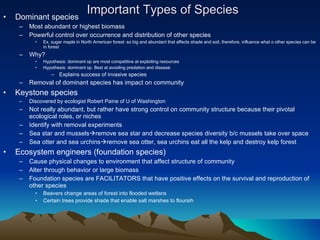
Important Types of Species Dominant species Most abundant or highest biomass Powerful control over occurrence and distribution of other species Ex, sugar maple in North American forest: so big and abundant that affects shade and soil, therefore, influence what o other species can be in forest Why? Hypothesis: dominant sp are most competitive at exploiting resources Hypothesis: dominant sp. Best at avoiding predation and disease Explains success of invasive species Removal of dominant species has impact on community Keystone species Discovered by ecologist Robert Paine of U of Washington Not really abundant, but rather have strong control on community structure because their pivotal ecological roles, or niches Identify with removal experiments Sea star and mussels  remove sea star and decrease species diversity b/c mussels take over space Sea otter and sea urchins  remove sea otter, sea urchins eat all the kelp and destroy kelp forest Ecosystem engineers (foundation species) Cause physical changes to environment that affect structure of community Alter through behavior or large biomass Foundation species are FACILITATORS that have positive effects on the survival and reproduction of other species Beavers change areas of forest into flooded wetlans Certain trees provide shade that enable salt marshes to floursih
Ecological Succession Do all ecosystems stay the same all the time? What are some things that cause changes to ecosystems? Natural and unnatural Quickly and slowly
Ecosystems are constantly changing in response to human  and natural disturbances.  As an ecosystem changes, older habitants die out and new organisms move in, causing more change
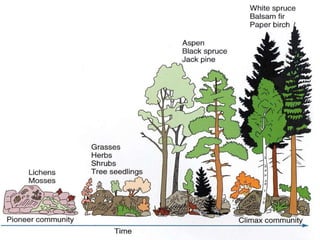
Ecological Succession Series of predictable changes that occur in a community over time Physical environment Natural disturbance Human disturbance
Intermediate Disturbance Hypothesis Moderate levels of disturbance can create conditions that foster greater species diversity than low or high levels of disturbance  High levels   wipe out species that are intolerable Low level   enable dominant species to take over
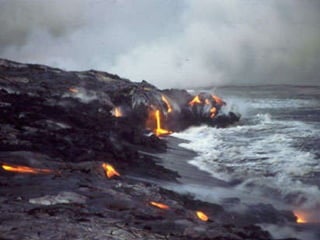
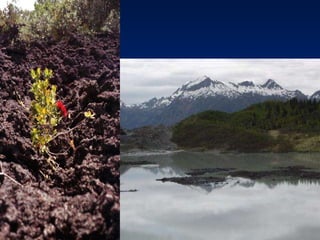
Primary Succession Succession on land that occurs on surfaces where no soil exists  Volcanic eruptions Glaciers melting  leveling moraine (bare rock)
 
 
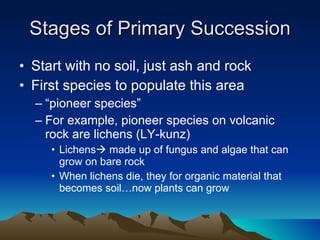
Stages of Primary Succession Start with no soil, just ash and rock First species to populate this area “ pioneer species” For example, pioneer species on volcanic rock are lichens (LY-kunz) Lichens   made up of fungus and algae that can grow on bare rock When lichens die, they for organic material that becomes soil…now plants can grow
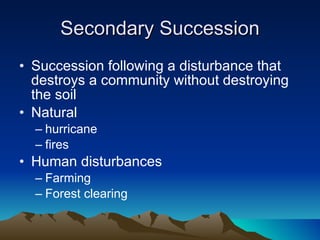
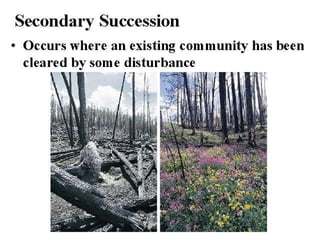
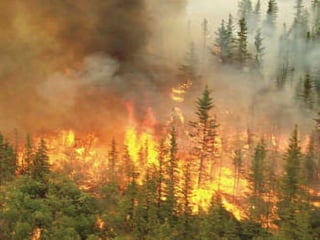
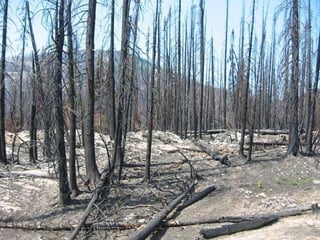
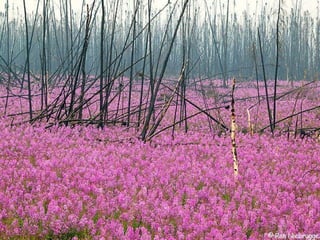
Secondary Succession Succession following a disturbance that destroys a community without destroying the soil Natural  hurricane fires Human disturbances Farming Forest clearing


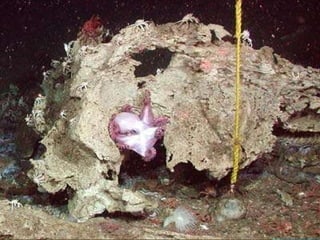
Succession in Marine Ecosystems Deep and dark Can succession happen? 1987 dead whale off of California Unique community of organisms living in remains Represents stage in succession in an otherwise stable, deep-sea ecosystem Whale-fall community
 
Whale-Fall Succession Begins when large whale dies Sinks to barren ocean floor Scavengers and decomposers flock to carcass , our first community Amphipods Hagfish sharks After a year, most tissues have been eaten Now, second small community of organisms live here Body is decomposing, releasing nutrients into the water Small fishes Crabs Snails worms Only skeleton remains… Third community moves in Heterotrophic bacteria Decompose oil in bones   release of chemical compounds Who uses these chemical compounds? Chemoosynthetic autotrophs In come the crabs, clams, and worms that feed on this bacteria
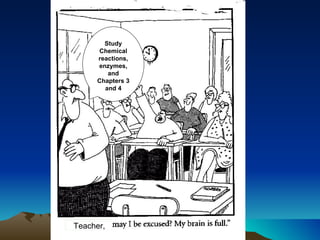
Teacher, Study Chemical reactions, enzymes, and Chapters 3 and 4

Community Interactions And Sucession

  • 1.
  • 2.
    Community Interactions Powerfullyaffect an ecosystem Include: Competition Predation Symbiosis Herbivory Disease
  • 3.
  • 4.
    Interspecific Competition Whenorganisms of the same or different species attempt to use an ecological resource at the same place and the same time Resource  any necessity to life Plants and animals compete Winner and losers Grass hoppers and bison Lynx and fox
  • 5.
    Rules, rules, rulesFundamental rule in ecology Competitive Exclusion Principle No two species can occupy the same niche in the same habitat and the same time Prevents competition Paramecium caudatum and Paramecium aurelia Fundamental Niche (potentially occupied) Realized Niche (actually occupied) P 1160
  • 6.
    How can speciescoexist in same community? Realized Niche Resource portioning Differentiation of niches that enables species to coexist Different perches Character displacement Tendency for characteristics to be more divergent in sympatric (geo overlapping) populations of two species that allopatric (geog sep) populations of two species Two species with similar niches will make slight changes in body structure and resources they need so they do not compete for resources Finches living on island that are usually very similar have different beaks, one for bigger seeds, one for smaller seeds
  • 7.
  • 8.
  • 9.
  • 10.
  • 11.
  • 12.
    Predation Interaction wherean organism captures and feeds on another organism (+/-) Predator Organism that does the killing and eating Prey Organism that is being killed and eaten (victim)
  • 13.
    Defenses p. 1162Cryptic coloration Camouflage Aposematic coloration Warning coloration for organisms with effective chemical defenses Batesian mimicry Harmless imitates dangerous Mullerian mimicry 2 or more unpalatable have similar appearance Cukoo bee and yellow jacket Coral snakes and yellow jackets…yellow Predators also use mimicry Turtle tongue
  • 14.
  • 15.
  • 16.
  • 17.
  • 18.
  • 19.
    Herbivory When aherbivore eats plant or algae (+/-) Large mammals, small invertebrates (insects), marine organisms (sea urchins, snails, fish) Toxic and nontoxic plants Chemical sensors olfactory Specialized teeth and digestive systems Plants defenses Toxins: tannins, nicotine, strychnine Not harmful to humans
  • 20.
    Symbiosis Any relationshipwhere two species live closely together Symbiosis literally means “living together” 3 main types Parasitism Mutualism commensalism
  • 21.
    What type ofrelationship is this? Who is helping who?
  • 22.
    Mutualism Both speciesbenefit from the relationship (+/+) A Happy couple Flowers and bees Flowers need bees for pollination, bees need flowers nectar
  • 23.
  • 24.
    Commensalism One memberof the relationship benefits while the other is neither harmed nor helped (+/0) One-sided Food or shelter Barnacles on whale
  • 25.
  • 26.
    What type ofrelation ship is going on here? Who is helping who?
  • 27.
  • 28.
    What type ofinteraction is going on here?
  • 29.
    Parasitism One organismlives on or inside another organism and harms it (+/-) Endoparasitism Ectoparasitim Parasitoidism Usually large and multicellular Parasite obtains all or part of its nutrients from the other organism Host Organism that is harmed in relation ship; the one that provides the nutrients to the parasite Parasite Organism that gets its nutrients from the host Do they want to kill their host? No, because they need them…mostly annoying
  • 30.
  • 31.
  • 32.
  • 33.
    Disease Disease causingagents (+/-) Bacteria, viruses, protists, sometimes fungi and prions Most are microscopic Inflict harm on host Not many studies, but they do have an ecological impact Sudden oak death: Phytophthora ramorum 1994-2004 Fungus-like protist killed thousands of oak trees from CA to Oregon West Nile virus 1999-2003 Killed thousands of birds in US as it spread
  • 34.
  • 35.
    Recap What arethe three types of interactions in a community? Competition Predation Herbivory Disease Symbiosis What types do we have? Mutualism Commensalism Parasitism
  • 36.
    Interspecific Interactions andAdaptation Coevolution Reciprocal evolutionary adaptations of 2 interacting species Genetic change in one sp. influences genetic change in another sp. Ex. Gene-for-gene recognition in plant and pathogen Aposematic coloration and predators reactions NOT coevolution Across multiple species, not 2 linked population Current hypothesis is that Predation and competition are key factors that control community structure and drive community dynamics Base on temperate and not tropical communities Hypothesis is being challenged
  • 37.
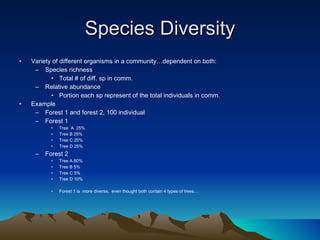
    Species Diversity Varietyof different organisms in a community…dependent on both: Species richness Total # of diff. sp in comm. Relative abundance Portion each sp represent of the total individuals in comm. Example Forest 1 and forest 2, 100 individual Forest 1 Tree A 25% Tree B 25% Tree C 25% Tree D 25% Forest 2 Tree A 80% Tree B 5% Tree C 5% Tree D 10% Forest 1 is more diverse, even thought both contain 4 types of trees…
  • 38.
    Limits on FoodWebs Charles Elton 1920 Oxford Biologist Food chains are not isolated units but linked in food web Each food chain in food web is only a few links long…most hardly more than 5 links from any producer to top-level consumer
  • 39.
    Why are theyshort? 2 hypotheses Energetic Hypothesis Food chain limited by inefficiency of energy transfer along chain (10%) Longer in habitats of high photosynthetic productivity Dynamic Stability Hypothesis Long chains less stable than short ones Longer chains have harder time recovering from setbacks like harsh winter, especially at the higher-level Shorter chains in unpredictable environments Another possibility for short food chains Animals tend to be larger at successive trophic levels (except parasites) Size of animal and feeding mechanism put limit on food it can put in its mouth Mostly, large carnivores cannot live on small organisms because they cannot get sufficent energy from them Exception is baleen whales
  • 40.
    Important Types ofSpecies Dominant species Most abundant or highest biomass Powerful control over occurrence and distribution of other species Ex, sugar maple in North American forest: so big and abundant that affects shade and soil, therefore, influence what o other species can be in forest Why? Hypothesis: dominant sp are most competitive at exploiting resources Hypothesis: dominant sp. Best at avoiding predation and disease Explains success of invasive species Removal of dominant species has impact on community Keystone species Discovered by ecologist Robert Paine of U of Washington Not really abundant, but rather have strong control on community structure because their pivotal ecological roles, or niches Identify with removal experiments Sea star and mussels  remove sea star and decrease species diversity b/c mussels take over space Sea otter and sea urchins  remove sea otter, sea urchins eat all the kelp and destroy kelp forest Ecosystem engineers (foundation species) Cause physical changes to environment that affect structure of community Alter through behavior or large biomass Foundation species are FACILITATORS that have positive effects on the survival and reproduction of other species Beavers change areas of forest into flooded wetlans Certain trees provide shade that enable salt marshes to floursih
  • 41.
    Ecological Succession Doall ecosystems stay the same all the time? What are some things that cause changes to ecosystems? Natural and unnatural Quickly and slowly
  • 42.
    Ecosystems are constantlychanging in response to human and natural disturbances. As an ecosystem changes, older habitants die out and new organisms move in, causing more change
  • 43.
    Ecological Succession Seriesof predictable changes that occur in a community over time Physical environment Natural disturbance Human disturbance
  • 44.
    Intermediate Disturbance HypothesisModerate levels of disturbance can create conditions that foster greater species diversity than low or high levels of disturbance High levels  wipe out species that are intolerable Low level  enable dominant species to take over
  • 45.
    Primary Succession Successionon land that occurs on surfaces where no soil exists Volcanic eruptions Glaciers melting leveling moraine (bare rock)
  • 46.
  • 47.
  • 48.
    Stages of PrimarySuccession Start with no soil, just ash and rock First species to populate this area “ pioneer species” For example, pioneer species on volcanic rock are lichens (LY-kunz) Lichens  made up of fungus and algae that can grow on bare rock When lichens die, they for organic material that becomes soil…now plants can grow
  • 49.
    Secondary Succession Successionfollowing a disturbance that destroys a community without destroying the soil Natural hurricane fires Human disturbances Farming Forest clearing
  • 50.
  • 51.
  • 52.
  • 53.
  • 54.
  • 55.
    Succession in MarineEcosystems Deep and dark Can succession happen? 1987 dead whale off of California Unique community of organisms living in remains Represents stage in succession in an otherwise stable, deep-sea ecosystem Whale-fall community
  • 56.
  • 57.
    Whale-Fall Succession Beginswhen large whale dies Sinks to barren ocean floor Scavengers and decomposers flock to carcass , our first community Amphipods Hagfish sharks After a year, most tissues have been eaten Now, second small community of organisms live here Body is decomposing, releasing nutrients into the water Small fishes Crabs Snails worms Only skeleton remains… Third community moves in Heterotrophic bacteria Decompose oil in bones  release of chemical compounds Who uses these chemical compounds? Chemoosynthetic autotrophs In come the crabs, clams, and worms that feed on this bacteria
  • 58.
    Teacher, Study Chemicalreactions, enzymes, and Chapters 3 and 4