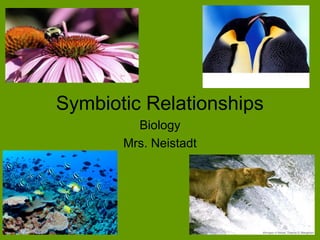
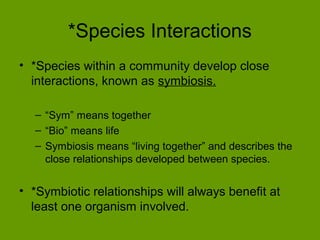
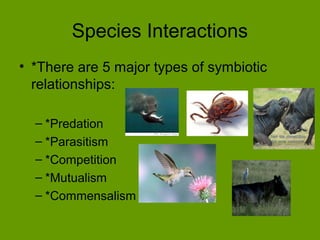
Symbiotic Relationships
         Biology
       Mrs. Neistadt
*Species Interactions
• *Species within a community develop close
  interactions, known as symbiosis.

   – “Sym” means together
   – “Bio” means life
   – Symbiosis means “living together” and describes the
     close relationships developed between species.


• *Symbiotic relationships will always benefit at
  least one organism involved.
Species Interactions
• *There are 5 major types of symbiotic
  relationships:

  – *Predation
  – *Parasitism
  – *Competition
  – *Mutualism
  – *Commensalism
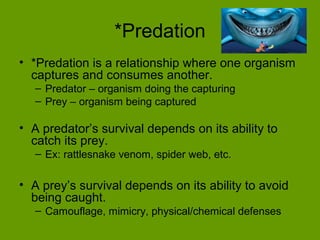
*Predation
• *Predation is a relationship where one organism
  captures and consumes another.
   – Predator – organism doing the capturing
   – Prey – organism being captured

• A predator’s survival depends on its ability to
  catch its prey.
   – Ex: rattlesnake venom, spider web, etc.

• A prey’s survival depends on its ability to avoid
  being caught.
   – Camouflage, mimicry, physical/chemical defenses
*Prey Defenses
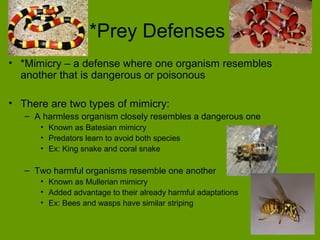
• *Mimicry – a defense where one organism resembles
  another that is dangerous or poisonous

• There are two types of mimicry:
   – A harmless organism closely resembles a dangerous one
      • Known as Batesian mimicry
      • Predators learn to avoid both species
      • Ex: King snake and coral snake

   – Two harmful organisms resemble one another
      • Known as Mullerian mimicry
      • Added advantage to their already harmful adaptations
      • Ex: Bees and wasps have similar striping
Prey Defenses
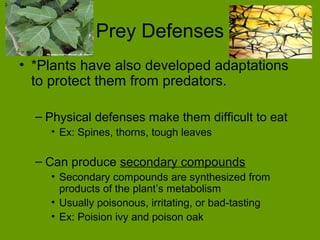
• *Plants have also developed adaptations
  to protect them from predators.

  – Physical defenses make them difficult to eat
    • Ex: Spines, thorns, tough leaves

  – Can produce secondary compounds
    • Secondary compounds are synthesized from
      products of the plant’s metabolism
    • Usually poisonous, irritating, or bad-tasting
    • Ex: Poision ivy and poison oak
*Parasitism
• *Parasitism – symbiotic relationship where
  one organism is harmed and the other is
  helped
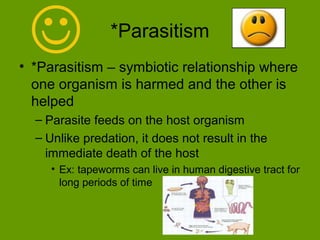
  – Parasite feeds on the host organism
  – Unlike predation, it does not result in the
    immediate death of the host
     • Ex: tapeworms can live in human digestive tract for
       long periods of time
Parasitism
• There are 2 different types of parasites:

  – Ectoparasites
     • External parasites – live on the outside of the host
     • Ex: ticks, fleas, mosquitoes


  – Endoparasites
     • Internal parasites – live inside the host’s body
     • Ex: bacteria, protists, tapeworms
*Competition
• *Competition – the use of the same limited
  resource by two or more species in the same
  place at the same time

  – Resource = anything necessity of life (water,
    nutrients, light, food, or space)


• Competition may cause the development of
  different niches or physical characteristics.
Competition
• Competitive Exclusion Principle
  – No two species can occupy the same niche in the same
    habitat at the same time
  – Ex: Paramecia
     • Two species of paramecia will thrive separately, but when put
       together, one species is eliminated
*Competition
• *Organisms may develop physical differences
  because of competition for resources.
• Character Displacement – evolution of anatomical
  differences that reduces competition
  – Happens most where ranges of competitors overlap

  – Ex: Darwin’s finches
     • Species found in separate locations have the same beak size
     • The same species found together have different beak sizes
         – allows them to feed on different seeds and reduces
           competition
Competition
• Organisms may develop differences in niches
  because of competition for resources.
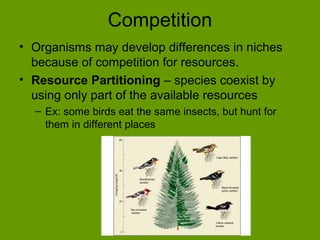
• Resource Partitioning – species coexist by
  using only part of the available resources
  – Ex: some birds eat the same insects, but hunt for
    them in different places
*Mutualism
• *Mutualism is a symbiotic relationship
  where both organisms are helped in some
  way.
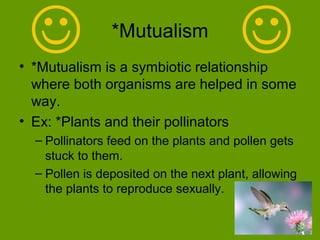
• Ex: *Plants and their pollinators
  – Pollinators feed on the plants and pollen gets
    stuck to them.
  – Pollen is deposited on the next plant, allowing
    the plants to reproduce sexually.
*Commensalism
• *Commensalism is a symbiotic
  relationship where one organism benefits
  and the second is neither harmed nor
  helped.

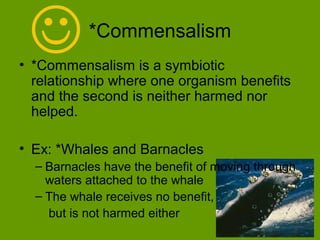
• Ex: *Whales and Barnacles
  – Barnacles have the benefit of moving through
    waters attached to the whale
  – The whale receives no benefit,
    but is not harmed either
Name the Symbiotic Relationship…
• A eagle hunting a mouse.
   – Predation
• A tick feeds on the blood of its host and may carry
  disease
   – Parasitism
• The flower lives on a tree and absorbs the water from
  runoff and the tree is unaffected.
   – Commensalism
• Two different types of finches feeding on seeds.
   – Competition
• An ant protects a caterpillar from predators and the
  caterpillar produces a sweet liquid for it to drink.
   – Mutualism

Ecology: Symbiotic Relationships

  • 1.
    Symbiotic Relationships Biology Mrs. Neistadt
  • 2.
    *Species Interactions • *Specieswithin a community develop close interactions, known as symbiosis. – “Sym” means together – “Bio” means life – Symbiosis means “living together” and describes the close relationships developed between species. • *Symbiotic relationships will always benefit at least one organism involved.
  • 3.
    Species Interactions • *Thereare 5 major types of symbiotic relationships: – *Predation – *Parasitism – *Competition – *Mutualism – *Commensalism
  • 4.
    *Predation • *Predation isa relationship where one organism captures and consumes another. – Predator – organism doing the capturing – Prey – organism being captured • A predator’s survival depends on its ability to catch its prey. – Ex: rattlesnake venom, spider web, etc. • A prey’s survival depends on its ability to avoid being caught. – Camouflage, mimicry, physical/chemical defenses
  • 5.
    *Prey Defenses • *Mimicry– a defense where one organism resembles another that is dangerous or poisonous • There are two types of mimicry: – A harmless organism closely resembles a dangerous one • Known as Batesian mimicry • Predators learn to avoid both species • Ex: King snake and coral snake – Two harmful organisms resemble one another • Known as Mullerian mimicry • Added advantage to their already harmful adaptations • Ex: Bees and wasps have similar striping
  • 6.
    Prey Defenses • *Plantshave also developed adaptations to protect them from predators. – Physical defenses make them difficult to eat • Ex: Spines, thorns, tough leaves – Can produce secondary compounds • Secondary compounds are synthesized from products of the plant’s metabolism • Usually poisonous, irritating, or bad-tasting • Ex: Poision ivy and poison oak
  • 7.
    *Parasitism • *Parasitism –symbiotic relationship where one organism is harmed and the other is helped – Parasite feeds on the host organism – Unlike predation, it does not result in the immediate death of the host • Ex: tapeworms can live in human digestive tract for long periods of time
  • 8.
    Parasitism • There are2 different types of parasites: – Ectoparasites • External parasites – live on the outside of the host • Ex: ticks, fleas, mosquitoes – Endoparasites • Internal parasites – live inside the host’s body • Ex: bacteria, protists, tapeworms
  • 9.
    *Competition • *Competition –the use of the same limited resource by two or more species in the same place at the same time – Resource = anything necessity of life (water, nutrients, light, food, or space) • Competition may cause the development of different niches or physical characteristics.
  • 10.
    Competition • Competitive ExclusionPrinciple – No two species can occupy the same niche in the same habitat at the same time – Ex: Paramecia • Two species of paramecia will thrive separately, but when put together, one species is eliminated
  • 11.
    *Competition • *Organisms maydevelop physical differences because of competition for resources. • Character Displacement – evolution of anatomical differences that reduces competition – Happens most where ranges of competitors overlap – Ex: Darwin’s finches • Species found in separate locations have the same beak size • The same species found together have different beak sizes – allows them to feed on different seeds and reduces competition
  • 12.
    Competition • Organisms maydevelop differences in niches because of competition for resources. • Resource Partitioning – species coexist by using only part of the available resources – Ex: some birds eat the same insects, but hunt for them in different places
  • 13.
    *Mutualism • *Mutualism isa symbiotic relationship where both organisms are helped in some way. • Ex: *Plants and their pollinators – Pollinators feed on the plants and pollen gets stuck to them. – Pollen is deposited on the next plant, allowing the plants to reproduce sexually.
  • 14.
    *Commensalism • *Commensalism isa symbiotic relationship where one organism benefits and the second is neither harmed nor helped. • Ex: *Whales and Barnacles – Barnacles have the benefit of moving through waters attached to the whale – The whale receives no benefit, but is not harmed either
  • 15.
    Name the SymbioticRelationship… • A eagle hunting a mouse. – Predation • A tick feeds on the blood of its host and may carry disease – Parasitism • The flower lives on a tree and absorbs the water from runoff and the tree is unaffected. – Commensalism • Two different types of finches feeding on seeds. – Competition • An ant protects a caterpillar from predators and the caterpillar produces a sweet liquid for it to drink. – Mutualism