Comic Creation  Beth Rajan Sockman PH.D.
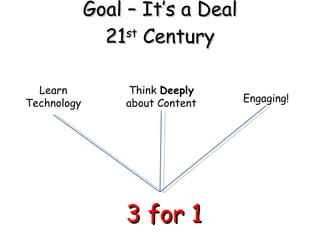
Goal – It’s a Deal 21 st  Century Learn Technology Think  Deeply  about Content Engaging! 3 for 1
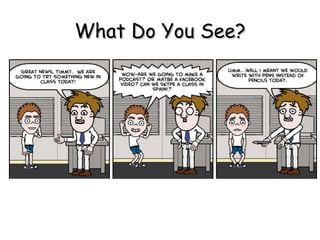
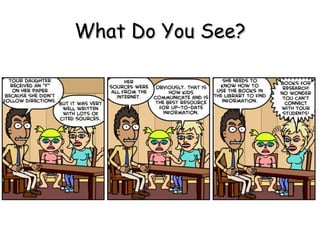
What Do You See?
What Do You See?
Why Comics Creation?  Builds Visual Literacy  (important for digital age) Sustains interaction with content  Enhances motivation Has potential for dual controversy Values multiple perspectives Appeals to males
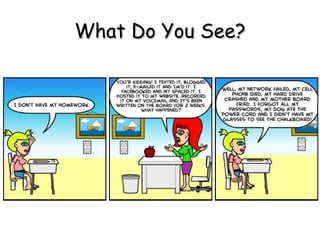
What Do You See?
Why Comics Creation? - Inquire  Allows learners to reflect on material and to  create deeper  meaning  -  VISUALLY
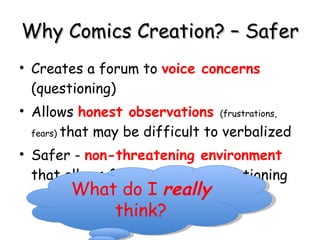
Why Comics Creation? – Safer  Creates a forum to  voice concerns  (questioning) Allows  honest observations  (frustrations, fears)  that may be difficult to verbalized Safer -  non-threatening environment  that allows for expression, questioning What do I  really  think?
Comic Pedagogy  (Decker, 2007) Sustains the a question until the learning has a place of understanding Attends to complexity and discourages the search for the simple Embraces a “punch line”, the counter-intuitive option
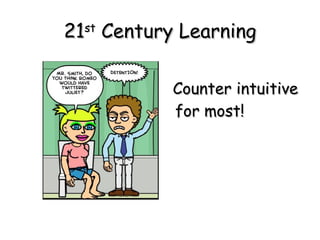
21 st  Century Learning Counter intuitive for most!
Structure with Comics Choose a comic making tool available in your school  (firewalls, flash, embedding?) Partner  on Content Start with single panel prompt Introduce a “in-service issue” Then try a multiple panel
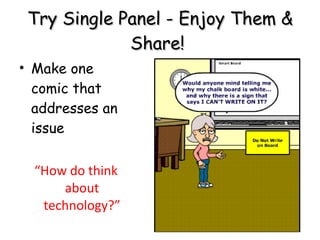
Try Single Panel - Enjoy Them & Share!  Make one comic that addresses an issue “ How do think about technology?”
Comic Builders
Use to Introduce Content 21 st  Century skill – Video, reading or presentation Give ideas on how to create a comic and an example http ://mcom510.wikispaces.com/Why+Technology%3F Write an explanation underneath comic
Extension Discuss on discussion board Ask if the teachers found it valuable and why Lead into ways that teachers could use it in their classroom.
References Brookfield, S. (1995).  Becoming a critically reflective teacher. San Francisco, CA: Jossey-Bass. Decker, E. (2007). Q. What's funny about teaching? A.Not Enough!: Arguing for a comic pedagogy.  Educational Insights, 11(3). Lamb, A., & Johnson, L. (2009). Graphic novels, digital comics, and technology-enhanced learning: Part 2.  Teacher Librarian, 37(1). Mezirow, J. (1990). How critical reflection triggers transformative learning. In J. Mezirow & A. B. Knox (Eds.),  Fostering critical reflection in adulthood: A guide to transformative and emancipatory learning (pp. 1-20). San Francisco, CA: Jossey Bass Inc. Muller, M., Ozcan, E., & Seizov, O. (2009). Dangerous depictions: A visual case study of contemporary cartoon controversies.  Popular Communication(7), 1. Peery, A. B. (2004).  Deep change: professional development from the inside out. Lanham, MD: Scarecrow Education. Reigeluth, C. M. (1999).  Instructional-design theories and models (Vol. 2). Mahwah, NJ: Lawrence Erlbaum Associates. Seglem, R., & Witte, S. (2009). You gotta see it to believe it: Teaching visual literacy in the English classroom.  Journal of Adolescent & Adult Literacy, 53(3), 216-226. Smetana, L., Odelson, D., Burns, H., & Grisham, D. L. (2009). Using graphic novels in the high school classroom: Engaging Deaf students with a new genre.  Journal of Adolescent & Adult Literacy, 53(3), 228-240. Sockman,B. R., & Sharma, P. (2008). Struggling toward a transformative model of instruction: It's not so easy!  Teaching and Teacher Education 24(4), 1070-1082.
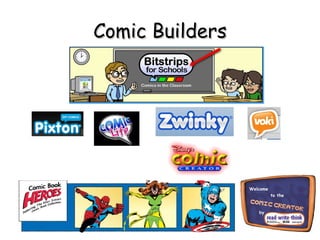
Comic Builders Bitstrips:  www.bitstrips.com   Pixton:  www.pixton.com   Comic Life:  www.comiclife.com Zwinky:  www.zwinky.com Voki:  www.voki.com Younger Disney Comic Creator  -  http://www.nfx.com/dcc.html Build Your own comic -  http://www.childrensmuseum.org/special_exhibits/comics/games.html Read Write Think Cartoon Creator -  http://www.readwritethink.org/files/resources/interactives/comic/

Comics

  • 1.
    Comic Creation Beth Rajan Sockman PH.D.
  • 2.
    Goal – It’sa Deal 21 st Century Learn Technology Think Deeply about Content Engaging! 3 for 1
  • 3.
  • 4.
  • 5.
    Why Comics Creation? Builds Visual Literacy (important for digital age) Sustains interaction with content Enhances motivation Has potential for dual controversy Values multiple perspectives Appeals to males
  • 6.
  • 7.
    Why Comics Creation?- Inquire Allows learners to reflect on material and to create deeper meaning - VISUALLY
  • 8.
    Why Comics Creation?– Safer Creates a forum to voice concerns (questioning) Allows honest observations (frustrations, fears) that may be difficult to verbalized Safer - non-threatening environment that allows for expression, questioning What do I really think?
  • 9.
    Comic Pedagogy (Decker, 2007) Sustains the a question until the learning has a place of understanding Attends to complexity and discourages the search for the simple Embraces a “punch line”, the counter-intuitive option
  • 10.
    21 st Century Learning Counter intuitive for most!
  • 11.
    Structure with ComicsChoose a comic making tool available in your school (firewalls, flash, embedding?) Partner on Content Start with single panel prompt Introduce a “in-service issue” Then try a multiple panel
  • 12.
    Try Single Panel- Enjoy Them & Share! Make one comic that addresses an issue “ How do think about technology?”
  • 13.
  • 14.
    Use to IntroduceContent 21 st Century skill – Video, reading or presentation Give ideas on how to create a comic and an example http ://mcom510.wikispaces.com/Why+Technology%3F Write an explanation underneath comic
  • 15.
    Extension Discuss ondiscussion board Ask if the teachers found it valuable and why Lead into ways that teachers could use it in their classroom.
  • 16.
    References Brookfield, S.(1995). Becoming a critically reflective teacher. San Francisco, CA: Jossey-Bass. Decker, E. (2007). Q. What's funny about teaching? A.Not Enough!: Arguing for a comic pedagogy. Educational Insights, 11(3). Lamb, A., & Johnson, L. (2009). Graphic novels, digital comics, and technology-enhanced learning: Part 2. Teacher Librarian, 37(1). Mezirow, J. (1990). How critical reflection triggers transformative learning. In J. Mezirow & A. B. Knox (Eds.), Fostering critical reflection in adulthood: A guide to transformative and emancipatory learning (pp. 1-20). San Francisco, CA: Jossey Bass Inc. Muller, M., Ozcan, E., & Seizov, O. (2009). Dangerous depictions: A visual case study of contemporary cartoon controversies. Popular Communication(7), 1. Peery, A. B. (2004). Deep change: professional development from the inside out. Lanham, MD: Scarecrow Education. Reigeluth, C. M. (1999). Instructional-design theories and models (Vol. 2). Mahwah, NJ: Lawrence Erlbaum Associates. Seglem, R., & Witte, S. (2009). You gotta see it to believe it: Teaching visual literacy in the English classroom. Journal of Adolescent & Adult Literacy, 53(3), 216-226. Smetana, L., Odelson, D., Burns, H., & Grisham, D. L. (2009). Using graphic novels in the high school classroom: Engaging Deaf students with a new genre. Journal of Adolescent & Adult Literacy, 53(3), 228-240. Sockman,B. R., & Sharma, P. (2008). Struggling toward a transformative model of instruction: It's not so easy! Teaching and Teacher Education 24(4), 1070-1082.
  • 17.
    Comic Builders Bitstrips: www.bitstrips.com Pixton: www.pixton.com Comic Life: www.comiclife.com Zwinky: www.zwinky.com Voki: www.voki.com Younger Disney Comic Creator - http://www.nfx.com/dcc.html Build Your own comic - http://www.childrensmuseum.org/special_exhibits/comics/games.html Read Write Think Cartoon Creator - http://www.readwritethink.org/files/resources/interactives/comic/

Editor's Notes

  • #2 As people come have a timed slide show running of the different comics….
  • #4 Starter to Presentation: Teacher-created cartoons – what do the participants “see” in this cartoon? Title: Gap in Generations
  • #5 Starter to Presentation: Teacher-created cartoons – what do the participants “see” in this cartoon?
  • #7 Starter to Presentation: Teacher-created cartoons – what do the participants “see” in this cartoon? Title: An Analogy
  • #8 For teachers Form of expression for teachers so that they honestly share their frustrations but don’t “sound” like to their colleagues/admin/supervisors that they are complaining or unwilling…their honesty can shine through their use of visuals not just verbal and text.
  • #9 For teachers Form of expression for teachers so that they honestly share their frustrations but don’t “sound” like to their colleagues/admin/supervisors that they are complaining or unwilling…their honesty can shine through their use of visuals not just verbal and text.
  • #11 16 years of sit – lecture format Now need to engage , use multiple perspectives, differentiate, be creative…
  • #12 I split into two slides…
  • #14 I created icons for these and then hyperlinked them. Are we sharing PowerPoint on Ning? We could also share page at end with hyperlinks written out. I added Voki (combines comic (avatar creation) with audio).
  • #16 I think we need to create our forum on Ning…I was going to put a link to it here, but I didn’t see it. I am registered for the PETE & C Ning but haven’t done this part yet – can do later when I get home and put link here.
  • #18 I created icons for these and then hyperlinked them. We are sharing PowerPoint on Ning? We could also share page at end with hyperlinks written out.