ECOSYSTEM AND ORGANISM
INTERACTIONS
Amos Watentena
wateamos@gmail.com
ECOSYSTEM AND ORGANISM
INTERACTIONS
 An ecosystem is a defined space in which interactions take place between a community,
with all its complex interrelationships, and the physical environment.
 A community is an assemblage of all interacting species of organisms in an area.
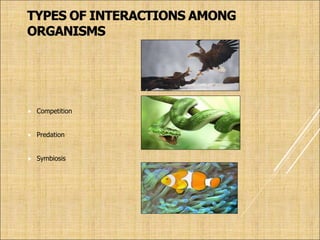
 Competition
 Predation
 Symbiosis
 It is a struggle between organisms as they attempt to
use the same limited resource
 Occurs when two species occupy
the same niche
 Why can’t two species occupy the same niche?
 If two species occupy the same niche, they will
compete directly against each other and one
species will eventually die off
COMPETITION
It occurs when two or
more individuals seek to
utilize the same limited
resource
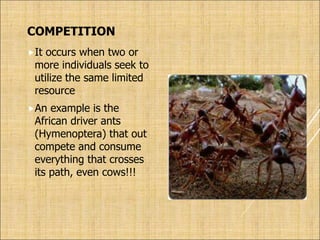
An example is the
African driver ants
(Hymenoptera) that out
compete and consume
everything that crosses
its path, even cows!!!
COMPETITION
 Competition is a kind of interaction in which two organisms strive to
obtain the same limited resource.
 Intraspecific competition is competition between members of same
species.
 Interspecific competition is competition between members of different
species.
COMPETITION
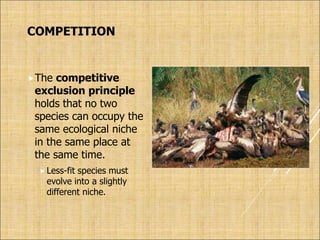
The competitive
exclusion principle
holds that no two
species can occupy the
same ecological niche
in the same place at
the same time.
 Less-fit species must
evolve into a slightly
different niche.
Complete competitors cannot coexist
Competitive exclusion is reached more slowly with
higher resource abundances
 Stable coexistence requires niche differentiation,
such that members of each species compete more
strongly among themselves than with members of
the other species.
 Therefore the level of intraspecific competition is
always greater than interspecific competition
SYMBIOSIS
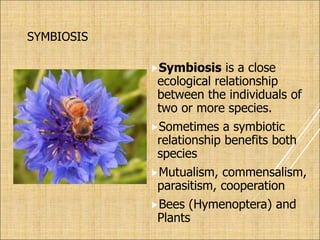
Symbiosis is a close
ecological relationship
between the individuals of
two or more species.
Sometimes a symbiotic
relationship benefits both
species
Mutualism, commensalism,
parasitism, cooperation
Bees (Hymenoptera) and
Plants
SYMBIOTIC RELATIONSHIPS
 Symbiosis is a close, long-lasting, physical relationship between two different species. At least
one species derives benefit from the interaction.
 There are three categories of symbiotic relationships:
 Parasitism
 Commensalism
 Mutualism
SYMBIOTIC RELATIONSHIPS
 Parasitism is a relationship in which one organism (parasite) lives in
or on another organism (host), from which it derives nourishment.
 Ecto-parasites live on the host’s surface.
 Fleas, lice, molds, mildews
 Endo-parasites live inside the body of the host.
 Tapeworms, malaria parasites, bacteria, fungi
SYMBIOTIC RELATIONSHIPS
Commensalism is a relationship in
which one organism benefits while the
other is not affected.
Remoras and sharks
Mutualism is a relationship in which
both species benefit. The relationship is
obligatory in many cases, as neither can
exist without the other.
Mycorrhizae
MUTUALISM AND SYMBIOSIS
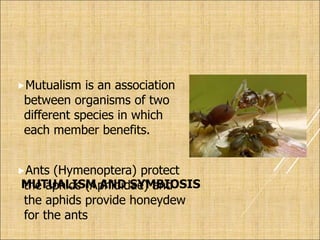
Mutualism is an association
between organisms of two
different species in which
each member benefits.
Ants (Hymenoptera) protect
the aphids (Aphididae) and
the aphids provide honeydew
for the ants
COMMENSALISM AND SYMBIOSIS
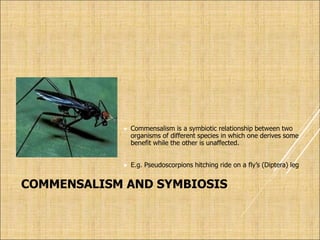
 Commensalism is a symbiotic relationship between two
organisms of different species in which one derives some
benefit while the other is unaffected.
 E.g. Pseudoscorpions hitching ride on a fly’s (Diptera) leg
PARASITISM AND SYMBIOSIS
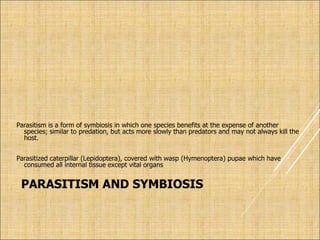
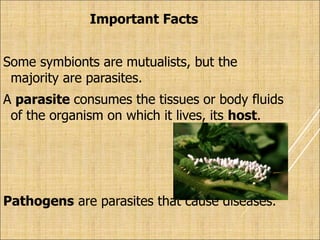
Parasitism is a form of symbiosis in which one species benefits at the expense of another
species; similar to predation, but acts more slowly than predators and may not always kill the
host.
Parasitized caterpillar (Lepidoptera), covered with wasp (Hymenoptera) pupae which have
consumed all internal tissue except vital organs
Symbionts
These are organisms that live in or on other organisms.
More than half of the millions of species that live on Earth are symbionts.
Human body is a habitat to many micro species.
Important Facts
Some symbionts are mutualists, but the
majority are parasites.
A parasite consumes the tissues or body fluids
of the organism on which it lives, its host.
Pathogens are parasites that cause diseases.
NATURAL HISTORY OF PARASITES
As a group, parasites typically harm, but do not immediately kill, the organisms they eat (unlike
predators). The degree of harm to the host varies widely.
Macro-parasites are large, such as arthropods and worms. Micro-parasites are microscopic, such as
bacteria.
Many Species Are Host to More Than One Parasite Species.
COEVOLUTION
This is when the host and the parasite evolve together each in response to the selection
pressure imposed by the other.
In this case, they both develop adaptations aimed at increasing their chances of survival.
ECOLOGICAL EFFECTS OF PARASITES
At the population level, harm done by parasites translates into reduction of population growth
rates.
Parasites can drive local host populations extinct and reduce their geographic ranges.
ECOLOGICAL EFFECTS OF PARASITES
The physical environment can be changed when a parasite attacks a species that is an ecosystem
engineer—a species whose actions change the physical character of its environment, as when a
beaver builds a dam.
ECOLOGICAL EFFECTS OF PARASITES
When the trematode parasite drives the amphipod populations to extinction, erosion increases, silt
content increases, and the islands disappear.
The amphipod Corophium is an ecosystem engineer in the tidal mudflats, the burrows it builds
hold the mud together, preventing erosion and forming “mud islands” at low tide.
COOPERATION
Cooperation is the act of working or acting together
Ants and bees colonies work together
Polyergus samurai raid and capture pupae of Formica
japonica and use them as workers when they emerge
PREDATOR AND PREY
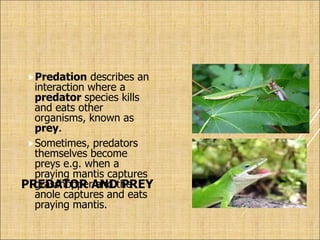
Predation describes an
interaction where a
predator species kills
and eats other
organisms, known as
prey.
Sometimes, predators
themselves become
preys e.g. when a
praying mantis captures
grasshopper and the
anole captures and eats
praying mantis.
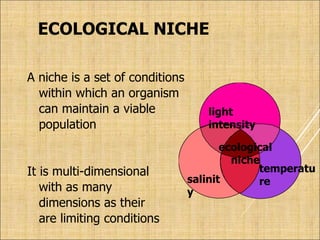
ECOLOGICAL NICHE
A niche is a set of conditions
within which an organism
can maintain a viable
population
It is multi-dimensional
with as many
dimensions as their
are limiting conditions
temperatu
re
light
intensity
salinit
y
ecological
niche
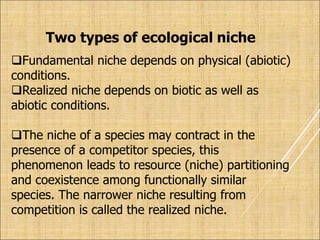
Two types of ecological niche
Fundamental niche depends on physical (abiotic)
conditions.
Realized niche depends on biotic as well as
abiotic conditions.
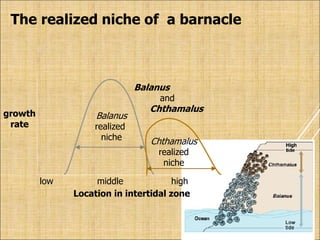
The niche of a species may contract in the
presence of a competitor species, this
phenomenon leads to resource (niche) partitioning
and coexistence among functionally similar
species. The narrower niche resulting from
competition is called the realized niche.
growth
rate
Location in intertidal zone
low high
middle
The realized niche of a barnacle
Balanus
realized
niche Chthamalus
realized
niche
Balanus
and
Chthamalus
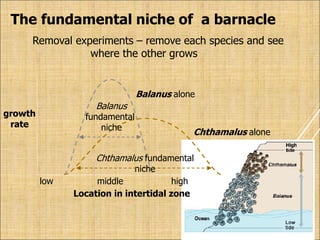
growth
rate
Location in intertidal zone
low high
middle
Chthamalus alone
Balanus alone
The fundamental niche of a barnacle
Removal experiments – remove each species and see
where the other grows
Balanus
fundamental
niche
Chthamalus fundamental
niche
growth
rate
Location in intertidal zone
low high
middle
Chthamalus
alone
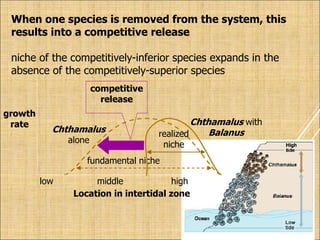
When one species is removed from the system, this
results into a competitive release
niche of the competitively-inferior species expands in the
absence of the competitively-superior species
fundamental niche
realized
niche
Chthamalus with
Balanus
competitive
release
Thank You.

interactionsoforganisms-180323200310.ppt.pptx

  • 1.
    ECOSYSTEM AND ORGANISM INTERACTIONS AmosWatentena wateamos@gmail.com
  • 2.
    ECOSYSTEM AND ORGANISM INTERACTIONS An ecosystem is a defined space in which interactions take place between a community, with all its complex interrelationships, and the physical environment.  A community is an assemblage of all interacting species of organisms in an area.
  • 3.
  • 4.
     It isa struggle between organisms as they attempt to use the same limited resource  Occurs when two species occupy the same niche  Why can’t two species occupy the same niche?  If two species occupy the same niche, they will compete directly against each other and one species will eventually die off
  • 5.
    COMPETITION It occurs whentwo or more individuals seek to utilize the same limited resource An example is the African driver ants (Hymenoptera) that out compete and consume everything that crosses its path, even cows!!!
  • 6.
    COMPETITION  Competition isa kind of interaction in which two organisms strive to obtain the same limited resource.  Intraspecific competition is competition between members of same species.  Interspecific competition is competition between members of different species.
  • 7.
    COMPETITION The competitive exclusion principle holdsthat no two species can occupy the same ecological niche in the same place at the same time.  Less-fit species must evolve into a slightly different niche.
  • 8.
    Complete competitors cannotcoexist Competitive exclusion is reached more slowly with higher resource abundances  Stable coexistence requires niche differentiation, such that members of each species compete more strongly among themselves than with members of the other species.  Therefore the level of intraspecific competition is always greater than interspecific competition
  • 9.
    SYMBIOSIS Symbiosis is aclose ecological relationship between the individuals of two or more species. Sometimes a symbiotic relationship benefits both species Mutualism, commensalism, parasitism, cooperation Bees (Hymenoptera) and Plants
  • 10.
    SYMBIOTIC RELATIONSHIPS  Symbiosisis a close, long-lasting, physical relationship between two different species. At least one species derives benefit from the interaction.  There are three categories of symbiotic relationships:  Parasitism  Commensalism  Mutualism
  • 11.
    SYMBIOTIC RELATIONSHIPS  Parasitismis a relationship in which one organism (parasite) lives in or on another organism (host), from which it derives nourishment.  Ecto-parasites live on the host’s surface.  Fleas, lice, molds, mildews  Endo-parasites live inside the body of the host.  Tapeworms, malaria parasites, bacteria, fungi
  • 12.
    SYMBIOTIC RELATIONSHIPS Commensalism isa relationship in which one organism benefits while the other is not affected. Remoras and sharks Mutualism is a relationship in which both species benefit. The relationship is obligatory in many cases, as neither can exist without the other. Mycorrhizae
  • 13.
    MUTUALISM AND SYMBIOSIS Mutualismis an association between organisms of two different species in which each member benefits. Ants (Hymenoptera) protect the aphids (Aphididae) and the aphids provide honeydew for the ants
  • 14.
    COMMENSALISM AND SYMBIOSIS Commensalism is a symbiotic relationship between two organisms of different species in which one derives some benefit while the other is unaffected.  E.g. Pseudoscorpions hitching ride on a fly’s (Diptera) leg
  • 15.
    PARASITISM AND SYMBIOSIS Parasitismis a form of symbiosis in which one species benefits at the expense of another species; similar to predation, but acts more slowly than predators and may not always kill the host. Parasitized caterpillar (Lepidoptera), covered with wasp (Hymenoptera) pupae which have consumed all internal tissue except vital organs
  • 16.
    Symbionts These are organismsthat live in or on other organisms. More than half of the millions of species that live on Earth are symbionts. Human body is a habitat to many micro species.
  • 17.
    Important Facts Some symbiontsare mutualists, but the majority are parasites. A parasite consumes the tissues or body fluids of the organism on which it lives, its host. Pathogens are parasites that cause diseases.
  • 18.
    NATURAL HISTORY OFPARASITES As a group, parasites typically harm, but do not immediately kill, the organisms they eat (unlike predators). The degree of harm to the host varies widely. Macro-parasites are large, such as arthropods and worms. Micro-parasites are microscopic, such as bacteria. Many Species Are Host to More Than One Parasite Species.
  • 19.
    COEVOLUTION This is whenthe host and the parasite evolve together each in response to the selection pressure imposed by the other. In this case, they both develop adaptations aimed at increasing their chances of survival.
  • 20.
    ECOLOGICAL EFFECTS OFPARASITES At the population level, harm done by parasites translates into reduction of population growth rates. Parasites can drive local host populations extinct and reduce their geographic ranges.
  • 21.
    ECOLOGICAL EFFECTS OFPARASITES The physical environment can be changed when a parasite attacks a species that is an ecosystem engineer—a species whose actions change the physical character of its environment, as when a beaver builds a dam.
  • 22.
    ECOLOGICAL EFFECTS OFPARASITES When the trematode parasite drives the amphipod populations to extinction, erosion increases, silt content increases, and the islands disappear. The amphipod Corophium is an ecosystem engineer in the tidal mudflats, the burrows it builds hold the mud together, preventing erosion and forming “mud islands” at low tide.
  • 23.
    COOPERATION Cooperation is theact of working or acting together Ants and bees colonies work together Polyergus samurai raid and capture pupae of Formica japonica and use them as workers when they emerge
  • 24.
    PREDATOR AND PREY Predationdescribes an interaction where a predator species kills and eats other organisms, known as prey. Sometimes, predators themselves become preys e.g. when a praying mantis captures grasshopper and the anole captures and eats praying mantis.
  • 25.
    ECOLOGICAL NICHE A nicheis a set of conditions within which an organism can maintain a viable population It is multi-dimensional with as many dimensions as their are limiting conditions temperatu re light intensity salinit y ecological niche
  • 26.
    Two types ofecological niche Fundamental niche depends on physical (abiotic) conditions. Realized niche depends on biotic as well as abiotic conditions. The niche of a species may contract in the presence of a competitor species, this phenomenon leads to resource (niche) partitioning and coexistence among functionally similar species. The narrower niche resulting from competition is called the realized niche.
  • 27.
    growth rate Location in intertidalzone low high middle The realized niche of a barnacle Balanus realized niche Chthamalus realized niche Balanus and Chthamalus
  • 28.
    growth rate Location in intertidalzone low high middle Chthamalus alone Balanus alone The fundamental niche of a barnacle Removal experiments – remove each species and see where the other grows Balanus fundamental niche Chthamalus fundamental niche
  • 29.
    growth rate Location in intertidalzone low high middle Chthamalus alone When one species is removed from the system, this results into a competitive release niche of the competitively-inferior species expands in the absence of the competitively-superior species fundamental niche realized niche Chthamalus with Balanus competitive release
  • 30.