

microevolution
• Microevolution – A change of allele
frequencies in a population over a short
time. The basis for all large-scale or
macroevolution.
• To fully appreciate evolution, we need to
look not just at the outcomes but also at
the processes that created those
outcomes.
Terminology review
• Population
• Genotype
• Phenotype
• Allele
• Gene pool – all the alleles that exist in a
population
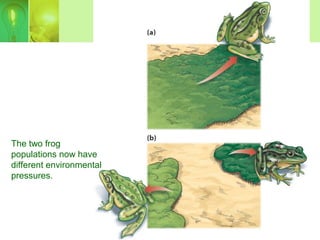
The two frog
populations now have
different environmental
pressures.
Exactly how do
populations evolve?
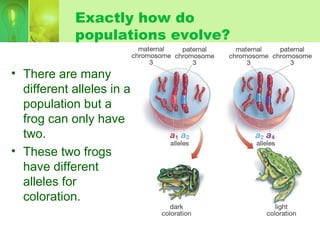
• There are many
different alleles in a
population but a
frog can only have
two.
• These two frogs
have different
alleles for
coloration.
What causes Evolution?
• Five Agents of Change that can alter
allele frequencies
– Mutation
– Gene flow
– Genetic drift
– Non-random mating
– Natural selection
Mutation
• Any permanent alterations in the makeup of
DNA.
– They must be heritable
– Base pair, deletion, translocation, etc.
– Most do nothing, a few are harmful, rarely are they
beneficial.
– These mutations are not working to further survival
and reproduction.
– These mutations are not likely to account for a
change in allele frequency.
– These good mutations bring new genetic information
into the genetic pool.
Gene Flow
• A change in allele frequency that can
occur when mating with members from
another population occurs.
– The movement of genes from one population
to another.
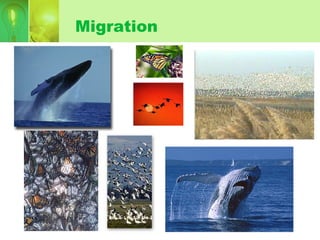
– Migration – the movement of individuals from
one population into the territory of another.
– Plants migrate, too.
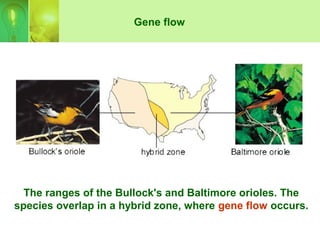
The ranges of the Bullock's and Baltimore orioles. The
species overlap in a hybrid zone, where gene flow occurs.
Gene flow
Migration
Genetic Drift
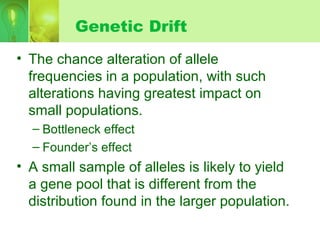
• The chance alteration of allele
frequencies in a population, with such
alterations having greatest impact on
small populations.
– Bottleneck effect
– Founder’s effect
• A small sample of alleles is likely to yield
a gene pool that is different from the
distribution found in the larger population.
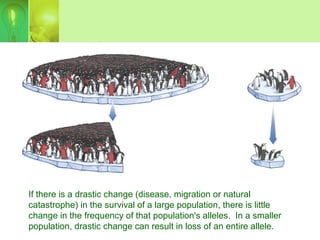
If there is a drastic change (disease, migration or natural
catastrophe) in the survival of a large population, there is little
change in the frequency of that population's alleles. In a smaller
population, drastic change can result in loss of an entire allele.
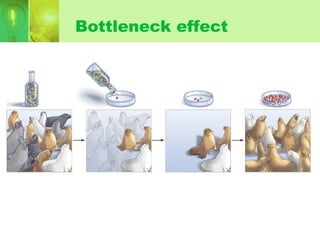
• Bottleneck effect – The change in allele
frequency in a population due to chance
following a sharp reduction in the
population size.
• Founder effect – When a small portion of
a population migrates to another area,
starting a new population.
Bottleneck effect
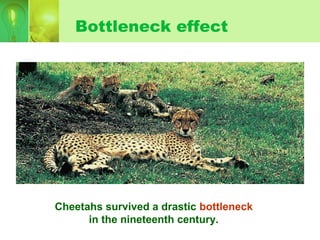
Cheetahs survived a drastic bottleneck
in the nineteenth century.
Bottleneck effect
Founder effect
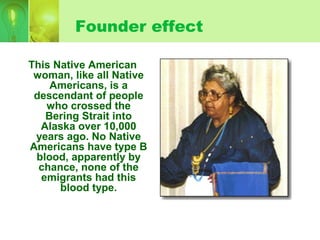
This Native American
woman, like all Native
Americans, is a
descendant of people
who crossed the
Bering Strait into
Alaska over 10,000
years ago. No Native
Americans have type B
blood, apparently by
chance, none of the
emigrants had this
blood type.
Nonrandom Mating
• Mating in which a given member of a
population is not equally likely to mate
with any other given member.
• Sexual selection is a form of nonrandom
mating. This is mating based on
phenotype, based on the choices made
by the female of the species.
• The male will increase the proportion of
his alleles in the next generation.
Natural Selection
• A process in which the differential
adaptation of organisms to their
environment selects those traits that will
be passed on with greater frequency from
one generation to the next.
• Traits of those who are more successful in
reproducing will become more widespread
in a population, the alleles that bring about
these traits will increase in frequency from
one generation to the next.
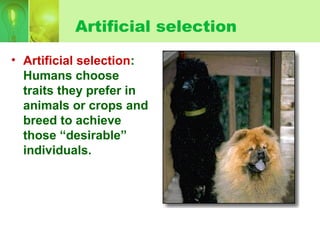
Artificial selection
• Artificial selection:
Humans choose
traits they prefer in
animals or crops and
breed to achieve
those “desirable”
individuals.
• Natural selection is the only one of the
five agents of microevolution that
consistently works to adapt organisms to
their environment.
– Genetic drift is random
– Mutation has a negative effect, or no effect
– Gene flow doesn’t necessarily bring in genes
that are better suited to the environment
– Non random mating doesn’t have anything to
do with matching individuals to environment
Fitness
• The success of an organism in passing
on its genes to offspring, relative to the
other members of its population.
• The allele frequencies will increase.
• Also known as “survival of the fittest”
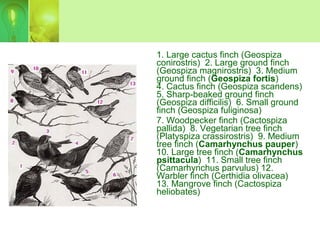
1. Large cactus finch (Geospiza
conirostris) 2. Large ground finch
(Geospiza magnirostris) 3. Medium
ground finch (Geospiza fortis)
4. Cactus finch (Geospiza scandens)
5. Sharp-beaked ground finch
(Geospiza difficilis) 6. Small ground
finch (Geospiza fuliginosa)
7. Woodpecker finch (Cactospiza
pallida) 8. Vegetarian tree finch
(Platyspiza crassirostris) 9. Medium
tree finch (Camarhynchus pauper)
10. Large tree finch (Camarhynchus
psittacula) 11. Small tree finch
(Camarhynchus parvulus) 12.
Warbler finch (Certhidia olivacea)
13. Mangrove finch (Cactospiza
heliobates)
Three modes of
Natural Selection
• When natural selection operates on
characters that are polygenic and
continuously variable, it can proceed in
one of three ways.
• Does natural selection favor what is
average or what is extreme?
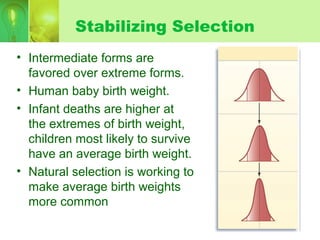
Stabilizing Selection
• Intermediate forms are
favored over extreme forms.
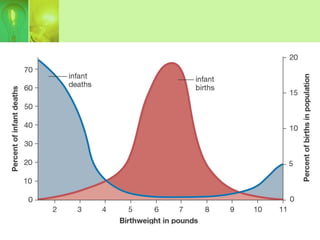
• Human baby birth weight.
• Infant deaths are higher at
the extremes of birth weight,
children most likely to survive
have an average birth weight.
• Natural selection is working to
make average birth weights
more common
Directional Selection
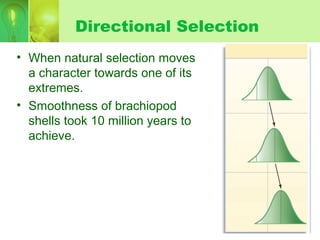
• When natural selection moves
a character towards one of its
extremes.
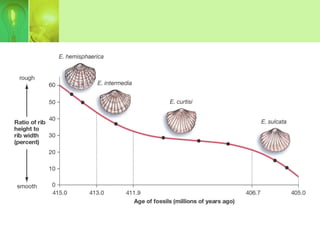
• Smoothness of brachiopod
shells took 10 million years to
achieve.
Disruptive Selection
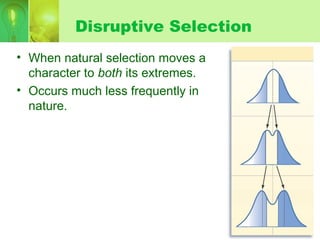
• When natural selection moves a
character to both its extremes.
• Occurs much less frequently in
nature.
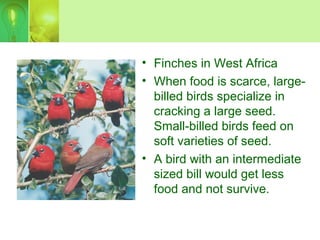
• Finches in West Africa
• When food is scarce, large-
billed birds specialize in
cracking a large seed.
Small-billed birds feed on
soft varieties of seed.
• A bird with an intermediate
sized bill would get less
food and not survive.

Microevolution

  • 1.
  • 2.
    • Microevolution –A change of allele frequencies in a population over a short time. The basis for all large-scale or macroevolution. • To fully appreciate evolution, we need to look not just at the outcomes but also at the processes that created those outcomes.
  • 3.
    Terminology review • Population •Genotype • Phenotype • Allele • Gene pool – all the alleles that exist in a population
  • 4.
    The two frog populationsnow have different environmental pressures.
  • 5.
    Exactly how do populationsevolve? • There are many different alleles in a population but a frog can only have two. • These two frogs have different alleles for coloration.
  • 6.
    What causes Evolution? •Five Agents of Change that can alter allele frequencies – Mutation – Gene flow – Genetic drift – Non-random mating – Natural selection
  • 7.
    Mutation • Any permanentalterations in the makeup of DNA. – They must be heritable – Base pair, deletion, translocation, etc. – Most do nothing, a few are harmful, rarely are they beneficial. – These mutations are not working to further survival and reproduction. – These mutations are not likely to account for a change in allele frequency. – These good mutations bring new genetic information into the genetic pool.
  • 8.
    Gene Flow • Achange in allele frequency that can occur when mating with members from another population occurs. – The movement of genes from one population to another. – Migration – the movement of individuals from one population into the territory of another. – Plants migrate, too.
  • 9.
    The ranges ofthe Bullock's and Baltimore orioles. The species overlap in a hybrid zone, where gene flow occurs. Gene flow
  • 10.
  • 11.
    Genetic Drift • Thechance alteration of allele frequencies in a population, with such alterations having greatest impact on small populations. – Bottleneck effect – Founder’s effect • A small sample of alleles is likely to yield a gene pool that is different from the distribution found in the larger population.
  • 12.
    If there isa drastic change (disease, migration or natural catastrophe) in the survival of a large population, there is little change in the frequency of that population's alleles. In a smaller population, drastic change can result in loss of an entire allele.
  • 13.
    • Bottleneck effect– The change in allele frequency in a population due to chance following a sharp reduction in the population size. • Founder effect – When a small portion of a population migrates to another area, starting a new population.
  • 14.
  • 15.
    Cheetahs survived adrastic bottleneck in the nineteenth century. Bottleneck effect
  • 16.
    Founder effect This NativeAmerican woman, like all Native Americans, is a descendant of people who crossed the Bering Strait into Alaska over 10,000 years ago. No Native Americans have type B blood, apparently by chance, none of the emigrants had this blood type.
  • 17.
    Nonrandom Mating • Matingin which a given member of a population is not equally likely to mate with any other given member. • Sexual selection is a form of nonrandom mating. This is mating based on phenotype, based on the choices made by the female of the species. • The male will increase the proportion of his alleles in the next generation.
  • 19.
    Natural Selection • Aprocess in which the differential adaptation of organisms to their environment selects those traits that will be passed on with greater frequency from one generation to the next. • Traits of those who are more successful in reproducing will become more widespread in a population, the alleles that bring about these traits will increase in frequency from one generation to the next.
  • 20.
    Artificial selection • Artificialselection: Humans choose traits they prefer in animals or crops and breed to achieve those “desirable” individuals.
  • 21.
    • Natural selectionis the only one of the five agents of microevolution that consistently works to adapt organisms to their environment. – Genetic drift is random – Mutation has a negative effect, or no effect – Gene flow doesn’t necessarily bring in genes that are better suited to the environment – Non random mating doesn’t have anything to do with matching individuals to environment
  • 22.
    Fitness • The successof an organism in passing on its genes to offspring, relative to the other members of its population. • The allele frequencies will increase. • Also known as “survival of the fittest”
  • 23.
    1. Large cactusfinch (Geospiza conirostris) 2. Large ground finch (Geospiza magnirostris) 3. Medium ground finch (Geospiza fortis) 4. Cactus finch (Geospiza scandens) 5. Sharp-beaked ground finch (Geospiza difficilis) 6. Small ground finch (Geospiza fuliginosa) 7. Woodpecker finch (Cactospiza pallida) 8. Vegetarian tree finch (Platyspiza crassirostris) 9. Medium tree finch (Camarhynchus pauper) 10. Large tree finch (Camarhynchus psittacula) 11. Small tree finch (Camarhynchus parvulus) 12. Warbler finch (Certhidia olivacea) 13. Mangrove finch (Cactospiza heliobates)
  • 24.
    Three modes of NaturalSelection • When natural selection operates on characters that are polygenic and continuously variable, it can proceed in one of three ways. • Does natural selection favor what is average or what is extreme?
  • 25.
    Stabilizing Selection • Intermediateforms are favored over extreme forms. • Human baby birth weight. • Infant deaths are higher at the extremes of birth weight, children most likely to survive have an average birth weight. • Natural selection is working to make average birth weights more common
  • 27.
    Directional Selection • Whennatural selection moves a character towards one of its extremes. • Smoothness of brachiopod shells took 10 million years to achieve.
  • 29.
    Disruptive Selection • Whennatural selection moves a character to both its extremes. • Occurs much less frequently in nature.
  • 30.
    • Finches inWest Africa • When food is scarce, large- billed birds specialize in cracking a large seed. Small-billed birds feed on soft varieties of seed. • A bird with an intermediate sized bill would get less food and not survive.