COMPETITION : INTRA & INTER -SPECIFIC
Master’s Seminar
ENT-591
Speaker :- Ajay Sharma
H-2017-01-
INDEX
Introduction
Competition
Type of competition
-Intraspecific and interspecific competition
-Interference vs exploitation
Mathematical models of competition
Results of Competition
-Range restriction
-Competitive displacement
-Competitive exclusion
Concept of Ecological Niche
Case studies
References
INTRODUCTION
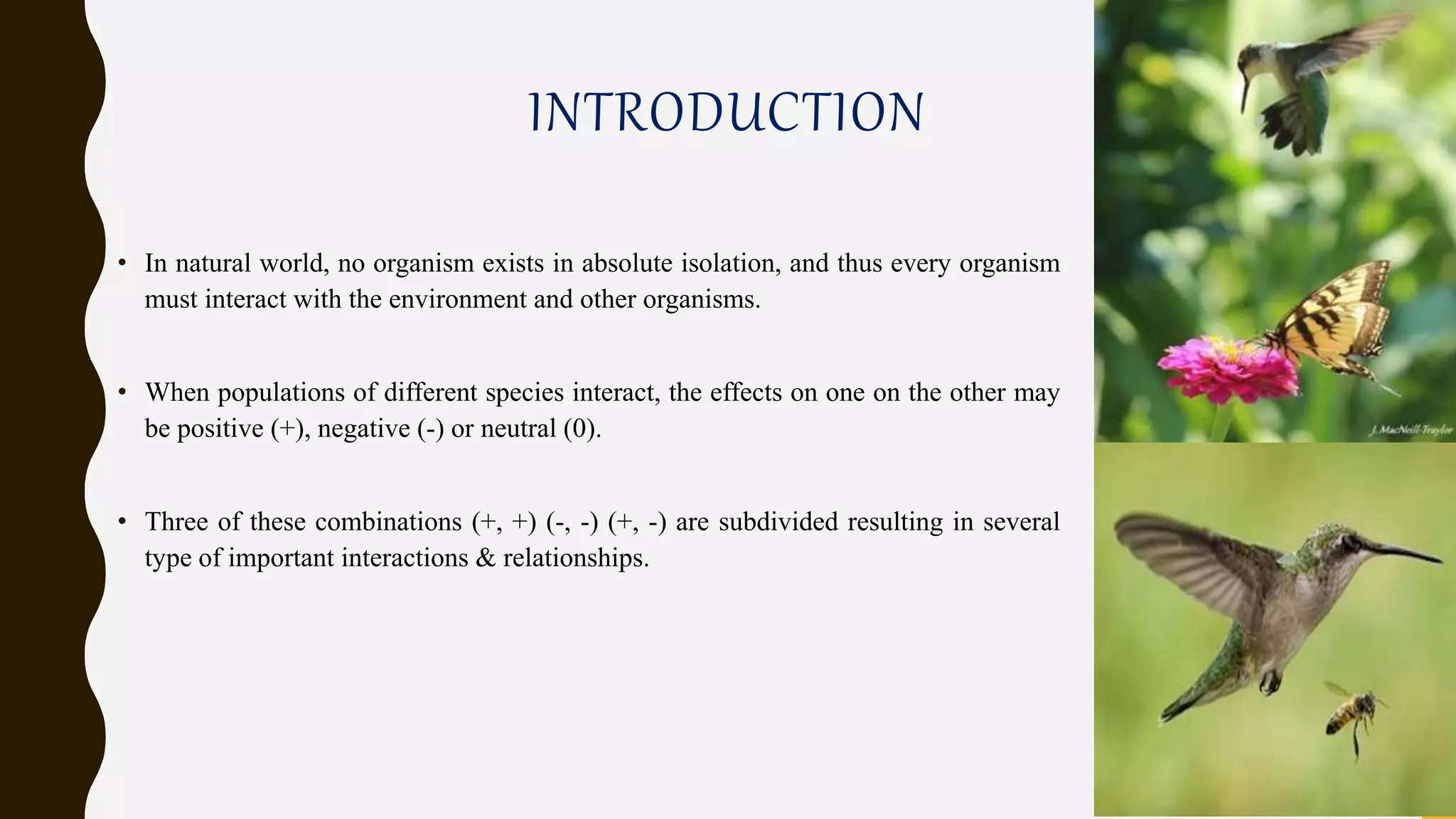
• In natural world, no organism exists in absolute isolation, and thus every organism
must interact with the environment and other organisms.
• When populations of different species interact, the effects on one on the other may
be positive (+), negative (-) or neutral (0).
• Three of these combinations (+, +) (-, -) (+, -) are subdivided resulting in several
type of important interactions & relationships.
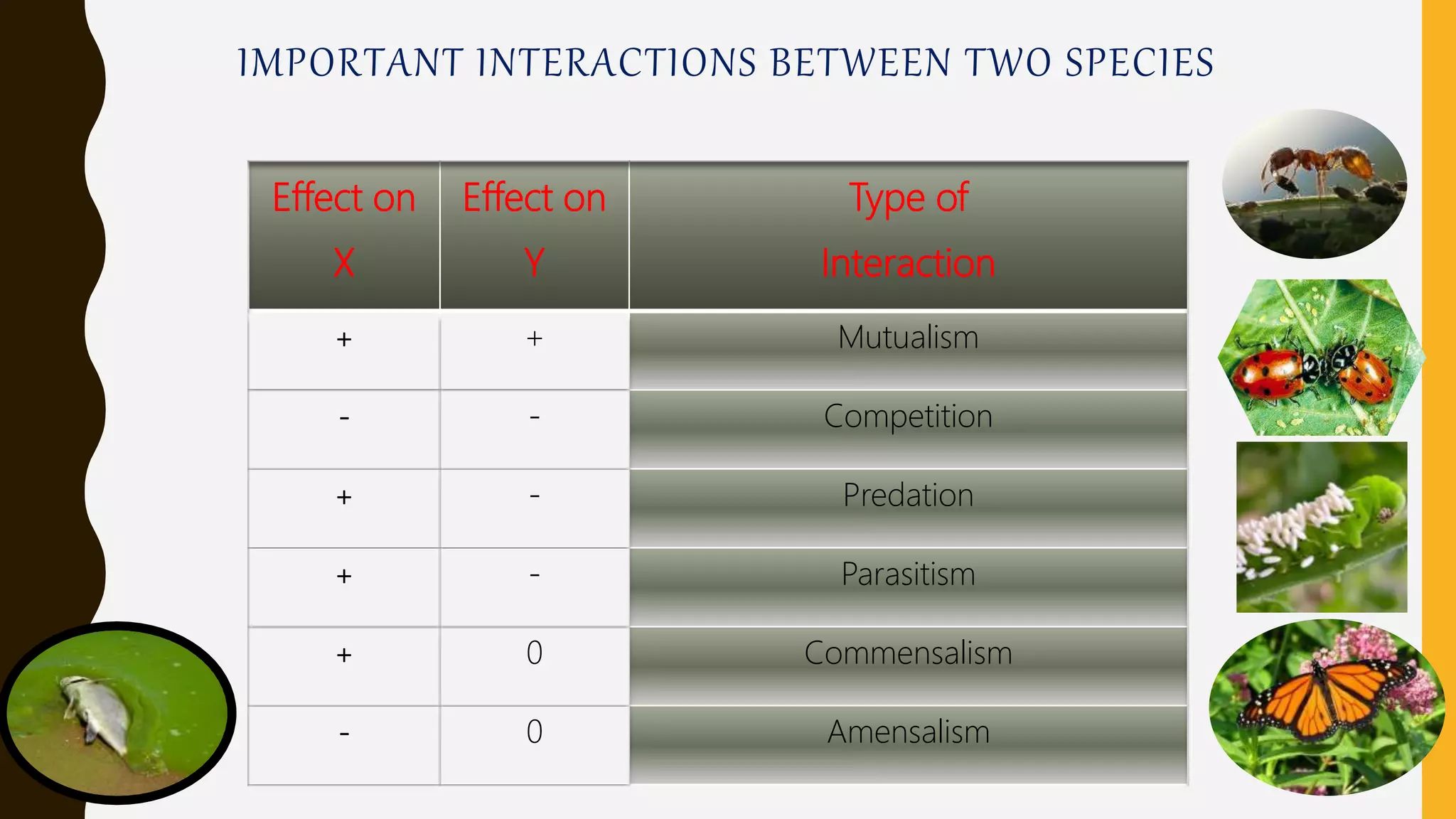
IMPORTANT INTERACTIONS BETWEEN TWO SPECIES
Effect on
X
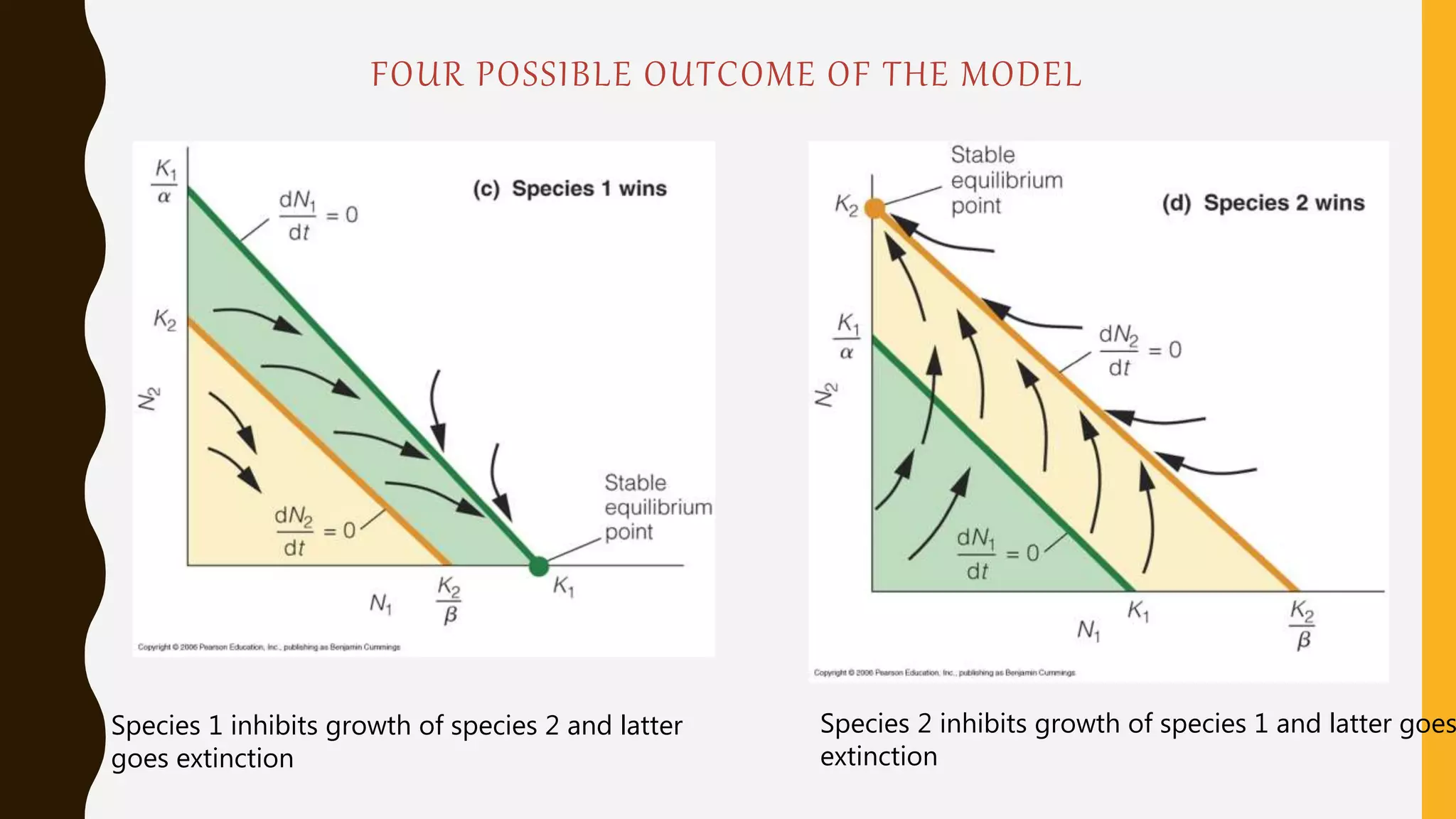
Effect on
Y
Type of
Interaction
+ + Mutualism
- - Competition
+ - Predation
+ - Parasitism
+ 0 Commensalism
- 0 Amensalism
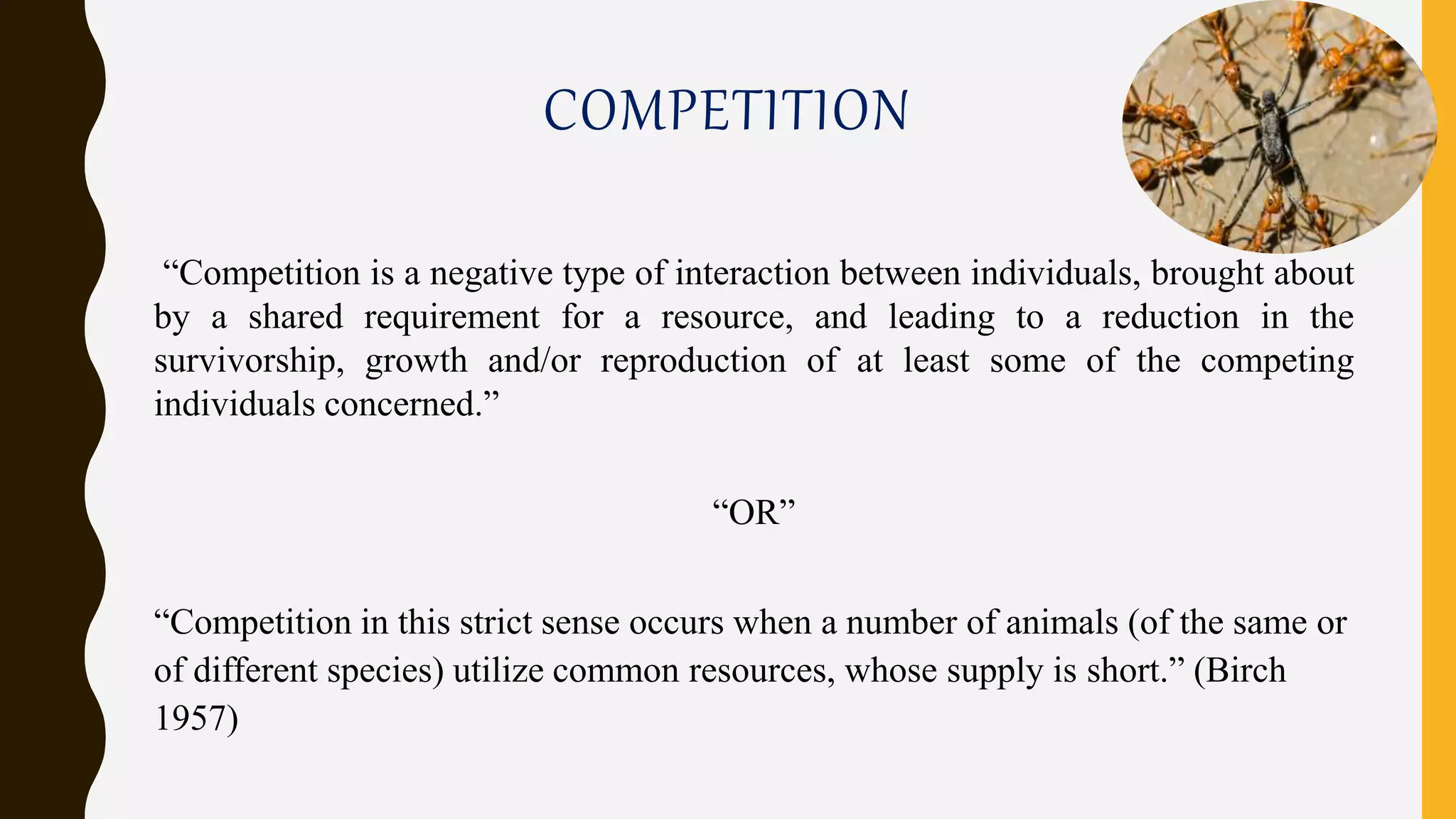
COMPETITION
“Competition is a negative type of interaction between individuals, brought about
by a shared requirement for a resource, and leading to a reduction in the
survivorship, growth and/or reproduction of at least some of the competing
individuals concerned.”
“OR”
“Competition in this strict sense occurs when a number of animals (of the same or
of different species) utilize common resources, whose supply is short.” (Birch
1957)
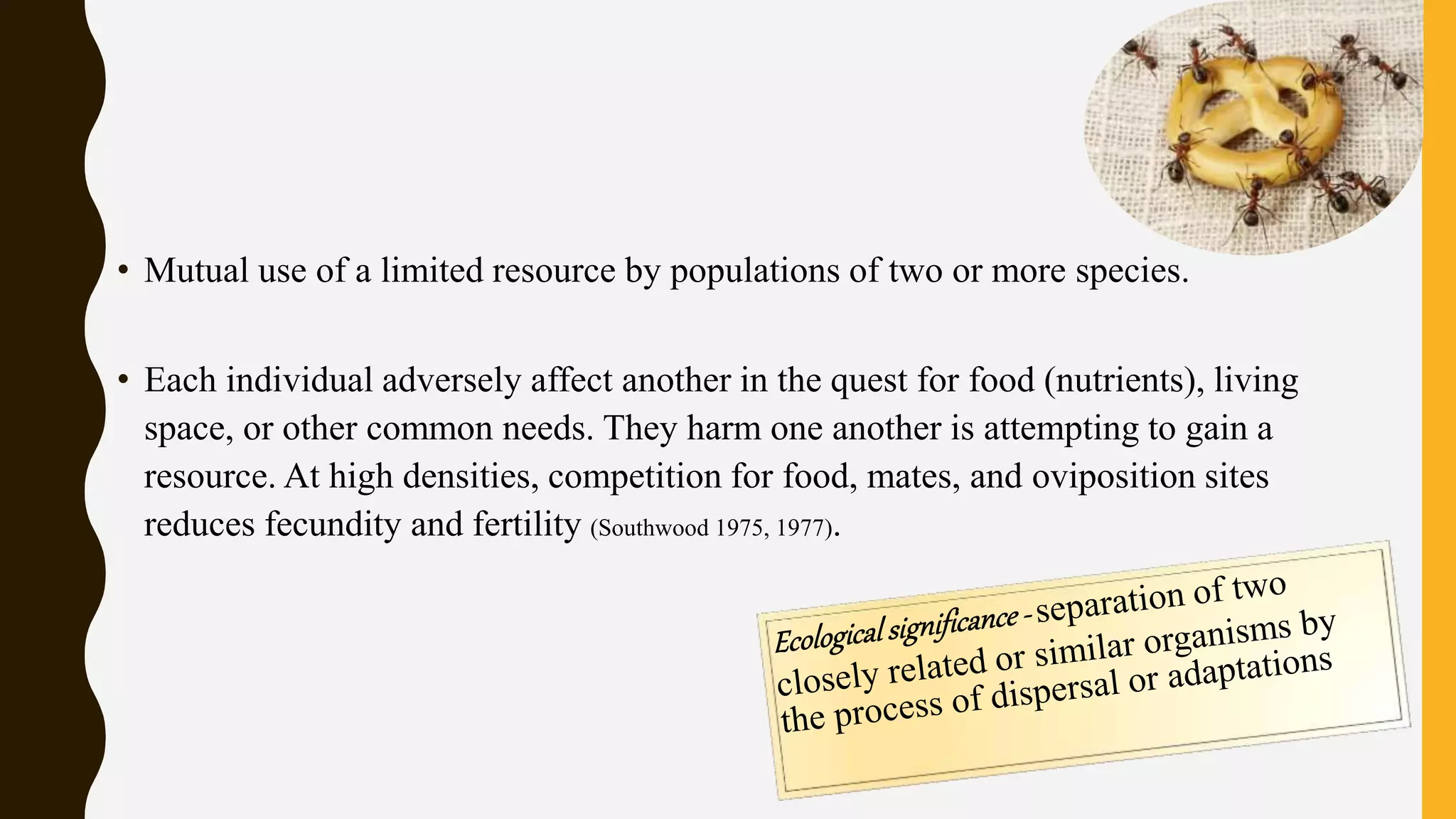
• Mutual use of a limited resource by populations of two or more species.
• Each individual adversely affect another in the quest for food (nutrients), living
space, or other common needs. They harm one another is attempting to gain a
resource. At high densities, competition for food, mates, and oviposition sites
reduces fecundity and fertility (Southwood 1975, 1977).
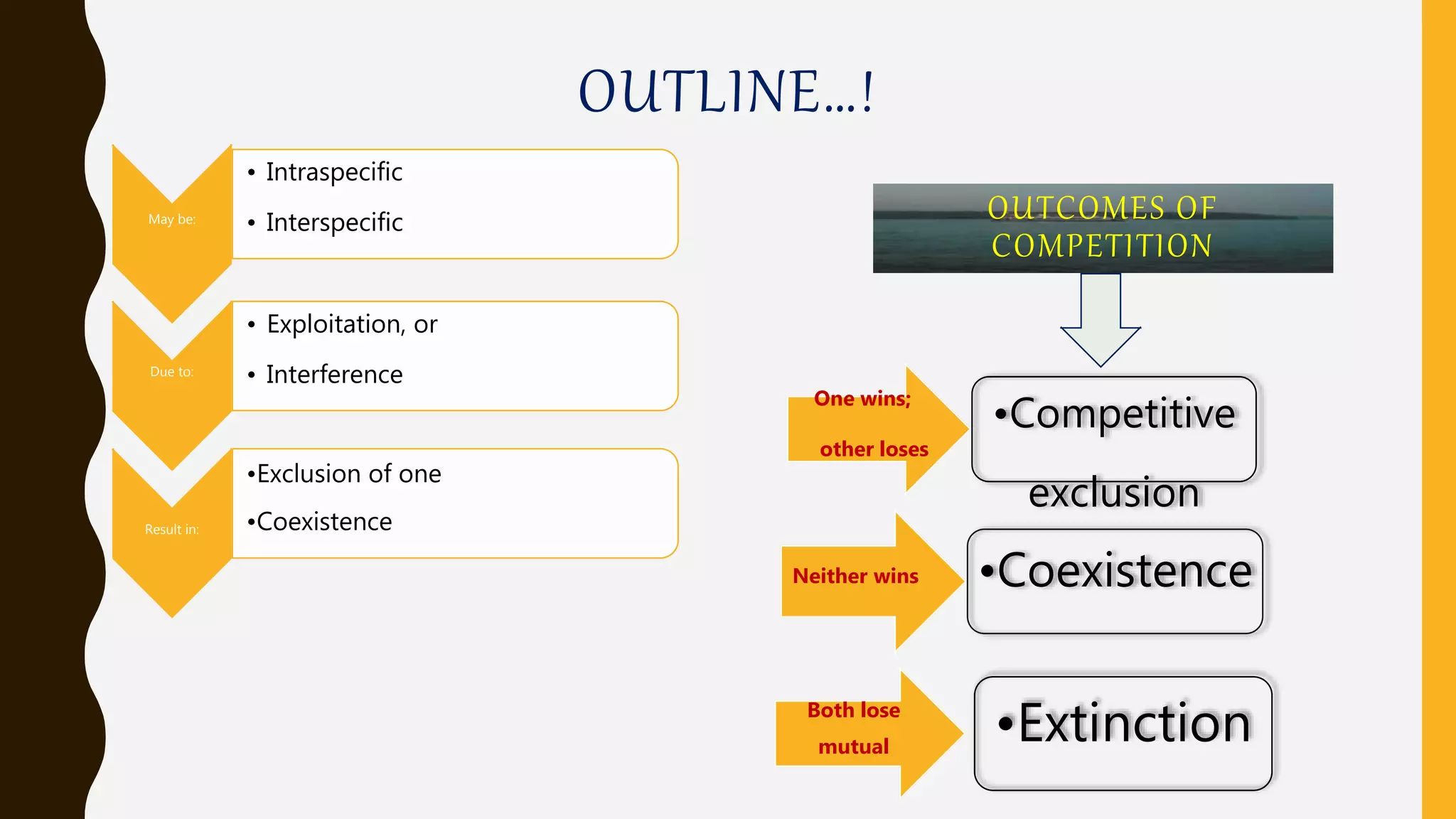
OUTLINE…!
May be:
• Intraspecific
• Interspecific
Due to:
• Exploitation, or
• Interference
Result in:
•Exclusion of one
•Coexistence
•Competitive
exclusion
One wins;
other loses
•CoexistenceNeither wins
•ExtinctionBoth lose
mutual
OUTCOMES OF
COMPETITION
-:TYPES OF COMPETITION:-
1. On the basis of taxonomic relationship
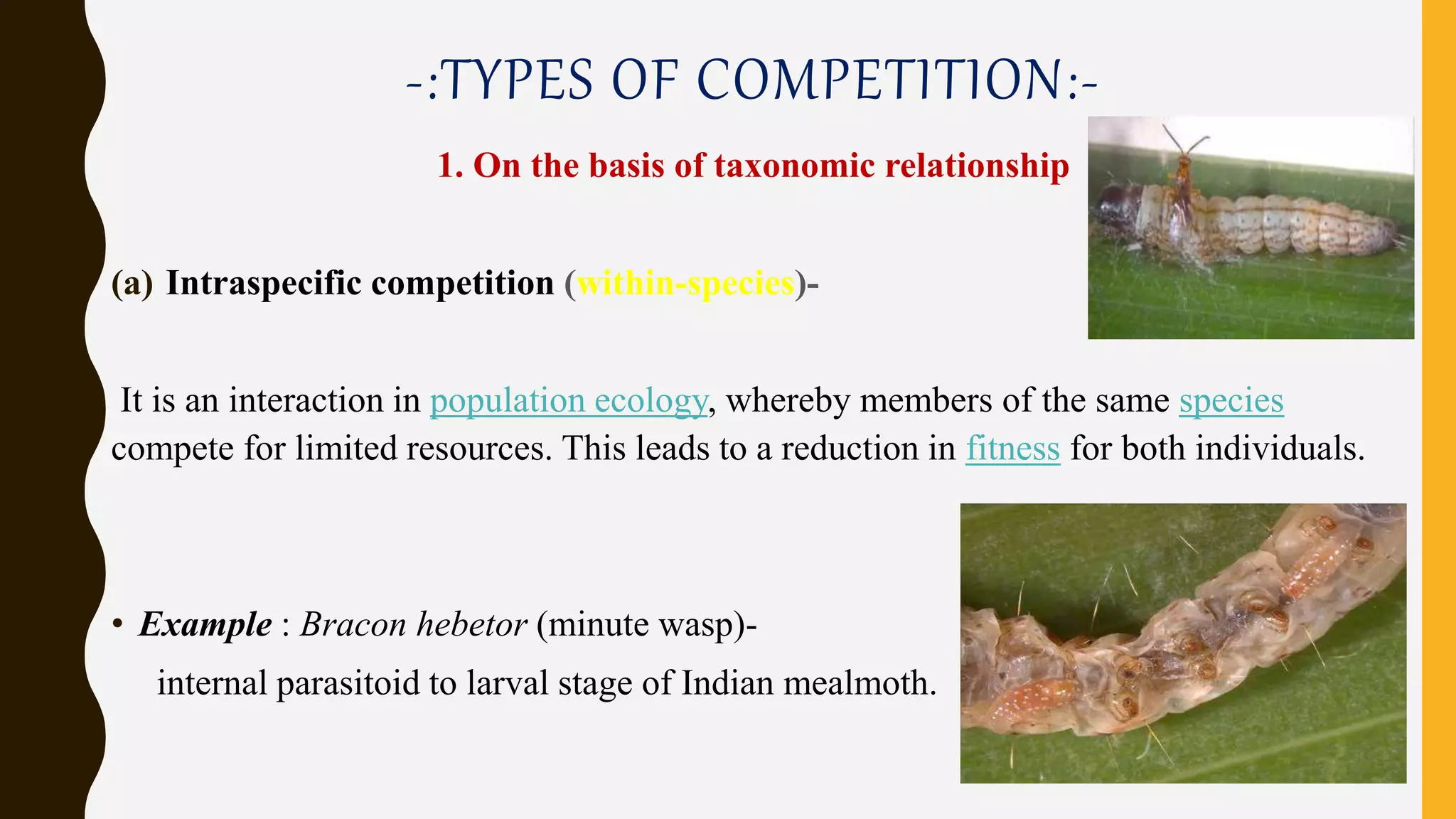
(a) Intraspecific competition (within-species)-
It is an interaction in population ecology, whereby members of the same species
compete for limited resources. This leads to a reduction in fitness for both individuals.
• Example : Bracon hebetor (minute wasp)-
internal parasitoid to larval stage of Indian mealmoth.
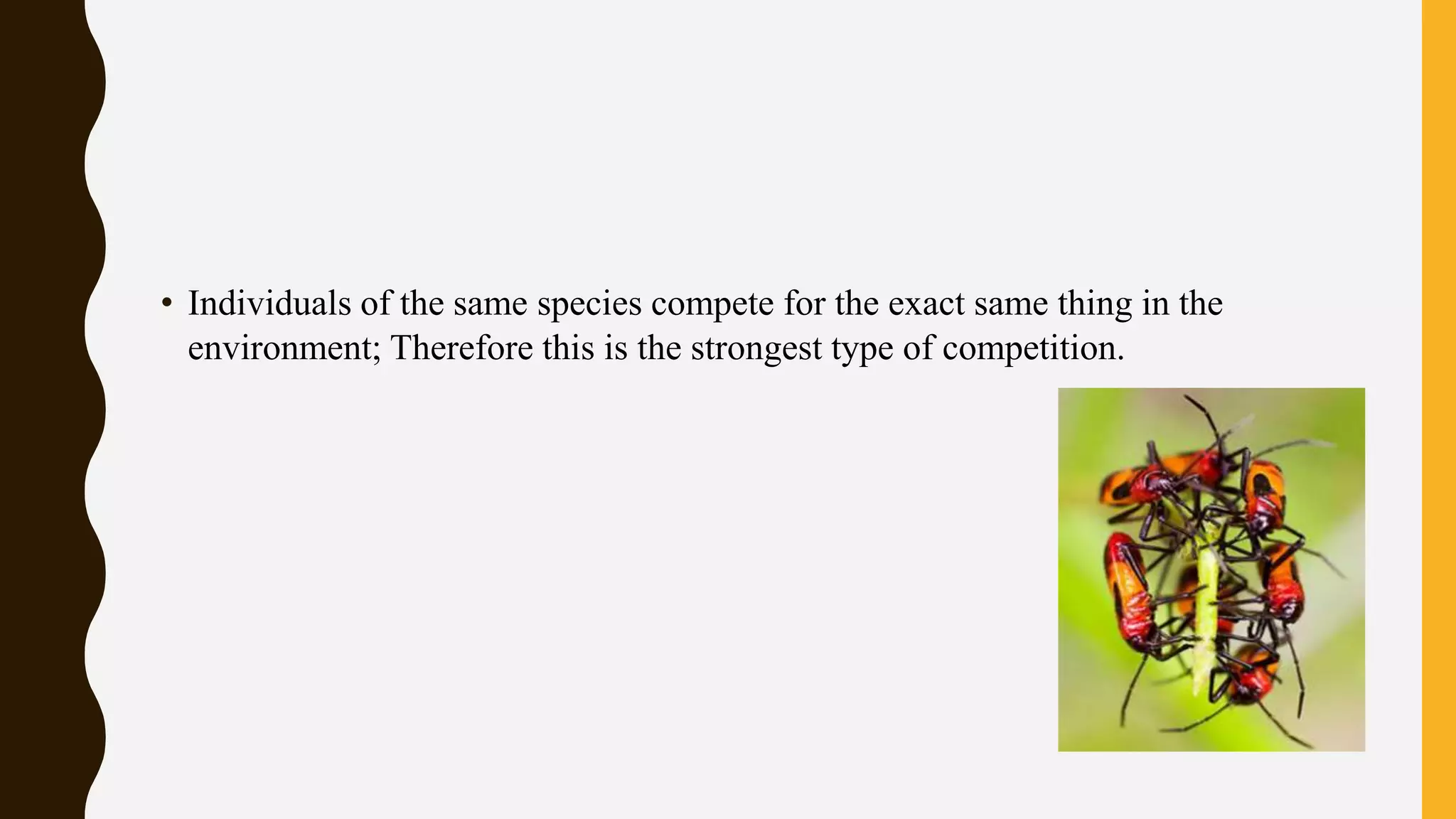
• Individuals of the same species compete for the exact same thing in the
environment; Therefore this is the strongest type of competition.
• Characteristics of Intraspecific Competition :-
• The ultimate effect: decreased contribution of individuals to the next generations
• The resource must be in limited supply.
• Competing individuals are all essentially equivalent.
• The effect on any individual increases with increasing number of competitors
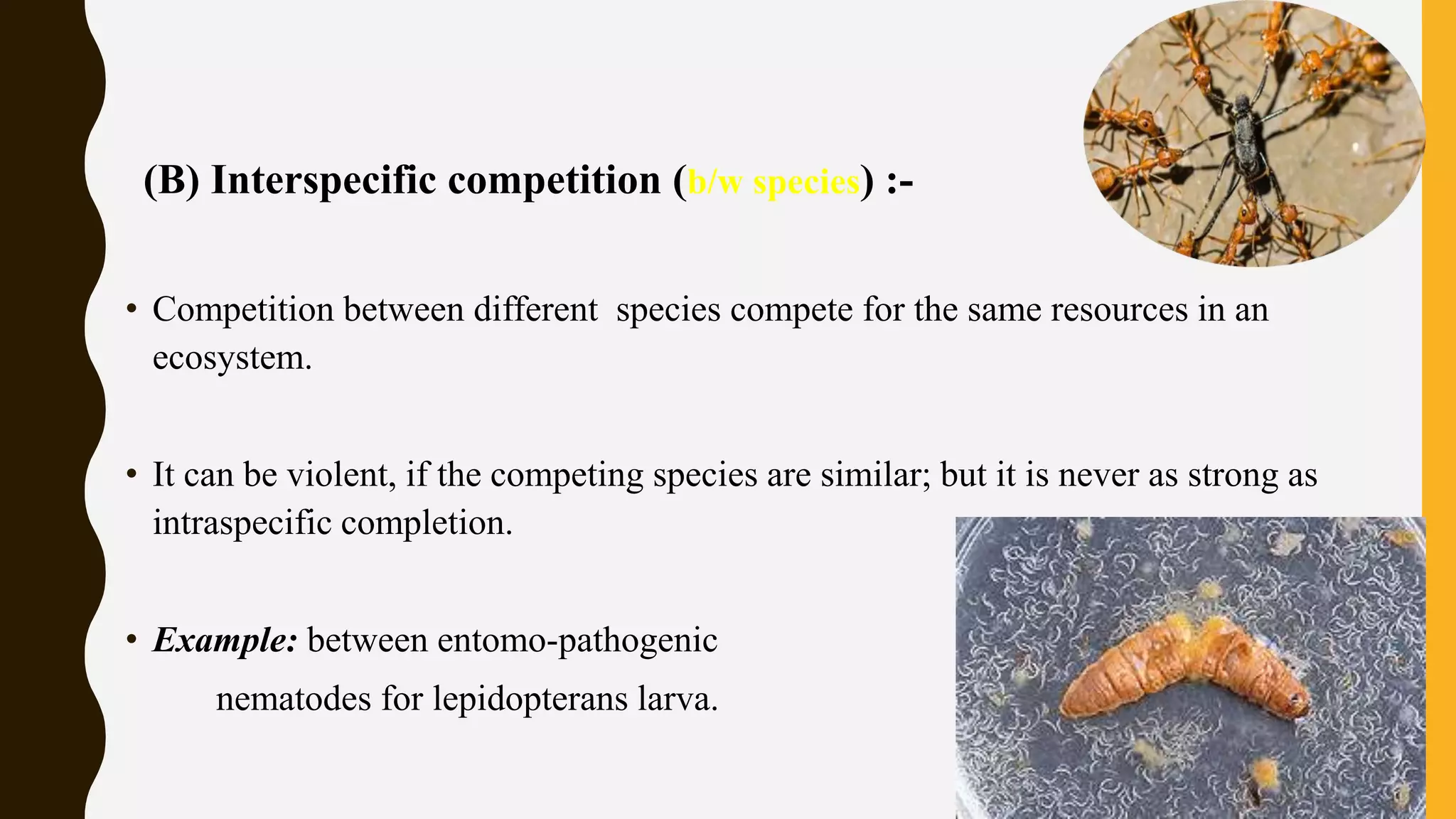
(B) Interspecific competition (b/w species) :-
• Competition between different species compete for the same resources in an
ecosystem.
• It can be violent, if the competing species are similar; but it is never as strong as
intraspecific completion.
• Example: between entomo-pathogenic
nematodes for lepidopterans larva.
Interactions in Interspecific Competition
(THOMAS SCHOENER)
• CONSUMPTION COMPETITION- Occurs when individuals of one species
inhibit another species by consuming a shared resource.
• PREEMPTIVE COMPETITION- Occurs primary among sessile organisms
where the competition by one individual precludes establishment (occupation)
by others.
• OVERGROWTH COMPETITION- occurs when one organism literally
grows over another (with or without physical contact), inhibiting access to some
essential resource.
• CHEMICAL COMPETITION- chemical growth inhibitors or toxins released
by an individual inhibit or kill other species Ex. Sunflower (Allelopathic).
• TERRITORIAL COMPETITION- Results from the behavioral exclusion of
others from a specific space that is defended as a territory.
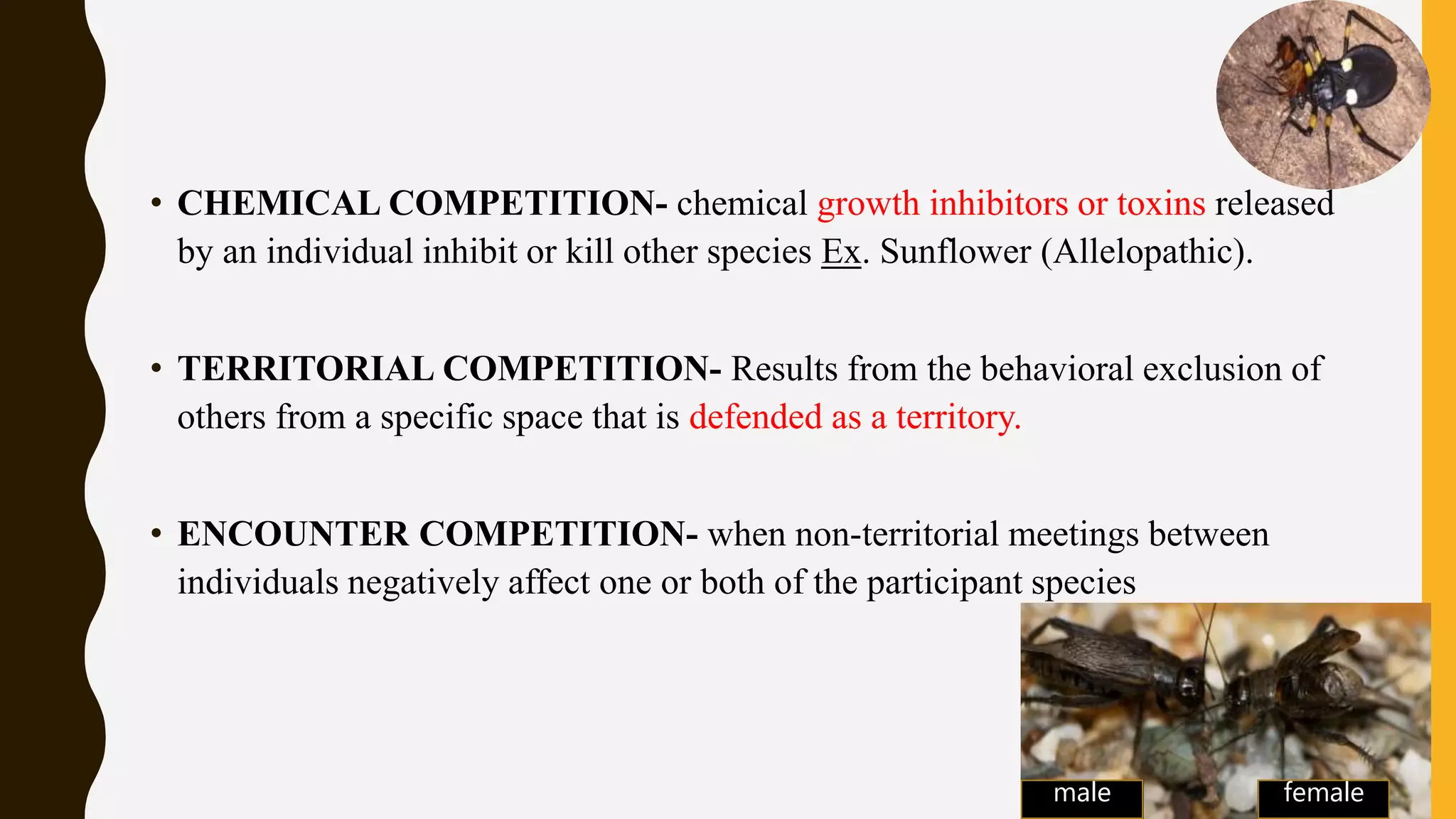
• ENCOUNTER COMPETITION- when non-territorial meetings between
individuals negatively affect one or both of the participant species
male female
2. ON the BASIS of MECHANISM
(a) Exploitation:
• In many cases, competing individuals do not interact with one another directly.
Instead, individuals respond to the level of a resource, which has been depressed
by the presence and activity of other individuals. It also referred to as Resource
competition.
• Thus, it is an Indirect competition.
For example-
Aphid species competing over the sap in plant phloem. Each aphid species that
feeds on host plant sap uses some of the resource, leaving less for competing
species.
In case of grasshoppers, a thriving population of grasshoppers (all of one
species) feeding on a field of grass (also of one species). The more grasshoppers
there are, an increased energy expenditure in search of food and a decreased rate
of food intake may all decrease a grasshopper’s chances of survival.
• (b) Interference:
Here individuals interact directly with each other, and one individual will
actually prevent another from exploiting the resources within a portion of the habitat.
These individuals interfere with foraging, survival, reproduction of
others, or by directly preventing their physical establishment in a portion of the
habitat.
so it is also called Direct competition.
For example- Different species of Burying Beetles (Nicrophorus sp.) compete to
other species of same genera for reproductive success.
In another example, the presence of a barnacle on a rock prevents
any other barnacle from occupying that same position, even though the supply of
food at that position may exceed the requirements of several barnacles. In such
cases, space can be seen as a resource in limited supply. (Joseph Connell)
HUTCHINSON RATIO
• By G. E. Hutchinson (1959)
• The ratio of the size differences between similar species when they were living
together as compared to when they were isolated.
• Various key attributes in species varied according to the ratio of 1.1-1.3
• For Co-existence Morphological displacement in harvesting organs(Ch. Disp.)
of
Closely related species
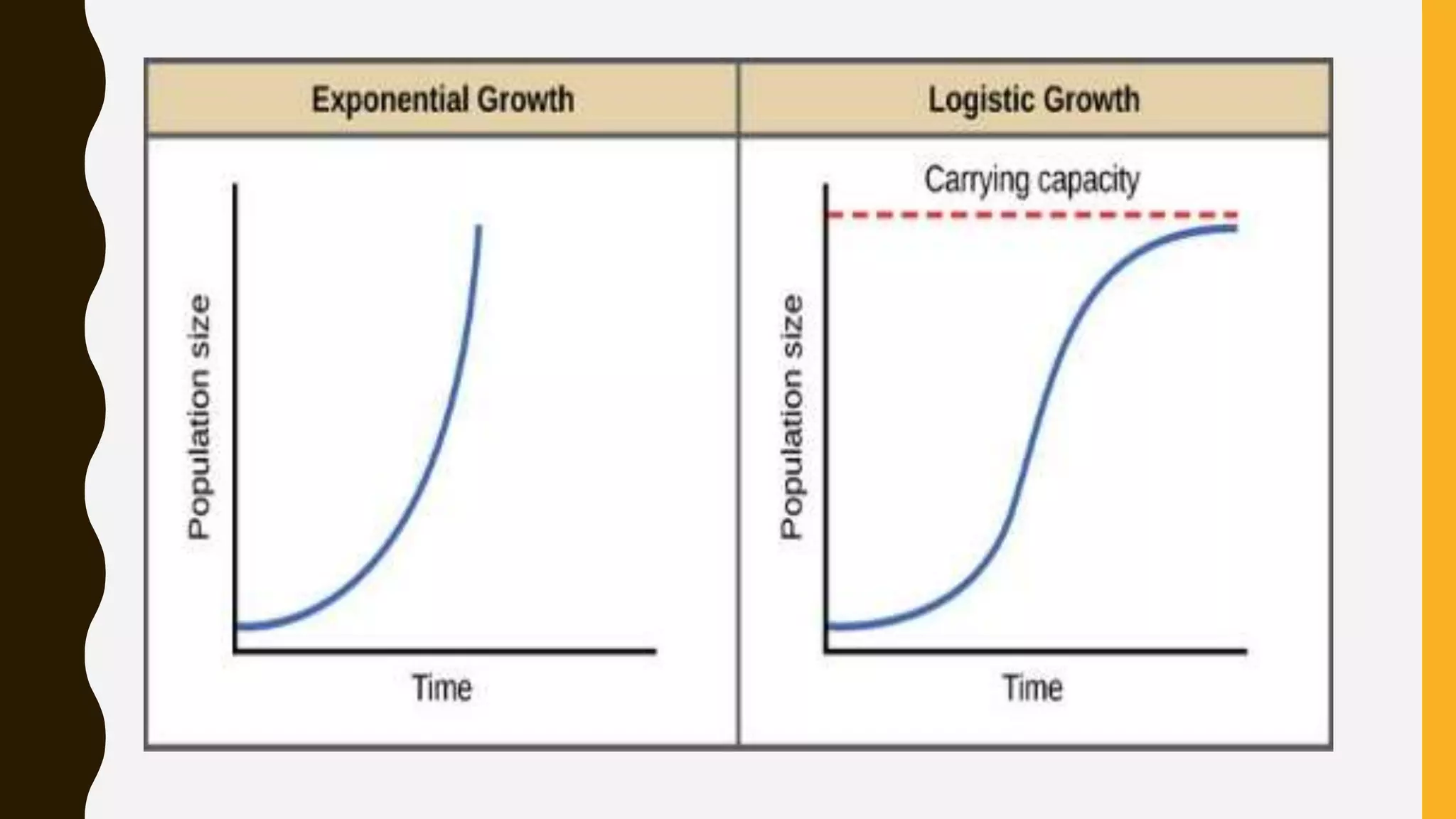
EXPONENTIAL GROWTH
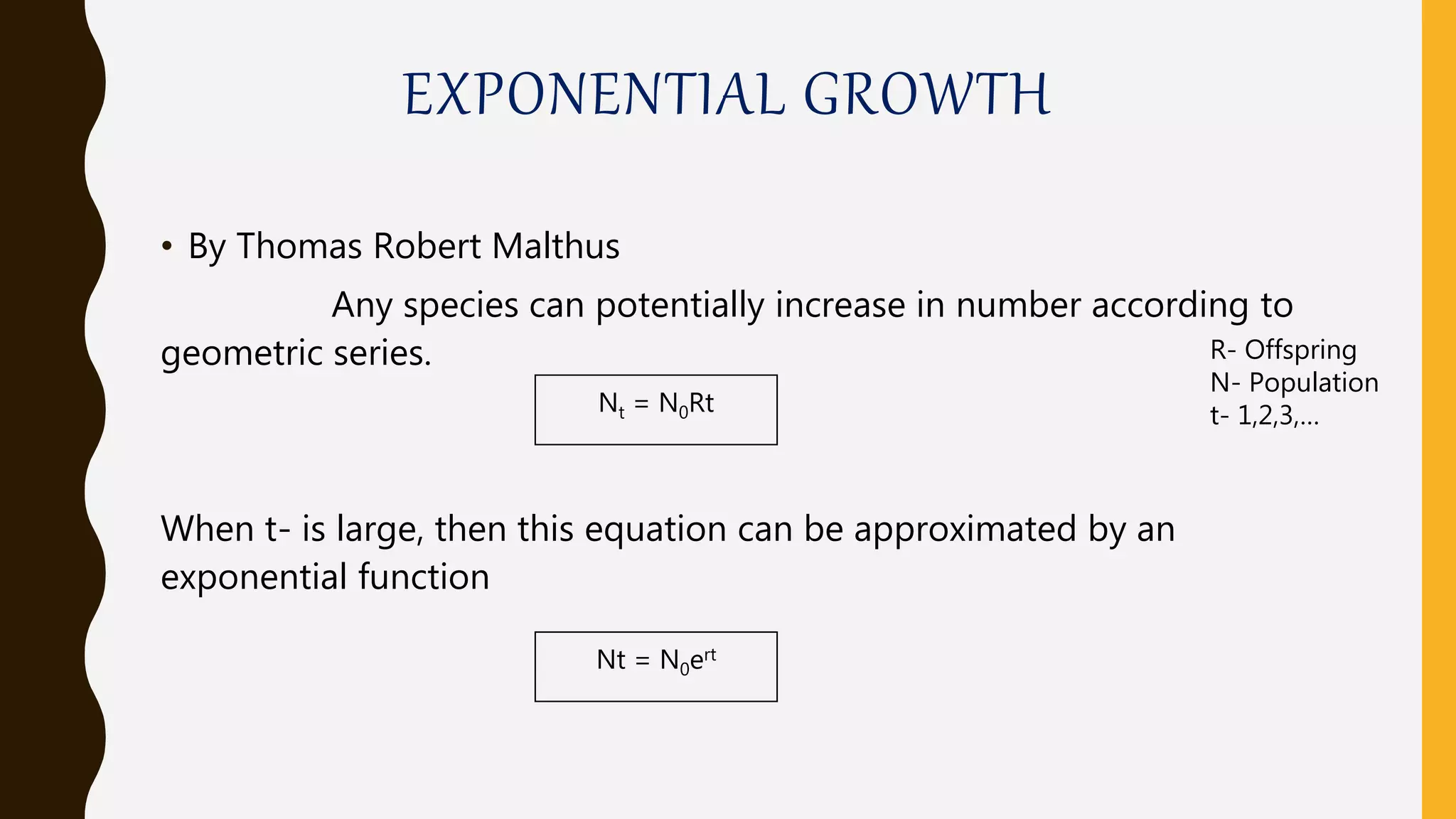
• By Thomas Robert Malthus
Any species can potentially increase in number according to
geometric series.
When t- is large, then this equation can be approximated by an
exponential function
Nt = N0Rt
Nt = N0ert
R- Offspring
N- Population
t- 1,2,3,…
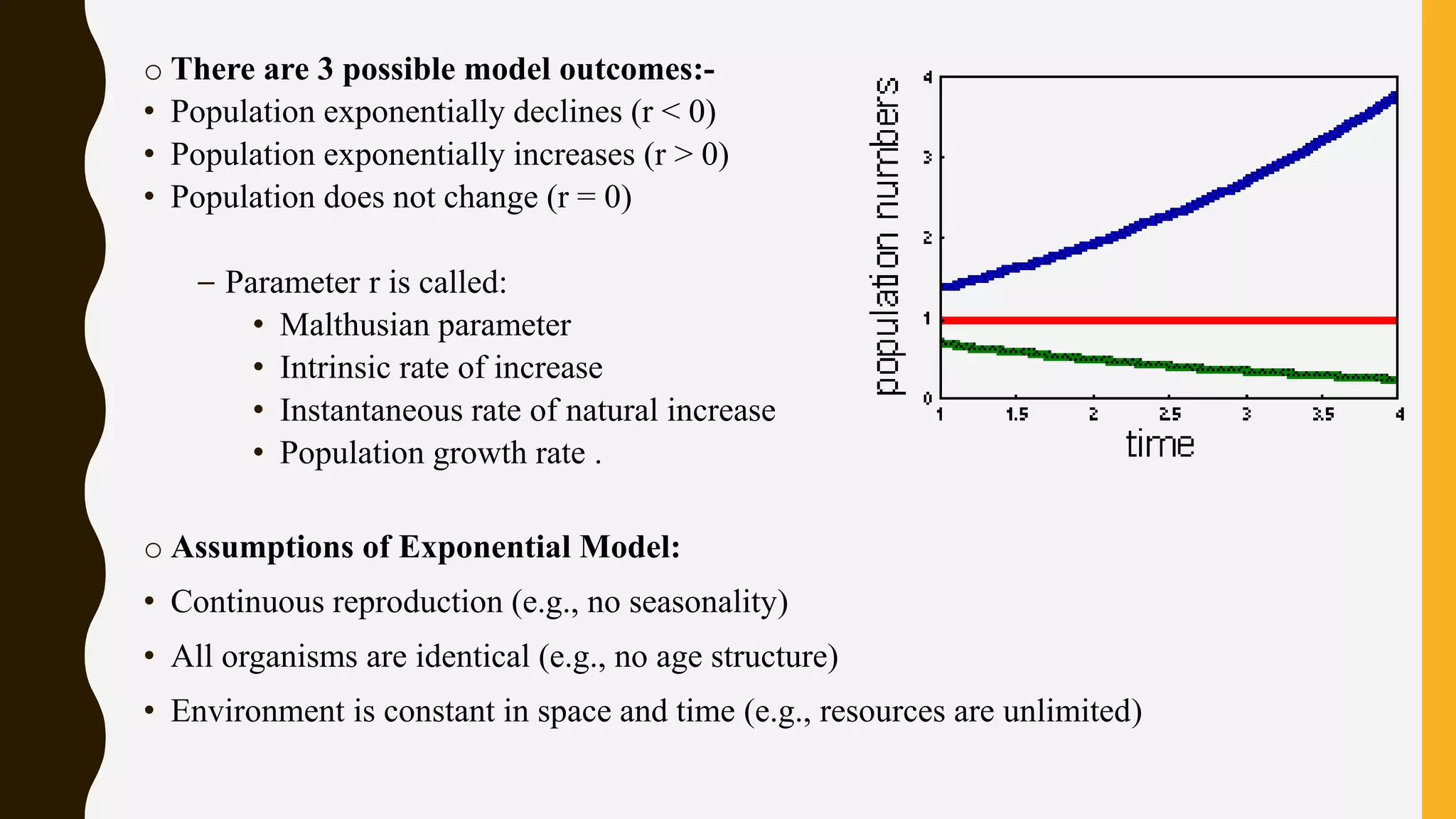
o There are 3 possible model outcomes:-
• Population exponentially declines (r < 0)
• Population exponentially increases (r > 0)
• Population does not change (r = 0)
– Parameter r is called:
• Malthusian parameter
• Intrinsic rate of increase
• Instantaneous rate of natural increase
• Population growth rate .
o Assumptions of Exponential Model:
• Continuous reproduction (e.g., no seasonality)
• All organisms are identical (e.g., no age structure)
• Environment is constant in space and time (e.g., resources are unlimited)
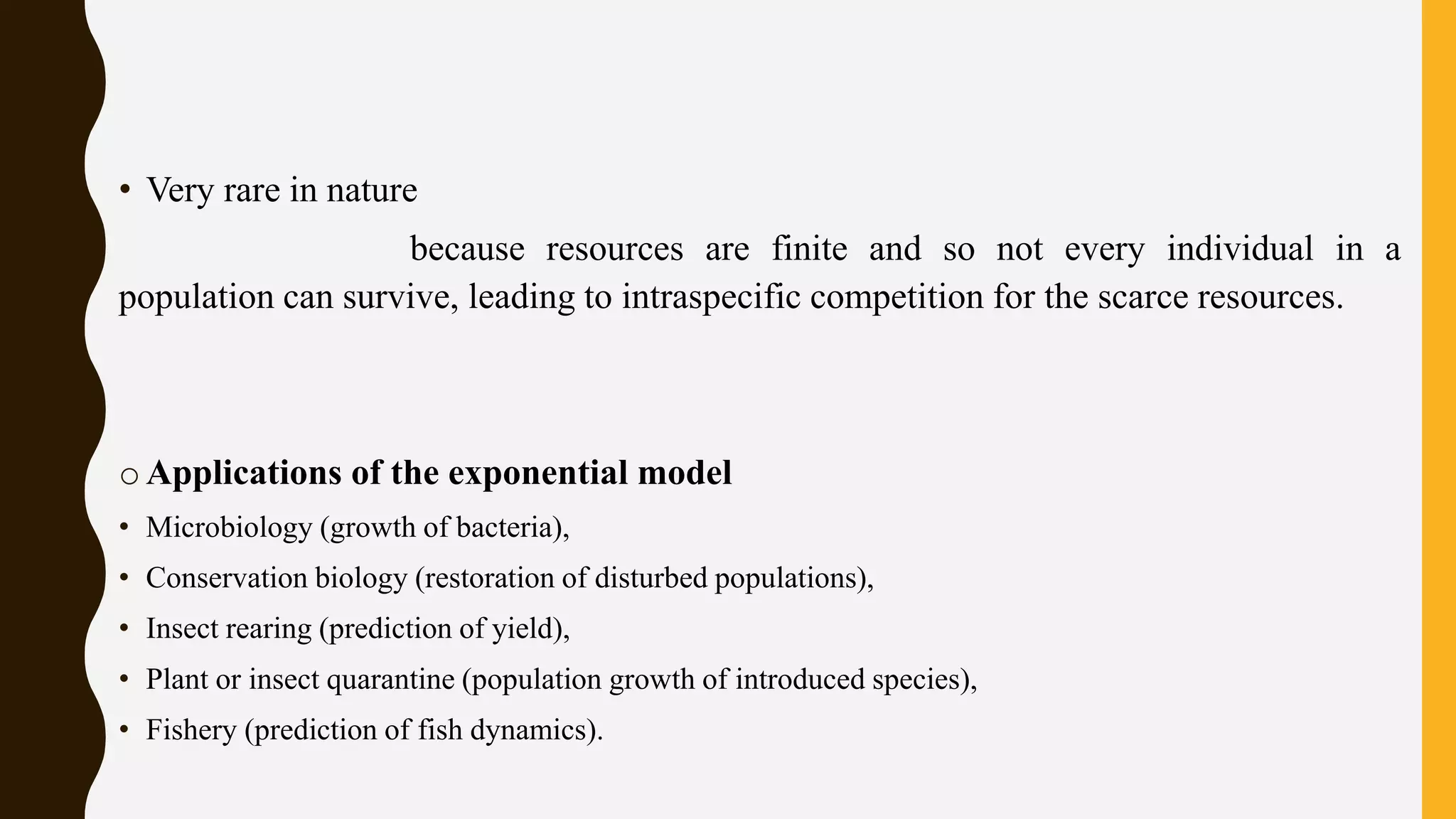
• Very rare in nature
because resources are finite and so not every individual in a
population can survive, leading to intraspecific competition for the scarce resources.
o Applications of the exponential model
• Microbiology (growth of bacteria),
• Conservation biology (restoration of disturbed populations),
• Insect rearing (prediction of yield),
• Plant or insect quarantine (population growth of introduced species),
• Fishery (prediction of fish dynamics).
LOGISTIC MODEL
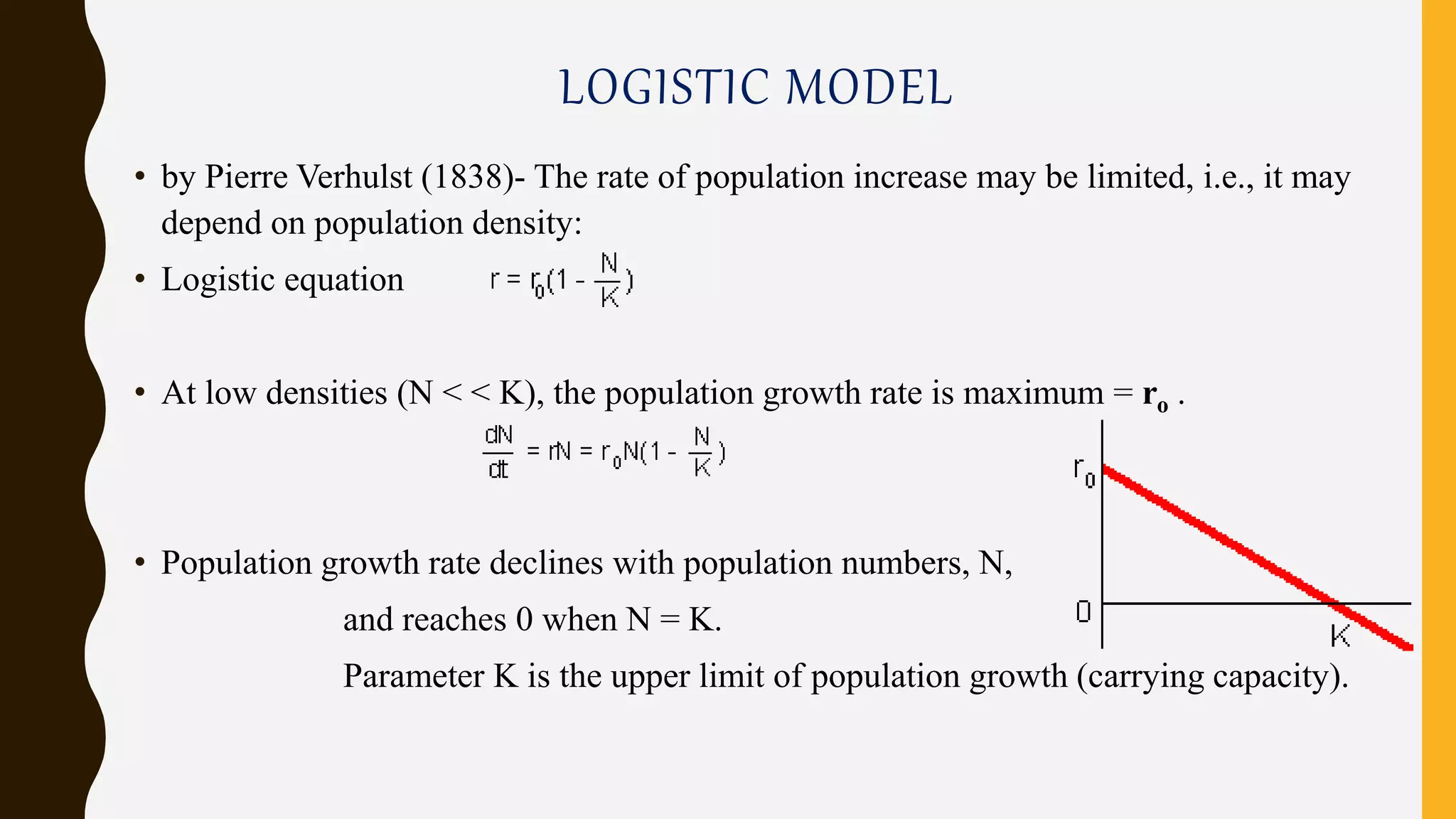
• by Pierre Verhulst (1838)- The rate of population increase may be limited, i.e., it may
depend on population density:
• Logistic equation
• At low densities (N < < K), the population growth rate is maximum = ro .
• Population growth rate declines with population numbers, N,
and reaches 0 when N = K.
Parameter K is the upper limit of population growth (carrying capacity).
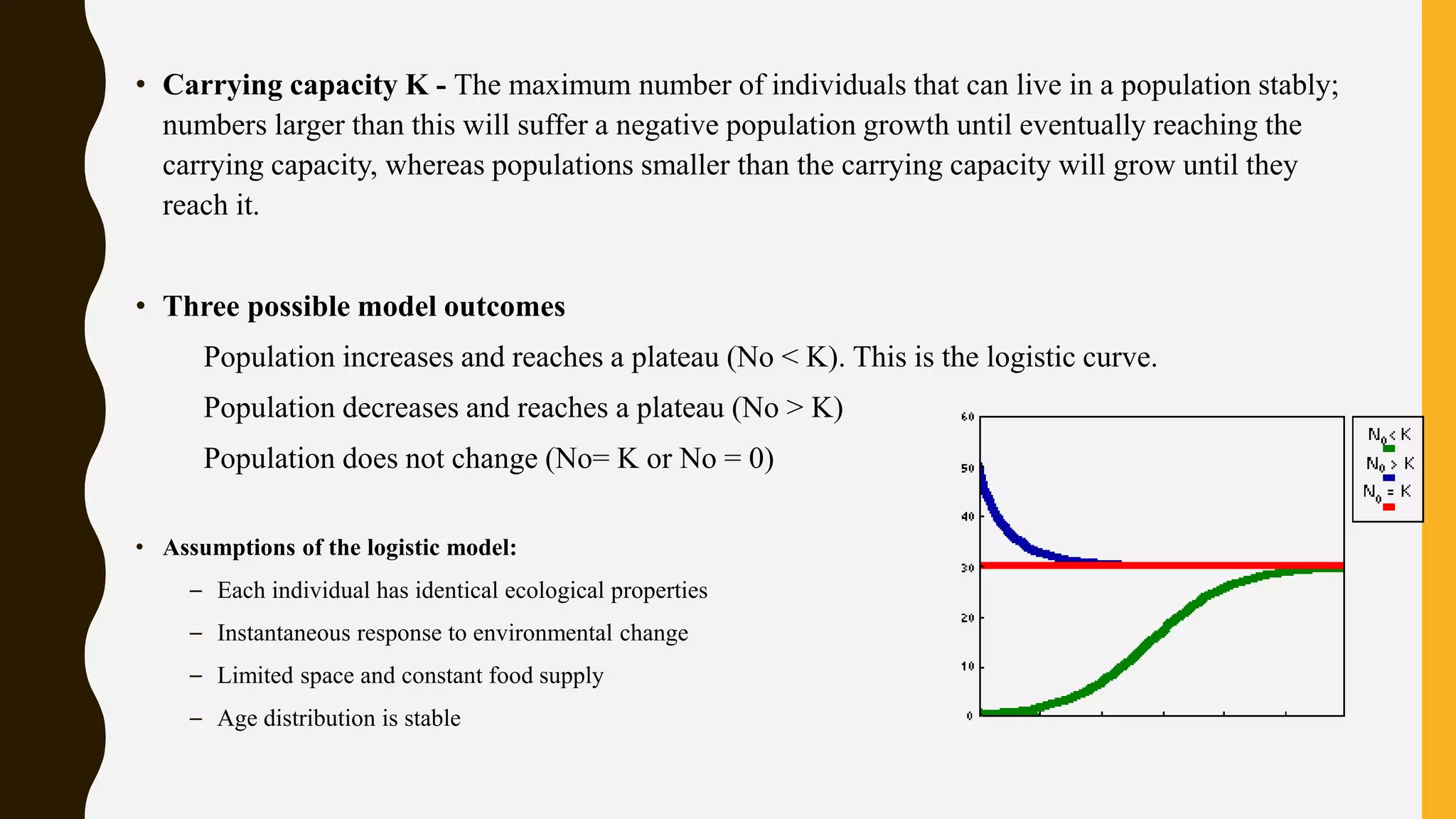
• Carrying capacity K - The maximum number of individuals that can live in a population stably;
numbers larger than this will suffer a negative population growth until eventually reaching the
carrying capacity, whereas populations smaller than the carrying capacity will grow until they
reach it.
• Three possible model outcomes
Population increases and reaches a plateau (No < K). This is the logistic curve.
Population decreases and reaches a plateau (No > K)
Population does not change (No= K or No = 0)
• Assumptions of the logistic model:
– Each individual has identical ecological properties
– Instantaneous response to environmental change
– Limited space and constant food supply
– Age distribution is stable
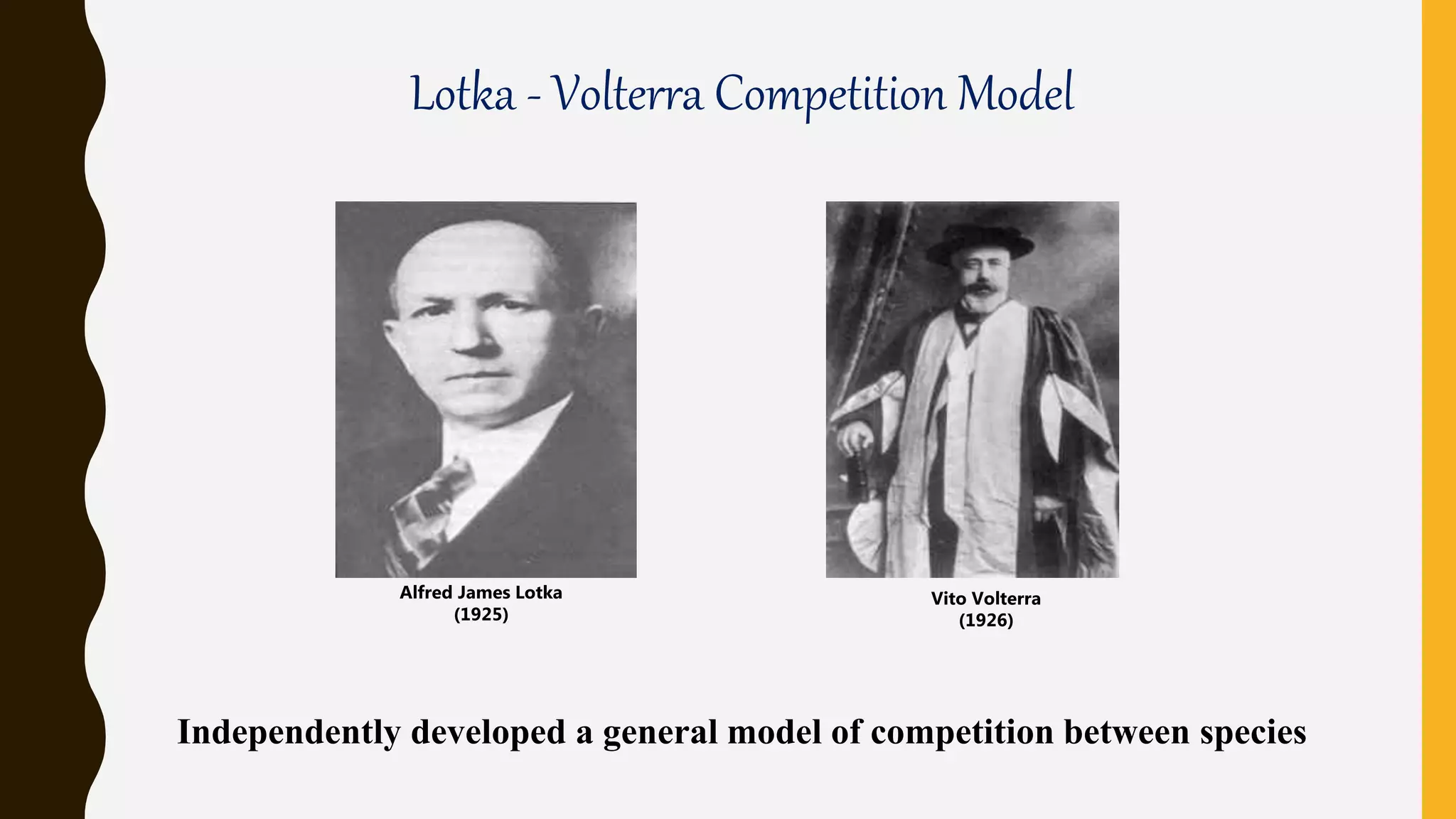
Lotka - Volterra Competition Model
Alfred James Lotka
(1925)
Vito Volterra
(1926)
Independently developed a general model of competition between species
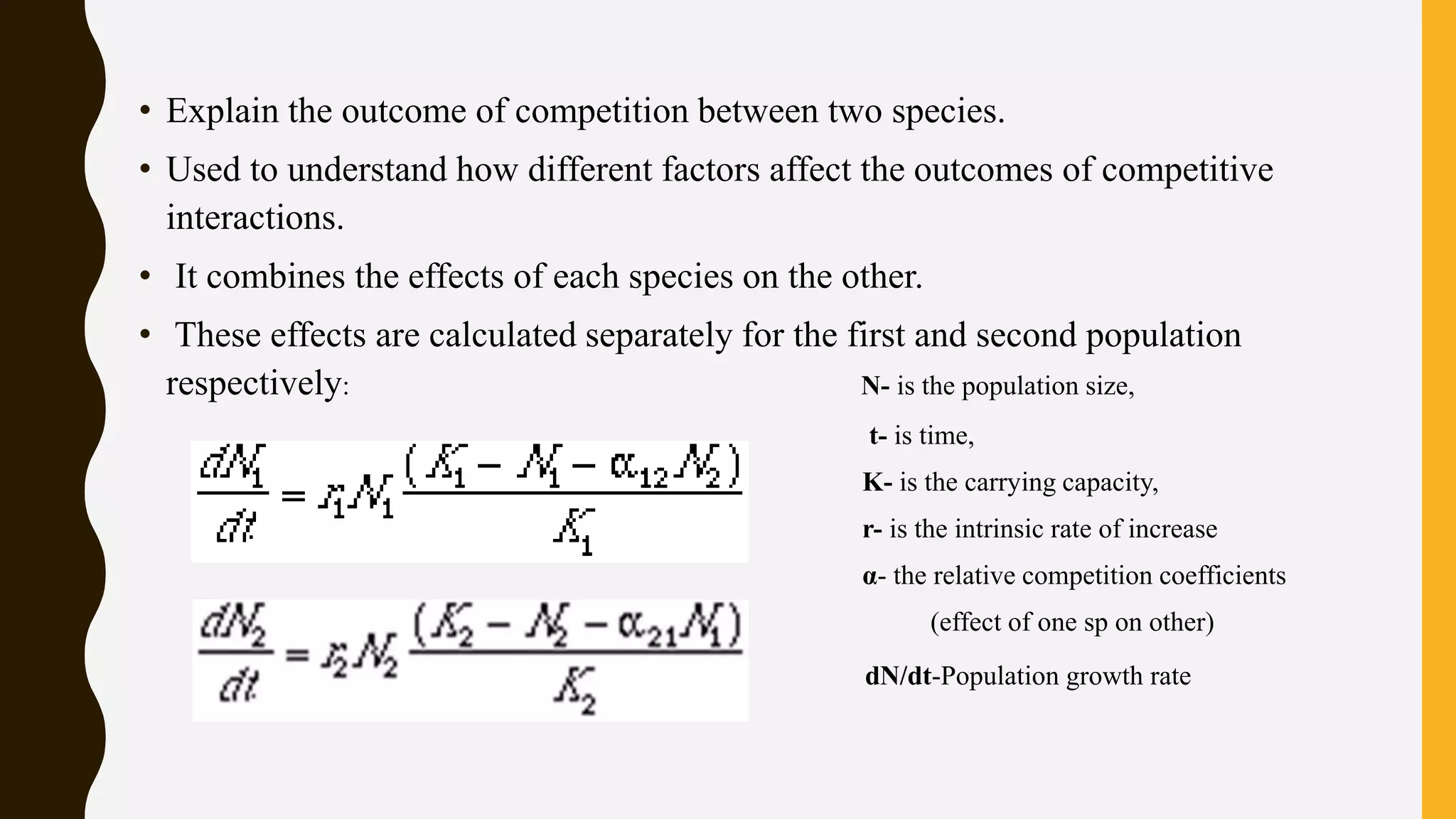
• Explain the outcome of competition between two species.
• Used to understand how different factors affect the outcomes of competitive
interactions.
• It combines the effects of each species on the other.
• These effects are calculated separately for the first and second population
respectively: N- is the population size,
t- is time,
K- is the carrying capacity,
r- is the intrinsic rate of increase
α- the relative competition coefficients
(effect of one sp on other)
dN/dt-Population growth rate
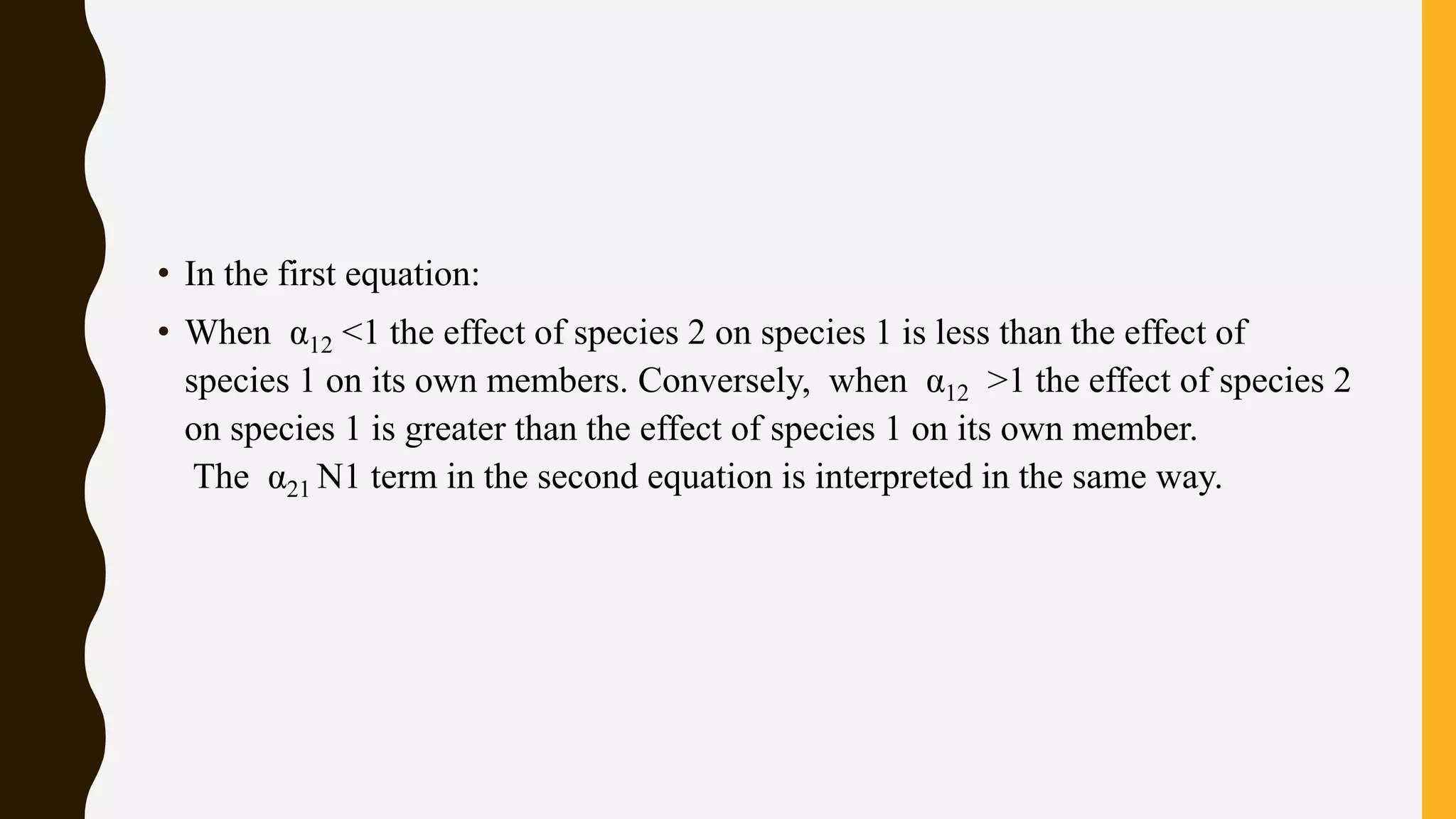
• In the first equation:
• When α12 <1 the effect of species 2 on species 1 is less than the effect of
species 1 on its own members. Conversely, when α12 >1 the effect of species 2
on species 1 is greater than the effect of species 1 on its own member.
The α21 N1 term in the second equation is interpreted in the same way.
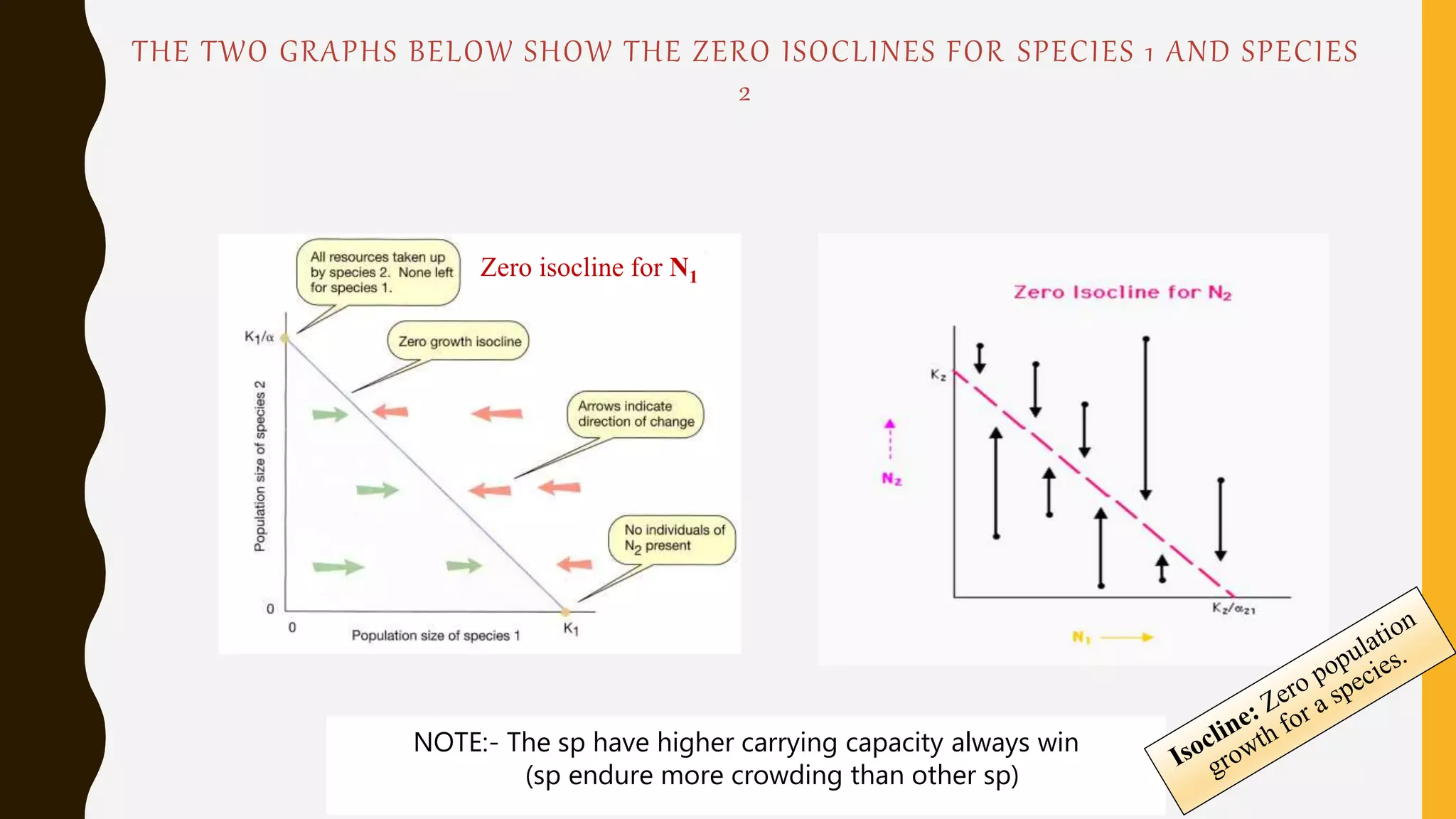
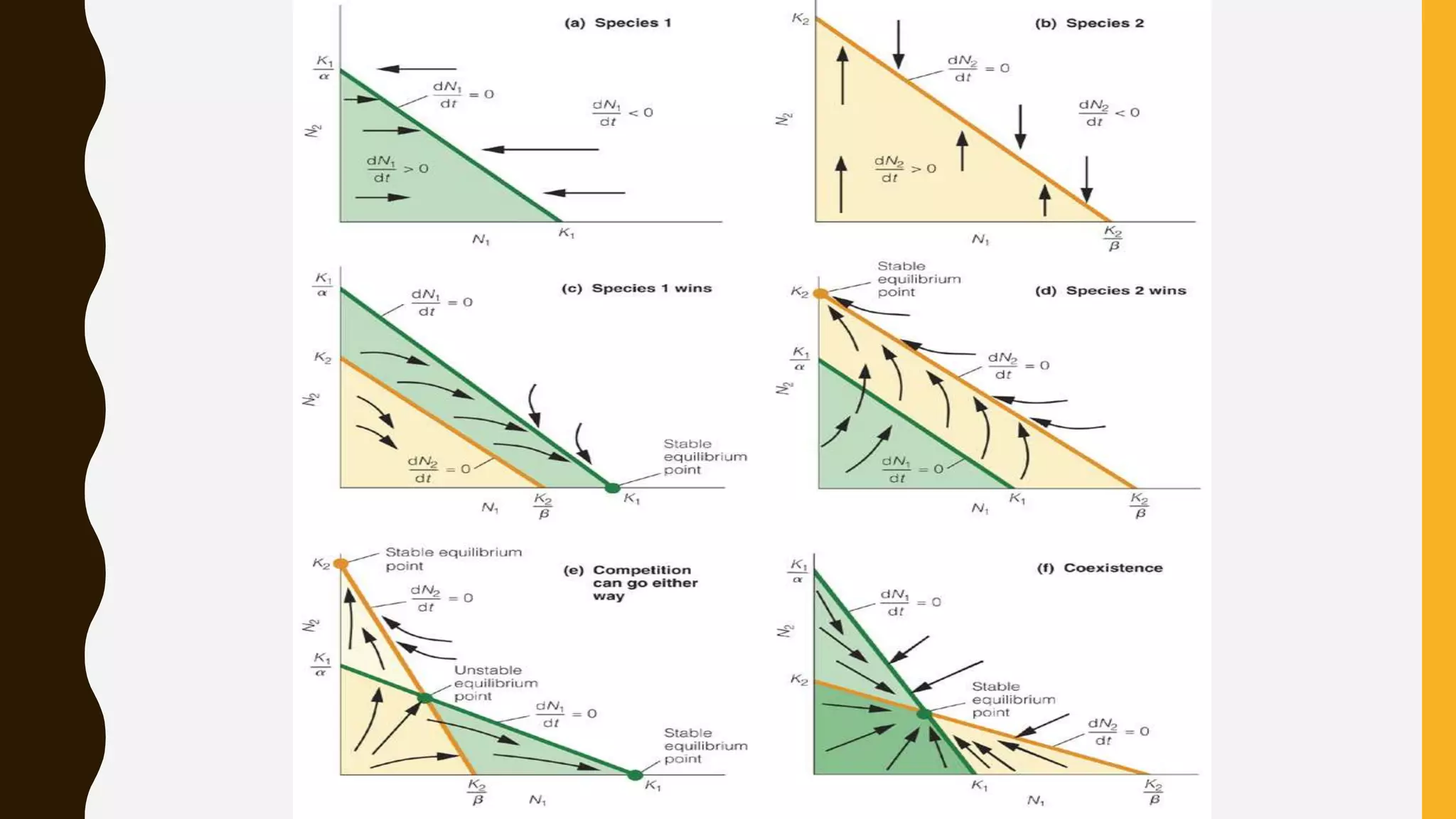
THE TWO GRAPHS BELOW SHOW THE ZERO ISOCLINES FOR SPECIES 1 AND SPECIES
2
NOTE:- The sp have higher carrying capacity always win
(sp endure more crowding than other sp)
Zero isocline for N1
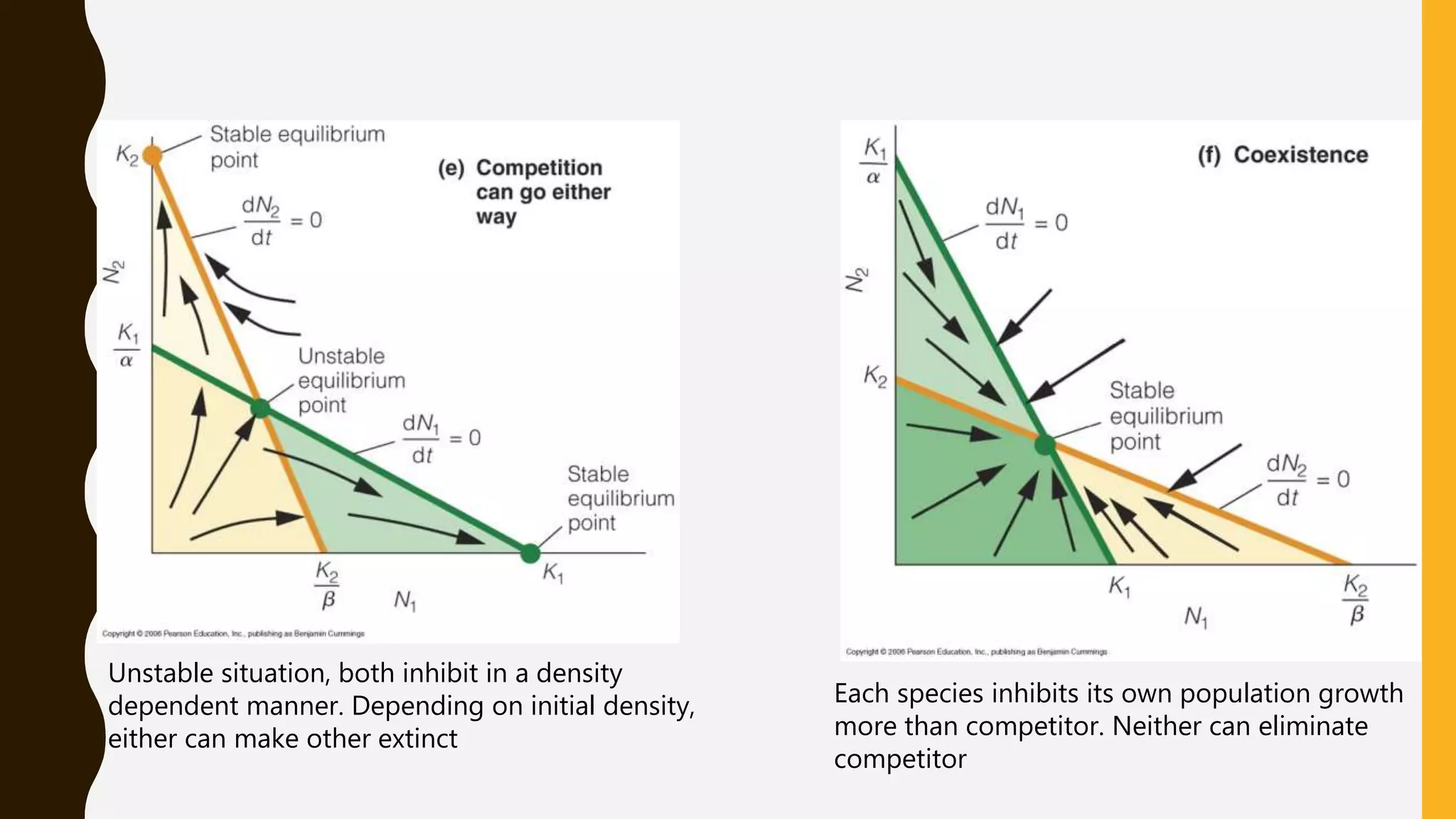
FOUR POSSIBLE OUTCOME OF THE MODEL
Species 1 inhibits growth of species 2 and latter
goes extinction
Species 2 inhibits growth of species 1 and latter goes
extinction
Unstable situation, both inhibit in a density
dependent manner. Depending on initial density,
either can make other extinct
Each species inhibits its own population growth
more than competitor. Neither can eliminate
competitor
ASSUMPTIONS:-
• Environment is homogenous & stable .
• Migration is not important .
• Co-existance requires a stable equilibrium point.
• Carrying capacities and competition coefficients for both sp is constants
TILMAN'S RESOURCE COMPETITION MODEL or R-STAR
CONCEPT
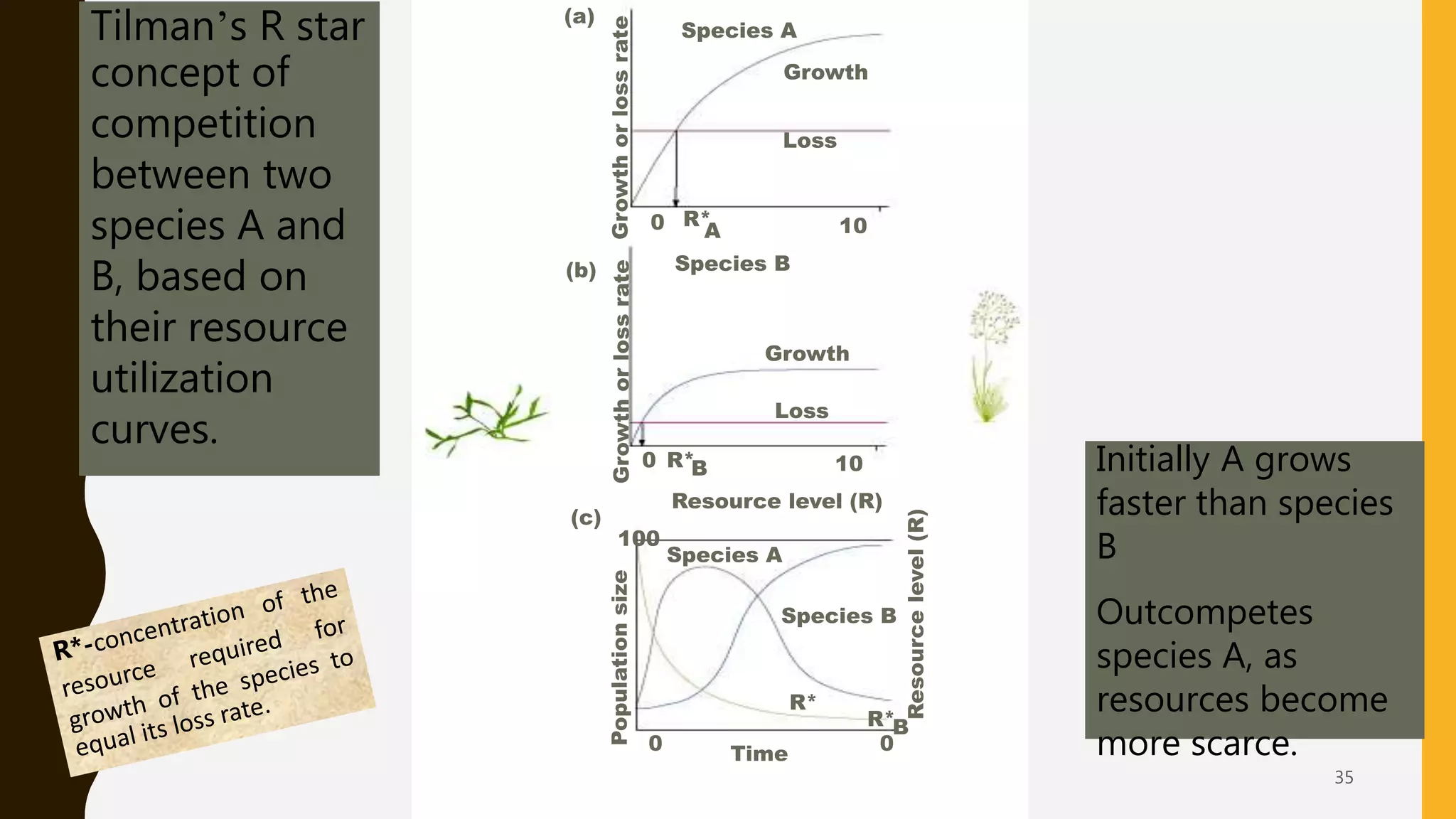
• R* - Tilman (1982, 1987) alternative
– Need to know the dependence of an organism's growth on the
availability of resources
chap08 Competition and coexistence 35
GrowthorlossrateGrowthorlossratePopulationsize
(a)
(b)
(c)
100
Species A
Species B
Species A
Species B
Loss
100 R*
A
0 R*B
Loss
Growth
Resource level (R)
Time0 0
Growth
10
R*
BR*
Resourcelevel(R)
Tilman’s R star
concept of
competition
between two
species A and
B, based on
their resource
utilization
curves.
Initially A grows
faster than species
B
Outcompetes
species A, as
resources become
more scarce.
RESULTS OF INTRASPECIFIC COMPETITION
Dispersal
Social interactions
– Dominance
– Territoriality
RESULTS of INTERSPECIFIC COMPETITION
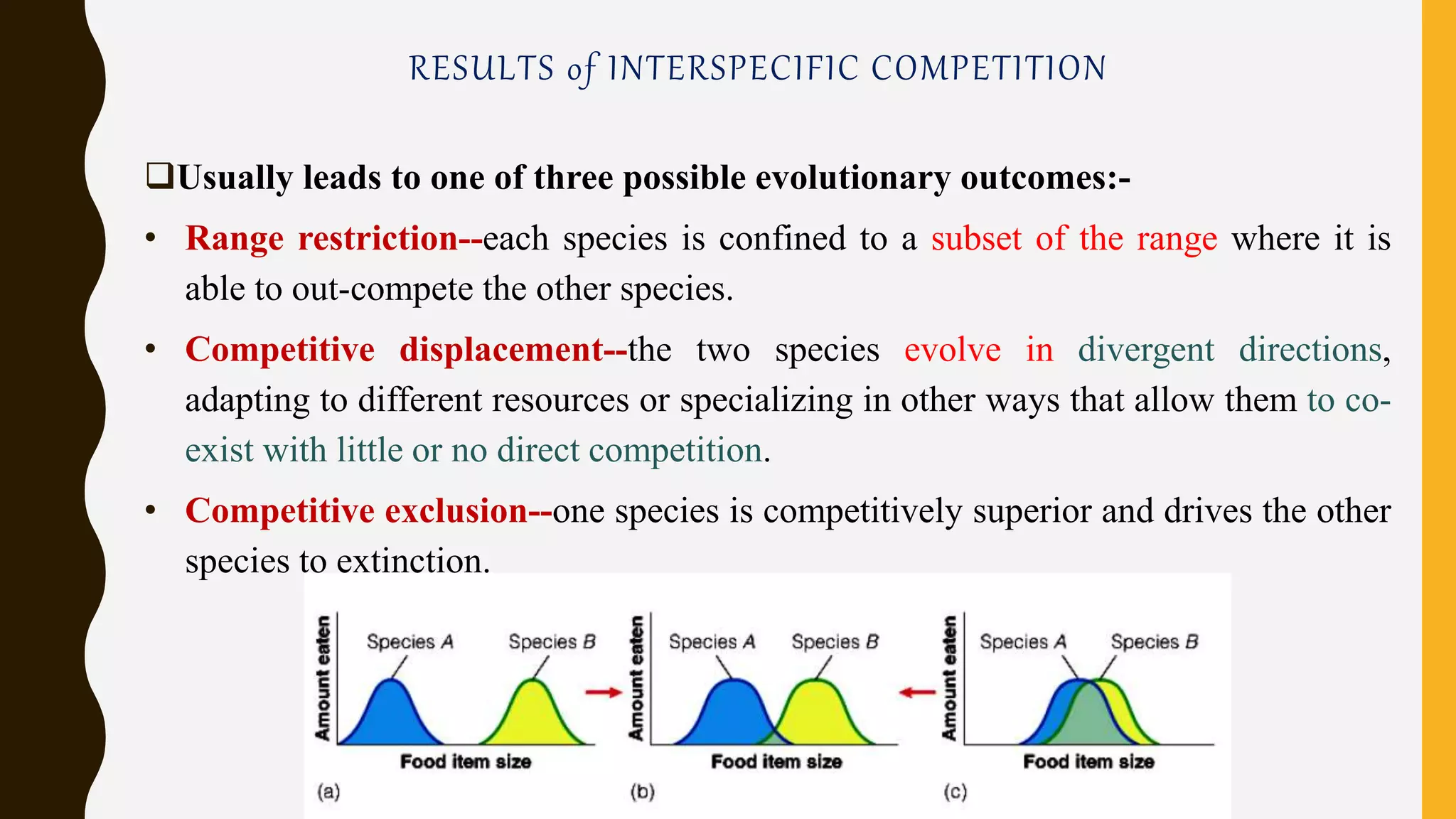
Usually leads to one of three possible evolutionary outcomes:-
• Range restriction--each species is confined to a subset of the range where it is
able to out-compete the other species.
• Competitive displacement--the two species evolve in divergent directions,
adapting to different resources or specializing in other ways that allow them to co-
exist with little or no direct competition.
• Competitive exclusion--one species is competitively superior and drives the other
species to extinction.
COMPETITIVE DISPLACEMENT HYPOTHESIS
• If two competing species coexist in a stable environment, then they do so as a
result of niche differentiation. If, however, there is no such differentiation, then
one competing species will eliminate or exclude the other. (Begon et. al. 1996)
• Different species having identical ecological niches (that is, ecological homologues)
cannot coexist for long in the same habitat. Those one will be a better competitor
and thus have higher fitness and eventually exclude the other.
• This hypothesis has been recognized as 'Gause's law’ or hypothesis', and 'the
Competitive exclusion principle’.
Eg. The replacement of the mediterranean fruit fly, Ceratitis caoitata W. around
Sydney, Australia by the Queensland fruit fly, Dacus trvoni F. (Andrewartha and Birch, 1954).
• In Israel the mealybug parasitoid, Clausenia purpurea Ishii, displaced the
established parasitoids Leptomastix flavus Mercet and Anagyrus kivuensis
Compere (Rivnay, 1964).
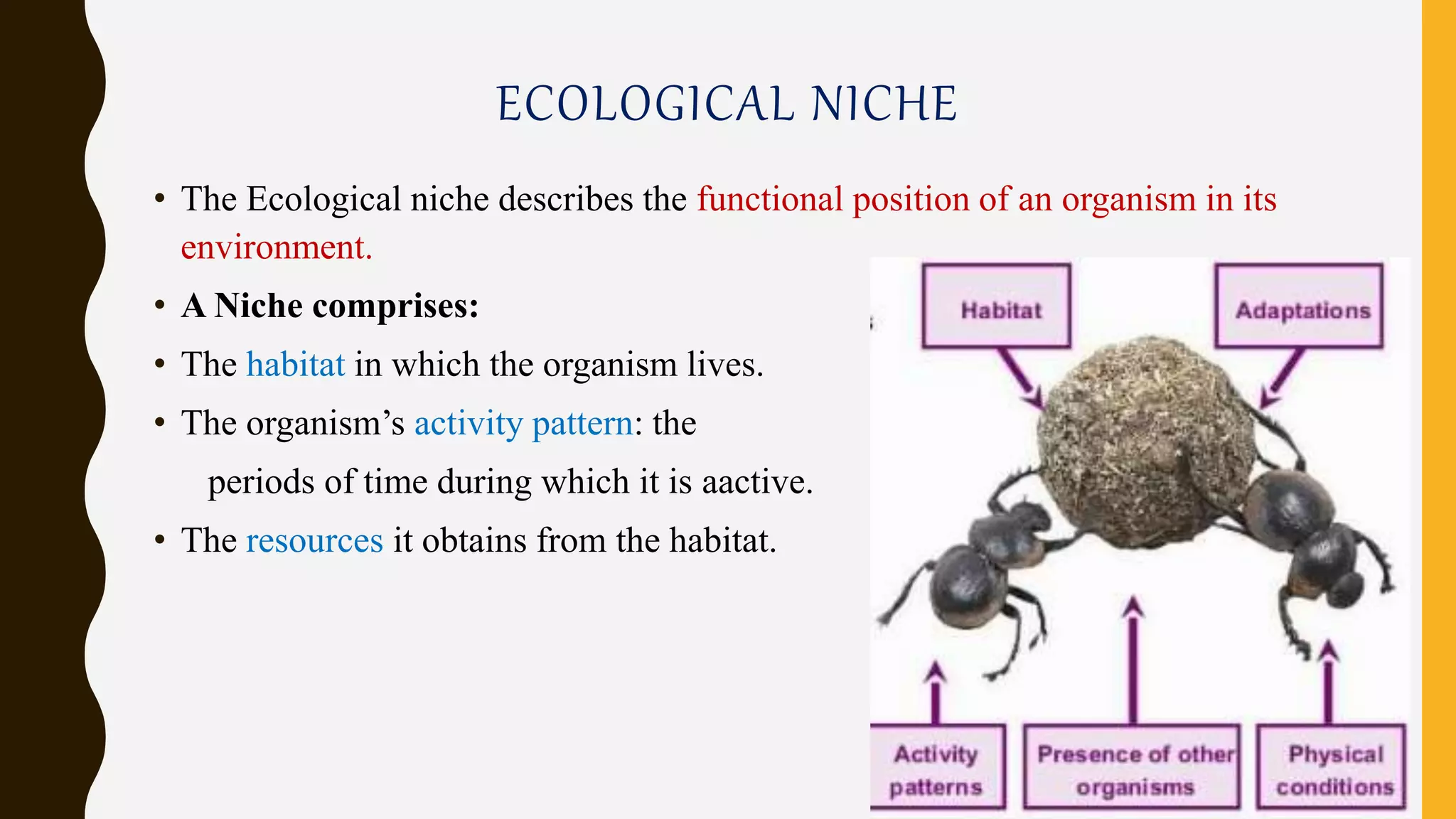
ECOLOGICAL NICHE
• The Ecological niche describes the functional position of an organism in its
environment.
• A Niche comprises:
• The habitat in which the organism lives.
• The organism’s activity pattern: the
periods of time during which it is aactive.
• The resources it obtains from the habitat.
Hutchinson (1957) defined niche- “a region (n-dimensional hyper volume) in a
multi-dimensional space of environmental factors that affect the welfare of a
species.”
n-number of environmental factors important to survival and reproduction of a
species.
Each species occupies a unique ecological niche within its community.
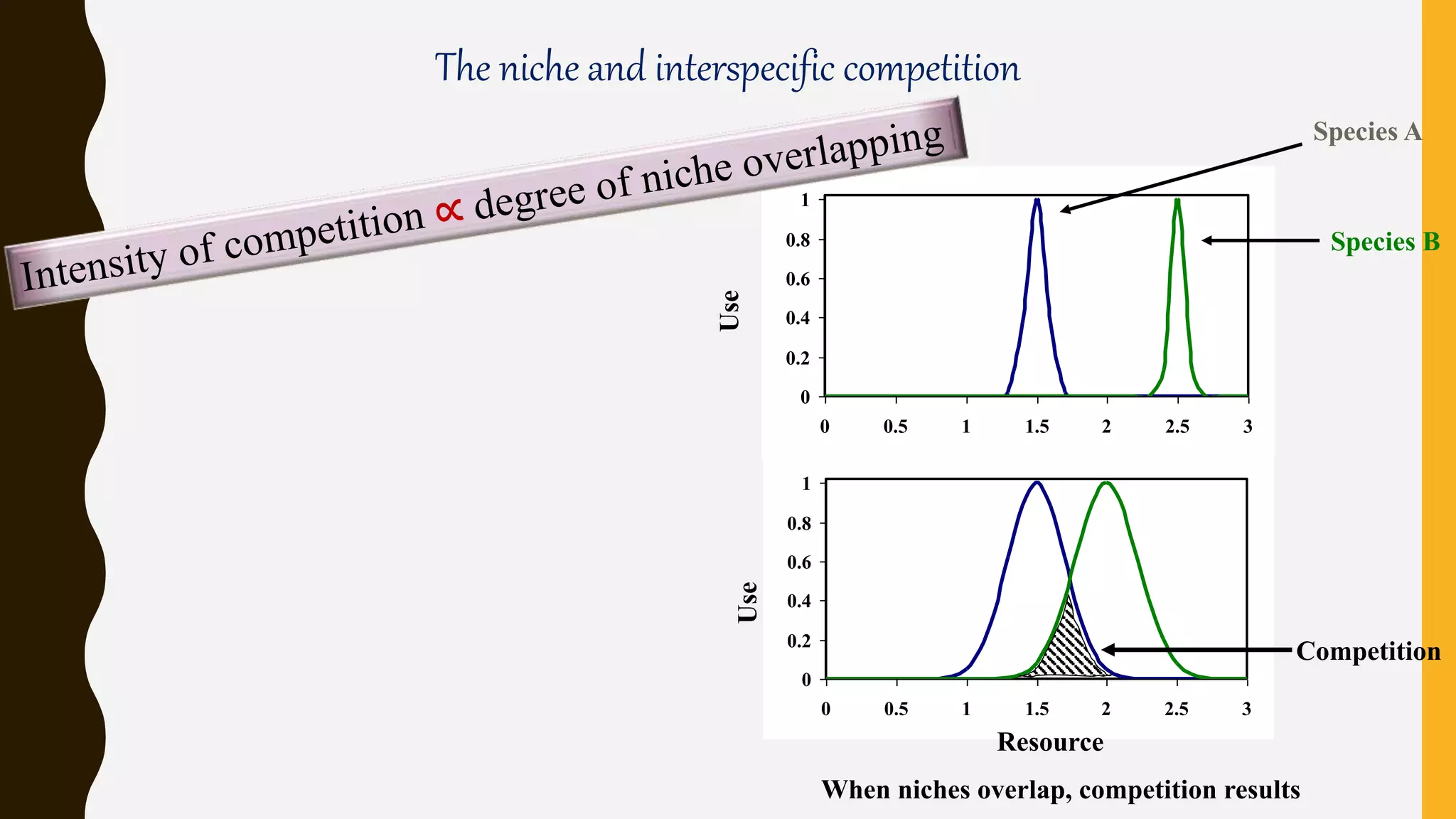
The niche and interspecific competition
0
0.2
0.4
0.6
0.8
1
0 0.5 1 1.5 2 2.5 3
0
0.2
0.4
0.6
0.8
1
0 0.5 1 1.5 2 2.5 3
ResourceUse
Use
Species A
Species B
Competition
When niches overlap, competition results
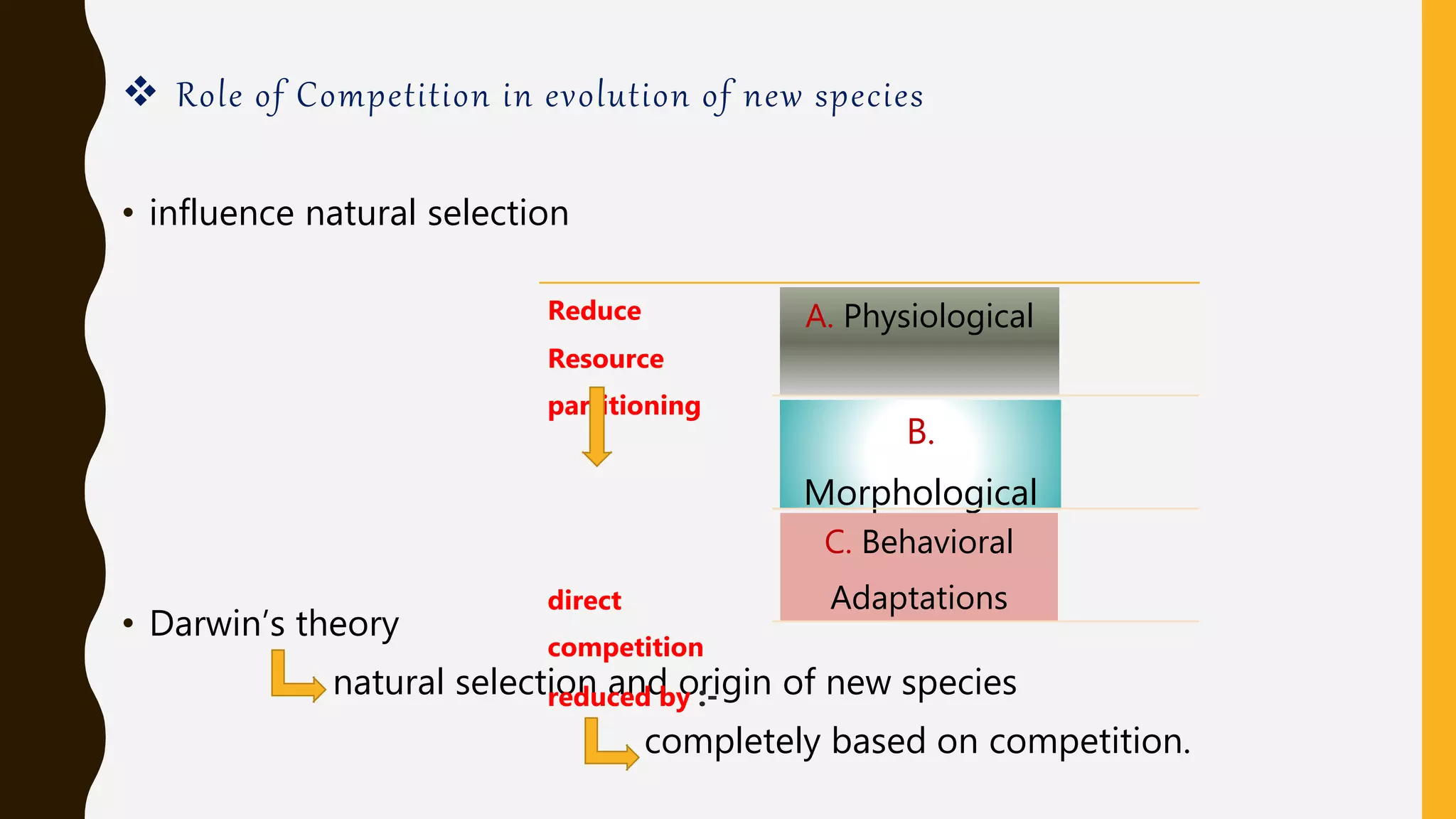
 Role of Competition in evolution of new species
• influence natural selection
• Darwin’s theory
natural selection and origin of new species
completely based on competition.
Reduce
Resource
partitioning
direct
competition
reduced by :-
A. Physiological
B.
Morphological
C. Behavioral
Adaptations
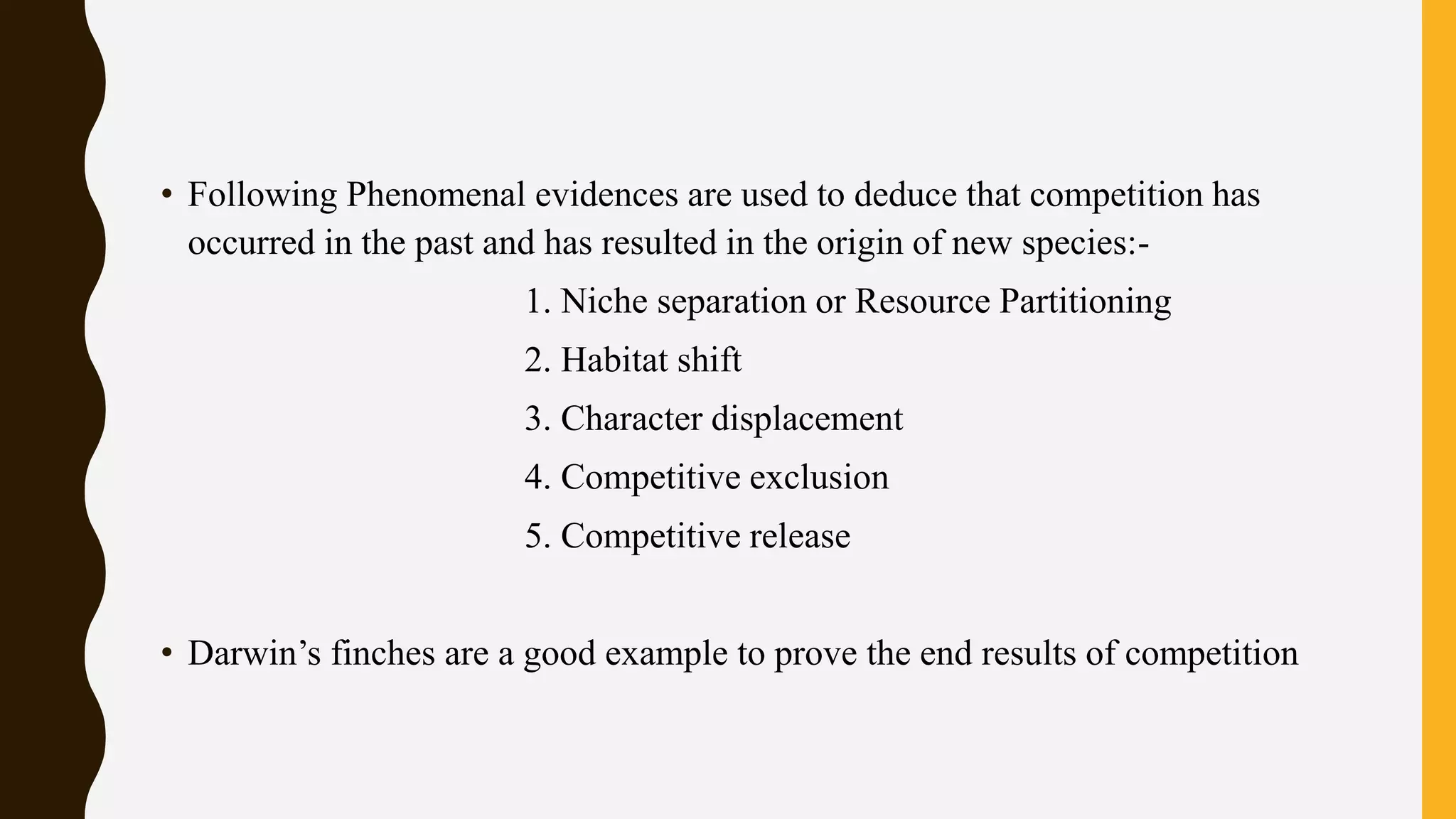
• Following Phenomenal evidences are used to deduce that competition has
occurred in the past and has resulted in the origin of new species:-
1. Niche separation or Resource Partitioning
2. Habitat shift
3. Character displacement
4. Competitive exclusion
5. Competitive release
• Darwin’s finches are a good example to prove the end results of competition
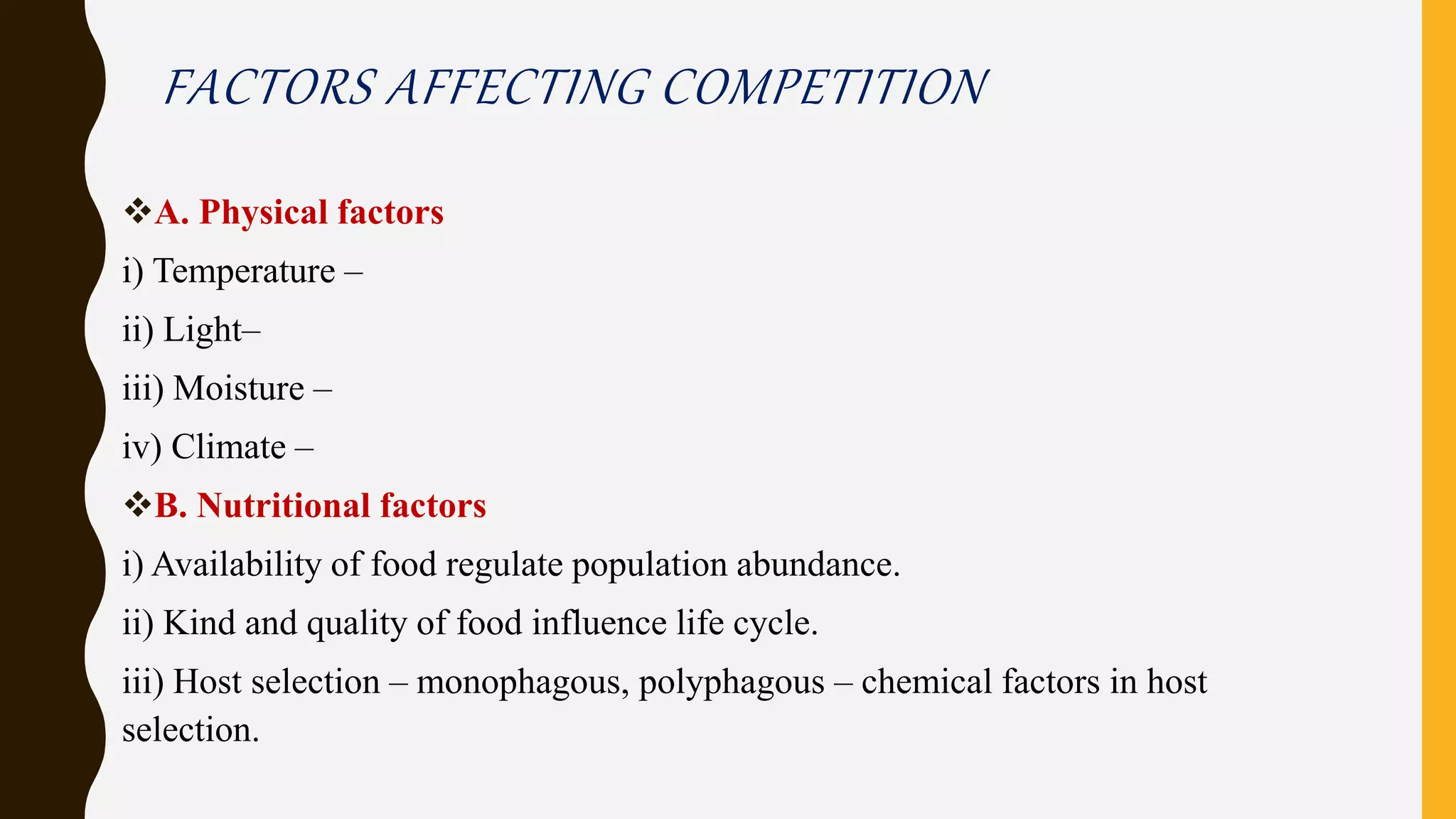
FACTORS AFFECTING COMPETITION
A. Physical factors
i) Temperature –
ii) Light–
iii) Moisture –
iv) Climate –
B. Nutritional factors
i) Availability of food regulate population abundance.
ii) Kind and quality of food influence life cycle.
iii) Host selection – monophagous, polyphagous – chemical factors in host
selection.
C. Host Plant association factors-
rapidity of growth, foliage characteristics, taste factors etc.
D. Biotic Factors-
i) Type of Competition – within and among different species (Inter and intra
specific).
ii) Parasites and predators parasites like fungi, bacteria, protozoo, nematodes and
various arthropods – predators like birds, mammals, reptiles, amphibions and insects
check the population.
iii) Human population trend – Rapidly growing world population – growth rate
projected world population – Indian population – resources
CASE STUDY-1
• Crombie (1945, 1946, 1947)
• Red flour beetle, Tribolium confusum and the saw-toothed grain beetle, Qryzaephilus
surinamensis as competitors with wheat flour as food.
• Tribolium was always the superior species, probably because it would eat the eggs and
pupae of Qryzaephilus. While the latter would only eat Tribolium eggs. Tribolium
eliminated Orvzaephilus from all environments.
• Different result occurred when cracked wheat instead of flour was used as food.
Qryzaephilus could not pupate within the wheat grains, which provided a
sufficient refuge for both species to coexist, in which the immature stages of the latter
were especially protected.
CASE STUDY-2
• Park and colleagues (Park, 1954, 1957 and Park et al., 1964).
• Between two Red flour beetle Tribolium confusum and Tribolium castaneum.
• Found that replacement of one species by the other was the rule, but critically
dependent upon a variety of conditions.
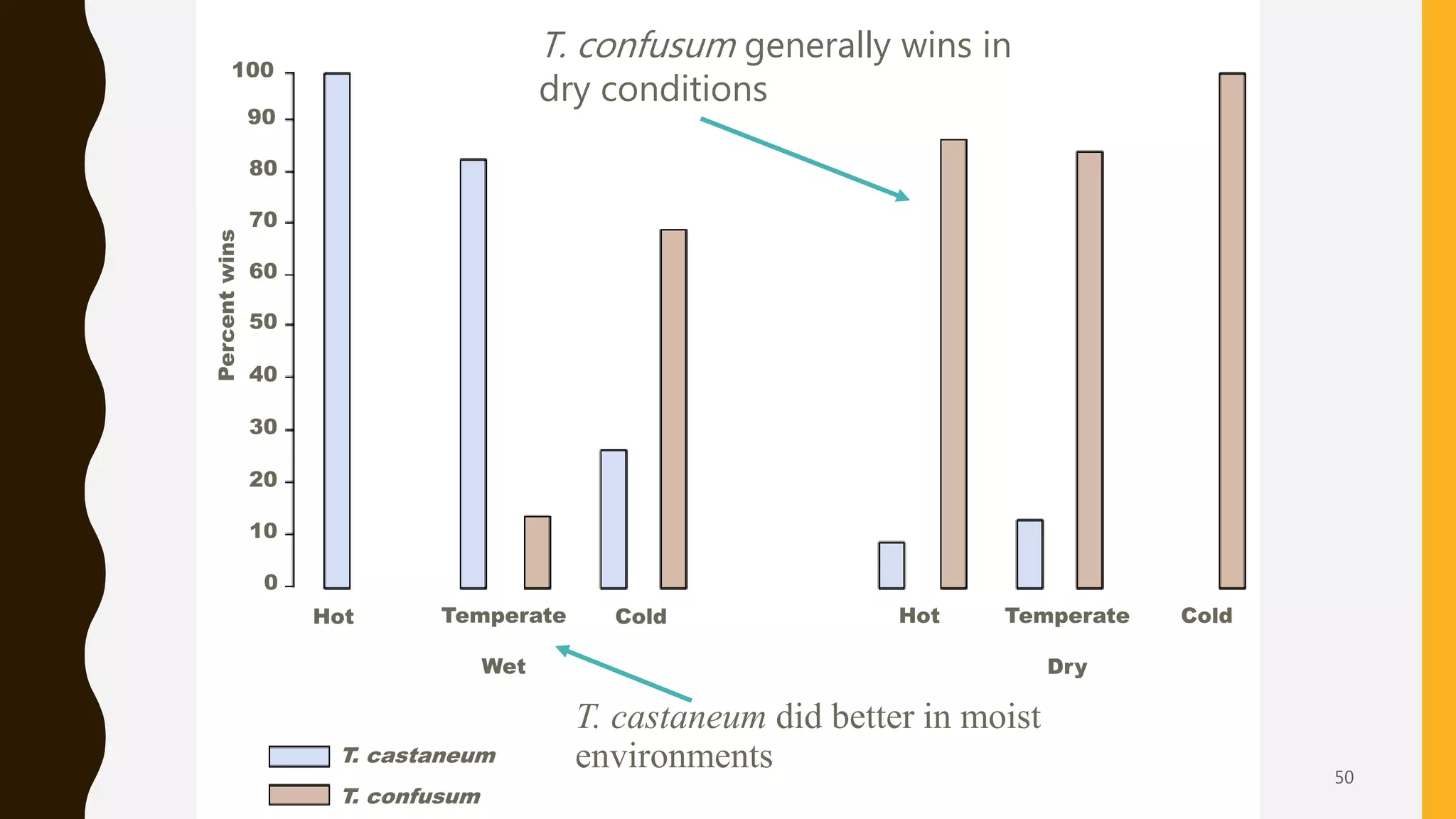
• T. castaneum was always the superior competitor at 34°C and 70% R.H. and always
inferior at 24°C and 30% R.H.
But at intermediate temperatures and humidities, the outcome would
vary from replicate to replicate.
• Park also found an additional factor affecting the outcome — the presence or absence
of a pathogenic microsporidian parasite, Adelina tribolii which affects both species, but
particularly T. castaneum.
chap08 Competition and coexistence 50
10
20
30
40
50
60
70
80
90
100
0
Hot Temperate
Wet
Cold Hot Temperate
Dry
Cold
T. confusum
T. castaneum
Percentwins
T. confusum generally wins in
dry conditions
T. castaneum did better in moist
environments
CASE STUDY-3
• Bai and Macuar (1991)
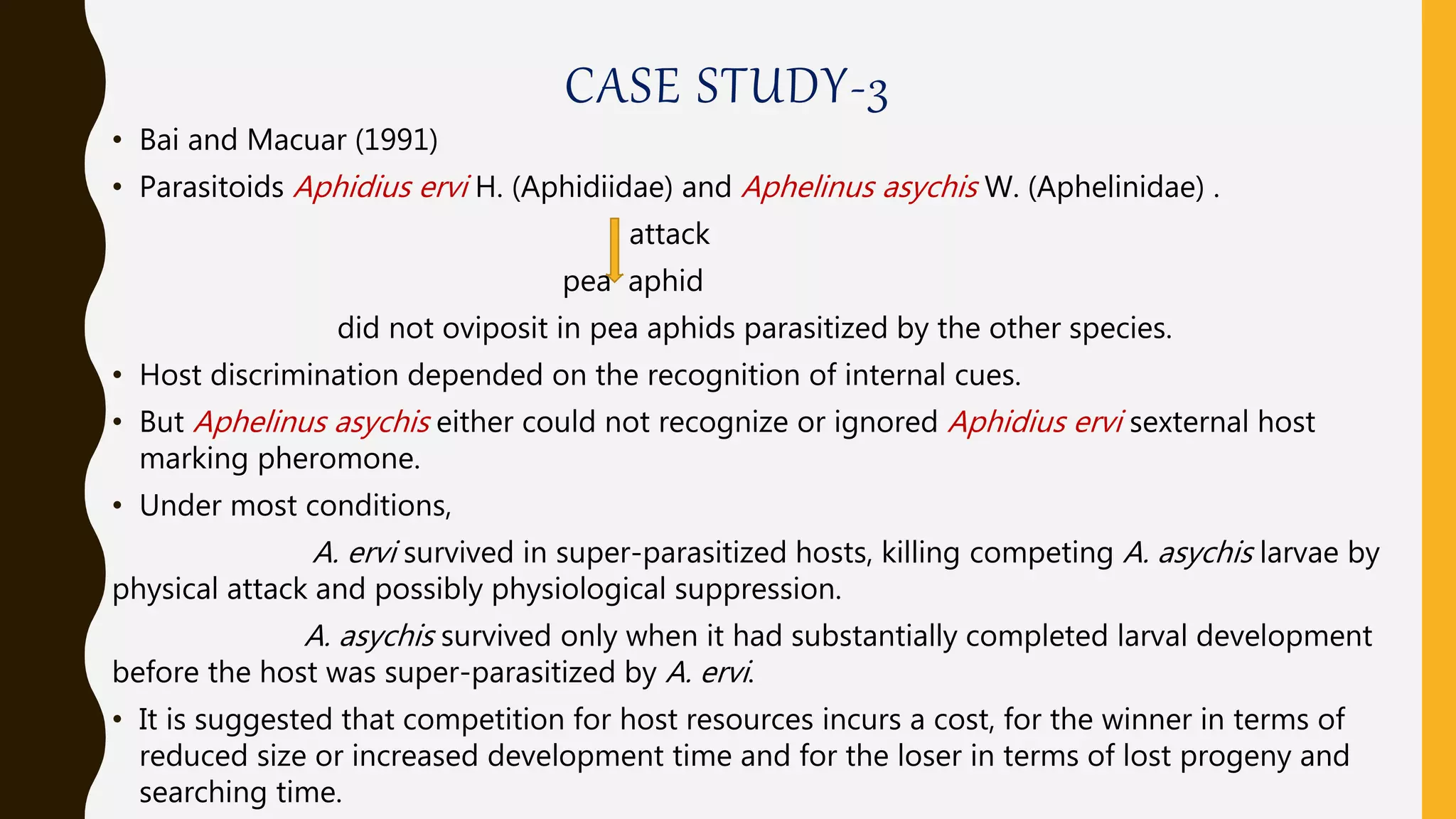
• Parasitoids Aphidius ervi H. (Aphidiidae) and Aphelinus asychis W. (Aphelinidae) .
attack
pea aphid
did not oviposit in pea aphids parasitized by the other species.

• Host discrimination depended on the recognition of internal cues.
• But Aphelinus asychis either could not recognize or ignored Aphidius ervi sexternal host
marking pheromone.
• Under most conditions,
A. ervi survived in super-parasitized hosts, killing competing A. asychis larvae by
physical attack and possibly physiological suppression.
A. asychis survived only when it had substantially completed larval development
before the host was super-parasitized by A. ervi.
• It is suggested that competition for host resources incurs a cost, for the winner in terms of
reduced size or increased development time and for the loser in terms of lost progeny and
searching time.
SUMMARY
• Competition- The interaction between the two organisms of the same or different species striving
for the same resource.
• Type- Intra-specific and Interspecific competition. It can be exploitative or interference type.
• Competition as a regulatory mechanisms of population dynamics and plays an important role in
ecological and evolutionary processes.
• Different competition models are helpful in understanding the competition among the members of
a population
• Strategies of Competition can be: i) complete exclusion of one species either 1 or 2
ii) stable-The stable equilibrium may be achieved by - Niche
separation, resource portioning or character displacement
iii) unstable equilibrium between the two species.
• Darwin’s theory of natural selection and origin of new species completely based on competition.
• Individual reduces the direct competition by specific physiological, morphological and behavioral
adaptations for the existence of a species.
references:
• Bacaer N. 2011.Verhulst and the logistic equation (1838) In: A Short History of Mathematical Population
Dynamics. Springer, London. pp 35-39.
• Birch LC. 1957. The meanings of competition. The American Naturalist 91:5-18.
• Southwood TRE. 1977. The relevance of population dynamics theory to pest status. In: Origins of Pest,
Parasite, Disease and Weed Problems. Symposium of the British Ecological Society 18 (J.M. Cherrett, and G.R.
Sagar, Eds.), British Ecological Society, London, UK. pp. 35–54.
• Southwood TRE. 1975. The dynamics of insect populations. In Insects, Science, and Society (D. Pimentel, Ed.),
Academic Press, San Diego, CA. pp. 151–199.
• Tilman D. 1982. Resource competition and community structure. Princeton: Princeton University Press. 296 p.
• Park T, Leslie PH and Mertz DB. 1964. Genetic strains and competition in populations
of Tribolium. Physiological Zoology 37:97–162.
• Bai B and Mackauer M. 1991. Recognition of heterospecific parasitism: Competition between Aphidiid
(Aphidius ervi) and Aphelinid (Aphelinus asychis) parasitoids of Aphids (Hymenoptera: Aphidiidae;
Aphelinidae). Journal of Insect Behavior 4:333-45.
• Crombie AC. 1947. Interspecific competition. Journal of Animal Ecology 16:44-73.

Competition intra and inter-specific

  • 1.
    COMPETITION : INTRA& INTER -SPECIFIC Master’s Seminar ENT-591 Speaker :- Ajay Sharma H-2017-01-
  • 2.
    INDEX Introduction Competition Type of competition -Intraspecificand interspecific competition -Interference vs exploitation Mathematical models of competition Results of Competition -Range restriction -Competitive displacement -Competitive exclusion Concept of Ecological Niche Case studies References
  • 3.
    INTRODUCTION • In naturalworld, no organism exists in absolute isolation, and thus every organism must interact with the environment and other organisms. • When populations of different species interact, the effects on one on the other may be positive (+), negative (-) or neutral (0). • Three of these combinations (+, +) (-, -) (+, -) are subdivided resulting in several type of important interactions & relationships.
  • 4.
    IMPORTANT INTERACTIONS BETWEENTWO SPECIES Effect on X Effect on Y Type of Interaction + + Mutualism - - Competition + - Predation + - Parasitism + 0 Commensalism - 0 Amensalism
  • 5.
    COMPETITION “Competition is anegative type of interaction between individuals, brought about by a shared requirement for a resource, and leading to a reduction in the survivorship, growth and/or reproduction of at least some of the competing individuals concerned.” “OR” “Competition in this strict sense occurs when a number of animals (of the same or of different species) utilize common resources, whose supply is short.” (Birch 1957)
  • 6.
    • Mutual useof a limited resource by populations of two or more species. • Each individual adversely affect another in the quest for food (nutrients), living space, or other common needs. They harm one another is attempting to gain a resource. At high densities, competition for food, mates, and oviposition sites reduces fecundity and fertility (Southwood 1975, 1977).
  • 7.
    OUTLINE…! May be: • Intraspecific •Interspecific Due to: • Exploitation, or • Interference Result in: •Exclusion of one •Coexistence •Competitive exclusion One wins; other loses •CoexistenceNeither wins •ExtinctionBoth lose mutual OUTCOMES OF COMPETITION
  • 8.
    -:TYPES OF COMPETITION:- 1.On the basis of taxonomic relationship (a) Intraspecific competition (within-species)- It is an interaction in population ecology, whereby members of the same species compete for limited resources. This leads to a reduction in fitness for both individuals. • Example : Bracon hebetor (minute wasp)- internal parasitoid to larval stage of Indian mealmoth.
  • 9.
    • Individuals ofthe same species compete for the exact same thing in the environment; Therefore this is the strongest type of competition.
  • 10.
    • Characteristics ofIntraspecific Competition :- • The ultimate effect: decreased contribution of individuals to the next generations • The resource must be in limited supply. • Competing individuals are all essentially equivalent. • The effect on any individual increases with increasing number of competitors
  • 11.
    (B) Interspecific competition(b/w species) :- • Competition between different species compete for the same resources in an ecosystem. • It can be violent, if the competing species are similar; but it is never as strong as intraspecific completion. • Example: between entomo-pathogenic nematodes for lepidopterans larva.
  • 12.
    Interactions in InterspecificCompetition (THOMAS SCHOENER) • CONSUMPTION COMPETITION- Occurs when individuals of one species inhibit another species by consuming a shared resource. • PREEMPTIVE COMPETITION- Occurs primary among sessile organisms where the competition by one individual precludes establishment (occupation) by others. • OVERGROWTH COMPETITION- occurs when one organism literally grows over another (with or without physical contact), inhibiting access to some essential resource.
  • 13.
    • CHEMICAL COMPETITION-chemical growth inhibitors or toxins released by an individual inhibit or kill other species Ex. Sunflower (Allelopathic). • TERRITORIAL COMPETITION- Results from the behavioral exclusion of others from a specific space that is defended as a territory. • ENCOUNTER COMPETITION- when non-territorial meetings between individuals negatively affect one or both of the participant species male female
  • 14.
    2. ON theBASIS of MECHANISM (a) Exploitation: • In many cases, competing individuals do not interact with one another directly. Instead, individuals respond to the level of a resource, which has been depressed by the presence and activity of other individuals. It also referred to as Resource competition. • Thus, it is an Indirect competition.
  • 15.
    For example- Aphid speciescompeting over the sap in plant phloem. Each aphid species that feeds on host plant sap uses some of the resource, leaving less for competing species. In case of grasshoppers, a thriving population of grasshoppers (all of one species) feeding on a field of grass (also of one species). The more grasshoppers there are, an increased energy expenditure in search of food and a decreased rate of food intake may all decrease a grasshopper’s chances of survival.
  • 16.
    • (b) Interference: Hereindividuals interact directly with each other, and one individual will actually prevent another from exploiting the resources within a portion of the habitat. These individuals interfere with foraging, survival, reproduction of others, or by directly preventing their physical establishment in a portion of the habitat. so it is also called Direct competition.
  • 17.
    For example- Differentspecies of Burying Beetles (Nicrophorus sp.) compete to other species of same genera for reproductive success. In another example, the presence of a barnacle on a rock prevents any other barnacle from occupying that same position, even though the supply of food at that position may exceed the requirements of several barnacles. In such cases, space can be seen as a resource in limited supply. (Joseph Connell)
  • 19.
    HUTCHINSON RATIO • ByG. E. Hutchinson (1959) • The ratio of the size differences between similar species when they were living together as compared to when they were isolated. • Various key attributes in species varied according to the ratio of 1.1-1.3 • For Co-existence Morphological displacement in harvesting organs(Ch. Disp.) of Closely related species
  • 20.
    EXPONENTIAL GROWTH • ByThomas Robert Malthus Any species can potentially increase in number according to geometric series. When t- is large, then this equation can be approximated by an exponential function Nt = N0Rt Nt = N0ert R- Offspring N- Population t- 1,2,3,…
  • 21.
    o There are3 possible model outcomes:- • Population exponentially declines (r < 0) • Population exponentially increases (r > 0) • Population does not change (r = 0) – Parameter r is called: • Malthusian parameter • Intrinsic rate of increase • Instantaneous rate of natural increase • Population growth rate . o Assumptions of Exponential Model: • Continuous reproduction (e.g., no seasonality) • All organisms are identical (e.g., no age structure) • Environment is constant in space and time (e.g., resources are unlimited)
  • 22.
    • Very rarein nature because resources are finite and so not every individual in a population can survive, leading to intraspecific competition for the scarce resources. o Applications of the exponential model • Microbiology (growth of bacteria), • Conservation biology (restoration of disturbed populations), • Insect rearing (prediction of yield), • Plant or insect quarantine (population growth of introduced species), • Fishery (prediction of fish dynamics).
  • 23.
    LOGISTIC MODEL • byPierre Verhulst (1838)- The rate of population increase may be limited, i.e., it may depend on population density: • Logistic equation • At low densities (N < < K), the population growth rate is maximum = ro . • Population growth rate declines with population numbers, N, and reaches 0 when N = K. Parameter K is the upper limit of population growth (carrying capacity).
  • 24.
    • Carrying capacityK - The maximum number of individuals that can live in a population stably; numbers larger than this will suffer a negative population growth until eventually reaching the carrying capacity, whereas populations smaller than the carrying capacity will grow until they reach it. • Three possible model outcomes Population increases and reaches a plateau (No < K). This is the logistic curve. Population decreases and reaches a plateau (No > K) Population does not change (No= K or No = 0) • Assumptions of the logistic model: – Each individual has identical ecological properties – Instantaneous response to environmental change – Limited space and constant food supply – Age distribution is stable
  • 26.
    Lotka - VolterraCompetition Model Alfred James Lotka (1925) Vito Volterra (1926) Independently developed a general model of competition between species
  • 27.
    • Explain theoutcome of competition between two species. • Used to understand how different factors affect the outcomes of competitive interactions. • It combines the effects of each species on the other. • These effects are calculated separately for the first and second population respectively: N- is the population size, t- is time, K- is the carrying capacity, r- is the intrinsic rate of increase α- the relative competition coefficients (effect of one sp on other) dN/dt-Population growth rate
  • 28.
    • In thefirst equation: • When α12 <1 the effect of species 2 on species 1 is less than the effect of species 1 on its own members. Conversely, when α12 >1 the effect of species 2 on species 1 is greater than the effect of species 1 on its own member. The α21 N1 term in the second equation is interpreted in the same way.
  • 29.
    THE TWO GRAPHSBELOW SHOW THE ZERO ISOCLINES FOR SPECIES 1 AND SPECIES 2 NOTE:- The sp have higher carrying capacity always win (sp endure more crowding than other sp) Zero isocline for N1
  • 30.
    FOUR POSSIBLE OUTCOMEOF THE MODEL Species 1 inhibits growth of species 2 and latter goes extinction Species 2 inhibits growth of species 1 and latter goes extinction
  • 31.
    Unstable situation, bothinhibit in a density dependent manner. Depending on initial density, either can make other extinct Each species inhibits its own population growth more than competitor. Neither can eliminate competitor
  • 33.
    ASSUMPTIONS:- • Environment ishomogenous & stable . • Migration is not important . • Co-existance requires a stable equilibrium point. • Carrying capacities and competition coefficients for both sp is constants
  • 34.
    TILMAN'S RESOURCE COMPETITIONMODEL or R-STAR CONCEPT • R* - Tilman (1982, 1987) alternative – Need to know the dependence of an organism's growth on the availability of resources
  • 35.
    chap08 Competition andcoexistence 35 GrowthorlossrateGrowthorlossratePopulationsize (a) (b) (c) 100 Species A Species B Species A Species B Loss 100 R* A 0 R*B Loss Growth Resource level (R) Time0 0 Growth 10 R* BR* Resourcelevel(R) Tilman’s R star concept of competition between two species A and B, based on their resource utilization curves. Initially A grows faster than species B Outcompetes species A, as resources become more scarce.
  • 37.
    RESULTS OF INTRASPECIFICCOMPETITION Dispersal Social interactions – Dominance – Territoriality
  • 38.
    RESULTS of INTERSPECIFICCOMPETITION Usually leads to one of three possible evolutionary outcomes:- • Range restriction--each species is confined to a subset of the range where it is able to out-compete the other species. • Competitive displacement--the two species evolve in divergent directions, adapting to different resources or specializing in other ways that allow them to co- exist with little or no direct competition. • Competitive exclusion--one species is competitively superior and drives the other species to extinction.
  • 39.
    COMPETITIVE DISPLACEMENT HYPOTHESIS •If two competing species coexist in a stable environment, then they do so as a result of niche differentiation. If, however, there is no such differentiation, then one competing species will eliminate or exclude the other. (Begon et. al. 1996) • Different species having identical ecological niches (that is, ecological homologues) cannot coexist for long in the same habitat. Those one will be a better competitor and thus have higher fitness and eventually exclude the other. • This hypothesis has been recognized as 'Gause's law’ or hypothesis', and 'the Competitive exclusion principle’.
  • 40.
    Eg. The replacementof the mediterranean fruit fly, Ceratitis caoitata W. around Sydney, Australia by the Queensland fruit fly, Dacus trvoni F. (Andrewartha and Birch, 1954). • In Israel the mealybug parasitoid, Clausenia purpurea Ishii, displaced the established parasitoids Leptomastix flavus Mercet and Anagyrus kivuensis Compere (Rivnay, 1964).
  • 41.
    ECOLOGICAL NICHE • TheEcological niche describes the functional position of an organism in its environment. • A Niche comprises: • The habitat in which the organism lives. • The organism’s activity pattern: the periods of time during which it is aactive. • The resources it obtains from the habitat.
  • 42.
    Hutchinson (1957) definedniche- “a region (n-dimensional hyper volume) in a multi-dimensional space of environmental factors that affect the welfare of a species.” n-number of environmental factors important to survival and reproduction of a species. Each species occupies a unique ecological niche within its community.
  • 43.
    The niche andinterspecific competition 0 0.2 0.4 0.6 0.8 1 0 0.5 1 1.5 2 2.5 3 0 0.2 0.4 0.6 0.8 1 0 0.5 1 1.5 2 2.5 3 ResourceUse Use Species A Species B Competition When niches overlap, competition results
  • 44.
     Role ofCompetition in evolution of new species • influence natural selection • Darwin’s theory natural selection and origin of new species completely based on competition. Reduce Resource partitioning direct competition reduced by :- A. Physiological B. Morphological C. Behavioral Adaptations
  • 45.
    • Following Phenomenalevidences are used to deduce that competition has occurred in the past and has resulted in the origin of new species:- 1. Niche separation or Resource Partitioning 2. Habitat shift 3. Character displacement 4. Competitive exclusion 5. Competitive release • Darwin’s finches are a good example to prove the end results of competition
  • 46.
    FACTORS AFFECTING COMPETITION A.Physical factors i) Temperature – ii) Light– iii) Moisture – iv) Climate – B. Nutritional factors i) Availability of food regulate population abundance. ii) Kind and quality of food influence life cycle. iii) Host selection – monophagous, polyphagous – chemical factors in host selection.
  • 47.
    C. Host Plantassociation factors- rapidity of growth, foliage characteristics, taste factors etc. D. Biotic Factors- i) Type of Competition – within and among different species (Inter and intra specific). ii) Parasites and predators parasites like fungi, bacteria, protozoo, nematodes and various arthropods – predators like birds, mammals, reptiles, amphibions and insects check the population. iii) Human population trend – Rapidly growing world population – growth rate projected world population – Indian population – resources
  • 48.
    CASE STUDY-1 • Crombie(1945, 1946, 1947) • Red flour beetle, Tribolium confusum and the saw-toothed grain beetle, Qryzaephilus surinamensis as competitors with wheat flour as food. • Tribolium was always the superior species, probably because it would eat the eggs and pupae of Qryzaephilus. While the latter would only eat Tribolium eggs. Tribolium eliminated Orvzaephilus from all environments. • Different result occurred when cracked wheat instead of flour was used as food. Qryzaephilus could not pupate within the wheat grains, which provided a sufficient refuge for both species to coexist, in which the immature stages of the latter were especially protected.
  • 49.
    CASE STUDY-2 • Parkand colleagues (Park, 1954, 1957 and Park et al., 1964). • Between two Red flour beetle Tribolium confusum and Tribolium castaneum. • Found that replacement of one species by the other was the rule, but critically dependent upon a variety of conditions. • T. castaneum was always the superior competitor at 34°C and 70% R.H. and always inferior at 24°C and 30% R.H. But at intermediate temperatures and humidities, the outcome would vary from replicate to replicate. • Park also found an additional factor affecting the outcome — the presence or absence of a pathogenic microsporidian parasite, Adelina tribolii which affects both species, but particularly T. castaneum.
  • 50.
    chap08 Competition andcoexistence 50 10 20 30 40 50 60 70 80 90 100 0 Hot Temperate Wet Cold Hot Temperate Dry Cold T. confusum T. castaneum Percentwins T. confusum generally wins in dry conditions T. castaneum did better in moist environments
  • 51.
    CASE STUDY-3 • Baiand Macuar (1991) • Parasitoids Aphidius ervi H. (Aphidiidae) and Aphelinus asychis W. (Aphelinidae) . attack pea aphid did not oviposit in pea aphids parasitized by the other species. • Host discrimination depended on the recognition of internal cues. • But Aphelinus asychis either could not recognize or ignored Aphidius ervi sexternal host marking pheromone. • Under most conditions, A. ervi survived in super-parasitized hosts, killing competing A. asychis larvae by physical attack and possibly physiological suppression. A. asychis survived only when it had substantially completed larval development before the host was super-parasitized by A. ervi. • It is suggested that competition for host resources incurs a cost, for the winner in terms of reduced size or increased development time and for the loser in terms of lost progeny and searching time.
  • 52.
    SUMMARY • Competition- Theinteraction between the two organisms of the same or different species striving for the same resource. • Type- Intra-specific and Interspecific competition. It can be exploitative or interference type. • Competition as a regulatory mechanisms of population dynamics and plays an important role in ecological and evolutionary processes. • Different competition models are helpful in understanding the competition among the members of a population • Strategies of Competition can be: i) complete exclusion of one species either 1 or 2 ii) stable-The stable equilibrium may be achieved by - Niche separation, resource portioning or character displacement iii) unstable equilibrium between the two species. • Darwin’s theory of natural selection and origin of new species completely based on competition. • Individual reduces the direct competition by specific physiological, morphological and behavioral adaptations for the existence of a species.
  • 53.
    references: • Bacaer N.2011.Verhulst and the logistic equation (1838) In: A Short History of Mathematical Population Dynamics. Springer, London. pp 35-39. • Birch LC. 1957. The meanings of competition. The American Naturalist 91:5-18. • Southwood TRE. 1977. The relevance of population dynamics theory to pest status. In: Origins of Pest, Parasite, Disease and Weed Problems. Symposium of the British Ecological Society 18 (J.M. Cherrett, and G.R. Sagar, Eds.), British Ecological Society, London, UK. pp. 35–54. • Southwood TRE. 1975. The dynamics of insect populations. In Insects, Science, and Society (D. Pimentel, Ed.), Academic Press, San Diego, CA. pp. 151–199. • Tilman D. 1982. Resource competition and community structure. Princeton: Princeton University Press. 296 p. • Park T, Leslie PH and Mertz DB. 1964. Genetic strains and competition in populations of Tribolium. Physiological Zoology 37:97–162. • Bai B and Mackauer M. 1991. Recognition of heterospecific parasitism: Competition between Aphidiid (Aphidius ervi) and Aphelinid (Aphelinus asychis) parasitoids of Aphids (Hymenoptera: Aphidiidae; Aphelinidae). Journal of Insect Behavior 4:333-45. • Crombie AC. 1947. Interspecific competition. Journal of Animal Ecology 16:44-73.