Species interactions
What do we mean by species interactions?
 Interaction (between species) refers to positive and negative associations
between species that favor or inhibit mutual growth and evolution of
populations.
 It may take the form of competition, predation, parasitism,
commensalism or mutualism.
 In nature no species exists in total isolation – all organisms interact with
both the abiotic environment and other organisms.
 If two species interact directly within a shared environment, they share a
positive association (they co-exist).
 If interactions within an environment are mutually detrimental to both
species, they share a negative association (do not co-exist).
Positive Associations :
 Predation (+,-) :
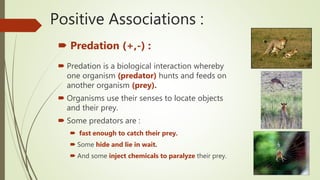
 Predation is a biological interaction whereby
one organism (predator) hunts and feeds on
another organism (prey).
 Organisms use their senses to locate objects
and their prey.
 Some predators are :
 fast enough to catch their prey.
 Some hide and lie in wait.
 And some inject chemicals to paralyze their prey.
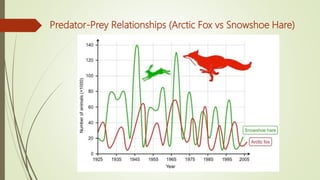
Predator-Prey Relationships (Arctic Fox vs Snowshoe Hare)
Predation continued
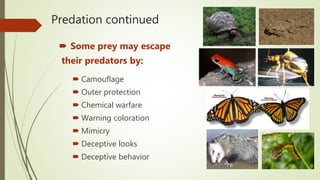
 Some prey may escape
their predators by:
 Camouflage
 Outer protection
 Chemical warfare
 Warning coloration
 Mimicry
 Deceptive looks
 Deceptive behavior
Coevolution
 Some species interact so intimately that they can cause evolutionary
changes in each other over time. This is called coevolution.
 when one species develops an evolutionary advantage, it triggers a
change in a closely associated species.
 This change may then cause another evolutionary change in the first
species, and both species will continue to evolve in response for each
other in a phenomenon called “ Arms race”.
 Evolutionary “arms race” :
The levels of defense and counter-defense will continue to escalate.
Coevolution and Predator / Prey “Arms
Race”
Moth vs Bat case study :
 Bats are nocturnal animals and use “echolocation” by ultra sonic sounds
to locate its prey “the moth”.
 Over time the moth formed an adaptation to avoid being located by the
bats by developing its own auditory sensory organ known as tympanal
organs.
 By hearing the bat’s echoes the moth could either escape, emits its own
echoes to warn the bat that it is not the desired moth “toxic”.
 A species of moths took this to whole new level and started to emit its
own ultrasonic sounds that “jam” the one emitted by the bat.
Coevolution and Predator / Prey “Arms
Races” case study
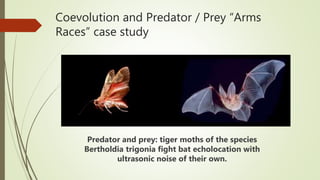
Predator and prey: tiger moths of the species
Bertholdia trigonia fight bat echolocation with
ultrasonic noise of their own.
Positive Associations :
Symbiotic Relationships
 Symbiosis describes the close and persistent (long-term) interaction
between two species
 Symbiotic relationships can be obligate (required for survival) or
facultative (advantageous without being strictly necessary)
 Symbiotic relationships can be beneficial to either one or both organisms
in the partnership:
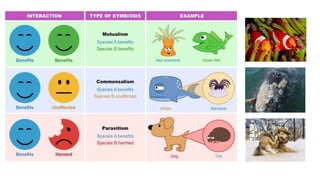
 Mutualism (+,+) Both species benefit from the interaction.
Commensalism (+, 0) One species benefits, the other is unaffected.
Parasitism (+,-) One species benefits to the detriment of the other species.
Mutualism (+,+)
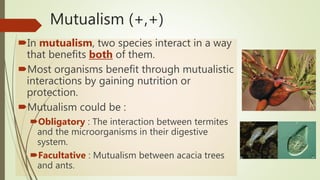
In mutualism, two species interact in a way
that benefits both of them.
Most organisms benefit through mutualistic
interactions by gaining nutrition or
protection.
Mutualism could be :
Obligatory : The interaction between termites
and the microorganisms in their digestive
system.
Facultative : Mutualism between acacia trees
and ants.
Mutualistic coevolution
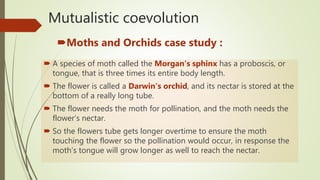
Moths and Orchids case study :
 A species of moth called the Morgan's sphinx has a proboscis, or
tongue, that is three times its entire body length.
 The flower is called a Darwin's orchid, and its nectar is stored at the
bottom of a really long tube.
 The flower needs the moth for pollination, and the moth needs the
flower’s nectar.
 So the flowers tube gets longer overtime to ensure the moth
touching the flower so the pollination would occur, in response the
moth’s tongue will grow longer as well to reach the nectar.
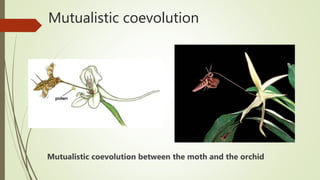
Mutualistic coevolution
Mutualistic coevolution between the moth and the orchid
Commensalism (+,0)
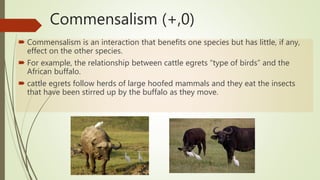
 Commensalism is an interaction that benefits one species but has little, if any,
effect on the other species.
 For example, the relationship between cattle egrets “type of birds” and the
African buffalo.
 cattle egrets follow herds of large hoofed mammals and they eat the insects
that have been stirred up by the buffalo as they move.
Parasitism (+,-)
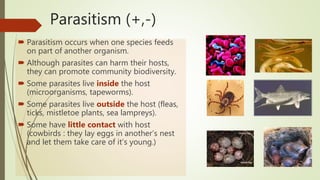
 Parasitism occurs when one species feeds
on part of another organism.
 Although parasites can harm their hosts,
they can promote community biodiversity.
 Some parasites live inside the host
(microorganisms, tapeworms).
 Some parasites live outside the host (fleas,
ticks, mistletoe plants, sea lampreys).
 Some have little contact with host
(cowbirds : they lay eggs in another’s nest
and let them take care of it’s young.)
Parasite / host Coevolution
 Myxoma virus vs rabbits case study :
 European rabbits were introduced into Australia in the 1800s. In the
absence of parasites and predators they multiplied rapidly causing
destruction to native vegetation.
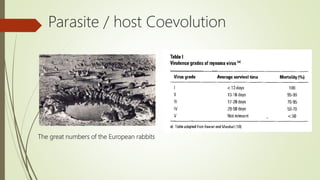
 When the myxoma virus was introduced into Australia in 1950 to
control rabbit populations and it killed 99.5% of the population in about
2 to 3 weeks.
 Since the rabbit population decreased drastically, a coevolution occurred
and the virus that was less virulent favored by natural selection.
 As a result, rabbit population started to increase and in response to the
virus, it developed immunity.
The great numbers of the European rabbits
Parasite / host Coevolution
Negative Associations :
 Competition (-,-) :
 Competition describes the interaction between two organisms whereby
the fitness of one is lowered by the presence of the other
 Competition can be intraspecific (between members of same species) or
interspecific (between members of different species)
 Limited supplies of resources (e.g. food, water, territory) usually triggers
one of two types of responses:
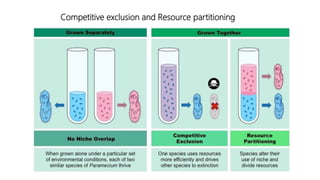
Competitive exclusion : One species uses the resources more efficiently,
driving the other species to local extinction
 Resource partitioning : Both species alter their use of the environment to
divide the resources between them
Competition
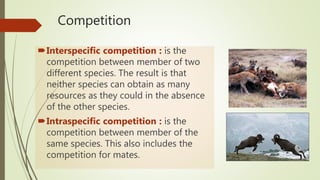
Interspecific competition : is the
competition between member of two
different species. The result is that
neither species can obtain as many
resources as they could in the absence
of the other species.
Intraspecific competition : is the
competition between member of the
same species. This also includes the
competition for mates.
Competitive exclusion and Resource partitioning
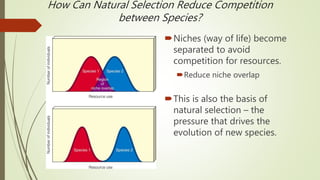
Niches (way of life) become
separated to avoid
competition for resources.
Reduce niche overlap
This is also the basis of
natural selection – the
pressure that drives the
evolution of new species.
How Can Natural Selection Reduce Competition
between Species?
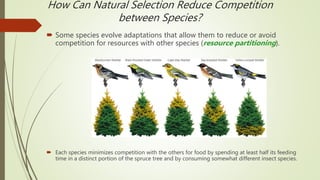
 Some species evolve adaptations that allow them to reduce or avoid
competition for resources with other species (resource partitioning).
 Each species minimizes competition with the others for food by spending at least half its feeding
time in a distinct portion of the spruce tree and by consuming somewhat different insect species.
How Can Natural Selection Reduce Competition
between Species?
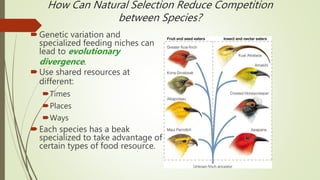
Genetic variation and
specialized feeding niches can
lead to evolutionary
divergence.
Use shared resources at
different:
Times
Places
Ways
Each species has a beak
specialized to take advantage of
certain types of food resource.
How Can Natural Selection Reduce Competition
between Species?
Any Questions?

Species interactions

  • 1.
  • 2.
    What do wemean by species interactions?  Interaction (between species) refers to positive and negative associations between species that favor or inhibit mutual growth and evolution of populations.  It may take the form of competition, predation, parasitism, commensalism or mutualism.  In nature no species exists in total isolation – all organisms interact with both the abiotic environment and other organisms.  If two species interact directly within a shared environment, they share a positive association (they co-exist).  If interactions within an environment are mutually detrimental to both species, they share a negative association (do not co-exist).
  • 3.
    Positive Associations : Predation (+,-) :  Predation is a biological interaction whereby one organism (predator) hunts and feeds on another organism (prey).  Organisms use their senses to locate objects and their prey.  Some predators are :  fast enough to catch their prey.  Some hide and lie in wait.  And some inject chemicals to paralyze their prey.
  • 4.
  • 5.
    Predation continued  Someprey may escape their predators by:  Camouflage  Outer protection  Chemical warfare  Warning coloration  Mimicry  Deceptive looks  Deceptive behavior
  • 6.
    Coevolution  Some speciesinteract so intimately that they can cause evolutionary changes in each other over time. This is called coevolution.  when one species develops an evolutionary advantage, it triggers a change in a closely associated species.  This change may then cause another evolutionary change in the first species, and both species will continue to evolve in response for each other in a phenomenon called “ Arms race”.  Evolutionary “arms race” : The levels of defense and counter-defense will continue to escalate.
  • 7.
    Coevolution and Predator/ Prey “Arms Race” Moth vs Bat case study :  Bats are nocturnal animals and use “echolocation” by ultra sonic sounds to locate its prey “the moth”.  Over time the moth formed an adaptation to avoid being located by the bats by developing its own auditory sensory organ known as tympanal organs.  By hearing the bat’s echoes the moth could either escape, emits its own echoes to warn the bat that it is not the desired moth “toxic”.  A species of moths took this to whole new level and started to emit its own ultrasonic sounds that “jam” the one emitted by the bat.
  • 8.
    Coevolution and Predator/ Prey “Arms Races” case study Predator and prey: tiger moths of the species Bertholdia trigonia fight bat echolocation with ultrasonic noise of their own.
  • 9.
    Positive Associations : SymbioticRelationships  Symbiosis describes the close and persistent (long-term) interaction between two species  Symbiotic relationships can be obligate (required for survival) or facultative (advantageous without being strictly necessary)  Symbiotic relationships can be beneficial to either one or both organisms in the partnership:  Mutualism (+,+) Both species benefit from the interaction. Commensalism (+, 0) One species benefits, the other is unaffected. Parasitism (+,-) One species benefits to the detriment of the other species.
  • 11.
    Mutualism (+,+) In mutualism,two species interact in a way that benefits both of them. Most organisms benefit through mutualistic interactions by gaining nutrition or protection. Mutualism could be : Obligatory : The interaction between termites and the microorganisms in their digestive system. Facultative : Mutualism between acacia trees and ants.
  • 12.
    Mutualistic coevolution Moths andOrchids case study :  A species of moth called the Morgan's sphinx has a proboscis, or tongue, that is three times its entire body length.  The flower is called a Darwin's orchid, and its nectar is stored at the bottom of a really long tube.  The flower needs the moth for pollination, and the moth needs the flower’s nectar.  So the flowers tube gets longer overtime to ensure the moth touching the flower so the pollination would occur, in response the moth’s tongue will grow longer as well to reach the nectar.
  • 13.
    Mutualistic coevolution Mutualistic coevolutionbetween the moth and the orchid
  • 14.
    Commensalism (+,0)  Commensalismis an interaction that benefits one species but has little, if any, effect on the other species.  For example, the relationship between cattle egrets “type of birds” and the African buffalo.  cattle egrets follow herds of large hoofed mammals and they eat the insects that have been stirred up by the buffalo as they move.
  • 15.
    Parasitism (+,-)  Parasitismoccurs when one species feeds on part of another organism.  Although parasites can harm their hosts, they can promote community biodiversity.  Some parasites live inside the host (microorganisms, tapeworms).  Some parasites live outside the host (fleas, ticks, mistletoe plants, sea lampreys).  Some have little contact with host (cowbirds : they lay eggs in another’s nest and let them take care of it’s young.)
  • 16.
    Parasite / hostCoevolution  Myxoma virus vs rabbits case study :  European rabbits were introduced into Australia in the 1800s. In the absence of parasites and predators they multiplied rapidly causing destruction to native vegetation.  When the myxoma virus was introduced into Australia in 1950 to control rabbit populations and it killed 99.5% of the population in about 2 to 3 weeks.  Since the rabbit population decreased drastically, a coevolution occurred and the virus that was less virulent favored by natural selection.  As a result, rabbit population started to increase and in response to the virus, it developed immunity.
  • 17.
    The great numbersof the European rabbits Parasite / host Coevolution
  • 18.
    Negative Associations : Competition (-,-) :  Competition describes the interaction between two organisms whereby the fitness of one is lowered by the presence of the other  Competition can be intraspecific (between members of same species) or interspecific (between members of different species)  Limited supplies of resources (e.g. food, water, territory) usually triggers one of two types of responses: Competitive exclusion : One species uses the resources more efficiently, driving the other species to local extinction  Resource partitioning : Both species alter their use of the environment to divide the resources between them
  • 19.
    Competition Interspecific competition :is the competition between member of two different species. The result is that neither species can obtain as many resources as they could in the absence of the other species. Intraspecific competition : is the competition between member of the same species. This also includes the competition for mates.
  • 20.
    Competitive exclusion andResource partitioning
  • 21.
    Niches (way oflife) become separated to avoid competition for resources. Reduce niche overlap This is also the basis of natural selection – the pressure that drives the evolution of new species. How Can Natural Selection Reduce Competition between Species?
  • 22.
     Some speciesevolve adaptations that allow them to reduce or avoid competition for resources with other species (resource partitioning).  Each species minimizes competition with the others for food by spending at least half its feeding time in a distinct portion of the spruce tree and by consuming somewhat different insect species. How Can Natural Selection Reduce Competition between Species?
  • 23.
    Genetic variation and specializedfeeding niches can lead to evolutionary divergence. Use shared resources at different: Times Places Ways Each species has a beak specialized to take advantage of certain types of food resource. How Can Natural Selection Reduce Competition between Species?
  • 24.