B Y :
M A R I Y A M N A Z E E R A G H A
K U D N O : 1 5 S 1 4 2 3 3
D E P T . O F S T U D I E S I N Z O O L O G Y
G O V T . A R T S A N D S C I E N C E C O L L E G E , K A R W A R
Explain animal relationship with
respect to prey and predator (action
and co – action) with suitable
example
Contents
 Introduction
 Prey – predator relationship
 Some examples
Introduction
 A predator is an organism that
eats another organism.
 The prey is the organism which
the predator eats.
 The words "predator" and "prey"
are almost always used to mean
only animals that eat animals,
but the same concept also applies
to plants.
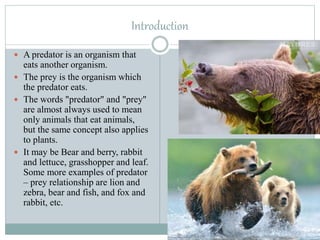
 It may be Bear and berry, rabbit
and lettuce, grasshopper and leaf.
Some more examples of predator
– prey relationship are lion and
zebra, bear and fish, and fox and
rabbit, etc.
Prey – predator relationship
 Predator and prey evolve together. The prey is part of the
predator's environment, and the predator dies if it does not get
food. So it evolves whatever is necessary in order to eat the
prey: speed, stealth, camouflage, a good sense of smell, sight,
or hearing, immunity to the prey's poison, poison (to kill the
prey) the right kind of mouth parts or digestive system, etc.
 Likewise, the predator is part of the prey's environment, and
the prey dies if it is eaten by the predator, so it evolves
whatever is necessary to avoid being eaten: speed, camouflage,
a good sense of smell, sight, or hearing (to detect the predator),
thorns, poison (to spray when approached or bitten), etc.
Examples
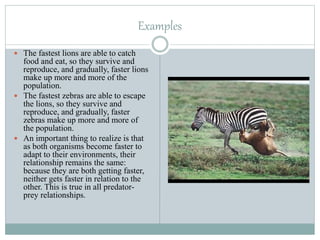
 The fastest lions are able to catch
food and eat, so they survive and
reproduce, and gradually, faster lions
make up more and more of the
population.
 The fastest zebras are able to escape
the lions, so they survive and
reproduce, and gradually, faster
zebras make up more and more of
the population.
 An important thing to realize is that
as both organisms become faster to
adapt to their environments, their
relationship remains the same:
because they are both getting faster,
neither gets faster in relation to the
other. This is true in all predator-
prey relationships.
Examples
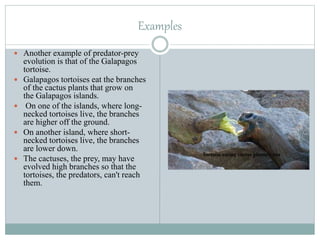
 Another example of predator-prey
evolution is that of the Galapagos
tortoise.
 Galapagos tortoises eat the branches
of the cactus plants that grow on
the Galapagos islands.
 On one of the islands, where long-
necked tortoises live, the branches
are higher off the ground.
 On another island, where short-
necked tortoises live, the branches
are lower down.
 The cactuses, the prey, may have
evolved high branches so that the
tortoises, the predators, can't reach
them.
Tortoise eating cactus pheonix zoo
animal relationship w.r.t prey and predator

animal relationship w.r.t prey and predator

  • 1.
    B Y : MA R I Y A M N A Z E E R A G H A K U D N O : 1 5 S 1 4 2 3 3 D E P T . O F S T U D I E S I N Z O O L O G Y G O V T . A R T S A N D S C I E N C E C O L L E G E , K A R W A R Explain animal relationship with respect to prey and predator (action and co – action) with suitable example
  • 2.
    Contents  Introduction  Prey– predator relationship  Some examples
  • 3.
    Introduction  A predatoris an organism that eats another organism.  The prey is the organism which the predator eats.  The words "predator" and "prey" are almost always used to mean only animals that eat animals, but the same concept also applies to plants.  It may be Bear and berry, rabbit and lettuce, grasshopper and leaf. Some more examples of predator – prey relationship are lion and zebra, bear and fish, and fox and rabbit, etc.
  • 4.
    Prey – predatorrelationship  Predator and prey evolve together. The prey is part of the predator's environment, and the predator dies if it does not get food. So it evolves whatever is necessary in order to eat the prey: speed, stealth, camouflage, a good sense of smell, sight, or hearing, immunity to the prey's poison, poison (to kill the prey) the right kind of mouth parts or digestive system, etc.  Likewise, the predator is part of the prey's environment, and the prey dies if it is eaten by the predator, so it evolves whatever is necessary to avoid being eaten: speed, camouflage, a good sense of smell, sight, or hearing (to detect the predator), thorns, poison (to spray when approached or bitten), etc.
  • 5.
    Examples  The fastestlions are able to catch food and eat, so they survive and reproduce, and gradually, faster lions make up more and more of the population.  The fastest zebras are able to escape the lions, so they survive and reproduce, and gradually, faster zebras make up more and more of the population.  An important thing to realize is that as both organisms become faster to adapt to their environments, their relationship remains the same: because they are both getting faster, neither gets faster in relation to the other. This is true in all predator- prey relationships.
  • 6.
    Examples  Another exampleof predator-prey evolution is that of the Galapagos tortoise.  Galapagos tortoises eat the branches of the cactus plants that grow on the Galapagos islands.  On one of the islands, where long- necked tortoises live, the branches are higher off the ground.  On another island, where short- necked tortoises live, the branches are lower down.  The cactuses, the prey, may have evolved high branches so that the tortoises, the predators, can't reach them. Tortoise eating cactus pheonix zoo