Correlation(Pearson & spearman) 
&Linear Regression
Correlation 
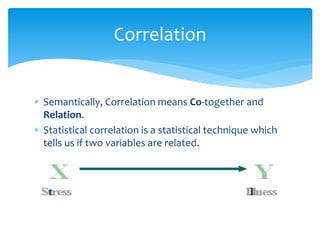
 Semantically, Correlation means Co-together and 
Relation. 
 Statistical correlation is a statistical technique which 
tells us if two variables are related.
PEARSON CORRELATION 
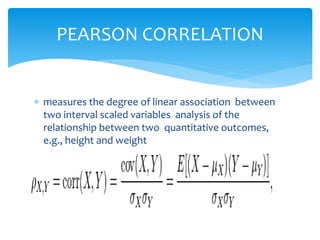
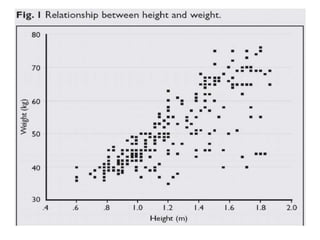
 measures the degree of linear association between 
two interval scaled variables analysis of the 
relationship between two quantitative outcomes, 
e.g., height and weight
Assumption under Pearson’s 
Correlation Coefficient 
 Assumption 1: The correlation coefficient r assumes 
that the two variables measured 
form a bivariate normal distribution population. 
 Assumption 2: The correlation coefficient r measures 
only linear associations: how nearly the data 
falls on a straight line. It is not a good summary of 
the association if the scatterplot has a nonlinear 
(curved) pattern.
Assumptions Contd. 
 Assumption 3: The correlation coefficient r is not a 
good summary of association if the data are 
heteroscedastic.(when random variables have the 
same finite variance. It is also known as homogenity 
of variance) 
 Assumption 4: The correlation coefficient r is not a 
good summary of association if the data have 
outliers.
Strength of Relationship 
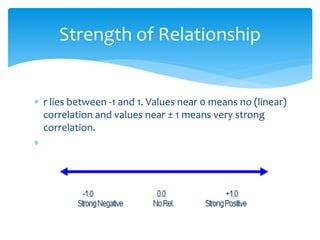
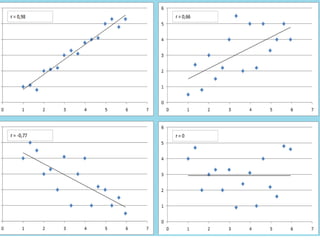
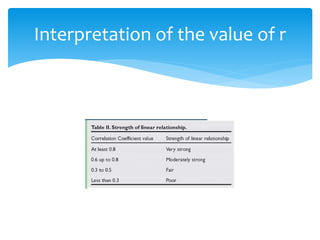
 r lies between -1 and 1. Values near 0 means no (linear) 
correlation and values near ± 1 means very strong 
correlation. 

Interpretation of the value of r
Coefficient of Determination 
 Pearson's r can be squared , r 2, to derive a 
coefficient of determination. 
 Coefficient of determination - the portion of 
variability in one of the variables that can be 
accounted for by variability in the second 
variable
Example 
 Pearson's r can be squared , r 2 
 If r=0.5, then r2=0.25 If r=0.7 then r2=0.49 
 Thus while r=0.5 versus 0.7 might not look so 
different in terms of strength, r2 tells us that r=0.7 
accounts for about twice the variability relative to 
r=0.5
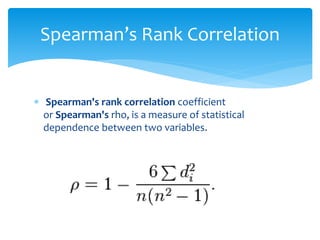
Spearman’s Rank Correlation 
 Spearman's rank correlation coefficient 
or Spearman's rho, is a measure of statistical 
dependence between two variables.
Interpretation 
 The sign of the Spearman correlation indicates the 
direction of association between X (the independent 
variable) and Y (the dependent variable). If Y tends to 
increase when X increases, the Spearman correlation 
coefficient is positive. If Y tends to decrease when X 
increases, the Spearman correlation coefficient is 
negative. A Spearman correlation of zero indicates 
that there is no tendency for Y to either increase or 
decrease when X increases
Repeated Ranks 
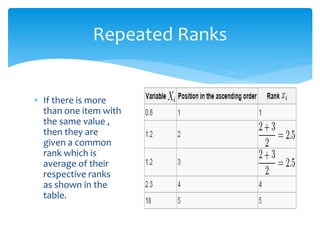
 If there is more 
than one item with 
the same value , 
then they are 
given a common 
rank which is 
average of their 
respective ranks 
as shown in the 
table.
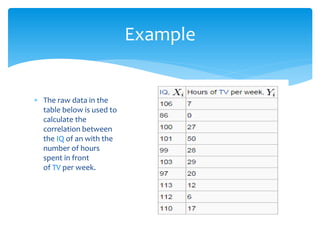
 The raw data in the 
table below is used to 
calculate the 
correlation between 
the IQ of an with the 
number of hours 
spent in front 
of TV per week. 
Example
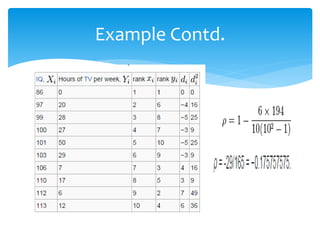
Example Contd.
Regression 
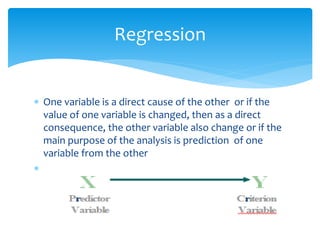
 One variable is a direct cause of the other or if the 
value of one variable is changed, then as a direct 
consequence, the other variable also change or if the 
main purpose of the analysis is prediction of one 
variable from the other 

Regression 
 Regression: the dependence of dependent variable Y 
on the independent variable X. 
 Relationship is summarized by a regression equation. 
y = a + bx 
 A=intercept at y axis 
 B=regression coefficient
The Least Squares Method 
 The line of regression is the line which gives the best 
estimate to the value of one variable for any specific 
value of the other variable. Thus the line of regression 
is the line of “best fit” and is Obtained by the principle 
of least squares. 
 This principle consists in minimizing the sum of the 
squares of the deviations of the actual values of y 
from their estimate values given by the line of best fit
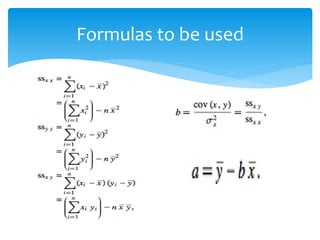
Formulas to be used
Example 
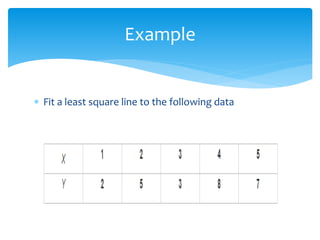
 Fit a least square line to the following data
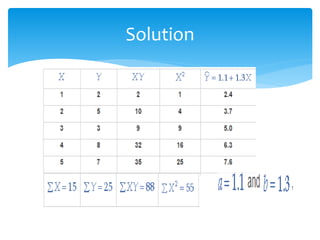
Solution
THANK YOU.

Correlation and regression

  • 1.
  • 2.
    Correlation  Semantically,Correlation means Co-together and Relation.  Statistical correlation is a statistical technique which tells us if two variables are related.
  • 3.
    PEARSON CORRELATION measures the degree of linear association between two interval scaled variables analysis of the relationship between two quantitative outcomes, e.g., height and weight
  • 4.
    Assumption under Pearson’s Correlation Coefficient  Assumption 1: The correlation coefficient r assumes that the two variables measured form a bivariate normal distribution population.  Assumption 2: The correlation coefficient r measures only linear associations: how nearly the data falls on a straight line. It is not a good summary of the association if the scatterplot has a nonlinear (curved) pattern.
  • 5.
    Assumptions Contd. Assumption 3: The correlation coefficient r is not a good summary of association if the data are heteroscedastic.(when random variables have the same finite variance. It is also known as homogenity of variance)  Assumption 4: The correlation coefficient r is not a good summary of association if the data have outliers.
  • 7.
    Strength of Relationship  r lies between -1 and 1. Values near 0 means no (linear) correlation and values near ± 1 means very strong correlation. 
  • 9.
  • 10.
    Coefficient of Determination  Pearson's r can be squared , r 2, to derive a coefficient of determination.  Coefficient of determination - the portion of variability in one of the variables that can be accounted for by variability in the second variable
  • 11.
    Example  Pearson'sr can be squared , r 2  If r=0.5, then r2=0.25 If r=0.7 then r2=0.49  Thus while r=0.5 versus 0.7 might not look so different in terms of strength, r2 tells us that r=0.7 accounts for about twice the variability relative to r=0.5
  • 12.
    Spearman’s Rank Correlation  Spearman's rank correlation coefficient or Spearman's rho, is a measure of statistical dependence between two variables.
  • 13.
    Interpretation  Thesign of the Spearman correlation indicates the direction of association between X (the independent variable) and Y (the dependent variable). If Y tends to increase when X increases, the Spearman correlation coefficient is positive. If Y tends to decrease when X increases, the Spearman correlation coefficient is negative. A Spearman correlation of zero indicates that there is no tendency for Y to either increase or decrease when X increases
  • 14.
    Repeated Ranks If there is more than one item with the same value , then they are given a common rank which is average of their respective ranks as shown in the table.
  • 15.
     The rawdata in the table below is used to calculate the correlation between the IQ of an with the number of hours spent in front of TV per week. Example
  • 16.
  • 17.
    Regression  Onevariable is a direct cause of the other or if the value of one variable is changed, then as a direct consequence, the other variable also change or if the main purpose of the analysis is prediction of one variable from the other 
  • 18.
    Regression  Regression:the dependence of dependent variable Y on the independent variable X.  Relationship is summarized by a regression equation. y = a + bx  A=intercept at y axis  B=regression coefficient
  • 19.
    The Least SquaresMethod  The line of regression is the line which gives the best estimate to the value of one variable for any specific value of the other variable. Thus the line of regression is the line of “best fit” and is Obtained by the principle of least squares.  This principle consists in minimizing the sum of the squares of the deviations of the actual values of y from their estimate values given by the line of best fit
  • 20.
  • 21.
    Example  Fita least square line to the following data
  • 22.
  • 23.