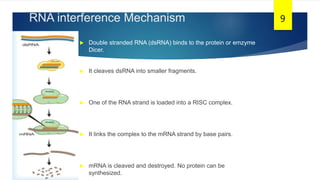
Small interfering RNA (siRNA) are double stranded RNA molecules that are 20-25 base pairs in length and silence gene expression through RNA interference. Andrew Fire and Craig Mello discovered RNA interference in 1998 through experiments injecting double stranded RNA into nematode worms, finding it caused gene silencing. The mechanism involves dicer cleaving double stranded RNA into siRNAs which are then loaded into an RISC complex to bind and cleave target mRNAs, preventing protein synthesis from that gene. SiRNA has significance in protecting against viruses, regulating development, and suppressing transcription, and applications in research to determine protein function and potential clinical uses like cancer treatment.