1
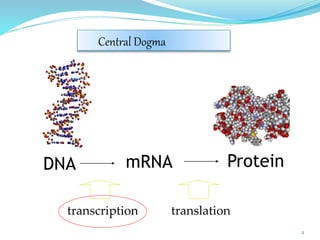
DNA mRNA Protein
transcription translation
Central Dogma
2
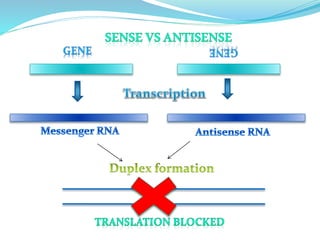
Single-stranded RNA that is complementary to a
messenger RNA(mRNA) strand transcribed within a
cell.
May be introduced into a cell to inhibit translation of
a complementary mRNA by base pairing to it.
RNA regulators – control gene expression by binding
to sequences on mRNA, inhibiting translation.
Antisense RNA
INTRODUCTION
What is antisense RNA Technology?
Antisense RNA Technology > tool used for
inhibition of gene expression.
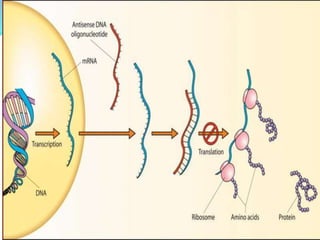
In this technique Short segments of single
stranded DNA called oligo de oxy nucleotides are
introduced.
These oligonucleotides are complementary to
the mRNA, which physically bind to the
mRNA.
This technique prevents the synthesis of
specific protein.
Powerful weapon for Studying gene function and
for discovering more specific treatments of
diseases.
History
1990- Richard Jorgenson gave the phenomenon of ‘cosupression
of gene expression’.
1992- Romano and Macino gave the phenomenon of as Virus
Induced Gene Silencing , set of such phenomenon was termed as
post transcriptional gene silencing.
1995-RNA silencing was first documented in animals by Guo and
Kemphues, and for this phenomenon they coined the term antisense
mediated silencing.
1998-Andrew Fire and Craig C.Mello coined the term RNA
interference (RNAi) .
2001-Thomas Tuschl, discovered with his colleagues that
RNAi could be prompted through the use of shorter pieces
of RNA known as small interfering RNAs (siRNAs).
2001-Gregory Hannon identified, described, and named
the "Dicer" enzyme, which chops dsRNA into siRNAs, as
well as the RNA-induced silencing complex (RISC), which
mediates the silencing process by degrading the homologous
mRNA.
2002-Effect named "short hairpin-activated gene silencing"
or SHAGging was introduced.
2004 Morris et al. Observed that siRNA silences genes at
the transcriptional level.
History
Contd….
Levels of gene silencing
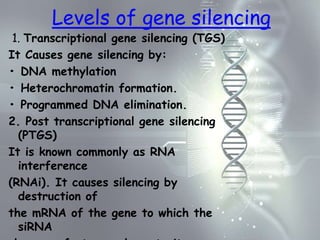
1. Transcriptional gene silencing (TGS)
It Causes gene silencing by:
• DNA methylation
• Heterochromatin formation.
• Programmed DNA elimination.
2. Post transcriptional gene silencing
(PTGS)
It is known commonly as RNA
interference
(RNAi). It causes silencing by
destruction of
the mRNA of the gene to which the
siRNA
Transcriptional gene silencing
 Transcriptional gene silencing - Result of modifications
of either the histones or DNA.
Gene silencing by modification of Histones and DNA
 Modification of nucleosomes alter the accessibility of the
gene to the transcriptional machinery and regulatory
proteins
 Heterochromatin is commonly involved in gene silencing,
and affects large sections of DNA.
 Methylation of particular DNA sequences can also silence
transcription in many eukaryotes.
Post transcriptional gene
silencing
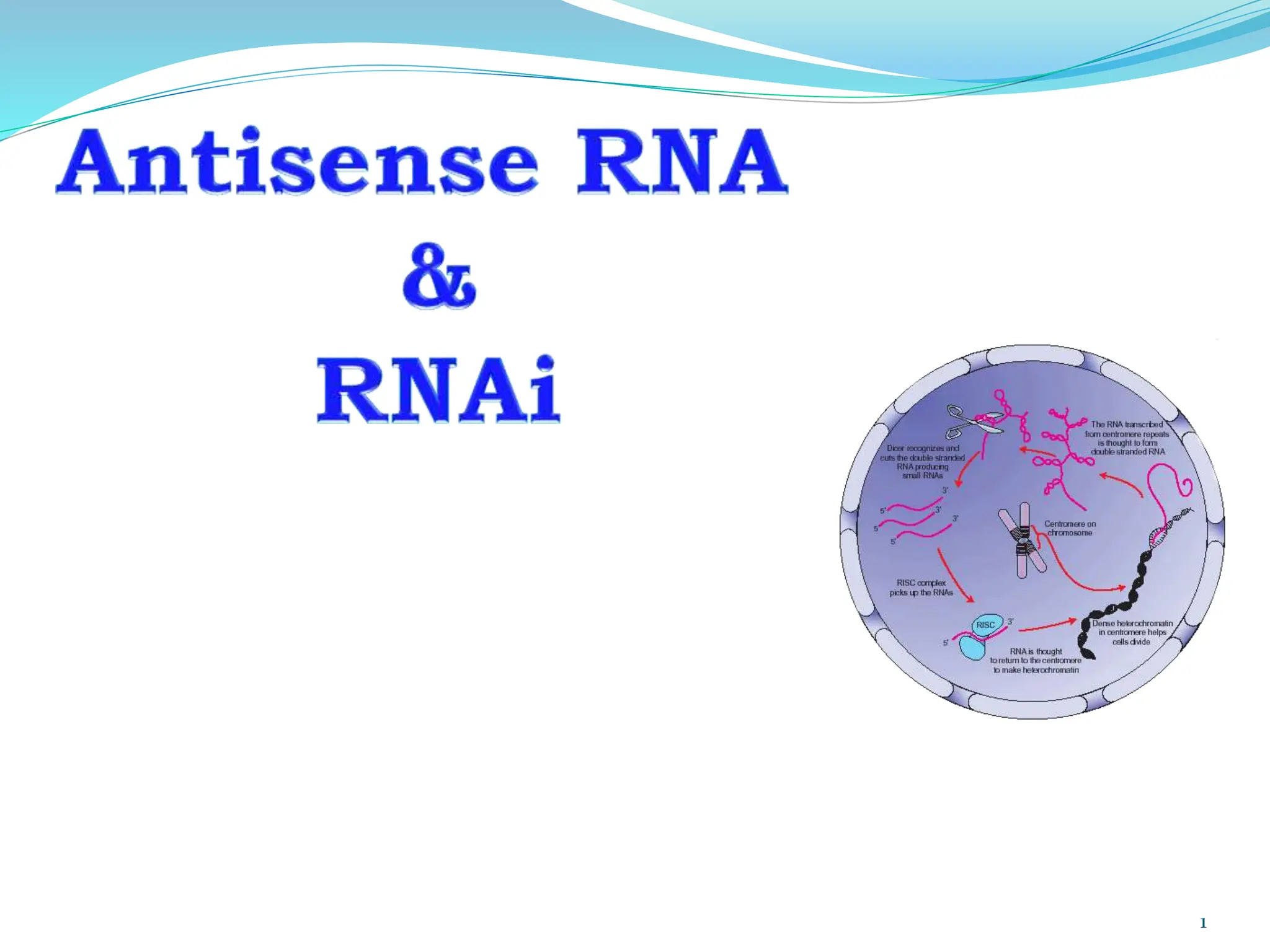
RNA interference (RNAi) is a molecular mechanism
in
which fragments of double stranded nucleic acid
(dsRNA)
interfere with the expression of a particular gene .
The dsRNA can be either, MicroRNA (miRNA) or
Small
interference RNA (siRNA)
https://lh6.ggpht.com/unnamed.jpg
The antisense effect of a
oligonucleotide sequence was
first demonstrated in 1970s by
Zamecnik and Stephenson, in
Rous sarcoma virus.
AS-ONs usually consist of 15–
20 nucleotides, which are
complementary to their target
mRNA.
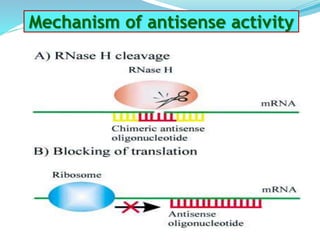
When these AS-ON combined
with target mRNA, a DNA/RNA
hybrid form,which degraded by
the enzyme RNase H.
RNase H
RNase H is a non-specific
endonuclease, catalyzes the
cleavage of RNA via hydrolytic
mechanism.
RNase H has ribonuclease
activity cleaves the 3’-O-P bond
of RNA in a DNA/RNA duplex.
Mechanism of antisense activity
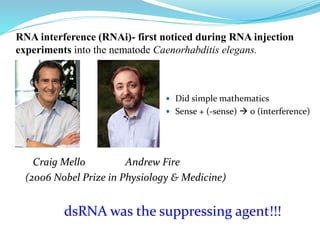
Craig Mello Andrew Fire
(2006 Nobel Prize in Physiology & Medicine)
dsRNA was the suppressing agent!!!
 Did simple mathematics
 Sense + (-sense)  0 (interference)
RNA interference (RNAi)- first noticed during RNA injection
experiments into the nematode Caenorhabditis elegans.
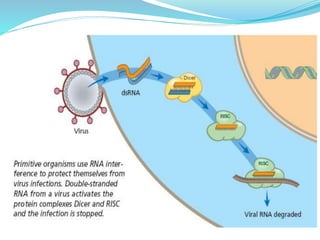
RNA interference (RNAi) represents an evolutionary
conserved cellular defense mechanism for
controlling the expression of alien genes in
filamentous fungi, microbes, plants, and animals.
Most widely held view is that RNAi evolved to protect
genome from viruses, and perhaps transposons or
mobile DNAs.
Natural ,biological mechanism in plants, insects and
mammals
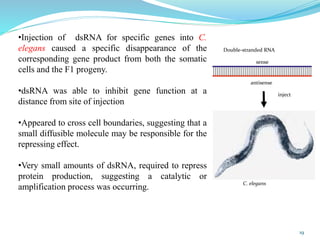
Double-stranded RNA
inject
C. elegans
sense
antisense
•Injection of dsRNA for specific genes into C.
elegans caused a specific disappearance of the
corresponding gene product from both the somatic
cells and the F1 progeny.
•dsRNA was able to inhibit gene function at a
distance from site of injection
•Appeared to cross cell boundaries, suggesting that a
small diffusible molecule may be responsible for the
repressing effect.
•Very small amounts of dsRNA, required to repress
protein production, suggesting a catalytic or
amplification process was occurring.
19
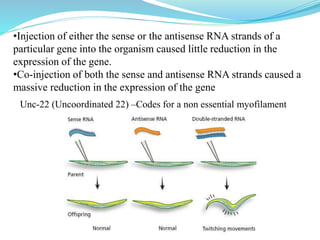
Unc-22 (Uncoordinated 22) –Codes for a non essential myofilament
•Injection of either the sense or the antisense RNA strands of a
particular gene into the organism caused little reduction in the
expression of the gene.
•Co-injection of both the sense and antisense RNA strands caused a
massive reduction in the expression of the gene
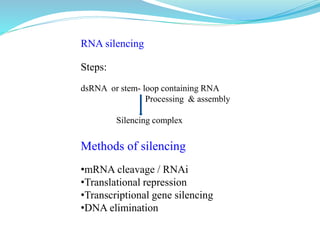
RNA silencing
Steps:
dsRNA or stem- loop containing RNA
Processing & assembly
Silencing complex
Methods of silencing
•mRNA cleavage / RNAi
•Translational repression
•Transcriptional gene silencing
•DNA elimination
 Definition: RNA interference (RNAi) is a sequence specific gene
silencing phenomenon caused by the presence of double stranded
RNA.
 It is called as Post-Transcriptional Gene Silencing (PTGS)
 In PTGS, the transcript of the silenced gene is synthesized but does not
accumulate because it is rapidly degraded. This is a more general term
than RNAi, since it can be triggered by several different means.
 This is a process by which double-stranded RNA (dsRNA) directs
sequence-specific degradation of mRNA
 dsRNA processed to short interfering RNA(siRNA)
RNA Interference (RNAi)
Remarkable Properties of RNAi
 RNAi is highly gene-specific
 dsRNA appears to move freely across cell boundaries
 RNAi works in flies, microbes, fungi, mice, animals
and plants
24
Small RNAs that provide target specificity to the silencing machinery
Short interfering RNAs (siRNAs),
Repeat-associated siRNAs (rasiRNAs)
MicroRNAs (miRNAs)
siRNAs
Processed from dsRNA precursors made up of two distinct
strands of perfectly base-paired RNA
siRNAs - 21–25 bp dsRNA with dinucleotide 3' overhangs
that are processed from longer dsRNA by Dicer in the
RNA interference pathway.
Introduction of synthetic siRNAs can induce RNA
interference in mammalian cells.
siRNAs can also originate from endogenous dsRNA
precursors.
miRNAs
Originate from a single, long transcript that forms
imperfectly base-paired hairpin structures
miRNAs - 19–23 nt single-stranded RNAs,
Endogenous in origin
miRNAs were discovered through their critical roles in
development and cellular regulation
Represent a large class of evolutionarily conserved
RNAs.
repeat-associated siRNAs, or rasiRNAs.
Endogenous siRNAs derived from repetitive sequences
within the genome
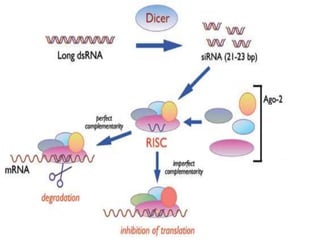
How does RNAi work?
1. Initiation step
dsRNA digested into 21-25 nt siRNAs (guide
RNAs) with the help of Dicer
2. Effector step
siRNA assemble into RISC
siRNA
• guide the RISC
• cleave
• destroy complementary RNA
Mechanism of RNAi
Major Actors in RNAi
1. Dicer: Responsible for the processing of dsRNA into
siRNAs. Initiates RNAi, progressively cleaves ds RNA 21-
25 bp intervals to generate si RNAs with 2-3’ overhangs at 3’
ends & phosphorylated 5’ ends
2. Small interfering RNA (siRNA): Produced in vivo by
cleavage of dsRNA. Amplification by an RNA-dependent
RNA polymerase (RdRP) occur. Incorporated into the RISC
guiding it to mRNA
3. RNA-Induced Silencing Complex (RISC): Nuclease
complex composed of proteins and siRNA. Targets and
destroys endogenous mRNAs complementary to the siRNA
28
29
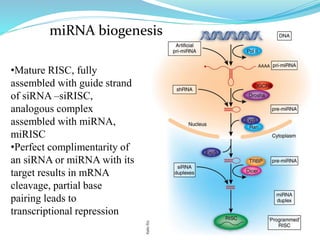
•Mature RISC, fully
assembled with guide strand
of siRNA –siRISC,
analogous complex
assembled with miRNA,
miRISC
•Perfect complimentarity of
an siRNA or miRNA with its
target results in mRNA
cleavage, partial base
pairing leads to
transcriptional repression
miRNA biogenesis
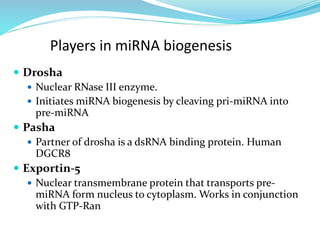
Players in miRNA biogenesis
 Drosha
 Nuclear RNase III enzyme.
 Initiates miRNA biogenesis by cleaving pri-miRNA into
pre-miRNA
 Pasha
 Partner of drosha is a dsRNA binding protein. Human
DGCR8
 Exportin-5
 Nuclear transmembrane protein that transports pre-
miRNA form nucleus to cytoplasm. Works in conjunction
with GTP-Ran
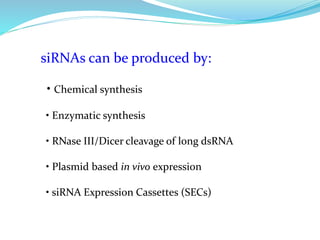
siRNAs can be produced by:
• Chemical synthesis
• Enzymatic synthesis
• RNase III/Dicer cleavage of long dsRNA
• Plasmid based in vivo expression
• siRNA Expression Cassettes (SECs)
Applications
Case study-
Flavr Savr Tomato
 The first FDA approved genetically modified
food
Licensed in 1994
 will not soften while ripening on the vine.
 Increased shelf life , tomatoes can be shipped
safely, keep their color, and have their natural
flavors.
BEFORE THE FLAVR SAVR
 Picked before ripe and gassed with ethylene to
give red color – keeps them from becoming
spoiled
 Tomatoes lose their taste and taste more like
“cardboard.”
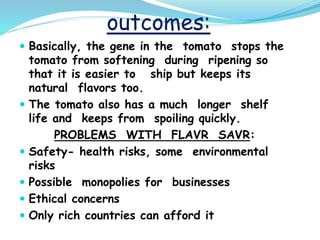
Making of Flavr Savr
 Enzyme
Polygalacturonase breaks
down structural
polysaccharide pectin in
wall of a plant.
 This is part of the
natural decay process in
a plant
 Flavr savr tomatoes have
been constructed that
express an antisense
mRNA complementary to
mRNA for an enzyme
involved in ethylene
production
 These tomatoes make only
10% of normal amount of
enzyme thus delaying
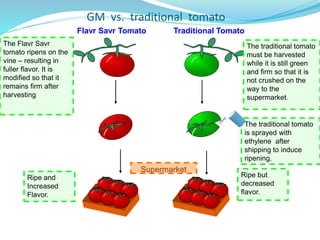
GM vs. traditional tomato
Flavr Savr Tomato Traditional Tomato
The Flavr Savr
tomato ripens on the
vine – resulting in
fuller flavor. It is
modified so that it
remains firm after
harvesting
The traditional tomato
must be harvested
while it is still green
and firm so that it is
not crushed on the
way to the
supermarket.
The traditional tomato
is sprayed with
ethylene after
shipping to induce
ripening.
Ripe and
Increased
Flavor.
Ripe but
decreased
flavor.
Supermarket
Modification of Brassica seed oil by antisense expression of a
stearoyl-acyl carrier protein desaturase gene
 Molecular gene transfer techniques have been used to engineer the
fatty acid composition of Brassica rapa and Brassica napus (canola)
oil.
 Stearoyl-acyl carrier protein (stearoyl-ACP) desaturase (EC
1.14.99.6) catalyzes the first desaturation step in seed oil
biosynthesis, converting stearoyl-ACP to oleoyl-ACP.
 Seed-specific antisense gene constructs of B. rapa stearoyl-ACP
desaturase were used to reduce the protein concentration and enzyme
activity of stearoyl-ACP desaturase in developing rapeseed embryos
during storage lipid biosynthesis.
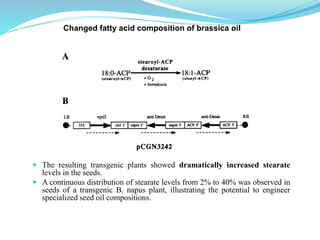
Changed fatty acid composition of brassica oil
 The resulting transgenic plants showed dramatically increased stearate
levels in the seeds.
 A continuous distribution of stearate levels from 2% to 40% was observed in
seeds of a transgenic B. napus plant, illustrating the potential to engineer
specialized seed oil compositions.
outcomes:
 Basically, the gene in the tomato stops the
tomato from softening during ripening so
that it is easier to ship but keeps its
natural flavors too.
 The tomato also has a much longer shelf
life and keeps from spoiling quickly.
PROBLEMS WITH FLAVR SAVR:
 Safety- health risks, some environmental
risks
 Possible monopolies for businesses
 Ethical concerns
 Only rich countries can afford it
CONCLUSION…
The Antisense RNA technology shows the
potential for
diverse applications to basic research and
therapy.
Antisense technology offers almost unlimited
scope for
the development of new methods of drug design
and one
of the most approved approaches among several
others,
for inactivating a single chosen gene.
40
Thank You

Antisence RNA and RNA Interference Technology

  • 1.
  • 2.
    DNA mRNA Protein transcriptiontranslation Central Dogma 2
  • 3.
    Single-stranded RNA thatis complementary to a messenger RNA(mRNA) strand transcribed within a cell. May be introduced into a cell to inhibit translation of a complementary mRNA by base pairing to it. RNA regulators – control gene expression by binding to sequences on mRNA, inhibiting translation. Antisense RNA
  • 4.
    INTRODUCTION What is antisenseRNA Technology? Antisense RNA Technology > tool used for inhibition of gene expression. In this technique Short segments of single stranded DNA called oligo de oxy nucleotides are introduced. These oligonucleotides are complementary to the mRNA, which physically bind to the mRNA. This technique prevents the synthesis of specific protein. Powerful weapon for Studying gene function and for discovering more specific treatments of diseases.
  • 5.
    History 1990- Richard Jorgensongave the phenomenon of ‘cosupression of gene expression’. 1992- Romano and Macino gave the phenomenon of as Virus Induced Gene Silencing , set of such phenomenon was termed as post transcriptional gene silencing. 1995-RNA silencing was first documented in animals by Guo and Kemphues, and for this phenomenon they coined the term antisense mediated silencing. 1998-Andrew Fire and Craig C.Mello coined the term RNA interference (RNAi) .
  • 6.
    2001-Thomas Tuschl, discoveredwith his colleagues that RNAi could be prompted through the use of shorter pieces of RNA known as small interfering RNAs (siRNAs). 2001-Gregory Hannon identified, described, and named the "Dicer" enzyme, which chops dsRNA into siRNAs, as well as the RNA-induced silencing complex (RISC), which mediates the silencing process by degrading the homologous mRNA. 2002-Effect named "short hairpin-activated gene silencing" or SHAGging was introduced. 2004 Morris et al. Observed that siRNA silences genes at the transcriptional level. History Contd….
  • 7.
    Levels of genesilencing 1. Transcriptional gene silencing (TGS) It Causes gene silencing by: • DNA methylation • Heterochromatin formation. • Programmed DNA elimination. 2. Post transcriptional gene silencing (PTGS) It is known commonly as RNA interference (RNAi). It causes silencing by destruction of the mRNA of the gene to which the siRNA
  • 8.
    Transcriptional gene silencing Transcriptional gene silencing - Result of modifications of either the histones or DNA. Gene silencing by modification of Histones and DNA  Modification of nucleosomes alter the accessibility of the gene to the transcriptional machinery and regulatory proteins  Heterochromatin is commonly involved in gene silencing, and affects large sections of DNA.  Methylation of particular DNA sequences can also silence transcription in many eukaryotes.
  • 9.
    Post transcriptional gene silencing RNAinterference (RNAi) is a molecular mechanism in which fragments of double stranded nucleic acid (dsRNA) interfere with the expression of a particular gene . The dsRNA can be either, MicroRNA (miRNA) or Small interference RNA (siRNA) https://lh6.ggpht.com/unnamed.jpg
  • 12.
    The antisense effectof a oligonucleotide sequence was first demonstrated in 1970s by Zamecnik and Stephenson, in Rous sarcoma virus. AS-ONs usually consist of 15– 20 nucleotides, which are complementary to their target mRNA.
  • 13.
    When these AS-ONcombined with target mRNA, a DNA/RNA hybrid form,which degraded by the enzyme RNase H. RNase H
  • 14.
    RNase H isa non-specific endonuclease, catalyzes the cleavage of RNA via hydrolytic mechanism. RNase H has ribonuclease activity cleaves the 3’-O-P bond of RNA in a DNA/RNA duplex.
  • 15.
  • 16.
    Craig Mello AndrewFire (2006 Nobel Prize in Physiology & Medicine) dsRNA was the suppressing agent!!!  Did simple mathematics  Sense + (-sense)  0 (interference) RNA interference (RNAi)- first noticed during RNA injection experiments into the nematode Caenorhabditis elegans.
  • 17.
    RNA interference (RNAi)represents an evolutionary conserved cellular defense mechanism for controlling the expression of alien genes in filamentous fungi, microbes, plants, and animals. Most widely held view is that RNAi evolved to protect genome from viruses, and perhaps transposons or mobile DNAs. Natural ,biological mechanism in plants, insects and mammals
  • 19.
    Double-stranded RNA inject C. elegans sense antisense •Injectionof dsRNA for specific genes into C. elegans caused a specific disappearance of the corresponding gene product from both the somatic cells and the F1 progeny. •dsRNA was able to inhibit gene function at a distance from site of injection •Appeared to cross cell boundaries, suggesting that a small diffusible molecule may be responsible for the repressing effect. •Very small amounts of dsRNA, required to repress protein production, suggesting a catalytic or amplification process was occurring. 19
  • 20.
    Unc-22 (Uncoordinated 22)–Codes for a non essential myofilament •Injection of either the sense or the antisense RNA strands of a particular gene into the organism caused little reduction in the expression of the gene. •Co-injection of both the sense and antisense RNA strands caused a massive reduction in the expression of the gene
  • 21.
    RNA silencing Steps: dsRNA orstem- loop containing RNA Processing & assembly Silencing complex Methods of silencing •mRNA cleavage / RNAi •Translational repression •Transcriptional gene silencing •DNA elimination
  • 22.
     Definition: RNAinterference (RNAi) is a sequence specific gene silencing phenomenon caused by the presence of double stranded RNA.  It is called as Post-Transcriptional Gene Silencing (PTGS)  In PTGS, the transcript of the silenced gene is synthesized but does not accumulate because it is rapidly degraded. This is a more general term than RNAi, since it can be triggered by several different means.  This is a process by which double-stranded RNA (dsRNA) directs sequence-specific degradation of mRNA  dsRNA processed to short interfering RNA(siRNA) RNA Interference (RNAi)
  • 23.
    Remarkable Properties ofRNAi  RNAi is highly gene-specific  dsRNA appears to move freely across cell boundaries  RNAi works in flies, microbes, fungi, mice, animals and plants
  • 24.
    24 Small RNAs thatprovide target specificity to the silencing machinery Short interfering RNAs (siRNAs), Repeat-associated siRNAs (rasiRNAs) MicroRNAs (miRNAs) siRNAs Processed from dsRNA precursors made up of two distinct strands of perfectly base-paired RNA siRNAs - 21–25 bp dsRNA with dinucleotide 3' overhangs that are processed from longer dsRNA by Dicer in the RNA interference pathway. Introduction of synthetic siRNAs can induce RNA interference in mammalian cells. siRNAs can also originate from endogenous dsRNA precursors.
  • 25.
    miRNAs Originate from asingle, long transcript that forms imperfectly base-paired hairpin structures miRNAs - 19–23 nt single-stranded RNAs, Endogenous in origin miRNAs were discovered through their critical roles in development and cellular regulation Represent a large class of evolutionarily conserved RNAs. repeat-associated siRNAs, or rasiRNAs. Endogenous siRNAs derived from repetitive sequences within the genome
  • 26.
    How does RNAiwork? 1. Initiation step dsRNA digested into 21-25 nt siRNAs (guide RNAs) with the help of Dicer 2. Effector step siRNA assemble into RISC siRNA • guide the RISC • cleave • destroy complementary RNA Mechanism of RNAi
  • 27.
    Major Actors inRNAi 1. Dicer: Responsible for the processing of dsRNA into siRNAs. Initiates RNAi, progressively cleaves ds RNA 21- 25 bp intervals to generate si RNAs with 2-3’ overhangs at 3’ ends & phosphorylated 5’ ends 2. Small interfering RNA (siRNA): Produced in vivo by cleavage of dsRNA. Amplification by an RNA-dependent RNA polymerase (RdRP) occur. Incorporated into the RISC guiding it to mRNA 3. RNA-Induced Silencing Complex (RISC): Nuclease complex composed of proteins and siRNA. Targets and destroys endogenous mRNAs complementary to the siRNA
  • 28.
  • 29.
    29 •Mature RISC, fully assembledwith guide strand of siRNA –siRISC, analogous complex assembled with miRNA, miRISC •Perfect complimentarity of an siRNA or miRNA with its target results in mRNA cleavage, partial base pairing leads to transcriptional repression miRNA biogenesis
  • 30.
    Players in miRNAbiogenesis  Drosha  Nuclear RNase III enzyme.  Initiates miRNA biogenesis by cleaving pri-miRNA into pre-miRNA  Pasha  Partner of drosha is a dsRNA binding protein. Human DGCR8  Exportin-5  Nuclear transmembrane protein that transports pre- miRNA form nucleus to cytoplasm. Works in conjunction with GTP-Ran
  • 31.
    siRNAs can beproduced by: • Chemical synthesis • Enzymatic synthesis • RNase III/Dicer cleavage of long dsRNA • Plasmid based in vivo expression • siRNA Expression Cassettes (SECs)
  • 32.
  • 33.
    Case study- Flavr SavrTomato  The first FDA approved genetically modified food Licensed in 1994  will not soften while ripening on the vine.  Increased shelf life , tomatoes can be shipped safely, keep their color, and have their natural flavors. BEFORE THE FLAVR SAVR  Picked before ripe and gassed with ethylene to give red color – keeps them from becoming spoiled  Tomatoes lose their taste and taste more like “cardboard.”
  • 34.
    Making of FlavrSavr  Enzyme Polygalacturonase breaks down structural polysaccharide pectin in wall of a plant.  This is part of the natural decay process in a plant  Flavr savr tomatoes have been constructed that express an antisense mRNA complementary to mRNA for an enzyme involved in ethylene production  These tomatoes make only 10% of normal amount of enzyme thus delaying
  • 35.
    GM vs. traditionaltomato Flavr Savr Tomato Traditional Tomato The Flavr Savr tomato ripens on the vine – resulting in fuller flavor. It is modified so that it remains firm after harvesting The traditional tomato must be harvested while it is still green and firm so that it is not crushed on the way to the supermarket. The traditional tomato is sprayed with ethylene after shipping to induce ripening. Ripe and Increased Flavor. Ripe but decreased flavor. Supermarket
  • 36.
    Modification of Brassicaseed oil by antisense expression of a stearoyl-acyl carrier protein desaturase gene  Molecular gene transfer techniques have been used to engineer the fatty acid composition of Brassica rapa and Brassica napus (canola) oil.  Stearoyl-acyl carrier protein (stearoyl-ACP) desaturase (EC 1.14.99.6) catalyzes the first desaturation step in seed oil biosynthesis, converting stearoyl-ACP to oleoyl-ACP.  Seed-specific antisense gene constructs of B. rapa stearoyl-ACP desaturase were used to reduce the protein concentration and enzyme activity of stearoyl-ACP desaturase in developing rapeseed embryos during storage lipid biosynthesis.
  • 37.
    Changed fatty acidcomposition of brassica oil  The resulting transgenic plants showed dramatically increased stearate levels in the seeds.  A continuous distribution of stearate levels from 2% to 40% was observed in seeds of a transgenic B. napus plant, illustrating the potential to engineer specialized seed oil compositions.
  • 38.
    outcomes:  Basically, thegene in the tomato stops the tomato from softening during ripening so that it is easier to ship but keeps its natural flavors too.  The tomato also has a much longer shelf life and keeps from spoiling quickly. PROBLEMS WITH FLAVR SAVR:  Safety- health risks, some environmental risks  Possible monopolies for businesses  Ethical concerns  Only rich countries can afford it
  • 39.
    CONCLUSION… The Antisense RNAtechnology shows the potential for diverse applications to basic research and therapy. Antisense technology offers almost unlimited scope for the development of new methods of drug design and one of the most approved approaches among several others, for inactivating a single chosen gene.
  • 40.