
RNA Interference (RNAi)
HARIS SADDIQUE
Ph.D Student (Biotechnology)
University of Malakand
RNAi
• RNA interference is a mechanism in living tissue or cell
that concern to controlling of gene activity. Small RNA
molecules i.e microRNA (miRNA) and small interfering
RNA (siRNA) are the two types that concern to RNA
interference.
• The direct product of genes are RNAs and they are often bind
to other RNA like mRNA effecting their activity like
preventing protein production by mRNA.
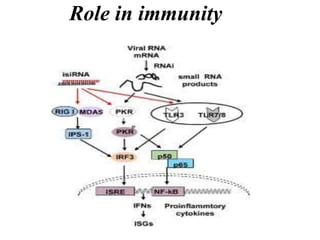
• This mechanism (RNAi) has a great importance in immunity
by preventing the cell against the parasitic invasion.
RNAi
RNA interference also called as post transcriptional
gene silencing is in immune response to dsRNA. It
shows resistance to endogenous and exogeneous
parasites as well control the protein coding gene
expression.
This mechanism has revolutionize many areas of
experimental biology with great practical application in
therapeutics and agriculture sectors.
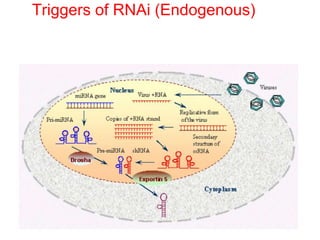
Triggers of RNAi (Endogenous)
Discovery
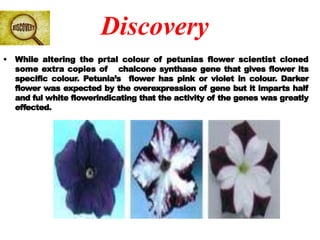
• While altering the prtal colour of petunias flower scientist cloned
some extra copies of chalcone synthase gene that gives flower its
specific colour. Petunia’s flower has pink or violet in colour. Darker
flower was expected by the overexpression of gene but it imparts half
and ful white flowerindicating that the activity of the genes was greatly
effected.
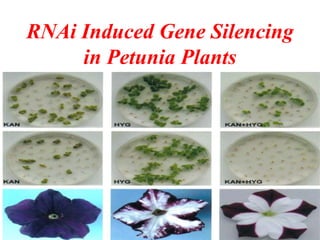
RNAi Induced Gene Silencing
in Petunia Plants
• At that time this was named as co- suppression also its
exact mechanism was remained unkown for long time.
• Plant produce certain virus specific proteins that
were resistant to viral infections but it was
against the expectation that plant also have some
short sequences in the non coding region that give
certain level if protectionof viral RNA showed some
levels of protection.
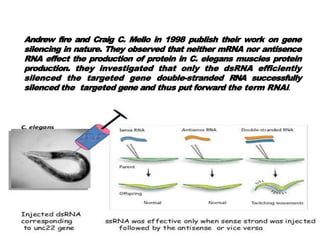
Andrew fire and Craig C. Mello in 1998 publish their work on gene
silencing in nature. They observed that neither mRNA nor antisence
RNA effect the production of protein in C. elegans muscles protein
production. they investigated that only the dsRNA efficiently
silenced the targeted gene double-stranded RNA successfully
silenced the targeted gene and thus put forward the term RNAi.
RNAi, theNobel winner
Craig C. Mello Andrew Fire
The Mechanism of RNAi
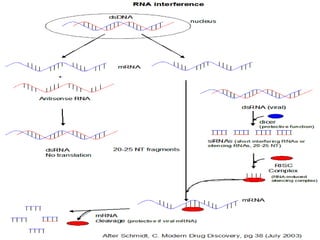
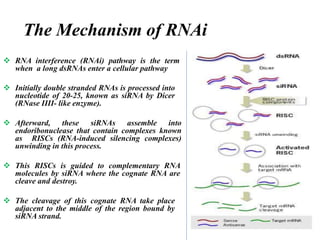
 RNA interference (RNAi) pathway is the term
when a long dsRNAs enter a cellular pathway
 Initially double stranded RNAs is processed into
nucleotide of 20-25, known as siRNA by Dicer
(RNase IIII- like enzyme).
 Afterward, these siRNAs assemble into
endoribonuclease that contain complexes known
as RISCs (RNA-induced silencing complexes)
unwinding in this process.
 This RISCs is guided to complementary RNA
molecules by siRNA where the cognate RNA are
cleave and destroy.
 The cleavage of this cognate RNA take place
adjacent to the middle of the region bound by
siRNA strand.
Biological Functions Of RNAi
Upregulation of genes
Downregulation of genes
Immunity
Role in immunity
RNAi technology strategies
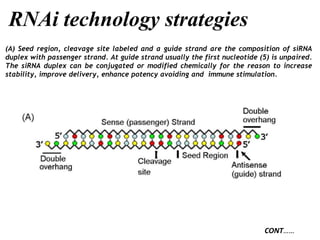
(A) Seed region, cleavage site labeled and a guide strand are the composition of siRNA
duplex with passenger strand. At guide strand usually the first nucleotide (5) is unpaired.
The siRNA duplex can be conjugated or modified chemically for the reason to increase
stability, improve delivery, enhance potency avoiding and immune stimulation.
CONT……
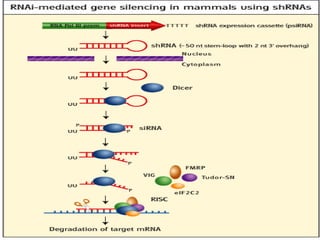
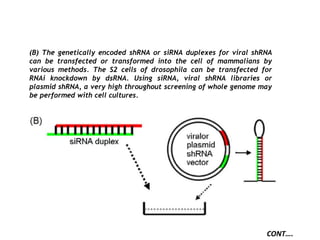
(B) The genetically encoded shRNA or siRNA duplexes for viral shRNA
can be transfected or transformed into the cell of mammalians by
various methods. The S2 cells of drosophila can be transfected for
RNAi knockdown by dsRNA. Using siRNA, viral shRNA libraries or
plasmid shRNA, a very high throughout screening of whole genome may
be performed with cell cultures.
CONT….
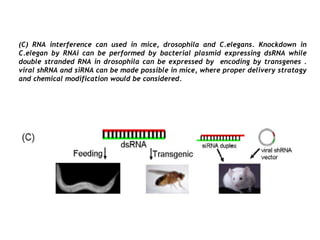
(C) RNA interference can used in mice, drosophila and C.elegans. Knockdown in
C.elegan by RNAi can be performed by bacterial plasmid expressing dsRNA while
double stranded RNA in drosophila can be expressed by encoding by transgenes .
viral shRNA and siRNA can be made possible in mice, where proper delivery stratagy
and chemical modification would be considered.
Applications of RNAi
• Functional genomics
• Gene knockdown
• Biotechnology
• Functional genomics
• Medicine
Role in Biotechnology
 RNAi has been widely usedin plant biotechnology to produce plant with low
level of toxins.
 A common cotton seed is rich in dietery protein but also contain terpeniod
product gossypol unsuitable for common use..
 RNA interference has also used in the production of cotton stocks. The
seeds has reduced levels of delta-cadinene synthase, a key enzyme that
helps in gossypol production. It does not effect the enzyme's production in
other parts of the plant. Gossypol is very important in preventing damage
from plant pests.
 In cassava plant it is used to reduce linamarin, a cyanogenic natural
product.
Role of RNAi in Medicine
 To exploit RNA interference intherapy.
 In the development of a safe delivery method for gene therapy.
 For the potential treatments of neurodegenerative diseases
 RNAi can be used to treat cancer by up regulating in cancer cells
References
http://www.ambion.com/techlib/append/RNAi_mechanism.html
http://en.wikipedia.org/wiki/RNA_interference
http://en.wikipedia.org/wiki/RNA-induced_silencing_complex
http://www.gene-quantification.de/rnai.html
http://www.uni-konstanz.de/FuF/chemie/jhartig/

RNA interference (RNAi)

  • 1.
    RNA Interference (RNAi) HARISSADDIQUE Ph.D Student (Biotechnology) University of Malakand
  • 2.
    RNAi • RNA interferenceis a mechanism in living tissue or cell that concern to controlling of gene activity. Small RNA molecules i.e microRNA (miRNA) and small interfering RNA (siRNA) are the two types that concern to RNA interference. • The direct product of genes are RNAs and they are often bind to other RNA like mRNA effecting their activity like preventing protein production by mRNA. • This mechanism (RNAi) has a great importance in immunity by preventing the cell against the parasitic invasion.
  • 3.
    RNAi RNA interference alsocalled as post transcriptional gene silencing is in immune response to dsRNA. It shows resistance to endogenous and exogeneous parasites as well control the protein coding gene expression. This mechanism has revolutionize many areas of experimental biology with great practical application in therapeutics and agriculture sectors.
  • 4.
    Triggers of RNAi(Endogenous)
  • 5.
    Discovery • While alteringthe prtal colour of petunias flower scientist cloned some extra copies of chalcone synthase gene that gives flower its specific colour. Petunia’s flower has pink or violet in colour. Darker flower was expected by the overexpression of gene but it imparts half and ful white flowerindicating that the activity of the genes was greatly effected.
  • 6.
    RNAi Induced GeneSilencing in Petunia Plants
  • 7.
    • At thattime this was named as co- suppression also its exact mechanism was remained unkown for long time. • Plant produce certain virus specific proteins that were resistant to viral infections but it was against the expectation that plant also have some short sequences in the non coding region that give certain level if protectionof viral RNA showed some levels of protection.
  • 8.
    Andrew fire andCraig C. Mello in 1998 publish their work on gene silencing in nature. They observed that neither mRNA nor antisence RNA effect the production of protein in C. elegans muscles protein production. they investigated that only the dsRNA efficiently silenced the targeted gene double-stranded RNA successfully silenced the targeted gene and thus put forward the term RNAi.
  • 9.
    RNAi, theNobel winner CraigC. Mello Andrew Fire
  • 12.
    The Mechanism ofRNAi  RNA interference (RNAi) pathway is the term when a long dsRNAs enter a cellular pathway  Initially double stranded RNAs is processed into nucleotide of 20-25, known as siRNA by Dicer (RNase IIII- like enzyme).  Afterward, these siRNAs assemble into endoribonuclease that contain complexes known as RISCs (RNA-induced silencing complexes) unwinding in this process.  This RISCs is guided to complementary RNA molecules by siRNA where the cognate RNA are cleave and destroy.  The cleavage of this cognate RNA take place adjacent to the middle of the region bound by siRNA strand.
  • 14.
    Biological Functions OfRNAi Upregulation of genes Downregulation of genes Immunity
  • 15.
  • 16.
    RNAi technology strategies (A)Seed region, cleavage site labeled and a guide strand are the composition of siRNA duplex with passenger strand. At guide strand usually the first nucleotide (5) is unpaired. The siRNA duplex can be conjugated or modified chemically for the reason to increase stability, improve delivery, enhance potency avoiding and immune stimulation. CONT……
  • 17.
    (B) The geneticallyencoded shRNA or siRNA duplexes for viral shRNA can be transfected or transformed into the cell of mammalians by various methods. The S2 cells of drosophila can be transfected for RNAi knockdown by dsRNA. Using siRNA, viral shRNA libraries or plasmid shRNA, a very high throughout screening of whole genome may be performed with cell cultures. CONT….
  • 18.
    (C) RNA interferencecan used in mice, drosophila and C.elegans. Knockdown in C.elegan by RNAi can be performed by bacterial plasmid expressing dsRNA while double stranded RNA in drosophila can be expressed by encoding by transgenes . viral shRNA and siRNA can be made possible in mice, where proper delivery stratagy and chemical modification would be considered.
  • 19.
    Applications of RNAi •Functional genomics • Gene knockdown • Biotechnology • Functional genomics • Medicine
  • 20.
    Role in Biotechnology RNAi has been widely usedin plant biotechnology to produce plant with low level of toxins.  A common cotton seed is rich in dietery protein but also contain terpeniod product gossypol unsuitable for common use..  RNA interference has also used in the production of cotton stocks. The seeds has reduced levels of delta-cadinene synthase, a key enzyme that helps in gossypol production. It does not effect the enzyme's production in other parts of the plant. Gossypol is very important in preventing damage from plant pests.  In cassava plant it is used to reduce linamarin, a cyanogenic natural product.
  • 21.
    Role of RNAiin Medicine  To exploit RNA interference intherapy.  In the development of a safe delivery method for gene therapy.  For the potential treatments of neurodegenerative diseases  RNAi can be used to treat cancer by up regulating in cancer cells
  • 22.

Editor's Notes

  • #5 Endogenous triggers of RNAi pathway include foreign DNA or double-stranded RNA (dsRNA) of viral origin, aberrant transcripts from repetitive sequences in the genome such as transposons, and premicroRNA (miRNA). In plants, RNAi forms the basis of virus-induced gene silencing (VIGS), suggesting an important role in pathogen resistance. A possible mechanism underlying the regulation of endogenous genes by the RNAi machinery was suggested from studies of C. elegans. In mammalian cells long (>30nt) double-stranded RNAs usually cause Interferon response