R O S H N I . P
M S C B I O C H E M I S T R Y
SiRNA : structure and function
What is RNA?
 Ribonucleic acid
 Ribonucleotides (Ribose, base, & phosphate)
 Types
 Coding: messenger RNA (mRNA)
 Non-coding:
 Ribosomal RNA (rRNA)
 Transfer RNA (tRNA)
 Small nuclear RNA (snRNA)
 Small nucleolar RNA (snoRNA)
 Interference RNA (RNAi)
 Short interfering RNA (siRNA)
 Micro RNA (miRNA)
siRNA : (small-interfering RNAs)
 Function of the species is regulation of gene expression
 siRNA originates with dsRNA
 Approximately 21-28 nucleotides in length.
 siRNA is most commonly a response to foreign RNA
(usually viral) and is often 100% complementary to the
target
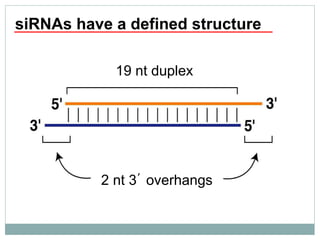
siRNAs have a defined structure
19 nt duplex
2 nt 3’
overhangs
siRNAs found in nature are derived from the
cytoplasmic processing of long dsRNA by the RNase-IIItype
enzyme termed Dicer.Dicer cleaves long dsRNA into 21- to 28-
nucleotide siRNA duplexes that contain 2-nucleotide 3′
overhangs with 5′ phosphate and 3′ hydroxyl termini.
Components of the RNAi machinery specifically recognize the
siRNA duplex and incorporate a single siRNA strand into a
protein complex termed the RNA-induced silencing complex
(RISC). RISC cleaves mRNAs containing perfectly
complementary sequences, 10 nucleotides from the 5′ end of
the incorporated siRNA strand.
siRNA design
Function of SiRNA
Function of the species is regulation
of gene expression : (RNAi)
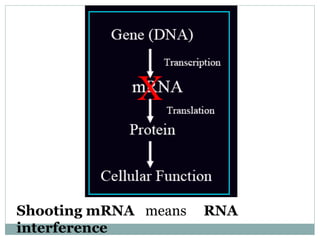
Shooting mRNA means RNA
interference
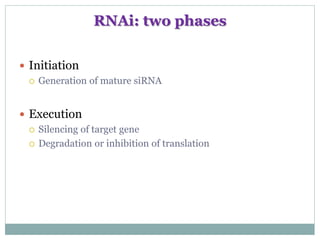
RNAi: two phases
 Initiation
 Generation of mature siRNA
 Execution
 Silencing of target gene
 Degradation or inhibition of translation
How does RNAi work?
•RNAi is mediated by small interfering RNAs (SiRNAs) that are
generated from long dsRNA.
•Long dsRNAs are cleaved by a ribonucleaseIII (RNaseIII) type
protein Dicer.
•Dicer homologues can be found in S.pombe, C.Elegans,
Drosophila, plants, and mammals, suggesting that small RNA –
mediated regulation is evolutionarily ancient and may have
critical biological roles.
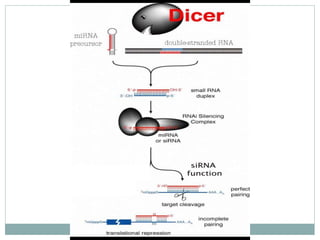
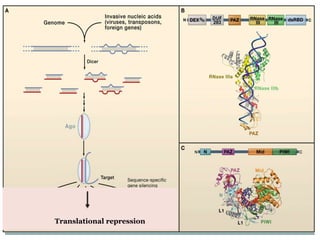
DICER
 Dicer (class 3 RNAse III) cleaves long dsRNA
into siRNA 21-25nt dsRNA
 Symmetric 2nt 3’ overhangs, 5’ phosphate groups
siRNA
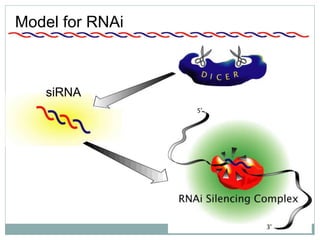
Model for RNAi
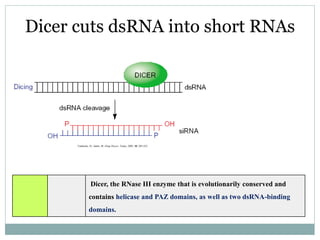
Dicer cuts dsRNA into short RNAs
Vanhecke, D.; Janitz, M. Drug Discov. Today, 2005, 10, 205-225.
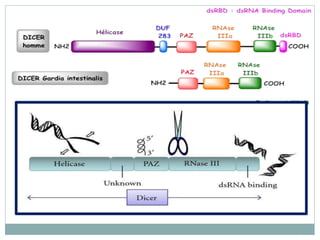
Dicer, the RNase III enzyme that is evolutionarily conserved and
contains helicase and PAZ domains, as well as two dsRNA-binding
domains.
How do Dicer proteins work in
dsRNA processing?
The PAZ (Piwi Argonaute Zwille) and
RNase III domains play central roles in
excising siRNAs preferentially from ends of
dsRNA molecules.
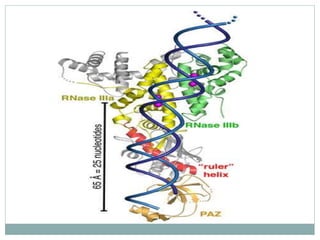
PAZ domains are shared with Argonaute proteins and are
specialized to bind RNA ends, especially duplex ends with short
(2 nt) 30 overhangs. An end engages the Dicer PAZ domain, and
the substrate dsRNA then extends approximately two helical
turns along the surface of the protein before it reaches a single
processing center.The center resides in a cleft of an
intramolecular dimer involving the RNase III domains. Each of
the two RNase III active sites cleaves one of the two strands,
leading to staggered duplex scission to generate new ends with 2
nt 30 overhangs. The reaction leaves a 50 monophosphate on the
product ends, consistent with a requirement for this group during
later stages of silencing.
Translational repression
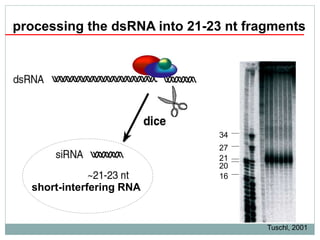
processing the dsRNA into 21-23 nt fragments
34
27
21
20
16
short-interfering RNA
Q uic kTime ™ a n d a
G IF d ec o mp re s so r
a re n ee d ed to s ee this p ic tu re .
Tuschl, 2001
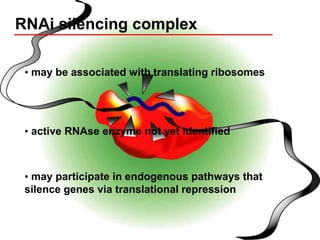
RNAi silencing complex
• may be associated with translating ribosomes
• active RNAse enzyme not yet identified
• may participate in endogenous pathways that
silence genes via translational repression
RNA Induced Silencing Complex
(RISC)
 RNAi effector complex
 Preferentially incorporates one strand of
unwound RNA .
 Antisense
 How does it know which is which?
 The strand with less 5’ stability usually incorporated
into RISC.
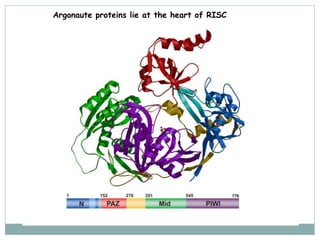
Argonaute proteins lie at the heart of RISC
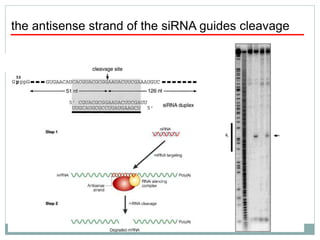
the antisense strand of the siRNA guides cleavage
 Basic research
 Determining protein function
 Easier than a knockout and may be used for partial
knockdowns
 Clinical research
 Cancer, hypercholesterolemia, infections, developmental
defects
siRNA for treatment of AMD
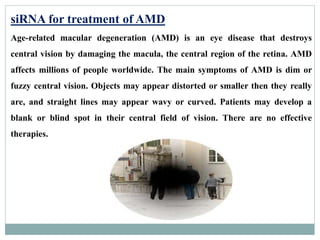
Age-related macular degeneration (AMD) is an eye disease that destroys
central vision by damaging the macula, the central region of the retina. AMD
affects millions of people worldwide. The main symptoms of AMD is dim or
fuzzy central vision. Objects may appear distorted or smaller then they really
are, and straight lines may appear wavy or curved. Patients may develop a
blank or blind spot in their central field of vision. There are no effective
therapies.
siRNA for treatment of AMD
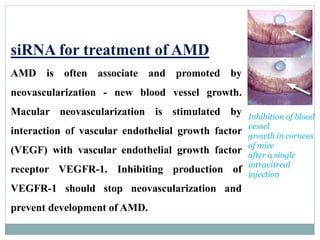
AMD is often associate and promoted by
neovascularization - new blood vessel growth.
Macular neovascularization is stimulated by
interaction of vascular endothelial growth factor
(VEGF) with vascular endothelial growth factor
receptor VEGFR-1. Inhibiting production of
VEGFR-1 should stop neovascularization and
prevent development of AMD.
Inhibition of blood
vessel
growth in corneas
of mice
after a single
intravitreal
injection
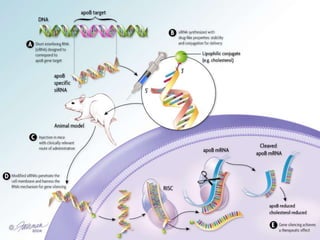
siRNA targeting ApoB
ApoB is a liver enzyme essential for the assembly and secretion
of low-density lipoprotein (LDL), which are required for
metabolism of cholesterol. High levels of ApoB and LDL
increase risk of coronary artery disease. Alnylam
Pharmaceuticals developed siRNA to target ApoB. They first
used chloresterol-conjugated siRNA to demonstrate its effect on
ApoB production in mice.
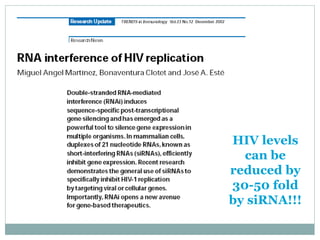
HIV levels
can be
reduced by
30-50 fold
by siRNA!!!
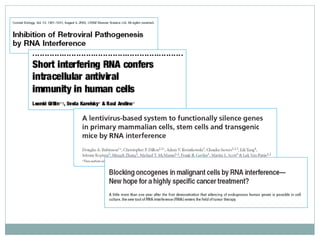
Defense Against Viruses
www.nobelprize.org
SiRNA have become not an exciting new tool in nolecular
biology but also the next frontier in molecular medicine.
Significant hurdles remain, most notably guaranteeing
specificity and finding safe and efficacious delivery system.
Work is ongoing to solve these problem, but the therapeutic
promise of SiRNA remains great.
CONCLUSION

SiRNA

  • 1.
    R O SH N I . P M S C B I O C H E M I S T R Y SiRNA : structure and function
  • 2.
    What is RNA? Ribonucleic acid  Ribonucleotides (Ribose, base, & phosphate)  Types  Coding: messenger RNA (mRNA)  Non-coding:  Ribosomal RNA (rRNA)  Transfer RNA (tRNA)  Small nuclear RNA (snRNA)  Small nucleolar RNA (snoRNA)  Interference RNA (RNAi)  Short interfering RNA (siRNA)  Micro RNA (miRNA)
  • 3.
    siRNA : (small-interferingRNAs)  Function of the species is regulation of gene expression  siRNA originates with dsRNA  Approximately 21-28 nucleotides in length.  siRNA is most commonly a response to foreign RNA (usually viral) and is often 100% complementary to the target
  • 4.
    siRNAs have adefined structure 19 nt duplex 2 nt 3’ overhangs
  • 5.
    siRNAs found innature are derived from the cytoplasmic processing of long dsRNA by the RNase-IIItype enzyme termed Dicer.Dicer cleaves long dsRNA into 21- to 28- nucleotide siRNA duplexes that contain 2-nucleotide 3′ overhangs with 5′ phosphate and 3′ hydroxyl termini. Components of the RNAi machinery specifically recognize the siRNA duplex and incorporate a single siRNA strand into a protein complex termed the RNA-induced silencing complex (RISC). RISC cleaves mRNAs containing perfectly complementary sequences, 10 nucleotides from the 5′ end of the incorporated siRNA strand.
  • 7.
  • 8.
    Function of SiRNA Functionof the species is regulation of gene expression : (RNAi)
  • 10.
    Shooting mRNA meansRNA interference
  • 11.
    RNAi: two phases Initiation  Generation of mature siRNA  Execution  Silencing of target gene  Degradation or inhibition of translation
  • 12.
  • 13.
    •RNAi is mediatedby small interfering RNAs (SiRNAs) that are generated from long dsRNA. •Long dsRNAs are cleaved by a ribonucleaseIII (RNaseIII) type protein Dicer. •Dicer homologues can be found in S.pombe, C.Elegans, Drosophila, plants, and mammals, suggesting that small RNA – mediated regulation is evolutionarily ancient and may have critical biological roles.
  • 14.
    DICER  Dicer (class3 RNAse III) cleaves long dsRNA into siRNA 21-25nt dsRNA  Symmetric 2nt 3’ overhangs, 5’ phosphate groups
  • 15.
  • 16.
    Dicer cuts dsRNAinto short RNAs Vanhecke, D.; Janitz, M. Drug Discov. Today, 2005, 10, 205-225. Dicer, the RNase III enzyme that is evolutionarily conserved and contains helicase and PAZ domains, as well as two dsRNA-binding domains.
  • 19.
    How do Dicerproteins work in dsRNA processing? The PAZ (Piwi Argonaute Zwille) and RNase III domains play central roles in excising siRNAs preferentially from ends of dsRNA molecules.
  • 20.
    PAZ domains areshared with Argonaute proteins and are specialized to bind RNA ends, especially duplex ends with short (2 nt) 30 overhangs. An end engages the Dicer PAZ domain, and the substrate dsRNA then extends approximately two helical turns along the surface of the protein before it reaches a single processing center.The center resides in a cleft of an intramolecular dimer involving the RNase III domains. Each of the two RNase III active sites cleaves one of the two strands, leading to staggered duplex scission to generate new ends with 2 nt 30 overhangs. The reaction leaves a 50 monophosphate on the product ends, consistent with a requirement for this group during later stages of silencing.
  • 21.
  • 22.
    processing the dsRNAinto 21-23 nt fragments 34 27 21 20 16 short-interfering RNA Q uic kTime ™ a n d a G IF d ec o mp re s so r a re n ee d ed to s ee this p ic tu re . Tuschl, 2001
  • 23.
    RNAi silencing complex •may be associated with translating ribosomes • active RNAse enzyme not yet identified • may participate in endogenous pathways that silence genes via translational repression
  • 24.
    RNA Induced SilencingComplex (RISC)  RNAi effector complex  Preferentially incorporates one strand of unwound RNA .  Antisense  How does it know which is which?  The strand with less 5’ stability usually incorporated into RISC.
  • 26.
    Argonaute proteins lieat the heart of RISC
  • 27.
    the antisense strandof the siRNA guides cleavage
  • 28.
     Basic research Determining protein function  Easier than a knockout and may be used for partial knockdowns  Clinical research  Cancer, hypercholesterolemia, infections, developmental defects
  • 29.
    siRNA for treatmentof AMD Age-related macular degeneration (AMD) is an eye disease that destroys central vision by damaging the macula, the central region of the retina. AMD affects millions of people worldwide. The main symptoms of AMD is dim or fuzzy central vision. Objects may appear distorted or smaller then they really are, and straight lines may appear wavy or curved. Patients may develop a blank or blind spot in their central field of vision. There are no effective therapies.
  • 30.
    siRNA for treatmentof AMD AMD is often associate and promoted by neovascularization - new blood vessel growth. Macular neovascularization is stimulated by interaction of vascular endothelial growth factor (VEGF) with vascular endothelial growth factor receptor VEGFR-1. Inhibiting production of VEGFR-1 should stop neovascularization and prevent development of AMD. Inhibition of blood vessel growth in corneas of mice after a single intravitreal injection
  • 31.
    siRNA targeting ApoB ApoBis a liver enzyme essential for the assembly and secretion of low-density lipoprotein (LDL), which are required for metabolism of cholesterol. High levels of ApoB and LDL increase risk of coronary artery disease. Alnylam Pharmaceuticals developed siRNA to target ApoB. They first used chloresterol-conjugated siRNA to demonstrate its effect on ApoB production in mice.
  • 33.
    HIV levels can be reducedby 30-50 fold by siRNA!!!
  • 35.
  • 36.
    SiRNA have becomenot an exciting new tool in nolecular biology but also the next frontier in molecular medicine. Significant hurdles remain, most notably guaranteeing specificity and finding safe and efficacious delivery system. Work is ongoing to solve these problem, but the therapeutic promise of SiRNA remains great. CONCLUSION