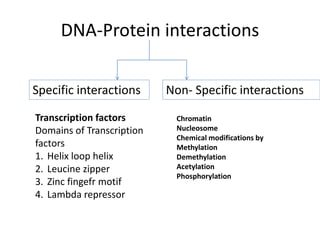
DNA-Protein interactions
Specific interactions Non- Specific interactions
Transcription factors
Domains of Transcription
factors
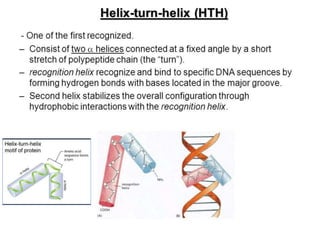
1. Helix loop helix
2. Leucine zipper
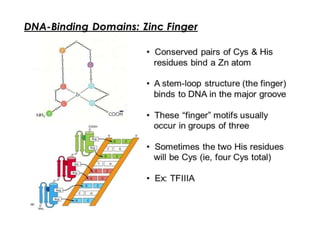
3. Zinc fingefr motif
4. Lambda repressor
Chromatin
Nucleosome
Chemical modifications by
Methylation
Demethylation
Acetylation
Phosphorylation
Protein–DNA interactions are when a protein
binds a molecule of DNA, often to regulate the
biological function of DNA, usually the
expression of a gene.
Among the proteins that bind to DNA are
transcription factors that activate or repress
gene expression by binding to DNA motifs and
histones that form part of the structure of
DNA and bind to it less specifically.
1. Transcription factors
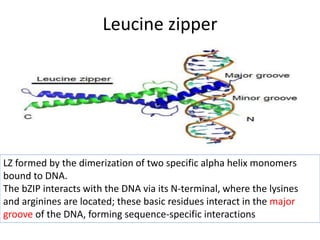
Leucine zipper
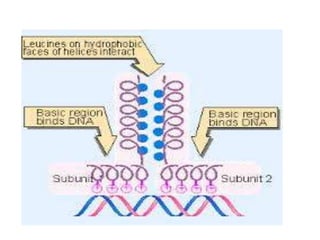
LZ formed by the dimerization of two specific alpha helix monomers
bound to DNA.
The bZIP interacts with the DNA via its N-terminal, where the lysines
and arginines are located; these basic residues interact in the major
groove of the DNA, forming sequence-specific interactions
Non-specific interactions
Histone modification

Protein dna interactions

  • 1.
    DNA-Protein interactions Specific interactionsNon- Specific interactions Transcription factors Domains of Transcription factors 1. Helix loop helix 2. Leucine zipper 3. Zinc fingefr motif 4. Lambda repressor Chromatin Nucleosome Chemical modifications by Methylation Demethylation Acetylation Phosphorylation
  • 2.
    Protein–DNA interactions arewhen a protein binds a molecule of DNA, often to regulate the biological function of DNA, usually the expression of a gene. Among the proteins that bind to DNA are transcription factors that activate or repress gene expression by binding to DNA motifs and histones that form part of the structure of DNA and bind to it less specifically.
  • 3.
  • 6.
    Leucine zipper LZ formedby the dimerization of two specific alpha helix monomers bound to DNA. The bZIP interacts with the DNA via its N-terminal, where the lysines and arginines are located; these basic residues interact in the major groove of the DNA, forming sequence-specific interactions
  • 11.
  • 12.