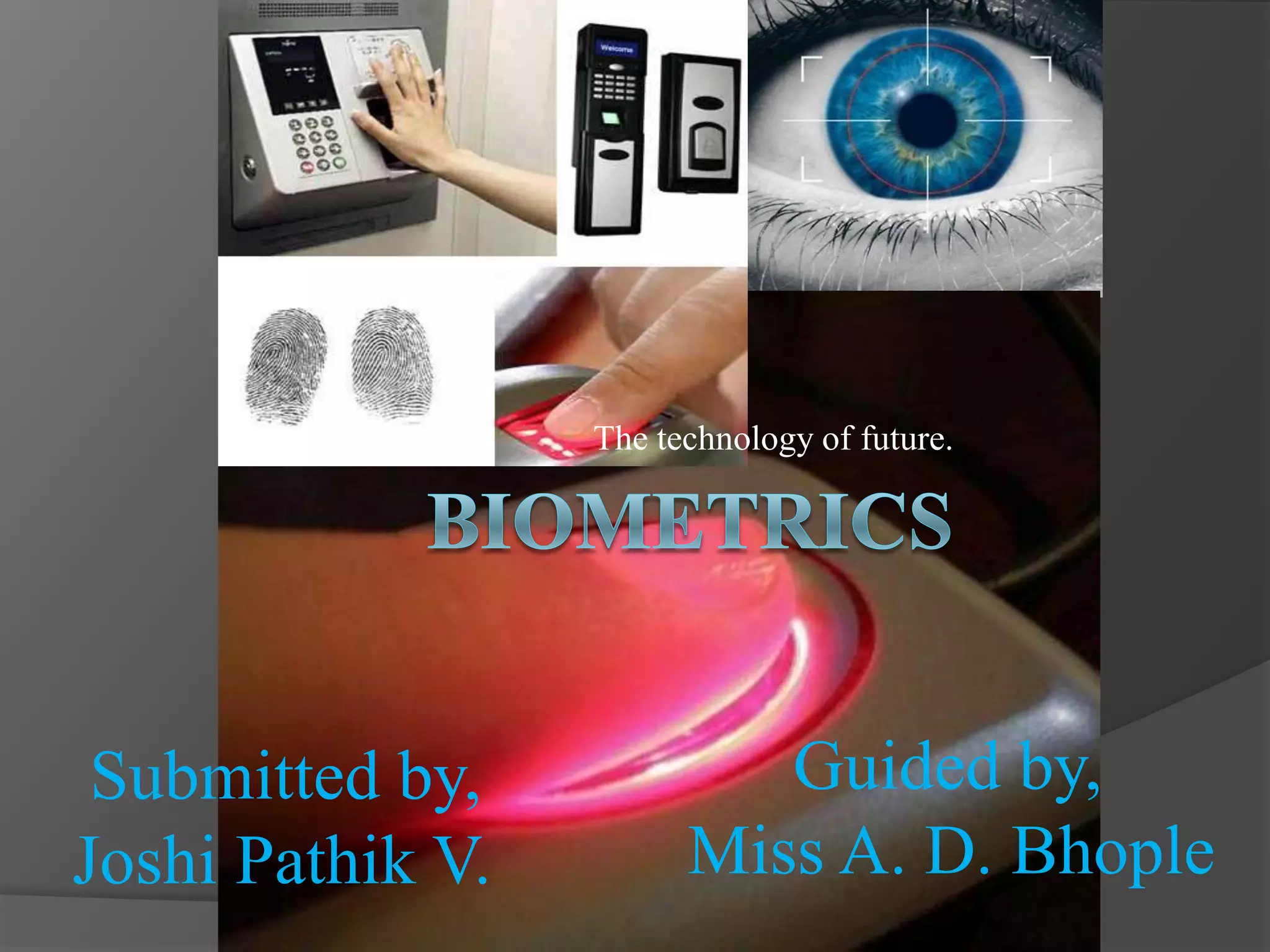
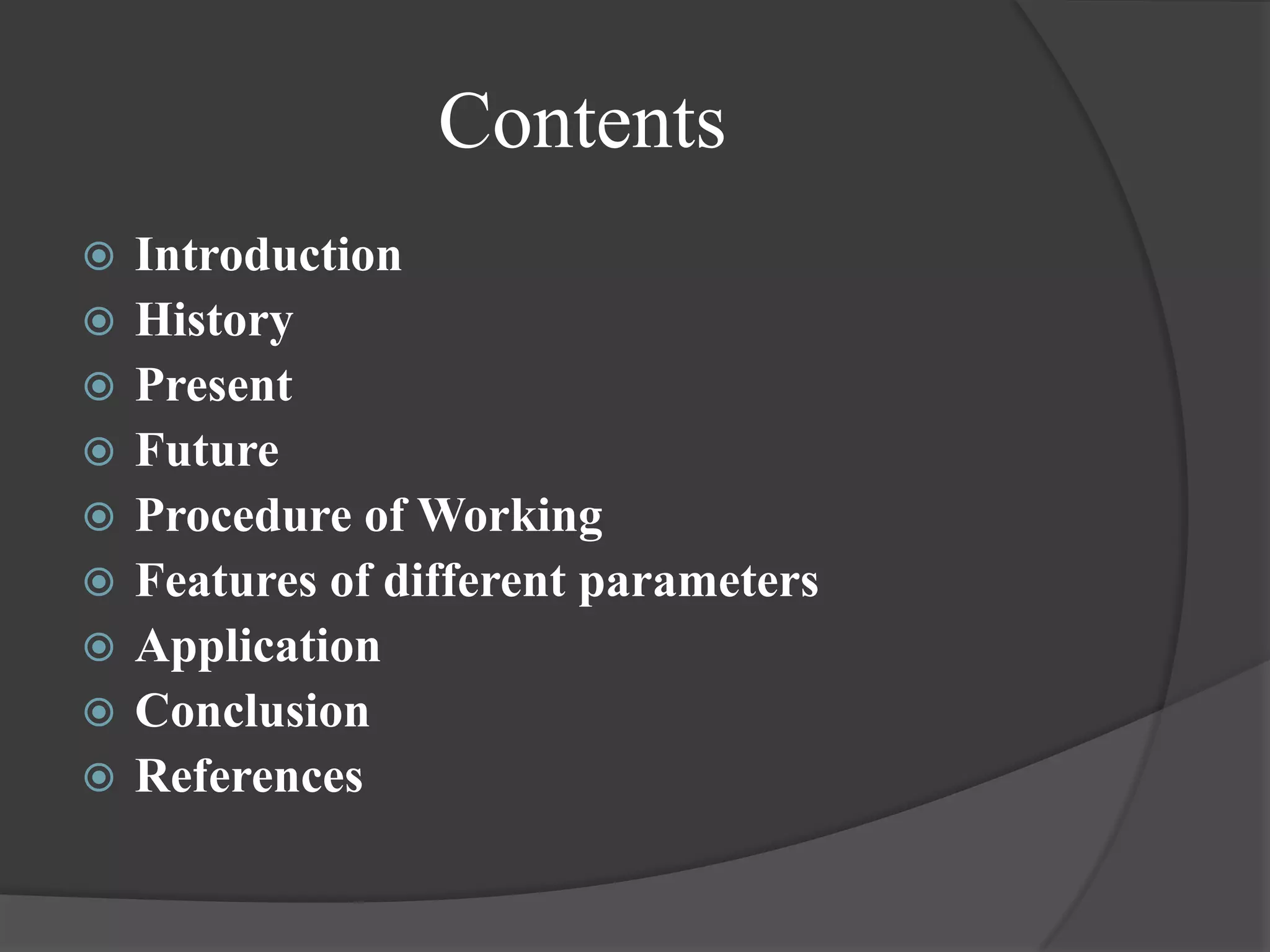
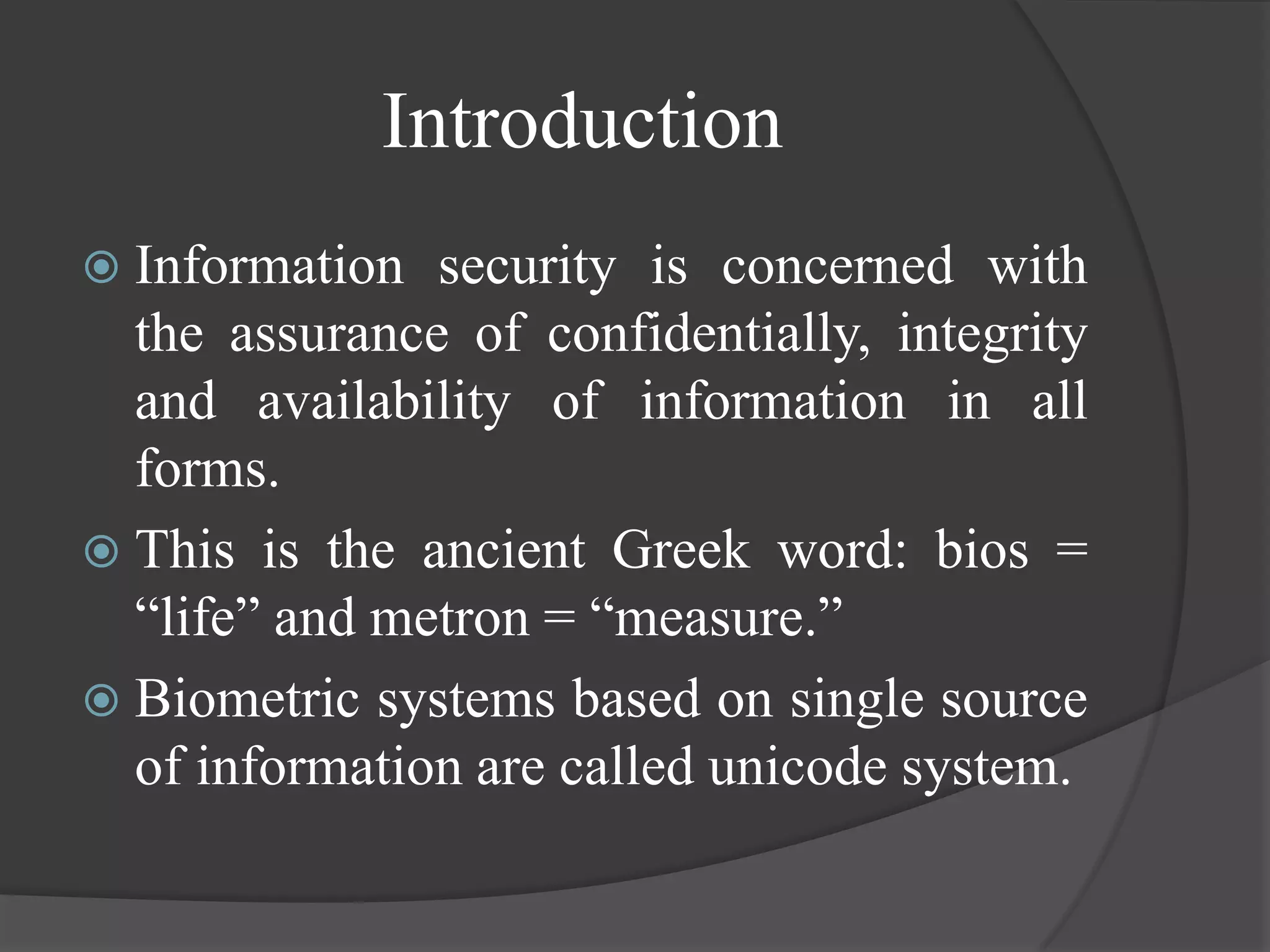
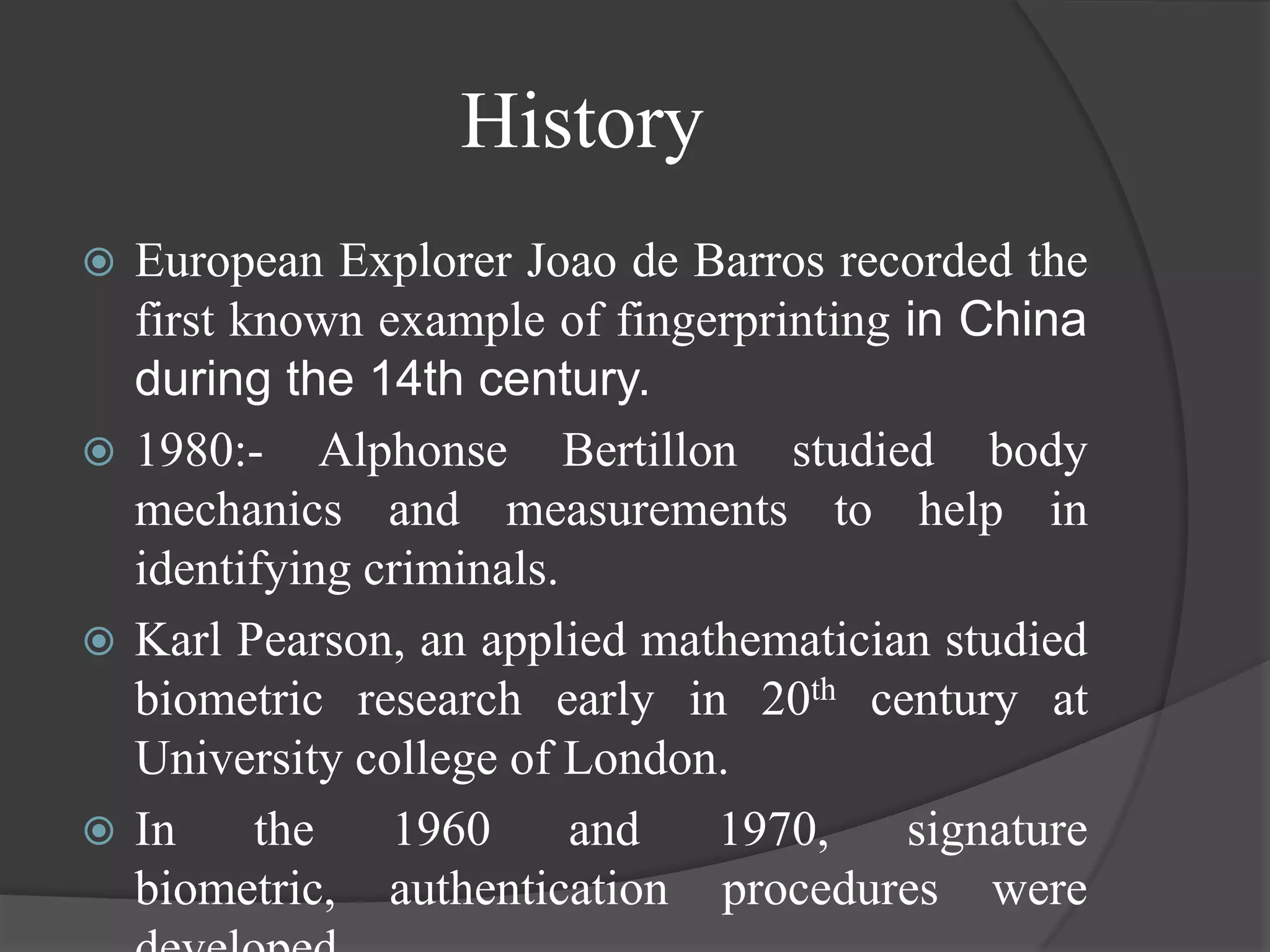
The technology of future.


 Submitted by,             Guided by,
Joshi Pathik V.         Miss A. D. Bhople
Contents
   Introduction
   History
   Present
   Future
   Procedure of Working
   Features of different parameters
   Application
   Conclusion
   References
Introduction
 Information  security is concerned with
  the assurance of confidentially, integrity
  and availability of information in all
  forms.
 This is the ancient Greek word: bios =
  “life” and metron = “measure.”
 Biometric systems based on single source
  of information are called unicode system.
History
 European Explorer Joao de Barros recorded the
  first known example of fingerprinting in China
  during the 14th century.
 1980:- Alphonse Bertillon studied body
  mechanics and measurements to help in
  identifying criminals.
 Karl Pearson, an applied mathematician studied
  biometric research early in 20th century at
  University college of London.
 In     the   1960      and  1970,     signature
  biometric, authentication procedures were
Present
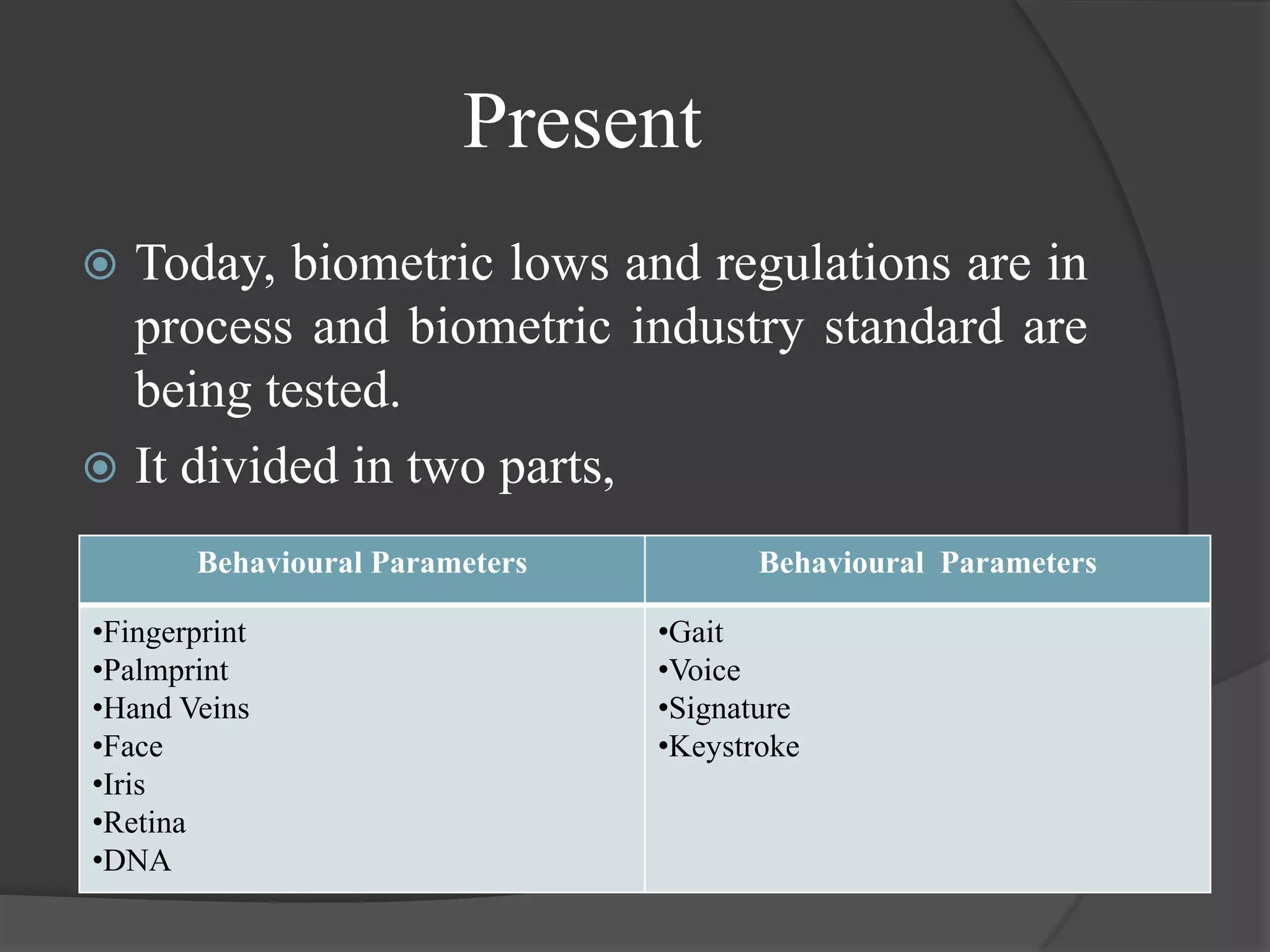
 Today, biometric lows and regulations are in
  process and biometric industry standard are
  being tested.
 It divided in two parts,

       Behavioural Parameters          Behavioural Parameters

•Fingerprint                    •Gait
•Palmprint                      •Voice
•Hand Veins                     •Signature
•Face                           •Keystroke
•Iris
•Retina
•DNA
Future
 A biometric system can provide two
  functions. One of which is verification and
  the other is Authentication.
 In the near future, these biometric
  techniques can be the solution for the
  current threats in the world of information
  security.
 Due to dynamic modification of the
  proposed metric, the rejection ration for a
  some person reduces by a lot.
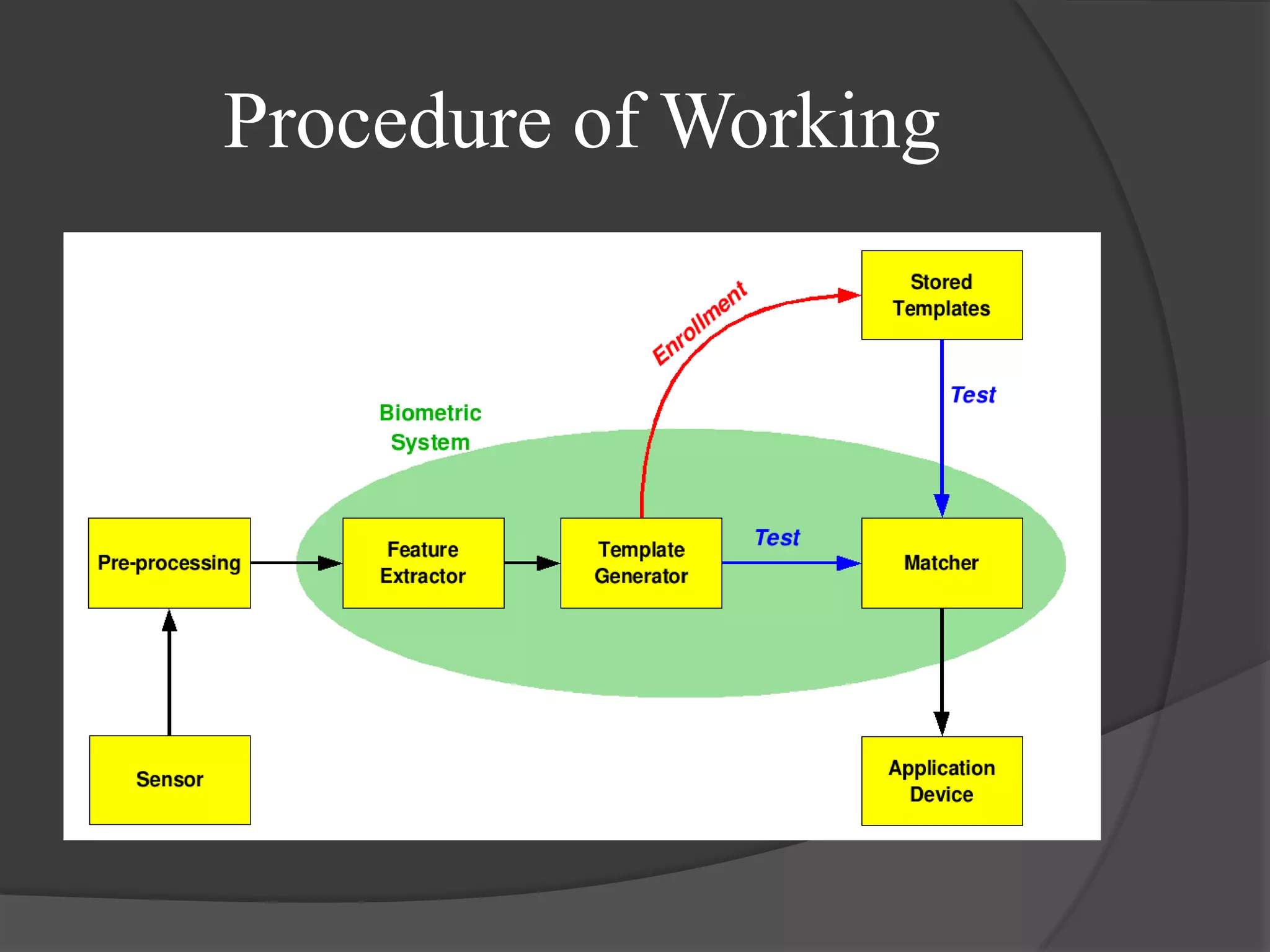
Procedure of Working
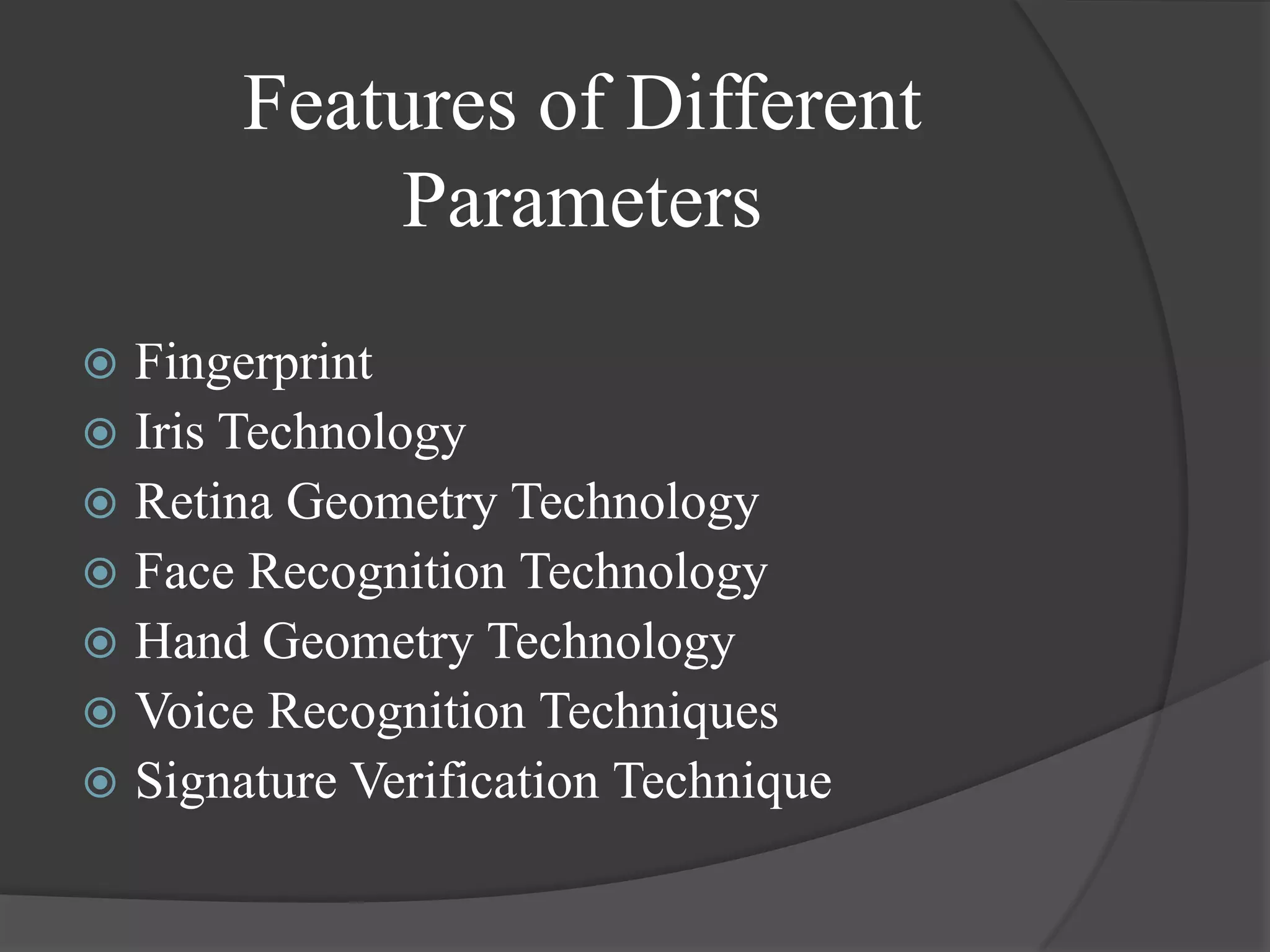
Features of Different
           Parameters
 Fingerprint
 Iris Technology
 Retina Geometry Technology
 Face Recognition Technology
 Hand Geometry Technology
 Voice Recognition Techniques
 Signature Verification Technique
Fingerprint
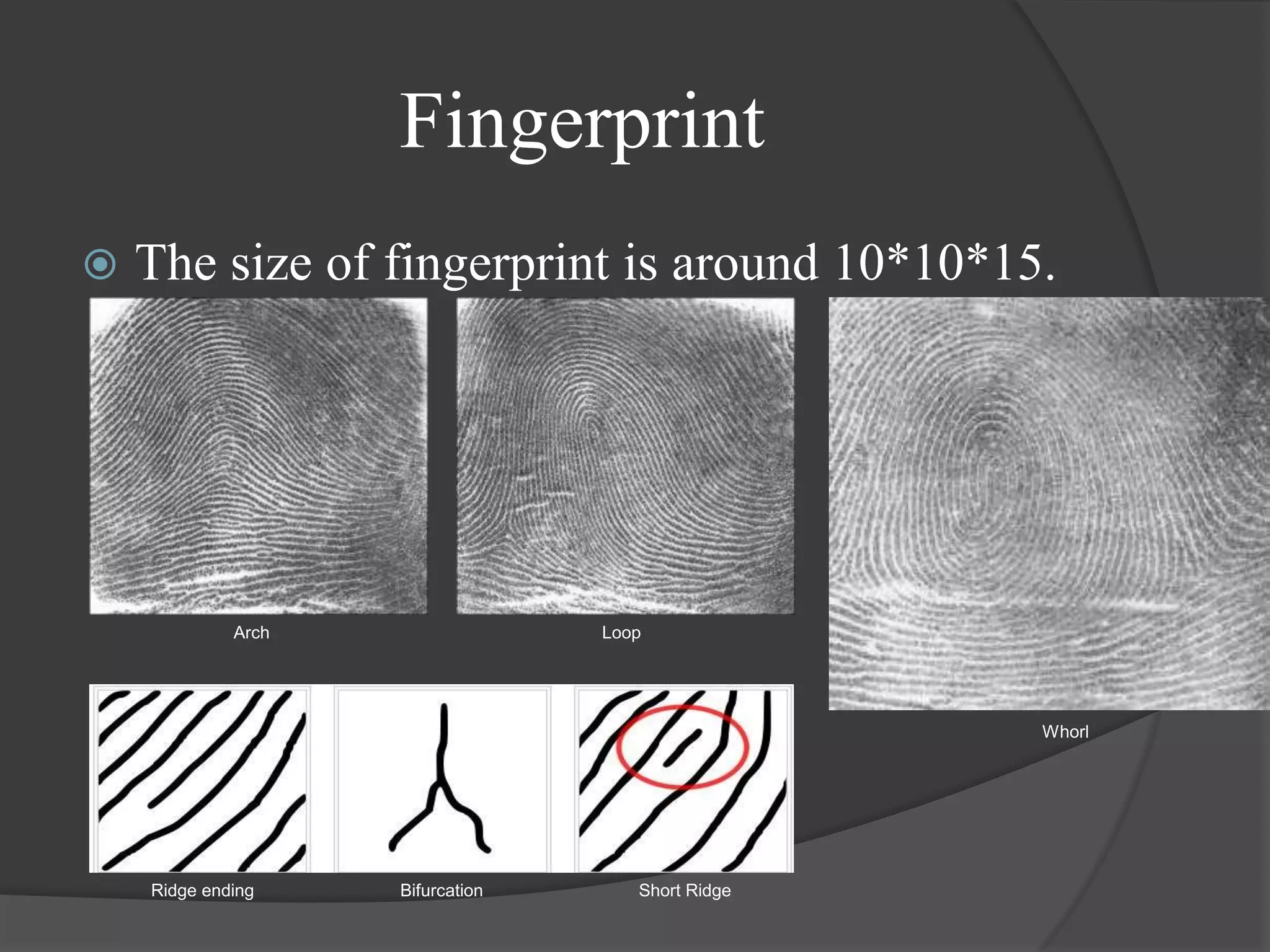
   The size of fingerprint is around 10*10*15.


             Arch                 Loop


                                                   Whorl


    Ridge ending    Bifurcation      Short Ridge
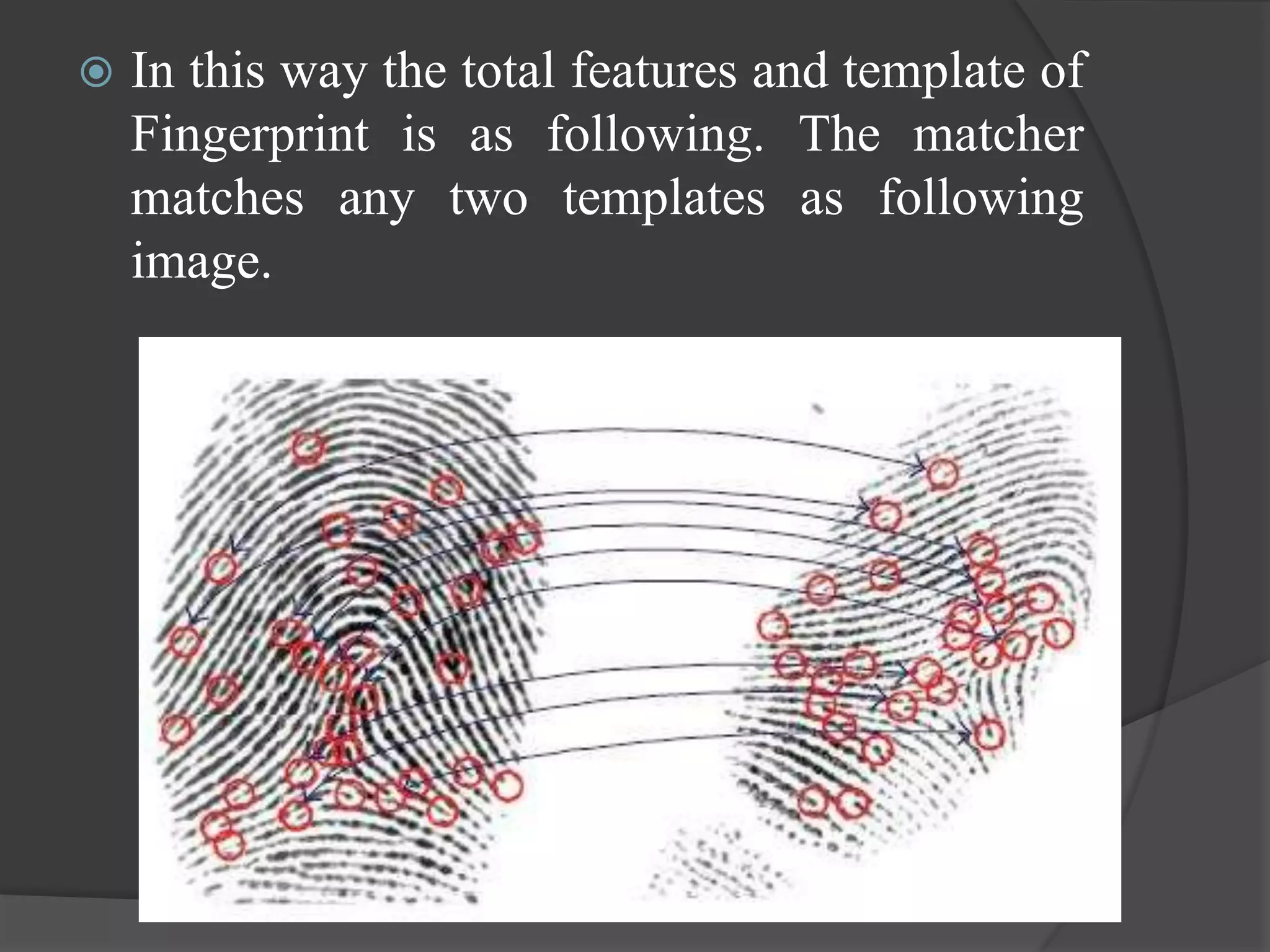
   In this way the total features and template of
    Fingerprint is as following. The matcher
    matches any two templates as following
    image.
Iris Recognition
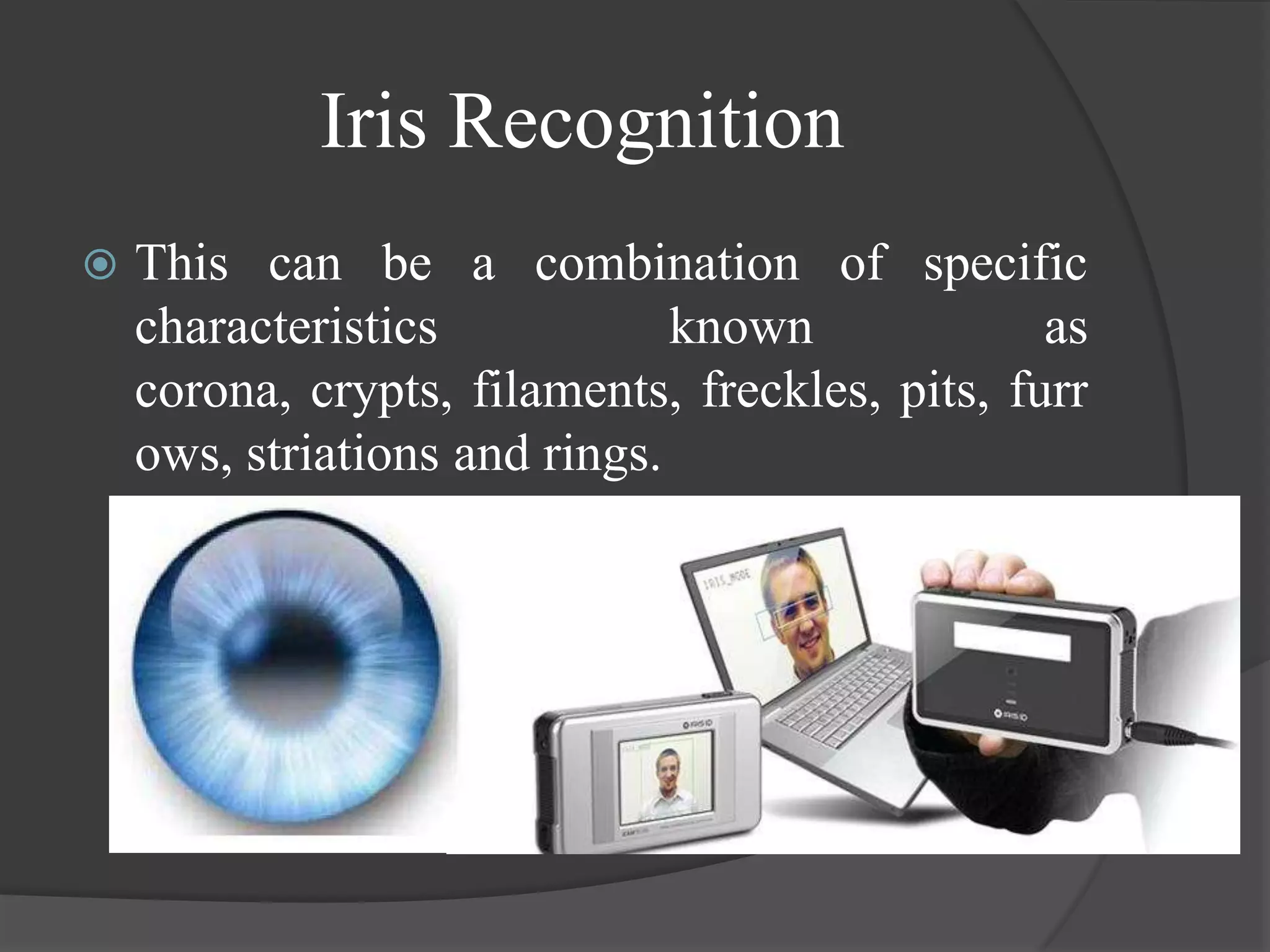
   This can be a combination of specific
    characteristics            known             as
    corona, crypts, filaments, freckles, pits, furr
    ows, striations and rings.
Retina Geometry Technology
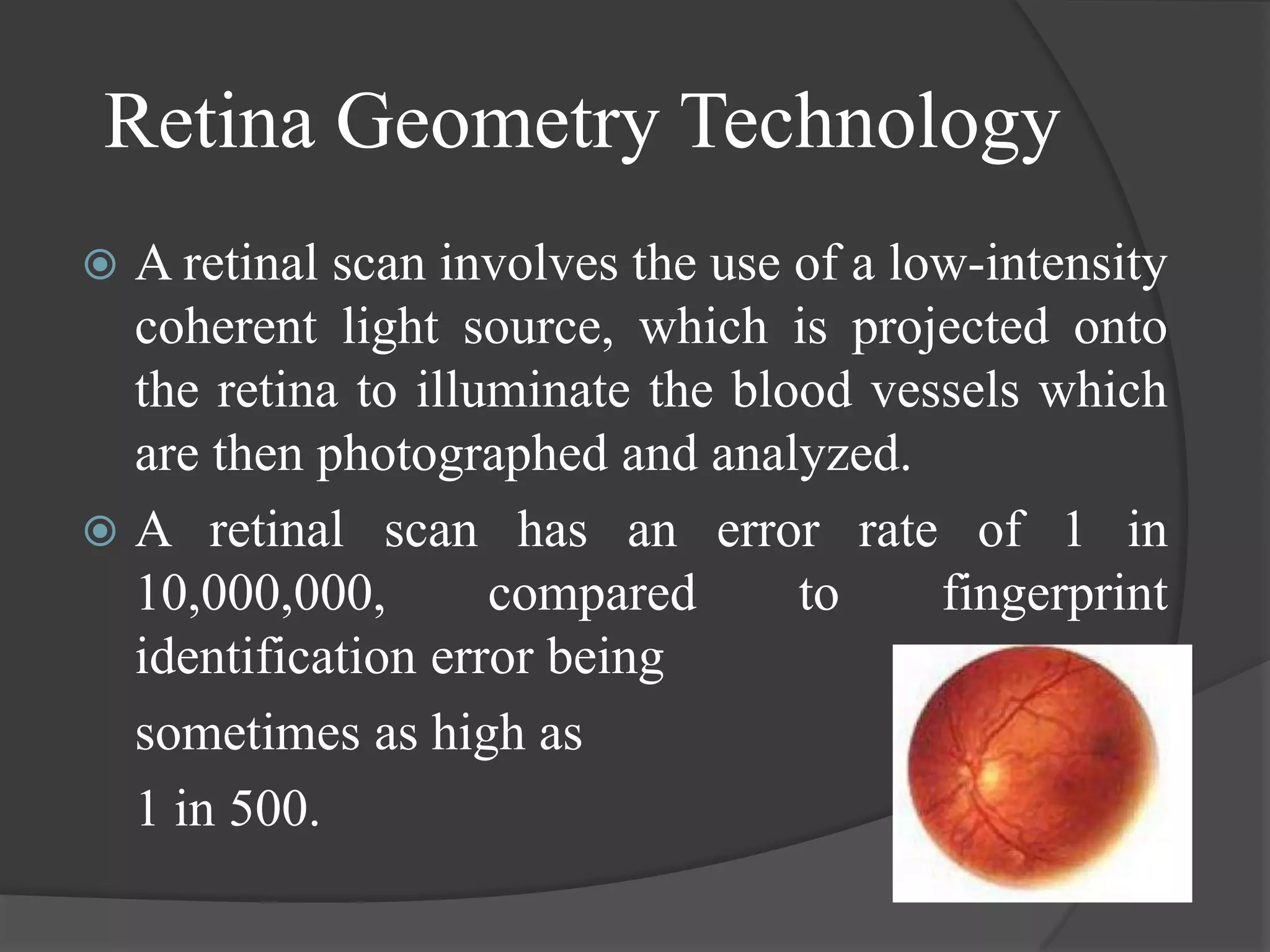
 A retinal scan involves the use of a low-intensity
  coherent light source, which is projected onto
  the retina to illuminate the blood vessels which
  are then photographed and analyzed.
 A retinal scan has an error rate of 1 in
  10,000,000,       compared      to     fingerprint
  identification error being
  sometimes as high as
  1 in 500.
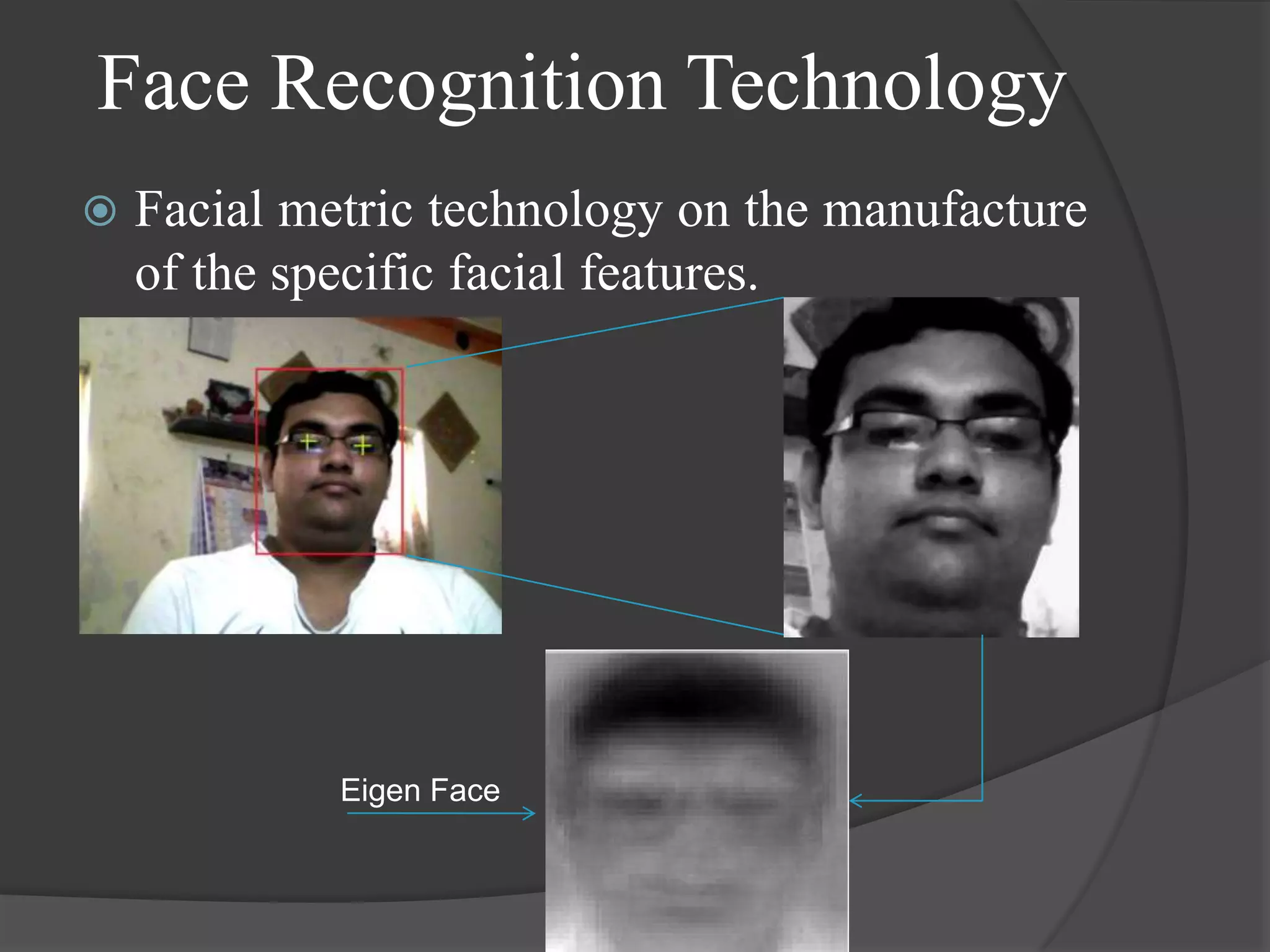
Face Recognition Technology
   Facial metric technology on the manufacture
    of the specific facial features.


             Eigen Face
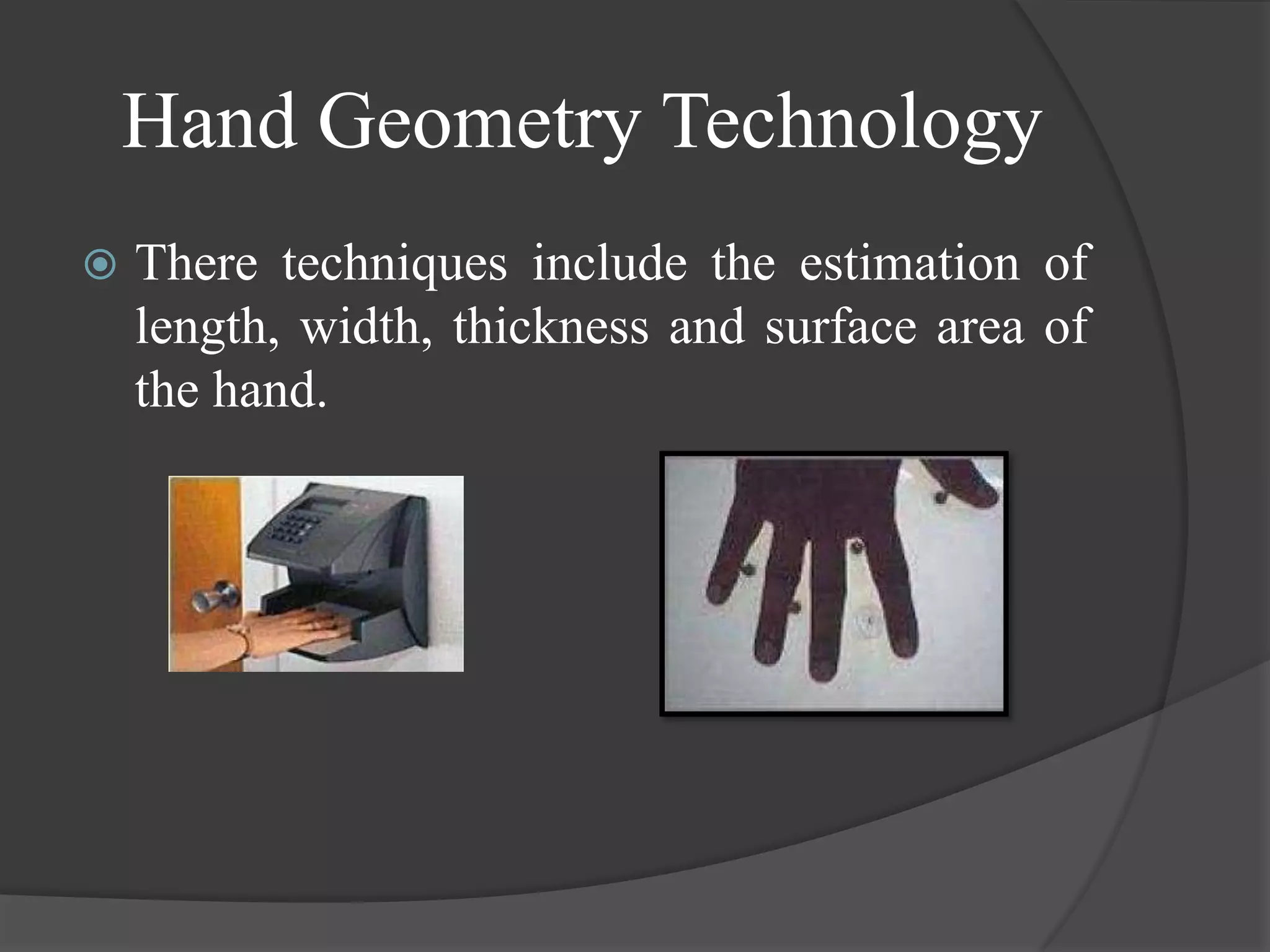
Hand Geometry Technology
   There techniques include the estimation of
    length, width, thickness and surface area of
    the hand.
Voice Recognition Techniques
 Voice verification focuses on the vocal
  characteristics that produce speeches and not
  on the sound or the pronunciation of speech
  itself.
 The vocal characteristics depend on the
  dimensions of the vocal tract, mouth, nasal
  cavities and the other speech processing
  mechanism of the human body.
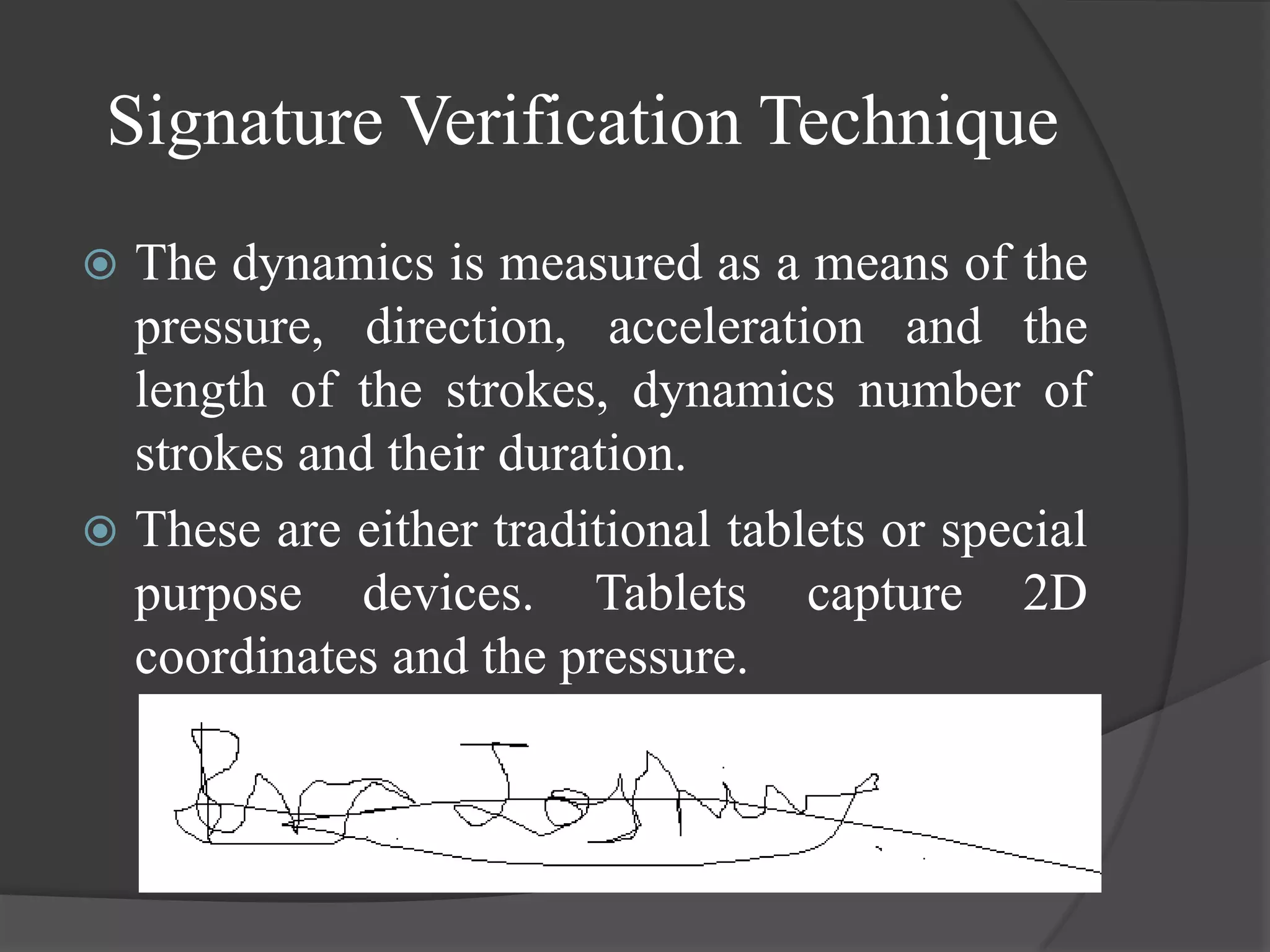
Signature Verification Technique
 The dynamics is measured as a means of the
  pressure, direction, acceleration and the
  length of the strokes, dynamics number of
  strokes and their duration.
 These are either traditional tablets or special
  purpose devices. Tablets capture 2D
  coordinates and the pressure.
Application of Biometrics
 Security
 Authentication
 E-commerce and E-governments
 Secure Banking and Financial Transaction
 Digital Rights Management
 Healthcare Application
 Crime Investigation
 Social Services
Conclusion
 While Biometric authentication can offer a
  high degree of security, they are far from
  perfect solution.
 The influences of biometric technology on
  society and the risks to privacy and threat to
  identify will require meditation through
  legislation.
References
[1] Smart Cart Alliance Identity Council (2007): Identity and Smart Card Technology and Application
      Glossary, http://www.smartcardalliances.org

[2] Langenburg, Glenn (January 24, 2005). "Are one's fingerprints similar to those of his or her parents in any discernable way?".
       Scientific American. Retrieved 28 August 2010.

[3] Thornton, John (May 9, 2000). "Latent Fingerprints, Setting Standards In The Comparison and Identification". 84th Annual
       Training Conference of the California State Division of IAI. Retrieved 30 August 2010.

[4] Wikipedia Image
       http://en.wikipedia.org/wiki/File:Biometric_system_diagram.png

[5] Sanjay R. Ganorkar, Ashok A. Ghatol, “Iris Recognition: An Emerging Biometrics Technology”, In Proc. of The sixth WSEAS
       International Conference on Single Processing, Robotics and Automation, Greece, Feb. 2007, pp. 91 – 96

[6] J. L. Wayman, A. K. Jain, D. Maltoni, and D. Maio, Eds, “Biometrics Systems: Technology, Design and Performance
        Evolution”, New York: Spinger Verlag, 2005

[7] M. A. Dabbah, W. L. Woo, and S. S. Dlay, “Secure Authentication for Face Recognition”, In Proc. of IEEE Symposium on
       computational Intelligence in Image and Signal Processing, April 2007, USA, pp. 121 – 126

[8] A. Kumar, D. C. Wong, H. C. Shen and A. K. Jain , “Personal Verification using Palmprinnt and Hand Geometry Biometrics”, In
        Proc. of fourth International Conference on Audio and Video based Biometric Person Authentication, Guildford, U.K.
        January 2003, pp 668-678

[9] S. Furui, “Recent Advances in Speaker Recognition”, In Proc. of first International Conference on Audio and video based
        Biometric person Authentication, UK, March 1997, pp 859 – 872

[10] A.K. Jain, A. Ross, and S. Prabhakar, “An Introduction to Biometrics Recognition,” IEEE Trans. Circuit Syst. Video
       Technology, Special Issue Image and Video based Biometrics, Volume 14, Issue 1st January 2004, pp. 4 – 20
Thank You

Slide-show on Biometrics

  • 1.
    The technology offuture. Submitted by, Guided by, Joshi Pathik V. Miss A. D. Bhople
  • 2.
    Contents  Introduction  History  Present  Future  Procedure of Working  Features of different parameters  Application  Conclusion  References
  • 3.
    Introduction  Information security is concerned with the assurance of confidentially, integrity and availability of information in all forms.  This is the ancient Greek word: bios = “life” and metron = “measure.”  Biometric systems based on single source of information are called unicode system.
  • 4.
    History  European ExplorerJoao de Barros recorded the first known example of fingerprinting in China during the 14th century.  1980:- Alphonse Bertillon studied body mechanics and measurements to help in identifying criminals.  Karl Pearson, an applied mathematician studied biometric research early in 20th century at University college of London.  In the 1960 and 1970, signature biometric, authentication procedures were
  • 5.
    Present  Today, biometriclows and regulations are in process and biometric industry standard are being tested.  It divided in two parts, Behavioural Parameters Behavioural Parameters •Fingerprint •Gait •Palmprint •Voice •Hand Veins •Signature •Face •Keystroke •Iris •Retina •DNA
  • 6.
    Future  A biometricsystem can provide two functions. One of which is verification and the other is Authentication.  In the near future, these biometric techniques can be the solution for the current threats in the world of information security.  Due to dynamic modification of the proposed metric, the rejection ration for a some person reduces by a lot.
  • 7.
  • 8.
    Features of Different Parameters  Fingerprint  Iris Technology  Retina Geometry Technology  Face Recognition Technology  Hand Geometry Technology  Voice Recognition Techniques  Signature Verification Technique
  • 9.
    Fingerprint  The size of fingerprint is around 10*10*15. Arch Loop Whorl Ridge ending Bifurcation Short Ridge
  • 10.
    In this way the total features and template of Fingerprint is as following. The matcher matches any two templates as following image.
  • 11.
    Iris Recognition  This can be a combination of specific characteristics known as corona, crypts, filaments, freckles, pits, furr ows, striations and rings.
  • 12.
    Retina Geometry Technology A retinal scan involves the use of a low-intensity coherent light source, which is projected onto the retina to illuminate the blood vessels which are then photographed and analyzed.  A retinal scan has an error rate of 1 in 10,000,000, compared to fingerprint identification error being sometimes as high as 1 in 500.
  • 13.
    Face Recognition Technology  Facial metric technology on the manufacture of the specific facial features. Eigen Face
  • 14.
    Hand Geometry Technology  There techniques include the estimation of length, width, thickness and surface area of the hand.
  • 15.
    Voice Recognition Techniques Voice verification focuses on the vocal characteristics that produce speeches and not on the sound or the pronunciation of speech itself.  The vocal characteristics depend on the dimensions of the vocal tract, mouth, nasal cavities and the other speech processing mechanism of the human body.
  • 16.
    Signature Verification Technique The dynamics is measured as a means of the pressure, direction, acceleration and the length of the strokes, dynamics number of strokes and their duration.  These are either traditional tablets or special purpose devices. Tablets capture 2D coordinates and the pressure.
  • 17.
    Application of Biometrics Security  Authentication  E-commerce and E-governments  Secure Banking and Financial Transaction  Digital Rights Management  Healthcare Application  Crime Investigation  Social Services
  • 18.
    Conclusion  While Biometricauthentication can offer a high degree of security, they are far from perfect solution.  The influences of biometric technology on society and the risks to privacy and threat to identify will require meditation through legislation.
  • 19.
    References [1] Smart CartAlliance Identity Council (2007): Identity and Smart Card Technology and Application Glossary, http://www.smartcardalliances.org [2] Langenburg, Glenn (January 24, 2005). "Are one's fingerprints similar to those of his or her parents in any discernable way?". Scientific American. Retrieved 28 August 2010. [3] Thornton, John (May 9, 2000). "Latent Fingerprints, Setting Standards In The Comparison and Identification". 84th Annual Training Conference of the California State Division of IAI. Retrieved 30 August 2010. [4] Wikipedia Image http://en.wikipedia.org/wiki/File:Biometric_system_diagram.png [5] Sanjay R. Ganorkar, Ashok A. Ghatol, “Iris Recognition: An Emerging Biometrics Technology”, In Proc. of The sixth WSEAS International Conference on Single Processing, Robotics and Automation, Greece, Feb. 2007, pp. 91 – 96 [6] J. L. Wayman, A. K. Jain, D. Maltoni, and D. Maio, Eds, “Biometrics Systems: Technology, Design and Performance Evolution”, New York: Spinger Verlag, 2005 [7] M. A. Dabbah, W. L. Woo, and S. S. Dlay, “Secure Authentication for Face Recognition”, In Proc. of IEEE Symposium on computational Intelligence in Image and Signal Processing, April 2007, USA, pp. 121 – 126 [8] A. Kumar, D. C. Wong, H. C. Shen and A. K. Jain , “Personal Verification using Palmprinnt and Hand Geometry Biometrics”, In Proc. of fourth International Conference on Audio and Video based Biometric Person Authentication, Guildford, U.K. January 2003, pp 668-678 [9] S. Furui, “Recent Advances in Speaker Recognition”, In Proc. of first International Conference on Audio and video based Biometric person Authentication, UK, March 1997, pp 859 – 872 [10] A.K. Jain, A. Ross, and S. Prabhakar, “An Introduction to Biometrics Recognition,” IEEE Trans. Circuit Syst. Video Technology, Special Issue Image and Video based Biometrics, Volume 14, Issue 1st January 2004, pp. 4 – 20
  • 20.