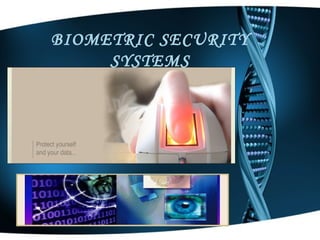
BIOMETRIC SECURITY
SYSTEMS
A FUTURE WITHOUT
PASSWORDS

End of “PASSWORD
OVERLOAD”

WORKPLACE
 DESKTOP
COMPUTER
 CORPORATE
COMPUTER
NETWORK
 INTERNET & E-MAIL
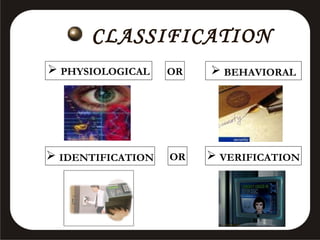
CLASSIFICATION
 PHYSIOLOGICAL

OR

 BEHAVIORAL

 IDENTIFICATION

OR

 VERIFICATION
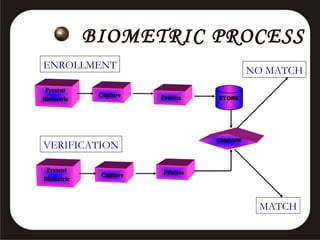
BIOMETRIC PROCESS
ENROLLMENT
Present
Biometric

Capture

NO MATCH
Process

COMPARE

VERIFICATION
Present
Biometric

Capture

STORE

Process

MATCH
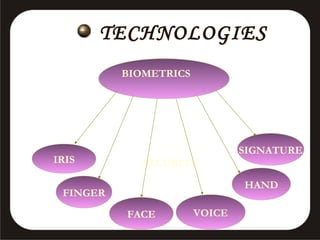
TECHNOLOGIES
BIOMETRICS

IRIS

SIGNATURE
SECURITY
HAND

FINGER
FACE

VOICE
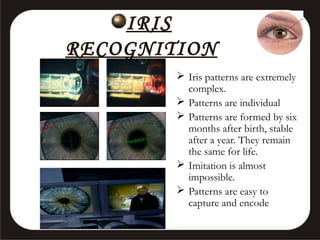
IRIS
RECOGNITION
 Iris patterns are extremely
complex.
 Patterns are individual
 Patterns are formed by six
months after birth, stable
after a year. They remain
the same for life.
 Imitation is almost
impossible.
 Patterns are easy to
capture and encode
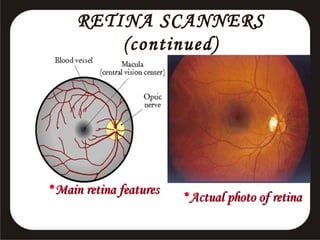
RETINA SCANNERS
(continued)

•Main retina features

•Actual photo of retina
IRIS SCANNERS
• High resolution cameras capture image from up to 3 feet
away (usually 10 to 12 inches)
• Converts picture of the distinctive fibers, furrows, flecks,
crypts, rifts, pits and coronas of the iris into a bar-code
like identifier
• Template around 256 Bytes in size
• Human iris is distinct with 250 differentiating features
• The recognition of irises by their IrisCodes is based upon
the failure of a test of statistical independence.
– Any given IrisCode is statistically guaranteed to pass
a test of independence against any IrisCode computed
from a different eye; but it will uniquely fail this same
test against the eye from which it was computed.
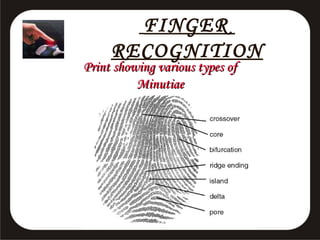
FINGER
RECOGNITION

Print showing various types of
Minutiae
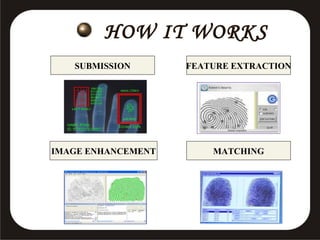
HOW IT WORKS
SUBMISSION

FEATURE EXTRACTION

IMAGE ENHANCEMENT

MATCHING
•

FINGER PRINT (continued )

Fingerprint matching techniques can be placed into two categories: minutiaebased and correlation based.
– Minutiae-based techniques first find minutiae points and then map their
relative placement on the finger. However, there are some difficulties
when using this approach.
• It is difficult to extract the minutiae points accurately when the
fingerprint is of low quality.
• Also this method does not take into account the global pattern of
ridges and furrows.
– The correlation-based method is able to overcome some of the difficulties
of the minutiae-based approach. However, it has some of its own
shortcomings.
• Correlation-based techniques (i.e. pattern matching) require the
precise location of a registration point and are affected by image
translation and rotation.
• Larger templates (often 2 – 3 times larger than minutiae-based)
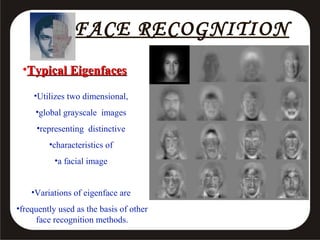
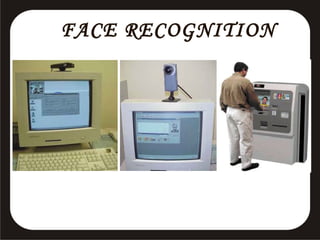
FACE RECOGNITION
•Typical Eigenfaces
•Utilizes two dimensional,
•global grayscale images
•representing distinctive
•characteristics of
•a facial image
•Variations of eigenface are
•frequently used as the basis of other
face recognition methods.
FACIAL (continued)
•

•

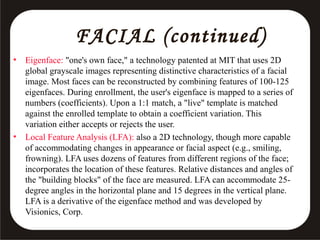
Eigenface: "one's own face," a technology patented at MIT that uses 2D
global grayscale images representing distinctive characteristics of a facial
image. Most faces can be reconstructed by combining features of 100-125
eigenfaces. During enrollment, the user's eigenface is mapped to a series of
numbers (coefficients). Upon a 1:1 match, a "live" template is matched
against the enrolled template to obtain a coefficient variation. This
variation either accepts or rejects the user.
Local Feature Analysis (LFA): also a 2D technology, though more capable
of accommodating changes in appearance or facial aspect (e.g., smiling,
frowning). LFA uses dozens of features from different regions of the face;
incorporates the location of these features. Relative distances and angles of
the "building blocks" of the face are measured. LFA can accommodate 25degree angles in the horizontal plane and 15 degrees in the vertical plane.
LFA is a derivative of the eigenface method and was developed by
Visionics, Corp.
FACE RECOGNITION
FACIAL (continued)
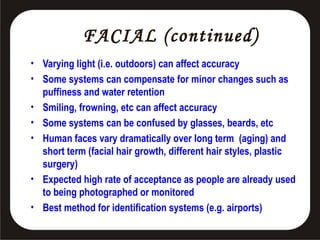
• Varying light (i.e. outdoors) can affect accuracy
• Some systems can compensate for minor changes such as
puffiness and water retention
• Smiling, frowning, etc can affect accuracy
• Some systems can be confused by glasses, beards, etc
• Human faces vary dramatically over long term (aging) and
short term (facial hair growth, different hair styles, plastic
surgery)
• Expected high rate of acceptance as people are already used
to being photographed or monitored
• Best method for identification systems (e.g. airports)
VOICE RECOGNITION
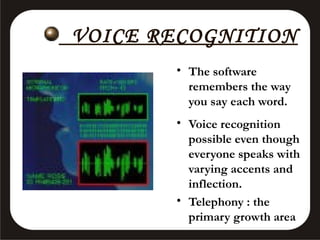
• The software
remembers the way
you say each word.
• Voice recognition
possible even though
everyone speaks with
varying accents and
inflection.
• Telephony : the
primary growth area
VOICE VERIFICATION
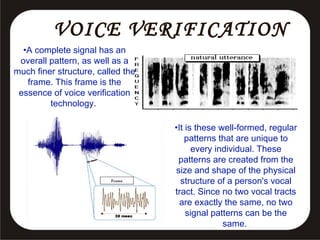
•A complete signal has an
overall pattern, as well as a
much finer structure, called the
frame. This frame is the
essence of voice verification
technology.
•It is these well-formed, regular
patterns that are unique to
every individual. These
patterns are created from the
size and shape of the physical
structure of a person's vocal
tract. Since no two vocal tracts
are exactly the same, no two
signal patterns can be the
same.
VOICE VERIFICATION
•These unique features
consist of cadence,
pitch, tone, harmonics,
and shape of vocal tract.
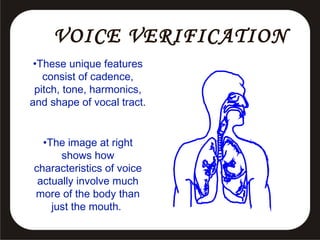
•The image at right
shows how
characteristics of voice
actually involve much
more of the body than
just the mouth.
HAND
GEOMETRY
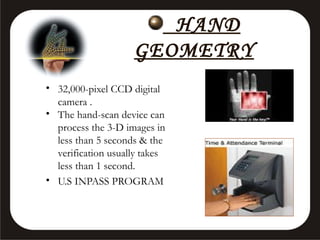
• 32,000-pixel CCD digital
camera .
• The hand-scan device can
process the 3-D images in
less than 5 seconds & the
verification usually takes
less than 1 second.
• U.S INPASS PROGRAM
HAND/FINGER GEOMETRY
(continued)
HAND/FINGER
GEOMETRY READERS
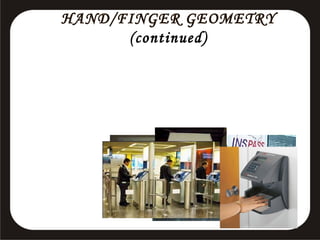
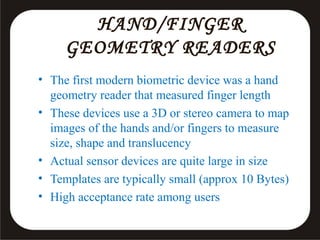
• The first modern biometric device was a hand
geometry reader that measured finger length
• These devices use a 3D or stereo camera to map
images of the hands and/or fingers to measure
size, shape and translucency
• Actual sensor devices are quite large in size
• Templates are typically small (approx 10 Bytes)
• High acceptance rate among users
SIGNATURE
RECOGNITION
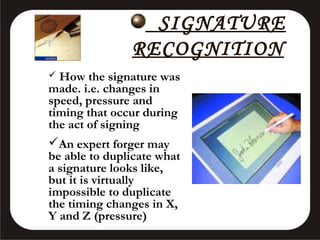
How the signature was
made. i.e. changes in
speed, pressure and
timing that occur during
the act of signing
An expert forger may
be able to duplicate what
a signature looks like,
but it is virtually
impossible to duplicate
the timing changes in X,
Y and Z (pressure)

SIGNATURE ANALYSIS
(continued)
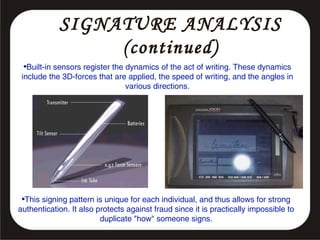
•Built-in sensors register the dynamics of the act of writing. These dynamics
include the 3D-forces that are applied, the speed of writing, and the angles in
various directions.

•This signing pattern is unique for each individual, and thus allows for strong
authentication. It also protects against fraud since it is practically impossible to
duplicate "how" someone signs.
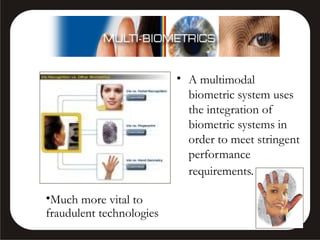
• A multimodal
biometric system uses
the integration of
biometric systems in
order to meet stringent
performance
requirements.
•Much more vital to
fraudulent technologies
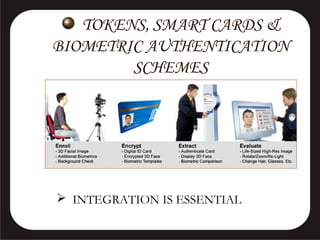
TOKENS, SMART CARDS &
BIOMETRIC AUTHENTICATION
SCHEMES

 INTEGRATION IS ESSENTIAL
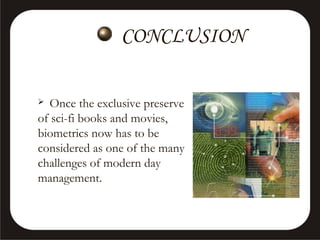
CONCLUSION
Once the exclusive preserve
of sci-fi books and movies,
biometrics now has to be
considered as one of the many
challenges of modern day
management.


Biometric security Presentation

  • 1.
  • 2.
    A FUTURE WITHOUT PASSWORDS Endof “PASSWORD OVERLOAD” WORKPLACE  DESKTOP COMPUTER  CORPORATE COMPUTER NETWORK  INTERNET & E-MAIL
  • 3.
  • 4.
  • 5.
  • 6.
    IRIS RECOGNITION  Iris patternsare extremely complex.  Patterns are individual  Patterns are formed by six months after birth, stable after a year. They remain the same for life.  Imitation is almost impossible.  Patterns are easy to capture and encode
  • 7.
    RETINA SCANNERS (continued) •Main retinafeatures •Actual photo of retina
  • 8.
    IRIS SCANNERS • Highresolution cameras capture image from up to 3 feet away (usually 10 to 12 inches) • Converts picture of the distinctive fibers, furrows, flecks, crypts, rifts, pits and coronas of the iris into a bar-code like identifier • Template around 256 Bytes in size • Human iris is distinct with 250 differentiating features • The recognition of irises by their IrisCodes is based upon the failure of a test of statistical independence. – Any given IrisCode is statistically guaranteed to pass a test of independence against any IrisCode computed from a different eye; but it will uniquely fail this same test against the eye from which it was computed.
  • 9.
  • 10.
    HOW IT WORKS SUBMISSION FEATUREEXTRACTION IMAGE ENHANCEMENT MATCHING
  • 11.
    • FINGER PRINT (continued) Fingerprint matching techniques can be placed into two categories: minutiaebased and correlation based. – Minutiae-based techniques first find minutiae points and then map their relative placement on the finger. However, there are some difficulties when using this approach. • It is difficult to extract the minutiae points accurately when the fingerprint is of low quality. • Also this method does not take into account the global pattern of ridges and furrows. – The correlation-based method is able to overcome some of the difficulties of the minutiae-based approach. However, it has some of its own shortcomings. • Correlation-based techniques (i.e. pattern matching) require the precise location of a registration point and are affected by image translation and rotation. • Larger templates (often 2 – 3 times larger than minutiae-based)
  • 12.
    FACE RECOGNITION •Typical Eigenfaces •Utilizestwo dimensional, •global grayscale images •representing distinctive •characteristics of •a facial image •Variations of eigenface are •frequently used as the basis of other face recognition methods.
  • 13.
    FACIAL (continued) • • Eigenface: "one'sown face," a technology patented at MIT that uses 2D global grayscale images representing distinctive characteristics of a facial image. Most faces can be reconstructed by combining features of 100-125 eigenfaces. During enrollment, the user's eigenface is mapped to a series of numbers (coefficients). Upon a 1:1 match, a "live" template is matched against the enrolled template to obtain a coefficient variation. This variation either accepts or rejects the user. Local Feature Analysis (LFA): also a 2D technology, though more capable of accommodating changes in appearance or facial aspect (e.g., smiling, frowning). LFA uses dozens of features from different regions of the face; incorporates the location of these features. Relative distances and angles of the "building blocks" of the face are measured. LFA can accommodate 25degree angles in the horizontal plane and 15 degrees in the vertical plane. LFA is a derivative of the eigenface method and was developed by Visionics, Corp.
  • 14.
  • 15.
    FACIAL (continued) • Varyinglight (i.e. outdoors) can affect accuracy • Some systems can compensate for minor changes such as puffiness and water retention • Smiling, frowning, etc can affect accuracy • Some systems can be confused by glasses, beards, etc • Human faces vary dramatically over long term (aging) and short term (facial hair growth, different hair styles, plastic surgery) • Expected high rate of acceptance as people are already used to being photographed or monitored • Best method for identification systems (e.g. airports)
  • 16.
    VOICE RECOGNITION • Thesoftware remembers the way you say each word. • Voice recognition possible even though everyone speaks with varying accents and inflection. • Telephony : the primary growth area
  • 17.
    VOICE VERIFICATION •A completesignal has an overall pattern, as well as a much finer structure, called the frame. This frame is the essence of voice verification technology. •It is these well-formed, regular patterns that are unique to every individual. These patterns are created from the size and shape of the physical structure of a person's vocal tract. Since no two vocal tracts are exactly the same, no two signal patterns can be the same.
  • 18.
    VOICE VERIFICATION •These uniquefeatures consist of cadence, pitch, tone, harmonics, and shape of vocal tract. •The image at right shows how characteristics of voice actually involve much more of the body than just the mouth.
  • 19.
    HAND GEOMETRY • 32,000-pixel CCDdigital camera . • The hand-scan device can process the 3-D images in less than 5 seconds & the verification usually takes less than 1 second. • U.S INPASS PROGRAM
  • 20.
  • 21.
    HAND/FINGER GEOMETRY READERS • Thefirst modern biometric device was a hand geometry reader that measured finger length • These devices use a 3D or stereo camera to map images of the hands and/or fingers to measure size, shape and translucency • Actual sensor devices are quite large in size • Templates are typically small (approx 10 Bytes) • High acceptance rate among users
  • 22.
    SIGNATURE RECOGNITION How the signaturewas made. i.e. changes in speed, pressure and timing that occur during the act of signing An expert forger may be able to duplicate what a signature looks like, but it is virtually impossible to duplicate the timing changes in X, Y and Z (pressure) 
  • 23.
    SIGNATURE ANALYSIS (continued) •Built-in sensorsregister the dynamics of the act of writing. These dynamics include the 3D-forces that are applied, the speed of writing, and the angles in various directions. •This signing pattern is unique for each individual, and thus allows for strong authentication. It also protects against fraud since it is practically impossible to duplicate "how" someone signs.
  • 24.
    • A multimodal biometricsystem uses the integration of biometric systems in order to meet stringent performance requirements. •Much more vital to fraudulent technologies
  • 25.
    TOKENS, SMART CARDS& BIOMETRIC AUTHENTICATION SCHEMES  INTEGRATION IS ESSENTIAL
  • 26.
    CONCLUSION Once the exclusivepreserve of sci-fi books and movies, biometrics now has to be considered as one of the many challenges of modern day management. 