Submitted By:
NAME - PREETI
Roll No -1219531098
BRANCH - ELECTRONICS AND
COMMUNICATION & ENGG.
March 27, 2015
1
GUIDED BY:
VIPIN KUMAR & SUNIL TIWARI.
CONTENT
Definiton of biometrics
Terms of biometrics
History of biometrics
Biometrics characteristics
Biometrics recognition techniques
Applications
Advantages & Disadvantages
conclusion
References
March27,2015
2
Biometrics refers to the automatic identification
of a person based on his or her physiological or
behavioral characteristics .
WhaT Is BIOMETRICs ?
INTODUCTION
March 27, 2015 3
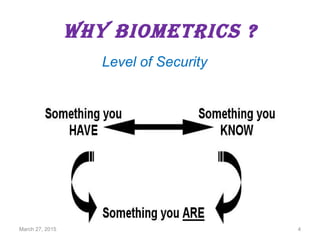
Why BIOMETRICs ?
March 27, 2015 4
Level of Security
hIsTORy
March 27, 2015 5
The ancient Egyptians and the Chinese played
a large role in biometrics history.
Biometrics in practice was a form of finger
printing being used in china in the 14th
century.
Bertillon developed a technique of multiple
body measurements .
A system called “Indentimat” which measured
shape of the hand and length of fingers was
introduced in 1970s.
ChaRaCTERsTICs Of
BIOMETRICs
 Any human characteristic can qualify as a
biometric characteristic as long as it satisfies the
following requirements:-
Universality
Distinctiveness
Permanence
Collectability
hOW BIOMETRICs WORks ?
March 27, 2015 7
No
Yes
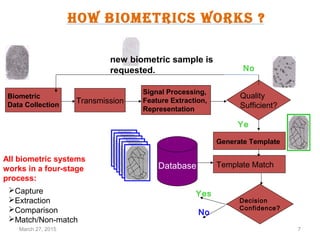
Biometric
Data Collection
Transmission
Quality
Sufficient?
Ye
s
Template Match
Signal Processing,
Feature Extraction,
Representation
Database
Generate Template
Decision
Confidence?
new biometric sample is
requested. No
All biometric systems
works in a four-stage
process:
Capture
Extraction
Comparison
Match/Non-match
A biometric system cAn operAte
in two modes
1.Identification: A one to many comparison of the captured
biometric against a biometric database in attempt to identify
an unknown individual.
2.Verification: A one to one comparison of a captured
biometric with a stored template to verify that the individual
is who he claims to be.
March 27, 2015 8
types of biometrics
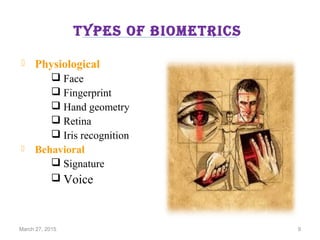
 Physiological
 Face
 Fingerprint
 Hand geometry
 Retina
 Iris recognition
 Behavioral
 Signature
 Voice
March 27, 2015 9
fingerprint recognition
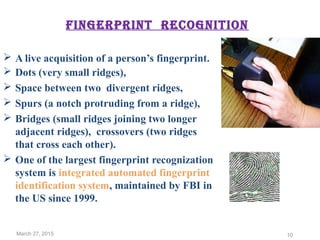
 A live acquisition of a person’s fingerprint.
 Dots (very small ridges),
 Space between two divergent ridges,
 Spurs (a notch protruding from a ridge),
 Bridges (small ridges joining two longer
adjacent ridges), crossovers (two ridges
that cross each other).
 One of the largest fingerprint recognization
system is integrated automated fingerprint
identification system, maintained by FBI in
the US since 1999.
March 27, 2015 10
fAce recognition:
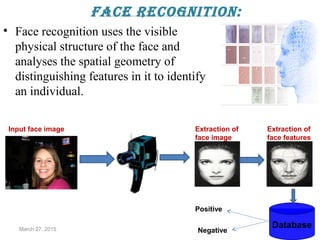
• Face recognition uses the visible
physical structure of the face and
analyses the spatial geometry of
distinguishing features in it to identify
an individual.
March 27, 2015 11
Database
Input face image Extraction of
face image
Extraction of
face features
Positive
Negative
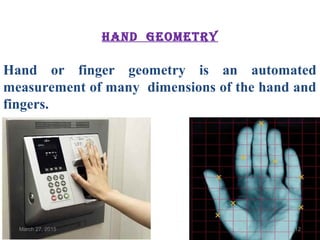
Hand or finger geometry is an automated
measurement of many dimensions of the hand and
fingers.
HAnd geometry
March 27, 2015 12
March 27, 2015 13
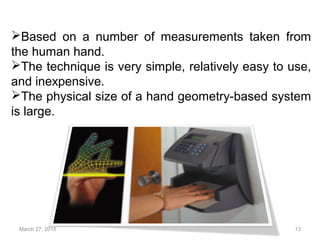
Based on a number of measurements taken from
the human hand.
The technique is very simple, relatively easy to use,
and inexpensive.
The physical size of a hand geometry-based system
is large.
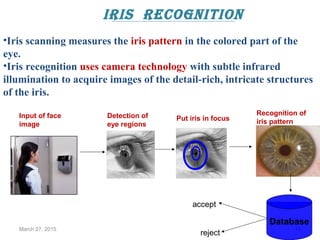
iris recognition
March 27, 2015 14
Database
Input of face
image
Detection of
eye regions
Put iris in focus
Recognition of
iris pattern
accept
reject
•Iris scanning measures the iris pattern in the colored part of the
eye.
•Iris recognition uses camera technology with subtle infrared
illumination to acquire images of the detail-rich, intricate structures
of the iris.
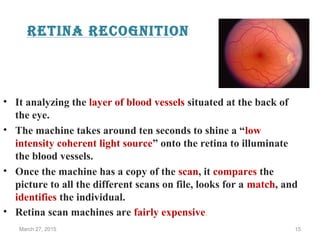
Retina Recognition
• It analyzing the layer of blood vessels situated at the back of
the eye.
• The machine takes around ten seconds to shine a “low
intensity coherent light source” onto the retina to illuminate
the blood vessels.
• Once the machine has a copy of the scan, it compares the
picture to all the different scans on file, looks for a match, and
identifies the individual.
• Retina scan machines are fairly expensive.
March 27, 2015 15
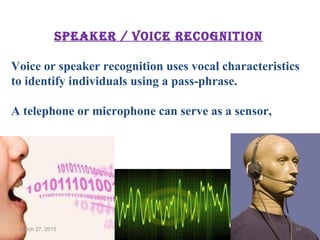
SpeakeR / Voice Recognition
Voice or speaker recognition uses vocal characteristics
to identify individuals using a pass-phrase.
A telephone or microphone can serve as a sensor,
March 27, 2015 16
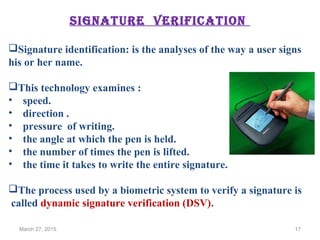
SignatuRe VeRification
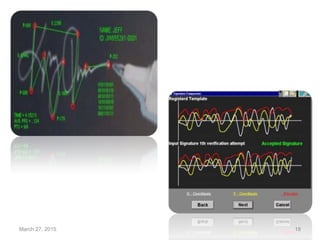
Signature identification: is the analyses of the way a user signs
his or her name.
This technology examines :
• speed.
• direction .
• pressure of writing.
• the angle at which the pen is held.
• the number of times the pen is lifted.
• the time it takes to write the entire signature.
The process used by a biometric system to verify a signature is
called dynamic signature verification (DSV).
March 27, 2015 17
March 27, 2015 18
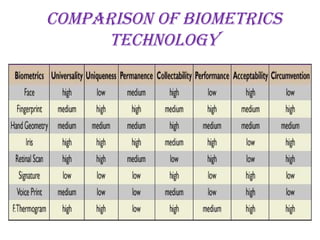
compaRiSon of BiometRicS
technology
futuRe pRoSpectS
Biometry is one of the most promising and life-altering
technologies in existence today. It is all set to change the way
we live in the future. Some of the emerging biometrics
technologies in the near future are:
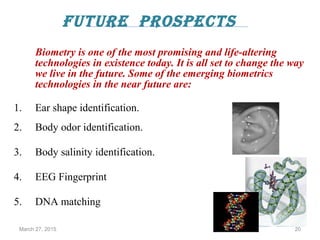
1. Ear shape identification.
2. Body odor identification.
3. Body salinity identification.
4. EEG Fingerprint
5. DNA matching
March 27, 2015 20
Prevent unauthorized access to ATMs, Cellular phones
Desktop PCs
Criminal identification
In automobiles biometrics can replace keys with keyless
entry devices
Airport security
applicationS
March 27, 2015 21
March 27, 2015 22
Eliminate problems caused by lost IDs or forgotten
passwords.
Reduce password administration costs.
Make it possible, automatically, to know WHO did WHAT,
WHERE and WHEN?
Replace hard-to-remember passwords which may be shared
or observed.
AdvAntAges of biometrics
Increase security.
multimodAl biometrics
system
It utilize more than one physiological or
behavioral characteristic for enrollment,
verification or identification.
This system takes advantage of the
capabilities of each individual biometric.
It can be used to overcome some of
the limitations of a single biometrics.
disAdvAntAges of biometrics
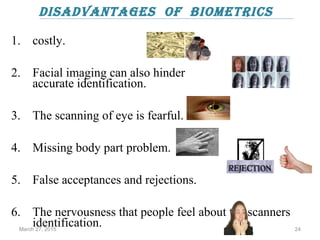
1. costly.
2. Facial imaging can also hinder
accurate identification.
3. The scanning of eye is fearful.
4. Missing body part problem.
5. False acceptances and rejections.
6. The nervousness that people feel about the scanners
identification.March 27, 2015 24
conclusion
Biometric is an emerging area with many
opportunities for growth.
Decreasing costs and increasing convenience.
Increasing both privacy and identity security.
Possibly in the near future, you will not have to
remember PINs and passwords and keys in your bags
or pockets will be things of the past.
March 27, 2015 25
references
•www.biometrics.com
•www.google.com
•www.facerecognization.com
•www.fingerprintscanner.com
•www.irisrecognization.com
March 27, 2015 26
March 27, 2015 27
March 27, 2015 28
Any Questions

Biometrics Technology Intresting PPT

  • 1.
    Submitted By: NAME -PREETI Roll No -1219531098 BRANCH - ELECTRONICS AND COMMUNICATION & ENGG. March 27, 2015 1 GUIDED BY: VIPIN KUMAR & SUNIL TIWARI.
  • 2.
    CONTENT Definiton of biometrics Termsof biometrics History of biometrics Biometrics characteristics Biometrics recognition techniques Applications Advantages & Disadvantages conclusion References March27,2015 2
  • 3.
    Biometrics refers tothe automatic identification of a person based on his or her physiological or behavioral characteristics . WhaT Is BIOMETRICs ? INTODUCTION March 27, 2015 3
  • 4.
    Why BIOMETRICs ? March27, 2015 4 Level of Security
  • 5.
    hIsTORy March 27, 20155 The ancient Egyptians and the Chinese played a large role in biometrics history. Biometrics in practice was a form of finger printing being used in china in the 14th century. Bertillon developed a technique of multiple body measurements . A system called “Indentimat” which measured shape of the hand and length of fingers was introduced in 1970s.
  • 6.
    ChaRaCTERsTICs Of BIOMETRICs  Anyhuman characteristic can qualify as a biometric characteristic as long as it satisfies the following requirements:- Universality Distinctiveness Permanence Collectability
  • 7.
    hOW BIOMETRICs WORks? March 27, 2015 7 No Yes Biometric Data Collection Transmission Quality Sufficient? Ye s Template Match Signal Processing, Feature Extraction, Representation Database Generate Template Decision Confidence? new biometric sample is requested. No All biometric systems works in a four-stage process: Capture Extraction Comparison Match/Non-match
  • 8.
    A biometric systemcAn operAte in two modes 1.Identification: A one to many comparison of the captured biometric against a biometric database in attempt to identify an unknown individual. 2.Verification: A one to one comparison of a captured biometric with a stored template to verify that the individual is who he claims to be. March 27, 2015 8
  • 9.
    types of biometrics Physiological  Face  Fingerprint  Hand geometry  Retina  Iris recognition  Behavioral  Signature  Voice March 27, 2015 9
  • 10.
    fingerprint recognition  Alive acquisition of a person’s fingerprint.  Dots (very small ridges),  Space between two divergent ridges,  Spurs (a notch protruding from a ridge),  Bridges (small ridges joining two longer adjacent ridges), crossovers (two ridges that cross each other).  One of the largest fingerprint recognization system is integrated automated fingerprint identification system, maintained by FBI in the US since 1999. March 27, 2015 10
  • 11.
    fAce recognition: • Facerecognition uses the visible physical structure of the face and analyses the spatial geometry of distinguishing features in it to identify an individual. March 27, 2015 11 Database Input face image Extraction of face image Extraction of face features Positive Negative
  • 12.
    Hand or fingergeometry is an automated measurement of many dimensions of the hand and fingers. HAnd geometry March 27, 2015 12
  • 13.
    March 27, 201513 Based on a number of measurements taken from the human hand. The technique is very simple, relatively easy to use, and inexpensive. The physical size of a hand geometry-based system is large.
  • 14.
    iris recognition March 27,2015 14 Database Input of face image Detection of eye regions Put iris in focus Recognition of iris pattern accept reject •Iris scanning measures the iris pattern in the colored part of the eye. •Iris recognition uses camera technology with subtle infrared illumination to acquire images of the detail-rich, intricate structures of the iris.
  • 15.
    Retina Recognition • Itanalyzing the layer of blood vessels situated at the back of the eye. • The machine takes around ten seconds to shine a “low intensity coherent light source” onto the retina to illuminate the blood vessels. • Once the machine has a copy of the scan, it compares the picture to all the different scans on file, looks for a match, and identifies the individual. • Retina scan machines are fairly expensive. March 27, 2015 15
  • 16.
    SpeakeR / VoiceRecognition Voice or speaker recognition uses vocal characteristics to identify individuals using a pass-phrase. A telephone or microphone can serve as a sensor, March 27, 2015 16
  • 17.
    SignatuRe VeRification Signature identification:is the analyses of the way a user signs his or her name. This technology examines : • speed. • direction . • pressure of writing. • the angle at which the pen is held. • the number of times the pen is lifted. • the time it takes to write the entire signature. The process used by a biometric system to verify a signature is called dynamic signature verification (DSV). March 27, 2015 17
  • 18.
  • 19.
  • 20.
    futuRe pRoSpectS Biometry isone of the most promising and life-altering technologies in existence today. It is all set to change the way we live in the future. Some of the emerging biometrics technologies in the near future are: 1. Ear shape identification. 2. Body odor identification. 3. Body salinity identification. 4. EEG Fingerprint 5. DNA matching March 27, 2015 20
  • 21.
    Prevent unauthorized accessto ATMs, Cellular phones Desktop PCs Criminal identification In automobiles biometrics can replace keys with keyless entry devices Airport security applicationS March 27, 2015 21
  • 22.
    March 27, 201522 Eliminate problems caused by lost IDs or forgotten passwords. Reduce password administration costs. Make it possible, automatically, to know WHO did WHAT, WHERE and WHEN? Replace hard-to-remember passwords which may be shared or observed. AdvAntAges of biometrics Increase security.
  • 23.
    multimodAl biometrics system It utilizemore than one physiological or behavioral characteristic for enrollment, verification or identification. This system takes advantage of the capabilities of each individual biometric. It can be used to overcome some of the limitations of a single biometrics.
  • 24.
    disAdvAntAges of biometrics 1.costly. 2. Facial imaging can also hinder accurate identification. 3. The scanning of eye is fearful. 4. Missing body part problem. 5. False acceptances and rejections. 6. The nervousness that people feel about the scanners identification.March 27, 2015 24
  • 25.
    conclusion Biometric is anemerging area with many opportunities for growth. Decreasing costs and increasing convenience. Increasing both privacy and identity security. Possibly in the near future, you will not have to remember PINs and passwords and keys in your bags or pockets will be things of the past. March 27, 2015 25
  • 26.
  • 27.
  • 28.
    March 27, 201528 Any Questions

Editor's Notes

  • #11 http://www.hhsc.state.tx.us/Consolidation/Consl_home.html. www.rediris.es/cert/doc/ unixsec/node14.html