TYPES OF BIOMETRICS (Based on Chapter 3&4) Chang Jia Sep 12th, 2005 Guide to Biometrics
In General Physiological  Behavioral  Examples:  face, fingerprint, hand geometry and iris recognition Examples:  signature and voice Biometrics can be sorted into two classes :
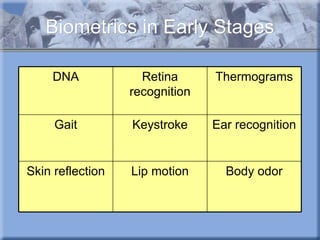
Biometric Identifiers Common: Fingerprint Recognition Face Recognition Speaker Recognition Iris Recognition Hand Geometry Signature verification Others: DNA Retina recognition Thermograms Gait Keystroke Ear recognition Skin reflection Lip motion Body odor
Some More* … *See details in  Chapter 7 Esoteric Biometrics  of  Biometrics   by John D. Woodward, Nicholas M. Orlans, Peter T. Higgins, New York : McGraw-Hill/Osborne, c2003 Footprint and Foot Dynamics Brain Wave Pattern  Hand Grip  Fingernail Bed Sweat Pores Vein Pattern
1. Fingerprint Recognition An extremely useful biometrics technology since fingerprints have long been recognized as a primary and accurate identification method.
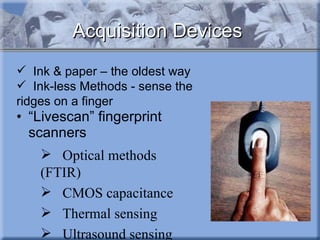
“ Livescan” fingerprint scanners Optical methods (FTIR) CMOS capacitance Thermal sensing Ultrasound sensing Acquisition Devices Ink & paper – the oldest way Ink-less Methods - sense the ridges on a finger
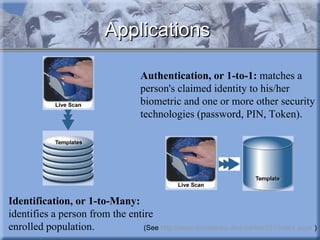
Applications Identification, or 1-to-Many:  identifies a person from the entire enrolled population.  Authentication, or 1-to-1:  matches a person's claimed identity to his/her biometric and one or more other security technologies (password, PIN, Token). (See  http://www.biometrics.dod.mil/bio101/index.aspx  )
Minutiae Uses the ridge endings and bifurcation's on a persons finger to plot points known as Minutiae The number and locations of the minutiae vary from finger to finger in any particular person, and from person to person for any particular finger Minutiae Finger Image + Minutiae Finger Image
Fingerprint scanning ( Minutiae based approach )
Matching Approaches Image techniques    Use both optical and numerical image correlation techniques Two basic classes of matching techniques: Combining the above two techniques: Hybrid techniques  (with improved accuracy)  Feature techniques Extracts features and develop representations from these features
2. Face Recognition Uses an image or series of images either from a camera or photograph to recognize a person. Principle: analysis of the unique shape, pattern and positioning of facial features.
Features Passive biometrics and does not require a persons cooperation  Highly complex technology and largely software based. Primary advantage is that the biometric system is able to operate “hands-free” and a user’s identity is confirmed by simply staring at the screen.
Details Source of data: Single image, video sequence, 3D image and Near Infrared Models: weak models of the human face that model face shape in terms of facial texture Face appearance Examples: eigenfaces Face geometry Examples: feature-based  method
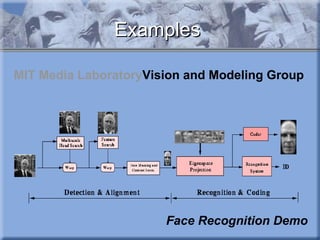
Examples MIT Media Laboratory Vision and Modeling Group Face Recognition Demo
3. Voice Recognition Voice recognition is not the same as speech recognition, it is speaker recognition  Considered both physiological and behavioral  Popular and low-cost, but less accurate and sometimes lengthy enrollment
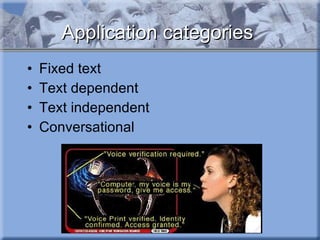
Application categories Fixed text Text dependent Text independent Conversational
Features Advantage Acoustic features :  1. Misspoken or misread phrases; 2. The human voice's tremendous variability, due to colds, aging, and simple tiredness Can be captured surreptitiously by a third party and replayed Less requirements for users, such that they do not have to go through a separate process for verification  Very little hardware is required, and ideally suited to telephone-based system for a remote identification Zero client-side cost, no special reader needs to be installed Disadvantage
4. Iris recognition Analysis of the iris of the eye, which is the colored ring of tissue that surrounds the pupil of the eye. Based on visible features, i.e. rings, furrows, freckles and the corona. Features and their location are used to form the Iriscodes, which is the digital template.  Widely regarded as the most safe, accurate biometrics technology and capable of performing 1-to-many matches at extraordinarily high speeds, without sacrificing accuracy.
Example Iris Images
Applications Iris recognition is a highly mature technology with a proven track record in a number of application areas. Used very effectively all over the world. Heathrow Airport (London) - Iris
5. Hand geometry Hand geometry systems are commonly available in two main forms. Full hand geometry systems take an image of the entire hand for comparison while Two Finger readers only image two fingers of the hand. Hand recognition technology is currently one of the most deployed biometrics disciplines world wide
How does it work A camera capture an image of the hand, with the help of a mirror to get also the edge. The silhouette of the hand is extracted, and some geometrical characteristics stored.  ( See Jain et al.  A Prototype  Hand   Geometry-based   Verification  System  )
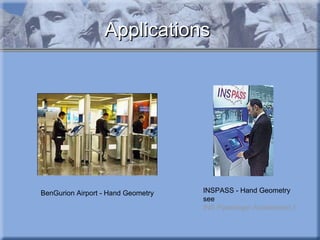
Applications BenGurion Airport - Hand Geometry INSPASS - Hand Geometry see  INS Passenger Accelerated Service System
6. Signature Verification Static/Off-line: the conventional way Dynamic/On-line: using electronically instrumented device Principle: the movement of the pen during the signing process rather than the static image of the signature. Many aspects of the signature in motion can be studied, such as pen pressure, the sound the pen makes
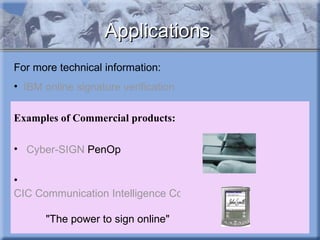
Applications For  more technical information:  IBM online signature verification   Examples of  Commercial products :                    Cyber-SIGN  PenOp                        CIC Communication Intelligence Corp.   "The power to sign online"            
Biometrics in Early Stages Body odor Lip motion Skin reflection Ear recognition Keystroke Gait Thermograms Retina recognition DNA
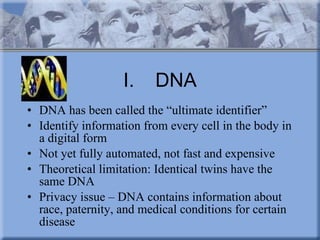
I. DNA DNA has been called the “ultimate identifier” Identify information from every cell in the body in a digital form  Not yet fully automated, not fast and expensive Theoretical limitation: Identical twins have the same DNA Privacy issue – DNA contains information about race, paternity, and medical conditions for certain disease
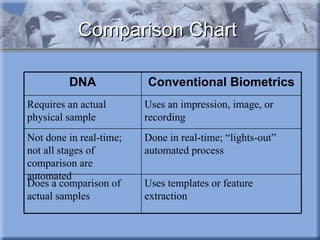
Comparison Chart Uses templates or feature extraction Does a comparison of actual samples Done in real-time;  “lights-out” automated process Not done in real-time; not all stages of comparison are automated Uses an impression, image, or recording Requires an actual physical sample Conventional Biometrics DNA
II. Retina recognition The pattern  of blood vessels that emanate from the optic nerve and disperse throughout the retina depends on individuals and never changes.  No two retinas are the same, even in identical twins.  Commercial products:  Retinal Technologies
III. Thermograms Thermograms requires an infrared camera to detect the heat patterns  of parts of the body that are unique to every human being (such as the face)  Normally expensive because of the sensors Useful paper:  Illumination Invariant Face Recognition Using Thermal Infrared Imagery  (Solikinski & als)
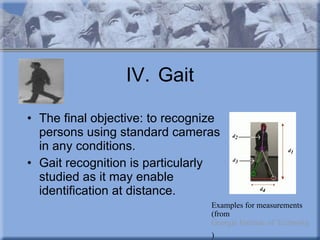
IV. Gait The final objective: to recognize persons using standard cameras in any conditions.  Gait recognition is particularly studied as it may enable identification at distance.  Examples for measurements  (from  Georgia Institute of Technology )
V. Keystroke 100% software-based, requiring no sensor more sophisticated than a home computer Example The rhythms with which one types at a keyboard are sufficiently distinctive to form the basis of the biometric technology known as keystroke dynamics
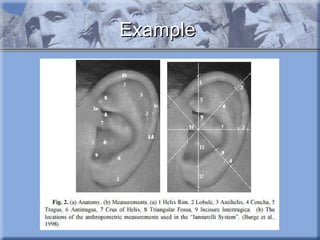
VI. Ear recognition Ear geometry recognition uses the shape of the ear to perform identification  Suggestions have been made that the shapes and characteristics of the human ear are widely different  An infrared image can be used to eliminate hair Might be recognized at a distance
Example
VII.   Skin reflection Lumidigm Inc.  has established that the absorption spectrum of the skin depends on the individuals. In a range of wavelengths over 6mm patch, several LEDs send light into the skin, and photodiodes read the scattered light, which is analyzed to perform the authentication.
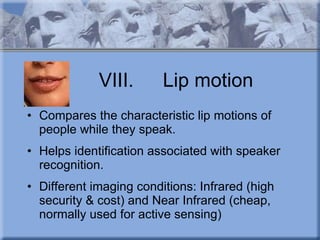
VIII. Lip motion Compares the characteristic lip motions of people while they speak. Helps identification associated with speaker recognition.  Different imaging conditions: Infrared (high security & cost) and Near Infrared (cheap, normally used for active sensing)
IX. Body odor It’s absolutely clear that people with differing immunity genes produce different body odors Electronic/artificial noses:  developed as a system for the automated detection and classification of odors, vapors, gases. Prometheus (Alpha Mos) ,  an example of electronic nose Schematic Diagram of Artificial nose Artificial noses are not yet sophisticated enough to do all the job
The Future “ Your body as password” ? Technical issues legal and privacy issues  Challenges: Are biometric technologies ready for what is being expected of them?
Thank you. Any Question?

Chapters 3 4

  • 1.
    TYPES OF BIOMETRICS(Based on Chapter 3&4) Chang Jia Sep 12th, 2005 Guide to Biometrics
  • 2.
    In General Physiological Behavioral Examples: face, fingerprint, hand geometry and iris recognition Examples: signature and voice Biometrics can be sorted into two classes :
  • 3.
    Biometric Identifiers Common:Fingerprint Recognition Face Recognition Speaker Recognition Iris Recognition Hand Geometry Signature verification Others: DNA Retina recognition Thermograms Gait Keystroke Ear recognition Skin reflection Lip motion Body odor
  • 4.
    Some More* …*See details in Chapter 7 Esoteric Biometrics of Biometrics by John D. Woodward, Nicholas M. Orlans, Peter T. Higgins, New York : McGraw-Hill/Osborne, c2003 Footprint and Foot Dynamics Brain Wave Pattern Hand Grip Fingernail Bed Sweat Pores Vein Pattern
  • 5.
    1. Fingerprint RecognitionAn extremely useful biometrics technology since fingerprints have long been recognized as a primary and accurate identification method.
  • 6.
    “ Livescan” fingerprintscanners Optical methods (FTIR) CMOS capacitance Thermal sensing Ultrasound sensing Acquisition Devices Ink & paper – the oldest way Ink-less Methods - sense the ridges on a finger
  • 7.
    Applications Identification, or1-to-Many: identifies a person from the entire enrolled population. Authentication, or 1-to-1: matches a person's claimed identity to his/her biometric and one or more other security technologies (password, PIN, Token). (See http://www.biometrics.dod.mil/bio101/index.aspx )
  • 8.
    Minutiae Uses theridge endings and bifurcation's on a persons finger to plot points known as Minutiae The number and locations of the minutiae vary from finger to finger in any particular person, and from person to person for any particular finger Minutiae Finger Image + Minutiae Finger Image
  • 9.
    Fingerprint scanning (Minutiae based approach )
  • 10.
    Matching Approaches Imagetechniques Use both optical and numerical image correlation techniques Two basic classes of matching techniques: Combining the above two techniques: Hybrid techniques (with improved accuracy) Feature techniques Extracts features and develop representations from these features
  • 11.
    2. Face RecognitionUses an image or series of images either from a camera or photograph to recognize a person. Principle: analysis of the unique shape, pattern and positioning of facial features.
  • 12.
    Features Passive biometricsand does not require a persons cooperation Highly complex technology and largely software based. Primary advantage is that the biometric system is able to operate “hands-free” and a user’s identity is confirmed by simply staring at the screen.
  • 13.
    Details Source ofdata: Single image, video sequence, 3D image and Near Infrared Models: weak models of the human face that model face shape in terms of facial texture Face appearance Examples: eigenfaces Face geometry Examples: feature-based method
  • 14.
    Examples MIT MediaLaboratory Vision and Modeling Group Face Recognition Demo
  • 15.
    3. Voice RecognitionVoice recognition is not the same as speech recognition, it is speaker recognition Considered both physiological and behavioral Popular and low-cost, but less accurate and sometimes lengthy enrollment
  • 16.
    Application categories Fixedtext Text dependent Text independent Conversational
  • 17.
    Features Advantage Acousticfeatures : 1. Misspoken or misread phrases; 2. The human voice's tremendous variability, due to colds, aging, and simple tiredness Can be captured surreptitiously by a third party and replayed Less requirements for users, such that they do not have to go through a separate process for verification Very little hardware is required, and ideally suited to telephone-based system for a remote identification Zero client-side cost, no special reader needs to be installed Disadvantage
  • 18.
    4. Iris recognitionAnalysis of the iris of the eye, which is the colored ring of tissue that surrounds the pupil of the eye. Based on visible features, i.e. rings, furrows, freckles and the corona. Features and their location are used to form the Iriscodes, which is the digital template. Widely regarded as the most safe, accurate biometrics technology and capable of performing 1-to-many matches at extraordinarily high speeds, without sacrificing accuracy.
  • 19.
  • 20.
    Applications Iris recognitionis a highly mature technology with a proven track record in a number of application areas. Used very effectively all over the world. Heathrow Airport (London) - Iris
  • 21.
    5. Hand geometryHand geometry systems are commonly available in two main forms. Full hand geometry systems take an image of the entire hand for comparison while Two Finger readers only image two fingers of the hand. Hand recognition technology is currently one of the most deployed biometrics disciplines world wide
  • 22.
    How does itwork A camera capture an image of the hand, with the help of a mirror to get also the edge. The silhouette of the hand is extracted, and some geometrical characteristics stored. ( See Jain et al. A Prototype Hand Geometry-based Verification System )
  • 23.
    Applications BenGurion Airport- Hand Geometry INSPASS - Hand Geometry see INS Passenger Accelerated Service System
  • 24.
    6. Signature VerificationStatic/Off-line: the conventional way Dynamic/On-line: using electronically instrumented device Principle: the movement of the pen during the signing process rather than the static image of the signature. Many aspects of the signature in motion can be studied, such as pen pressure, the sound the pen makes
  • 25.
    Applications For more technical information: IBM online signature verification Examples of Commercial products :                  Cyber-SIGN PenOp                     CIC Communication Intelligence Corp. "The power to sign online"           
  • 26.
    Biometrics in EarlyStages Body odor Lip motion Skin reflection Ear recognition Keystroke Gait Thermograms Retina recognition DNA
  • 27.
    I. DNA DNAhas been called the “ultimate identifier” Identify information from every cell in the body in a digital form Not yet fully automated, not fast and expensive Theoretical limitation: Identical twins have the same DNA Privacy issue – DNA contains information about race, paternity, and medical conditions for certain disease
  • 28.
    Comparison Chart Usestemplates or feature extraction Does a comparison of actual samples Done in real-time; “lights-out” automated process Not done in real-time; not all stages of comparison are automated Uses an impression, image, or recording Requires an actual physical sample Conventional Biometrics DNA
  • 29.
    II. Retina recognitionThe pattern of blood vessels that emanate from the optic nerve and disperse throughout the retina depends on individuals and never changes. No two retinas are the same, even in identical twins. Commercial products: Retinal Technologies
  • 30.
    III. Thermograms Thermogramsrequires an infrared camera to detect the heat patterns of parts of the body that are unique to every human being (such as the face) Normally expensive because of the sensors Useful paper: Illumination Invariant Face Recognition Using Thermal Infrared Imagery (Solikinski & als)
  • 31.
    IV. Gait Thefinal objective: to recognize persons using standard cameras in any conditions. Gait recognition is particularly studied as it may enable identification at distance. Examples for measurements (from Georgia Institute of Technology )
  • 32.
    V. Keystroke 100%software-based, requiring no sensor more sophisticated than a home computer Example The rhythms with which one types at a keyboard are sufficiently distinctive to form the basis of the biometric technology known as keystroke dynamics
  • 33.
    VI. Ear recognitionEar geometry recognition uses the shape of the ear to perform identification Suggestions have been made that the shapes and characteristics of the human ear are widely different An infrared image can be used to eliminate hair Might be recognized at a distance
  • 34.
  • 35.
    VII. Skin reflection Lumidigm Inc. has established that the absorption spectrum of the skin depends on the individuals. In a range of wavelengths over 6mm patch, several LEDs send light into the skin, and photodiodes read the scattered light, which is analyzed to perform the authentication.
  • 36.
    VIII. Lip motionCompares the characteristic lip motions of people while they speak. Helps identification associated with speaker recognition. Different imaging conditions: Infrared (high security & cost) and Near Infrared (cheap, normally used for active sensing)
  • 37.
    IX. Body odorIt’s absolutely clear that people with differing immunity genes produce different body odors Electronic/artificial noses: developed as a system for the automated detection and classification of odors, vapors, gases. Prometheus (Alpha Mos) , an example of electronic nose Schematic Diagram of Artificial nose Artificial noses are not yet sophisticated enough to do all the job
  • 38.
    The Future “Your body as password” ? Technical issues legal and privacy issues Challenges: Are biometric technologies ready for what is being expected of them?
  • 39.
    Thank you. AnyQuestion?