10/23/2016 1
Content
 Introduction.
 Multimodal Biometric System.
 Verification module.
 Fingerprint verification
 Face recognition
 Speaker verification
 Decision fusion.
 Performance Evaluation
 Databases
 Benchmarks
 Conclusions
10/23/2016 2
Introduction
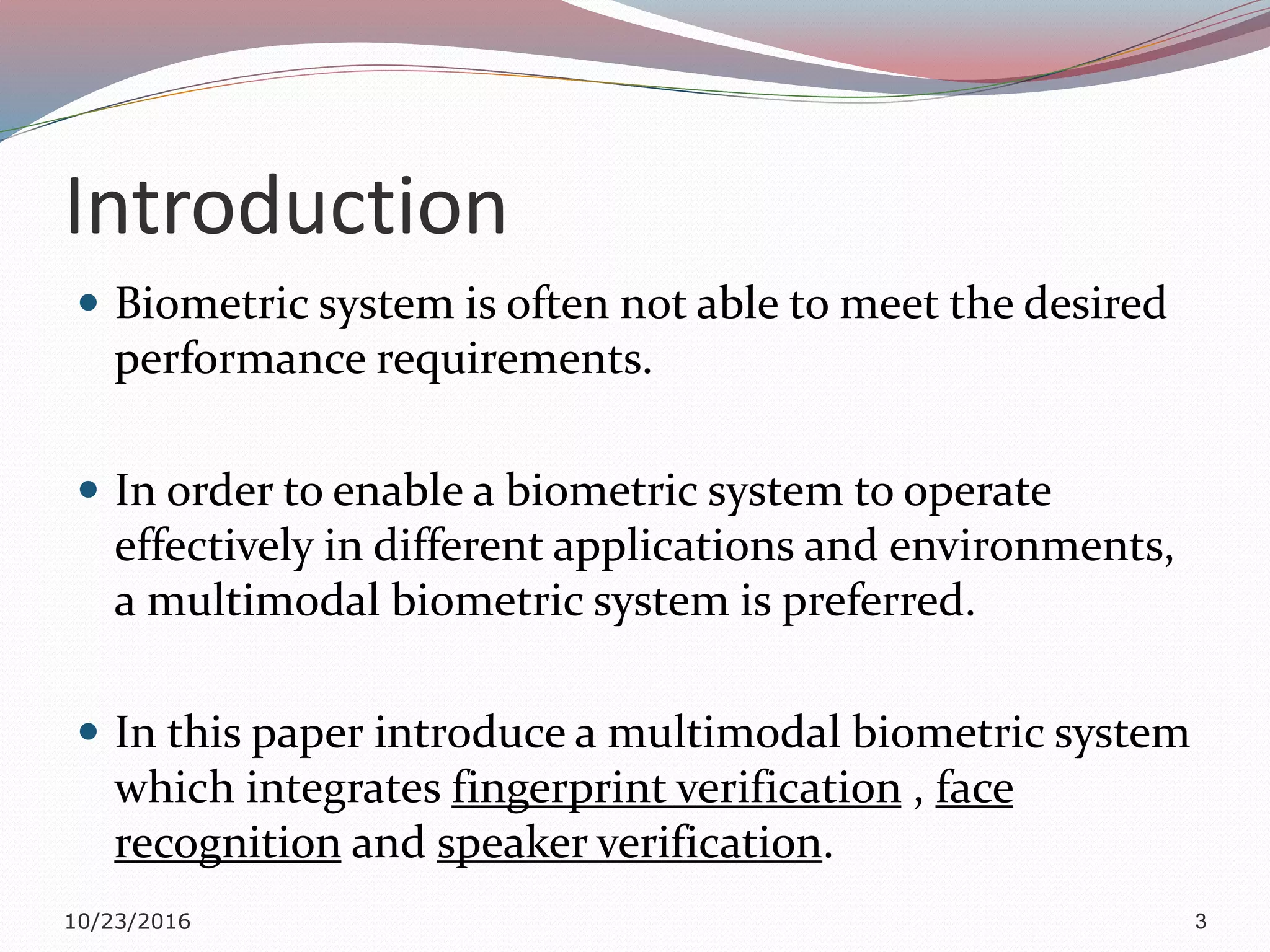
 Biometric system is often not able to meet the desired
performance requirements.
 In order to enable a biometric system to operate
effectively in different applications and environments,
a multimodal biometric system is preferred.
 In this paper introduce a multimodal biometric system
which integrates fingerprint verification , face
recognition and speaker verification.
10/23/2016 3
Introduction
10/23/2016 4
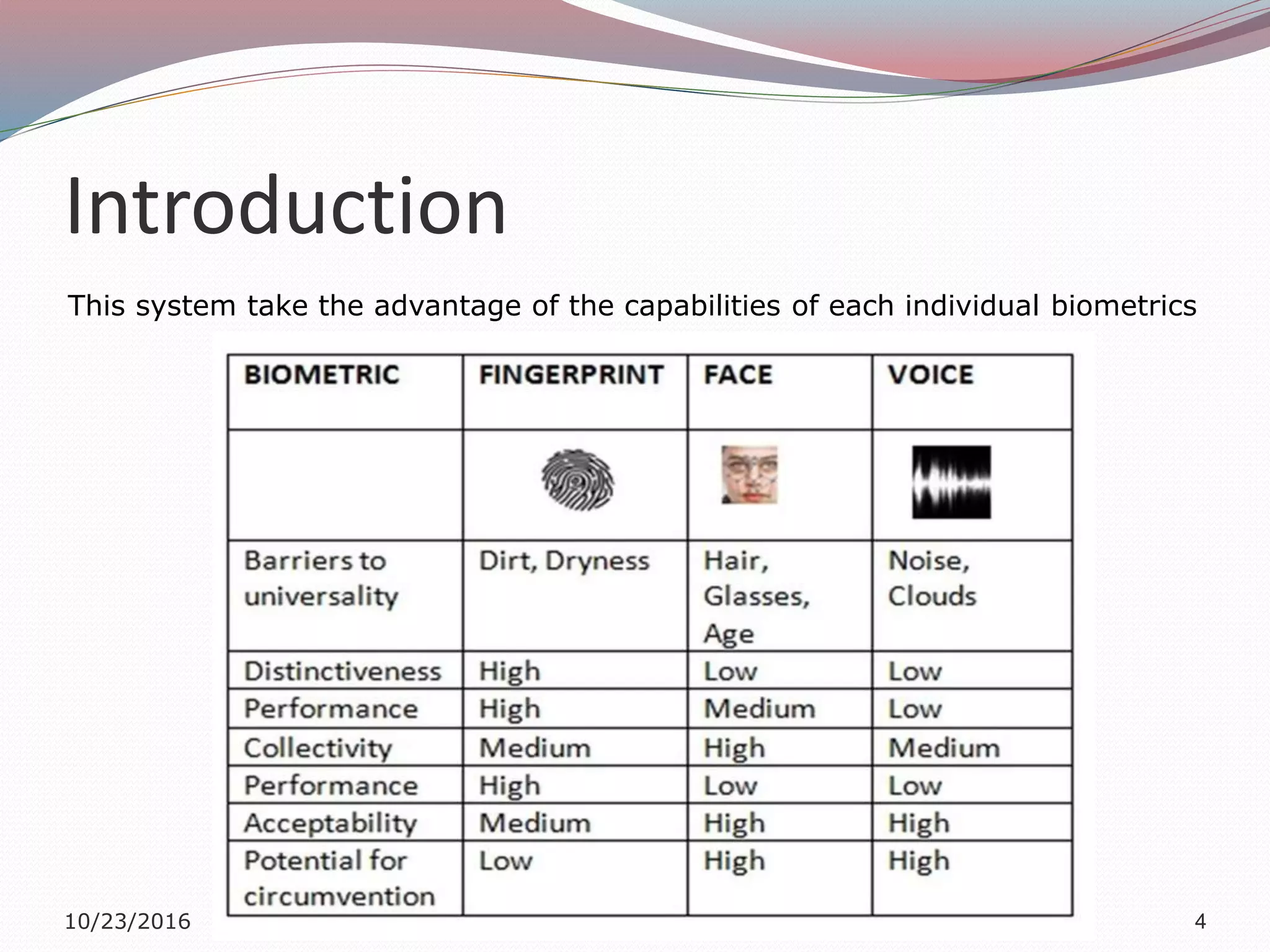
This system take the advantage of the capabilities of each individual biometrics
Introduction
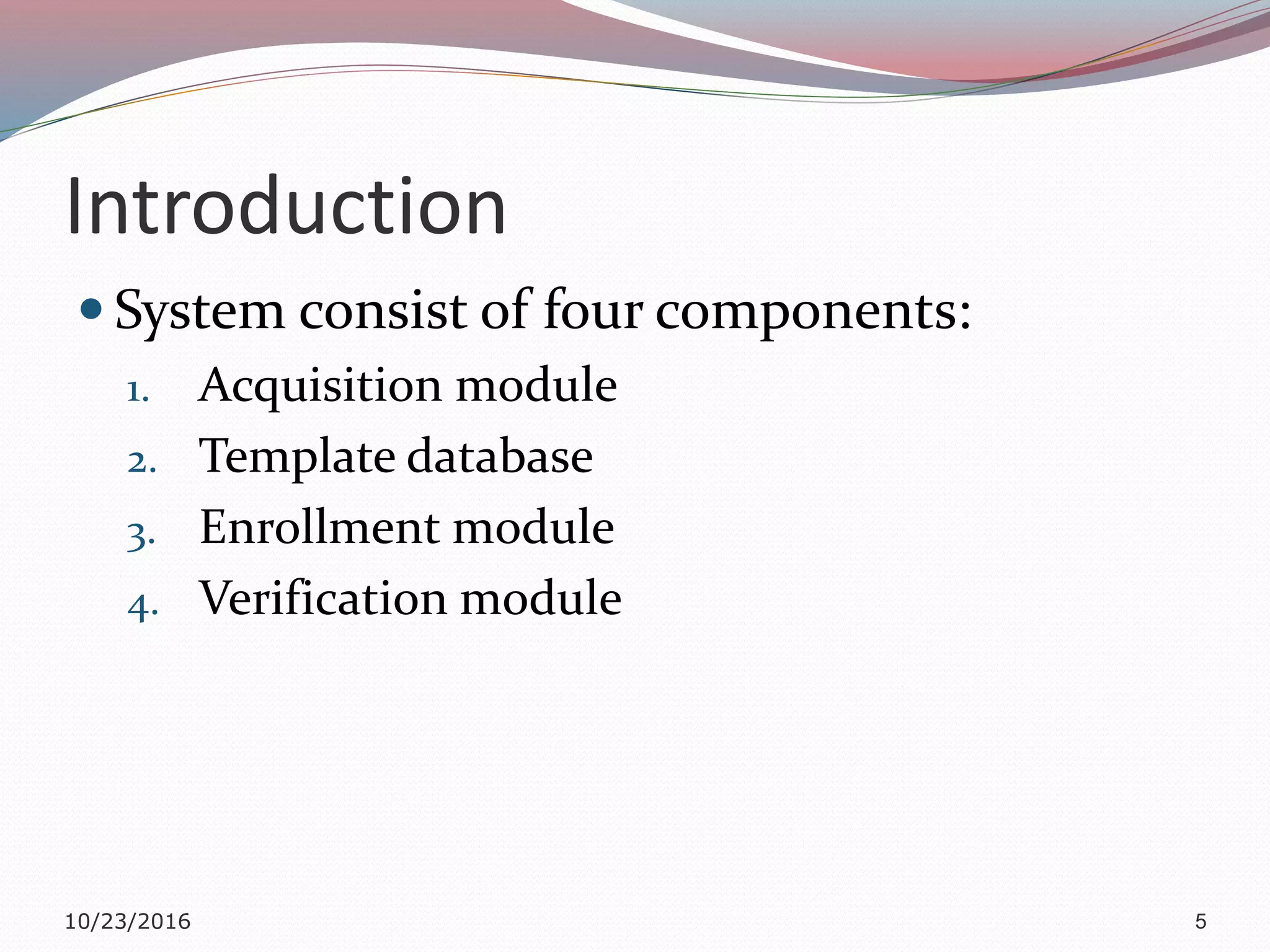
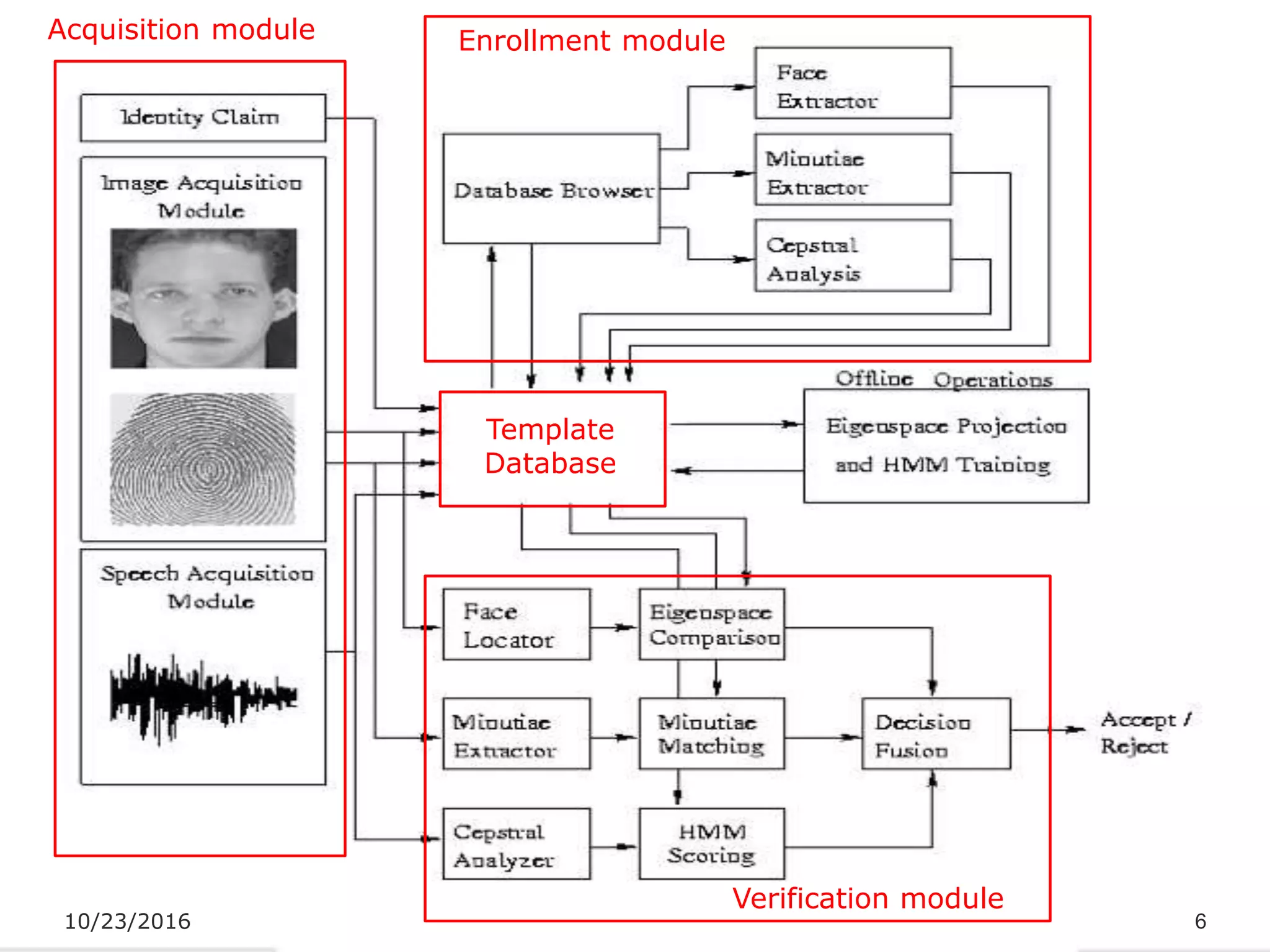
 System consist of four components:
1. Acquisition module
2. Template database
3. Enrollment module
4. Verification module
10/23/2016 5
10/23/2016 6
Acquisition module Enrollment module
Verification module
Template
Database
Content
 Introduction.
 Multimodal Biometric System.
 Verification module.
 Fingerprint verification
 Face recognition
 Speaker verification
 Decision fusion.
 Performance Evaluation
 Databases
 Benchmarks
 Conclusions
10/23/2016 7
Formulation
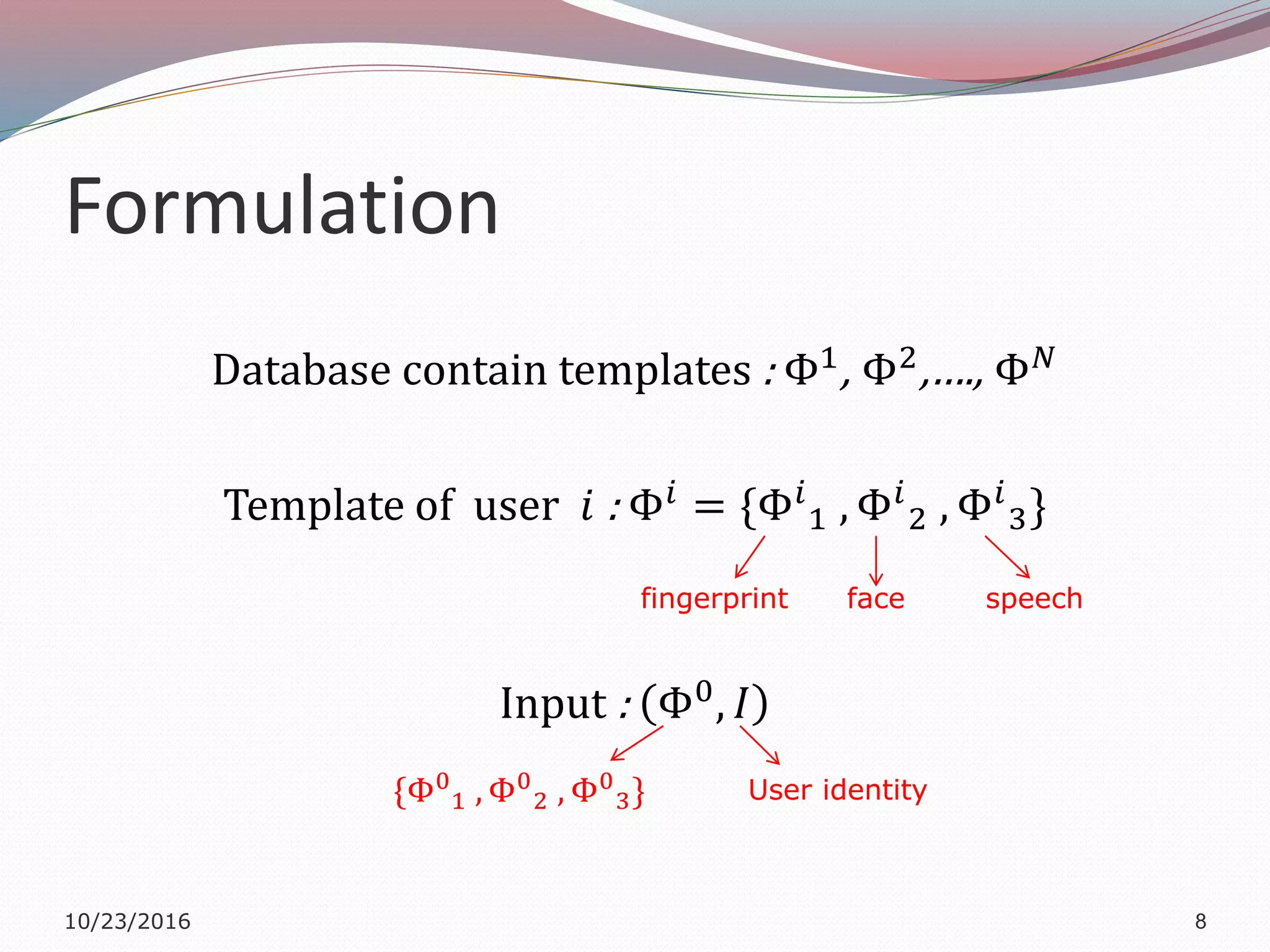
Database contain templates : Φ1
, Φ2
,…., Φ 𝑁
Template of user 𝑖 : Φ𝑖
= {Φ𝑖
1 , Φ𝑖
2 , Φ𝑖
3}
Input : Φ0
, 𝐼
10/23/2016 8
fingerprint face speech
{Φ0
1 , Φ0
2 , Φ0
3} User identity
Formulation
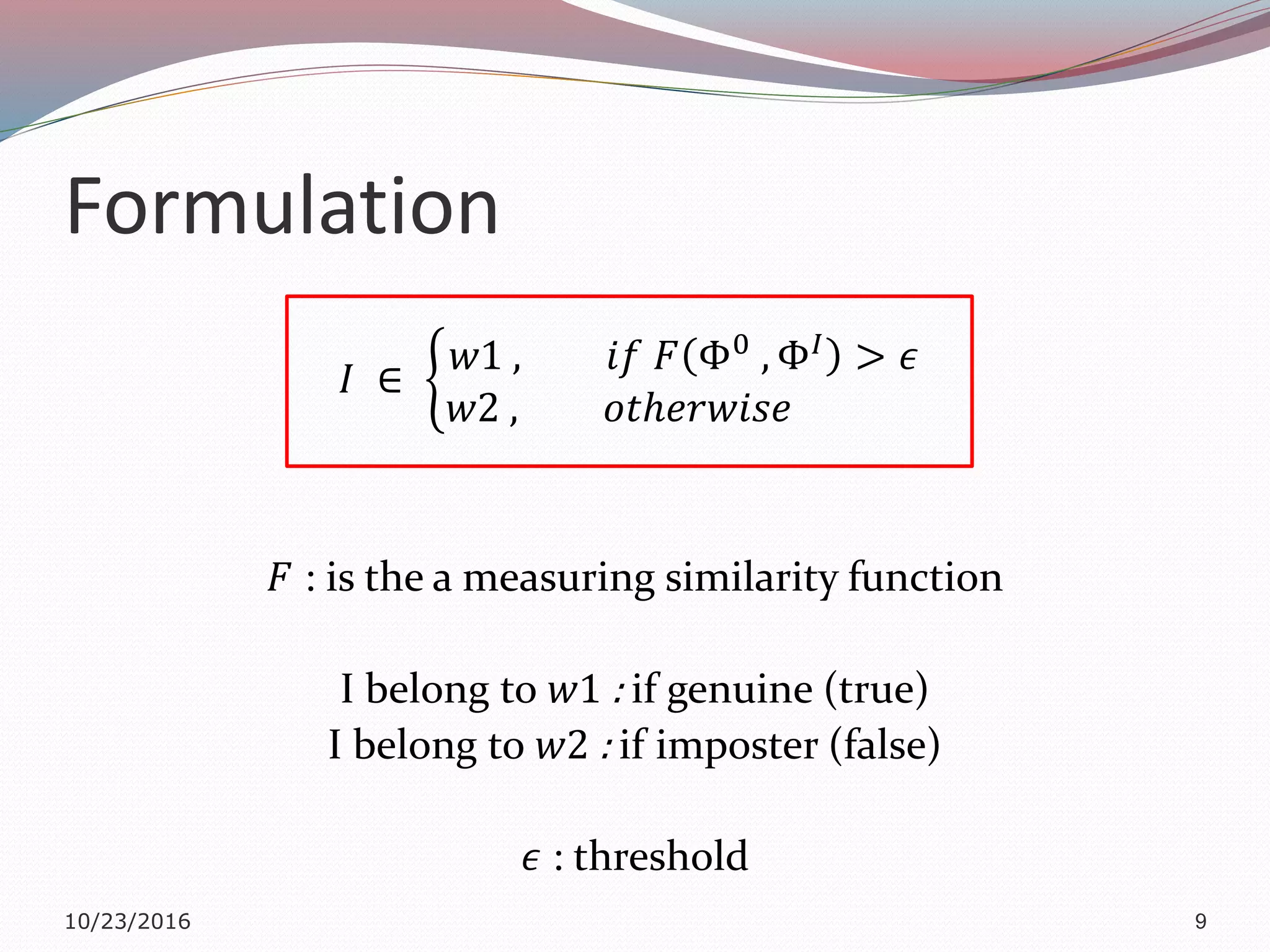
𝐼 ∈
𝑤1 , 𝑖𝑓 𝐹 Φ0 , Φ 𝐼 > 𝜖
𝑤2 , 𝑜𝑡ℎ𝑒𝑟𝑤𝑖𝑠𝑒
𝐹 : is the a measuring similarity function
I belong to 𝑤1 : if genuine (true)
I belong to 𝑤2 : if imposter (false)
𝜖 : threshold
10/23/2016 9
Content
 Introduction.
 Multimodal Biometric System.
 Verification module.
 Fingerprint verification
 Face recognition
 Speaker verification
 Decision fusion.
 Performance Evaluation
 Databases
 Benchmarks
 Conclusions
10/23/2016 10
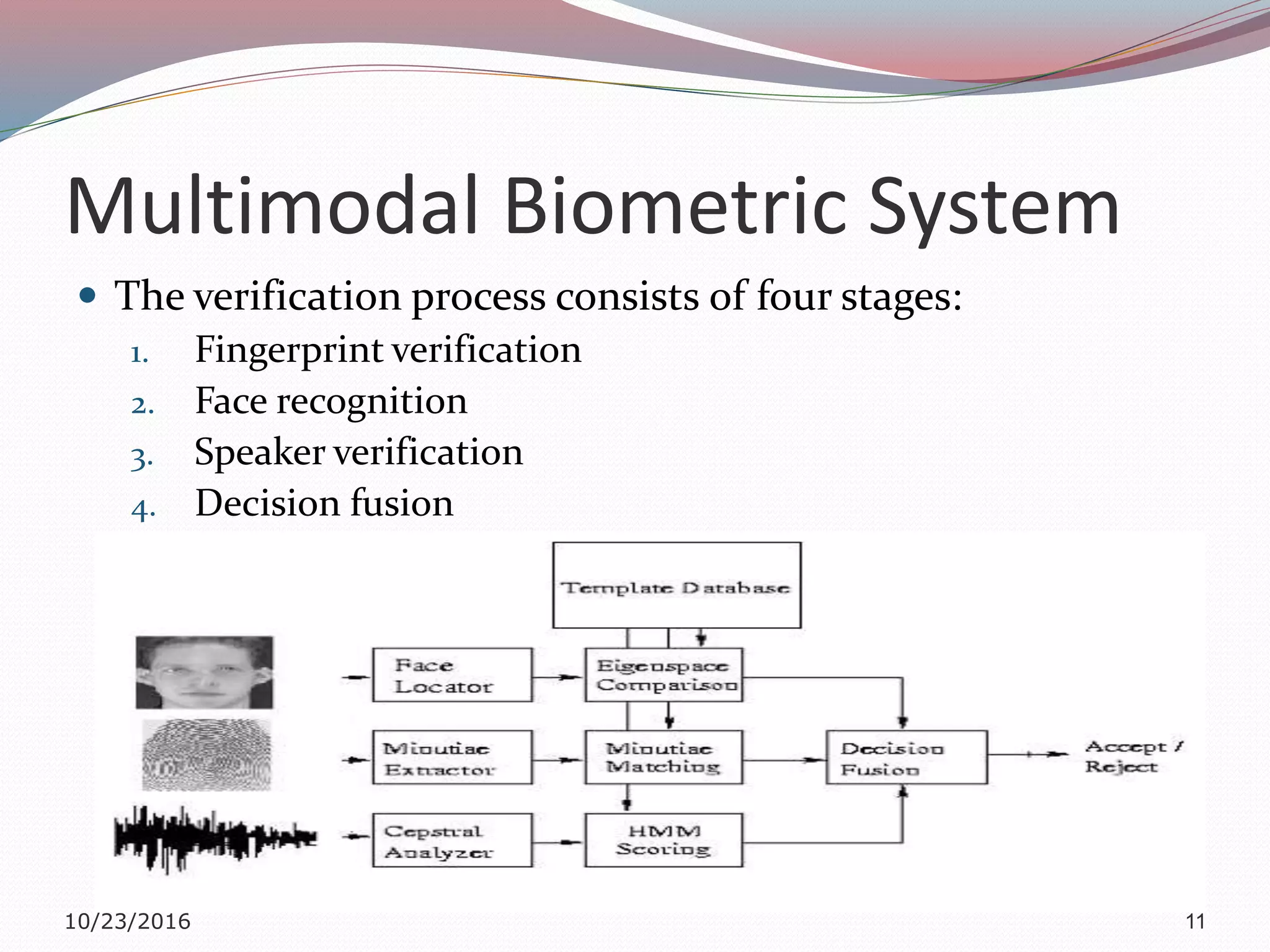
Multimodal Biometric System
 The verification process consists of four stages:
1. Fingerprint verification
2. Face recognition
3. Speaker verification
4. Decision fusion
10/23/2016 11
Fingerprint Verification
10/23/2016 12
Fingerprint Verification
 Fingerprint is the pattern of ridges.
 The two most prominent ridge characteristics, called
minutiae features, are: Ridge ending and Ridge
bifurcation.
10/23/2016 13
Ridge ending Bifurcation
Fingerprint Verification
Steps:
 Minutiae extracting : extract minutiae from input finger
print images.
 Minutiae matching : determine the similarity of two
minutiae patterns.
10/23/2016 14
Fingerprint Verification
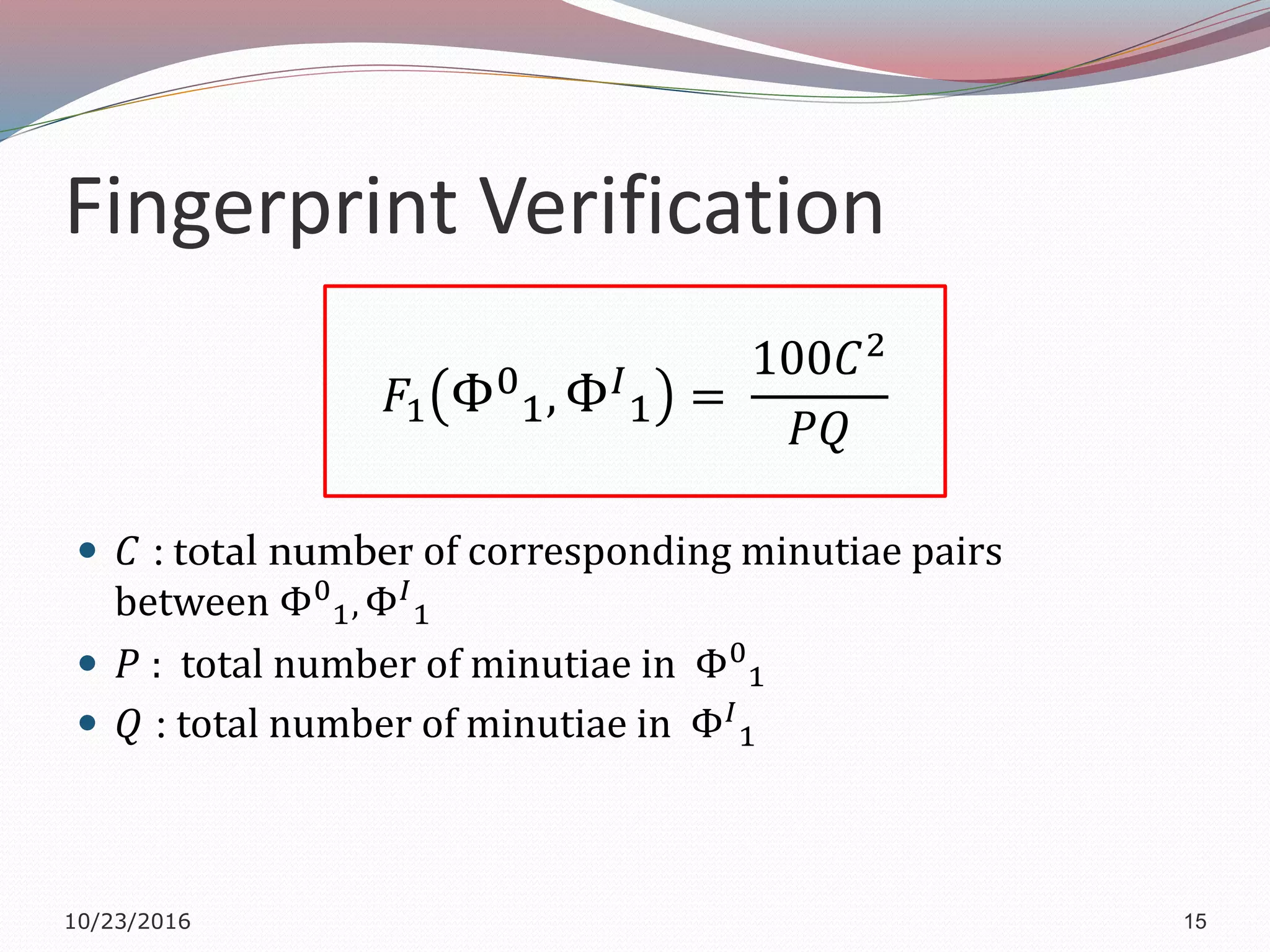
𝐹1 Φ0
1, Φ 𝐼
1 =
100𝐶2
𝑃𝑄
 𝐶 : total number of corresponding minutiae pairs
between Φ0
1, Φ 𝐼
1
 𝑃 : total number of minutiae in Φ0
1
 𝑄 : total number of minutiae in Φ 𝐼
1
10/23/2016 15
Face Recognition
10/23/2016 16
Face Recognition
There are two major tasks:
 Face location : finds if there is a face in the input image.
 Face recognition : finds the similarity between the
located face and the stored templates.
10/23/2016 17
Face Recognition
 In our system : eigenface approach is used.
 The eigenface-based face recognition method is
divided into two stages:
1. Training stage.
2. Operational stage.
10/23/2016 18
Face Recognition
1. Training stage :
 set of orthonormal images that best describe the
distribution of the training facial image in a lower
dimensional subspace (eigenspace) is computed.
 The training facial images are projected onto eigenspace
to generate the representations of the facial images in the
eigenspace.
10/23/2016 19
Face Recognition
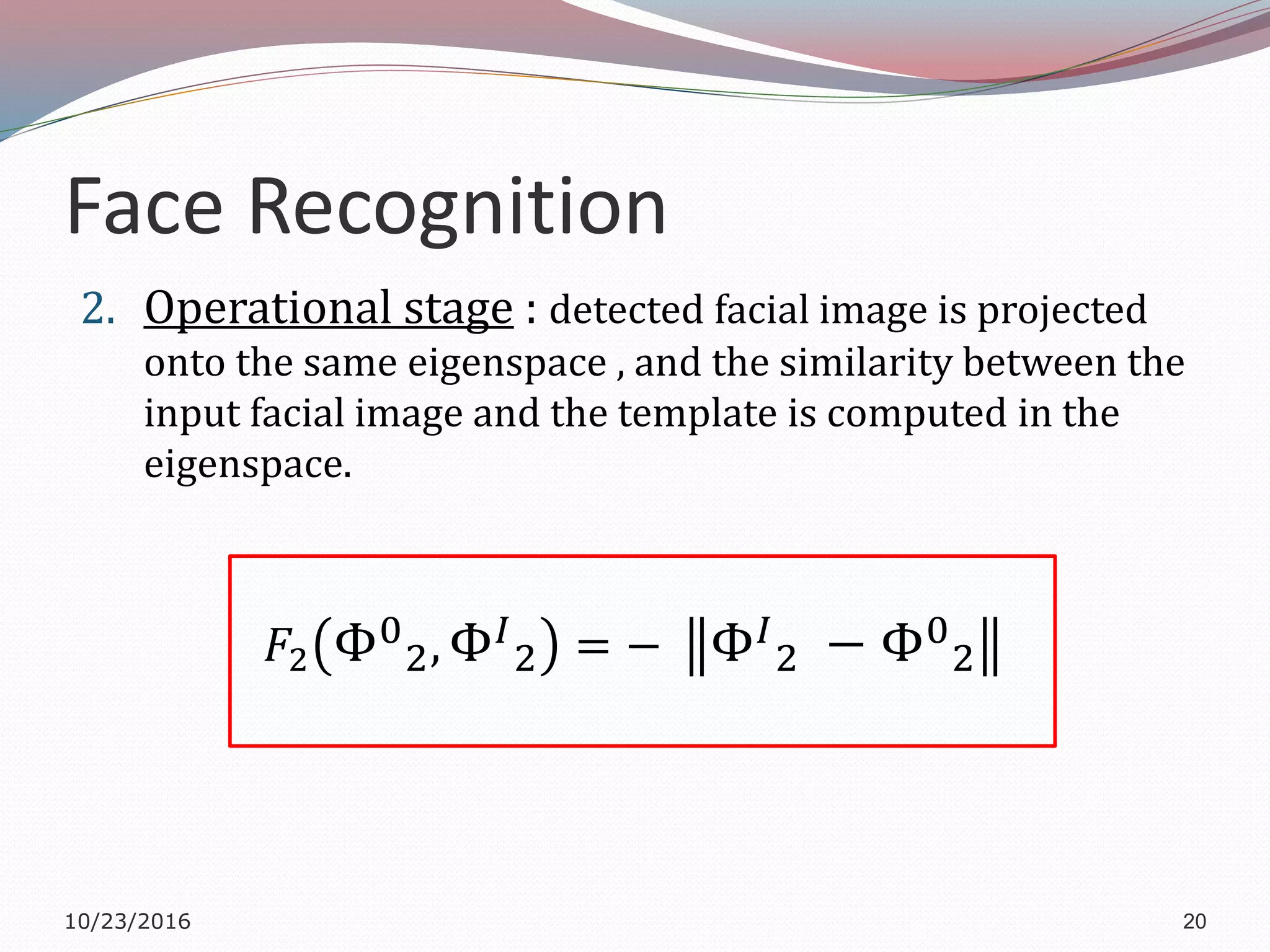
2. Operational stage : detected facial image is projected
onto the same eigenspace , and the similarity between the
input facial image and the template is computed in the
eigenspace.
𝐹2 Φ0
2, Φ 𝐼
2 = − Φ 𝐼
2 − Φ0
2
10/23/2016 20
Speaker Verification
10/23/2016 21
Speaker Verification
 Text-dependent system : system knows text spoken by
user.
 Uses left to right Hidden Markov Model (HMM) of the
10th order linear prediction coefficients (LPC) of the
cepstrum to make a verification.
10/23/2016 22
Speaker Verification
𝐹3 Φ0
3, Φ 𝐼
3 = max
𝑖1……𝑖 𝐿
{
𝑘=1
𝐿
𝑞 𝑠𝑖𝑘|𝑡𝑖𝑘 𝑝 𝑡𝑖𝑘|𝑡𝑖𝑘−1 }
 L : feature vector length.
 𝑞 𝑠𝑖𝑘|𝑡𝑖𝑘 : probability of transition to visible state
depends on current hidden state.
 𝑝 𝑡𝑖𝑘|𝑡𝑖𝑘−1 : probability of a state for each time step
depend only on the previous state
10/23/2016 23
Decision Fusion
10/23/2016 24
Decision Fusion
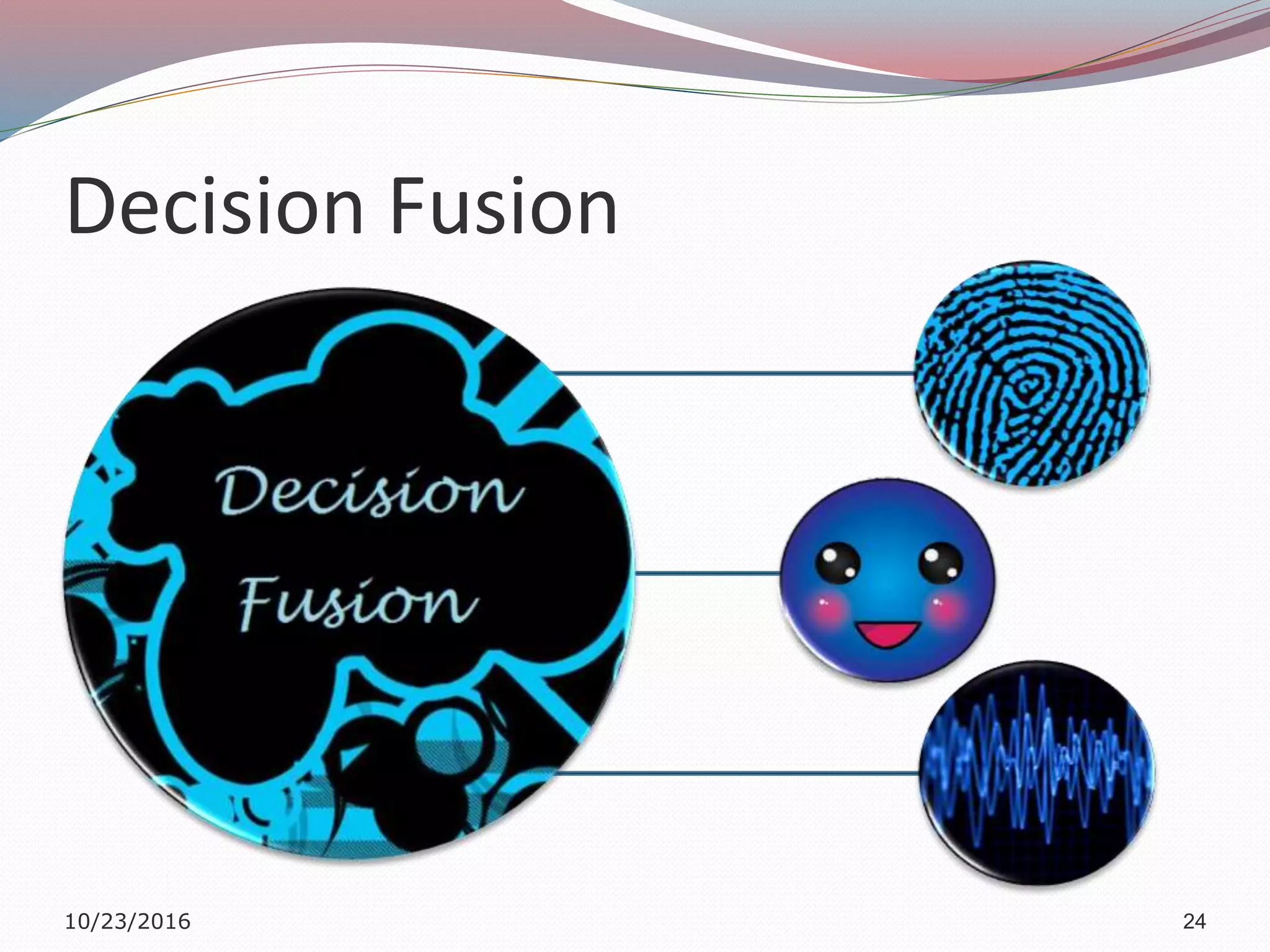
 The final decision made by our system is based on the
integration of the decision made by the tree
biometrics.
 The output of each module is a similarity value.
 𝑋1, 𝑋2, 𝑋3 are variables used to indicate the similarity
between input and template.
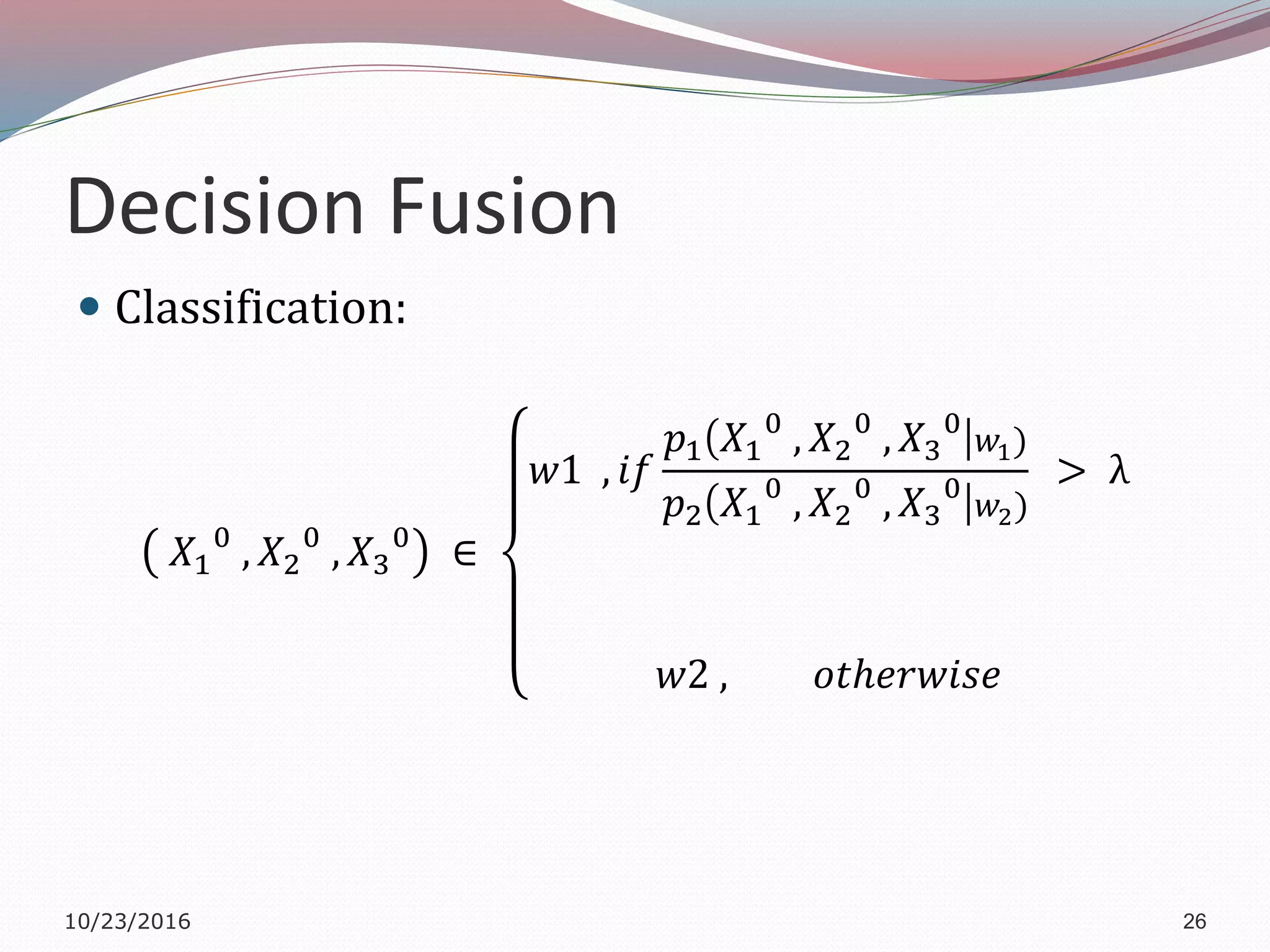
10/23/2016 25
Decision Fusion
 Classification:
𝑋1
0
, 𝑋2
0
, 𝑋3
0
∈
𝑤1 , 𝑖𝑓
𝑝1 𝑋1
0
, 𝑋2
0
, 𝑋3
0
𝑤1)
𝑝2 𝑋1
0
, 𝑋2
0
, 𝑋3
0
𝑤2)
> λ
𝑤2 , 𝑜𝑡ℎ𝑒𝑟𝑤𝑖𝑠𝑒
10/23/2016 26
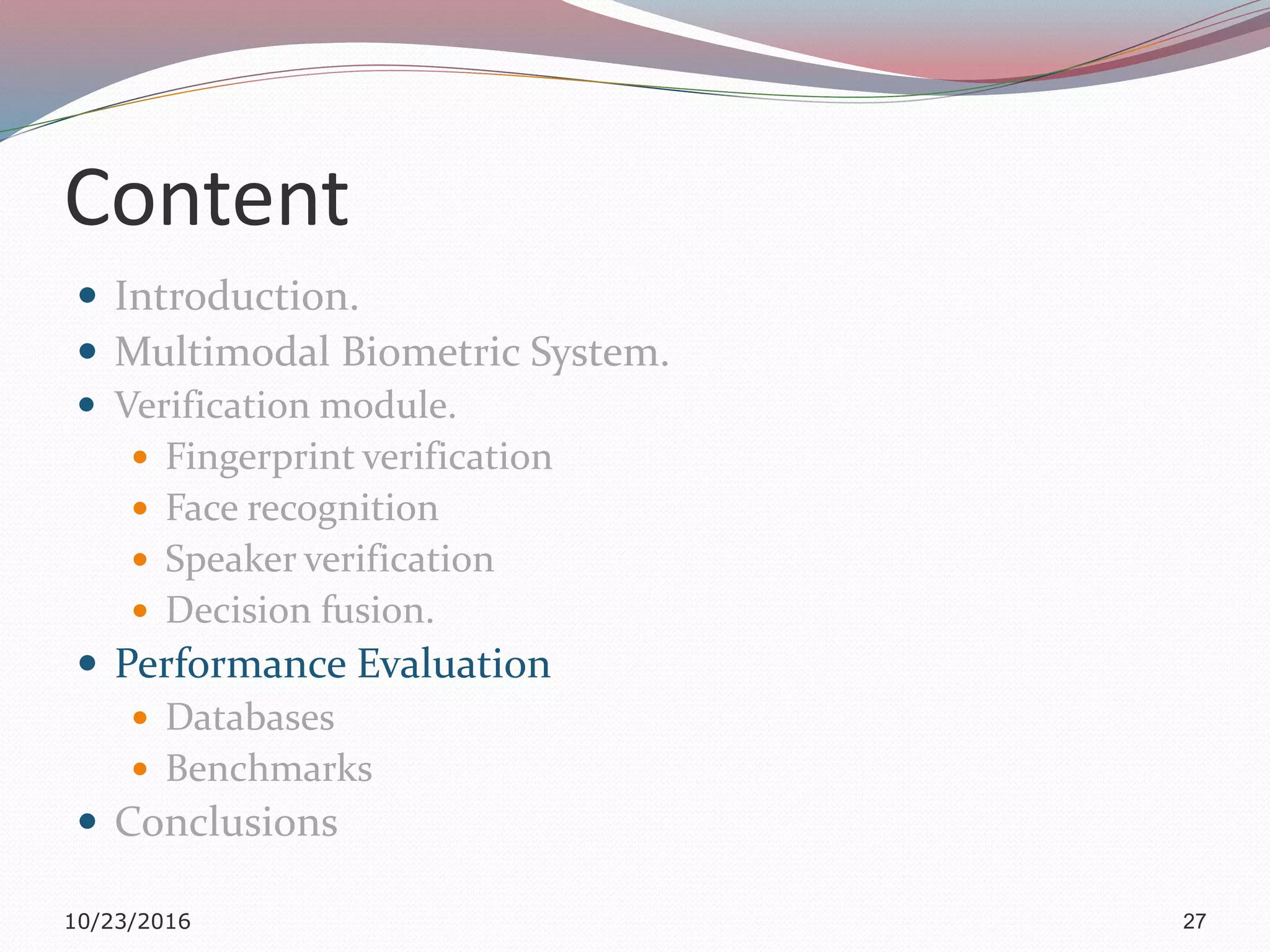
Content
 Introduction.
 Multimodal Biometric System.
 Verification module.
 Fingerprint verification
 Face recognition
 Speaker verification
 Decision fusion.
 Performance Evaluation
 Databases
 Benchmarks
 Conclusions
10/23/2016 27
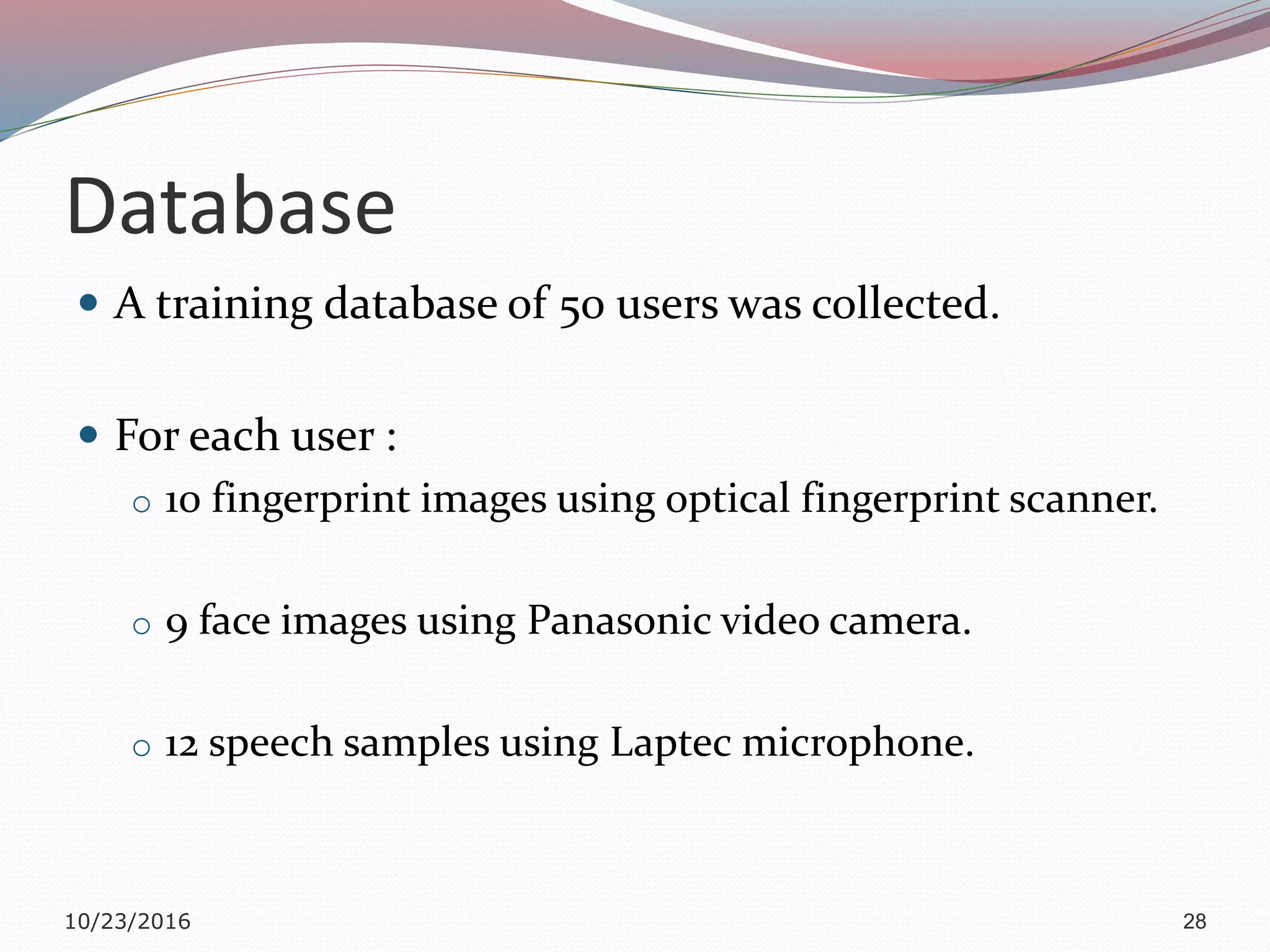
Database
 A training database of 50 users was collected.
 For each user :
o 10 fingerprint images using optical fingerprint scanner.
o 9 face images using Panasonic video camera.
o 12 speech samples using Laptec microphone.
10/23/2016 28
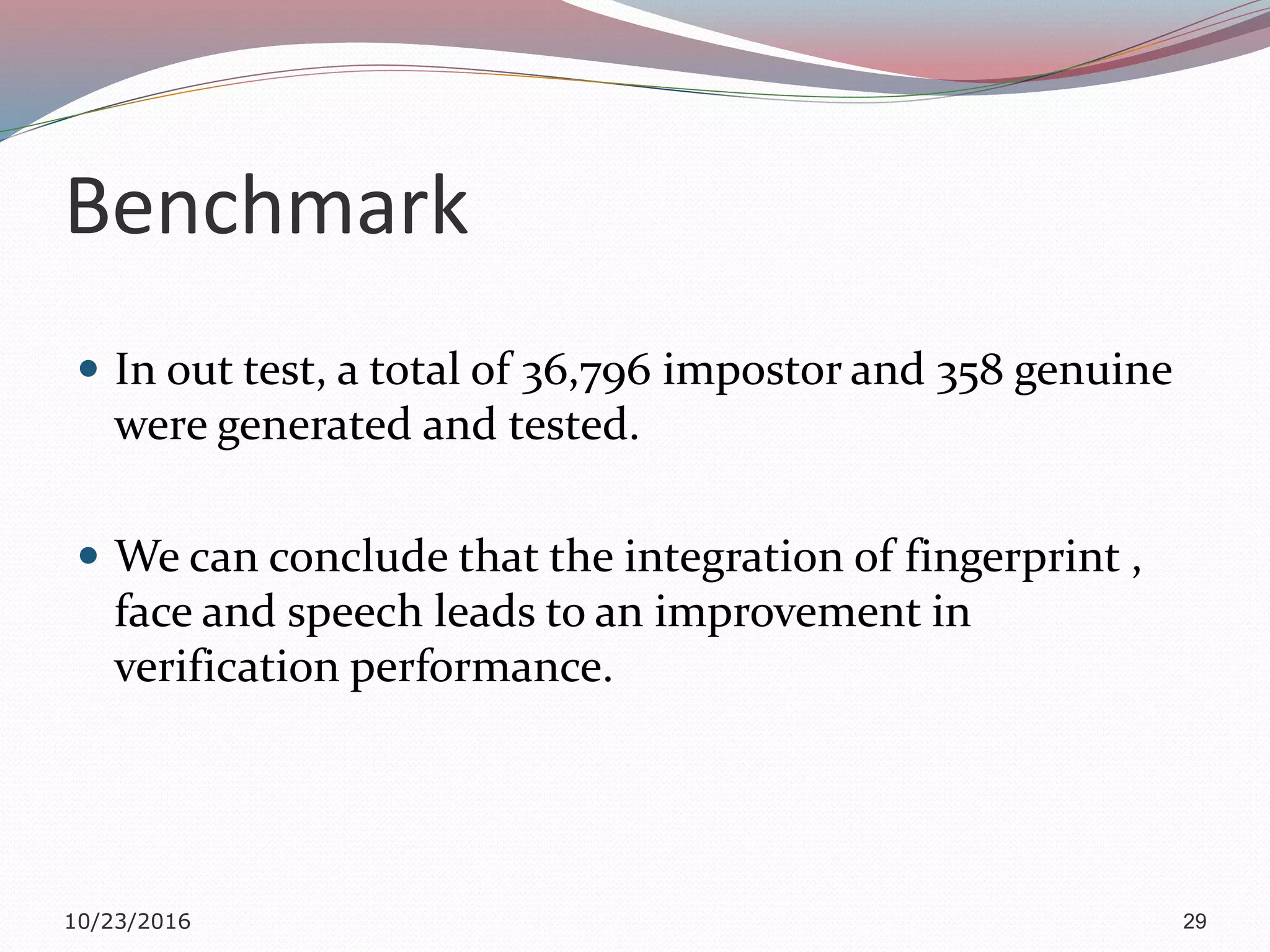
Benchmark
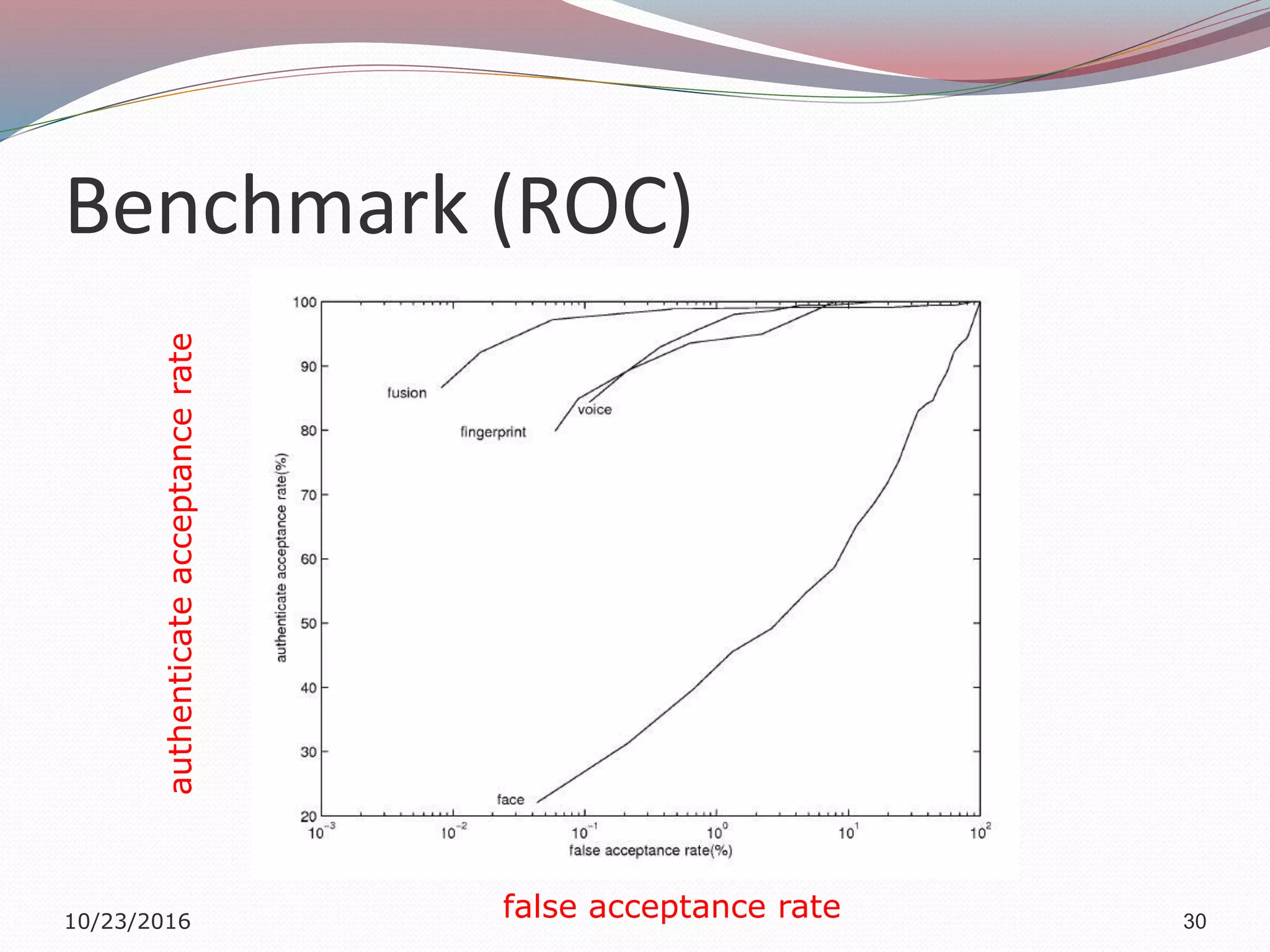
 In out test, a total of 36,796 impostor and 358 genuine
were generated and tested.
 We can conclude that the integration of fingerprint ,
face and speech leads to an improvement in
verification performance.
10/23/2016 29
Benchmark (ROC)
10/23/2016 30
false acceptance rate
authenticateacceptancerate
Content
 Introduction.
 Multimodal Biometric System.
 Verification module.
 Fingerprint verification
 Face recognition
 Speaker verification
 Decision fusion.
 Performance Evaluation
 Databases
 Benchmarks
 Conclusions
10/23/2016 31
Conclusion
 Multimodal biometric technique which combines multiple
biometrics in making a personal identification can be used to
overcome the limitations of individual biometrics.
 If a user can not provide a good fingerprint images ( due to dry
fingers , cuts, etc.) then face and voice may be better biometric
indicators.
 These biometrics indicators complement one another in their
advantages and strengths.
10/23/2016 32
10/23/2016 33

Paper multi-modal biometric system using fingerprint , face and speech

  • 1.
  • 2.
    Content  Introduction.  MultimodalBiometric System.  Verification module.  Fingerprint verification  Face recognition  Speaker verification  Decision fusion.  Performance Evaluation  Databases  Benchmarks  Conclusions 10/23/2016 2
  • 3.
    Introduction  Biometric systemis often not able to meet the desired performance requirements.  In order to enable a biometric system to operate effectively in different applications and environments, a multimodal biometric system is preferred.  In this paper introduce a multimodal biometric system which integrates fingerprint verification , face recognition and speaker verification. 10/23/2016 3
  • 4.
    Introduction 10/23/2016 4 This systemtake the advantage of the capabilities of each individual biometrics
  • 5.
    Introduction  System consistof four components: 1. Acquisition module 2. Template database 3. Enrollment module 4. Verification module 10/23/2016 5
  • 6.
    10/23/2016 6 Acquisition moduleEnrollment module Verification module Template Database
  • 7.
    Content  Introduction.  MultimodalBiometric System.  Verification module.  Fingerprint verification  Face recognition  Speaker verification  Decision fusion.  Performance Evaluation  Databases  Benchmarks  Conclusions 10/23/2016 7
  • 8.
    Formulation Database contain templates: Φ1 , Φ2 ,…., Φ 𝑁 Template of user 𝑖 : Φ𝑖 = {Φ𝑖 1 , Φ𝑖 2 , Φ𝑖 3} Input : Φ0 , 𝐼 10/23/2016 8 fingerprint face speech {Φ0 1 , Φ0 2 , Φ0 3} User identity
  • 9.
    Formulation 𝐼 ∈ 𝑤1 ,𝑖𝑓 𝐹 Φ0 , Φ 𝐼 > 𝜖 𝑤2 , 𝑜𝑡ℎ𝑒𝑟𝑤𝑖𝑠𝑒 𝐹 : is the a measuring similarity function I belong to 𝑤1 : if genuine (true) I belong to 𝑤2 : if imposter (false) 𝜖 : threshold 10/23/2016 9
  • 10.
    Content  Introduction.  MultimodalBiometric System.  Verification module.  Fingerprint verification  Face recognition  Speaker verification  Decision fusion.  Performance Evaluation  Databases  Benchmarks  Conclusions 10/23/2016 10
  • 11.
    Multimodal Biometric System The verification process consists of four stages: 1. Fingerprint verification 2. Face recognition 3. Speaker verification 4. Decision fusion 10/23/2016 11
  • 12.
  • 13.
    Fingerprint Verification  Fingerprintis the pattern of ridges.  The two most prominent ridge characteristics, called minutiae features, are: Ridge ending and Ridge bifurcation. 10/23/2016 13 Ridge ending Bifurcation
  • 14.
    Fingerprint Verification Steps:  Minutiaeextracting : extract minutiae from input finger print images.  Minutiae matching : determine the similarity of two minutiae patterns. 10/23/2016 14
  • 15.
    Fingerprint Verification 𝐹1 Φ0 1,Φ 𝐼 1 = 100𝐶2 𝑃𝑄  𝐶 : total number of corresponding minutiae pairs between Φ0 1, Φ 𝐼 1  𝑃 : total number of minutiae in Φ0 1  𝑄 : total number of minutiae in Φ 𝐼 1 10/23/2016 15
  • 16.
  • 17.
    Face Recognition There aretwo major tasks:  Face location : finds if there is a face in the input image.  Face recognition : finds the similarity between the located face and the stored templates. 10/23/2016 17
  • 18.
    Face Recognition  Inour system : eigenface approach is used.  The eigenface-based face recognition method is divided into two stages: 1. Training stage. 2. Operational stage. 10/23/2016 18
  • 19.
    Face Recognition 1. Trainingstage :  set of orthonormal images that best describe the distribution of the training facial image in a lower dimensional subspace (eigenspace) is computed.  The training facial images are projected onto eigenspace to generate the representations of the facial images in the eigenspace. 10/23/2016 19
  • 20.
    Face Recognition 2. Operationalstage : detected facial image is projected onto the same eigenspace , and the similarity between the input facial image and the template is computed in the eigenspace. 𝐹2 Φ0 2, Φ 𝐼 2 = − Φ 𝐼 2 − Φ0 2 10/23/2016 20
  • 21.
  • 22.
    Speaker Verification  Text-dependentsystem : system knows text spoken by user.  Uses left to right Hidden Markov Model (HMM) of the 10th order linear prediction coefficients (LPC) of the cepstrum to make a verification. 10/23/2016 22
  • 23.
    Speaker Verification 𝐹3 Φ0 3,Φ 𝐼 3 = max 𝑖1……𝑖 𝐿 { 𝑘=1 𝐿 𝑞 𝑠𝑖𝑘|𝑡𝑖𝑘 𝑝 𝑡𝑖𝑘|𝑡𝑖𝑘−1 }  L : feature vector length.  𝑞 𝑠𝑖𝑘|𝑡𝑖𝑘 : probability of transition to visible state depends on current hidden state.  𝑝 𝑡𝑖𝑘|𝑡𝑖𝑘−1 : probability of a state for each time step depend only on the previous state 10/23/2016 23
  • 24.
  • 25.
    Decision Fusion  Thefinal decision made by our system is based on the integration of the decision made by the tree biometrics.  The output of each module is a similarity value.  𝑋1, 𝑋2, 𝑋3 are variables used to indicate the similarity between input and template. 10/23/2016 25
  • 26.
    Decision Fusion  Classification: 𝑋1 0 ,𝑋2 0 , 𝑋3 0 ∈ 𝑤1 , 𝑖𝑓 𝑝1 𝑋1 0 , 𝑋2 0 , 𝑋3 0 𝑤1) 𝑝2 𝑋1 0 , 𝑋2 0 , 𝑋3 0 𝑤2) > λ 𝑤2 , 𝑜𝑡ℎ𝑒𝑟𝑤𝑖𝑠𝑒 10/23/2016 26
  • 27.
    Content  Introduction.  MultimodalBiometric System.  Verification module.  Fingerprint verification  Face recognition  Speaker verification  Decision fusion.  Performance Evaluation  Databases  Benchmarks  Conclusions 10/23/2016 27
  • 28.
    Database  A trainingdatabase of 50 users was collected.  For each user : o 10 fingerprint images using optical fingerprint scanner. o 9 face images using Panasonic video camera. o 12 speech samples using Laptec microphone. 10/23/2016 28
  • 29.
    Benchmark  In outtest, a total of 36,796 impostor and 358 genuine were generated and tested.  We can conclude that the integration of fingerprint , face and speech leads to an improvement in verification performance. 10/23/2016 29
  • 30.
    Benchmark (ROC) 10/23/2016 30 falseacceptance rate authenticateacceptancerate
  • 31.
    Content  Introduction.  MultimodalBiometric System.  Verification module.  Fingerprint verification  Face recognition  Speaker verification  Decision fusion.  Performance Evaluation  Databases  Benchmarks  Conclusions 10/23/2016 31
  • 32.
    Conclusion  Multimodal biometrictechnique which combines multiple biometrics in making a personal identification can be used to overcome the limitations of individual biometrics.  If a user can not provide a good fingerprint images ( due to dry fingers , cuts, etc.) then face and voice may be better biometric indicators.  These biometrics indicators complement one another in their advantages and strengths. 10/23/2016 32
  • 33.