10/23/2016 1
Content
 Introduction.
 Multimodal Biometrics.
 Scenarios in a multimodal biometric system.
 Modes of Operation.
 Levels of Fusion.
 Advantages & Disadvantages.
10/23/2016 2
Introduction
Unimodal biometrics has several problems such as:
 Noisy data.
 Intra class variation.
 Inter class similarities.
 Non universality.
 Spoofing.
which cause this system less accurate and secure.
10/23/2016 3
Introduction
 Noisy data : Susceptibility of biometric sensors to noise leads
to inaccurate matching, as noisy data may lead to false rejection.
 Intra class variation : The biometric data acquired during
verification will not be identical to the data used for generating
template during enrollment for an individual. This is known as
intra-class variation. Large intra-class variations increase the
False Rejection Rate (FRR) of a biometric system.
10/23/2016 4
Introduction
 Interclass similarities : Inter-class similarity refers to the
overlap of feature spaces corresponding to multiple individuals.
Large Inter-class similarities increase the False Acceptance Rate
(FAR) of a biometric system.
 Non universality “ Failure to enroll(FTE) ”: Some persons
cannot provide the required standalone biometric, owing to
illness or disabilities.
 Spoofing : Unimodal biometrics is vulnerable to spoofing
where the data can be imitated or forged.
10/23/2016 5
Content
 Introduction.
 Multimodal Biometrics.
 Scenarios in a multimodal biometric system.
 Modes of Operation.
 Levels of Fusion.
 Advantages & Disadvantages.
10/23/2016 6
Multimodal Biometrics
 Some of the limitations imposed by unimodal biometric
systems can be overcome by using multiple biometric
modalities.
 Multimodal biometric systems are those that utilize more
than one physical or behavioural characteristic for
enrolment , verification, or identification.
10/23/2016 7
Content
 Introduction.
 Multimodal Biometrics.
 Scenarios in a multimodal biometric system.
 Modes of Operation.
 Levels of Fusion.
 Advantages & Disadvantages.
10/23/2016 8
10/23/2016 9
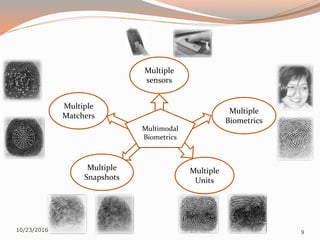
Multimodal
Biometrics
Multiple
sensors
Multiple
Matchers
Multiple
Snapshots
Multiple
Units
Multiple
Biometrics
Scenarios in a multimodal biometric system
 Multiple sensors : multiple sensors are used to sense the same biometric
identifier.
 Multiple Biometrics : sense different biometric identifiers.
 Multiple Units : fingerprints from two or more fingers.
 Multiple Snapshots : more than one instance of the same biometric.
 Multiple Matching algorithm : combines different representation and
matching algorithms.
10/23/2016 10
Content
 Introduction.
 Multimodal Biometrics.
 Scenarios in a multimodal biometric system.
 Modes of Operation.
 Levels of Fusion.
 Advantages & Disadvantages.
10/23/2016 11
Modes
A multimodal biometric system can operate in one of
three different modes:
 Serial
 Parallel
 Hierarchical
10/23/2016 12
Modes
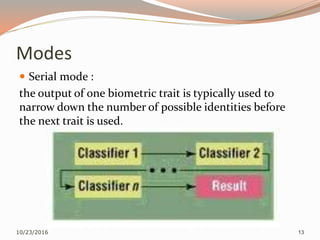
 Serial mode :
the output of one biometric trait is typically used to
narrow down the number of possible identities before
the next trait is used.
10/23/2016 13
Modes
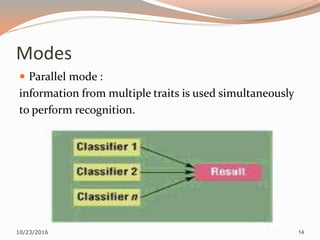
 Parallel mode :
information from multiple traits is used simultaneously
to perform recognition.
10/23/2016 14
Modes
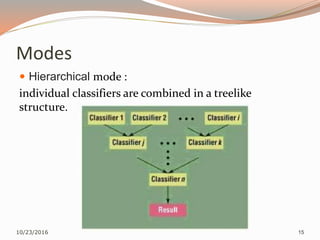
 Hierarchical mode :
individual classifiers are combined in a treelike
structure.
10/23/2016 15
Content
 Introduction.
 Multimodal Biometrics.
 Scenarios in a multimodal biometric system.
 Modes of Operation.
 Levels of Fusion.
 Advantages & Disadvantages.
10/23/2016 16
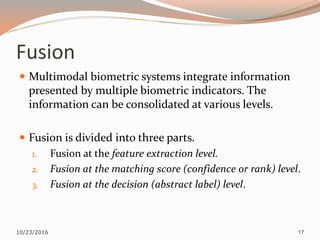
Fusion
 Multimodal biometric systems integrate information
presented by multiple biometric indicators. The
information can be consolidated at various levels.
 Fusion is divided into three parts.
1. Fusion at the feature extraction level.
2. Fusion at the matching score (confidence or rank) level.
3. Fusion at the decision (abstract label) level.
10/23/2016 17
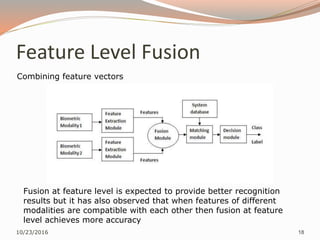
Feature Level Fusion
10/23/2016 18
Combining feature vectors
Fusion at feature level is expected to provide better recognition
results but it has also observed that when features of different
modalities are compatible with each other then fusion at feature
level achieves more accuracy
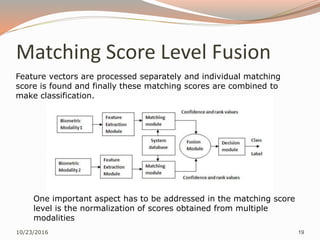
Matching Score Level Fusion
10/23/2016 19
Feature vectors are processed separately and individual matching
score is found and finally these matching scores are combined to
make classification.
One important aspect has to be addressed in the matching score
level is the normalization of scores obtained from multiple
modalities
Decision Level Fusion
10/23/2016 20
Each biometric system makes its own recognition decision
based on its own feature vector.
Content
 Introduction.
 Multimodal Biometrics.
 Scenarios in a multimodal biometric system.
 Modes of Operation.
 Levels of Fusion.
 Advantages & Disadvantages.
10/23/2016 21
Advantages of Multi-modal Biometrics
 More Secure : hard to spoof.
 More accurate.
 Reduce False accept rate (FAR).
 Reduce False reject rate (FRR).
 Reduce Failure to enrol rate (FTE).
10/23/2016 22
Disadvantages of Multi-modal Biometrics
 High cost.
 High enrolment time.
 High transit times.
 Increase system development and complexity.
 Reduced Matching Level: if a stronger biometric is used with a
weaker biometric, the result is not a stronger combined system. The
error rate of the weaker biometric can bring down the overall
effectiveness of the system.
10/23/2016 23
10/23/2016 24

Multi modal biometric system

  • 1.
  • 2.
    Content  Introduction.  MultimodalBiometrics.  Scenarios in a multimodal biometric system.  Modes of Operation.  Levels of Fusion.  Advantages & Disadvantages. 10/23/2016 2
  • 3.
    Introduction Unimodal biometrics hasseveral problems such as:  Noisy data.  Intra class variation.  Inter class similarities.  Non universality.  Spoofing. which cause this system less accurate and secure. 10/23/2016 3
  • 4.
    Introduction  Noisy data: Susceptibility of biometric sensors to noise leads to inaccurate matching, as noisy data may lead to false rejection.  Intra class variation : The biometric data acquired during verification will not be identical to the data used for generating template during enrollment for an individual. This is known as intra-class variation. Large intra-class variations increase the False Rejection Rate (FRR) of a biometric system. 10/23/2016 4
  • 5.
    Introduction  Interclass similarities: Inter-class similarity refers to the overlap of feature spaces corresponding to multiple individuals. Large Inter-class similarities increase the False Acceptance Rate (FAR) of a biometric system.  Non universality “ Failure to enroll(FTE) ”: Some persons cannot provide the required standalone biometric, owing to illness or disabilities.  Spoofing : Unimodal biometrics is vulnerable to spoofing where the data can be imitated or forged. 10/23/2016 5
  • 6.
    Content  Introduction.  MultimodalBiometrics.  Scenarios in a multimodal biometric system.  Modes of Operation.  Levels of Fusion.  Advantages & Disadvantages. 10/23/2016 6
  • 7.
    Multimodal Biometrics  Someof the limitations imposed by unimodal biometric systems can be overcome by using multiple biometric modalities.  Multimodal biometric systems are those that utilize more than one physical or behavioural characteristic for enrolment , verification, or identification. 10/23/2016 7
  • 8.
    Content  Introduction.  MultimodalBiometrics.  Scenarios in a multimodal biometric system.  Modes of Operation.  Levels of Fusion.  Advantages & Disadvantages. 10/23/2016 8
  • 9.
  • 10.
    Scenarios in amultimodal biometric system  Multiple sensors : multiple sensors are used to sense the same biometric identifier.  Multiple Biometrics : sense different biometric identifiers.  Multiple Units : fingerprints from two or more fingers.  Multiple Snapshots : more than one instance of the same biometric.  Multiple Matching algorithm : combines different representation and matching algorithms. 10/23/2016 10
  • 11.
    Content  Introduction.  MultimodalBiometrics.  Scenarios in a multimodal biometric system.  Modes of Operation.  Levels of Fusion.  Advantages & Disadvantages. 10/23/2016 11
  • 12.
    Modes A multimodal biometricsystem can operate in one of three different modes:  Serial  Parallel  Hierarchical 10/23/2016 12
  • 13.
    Modes  Serial mode: the output of one biometric trait is typically used to narrow down the number of possible identities before the next trait is used. 10/23/2016 13
  • 14.
    Modes  Parallel mode: information from multiple traits is used simultaneously to perform recognition. 10/23/2016 14
  • 15.
    Modes  Hierarchical mode: individual classifiers are combined in a treelike structure. 10/23/2016 15
  • 16.
    Content  Introduction.  MultimodalBiometrics.  Scenarios in a multimodal biometric system.  Modes of Operation.  Levels of Fusion.  Advantages & Disadvantages. 10/23/2016 16
  • 17.
    Fusion  Multimodal biometricsystems integrate information presented by multiple biometric indicators. The information can be consolidated at various levels.  Fusion is divided into three parts. 1. Fusion at the feature extraction level. 2. Fusion at the matching score (confidence or rank) level. 3. Fusion at the decision (abstract label) level. 10/23/2016 17
  • 18.
    Feature Level Fusion 10/23/201618 Combining feature vectors Fusion at feature level is expected to provide better recognition results but it has also observed that when features of different modalities are compatible with each other then fusion at feature level achieves more accuracy
  • 19.
    Matching Score LevelFusion 10/23/2016 19 Feature vectors are processed separately and individual matching score is found and finally these matching scores are combined to make classification. One important aspect has to be addressed in the matching score level is the normalization of scores obtained from multiple modalities
  • 20.
    Decision Level Fusion 10/23/201620 Each biometric system makes its own recognition decision based on its own feature vector.
  • 21.
    Content  Introduction.  MultimodalBiometrics.  Scenarios in a multimodal biometric system.  Modes of Operation.  Levels of Fusion.  Advantages & Disadvantages. 10/23/2016 21
  • 22.
    Advantages of Multi-modalBiometrics  More Secure : hard to spoof.  More accurate.  Reduce False accept rate (FAR).  Reduce False reject rate (FRR).  Reduce Failure to enrol rate (FTE). 10/23/2016 22
  • 23.
    Disadvantages of Multi-modalBiometrics  High cost.  High enrolment time.  High transit times.  Increase system development and complexity.  Reduced Matching Level: if a stronger biometric is used with a weaker biometric, the result is not a stronger combined system. The error rate of the weaker biometric can bring down the overall effectiveness of the system. 10/23/2016 23
  • 24.