WELCOME
BIOMETRICS Presented By, Aleena P.S. S2 MCA
Introduction Biometrics is the study of methods for uniquely recognizing humans based on some physical and behavioral traits. Biometric characteristics can be divided in two main classes: Physiological  are related to the shape of the body. Examples include, but are not limited to   fingerprint, face recognition, DNA,   hand and palm geometry,   iris recognition,   which has largely replaced   retina,   and odor/scent.  Behavioral  are related to the behavior of a person. Examples include, but are not limited to   typing rhythm, gait,  and   voice .
Fields of biometrics Fingerprint - from a print made by an impression of ridges in the skin of a finger. Face recognition  – scanning a persons face and matching it with a library of known faces. Iris scanning-  scanning the iris. The structure of iris is distinct. Signature recognition  – scanning a person’s signature and matching it with known signatures. Voice recognition  – identification by electronically recognizing and graphically representing a person’s voice.
Operation and performance First the physical and behavioral characteristics are obtained from a person. This information is then passed to the database by creating a digital representation or template. In order to use the system ,the biometrics of the person is captured again and processed to create a digital templates. Then the templates now generated and those in the database are compared. If a match occurs then system will allow the user to log in. Otherwise it will never allow the user to login. This enables authentication. performance is mainly measured in terms of  FAR- false accept rate FRR- false reject rate.
FAR measures the percentage of invalid users that is incorrectly accepted as genuine users. FRR measures percentage of valid users who are rejected as imposters. One of the most common measures of real world biometric system is the rate at which both accept and reject rate are equal ie, the equal error rate (ERR) or cross over error rate (CER). The lower the ERR or CER ,the more accurate the system is considered to be.
Facial recognition During 1964 and 1965 ,Woody Bledsoe, Helen Chan Wolf and Charles Bisson introduced this technology. Face recognition works by using a  computer  to analyze a subject's  facial  structure. Face recognition software takes a number of points and measurements, including the distances between key characteristics such as eyes, nose and mouth, angles of key features such as the jaw and forehead, and lengths of various portions of the face. Using all of this information, the program creates a unique template incorporating all of the numerical data.  This template may then be compared to enormous databases of facial images to identify the subject. Good biometric software then produces a number of potential matches, rating each based on a numeric score of how similar the match is.
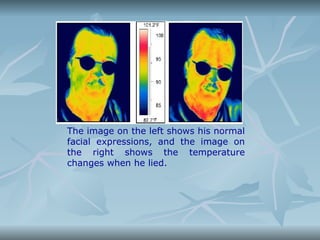
The image on the left shows his normal facial expressions, and the image on the right shows the temperature changes when he lied.
Some Images . . .  Finger print scanning Iris scanning
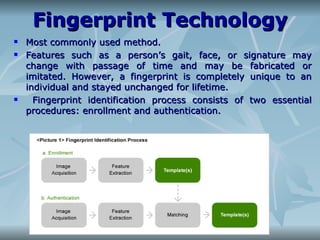
Fingerprint Technology Most commonly used method. Features such as a person’s gait, face, or signature may change with passage of time and may be fabricated or imitated. However, a fingerprint is completely unique to an individual and stayed unchanged for lifetime. Fingerprint identification process consists of two essential procedures: enrollment and authentication.
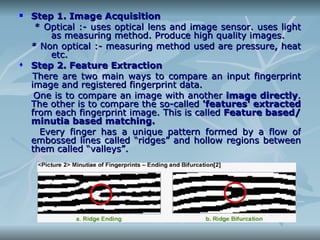
Step 1. Image Acquisition * Optical :- uses optical lens and image sensor. uses light  as measuring method. Produce high quality images. * Non optical :- measuring method used are pressure, heat  etc. Step 2. Feature Extraction There are two main ways to compare an input fingerprint image and registered fingerprint data. One is to compare an image with another  image directly . The other is to compare the so-called  'features' extracted  from each fingerprint image. This is called  Feature based/minutia based matching. Every finger has a unique pattern formed by a flow of embossed lines called “ridges” and hollow regions between them called “valleys”.
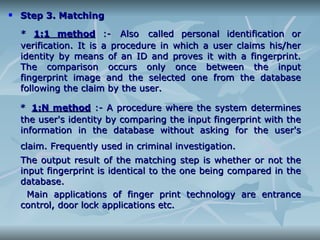
Step 3. Matching *  1:1 method  :-   Also   called personal identification or verification. It is a procedure in which a user claims his/her identity by means of an ID and proves it with a fingerprint. The comparison occurs only once between the input fingerprint image and the selected one from the database following the claim by the user. *   1:N method  :- A procedure where the system determines the user's identity by comparing the input fingerprint with the information in the database without asking for the user's claim. Frequently used in criminal investigation.   The output result of the matching step is whether or not the input fingerprint is identical to the one being compared in the database. Main applications of finger print technology are entrance control, door lock applications etc.
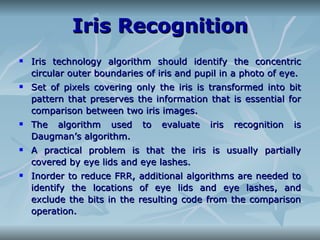
Iris Recognition Iris technology algorithm should identify the concentric circular outer boundaries of iris and pupil in a photo of eye. Set of pixels covering only the iris is transformed into bit pattern that preserves the information that is essential for comparison between two iris images. The algorithm used to evaluate iris recognition is Daugman’s algorithm. A practical problem is that the iris is usually partially covered by eye lids and eye lashes. Inorder to reduce FRR, additional algorithms are needed to identify the locations of eye lids and eye lashes, and exclude the bits in the resulting code from the comparison operation.
Advantages Biometric identification can provide extremely accurate, secured access to information; fingerprints, retinal and iris scans produce absolutely unique data sets when done properly. Current methods like password verification have many problems (people write them down, they forget them, they make up easy-to-hack passwords).  Automated biometric identification can be done very rapidly and uniformly, with a minimum of training.  Your identity can be verified without resort to documents that may be stolen, lost or altered.
Disadvantages   The finger print of those people working in Chemical industries are often affected. Therefore these companies should not use the finger print mode of authentication.  It is found that with age, the voice of a person differs. Also when the person has flu or throat infection the voice changes or if there are too much noise in the environment this method may not authenticate correctly. Therefore this method of verification is not workable all the time  For people affected with diabetes, the eyes get affected resulting in differences.   Biometrics is an expensive security solution.
Issues and concerns   Privacy   One common concern is how a person's biometric, once collected, can be protected.  Discrimination   There are concerns whether our personal information taken through biometric methods can be misused.   Danger to owners of secured items   When thieves cannot get access to secure properties, there is a chance that the thieves will stalk and assault the property owner to gain access.  Cancelable biometrics   One advantage of passwords over biometrics is that they can be re-issued. If a token or a password is lost or stolen, it can be cancelled and replaced by a newer version.
Conclusion Biometric authentication technology is used for the research field of IT industry. It is shown that more than seven thousand single possible risk effect classes can be identified using biometrics. IT security biometrics is based on person recognition methods based on sensing a person’s biological characters ,measuring them and creating templates and verifying them.   A biometric authentication is defined as a set of hardware components, processes ,algorithms fulfilling internalor external communication between elements for the purpose of biometric authentication.
THANK YOU

Biometrics

  • 1.
  • 2.
    BIOMETRICS Presented By,Aleena P.S. S2 MCA
  • 3.
    Introduction Biometrics isthe study of methods for uniquely recognizing humans based on some physical and behavioral traits. Biometric characteristics can be divided in two main classes: Physiological are related to the shape of the body. Examples include, but are not limited to fingerprint, face recognition, DNA, hand and palm geometry, iris recognition, which has largely replaced retina, and odor/scent. Behavioral are related to the behavior of a person. Examples include, but are not limited to typing rhythm, gait, and voice .
  • 4.
    Fields of biometricsFingerprint - from a print made by an impression of ridges in the skin of a finger. Face recognition – scanning a persons face and matching it with a library of known faces. Iris scanning- scanning the iris. The structure of iris is distinct. Signature recognition – scanning a person’s signature and matching it with known signatures. Voice recognition – identification by electronically recognizing and graphically representing a person’s voice.
  • 5.
    Operation and performanceFirst the physical and behavioral characteristics are obtained from a person. This information is then passed to the database by creating a digital representation or template. In order to use the system ,the biometrics of the person is captured again and processed to create a digital templates. Then the templates now generated and those in the database are compared. If a match occurs then system will allow the user to log in. Otherwise it will never allow the user to login. This enables authentication. performance is mainly measured in terms of FAR- false accept rate FRR- false reject rate.
  • 6.
    FAR measures thepercentage of invalid users that is incorrectly accepted as genuine users. FRR measures percentage of valid users who are rejected as imposters. One of the most common measures of real world biometric system is the rate at which both accept and reject rate are equal ie, the equal error rate (ERR) or cross over error rate (CER). The lower the ERR or CER ,the more accurate the system is considered to be.
  • 7.
    Facial recognition During1964 and 1965 ,Woody Bledsoe, Helen Chan Wolf and Charles Bisson introduced this technology. Face recognition works by using a computer to analyze a subject's facial structure. Face recognition software takes a number of points and measurements, including the distances between key characteristics such as eyes, nose and mouth, angles of key features such as the jaw and forehead, and lengths of various portions of the face. Using all of this information, the program creates a unique template incorporating all of the numerical data. This template may then be compared to enormous databases of facial images to identify the subject. Good biometric software then produces a number of potential matches, rating each based on a numeric score of how similar the match is.
  • 8.
    The image onthe left shows his normal facial expressions, and the image on the right shows the temperature changes when he lied.
  • 9.
    Some Images .. . Finger print scanning Iris scanning
  • 10.
    Fingerprint Technology Mostcommonly used method. Features such as a person’s gait, face, or signature may change with passage of time and may be fabricated or imitated. However, a fingerprint is completely unique to an individual and stayed unchanged for lifetime. Fingerprint identification process consists of two essential procedures: enrollment and authentication.
  • 11.
    Step 1. ImageAcquisition * Optical :- uses optical lens and image sensor. uses light as measuring method. Produce high quality images. * Non optical :- measuring method used are pressure, heat etc. Step 2. Feature Extraction There are two main ways to compare an input fingerprint image and registered fingerprint data. One is to compare an image with another image directly . The other is to compare the so-called 'features' extracted from each fingerprint image. This is called Feature based/minutia based matching. Every finger has a unique pattern formed by a flow of embossed lines called “ridges” and hollow regions between them called “valleys”.
  • 12.
    Step 3. Matching* 1:1 method :- Also called personal identification or verification. It is a procedure in which a user claims his/her identity by means of an ID and proves it with a fingerprint. The comparison occurs only once between the input fingerprint image and the selected one from the database following the claim by the user. * 1:N method :- A procedure where the system determines the user's identity by comparing the input fingerprint with the information in the database without asking for the user's claim. Frequently used in criminal investigation. The output result of the matching step is whether or not the input fingerprint is identical to the one being compared in the database. Main applications of finger print technology are entrance control, door lock applications etc.
  • 13.
    Iris Recognition Iristechnology algorithm should identify the concentric circular outer boundaries of iris and pupil in a photo of eye. Set of pixels covering only the iris is transformed into bit pattern that preserves the information that is essential for comparison between two iris images. The algorithm used to evaluate iris recognition is Daugman’s algorithm. A practical problem is that the iris is usually partially covered by eye lids and eye lashes. Inorder to reduce FRR, additional algorithms are needed to identify the locations of eye lids and eye lashes, and exclude the bits in the resulting code from the comparison operation.
  • 14.
    Advantages Biometric identificationcan provide extremely accurate, secured access to information; fingerprints, retinal and iris scans produce absolutely unique data sets when done properly. Current methods like password verification have many problems (people write them down, they forget them, they make up easy-to-hack passwords). Automated biometric identification can be done very rapidly and uniformly, with a minimum of training. Your identity can be verified without resort to documents that may be stolen, lost or altered.
  • 15.
    Disadvantages The finger print of those people working in Chemical industries are often affected. Therefore these companies should not use the finger print mode of authentication. It is found that with age, the voice of a person differs. Also when the person has flu or throat infection the voice changes or if there are too much noise in the environment this method may not authenticate correctly. Therefore this method of verification is not workable all the time For people affected with diabetes, the eyes get affected resulting in differences.  Biometrics is an expensive security solution.
  • 16.
    Issues and concerns Privacy One common concern is how a person's biometric, once collected, can be protected. Discrimination There are concerns whether our personal information taken through biometric methods can be misused. Danger to owners of secured items When thieves cannot get access to secure properties, there is a chance that the thieves will stalk and assault the property owner to gain access. Cancelable biometrics One advantage of passwords over biometrics is that they can be re-issued. If a token or a password is lost or stolen, it can be cancelled and replaced by a newer version.
  • 17.
    Conclusion Biometric authenticationtechnology is used for the research field of IT industry. It is shown that more than seven thousand single possible risk effect classes can be identified using biometrics. IT security biometrics is based on person recognition methods based on sensing a person’s biological characters ,measuring them and creating templates and verifying them. A biometric authentication is defined as a set of hardware components, processes ,algorithms fulfilling internalor external communication between elements for the purpose of biometric authentication.
  • 18.