Review Article
• Application of earth science to legal matters1
• A forensic geologist identifies, analyzes, and
compares earth materials, such as soil, rocks,
minerals, and fossils found on or in a receptor
to possible source areas.2
• Assisting the police to search for homicide
graves1
Geological trace evidence includes2 :-
• Rock fragments
• Soil and sediments
• Geological raw materials like bricks, concrete,
glass, plaster board.
• Microfossils
• Etc.
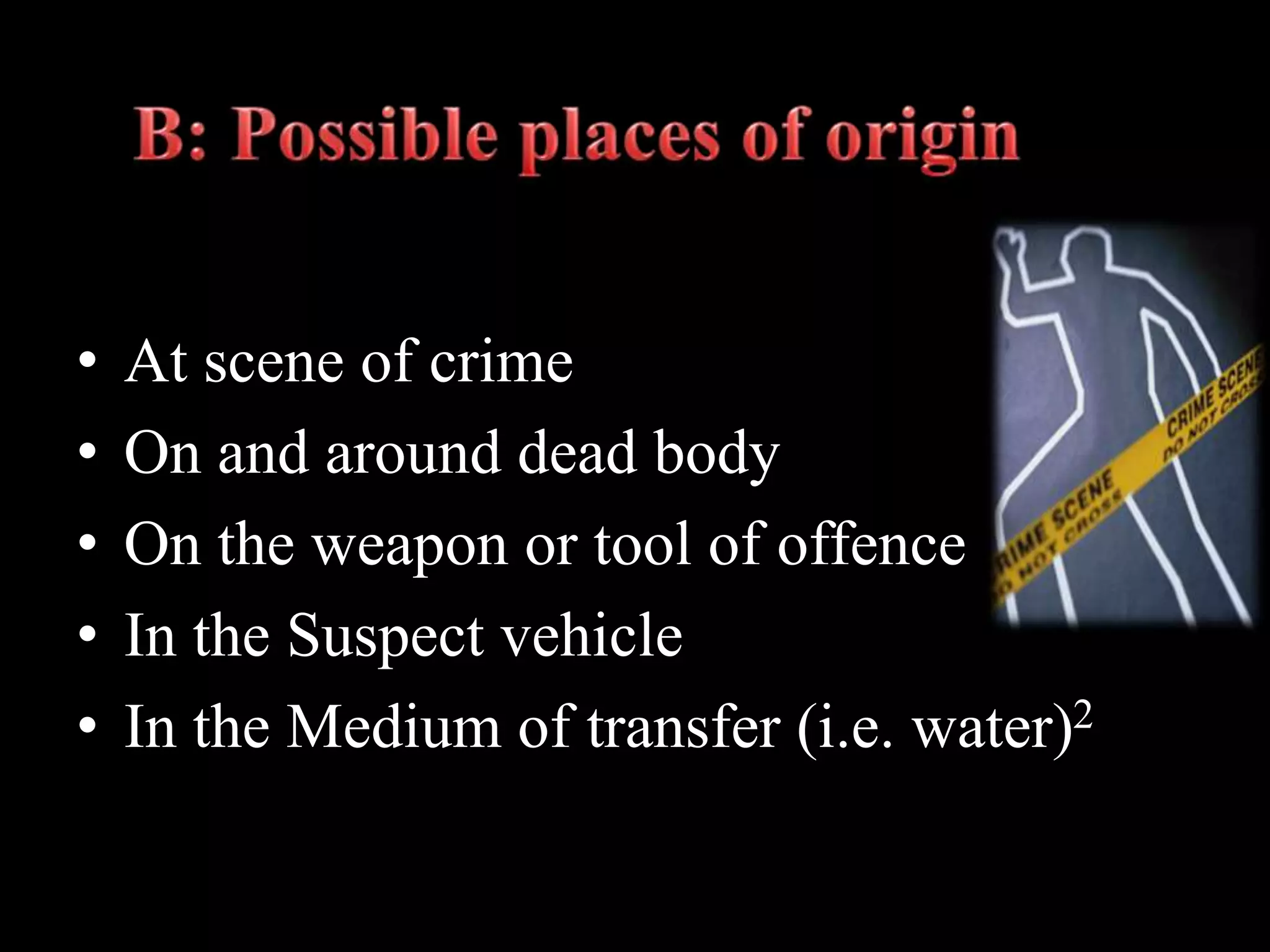
• At scene of crime
• On and around dead body
• On the weapon or tool of offence
• In the Suspect vehicle
• In the Medium of transfer (i.e. water)2
Geological evidences is based on the principle that
when two objects make contact, there is transfer of
materials from one object to other object. This is
famously called as the Locard’s principle of
exchange,given by Dr.Edmund Locard in 1929.1
• Present on almost all crime scenes.
• Being minute, they are unnoticed by culprit and
remain undestroyed, undisturbed and unmutilated.
• Helps to determine corpus delicti.
• Helps to link suspect with scene of crime.
• Can indicate the profession of suspect or victim.
• Helps to reconstruct the sequence of events and the
modus operandi.3
Purpose is to
• Obtain evidence for prosecution
• Gain intelligence
• Deprive criminals of their resources and opportunities
• Locate vulnerable persons
• Protect potential target
• Search for homicide grave and associated buried
items or objects1
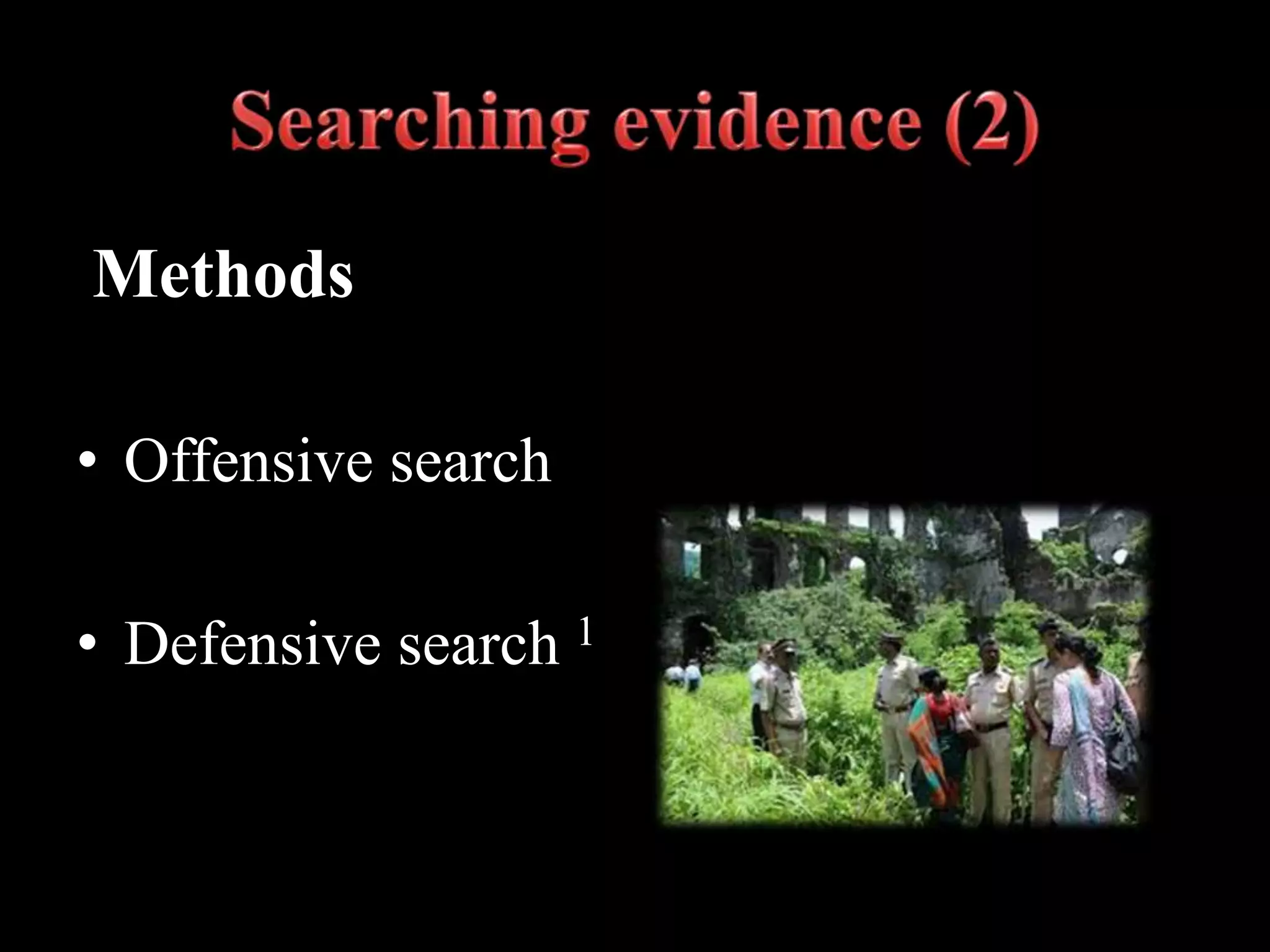
Methods
• Offensive search
• Defensive search 1
Factors influencing search
• Weather conditions
• Type of terrain
• Press and media interferences
• The public and communities
• The victim’s family members and friends
• Search area1
• Geomorphological mapping
• Remote sensing,
• Analysis of high resolution air photographs,
• Geophysics,
• Hydrochemistry & geochemistry,
• Police dogs, often known as ‘cadaver dogs’, ‘victim
recovery dogs (VRD), or ‘human remains dogs’
(HRD) 1
• Photography :- All evidences should be
photographed before attempting any other
method.
• Hand-picking :- The macro-evidences are picked
using forceps and packed in airtight plastic bags.
• Tape lifting :- The evidences are lifted using
tape.
• Scraping :- Evidences like wet mud are scraped
using a sharp tool and collected.
• Casting :- Three dimensional impression of
barefoot and footwear are created using casting
techniques. 3
• Comparison & Superimposition
• Microscopy
• Micro-chemical analysis
• X-ray spectroscopy
• IR-Microspectrophotometry3
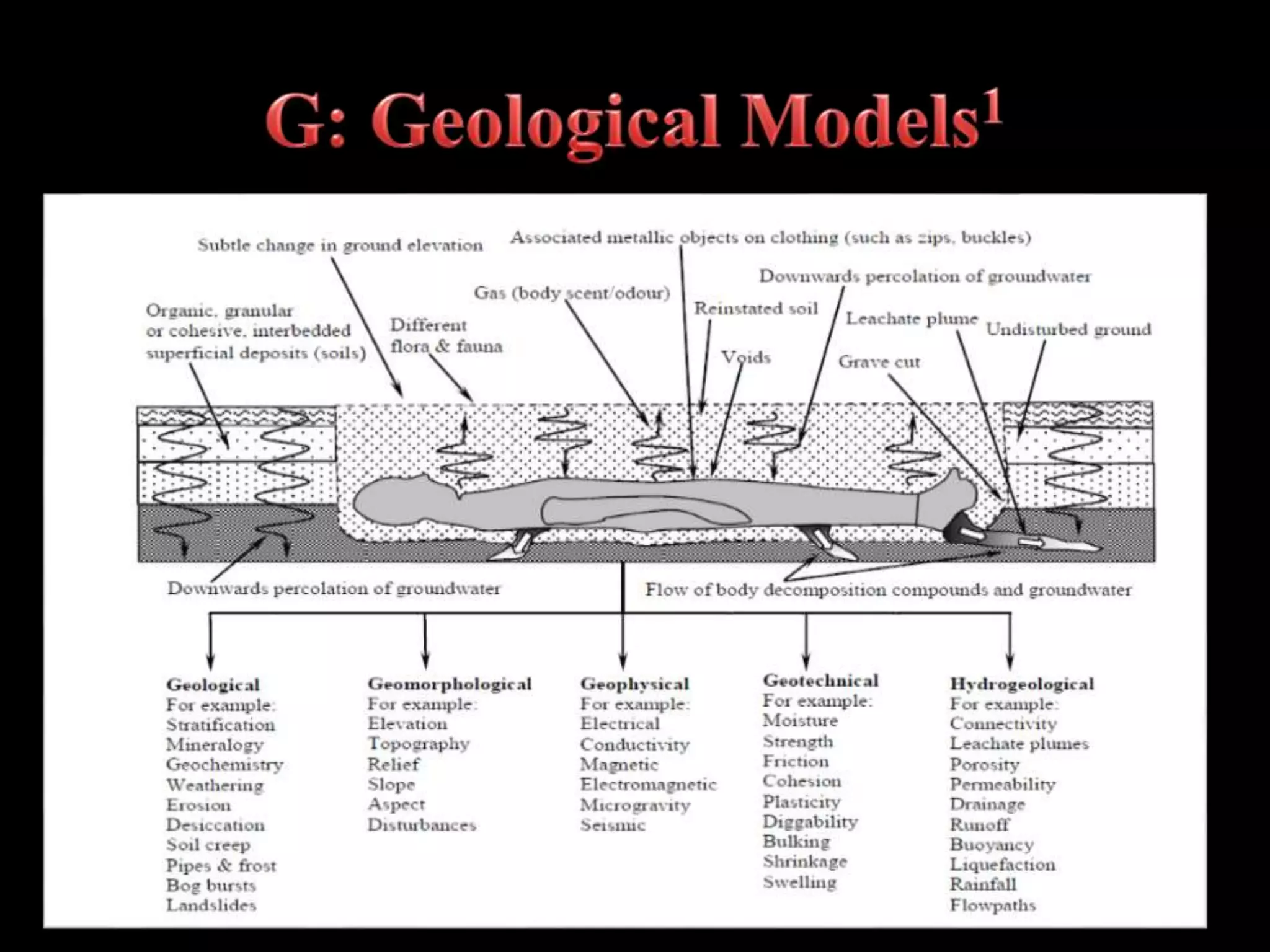
(a)Information on the
Geology
Soil characteristics
Groundwater
Rock types
(b) Demonstrate the level of
Difficulty or ease to dig shallow grave
Time required
Depth which can be achieved
(c) Demonstrate how effectively
Soil can be reinstated
Visible topographical features
Possible presence of the grave
(d) Provide a prediction for
Length of time for offender to dispose
of the body. 1
1. Under-fender dirt/soil deposited on the road
At impact area with the victim
For locating car/driver
2. Matching grease on victim with
Grease under the car
To support evidence 2
I. Hit & Run cases:
II. Murder:
Geological evidences
Determine primary crime scene
Action of any medium like water
For movement of dead body
Clandestine graves
Weapon of offense 2
III. Rape:
Soil on clothing of a suspected rapist
To place the suspect at the crime scene
To eliminate the suspect's alibi 2
IV. Environmental Evidence:
1. Groundwater Contamination
2. Surface Water Impacts
3. Wetlands
4. Land subsidence2
V. Subsurface Investigations:
1. Locate buried objects
2. Mineral Resources
VI. Insurance Claims - Accidents /
Personal Injury:
1. Vehicle Accident
2. Excavation/Trench Collapse
3. Subsurface Explosion2
VII. Insurance Claims - Property
Damage:
1. Vandalism
2. Flood Damage
3. Chemical Exposure
VIII. Case Settlement:
1. Dispute2
• Basics of geoforensics and their applications like
evidences, principle, searching, methods, analysis
etc.
• They have varied applications for outdoor crimes.
• Due to lack of information and training, geo-
forensic evidences are often not used
• Let us hope that the future world will recognize
its importance and use it extensively
1. Dr. Laurence J. Donnelly, The role of geo-
forensics in policing and law enforcement,
www2.le.ac.uk/departments/.../Emergency%20Globa
l%20FINAL.pdf
2. Robert A. Hayes, CPG, Forensic Geologists
Uncover Evidence In Soil And Water,
http://www.geoforensics.com/geoforensics/fgeology.
html
3. Dr. B.P. Maithil, Physical investigation in criminal
investigation and Trials

Geoforensic

  • 1.
  • 2.
    • Application ofearth science to legal matters1 • A forensic geologist identifies, analyzes, and compares earth materials, such as soil, rocks, minerals, and fossils found on or in a receptor to possible source areas.2 • Assisting the police to search for homicide graves1
  • 4.
    Geological trace evidenceincludes2 :- • Rock fragments • Soil and sediments • Geological raw materials like bricks, concrete, glass, plaster board. • Microfossils • Etc.
  • 5.
    • At sceneof crime • On and around dead body • On the weapon or tool of offence • In the Suspect vehicle • In the Medium of transfer (i.e. water)2
  • 6.
    Geological evidences isbased on the principle that when two objects make contact, there is transfer of materials from one object to other object. This is famously called as the Locard’s principle of exchange,given by Dr.Edmund Locard in 1929.1
  • 7.
    • Present onalmost all crime scenes. • Being minute, they are unnoticed by culprit and remain undestroyed, undisturbed and unmutilated. • Helps to determine corpus delicti. • Helps to link suspect with scene of crime. • Can indicate the profession of suspect or victim. • Helps to reconstruct the sequence of events and the modus operandi.3
  • 8.
    Purpose is to •Obtain evidence for prosecution • Gain intelligence • Deprive criminals of their resources and opportunities • Locate vulnerable persons • Protect potential target • Search for homicide grave and associated buried items or objects1
  • 9.
  • 10.
    Factors influencing search •Weather conditions • Type of terrain • Press and media interferences • The public and communities • The victim’s family members and friends • Search area1
  • 11.
    • Geomorphological mapping •Remote sensing, • Analysis of high resolution air photographs, • Geophysics, • Hydrochemistry & geochemistry, • Police dogs, often known as ‘cadaver dogs’, ‘victim recovery dogs (VRD), or ‘human remains dogs’ (HRD) 1
  • 13.
    • Photography :-All evidences should be photographed before attempting any other method. • Hand-picking :- The macro-evidences are picked using forceps and packed in airtight plastic bags. • Tape lifting :- The evidences are lifted using tape. • Scraping :- Evidences like wet mud are scraped using a sharp tool and collected. • Casting :- Three dimensional impression of barefoot and footwear are created using casting techniques. 3
  • 14.
    • Comparison &Superimposition • Microscopy • Micro-chemical analysis • X-ray spectroscopy • IR-Microspectrophotometry3
  • 15.
    (a)Information on the Geology Soilcharacteristics Groundwater Rock types (b) Demonstrate the level of Difficulty or ease to dig shallow grave Time required Depth which can be achieved
  • 16.
    (c) Demonstrate howeffectively Soil can be reinstated Visible topographical features Possible presence of the grave (d) Provide a prediction for Length of time for offender to dispose of the body. 1
  • 17.
    1. Under-fender dirt/soildeposited on the road At impact area with the victim For locating car/driver 2. Matching grease on victim with Grease under the car To support evidence 2 I. Hit & Run cases:
  • 18.
    II. Murder: Geological evidences Determineprimary crime scene Action of any medium like water For movement of dead body Clandestine graves Weapon of offense 2
  • 19.
    III. Rape: Soil onclothing of a suspected rapist To place the suspect at the crime scene To eliminate the suspect's alibi 2
  • 20.
    IV. Environmental Evidence: 1.Groundwater Contamination 2. Surface Water Impacts 3. Wetlands 4. Land subsidence2
  • 21.
    V. Subsurface Investigations: 1.Locate buried objects 2. Mineral Resources VI. Insurance Claims - Accidents / Personal Injury: 1. Vehicle Accident 2. Excavation/Trench Collapse 3. Subsurface Explosion2
  • 22.
    VII. Insurance Claims- Property Damage: 1. Vandalism 2. Flood Damage 3. Chemical Exposure VIII. Case Settlement: 1. Dispute2
  • 23.
    • Basics ofgeoforensics and their applications like evidences, principle, searching, methods, analysis etc. • They have varied applications for outdoor crimes. • Due to lack of information and training, geo- forensic evidences are often not used • Let us hope that the future world will recognize its importance and use it extensively
  • 24.
    1. Dr. LaurenceJ. Donnelly, The role of geo- forensics in policing and law enforcement, www2.le.ac.uk/departments/.../Emergency%20Globa l%20FINAL.pdf 2. Robert A. Hayes, CPG, Forensic Geologists Uncover Evidence In Soil And Water, http://www.geoforensics.com/geoforensics/fgeology. html 3. Dr. B.P. Maithil, Physical investigation in criminal investigation and Trials