LIPIDS: STRUCTURE &FUNCTION
Heterogenoushydrophobic group of organic molecules
made of C,H,O
No general formula- no common functional group
physical and not structurally characterised
Greasy or oily
dissolve easily in organic solvents, solubility varies
Hydrophobic – “water-fearing” & lipophilic – “fat-
loving”
Fats - solid at room temperature.
Oils - liquid at room temperature
2.
FUNCTIONS OF LIPIDS
1.Energy storage
2. Cell membrane structure
1. Cushion- serve as blanket for
Thermal insulation against cold
Absorbing shocks.
desiccation (drying out).
Electric insulation to allow rapid propagation of depolarization wave
long myelinated nerves.
3. Precursors of hormones (steroids and prostaglandins)
4. Carriers of essential components in the body eg
lipoproteins & the glycoproteins.
5. Hormone synthesis-sex hormones synthesised from .
cholesterol
3.
FUNCTIONS OF LIPIDS
Involvedin the activation of some enzymes
Precursors of
Vitamins- fatty soluble vitamins eg Vit D
hormones- steroid hormones, contraceptives
Mechanical protection to many organisms
Adjust buoyancy in marine animals.
Precursors for detergents in industry
Makes food tastier and palatable
Lipophilic bile acids aid in lipid solubilisation
4.
FATTY ACIDS
Key buildingblocks / manomeric units of lipids
Determine the characteristics of the fat
Serve the following major roles in the body
1. Components of complex membrane lipids-phospholipids
& glycolipids
2. Major components of triacylglycerols- (stored fat)
3. Target proteins to membranes
4. High energy source of fuel
5. F.a derivatives are used as hormones & intracellular
messengers
5.
STRUCTURE FATTY ACIDS
Linearchains of long hydrocarbon chain (12-36 C)
Long chain monocarboxylic acids– one end has
a hydrophilic carboxyl group ( -COOH)
a hydrocarbon tail (CH3) (fat)
6.
STRUCTURE FATTY ACIDS
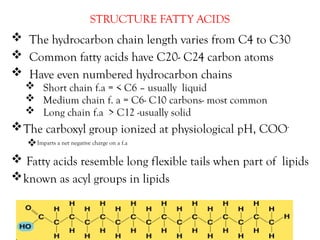
The hydrocarbon chain length varies from C4 to C30
Common fatty acids have C20- C24 carbon atoms
Have even numbered hydrocarbon chains
Short chain f.a = < C6 – usually liquid
Medium chain f. a = C6- C10 carbons- most common
Long chain f.a > C12 -usually solid
The carboxyl group ionized at physiological pH, COO-
Imparts a net negative charge on a f.a
Fatty acids resemble long flexible tails when part of lipids
known as acyl groups in lipids
7.
TYPES OF FATTYACIDS:
Fatty acids exists as
“free fatty acids ” or
combined-attached to another compound
Saturated fatty acids – have C-C single bonds
Unsaturated fatty acids – have atleast a C-C db
The degree of unsaturation varies
Monounsaturated- one db
Polyunsaturated – more than one db
Saturated & Unsaturated f.a
8.
Saturated fatty acids
Exhibitmaximum number of hydrogen atoms possible
No double bonds but single C-C bonds in hydrocarbon tails
solid at room temp
most found in animal fats
• .
TYPES OF FATTY ACIDS
8
(a) Saturated fat and fatty acid
Stearic acid
9.
Unsaturated fatty acids
oneor more C=C bonds in their structure.
Vary in the length and number and locations of d.b
D. b cause “kinks” in the hydophobic tails molecule’s shape.
I.e d-b pushes the molecules apart, lowering the density, mp
liquid at room temp
most plant fats
9
(b) Unsaturated fat and fatty acid
cis double bond
causes bending
Oleic acid
TYPES OF FATTYACIDS:
Saturated f.a < C8 atoms are liquid at room temp
Long chain f.a > C10 are solids at room temp
Long-chain saturated f.a stack tightly and form solids
at room temp
Unsaturated f.a have two types of db
Cis d.b:- H on the carbons joined by a d.b are on the
same side
the carbon chain is bent
Trans d.b:- H on the carbons joined by a d.b are on
the opposite side
the carbon chain is straighter
the "kink" orbend, in the Hydrocarbon –
chains unsaturated fats prevents close packing of
f.a
makes the fatty acid stay fluid at r.t
kinks in the structure make cell membranes
flexible & permeable
Some mono-unsaturated fats, eg olive oil will
solidify when refrigerated due less number of
unsaturations .
Poly-unsaturated fats, stay fluid even when
refrigerated due to many kinks in their
structures.
kinks in the structure make cell membranes
flexible & permeable and nutrients to enter the
cell and waste products to leave.
TYPES OF FATTY ACIDS:
14.
UNSATURATED FATTY ACIDS
Monounsaturated-a single d.b
polyunsaturated- more than one d.b
Unsaturated have f.a have cis rather than trans d.b
The presence of d.bs in f.a lowers the mp of F.a
diverse f.a due to chain length & degree of saturation.
Fatty acids with Cis d.b
forms a rigid kink/bend in the f.a carbon chain
prevents close packing hence f.a don’t stack compactly
Intermolcecular forces are less effective leading to low
b.p and m.p
Most are liquid at room temp
Nomenclature of fattyacids
1. Trivial
2. Conventional numbering
Carbon atoms -numbered from the carboxylate group
carboxylate group taking position 1
Each C atom is designated with numerical number
Carboxy group is C1, then C2, C3, C4 C5…….etc
β α O
H3C - (CH2)n - C – C – C - OH
3 2 1
20.
Nomenclature of fattyacids
1. Greek lettering system
C2 & C3 from the carboxyl end referred to as α- and β-
carbon atoms respectively
Similarly , there are gama, delta, theta carbon atoms etc
Distal (methyl) carbon – the omega carbon
• 3 2 1
21.
Nomenclature of fattyacids
Omega fatty acids:
C-atoms counted from the methyl C end of a f.a (omega)
α–carbon- C2 from the carboxyl end
ω - carbon- distal carbon atom
Position of db from the omega carbon indicates the
type of omega f.a
ω – 3 Fatty Acid – double bond at carbon 3
ω - 6 Fatty Acid – double bond at carbon 6
ω - 9 Fatty Acid – double bond at carbon 9
Abreviated as
18:0, 18:1, etc.
Nomenclature of Fattyacids
Systemic ( IUPAC)
Name derived from name of parent hydrocarbon (alkane)
Substitution of a final e with oic acid
Eg octadecanoic acid -C18 saturated f.a -parent octadecane
Unsaturated f.a with d.bs ends with enoic acid – eg
octadecadienoic acid, octadecatrienoic acids – 3 d.b etc
24.
Fatty acid Nomenclature
Numericdesignations of d.b come from the numeric number
of carbon - followed by the number of sites of unsaturation
E.g, palmitic acid, a saturated C16-carbon f.a with is
designated as16:0).
Unsaturation site indicated by the symbol ∆ and the
superscript number of the first carbon of the d.b
e.g. palmitoleic acid a C-16 f.a with one site of unsaturation
between carbons 9 and 10, and is designated by 16:1 ∆9
).
20: 0 C20 saturated fatty acid
20: 2 ∆9, 12
a C20 unsaturated f.a with 2db, between C9
&C10 & C12& C13
Hence Cis 20: 1 ∆9 cis
db between C9 and C10
Trans 20: 1 ∆9
trans db between C9 and C10
Numerical Symbol CommonName Structure Comments
14:0 Myristic acid CH3(CH2)12COOH
Often found attached to the
N-term. of plasma membrane-
associated cytoplasmic
proteins
16:0 Palmitic acid CH3(CH2)14COOH
End product of mammalian
fatty acid synthesis
16:1 9
Palmitoleic acid
CH3(CH2)5C=C(CH2)7CO
OH
18:0 Stearic acid CH3(CH2)16COOH
18:1 9
Oleic acid
CH3(CH2)7C=C(CH2)7CO
OH
18:2 9,12
Linoleic acid
CH3(CH2)4C=CCH2C=C(
CH2)7COOH
Essential fatty acid
18:3 9,12,15
Linolenic acid
CH3CH2C=CCH2C=CCH
2C=C(CH2)7COOH
Essential fatty acid
20:4 5,8,11,14
Arachidonic acid
CH3(CH2)3(CH2C=C)4(CH Precursor for eicosanoid
Physiologically Relevant Fatty Acids
27.
Essential and NonessentialFatty Acids
Non essential:
Easily synthesized by the body
not a requisite component of the diet
Essential Fatty Acids
required for normal body function
Cannot be synthesized by the body
Derived mainly from exogenous ( dietary ) sources
Essentially f.a with C= C before 9th
carbon– omega-3 & Omega-6
Humans cannot make C-C d.b before the 9th
carbon from omega C)
Examples of essential fatty acids
Omega-3:
Alpha-Linolenic Acid (ALA),
Eicosapentaenoic Acid (EPA),
Docosahexaenoic Acid (DHA)
Omega-6 fatty acids
linoleic acid
alpha-linolenic acid
Arachidonic Acid
28.
Sources of OmegaFatty Acids
Omega-3 Fatty Acids
soybean oil,
walnuts,
some leafy dark green vegetables
Fatty fish: salmon, tuna, and mackerel,
fish oils (EPA and DHA)
Omega-6 Fatty Acids
Seeds
Nuts
common vegetable oils
Corn
safflower
cottonseed
sunflower seed
peanut (linoleic acid)
Meat (arachidonic acid)
30.
FATTY ACIDS
EICOSANOIDS
• Asmall % of fatty acids become eicosanoids
• Eicosanoids consists of 20 or more carbons
• Important in the
– inflammatory process
– blood vessel dilation and constriction
– blood clotting
Omega-6s
• Linoleic acid is converted to arachidonic acid
• Involved in constricting blood vessels, promoting inflammation and
blood clotting
Omega-3s
• Alpha-linolenic acid is converted to eicosapentanoic acid (EPA) and
docosahexanoic acid (DHA)
• Involved in the dilation of blood vessels, discouraging blood
clotting, and reducing inflammation
31.
Classification of lipids
Classificationbased on
Solubility
– Water soluble ( polar) Vs fat soluble (nonpolar)
Water soluble –lipids
Short chain f.a
ethanoate, pronanoate, & butanoate
ketone bodies,
acetoacetate - hydroxybutryate & acetone
β
appreciable water solubility
Solubility decreases progressively as the hydrocarbon chain
increases.
31
32.
Classification of lipids
Chemicalreactions
Saponifiable Vs nonsaponifiable lipids
Saponification –hydrolysis of lipids
Can be catalysed by bases eg NaOH, acid (HCl) or enzyme.
Saponifiable lipids contain ester group -undergo hydrolysis
cleaves a saponifiable lipid into two or more smaller molecules.
Saponifiable lipids are not derivatives of long chain fatty acids, and
are more soluble in organic solvents than in water.
Non-saponifiable lipids do not undergo hydrolytic cleavage into
smaller molecules in presence of acids or bases.
Common examples of nonsaponifiable lipids include, sterols,
terpenes, leukotrienes and prostaglandins
33.
Saponification
Soaps and detergentsare manu by saponification
Base saponification of TG yields salts of carboxylic acids
and glycerol.
The carboxylate salts formed have considerable high water
solubility.
important in biological systems since the body must
solubilise cpds with COOH group.
drugs are usually administered in the form of carboxylate
salt instead of the carboxylate acid to achieve faster
absorption into the body.
salts of carboxylic acids are known as soaps.
used to remove off greasy dirt from surfaces from
machinery clothing floors and other surfaces. 33
Classification of lipids
Chemicalcompositions
Simple lipids –
F.a or esters of f.a with alcohol groups
Complex –compound-
esters of f.a with alcohol and other groups
Derived lipids-
Derivatives of simple or complex lipids
35
36.
Classification of lipids:Simple lipids
Include :
fatty acids
Fatty acid esters (acylglycerols)
Waxes
Occur in plants and animals(adipose tissue) .
Fatty acid esters
Known as acylglycerols or neutral fats.
Esters of f.a with alcohol groups
Commonly occurring ester of f.a with glycerol
acyl group-esterified fatty acid
36
37.
Classification of lipids:Simple lipids
Three types of acylglcerols.
Monoacylglcerols (Monoglycerides)
consist of one acyl group esterified to a glycerol backbone.
one fatty acid +glycerol
Diacyglyerols (Diglycerides)
two fatty acids (acyl groups) esterified to a glycerol
two fatty acids +glycerol
Triacylglycerols
three fatty acids attached to a glycerol backbone
TAGs are the common lipids in the body, MAG and DAG
are derived from the hdrolysis of TAGs
38.
38
Monoacylglcerols
consist of anacyl
group esterified to
a glycerol
backbone.
Diacyglyerols
(diglycerides)
Consist of two acyl
groups esterified to
twohydroxyl
groupsof a glycerol
backbone.
Triacylglycerols
Triacylglycerols
consist of three
acyl groups
esterified to the
three hydroxyl
groups of glycerol
backbone.
Triacylglycerols
3 ester linkagesare formed between a hydroxyl group of
the glycerol and a carboxyl group of the fatty acid.
TAGs are the most common in the body
MAG and DAG are intestinal hydrolytic products of TAG
Simple TAG has similar acyl (R) groups
Mixed TAG have different acyl (R) groups
differ in fatty acids composition
Used for energy storage,
Cushions for organs,
Insulation.
Provide more energy per mass.
43.
Triacylglycerols
Stored in theadipose tissue
Colourless but becomes coloured on a mixture with other
substances
MAG and DAG form micelles unlike TAG
Micelles are structures –
polar head groups point to the polar surface –
hydrocarbon tails sequestered inside
MAG and DAG have both polar and nonpolar groups
Polar groups interacts with sorrounding aqueous phase
TAG is only hydrophobic and hydrophobic prefers
interaction with each other
44.
Triacylglycerols
FUNCTIONS
Major lipid inthe body and diet
Stored fat provides about 60% of the body’s resting
energy needs – compactly!
Insulation and protection
Carrier of fat-soluble compounds
Sensory qualities – flavor and texture
45.
Waxes
Esters of madeof long chain monohydric alcohols& long chain f.a
unbranched with even carbon numbers
Chain length varies from C16 to C36
mixtures of esters although some are ketones.
Examples - triacontaylhexadecanoate
Function
serve as form natural coatings on fruits, leaves, furs, feathers and
skin.
Offer protective functions against physical damage
water repellence functions.
Natural waxes used commercially in polishers, cosmetics and
ointments.
46.
Reactions of fattyacid esters
• Undergo most reactions of C=C
Hydrolysis
reverse of esterification reaction
Hydrolysed to f.a and glycerol
• Accomplished by
– Acids
– Bases
– Enzymes (lipases)
• Saponification - TAG hydrolysis by base
– Important reactions for soap formation
47.
Reactions of fattyacid esters
Reduction
Hardening /hydrogenation process
Not important in vitro
hydrogen is passed through fats under pressure
requires a suitable catalyst
(finely divided nickel/ Ramney nickel
Unsaturated oil is converted to a solid saturated fats
Process improves colour, odour and taste of oils
hydrogenated oils are used for the manufacture of
margarine
soaps
candles.
48.
Reactions of fattyacid esters
Oxidation (Rancidification)
direct attack of a lipid by molecular oxygen
frequent in vivo.
Results in the formation of peroxide s as an initial
product
Peroxides – further hydrolysed to diols
The long chain breaks to produce short chain f.a
characteristic smells in food,- rancid food.
long storage of fats in contact with air & moisture-
rancidity.
slow decomposition and develop unpleasant smell.
49.
Reactions of fattyacid esters
Rancidification process
Enzymatic hydrolysis of fats by microbial enzymes
short chain f. a with bad smell are produced
Aerial oxidation of short chain unsaturated f. a to
aldehydes
ketones with unpleasant odour.
- oxidation and decaboxylation of saturated f.a products
ketones with unpleasant flavour.
anti-oxidants eg tocopherol prevents rancidificaiton
Oxidation of polyunsaturated membranes lead to significant
decrease action and rigidity
50.
Reactions of fattyacid esters
Hydrogenolysis
Passage of excess H2 thro oil under pressure
cop per or chromium are used as catalyst,
TAG is split up into
Glycerol
higher aliphatic alcohols.
Addition
Water easily adds across a d.b of f.a in vivo
Known as hydration reaction
51.
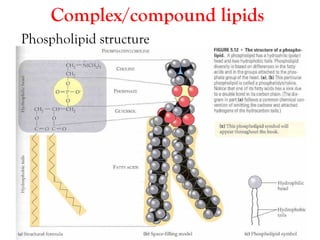
Complex/compound lipids
Esters off.a with other groups in addition to alcohol& f.a
Glycerol + 2 fatty acids + phosphate group.
Consists of a hydrophilic “head” and hydrophobic “tails”
glycerol or sphingosine are common alcohol moieties
Examples of complex lipids
Phospholipids
Glycolipids.
Phospholipids –
major class of membrane lipids.
two acyl groups on glycerol backbone
A phosphate group is on third OH
52.
Complex/compound lipids
two typesof phospholipids
based on the alcohol backbone usually
glycerol
sphingosine.
Phosphoglycerols-
also known as acylphosphoglycerols, phosphoglycerides
have a glycerol backbone
Phosphosphingolipids
have sphingosine as the alcohol backbone
53.
Glycerol based phosholipids–
have glycerol as the alcohol backbone
two acylgroups esterified on 1st
and 2nd
OH of glycerol
phosphate group esterified on the 3-OH -phosphatidate,
A phosphatidate is a precursor of other phospholipids
Specific phospholipids occur by the esterification of an
hydrophilic amino alcohol to phosphate group
Examples of amino alcohols
ethanolamine
serine
choline
inositol
PO3-2
group is hydrophilic ; fatty groups are lipophilic 53
Complex/compound lipids
CH2
O
P
O O
O
CH2
CH
CH2
O
O
C OC O
Phosphate
Glycerol
(a) Structural formula
(b) Space-filling model
Fatty acids
(c) Phospholipid
symbol
Hydrophobic
tails
Hydrophilic
head
Hydrophobic
tails
–
Hydrophilic
head
CH2
Choline
+
Figure 5.13
N(CH3)3
56.
Complex/compound lipids
Phospholipid namedby
Phosphatidyl placed before the amino alcohol
name , eg
phosphatidyl inositol
phosphatidyl serine
phosphatidylcholine,
phosphatidylethanolamine
Can be named as a derivative if acyl group is known, eg
1, 2 dipalmitoylglycerolphosphatidyl choline
57.
PC:/ Lecithins.
neutralat physiological pH.
palmitic or stearic acidprimarily at C 1
C2- oleic, linoleic or linolenic acid
dipalmitoyllecithin is a component of lung or
pulmonary surfactant.
PC -(80%) lines the pulmonary alveoli.
PC : Liver, egg yolk, soybeans, peanuts, legumes,
spinach, and wheat germ
Usually lost during food processing
PE: Cephalins
neutral zwitterions at physiological pH.
C1- primarily palmitic or stearic acid
C2- long chain unsaturated fatty acid (e.g.
18:2, 20:4 and 22:6) on carbon 2.
Phosphatidylcholine (PC)
Phosphatidylethanolamine (PE)
Complex/compound lipids
58.
Complex/compound lipids
PS:
net-ve 1 charge at physiological pH
C1- primarily palmitic or stearic acid
C2- long chain unsaturated fatty acid (e.g. 18:2, 20:4 and 22:6) on carbon 2.
PI:
C I stearic acid & C2-arachidonic acid exclusively
composed of non-phosphorylated inositol
exhibit a net -ve charge at physiological pH.
exist in membranes as polyphosphoinositides- phosphorylated inositol.
polyphosphoinositides are
intracellular transducers of signals emanating from the plasma membrane.
Phosphatidylserine (PS)
Phosphatidylinositol (PI)
59.
Complex/compound lipids
Diphosphatidylglycerol (DPG)
Phosphatidylglycerol(PG)
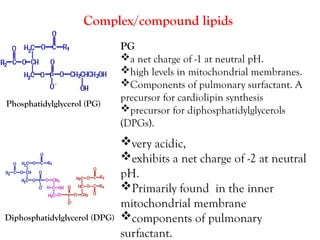
PG
a net charge of -1 at neutral pH.
high levels in mitochondrial membranes.
Components of pulmonary surfactant. A
precursor for cardiolipin synthesis
precursor for diphosphatidylglycerols
(DPGs).
very acidic,
exhibits a net charge of -2 at neutral
pH.
Primarily found in the inner
mitochondrial membrane
components of pulmonary
surfactant.
60.
Phosphatidylcholine (PC) lecithin–
contain glycerol and fatty acids and
choline esterified to a phosphate
Phosphatidylethanolamine
(cephalins)
They occur in tissue in association
lecithin
Phosphatidylserine (PS)
.
Phosphatidyl inositol (lipositol) acts
as a second massager in a Ca2+
.
Dependent hormone action they are
more acidic than other
phospholipids
Phosphatidylglycerol (PG)
60
61.
Functions of Phospholipids
Structureof the cell membranes
Main structural component of
membranes, arranged in bilayers.
Self-assembles into micelles or bilayers, an
important part of cell membranes
Fatty acids, choline, etc are bound in the
phospholipid bilayer layer
participate in the lipoprotein comp
Lipoproteins -matrix of cell walls
&membranes,the myelin sheath,
mitochondria and microsomes.
impart physical characteristics – selective
permeability towards certain non polar
(hydrophobic) molecules.
Protein Channel
Hydrophilic
Hydrophilic
Hydrophilic
62.
Functions of Phospholipids
lipidabsorption in the intestine –
– lecithin involved emulsificaiton of lipids by lowering the
surface tension of water and f. a. / water mix.
prerequisite in digestion and adsorption of lipids from G1
tract.
Lipid Transport
Carry lipid-insoluble cpds from stomach/ intestine to
bloodstream, and the lymphatic system
Endogenous TG carried from liver to various tissue
chylomicrons, lipoprotein complexes etc
PL is required for the formation of the lipoprotein complex.
transportation of lipids from liver to various tissues.
63.
• Chylomicrons (fromthe Greek chylo,
meaning juice or milky fluid, and micron, meaning small
particle) arelipoprotein particles that consist of
triglycerides (85–92%), phospholipids (6–12%),
cholesterol (1–3%), andproteins (1–2%).[1]
They
transport dietary lipids from the intestines to other
locations in the body. Chylomicrons are one of the five
major groups of lipoproteins (chylomicrons, VLDL, IDL,
LDL, HDL) that enable fats andcholesterol to move
within the water-based solution of the bloodstream.
Functions of phospholipids
Emulsifiers
idealemulsifiers, due to their structure
Lecithins are used by the food industry to:
• Combine foods that wouldn’t normally mix
• Increase dispersion and reduce fat separation
• Increase shelf-life, prolong flavor release,
• prevent such products as gum from sticking to teeth
A typical diet contains only about 2 grams per day
Even though lecithinis largely composed
of the B vitamin choline, it also contains
linoleic acid and inositol. It has been
nicknamed "nature's emulsifier" because
of its detergent-like effect on fat, keeping
it suspended in the bloodstream and
preventing it from settling on membrane
walls. Lecithin acts as a solvent for
cholesterol, triglycerides, and other fats.
68.
Functions of phospholipids
•Role in enzyme action
– Certain enzyme require tightly bound
phospholipids for their action
– eg enzymes involved in oxidative phosphorylation.
• Role in blood coagulation.
– Required at the stage of conversion of prothrombin
to thrombin by active factor x
– possibly also in the activation of factor IX.
69.
Functions of Phospholipids
Rolein electron transport; -
PL help to couple oxidation with phosphorylation
maintain electron transport enzymes in active state
Lipotropic action of lecithin –
choline acts as a lipotropic agent
Prevent formation of fatty liver.
Ion transport and secretion
Membrane phospholipids are sources of arachidomic acid
utilized in the synthesis of prostaglandins.
Insulation –
phosphoglycerides of myelin sheath provide the insulation
around the nerve fibres.
70.
Phospholipids
Plasmalogens
glycerol etherphospholipids.
two types,
alkyl ether (-O-CH2-)
alkenyl ether (-O-CH=CH-)
DHAP-precursor glycerol ether phospholipids.
3major classes of plasmalogens : choline, ethanolamine & serine
– Ethanolamine- prevalent in myelin.
– Choline - is abundant in cardiac tissue.
platelet activating factor, PAF. plasmalogen (1-O-1'-enyl-2-acetyl-sn-glycero-3-
phosphocholine)-
– powerful biological mediator,
– induce cellular responses at conc (10-11
M. )
– A mediator of hypersensitivity,
• acute inflammatory reactions
• anaphylactic shock.
Platelet activating factor (PAF)
71.
Sphingolipids
Sphingosine isthe alcohol moeity
a long-chain amino alcohol
has a polar head group and two
nonpolar tails.
are a component of all membranes
abundant in the myelin sheath
1. Sphingomyelins
structural lipid components of nerve cell
membranes.
the only sphingolipid that are a
phosphate group
a ceramide results from amino
acylation, with a long chain fatty acid, at
carbon 2 of sphingosine
Sphingosine
Ceramide
72.
Sphingolipids
• Examples ofsphingolipids
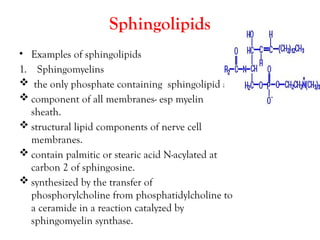
1. Sphingomyelins
the only phosphate containing sphingolipid a
component of all membranes- esp myelin
sheath.
structural lipid components of nerve cell
membranes.
contain palmitic or stearic acid N-acylated at
carbon 2 of sphingosine.
synthesized by the transfer of
phosphorylcholine from phosphatidylcholine to
a ceramide in a reaction catalyzed by
sphingomyelin synthase.
73.
Sphingolipids
2. Glycosphingolipids
A lsoknown as glycolipids
composed of a ceramide backbone with a
various –CHO (mono- or oligosaccharides)
CHO are attached to carbon 1 of
sphingosine.
Include
cerebrosides
sulfatides
globosides
gangliosides
A Galactocerebroside
74.
Sphingolipids
Cerebrosides
have a singlesugar group linked to ceramide.
common is galactose or glucose
galactocerebrosides-
– Made from galactose
– Predominantly found in neuronal cell membranes
– synthesized from ceramide and UDP-galactose
glucocerebrosides-
– Made from glucose (minor).
– not normally found in membranes,
– intermediates in the synthesis or degradation of more
complex glycosphingolipids.
– Excess glucocerebrosides accumulation -gauchers diseases
75.
Sphingolipids
Sulfatides:
sulfuric acidesters of galactocerebrosides
synthesized from galactocerebrosides and activated sulfate, 3'-
phosphoadenosine 5'-phosphosulfate (PAPS).
Excess accumulation of sulfatides leads to sulfatide lipidosis
(metachromatic leukodystrophy).
• Globosides:
cerebrosides that contain additional carbohydrates, predominantly
galactose, glucose or GalNAc.
Lactosyl ceramide is a globoside found in erythrocyte plasma
membranes.
Globotriaosylceramide (also called ceramide trihexoside) contains
glucose and two moles of galactose and accumulates, primarily in
the kidneys, of patients suffering from fabry’s disease
76.
Sphingolipids
Gangliosides:
similar to globosides
exceptalso contain NANA in varying amounts.
specific names for gangliosides are a key to their structure.
Each has letter G refers to ganglioside,
the subscripts M, D, T and Q indicate that the molecule contains
mono-, di-, tri and quatra(tetra)-sialic acid.
The numerical subscripts 1, 2 and 3 refer to the carbohydrate
sequence that is attached to ceramide
1 stands for GalGalNAcGalGlc-ceramide,
2 for GalNAcGalGlc-ceramide and
3 for GalGlc-ceramide.
lysosomal enzyme difficiency for the degradation of the carbohydrate
portions of various gangliosides, lipid storage diseases
77.
Derived lipids
• Derivativesof hydrolysis of simple or compound lipids.
Examples
glycerol
fatty acids
steroids &sterols
fatty aldehydes
ketone bodies
fatty soluble vitamins
steroid hormones.
Common are sterols and steriods
77
78.
Sterols and Steroids
Lipidswith 4 fused rings carbon skeleton
structure
Differ in the functional groups attached to the
rings.
hydrophobic & lipophilic but no fatty acids
Examples:
– cholesterol
– sex hormones
78
79.
• Cholesterol
Cholesterol-best-knownsterol
found only in animal products
• Four carbon rings with no fatty acid tails
• Component of animal cell membranes
• Modified to form sex hormones
HO
CH3
CH3
H3C
CH3
CH3
79
81.
CHOLESTEROL
• Major componentof cell membranes
• abundant in nerve and brain tissue
• Precursor molecule:
– Vitamin D
– estrogen are synthesized from cholesterol
• Important in the synthesis of bile acids
• The liver manufactures most of the cholesterol in the
body
• The intestine and all cells contribute a small amount
• Overall, the body produces about 1000 mg per day
• Serum cholesterol levels are homeostatically controlled
(set-point)













![• Chylomicrons (from the Greek chylo,
meaning juice or milky fluid, and micron, meaning small
particle) arelipoprotein particles that consist of
triglycerides (85–92%), phospholipids (6–12%),
cholesterol (1–3%), andproteins (1–2%).[1]
They
transport dietary lipids from the intestines to other
locations in the body. Chylomicrons are one of the five
major groups of lipoproteins (chylomicrons, VLDL, IDL,
LDL, HDL) that enable fats andcholesterol to move
within the water-based solution of the bloodstream.](https://image.slidesharecdn.com/lipids-structureandfunction-250329182942-9403d988/85/LIPIDS-STRUCTURE-AND-FUNCTION-pptx-bchem-63-320.jpg)