Department of Botany G.S.S.C Peshawar. 1
LIPIDS
ASAD KHAN
B.S Botany
3RD Semester
2Department of Botany G.S.S.C Peshawar.
LIPIDS
• Lipids are diverse group of chemicals that
are fats and oily substances.
• Lipids are hydrophobic.
• These are insoluble in water.
• Lipids are in soluble in organic solvents,
such as Ether, Ethanol, Acetone,
Chloroform, Benzene, etc.
3Department of Botany G.S.S.C Peshawar.
Continued………
• Lipids contain Carbon, Hydrogen and
Oxygen, as in Carbohydrates. But in lipids
the proportion of Oxygen is much less.
• Having only two Oxygen atoms at one
end of long molecule.
4Department of Botany G.S.S.C Peshawar.
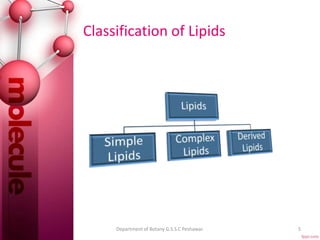
Classification of Lipids
5Department of Botany G.S.S.C Peshawar.
Simple Lipids
• Simple Lipids are esters of fatty acids with
alcohols.
• Simple Lipids can be sub-divided into:
1. Fats
2. Waxes
6Department of Botany G.S.S.C Peshawar.
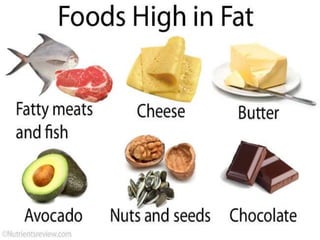
Fats
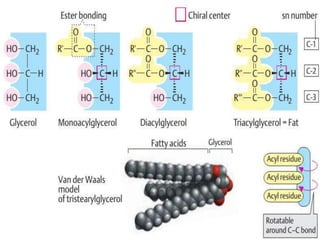
• Esters of fatty acids with glycerol.
• Solid at room temperature.
• Some are liquid at room temperature,
and are known as oils.
• Physical state depends upon the nature
of fatty acids.
• Fats are rich in saturated fatty acids.
• Oils are rich in unsaturated fatty acids.
7Department of Botany G.S.S.C Peshawar.
Slide Title
8Department of Botany G.S.S.C Peshawar.
Department of Botany G.S.S.C Peshawar. 9
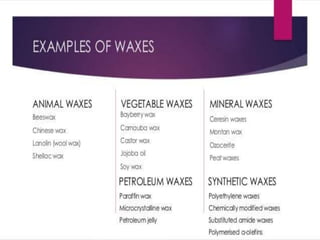
Waxes
• They are esters of higher fatty acids with
higher mono hydroxy aliphatic alcohols(e.g.
Cetyl alcohol)
• Have very long straight chain of 60-100
carbon Atoms
• They can take up water without getting
dissolved in it.
• Used as bases for the preparation of
cosmetics, ointments, polishes, lubricants
and candles.
• In nature, they are found on the surface of
plants and insects.
10Department of Botany G.S.S.C Peshawar.
Slide Title
11Department of Botany G.S.S.C Peshawar.
Fatty acids
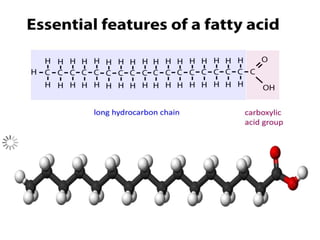
• Fatty acids are carboxylic acids with
hydrocarbon side chain.
• The are the simplest form of lipids.
12Department of Botany G.S.S.C Peshawar.
Department of Botany G.S.S.C Peshawar. 13
Occurrence of Fatty acid
• Majorly occur in esterified form as major
constituents of various lipids.
• They are also present as free
(unesterified) fatty acids.
• Fatty acids of animal origin are much
more simpler in structure in contrast to
those of plant origin.
14Department of Botany G.S.S.C Peshawar.
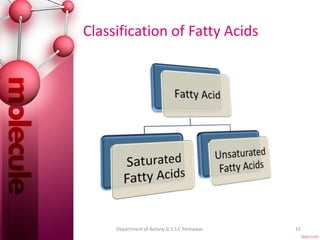
Classification of Fatty Acids
15Department of Botany G.S.S.C Peshawar.
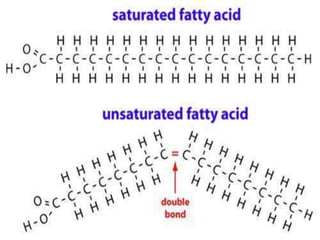
Saturated Fatty Acids
• Contain only single C–C bonds
• Closely packed
• Strong attractions between chains
• High melting points
• Solids at room temperature
16Department of Botany G.S.S.C Peshawar.
Unsaturated Fatty Acids
• Contain one or more double C=C bonds
• Nonlinear chains do not allow molecules
to pack closely
• Few interactions between chains
• Low melting points
• Liquids at room temperature
17Department of Botany G.S.S.C Peshawar.
Slide Title
18Department of Botany G.S.S.C Peshawar.
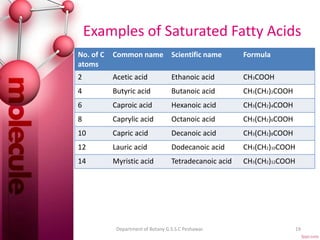
Examples of Saturated Fatty Acids
No. of C
atoms
Common name Scientific name Formula
2 Acetic acid Ethanoic acid CH3COOH
4 Butyric acid Butanoic acid CH3(CH2)2COOH
6 Caproic acid Hexanoic acid CH3(CH2)4COOH
8 Caprylic acid Octanoic acid CH3(CH2)6COOH
10 Capric acid Decanoic acid CH3(CH2)8COOH
12 Lauric acid Dodecanoic acid CH3(CH2)10COOH
14 Myristic acid Tetradecanoic acid CH3(CH2)12COOH
19Department of Botany G.S.S.C Peshawar.
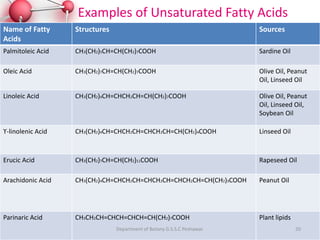
Examples of Unsaturated Fatty Acids
Name of Fatty
Acids
Structures Sources
Palmitoleic Acid CH3(CH2)5CH=CH(CH2)7COOH Sardine Oil
Oleic Acid CH3(CH2)7CH=CH(CH2)7COOH Olive Oil, Peanut
Oil, Linseed Oil
Linoleic Acid CH3(CH2)4CH=CHCH2CH=CH(CH2)7COOH Olive Oil, Peanut
Oil, Linseed Oil,
Soybean Oil
ϒ-linolenic Acid CH3(CH2)4CH=CHCH2CH=CHCH2CH=CH(CH2)4COOH Linseed Oil
Erucic Acid CH3(CH2)7CH=CH(CH2)11COOH Rapeseed Oil
Arachidonic Acid CH3(CH2)4CH=CHCH2CH=CHCH2CH=CHCH2CH=CH(CH2)3COOH Peanut Oil
Parinaric Acid CH3CH2CH=CHCH=CHCH=CH(CH2)7COOH Plant lipids
20Department of Botany G.S.S.C Peshawar.
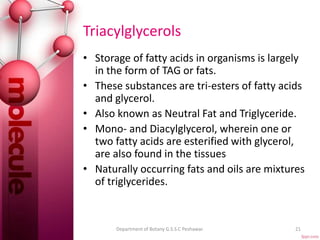
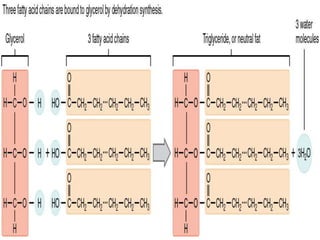
Triacylglycerols
• Storage of fatty acids in organisms is largely
in the form of TAG or fats.
• These substances are tri-esters of fatty acids
and glycerol.
• Also known as Neutral Fat and Triglyceride.
• Mono- and Diacylglycerol, wherein one or
two fatty acids are esterified with glycerol,
are also found in the tissues
• Naturally occurring fats and oils are mixtures
of triglycerides.
21Department of Botany G.S.S.C Peshawar.
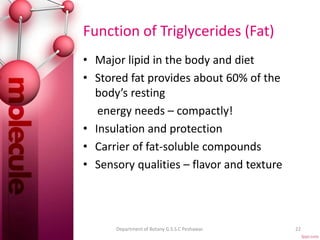
Function of Triglycerides (Fat)
• Major lipid in the body and diet
• Stored fat provides about 60% of the
body’s resting
energy needs – compactly!
• Insulation and protection
• Carrier of fat-soluble compounds
• Sensory qualities – flavor and texture
22Department of Botany G.S.S.C Peshawar.
Slide Title
23Department of Botany G.S.S.C Peshawar.
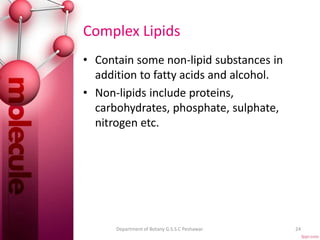
Complex Lipids
• Contain some non-lipid substances in
addition to fatty acids and alcohol.
• Non-lipids include proteins,
carbohydrates, phosphate, sulphate,
nitrogen etc.
24Department of Botany G.S.S.C Peshawar.
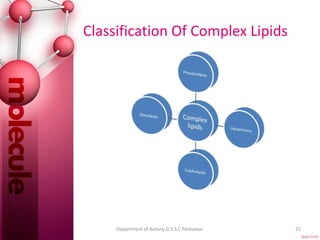
Classification Of Complex Lipids
25Department of Botany G.S.S.C Peshawar.
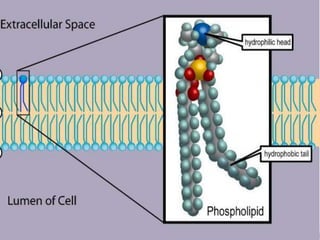
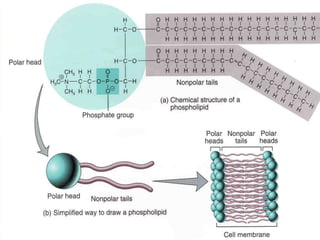
Phospholipids
• Made up of fatty acids, an alcohol,
phosphoric acid and a nitrogenous base.
• Some examples are lecithin, cephalin and
sphingomyelin
26Department of Botany G.S.S.C Peshawar.
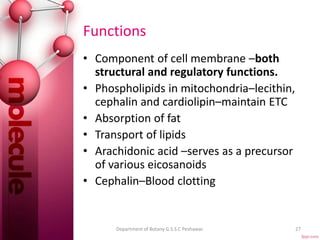
Functions
• Component of cell membrane –both
structural and regulatory functions.
• Phospholipids in mitochondria–lecithin,
cephalin and cardiolipin–maintain ETC
• Absorption of fat
• Transport of lipids
• Arachidonic acid –serves as a precursor
of various eicosanoids
• Cephalin–Blood clotting
27Department of Botany G.S.S.C Peshawar.
Slide Title
28Department of Botany G.S.S.C Peshawar.
Slide Title
29Department of Botany G.S.S.C Peshawar.
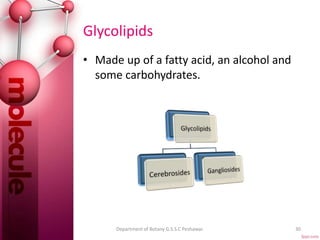
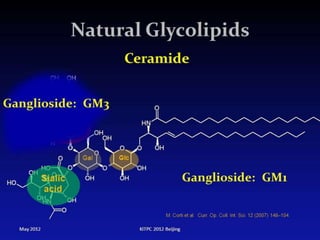
Glycolipids
• Made up of a fatty acid, an alcohol and
some carbohydrates.
30Department of Botany G.S.S.C Peshawar.
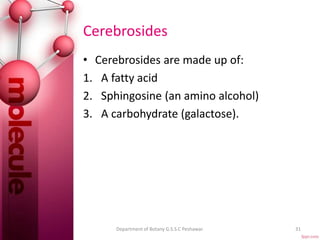
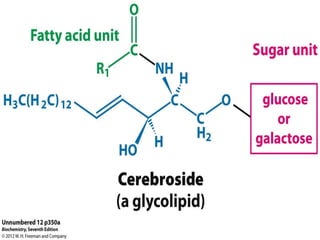
Cerebrosides
• Cerebrosides are made up of:
1. A fatty acid
2. Sphingosine (an amino alcohol)
3. A carbohydrate (galactose).
31Department of Botany G.S.S.C Peshawar.
Slide Title
32Department of Botany G.S.S.C Peshawar.
Gangliosides
• Gangliosides are made up of:
1. A fatty acid
2. Sphingosine
3. N-acetyl-neuraminic acid
4. Some hexoses
33Department of Botany G.S.S.C Peshawar.
Slide Title
34Department of Botany G.S.S.C Peshawar.
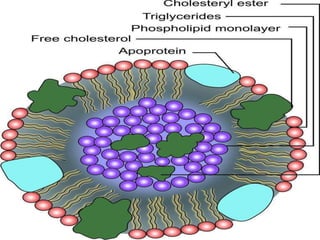
Lipoproteins
• May be considered to be conjugated
proteins or compound lipids.
• Made up of some lipids combined with some
specific proteins.
• Lipids includes triglycerides, phospholipids,
cholesterol and fatty acids.
• These are soluble in water because of their
protein content.
• These are the form in which lipids are
transported in circulation.
35Department of Botany G.S.S.C Peshawar.
Slide Title
36Department of Botany G.S.S.C Peshawar.
Slide Title
37Department of Botany G.S.S.C Peshawar.
Derived Lipids
• These compounds which obtained on
hydrolysis of simple and compound lipids.
• Possessing properties of lipids.
• Examples are fatty acids, higher alcohols,
sterols, steroids, hydrocarbons etc.
38Department of Botany G.S.S.C Peshawar.
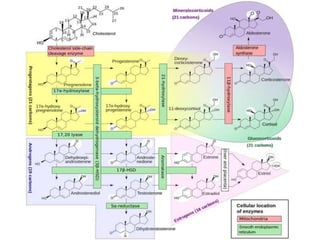
Steroids
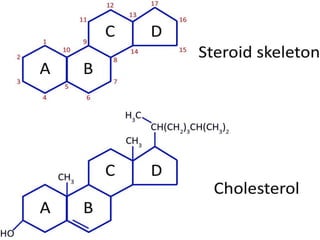
• Steroids are lipids containing a steroid
nucleus (core structure).
• The steroid nucleus is a fused ring system
consisting of three cyclohexane rings and
one cyclopentane ring.
• The rings are designated A, B, C and D.
• Attachment of different groups to the
core steroid structure leads to a wide
variety of steroid compounds, including
cholesterol, bile salts and steroid
hormones.
39Department of Botany G.S.S.C Peshawar.
Continued……………
• They are involved with regulating
metabolic processes/activities in the
body because many forms of them are
Hormones.
• Testosterone, Estrogen, and progesterone
are all examples of Steroid Hormones.
• Cholesterol is the most common Steroid.
• It is the building block for other Steroid
Hormones and also function in cell
membrane structure.
40Department of Botany G.S.S.C Peshawar.
Slide Title
41Department of Botany G.S.S.C Peshawar.
Slide Title
42Department of Botany G.S.S.C Peshawar.
Chemical reactions of lipids
• Lipids can undergo:
• Hydrolysis: The ester bonds of lipids can be
hydrolysed by specific enzymes.
• Saponification: Hydrolysis of triglycerides by
alkalis is known as saponification. It results in the
formation of alkali salts of fatty acids (soaps).
• Hydrogenation: Double bonds of unsaturated fatty
acids can be hydrogenated in the presence of catalysts
e.g. nickel
43Department of Botany G.S.S.C Peshawar.
Continued…….
• Iodination: Iodine can also reduce the double bonds
of unsaturated fatty acids.
• Oxidation: Unsaturated fatty acids can react with
atmospheric oxygen to form:
 Fatty acid peroxides
 Fatty acids epoxides
 Fatty acid aldehydes
44Department of Botany G.S.S.C Peshawar.
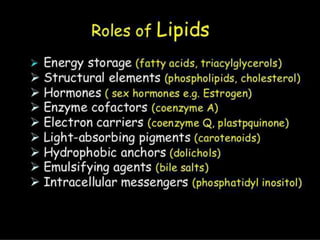
Functions of Lipids
• Storage form of energy.
• Important dietary components because of their
high energy value and also because of the fat
soluble vitamins and the essential fatty acids
contained in the fat of natural foods.
• Structural components of cell membranes
• Serve as thermal insulators in the subcutaneous
tissues and around certain organs.
• Non-polar lipids act as electrical insulators,
allowing rapid propagation of depolarization
waves along myelinated nerves.
45Department of Botany G.S.S.C Peshawar.
Continued…………….
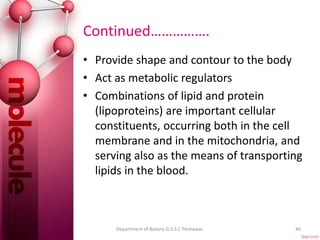
• Provide shape and contour to the body
• Act as metabolic regulators
• Combinations of lipid and protein
(lipoproteins) are important cellular
constituents, occurring both in the cell
membrane and in the mitochondria, and
serving also as the means of transporting
lipids in the blood.
46Department of Botany G.S.S.C Peshawar.
Slide Title
47Department of Botany G.S.S.C Peshawar.
48Department of Botany G.S.S.C Peshawar.
References
• www.slideshare.net
• www.slideplayer.net
• www.biologyboom.com
• www.wikipedia.com
• www.google-image.com
• www.google-scholar.com
• Principles of Botany
By: Tanveer Ahmad Malik
49Department of Botany G.S.S.C Peshawar.
PreparedBy: AsadAfridi
50Department of Botany G.S.S.C Peshawar.
.
THANK YOU
Department of Botany G.S.S.C Peshawar. 51

Lipids Notes

  • 1.
    Department of BotanyG.S.S.C Peshawar. 1
  • 2.
    LIPIDS ASAD KHAN B.S Botany 3RDSemester 2Department of Botany G.S.S.C Peshawar.
  • 3.
    LIPIDS • Lipids arediverse group of chemicals that are fats and oily substances. • Lipids are hydrophobic. • These are insoluble in water. • Lipids are in soluble in organic solvents, such as Ether, Ethanol, Acetone, Chloroform, Benzene, etc. 3Department of Botany G.S.S.C Peshawar.
  • 4.
    Continued……… • Lipids containCarbon, Hydrogen and Oxygen, as in Carbohydrates. But in lipids the proportion of Oxygen is much less. • Having only two Oxygen atoms at one end of long molecule. 4Department of Botany G.S.S.C Peshawar.
  • 5.
    Classification of Lipids 5Departmentof Botany G.S.S.C Peshawar.
  • 6.
    Simple Lipids • SimpleLipids are esters of fatty acids with alcohols. • Simple Lipids can be sub-divided into: 1. Fats 2. Waxes 6Department of Botany G.S.S.C Peshawar.
  • 7.
    Fats • Esters offatty acids with glycerol. • Solid at room temperature. • Some are liquid at room temperature, and are known as oils. • Physical state depends upon the nature of fatty acids. • Fats are rich in saturated fatty acids. • Oils are rich in unsaturated fatty acids. 7Department of Botany G.S.S.C Peshawar.
  • 8.
    Slide Title 8Department ofBotany G.S.S.C Peshawar.
  • 9.
    Department of BotanyG.S.S.C Peshawar. 9
  • 10.
    Waxes • They areesters of higher fatty acids with higher mono hydroxy aliphatic alcohols(e.g. Cetyl alcohol) • Have very long straight chain of 60-100 carbon Atoms • They can take up water without getting dissolved in it. • Used as bases for the preparation of cosmetics, ointments, polishes, lubricants and candles. • In nature, they are found on the surface of plants and insects. 10Department of Botany G.S.S.C Peshawar.
  • 11.
    Slide Title 11Department ofBotany G.S.S.C Peshawar.
  • 12.
    Fatty acids • Fattyacids are carboxylic acids with hydrocarbon side chain. • The are the simplest form of lipids. 12Department of Botany G.S.S.C Peshawar.
  • 13.
    Department of BotanyG.S.S.C Peshawar. 13
  • 14.
    Occurrence of Fattyacid • Majorly occur in esterified form as major constituents of various lipids. • They are also present as free (unesterified) fatty acids. • Fatty acids of animal origin are much more simpler in structure in contrast to those of plant origin. 14Department of Botany G.S.S.C Peshawar.
  • 15.
    Classification of FattyAcids 15Department of Botany G.S.S.C Peshawar.
  • 16.
    Saturated Fatty Acids •Contain only single C–C bonds • Closely packed • Strong attractions between chains • High melting points • Solids at room temperature 16Department of Botany G.S.S.C Peshawar.
  • 17.
    Unsaturated Fatty Acids •Contain one or more double C=C bonds • Nonlinear chains do not allow molecules to pack closely • Few interactions between chains • Low melting points • Liquids at room temperature 17Department of Botany G.S.S.C Peshawar.
  • 18.
    Slide Title 18Department ofBotany G.S.S.C Peshawar.
  • 19.
    Examples of SaturatedFatty Acids No. of C atoms Common name Scientific name Formula 2 Acetic acid Ethanoic acid CH3COOH 4 Butyric acid Butanoic acid CH3(CH2)2COOH 6 Caproic acid Hexanoic acid CH3(CH2)4COOH 8 Caprylic acid Octanoic acid CH3(CH2)6COOH 10 Capric acid Decanoic acid CH3(CH2)8COOH 12 Lauric acid Dodecanoic acid CH3(CH2)10COOH 14 Myristic acid Tetradecanoic acid CH3(CH2)12COOH 19Department of Botany G.S.S.C Peshawar.
  • 20.
    Examples of UnsaturatedFatty Acids Name of Fatty Acids Structures Sources Palmitoleic Acid CH3(CH2)5CH=CH(CH2)7COOH Sardine Oil Oleic Acid CH3(CH2)7CH=CH(CH2)7COOH Olive Oil, Peanut Oil, Linseed Oil Linoleic Acid CH3(CH2)4CH=CHCH2CH=CH(CH2)7COOH Olive Oil, Peanut Oil, Linseed Oil, Soybean Oil ϒ-linolenic Acid CH3(CH2)4CH=CHCH2CH=CHCH2CH=CH(CH2)4COOH Linseed Oil Erucic Acid CH3(CH2)7CH=CH(CH2)11COOH Rapeseed Oil Arachidonic Acid CH3(CH2)4CH=CHCH2CH=CHCH2CH=CHCH2CH=CH(CH2)3COOH Peanut Oil Parinaric Acid CH3CH2CH=CHCH=CHCH=CH(CH2)7COOH Plant lipids 20Department of Botany G.S.S.C Peshawar.
  • 21.
    Triacylglycerols • Storage offatty acids in organisms is largely in the form of TAG or fats. • These substances are tri-esters of fatty acids and glycerol. • Also known as Neutral Fat and Triglyceride. • Mono- and Diacylglycerol, wherein one or two fatty acids are esterified with glycerol, are also found in the tissues • Naturally occurring fats and oils are mixtures of triglycerides. 21Department of Botany G.S.S.C Peshawar.
  • 22.
    Function of Triglycerides(Fat) • Major lipid in the body and diet • Stored fat provides about 60% of the body’s resting energy needs – compactly! • Insulation and protection • Carrier of fat-soluble compounds • Sensory qualities – flavor and texture 22Department of Botany G.S.S.C Peshawar.
  • 23.
    Slide Title 23Department ofBotany G.S.S.C Peshawar.
  • 24.
    Complex Lipids • Containsome non-lipid substances in addition to fatty acids and alcohol. • Non-lipids include proteins, carbohydrates, phosphate, sulphate, nitrogen etc. 24Department of Botany G.S.S.C Peshawar.
  • 25.
    Classification Of ComplexLipids 25Department of Botany G.S.S.C Peshawar.
  • 26.
    Phospholipids • Made upof fatty acids, an alcohol, phosphoric acid and a nitrogenous base. • Some examples are lecithin, cephalin and sphingomyelin 26Department of Botany G.S.S.C Peshawar.
  • 27.
    Functions • Component ofcell membrane –both structural and regulatory functions. • Phospholipids in mitochondria–lecithin, cephalin and cardiolipin–maintain ETC • Absorption of fat • Transport of lipids • Arachidonic acid –serves as a precursor of various eicosanoids • Cephalin–Blood clotting 27Department of Botany G.S.S.C Peshawar.
  • 28.
    Slide Title 28Department ofBotany G.S.S.C Peshawar.
  • 29.
    Slide Title 29Department ofBotany G.S.S.C Peshawar.
  • 30.
    Glycolipids • Made upof a fatty acid, an alcohol and some carbohydrates. 30Department of Botany G.S.S.C Peshawar.
  • 31.
    Cerebrosides • Cerebrosides aremade up of: 1. A fatty acid 2. Sphingosine (an amino alcohol) 3. A carbohydrate (galactose). 31Department of Botany G.S.S.C Peshawar.
  • 32.
    Slide Title 32Department ofBotany G.S.S.C Peshawar.
  • 33.
    Gangliosides • Gangliosides aremade up of: 1. A fatty acid 2. Sphingosine 3. N-acetyl-neuraminic acid 4. Some hexoses 33Department of Botany G.S.S.C Peshawar.
  • 34.
    Slide Title 34Department ofBotany G.S.S.C Peshawar.
  • 35.
    Lipoproteins • May beconsidered to be conjugated proteins or compound lipids. • Made up of some lipids combined with some specific proteins. • Lipids includes triglycerides, phospholipids, cholesterol and fatty acids. • These are soluble in water because of their protein content. • These are the form in which lipids are transported in circulation. 35Department of Botany G.S.S.C Peshawar.
  • 36.
    Slide Title 36Department ofBotany G.S.S.C Peshawar.
  • 37.
    Slide Title 37Department ofBotany G.S.S.C Peshawar.
  • 38.
    Derived Lipids • Thesecompounds which obtained on hydrolysis of simple and compound lipids. • Possessing properties of lipids. • Examples are fatty acids, higher alcohols, sterols, steroids, hydrocarbons etc. 38Department of Botany G.S.S.C Peshawar.
  • 39.
    Steroids • Steroids arelipids containing a steroid nucleus (core structure). • The steroid nucleus is a fused ring system consisting of three cyclohexane rings and one cyclopentane ring. • The rings are designated A, B, C and D. • Attachment of different groups to the core steroid structure leads to a wide variety of steroid compounds, including cholesterol, bile salts and steroid hormones. 39Department of Botany G.S.S.C Peshawar.
  • 40.
    Continued…………… • They areinvolved with regulating metabolic processes/activities in the body because many forms of them are Hormones. • Testosterone, Estrogen, and progesterone are all examples of Steroid Hormones. • Cholesterol is the most common Steroid. • It is the building block for other Steroid Hormones and also function in cell membrane structure. 40Department of Botany G.S.S.C Peshawar.
  • 41.
    Slide Title 41Department ofBotany G.S.S.C Peshawar.
  • 42.
    Slide Title 42Department ofBotany G.S.S.C Peshawar.
  • 43.
    Chemical reactions oflipids • Lipids can undergo: • Hydrolysis: The ester bonds of lipids can be hydrolysed by specific enzymes. • Saponification: Hydrolysis of triglycerides by alkalis is known as saponification. It results in the formation of alkali salts of fatty acids (soaps). • Hydrogenation: Double bonds of unsaturated fatty acids can be hydrogenated in the presence of catalysts e.g. nickel 43Department of Botany G.S.S.C Peshawar.
  • 44.
    Continued……. • Iodination: Iodinecan also reduce the double bonds of unsaturated fatty acids. • Oxidation: Unsaturated fatty acids can react with atmospheric oxygen to form:  Fatty acid peroxides  Fatty acids epoxides  Fatty acid aldehydes 44Department of Botany G.S.S.C Peshawar.
  • 45.
    Functions of Lipids •Storage form of energy. • Important dietary components because of their high energy value and also because of the fat soluble vitamins and the essential fatty acids contained in the fat of natural foods. • Structural components of cell membranes • Serve as thermal insulators in the subcutaneous tissues and around certain organs. • Non-polar lipids act as electrical insulators, allowing rapid propagation of depolarization waves along myelinated nerves. 45Department of Botany G.S.S.C Peshawar.
  • 46.
    Continued……………. • Provide shapeand contour to the body • Act as metabolic regulators • Combinations of lipid and protein (lipoproteins) are important cellular constituents, occurring both in the cell membrane and in the mitochondria, and serving also as the means of transporting lipids in the blood. 46Department of Botany G.S.S.C Peshawar.
  • 47.
    Slide Title 47Department ofBotany G.S.S.C Peshawar.
  • 48.
    48Department of BotanyG.S.S.C Peshawar.
  • 49.
    References • www.slideshare.net • www.slideplayer.net •www.biologyboom.com • www.wikipedia.com • www.google-image.com • www.google-scholar.com • Principles of Botany By: Tanveer Ahmad Malik 49Department of Botany G.S.S.C Peshawar.
  • 50.
  • 51.
    . THANK YOU Department ofBotany G.S.S.C Peshawar. 51