Dr Sufyan Akram
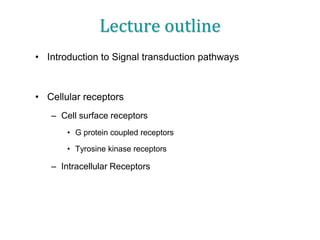
Lecture outline
• Introduction to Signal transduction pathways
• Cellular receptors
– Cell surface receptors
• G protein coupled receptors
• Tyrosine kinase receptors
– Intracellular Receptors
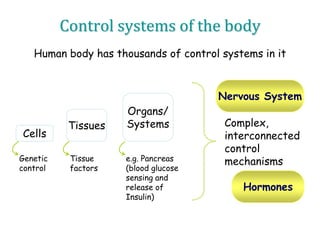
Control systems of the body
Human body has thousands of control systems in it
Cells
Genetic
control
Tissues
Tissue
factors
Organs/
Systems
e.g. Pancreas
(blood glucose
sensing and
release of
Insulin)
Nervous System
Hormones
Complex,
interconnected
control
mechanisms
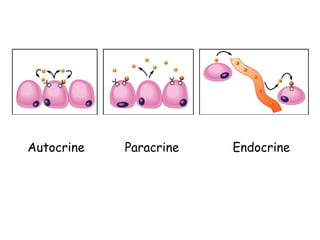
Autocrine Paracrine Endocrine
What are hormones
• Endocrine hormones are secreted by specialized
glands/tissues
• Carried by blood to cells throughout the body
• Some have general effects, while others only affect
specific target organs
• Hormonal effects on target cells depend upon presence
of specific receptors
General Mechanism of Hormone Action
• Specificity of Hormone and Target Tissue interaction
is dependent upon the location of cellular receptors:
• Plasma membrane of cells (surface receptors)
• In the cytosol or nucleus (intra-cellular receptors)
Hormone Receptors
• The interaction is swift and reversible, allowing rapid
onset and termination of hormone action
• Receptor affinity for hormone must be high as
hormones circulate in pico- or nanomole
concentrations
• Receptors are also specific
What are Receptors?
• Usually proteins or glycoproteins
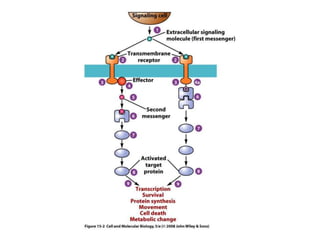
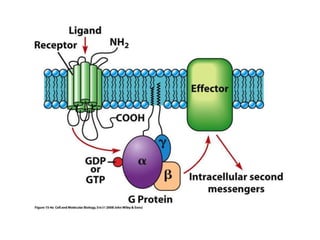
• Ligand-receptor interaction brings about
conformational change in the receptor leading to
activation of intracellular mediators (“second
messengers”)
• Second messengers, would then activate further
molecules in the cell…
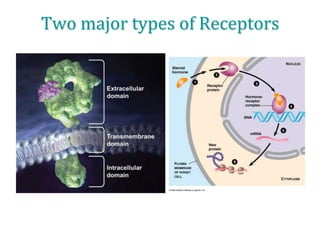
Two major types of Receptors
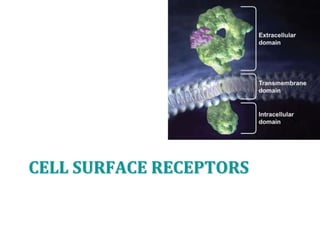
CELL SURFACE RECEPTORS
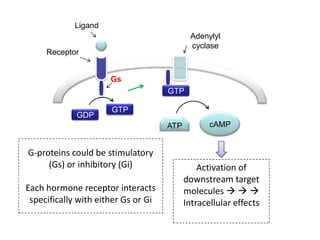
GDP
GTP
GTP
ATP cAMP
Activation of
downstream target
molecules   
Intracellular effects
G-proteins could be stimulatory
(Gs) or inhibitory (Gi)
Each hormone receptor interacts
specifically with either Gs or Gi
Gs
Receptor
Adenylyl
cyclase
Ligand
cAMP
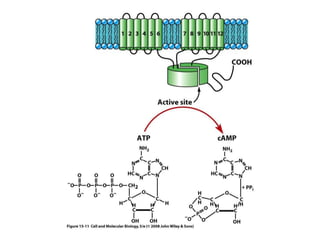
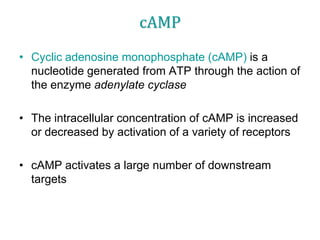
• Cyclic adenosine monophosphate (cAMP) is a
nucleotide generated from ATP through the action of
the enzyme adenylate cyclase
• The intracellular concentration of cAMP is increased
or decreased by activation of a variety of receptors
• cAMP activates a large number of downstream
targets
cAMP
• Protein kinase A is normally in a catalytically-
inactive state, but becomes active when it binds to
cAMP
• Upon activation, protein kinase A phosphorylates a
number of other proteins
• Levels of cAMP decrease due to destruction by
cAMP-phosphodiesterase and the inactivation of
adenylate cyclase
RTK
• The receptors for several protein hormones are
themselves protein kinases which are switched on
by binding of hormone. The kinase activity
associated with such receptors results in
phosphorylation of tyrosine residues on other
proteins
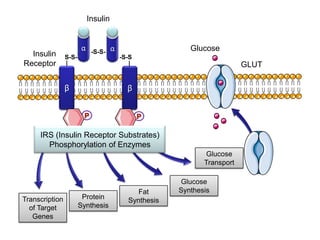
• Insulin is an example of a hormone whose receptor
is a tyrosine kinase
RTK
• The hormone binds to domains exposed on the
cell's surface, resulting in a conformational change
that activates kinase domains located in the
cytoplasmic regions of the receptor
• In many cases, the receptor phosphorylates itself as
part of the kinase activation process
• The activated receptor phosphorylates a variety of
intracellular targets, many of which are enzymes
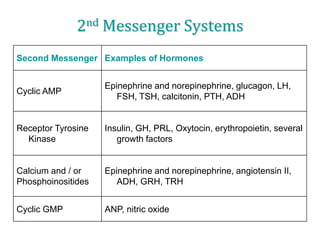
2nd Messenger Systems
Second Messenger Examples of Hormones
Cyclic AMP
Epinephrine and norepinephrine, glucagon, LH,
FSH, TSH, calcitonin, PTH, ADH
Receptor Tyrosine
Kinase
Insulin, GH, PRL, Oxytocin, erythropoietin, several
growth factors
Calcium and / or
Phosphoinositides
Epinephrine and norepinephrine, angiotensin II,
ADH, GRH, TRH
Cyclic GMP ANP, nitric oxide
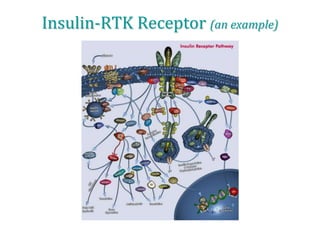
Insulin-RTK Receptor (an example)
Insulin
• Insulin is a hormone associated with energy
abundance
• In the case of excess carbohydrates, it causes them
to be stored as glycogen mainly in the liver and
muscles
• Excess carbohydrates that cannot be stored as
glycogen are converted into fats and stored in the
adipose tissue
• In the case of proteins, insulin has a direct effect in
promoting amino acid uptake by cells
Insulin
• To initiate its effects on target cells, insulin first binds
with and activates a membrane receptor protein
(RTK)
PP
Insulin
Insulin
Receptor
Transcription
of Target
Genes
β β
α α-S-S-
S-S- -S-S
Protein
Synthesis
Fat
Synthesis
Glucose
Synthesis
Glucose
Transport
GLUT
Glucose
IRS (Insulin Receptor Substrates)
Phosphorylation of Enzymes
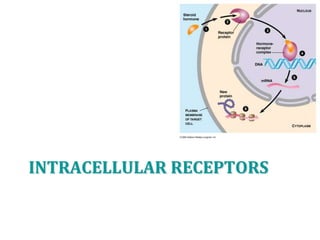
INTRACELLULAR RECEPTORS
Intracellular Receptors
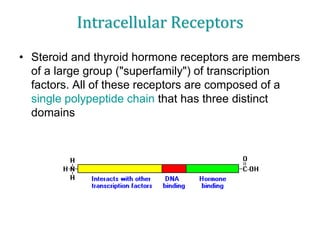
• Steroid and thyroid hormone receptors are members
of a large group ("superfamily") of transcription
factors. All of these receptors are composed of a
single polypeptide chain that has three distinct
domains
Intracellular Receptors
• The amino-terminus: this region is involved in
activating or stimulating transcription by interacting
with other components of the transcriptional
machinery.
• DNA binding domain: Amino acids in this region are
responsible for binding of the receptor to specific
sequences of DNA.
• The carboxy-terminus or ligand-binding domain:
This is the region that binds hormone
Hormone-Receptor Binding and
Interactions with DNA
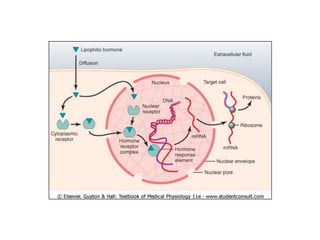
• Being lipids, steroid hormones enter the cell by
simple diffusion across the plasma membrane.
Thyroid hormones enter the cell by facilitated
diffusion
• The receptors exist either in the cytoplasm or
nucleus, which is where they meet the hormone.
When hormone binds to receptor, a characteristic
series of events occurs…
• Receptor activation is the term used to describe
conformational changes in the receptor induced by
binding hormone. The major consequence of activation
is that the receptor becomes competent to bind DNA
• Activated receptors bind to hormone response elements,
which are short specific sequences of DNA which are
located in promoters of hormone-responsive genes
• Most commonly, receptor binding to DNA stimulates
transcription. The hormone-receptor complex thus
functions as a transcription factor
In Summary
• Receptors are specific proteins which can be
activated by various factors (ligands)
• Once activated, the receptors activate further
molecules leading to a chain of events (signaling
cascade)
• The effects could be immediate (like changes in
membrane permeability to certain ions) or long-
term (like transcription of genes)
 signal transduction

signal transduction

  • 1.
  • 2.
    Lecture outline • Introductionto Signal transduction pathways • Cellular receptors – Cell surface receptors • G protein coupled receptors • Tyrosine kinase receptors – Intracellular Receptors
  • 3.
    Control systems ofthe body Human body has thousands of control systems in it Cells Genetic control Tissues Tissue factors Organs/ Systems e.g. Pancreas (blood glucose sensing and release of Insulin) Nervous System Hormones Complex, interconnected control mechanisms
  • 4.
  • 5.
    What are hormones •Endocrine hormones are secreted by specialized glands/tissues • Carried by blood to cells throughout the body • Some have general effects, while others only affect specific target organs • Hormonal effects on target cells depend upon presence of specific receptors
  • 6.
    General Mechanism ofHormone Action • Specificity of Hormone and Target Tissue interaction is dependent upon the location of cellular receptors: • Plasma membrane of cells (surface receptors) • In the cytosol or nucleus (intra-cellular receptors)
  • 7.
    Hormone Receptors • Theinteraction is swift and reversible, allowing rapid onset and termination of hormone action • Receptor affinity for hormone must be high as hormones circulate in pico- or nanomole concentrations • Receptors are also specific
  • 8.
    What are Receptors? •Usually proteins or glycoproteins • Ligand-receptor interaction brings about conformational change in the receptor leading to activation of intracellular mediators (“second messengers”) • Second messengers, would then activate further molecules in the cell…
  • 9.
    Two major typesof Receptors
  • 10.
  • 14.
    GDP GTP GTP ATP cAMP Activation of downstreamtarget molecules    Intracellular effects G-proteins could be stimulatory (Gs) or inhibitory (Gi) Each hormone receptor interacts specifically with either Gs or Gi Gs Receptor Adenylyl cyclase Ligand
  • 15.
    cAMP • Cyclic adenosinemonophosphate (cAMP) is a nucleotide generated from ATP through the action of the enzyme adenylate cyclase • The intracellular concentration of cAMP is increased or decreased by activation of a variety of receptors • cAMP activates a large number of downstream targets
  • 16.
    cAMP • Protein kinaseA is normally in a catalytically- inactive state, but becomes active when it binds to cAMP • Upon activation, protein kinase A phosphorylates a number of other proteins • Levels of cAMP decrease due to destruction by cAMP-phosphodiesterase and the inactivation of adenylate cyclase
  • 17.
    RTK • The receptorsfor several protein hormones are themselves protein kinases which are switched on by binding of hormone. The kinase activity associated with such receptors results in phosphorylation of tyrosine residues on other proteins • Insulin is an example of a hormone whose receptor is a tyrosine kinase
  • 18.
    RTK • The hormonebinds to domains exposed on the cell's surface, resulting in a conformational change that activates kinase domains located in the cytoplasmic regions of the receptor • In many cases, the receptor phosphorylates itself as part of the kinase activation process • The activated receptor phosphorylates a variety of intracellular targets, many of which are enzymes
  • 19.
    2nd Messenger Systems SecondMessenger Examples of Hormones Cyclic AMP Epinephrine and norepinephrine, glucagon, LH, FSH, TSH, calcitonin, PTH, ADH Receptor Tyrosine Kinase Insulin, GH, PRL, Oxytocin, erythropoietin, several growth factors Calcium and / or Phosphoinositides Epinephrine and norepinephrine, angiotensin II, ADH, GRH, TRH Cyclic GMP ANP, nitric oxide
  • 20.
  • 21.
    Insulin • Insulin isa hormone associated with energy abundance • In the case of excess carbohydrates, it causes them to be stored as glycogen mainly in the liver and muscles • Excess carbohydrates that cannot be stored as glycogen are converted into fats and stored in the adipose tissue • In the case of proteins, insulin has a direct effect in promoting amino acid uptake by cells
  • 22.
    Insulin • To initiateits effects on target cells, insulin first binds with and activates a membrane receptor protein (RTK)
  • 23.
    PP Insulin Insulin Receptor Transcription of Target Genes β β αα-S-S- S-S- -S-S Protein Synthesis Fat Synthesis Glucose Synthesis Glucose Transport GLUT Glucose IRS (Insulin Receptor Substrates) Phosphorylation of Enzymes
  • 24.
  • 25.
    Intracellular Receptors • Steroidand thyroid hormone receptors are members of a large group ("superfamily") of transcription factors. All of these receptors are composed of a single polypeptide chain that has three distinct domains
  • 26.
    Intracellular Receptors • Theamino-terminus: this region is involved in activating or stimulating transcription by interacting with other components of the transcriptional machinery. • DNA binding domain: Amino acids in this region are responsible for binding of the receptor to specific sequences of DNA. • The carboxy-terminus or ligand-binding domain: This is the region that binds hormone
  • 27.
    Hormone-Receptor Binding and Interactionswith DNA • Being lipids, steroid hormones enter the cell by simple diffusion across the plasma membrane. Thyroid hormones enter the cell by facilitated diffusion • The receptors exist either in the cytoplasm or nucleus, which is where they meet the hormone. When hormone binds to receptor, a characteristic series of events occurs…
  • 29.
    • Receptor activationis the term used to describe conformational changes in the receptor induced by binding hormone. The major consequence of activation is that the receptor becomes competent to bind DNA • Activated receptors bind to hormone response elements, which are short specific sequences of DNA which are located in promoters of hormone-responsive genes • Most commonly, receptor binding to DNA stimulates transcription. The hormone-receptor complex thus functions as a transcription factor
  • 30.
    In Summary • Receptorsare specific proteins which can be activated by various factors (ligands) • Once activated, the receptors activate further molecules leading to a chain of events (signaling cascade) • The effects could be immediate (like changes in membrane permeability to certain ions) or long- term (like transcription of genes)