LIPID CHEMISTRY 
Dr.Charles / Dr Ayyub
Introduction 
• Lipids are heterogeneous group of water 
insoluble (hydrophobic) organic molecules 
• They are fats, oils, steroids and waxes 
• Insoluble in water, but soluble in non-polar 
solvents such as ether, chloroform 
• They are important dietary constituents 
providing (a) high energy value ( 1 g = 9 
kcal) (b) Fat soluble vitamins and (c) 
Essential fatty acids
Biological importance of Lipids 
• Important dietary compounds (Essentitial 
fatty acids) and storage form of energy 
(Triglycerides) 
• Structural components of biomembranes 
(phospholipids and cholesterol) 
• Providing insulation against changes in 
external temperature (subcutaneous fat) 
• Giving shape and contour (outline) to the 
body 
• Protecting internal organs by providing a 
cushioning effect (pads of fat)
Contd.. 
• Metabolic regulators (steroid hormones and 
prostaglandins) 
• Acting as surfactant, detergents and 
emulsifying agents (amphipathic lipids) 
• Acting as electric insulators in neurons 
• Helping in absorption of fat soluble vitamins 
(A,D,E, & K) 
• With proteins and carbohydrates, they form 
important cellular constituents (lipoproteins, 
glycolipids)
Classification of Lipids 
• Lipids are classified into simple, complex and 
derived lipids 
1.Simple lipids: Esters of fatty acids (FA) with 
various glycerol 
a. Fats: esters of FA with glycerol (TAG) 
b. Waxes: esters of FA with higher 
molecular weight alcohols 
2. Complex Lipids: Esters of FA containing groups 
in addition to an alcohol and a FA 
a. Phospholipids: Esters of FA with 
alcohol and phosphoric acid. 
In glycerophospholipids the alcohol is glycerol 
In sphingophospholipids the alcohol is sphingosine
Classification contd….. 
b. Glycolipids are lipids with carbohydrates 
and sphingosine 
c. Others complex lipids are lipoproteins 
3.Derived Lipids: These include FA, glycerol, 
steroids, some alcohols, fatty aldehydes 
and ketone bodies. 
Acylglycerols (glycerides), cholesterol & 
cholesterol esters are termed neutral lipids 
because, they are uncharged.
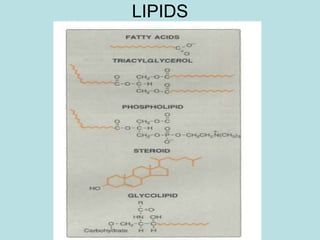
LIPIDS
A. Fatty acids (FA) 
• FA are aliphatic carboxylic acids. Their 
chain may be saturated (no double bond) 
or unsaturated (contain one or more 
double bond) 
• Saturated FA end in -anoic ( eg., octanoic) 
• Unsaturated FA end in –enoic 
(eg.,decaenoic acid or oleic acid) 
• Carbon are numbered from the carboxyl 
carbon (carbon no 1). 
• The carbon atoms adjacent to the carboxyl 
carbon (carbon 2,3,4) are also known as 
α,β,γ respectively.
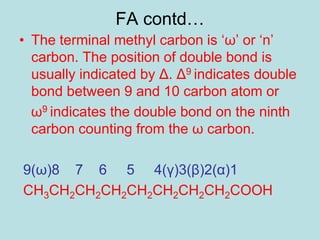
FA contd… 
• The terminal methyl carbon is ‘ω’ or ‘n’ 
carbon. The position of double bond is 
usually indicated by Δ. Δ9 indicates double 
bond between 9 and 10 carbon atom or 
ω9 indicates the double bond on the ninth 
carbon counting from the ω carbon. 
9(ω)8 7 6 5 4(γ)3(β)2(α)1 
CH3CH2CH2CH2CH2CH2CH2CH2COOH
FA contd… 
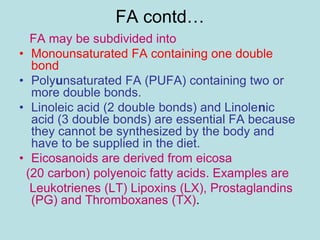
FA may be subdivided into 
• Monounsaturated FA containing one double 
bond 
• Polyunsaturated FA (PUFA) containing two or 
more double bonds. 
• Linoleic acid (2 double bonds) and Linolenic 
acid (3 double bonds) are essential FA because 
they cannot be synthesized by the body and 
have to be supplied in the diet. 
• Eicosanoids are derived from eicosa 
(20 carbon) polyenoic fatty acids. Examples are 
Leukotrienes (LT) Lipoxins (LX), Prostaglandins 
(PG) and Thromboxanes (TX).
FA contd… 
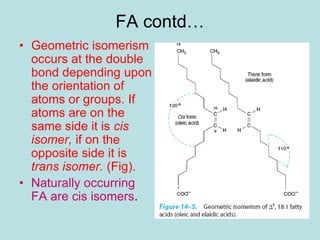
• Geometric isomerism 
occurs at the double 
bond depending upon 
the orientation of 
atoms or groups. If 
atoms are on the 
same side it is cis 
isomer, if on the 
opposite side it is 
trans isomer. (Fig). 
• Naturally occurring 
FA are cis isomers.
FA contd… 
• Triacyl glycerols 
(triglycerides) are the 
main storage forms of 
FA 
• The TG are esters of the 
trihydric alcohol, glycerol 
and fatty acids. 
• Cerebronic acid and 
ricinoleic acid are 
hydroxy fatty
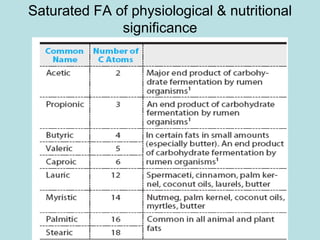
Saturated FA of physiological & nutritional 
significance
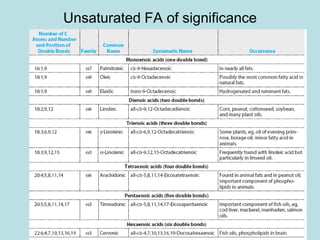
Unsaturated FA of significance
Few properties of FA 
• Melting point: The short and medium chain 
FA are liquids, whereas the long chain FA are 
solids at 250 C 
• The melting and boiling points increase, with 
increase in chain length 
• The unsaturated FA have lower melting 
points compared to saturated FA with the 
same chain length 
• Unsaturation decreases the melting points of 
FA
Few properties of FA contd 
• Lipid peroxidation: In vitro, lipid peroxidation 
leads to rancidity (unpleasant smell). 
• In vivo, the membrane lipids are more liable 
to attack by free radicals and damage the 
membrane, causing cancer, inflammatory 
diseases, atherosclerosis or aging. 
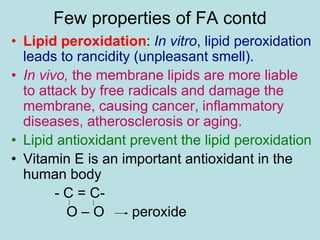
• Lipid antioxidant prevent the lipid peroxidation 
• Vitamin E is an important antioxidant in the 
human body 
- C = C-O 
– O peroxide
B.Phospholipids (PL) 
• Phospholipids are the main lipid constituents of 
membranes. 
• Take part in lipoprotein metabolism 
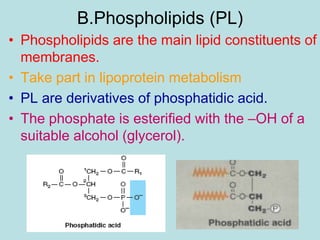
• PL are derivatives of phosphatidic acid. 
• The phosphate is esterified with the –OH of a 
suitable alcohol (glycerol).
PL contd…. 
1. Phosphatidyl choline (lecithin). 
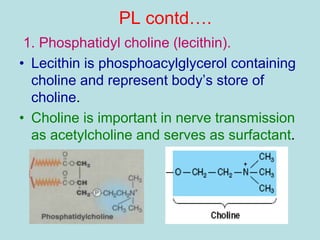
• Lecithin is phosphoacylglycerol containing 
choline and represent body’s store of 
choline. 
• Choline is important in nerve transmission 
as acetylcholine and serves as surfactant.
2.Phosphatidyl ethanolamine and 
3.Phosphatidyl serine 
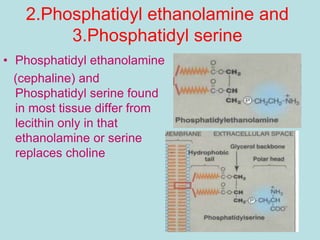
• Phosphatidyl ethanolamine 
(cephaline) and 
Phosphatidyl serine found 
in most tissue differ from 
lecithin only in that 
ethanolamine or serine 
replaces choline
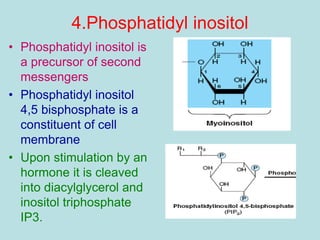
4.Phosphatidyl inositol 
• Phosphatidyl inositol is 
a precursor of second 
messengers 
• Phosphatidyl inositol 
4,5 bisphosphate is a 
constituent of cell 
membrane 
• Upon stimulation by an 
hormone it is cleaved 
into diacylglycerol and 
inositol triphosphate 
IP3.
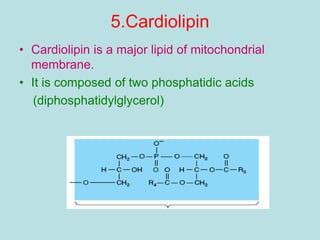
5.Cardiolipin 
• Cardiolipin is a major lipid of mitochondrial 
membrane. 
• It is composed of two phosphatidic acids 
(diphosphatidylglycerol)
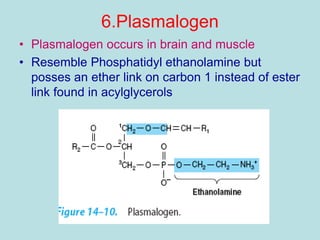
6.Plasmalogen 
• Plasmalogen occurs in brain and muscle 
• Resemble Phosphatidyl ethanolamine but 
posses an ether link on carbon 1 instead of ester 
link found in acylglycerols
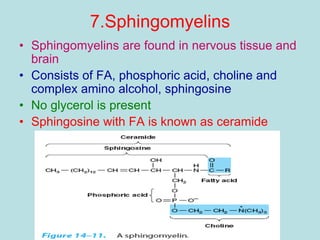
7.Sphingomyelins 
• Sphingomyelins are found in nervous tissue and 
brain 
• Consists of FA, phosphoric acid, choline and 
complex amino alcohol, sphingosine 
• No glycerol is present 
• Sphingosine with FA is known as ceramide
C.Glycolipids 
• Glycolipids are made 
up of lipids and 
carbohydrates. 
• They are widely 
present in the body, 
particularly in brain 
• They provide the outer 
layer of membranes 
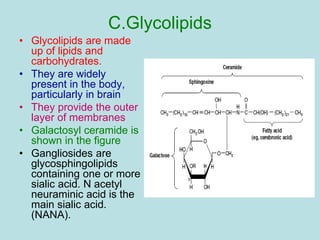
• Galactosyl ceramide is 
shown in the figure 
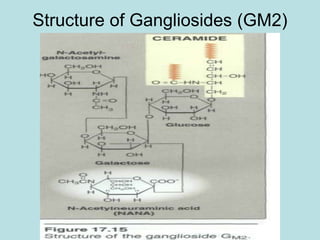
• Gangliosides are 
glycosphingolipids 
containing one or more 
sialic acid. N acetyl 
neuraminic acid is the 
main sialic acid. 
(NANA).
Structure of Gangliosides (GM2)
D.Steroids 
• Precursors for many important steroids 
such as, bile acids, adrenocortical 
hormones, sex hormones and D vitamins 
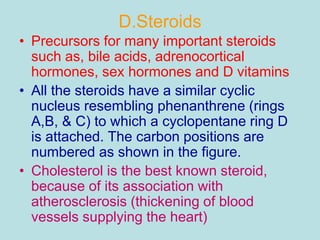
• All the steroids have a similar cyclic 
nucleus resembling phenanthrene (rings 
A,B, & C) to which a cyclopentane ring D 
is attached. The carbon positions are 
numbered as shown in the figure. 
• Cholesterol is the best known steroid, 
because of its association with 
atherosclerosis (thickening of blood 
vessels supplying the heart)
Steroids contd… 
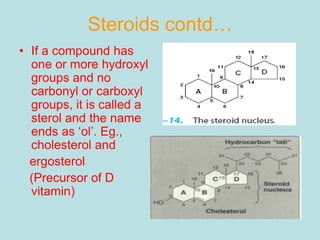
• If a compound has 
one or more hydroxyl 
groups and no 
carbonyl or carboxyl 
groups, it is called a 
sterol and the name 
ends as ‘ol’. Eg., 
cholesterol and 
ergosterol 
(Precursor of D 
vitamin)
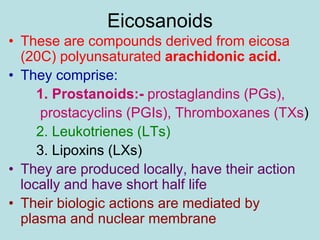
Eicosanoids 
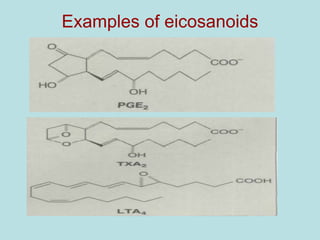
• These are compounds derived from eicosa 
(20C) polyunsaturated arachidonic acid. 
• They comprise: 
1. Prostanoids:- prostaglandins (PGs), 
prostacyclins (PGIs), Thromboxanes (TXs) 
2. Leukotrienes (LTs) 
3. Lipoxins (LXs) 
• They are produced locally, have their action 
locally and have short half life 
• Their biologic actions are mediated by 
plasma and nuclear membrane
Examples of eicosanoids
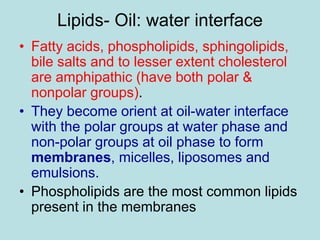
Lipids- Oil: water interface 
• Fatty acids, phospholipids, sphingolipids, 
bile salts and to lesser extent cholesterol 
are amphipathic (have both polar & 
nonpolar groups). 
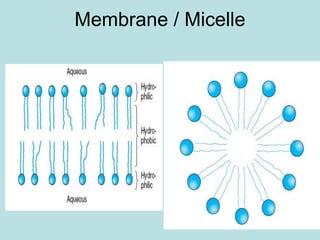
• They become orient at oil-water interface 
with the polar groups at water phase and 
non-polar groups at oil phase to form 
membranes, micelles, liposomes and 
emulsions. 
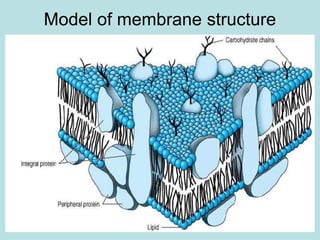
• Phospholipids are the most common lipids 
present in the membranes
Membrane / Micelle
Model of membrane structure

Lipids Chemistry Structure & Function (More Detailed)

  • 1.
  • 2.
    Introduction • Lipidsare heterogeneous group of water insoluble (hydrophobic) organic molecules • They are fats, oils, steroids and waxes • Insoluble in water, but soluble in non-polar solvents such as ether, chloroform • They are important dietary constituents providing (a) high energy value ( 1 g = 9 kcal) (b) Fat soluble vitamins and (c) Essential fatty acids
  • 3.
    Biological importance ofLipids • Important dietary compounds (Essentitial fatty acids) and storage form of energy (Triglycerides) • Structural components of biomembranes (phospholipids and cholesterol) • Providing insulation against changes in external temperature (subcutaneous fat) • Giving shape and contour (outline) to the body • Protecting internal organs by providing a cushioning effect (pads of fat)
  • 4.
    Contd.. • Metabolicregulators (steroid hormones and prostaglandins) • Acting as surfactant, detergents and emulsifying agents (amphipathic lipids) • Acting as electric insulators in neurons • Helping in absorption of fat soluble vitamins (A,D,E, & K) • With proteins and carbohydrates, they form important cellular constituents (lipoproteins, glycolipids)
  • 5.
    Classification of Lipids • Lipids are classified into simple, complex and derived lipids 1.Simple lipids: Esters of fatty acids (FA) with various glycerol a. Fats: esters of FA with glycerol (TAG) b. Waxes: esters of FA with higher molecular weight alcohols 2. Complex Lipids: Esters of FA containing groups in addition to an alcohol and a FA a. Phospholipids: Esters of FA with alcohol and phosphoric acid. In glycerophospholipids the alcohol is glycerol In sphingophospholipids the alcohol is sphingosine
  • 6.
    Classification contd….. b.Glycolipids are lipids with carbohydrates and sphingosine c. Others complex lipids are lipoproteins 3.Derived Lipids: These include FA, glycerol, steroids, some alcohols, fatty aldehydes and ketone bodies. Acylglycerols (glycerides), cholesterol & cholesterol esters are termed neutral lipids because, they are uncharged.
  • 7.
  • 8.
    A. Fatty acids(FA) • FA are aliphatic carboxylic acids. Their chain may be saturated (no double bond) or unsaturated (contain one or more double bond) • Saturated FA end in -anoic ( eg., octanoic) • Unsaturated FA end in –enoic (eg.,decaenoic acid or oleic acid) • Carbon are numbered from the carboxyl carbon (carbon no 1). • The carbon atoms adjacent to the carboxyl carbon (carbon 2,3,4) are also known as α,β,γ respectively.
  • 9.
    FA contd… •The terminal methyl carbon is ‘ω’ or ‘n’ carbon. The position of double bond is usually indicated by Δ. Δ9 indicates double bond between 9 and 10 carbon atom or ω9 indicates the double bond on the ninth carbon counting from the ω carbon. 9(ω)8 7 6 5 4(γ)3(β)2(α)1 CH3CH2CH2CH2CH2CH2CH2CH2COOH
  • 10.
    FA contd… FAmay be subdivided into • Monounsaturated FA containing one double bond • Polyunsaturated FA (PUFA) containing two or more double bonds. • Linoleic acid (2 double bonds) and Linolenic acid (3 double bonds) are essential FA because they cannot be synthesized by the body and have to be supplied in the diet. • Eicosanoids are derived from eicosa (20 carbon) polyenoic fatty acids. Examples are Leukotrienes (LT) Lipoxins (LX), Prostaglandins (PG) and Thromboxanes (TX).
  • 11.
    FA contd… •Geometric isomerism occurs at the double bond depending upon the orientation of atoms or groups. If atoms are on the same side it is cis isomer, if on the opposite side it is trans isomer. (Fig). • Naturally occurring FA are cis isomers.
  • 12.
    FA contd… •Triacyl glycerols (triglycerides) are the main storage forms of FA • The TG are esters of the trihydric alcohol, glycerol and fatty acids. • Cerebronic acid and ricinoleic acid are hydroxy fatty
  • 13.
    Saturated FA ofphysiological & nutritional significance
  • 14.
    Unsaturated FA ofsignificance
  • 15.
    Few properties ofFA • Melting point: The short and medium chain FA are liquids, whereas the long chain FA are solids at 250 C • The melting and boiling points increase, with increase in chain length • The unsaturated FA have lower melting points compared to saturated FA with the same chain length • Unsaturation decreases the melting points of FA
  • 16.
    Few properties ofFA contd • Lipid peroxidation: In vitro, lipid peroxidation leads to rancidity (unpleasant smell). • In vivo, the membrane lipids are more liable to attack by free radicals and damage the membrane, causing cancer, inflammatory diseases, atherosclerosis or aging. • Lipid antioxidant prevent the lipid peroxidation • Vitamin E is an important antioxidant in the human body - C = C-O – O peroxide
  • 17.
    B.Phospholipids (PL) •Phospholipids are the main lipid constituents of membranes. • Take part in lipoprotein metabolism • PL are derivatives of phosphatidic acid. • The phosphate is esterified with the –OH of a suitable alcohol (glycerol).
  • 18.
    PL contd…. 1.Phosphatidyl choline (lecithin). • Lecithin is phosphoacylglycerol containing choline and represent body’s store of choline. • Choline is important in nerve transmission as acetylcholine and serves as surfactant.
  • 19.
    2.Phosphatidyl ethanolamine and 3.Phosphatidyl serine • Phosphatidyl ethanolamine (cephaline) and Phosphatidyl serine found in most tissue differ from lecithin only in that ethanolamine or serine replaces choline
  • 20.
    4.Phosphatidyl inositol •Phosphatidyl inositol is a precursor of second messengers • Phosphatidyl inositol 4,5 bisphosphate is a constituent of cell membrane • Upon stimulation by an hormone it is cleaved into diacylglycerol and inositol triphosphate IP3.
  • 21.
    5.Cardiolipin • Cardiolipinis a major lipid of mitochondrial membrane. • It is composed of two phosphatidic acids (diphosphatidylglycerol)
  • 22.
    6.Plasmalogen • Plasmalogenoccurs in brain and muscle • Resemble Phosphatidyl ethanolamine but posses an ether link on carbon 1 instead of ester link found in acylglycerols
  • 23.
    7.Sphingomyelins • Sphingomyelinsare found in nervous tissue and brain • Consists of FA, phosphoric acid, choline and complex amino alcohol, sphingosine • No glycerol is present • Sphingosine with FA is known as ceramide
  • 24.
    C.Glycolipids • Glycolipidsare made up of lipids and carbohydrates. • They are widely present in the body, particularly in brain • They provide the outer layer of membranes • Galactosyl ceramide is shown in the figure • Gangliosides are glycosphingolipids containing one or more sialic acid. N acetyl neuraminic acid is the main sialic acid. (NANA).
  • 25.
  • 26.
    D.Steroids • Precursorsfor many important steroids such as, bile acids, adrenocortical hormones, sex hormones and D vitamins • All the steroids have a similar cyclic nucleus resembling phenanthrene (rings A,B, & C) to which a cyclopentane ring D is attached. The carbon positions are numbered as shown in the figure. • Cholesterol is the best known steroid, because of its association with atherosclerosis (thickening of blood vessels supplying the heart)
  • 27.
    Steroids contd… •If a compound has one or more hydroxyl groups and no carbonyl or carboxyl groups, it is called a sterol and the name ends as ‘ol’. Eg., cholesterol and ergosterol (Precursor of D vitamin)
  • 28.
    Eicosanoids • Theseare compounds derived from eicosa (20C) polyunsaturated arachidonic acid. • They comprise: 1. Prostanoids:- prostaglandins (PGs), prostacyclins (PGIs), Thromboxanes (TXs) 2. Leukotrienes (LTs) 3. Lipoxins (LXs) • They are produced locally, have their action locally and have short half life • Their biologic actions are mediated by plasma and nuclear membrane
  • 29.
  • 30.
    Lipids- Oil: waterinterface • Fatty acids, phospholipids, sphingolipids, bile salts and to lesser extent cholesterol are amphipathic (have both polar & nonpolar groups). • They become orient at oil-water interface with the polar groups at water phase and non-polar groups at oil phase to form membranes, micelles, liposomes and emulsions. • Phospholipids are the most common lipids present in the membranes
  • 31.
  • 32.